In short
The BBC Global Story episode examines whether new U.S. “secondary sanctions” on Iran—threatening not only Iran but any country or financial institution doing business with it—could backfire and escalate into a wider U.S.-China economic conflict.
Guests
Vali Nasser, professor of international affairs and Middle East studies at Johns Hopkins University (Washington, D.C.).
Guest background
Nasser draws on historical sanctions cases (Iraq, Cuba, Venezuela) and explains how U.S. financial “dollar dominance” makes sanctions especially powerful.
Key claims
Sanctions often punish ordinary people rather than topple governments; Iran has repeatedly “weathered” sanctions; secondary sanctions could trigger Chinese retaliation or bargaining; escalation could become a U.S.-China economic war affecting global inflation and oil.
Notable examples
Iraq sanctions in the 1990s; Iran’s oil circumvention via tankers, UAE oil dealers, and China as a major buyer; possible worst-case outcomes like Strait of Hormuz/Red Sea disruptions.
Written by AI. May contain mistakes. Listen to the episode to check what was said.
Chapters
Tap a time to open that second in VOSanctions Against Iran: An Overview
0:39 to 3:09
Discussion on new sanctions targeting Iran by the Trump administration.
“Get more with BBC Podcasts, wherever you listen.”
The Concept of Sanctions
3:09 to 4:55
Exploration of the meaning and history of sanctions in U.S. foreign policy.
“But could this plan backfire in unexpected ways?”
Historical Context of U.S.-Iran Sanctions
4:55 to 9:21
A historical overview of U.S. sanctions on Iran from 1953 to present.
“Secondary sanctions was an idea that was first concocted by President Obama back in 2011.”
Impact of Sanctions on Iranian Society
9:21 to 15:25
Discussion on how sanctions affect ordinary Iranians and their economy.
“And so there is a moral cost to sanctions because ultimately the target of sanctions are ordinary people.”
Iran's Strategies to Circumvent Sanctions
15:25 to 17:24
Discover how Iran manages to sell oil despite international sanctions.
“I mean, one big way would appear to be that they have still managed to sell their oil on international markets, circumventing those sanctions.”
Geopolitical Implications of U.S. Sanctions
17:24 to 19:30
Examine how U.S. sanctions could lead to retaliation from China and others.
“But also because Iran to China is a geopolitically significant country.”
The Game of Chicken: U.S. vs. China
19:30 to 21:42
Understand the strategic stalemate between the U.S. and China regarding Iran.
“where the situation is something like a game of chicken between the United States and China, the world's two biggest powers?”
Exploring Worst and Best Case Scenarios
22:28 to 26:30
Analyze the potential outcomes of U.S. sanctions on Iran and China.
“attempt to contain the crisis may actually be allowing it to expand and become even more consequential.”
Transcript
Automatic transcript. May contain errors.0:00This BBC podcast is supported by ads outside the UK.
0:30Your business needs in one place, saving you time, headaches and serious money. Stop paying for missing pieces. Go to odoo.com. That's O-D-O-O dot com to learn more. Get more with BBC Podcasts, wherever you listen. Be the first to listen to your favourite shows like Evil Genius, Good Bad Billionaire and You're Dead to Me with a subscription to BBC Podcasts Premium on Apple Podcasts. You can also enjoy a range of our podcasts ad-free with an Amazon Music subscription.
1:03This is a sustained campaign to collapse every last option for Iran. This was Scott Besant, the U.S. Treasury Secretary, on Monday, announcing new sanctions targeting Iran. This is the Trump administration's latest bid to end the war that it started in February. Beginning today, the actions of Treasury and other agencies will tighten the noose and block every potential source of revenue that funds the IRGC and the evil Iranian regime. But haven't we been somewhere a bit like this before? I have decided to ask for an early meeting of the United Nations Security Council to impose international economic sanctions upon Iran.
1:52Verifiably suspend your enrichment program, or else you will face further sanctions and further isolation. I'm pleased to sign into law the toughest sanctions against Iran ever passed by the United States Congress. There have been a lot of sanctions programs against Iran. They started off with boring names like Executive Order 12-170 under President Jimmy Carter and the Iran and Libya Sanctions Act under Clinton. But once Donald Trump becomes president, the names get a bit more interesting. In 2016, there was campaign maximum pressure, hard to follow. So they turned it up to 11 with Operation Economic Fury earlier this year.
2:38The latest one, Operation Economic Outcast, is promising something new. Punishment not just for Iran, but for anyone helping Iran, like China. It is now a time for world leaders to make a decision. between prosperity and isolation, peace and terror, America and Iran. From the BBC, I'm Tristan Redman in London. And today on The Global Story, the US says it's going further than ever before in putting economic pressure on Iran. But could this plan backfire in unexpected ways?
3:24Vali Nasr:I'm Vali Nasser. I'm a professor of international affairs and Middle East studies at Johns Hopkins University in Washington, D.C. Great to have you with us, Vali. Scott Besant has announced this big plan to put pressure on Iran and ultimately, he says, end the war. He wrote in the Financial Times on Sunday, he said, quote, now we are entering the end game. At dawn begins an economic D-Day, which sounds pretty serious. What would this new round of U.S. sanctions that he's promising actually entail, Vali? Well, from what he has said, it looks like he's putting sanctions on everybody else other than Iran, Because going back decades now, the U.S.
4:12Vali Nasr:has pretty much put every kind of sanction possible on Iran. And President Trump actually had introduced in 2018 this idea of maximum pressure sanctions, which was supposed to break Iran's back then. But it didn't. And now here we are. So it sounds like Secretary Besant's grand idea is that I'm going to punish everybody else who does any kind of business with Iran. And then he said that there might be an announcement of a major financial institution that will be sanctioned for dealing with Iran. So it's basically punishing other countries who have relations with Iran. Secondary sanctions, as they're called.
4:56Is that right?
4:57Vali Nasr:That's right. Secondary sanctions was an idea that was first concocted by President Obama back in 2011. Now, Secretary Besant is essentially taking Obama's secondary sanctions idea and he's saying that for the first time, according to him, the United States is actually going to implement these secondary sanctions fully. I wonder if you can help us out with the semantics a little bit, because what do we actually mean when we hear the word sanctions? It's so commonplace these days. I mean, I remember hearing the word sanctions probably used for the very first time around about the first Gulf War when I was 10 years old or something like that.
5:36What does it actually mean?
5:38Vali Nasr:Well, it's an idea that goes back actually to World War I, when the United States and Europe came up with the idea that as a complement to bombing countries or attacking them with navies, air force and armies, you could actually try to punish countries or break them by imposing economic pressure on them, preventing them from engaging in trade. If countries can't engage in trade, their economies will shrink, their people will go poor, and they basically will collapse internally. So the idea was that every government is responsible for its people. And if you basically make us create a situation where people cannot eat, that the government would then change its behavior.
6:26Vali Nasr:And over time, it was used here and there, but it gradually started becoming America's foreign policy tool of choice. Especially after Vietnam, the more reluctant the United States became to go to war, the more it became interested in economic sanctions. Because largely, economic sanctions don't involve soldiers. In fact, as one historian once said it, it's a kind of warfare that is not waged from a turret of a tank, but from behind a mahogany desk. It is essentially laws. In other words, it's basically legal directives that the Department of Treasury, or let's say the European Union write, which forbid trade with the country or forbid trade in certain commodities.
7:18Vali Nasr:And as the world economy has moved from goods towards services, now increasingly it covers services. And the most important service that it covers is actually financial transactions. Now, this, I have to say, gives the United States a disproportionate advantage in using sanctions. And that's why the United States is developing an addiction to it. It's because the United States enjoys dollar dominance over the global economy. The United States basically can dictate what economic transaction will happen or not by kicking banks or countries out of the dollar. And the U.S. has been using this dominance in the financial system to basically force countries to do certain things.
8:07Vali Nasr:And one of the most important cases in recent times was against Saddam Hussein's Iraq in the 1990s with devastating impact. All the reports coming out of Baghdad say the country's in a bad way. Food stocks are down, rations cut, crime on the increase. It's what the sanctions regime was intended to promote, internal dissatisfaction which threatened the survival of the government. There were reports of starvation of children in the wake of those sanctions back then, right? Yes. I mean, the sanctions were devastating to Iraqi people, but it didn't topple Saddam. In the end, the U.S. had to do it the old-fashioned way, through a war.
8:43Vali Nasr:In effect, you know, the language of sanctions has been sanitized. We have targeted sanctions. We sanctioned countries. But in reality, you sanction people. When the United States started its sanctions on Iraq, Iraq had the highest rate of engineers per capita in the Arab world. It had the lowest infant mortality, highest life expectancy of any Arab country. By the time American troops a decade later arrived in Baghdad, none of this was true. And a majority of Iraqis had been pushed into poverty. This is also true of Cuba. It's true of Venezuela. And so there is a moral cost to sanctions because ultimately the target of sanctions are ordinary people.
9:30OK, so sanctions are an economic alternative, in theory, to waging war on a country. Can you give us the abridged history of U.S. governments threatening Iran with sanctions? When did all of this start?
9:47Vali Nasr:The first sanctions on Iran actually really historically go back to 1953. Then Prime Minister Mohammad Mossadegh threatened to nationalize the Anglo-Iran oil company, which is the parent to British Petroleum. And before a military coup backed by US and Britain overthrew Mossadegh, Britain put Iran under economic sanctions. Intense Tehran anti-British fever mounts as thousands of demonstrators march to Parliament to demand that Iran stand firm in the oil crisis dispute with Britain and reject World Court proposals for arbitration. The next time Iran faced sanctions was after it took American diplomats hostage, a few months after the revolution succeeded.
10:33Somebody call them! Help us! Help us! This is the only way they could show that U.S. get your hands out of Iran. We don't want you here.
10:42Vali Nasr:U.S. punished Iran for that by putting it under sanctions. They and all others must know that the United States of America will not yield to international terrorism or to blackmail. But towards the end, when President Reagan made the deal with Iran to release the hostages, many of those sanctions were lifted. Iran and the United States still kept hitting at each other, especially in Lebanon, where in the 1980s, Iran engaged in a series of hostage takings and then in a horrendous attack on the American Marines' barracks. The Marines had a speeding pickup truck, crashed through barriers and exploded in the lobby of the headquarters building where Marines were sleeping.
11:23The blast opened a crater 30 feet deep and 40 feet across, causing the four-story structure to collapse.
11:30Vali Nasr:Which killed over 300 American Marines. and on the French barracks, which killed over 50 French soldiers. And then the United States again put Iran under sanctions. And then through the decades, every time Iran did something, attack on a Jewish center in Buenos Aires. July 18, 1994 was the day that changed my life forever. I became the survivor of the terrorist attack against AMIA, the Jewish community center in Buenos Aires, considered the most horrifying anti-Jewish act after the Holocaust. Attack on Western targets in Europe or elsewhere. The answer of the United States often was sanctions.
12:18The American Secretary of State, Warren Christopher, says Iran is an international outlaw which must be contained. He called for a new action against terrorism and urged the international community to reduce its commercial and economic links with Iran. I feel that Iran is the principal culprit in this situation, and they need to be both contained and restrained.
12:42Vali Nasr:And then you end up in another period, which is after 2003, when you have the discovery that Iran is pursuing a nuclear program. And now Iran starts going on a systematically higher and more methodic sanctions by the United States, by the European Union and by the United Nations to force it to come to the table and make a deal over its nuclear program. A new package of sanctions designed to increase the pressure on Iran to halt its uranium enrichment has been agreed by the five permanent members of the United Nations Security Council in Germany. The measures include an arms embargo and an extension of a freeze on assets linked to Iran's nuclear program.
13:25Vali Nasr:Here we are 47 years later. Iranians are poorer. Iran is perhaps one of the countries that has been most systematically and most intensely sanctioned in history. And yet the United States has not achieved any of its foreign policy objectives with Iran. You said earlier, Vali, that you don't really sanction a country, you sanction a people. If the plan here is basically to starve Iran of money, and maybe that means starving food, electricity, essentially smoking out the Iranian government. You're from Iran. I wonder, are you hearing how the sanctions so far are affecting people? Yes, I mean, Iranians have lived with sanctions for a long time.
14:09Vali Nasr:They've learned to build things domestically. They make their own pharmaceutical. They make a lot of their own food products. They make their own industrial products. But when sanctions have become intense, more and more Iranians have become poor. Their meat caloric intake has gone down. Inflation has got bigger. Inflation is the single biggest cause of poverty. And so, yes, the country survives. Its leadership could basically resist. We say that we're putting sanctions on a country, on its leaders. But in reality, it is a policy of basically telling the people of a country that I'm going to starve you until you rebel against your government, fully well knowing that there's very, very, very few governments that have changed as a consequence of sanctions.
15:05Vali Nasr:So the idea that Secretary Besant would now go back to sanctions as a cure-all for this war is not something that's supported by the history of sanctions. Okay, so Iran has weathered many rounds of sanctions in the past, Vali, and is still standing. But how have they actually managed to do this? I mean, one big way would appear to be that they have still managed to sell their oil on international markets, circumventing those sanctions. So let's imagine, say, Vali, that I am an Iranian oil producer. How do I actually get around the sanctions? What are the tricks and methods I've learned over the decades?
15:50Vali Nasr:I mean, the first thing I should note is that Iran has become less dependent on oil. In a way, the sanctions has forced Iran to do something like the Gulf countries claim to want to be doing, to go to economies that are no longer reliant on fossil fuels. Iran was exporting six and a half million barrels of oil when the revolution happened. And it was a very rich country as a result. Today, it barely is exporting one million barrels. But you're right. They still sell oil and they export it. So the Iranians over the years have invested in building their own oil tankers. They have something like between 50 to 80 oil tankers.
16:28Vali Nasr:They pump oil. They put them on these tankers. They send them around the world to either countries or companies or oil dealers that buy them, mix them up with other oil or resell them. Their single biggest customer is China. And then they also sell a lot of oil through oil dealers in UAE. In other words, it's nondescript oil. Oil that comes on an unmarked tanker, goes to an unmarked destination. it's basically sold on and off the books. And the money doesn't go directly from a country's treasury to a country's treasury, right? The Revolutionary Guard sells oil on the black market. It doesn't even go on the Iranian government's books.
17:15Vali Nasr:It goes into their own black budget that they use for varieties of things. But China is Iran's largest oil customer. The Chinese buy most of their oil from UAE and Saudi Arabia, but they like to hedge. That's why they invested in Venezuela. That's why they invested in Iran. But also because Iran to China is a geopolitically significant country. It's a large landmass. It's the endpoint of Eurasia. And keeping Iran afloat out of American hands is of strategic value to China. China is Iran's largest trading partner, full stop, Vali. How are they likely to respond to these new sanctions that have been threatened by Scott Besant?
18:01Vali Nasr:Well, first of all, they could basically counter-sanction the US. We just saw puny Canada do the same with America. The more the United States loses altitude as a consequence of the outcome of this war with Iran, the more likely we're going to see more Mark Carney's pop up all around the world. So one outcome could be that the Chinese will retaliate in kind if you go after the country or after one of its businesses. The second is basically they could just basically brush off the U.S. and continue business as usual and ignore Basin. And the third is that they basically could say, okay, you want us not buy from Iran?
18:41Vali Nasr:What are you willing to pay? We have all of these other accounts for you from buying sensitive technologies to things you've sanctioned. You want us to abide by this? you have to relax something else. I mean, the danger of what the U.S. is doing with countries like Russia and China, which are Iran's biggest trading partners, is that they have the capability to stand up, to retaliate. So the way Secretary Besant laid this out, it's as if this is very simple, that you basically call up these countries and threaten them and they'll fall in line. But in reality, it's going to be much more messy and the policy is going to face a lot of resistance.
19:25Vali Nasr:It's going to prove costly and it may not actually end up being effective at all. Are we essentially in a situation now where the situation is something like a game of chicken between the United States and China, the world's two biggest powers? Well, it has been something like that. But one of the interesting things is that throughout the Iran war, the US has lost strategic stature. It went into this war as the world's uber superpower. That's the way President Trump saw himself, saw the U.S. It hasn't been able to defeat a secondary military power. So the United States is not as scary, as dominant as it was before the war.
20:06Vali Nasr:Then the war is also, as far as China is concerned, diminished the U.S. in other ways. It has shown that you can fight the U.S. military. If the Iranians can deplete the U.S.'s munitions, surely the Chinese can. If the Taiwanese are watching what happened to UAE, Saudi Arabia, etc., they may calculate that their relationship with China cannot be as adversarial as it was in the past. That's the way actually Iran's Arab neighbors are behaving. As much as they're angry at Iran or fear Iran, they realize that the U.S. is unable or unwilling to provide the security blanket. So they need to have relations with Iran.
20:49Vali Nasr:They cannot be on a worse footing with Iran. So what's happened in the Gulf is basically impacting the U.S.'s standing credibility, capability to assert itself in other regions of the world. and most importantly, the two most important geopolitical arenas, which is Europe, particularly Russia v. Ukraine and Russia v. Europe, and then also in the Pacific region, as far as China and Southeast Asia and the rest of East Asia are concerned. So the game of chicken is increasingly in favor of the Chinese. The Chinese can actually begin to put greater odds on standing up to the U.S. or on demanding things from the U.S.
21:40Vali Nasr:that was the case before U.S. went to war with Iran.
21:54I'm Brooke Gladstone, co-host of WNYC's On the Media. information doesn't just inform us, it shapes how we see the world, what we fear, and who we trust. That's where On the Media comes in. Each week we investigate how information flows, who controls it, and what that means for our democracy. It's not about the headlines. It's about the hidden structures behind them. Don't be a passive consumer. Listen wherever you get your podcasts.
22:28Vali, the situation you're describing is one in which a U.S. attempt to contain the crisis may actually be allowing it to expand and become even more consequential. But I'd like you to help us break this down into the simplest possible terms. If the U.S. plan were to be enacted, if China were to buy oil from Iran, and they're the biggest buyer right now of Iranian oil, the U.S. would then, in these secondary sanctions, punish China. And then the question becomes, what would China do in retaliation to the United States?
23:08Vali Nasr:Well, a number of things. First of all, the Chinese could also sanction American companies or not sell certain things to the U.S., as they did in the past, like rare earth minerals. They can completely ignore the U.S. And then the U.S. would then be in a situation that it has to escalate sanctions on China. But essentially, once the U.S. sanctions China, it has started an economic war with China. Then it's not about Iran alone. Then it becomes a whole new battlefront in U.S.-China relations. And then the U.S. will find out that actually its war with Iran has now become its war with China. Right?
23:50Vali Nasr:And then the same would happen with India. The same would happen with Russia. Okay, Europe, because it has no, right now, economic relations with Iran, does not need to worry about this scenario. It's a very risky game the U.S. is playing by expanding the Iran war into head-to-head conflicts with other sets of players. Now, one other scenario that might happen is that everything I just said may be quite evident to Secretary Besant as well. And he may decide tomorrow to pick on a few little countries and try to make an example of them. Put maximum sanctions on Georgia for buying pistachios from Iran, for instance.
24:29Vali Nasr:but never don't go after China. In which case then this whole D-Day thing becomes a farce. If you don't go after China, there is no D-Day economic scenario. If you go after China, you're opening a battlefront for China. Vali, I hate to ask you a worst case scenario question because as journalists, we often get accused of being doom mongers. So I'm going to ask you a best case scenario as well to hedge in my defense. What is the worst case though of all of this? If the United States were to impose sanctions on China, what could the unintended consequences of that be? The worst case that, first of all, it leads U.S.
Read the full transcript
25:08Vali Nasr:and China separate from Iran to enter into an escalation. So then their conflict basically starts over sanctions of Iran, but then finds a life of itself. And their relationship, which has been fairly stable, although not friendly, would begin to deteriorate very rapidly. Secondly, is that any kind of a U.S.-China tit-for-tat economically will have enormous amount of impact on the global economy, on inflation, unemployment, et cetera. And thirdly, is that Iran decides to retaliate on its own if it sees that the Chinese market is going. And already their national security advisor has said, if we don't sell oil, nobody else will sell oil.
25:48Vali Nasr:The Iranians are really citing Per Harbor. And as we have the capability to retaliate against economic sanctions, and we're going to go after UAE, Qatar, Saudi Arabia, Iraq, everybody's oil will be off the mark. We're going to completely shut down not only the Strait of Hormuz, but also the Red Sea oil trip. And if that escalates, you could have kind of damage done to oil facilities across the region that could take them off for another two to three years. And then you're going to be looking at a much deeper economic situation for Europe, for Asia, come winter into a certain period of time. That's the worst case scenario.
26:30And what about the best case scenario, Vali?
26:32Vali Nasr:So the best case scenario is that the two of them will actually find their way back to the table.
26:40Vali Nasr:There is a deal to be done, but that deal would not give him the aura that he wants going into midterm elections. So the best case scenario is that he overcomes that hesitation and he agrees to a diplomatic agreement like the one that he signed with Iran in June, the so-called MOU, according to which the straight-up hormones opens, the American blockade gets lifted, the global economy can breathe a sigh of relief. I think in tandem with everything that Secretary Bestand is saying, there is movement in that That's why just before you and I started talking, Pakistan's army chief went to Tehran. He claimed that he was not carrying or receiving any messages, but I'm sure he didn't go there for sightseeing.
27:29Vali Nasr:His very presence in Tehran would basically suggest that there is effort on both sides also to explore a diplomatic off-ramp.
27:42Vali Nasser, thank you so much. It's been a pleasure.
27:44Vali Nasr:Thank you for inviting me. Good to be with you.
27:51That was Vali Nasser, Professor of International Affairs and Middle East Studies at Johns Hopkins University. And that's it from us for today. Our episode was produced by Vari McKenzie and Lucy Paul. Our digital producer was Matt Pintus. It was mixed by Travis Evans and edited by James Shield. Our senior news editor is Chyna Collins. Thanks as always for listening. We'll be back again tomorrow. Cheerio.
28:40You can also enjoy a range of our podcasts ad-free with an Amazon Music subscription.
From the publisher
There have been a lot of sanctions programmes against Iran. But this week US Treasury Secretary Scott Bessent announced Operation Economic Outcast, which promises to go further than ever before. It will punish not just Iran but any country helping Iran - including China.
It is the Trump administration’s latest attempt to end the war. Will it work?
We speak to Vali Nasr, professor of international affairs and Middle East studies at Johns Hopkins University, and ask whether in trying to end one war, President Trump risks starting a global trade conflict.
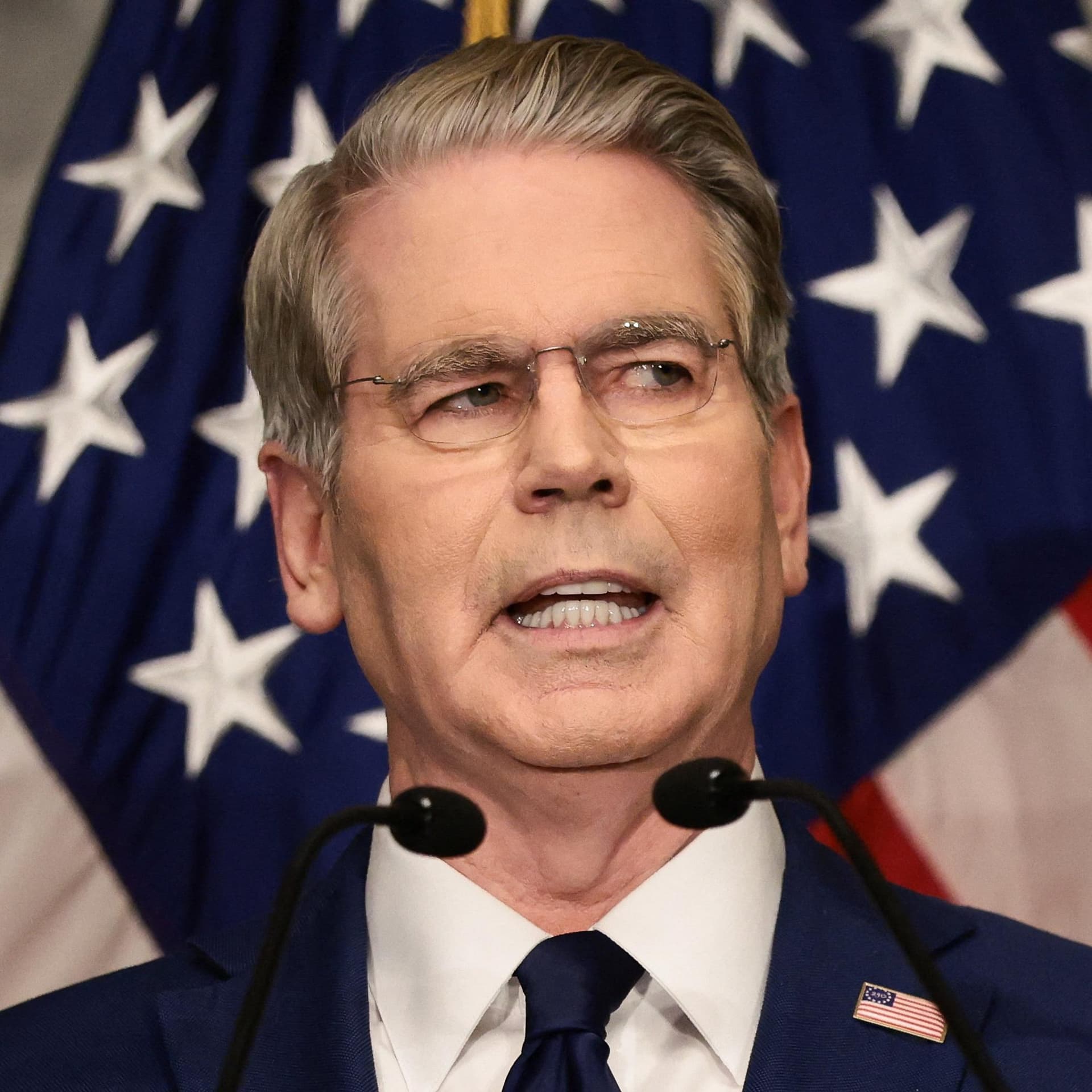
(Photo: US Treasury Secretary Scott Bessent speaks during a press conference to outline further sanctions against Iran, at the Treasury Department in Washington, DC, 24 August, 2026. He has short, mousy-grey hair and is wearing glasses, with the American flag behind him. Credit: Evelyn Hockstein/Reuters)
Producers: Mhairi MacKenzie and Lucy Pawle
Sound engineer: Travis Evans
Editor: James Shield
Senior news editor: China Collins