In short
Pope Leo XIV’s escalating public criticism of US President Donald Trump, especially over immigration/deportation, foreign interventions (Venezuela, Iran), and war language, culminating in Trump’s April 12 Truth Social attack and Pope Leo’s April 7–12 responses.
Guest backgrounds
Ed Sturton, BBC reporter with decades covering US politics and religious affairs; previously reported on Pope-and-politics issues.
Key claims
The pope’s “peace” message is consistent with Catholic teaching since Vatican II, but his tone has become more direct. JD Vance (a Catholic and former pope meeting) urged the Vatican to focus on morality, not US policy. The conflict reflects two American Christian styles: Catholic teaching authority vs evangelical Christian nationalism.
Notable examples
Vatican-Pentagon meeting after Venezuela comments; Pentagon prayer by Pete Hegseth; Pope’s Palm Sunday rebuke (“Jesus… rejects war”; “hands full of blood”); Trump’s Jesus-like AI post and “not a big fan” rant; Pope’s Africa trip and letter warning democracies against tyranny/elite dominance.
Written by AI. May contain mistakes. Listen to the episode to check what was said.
Chapters
Tap a time to open that second in VOTension Between Trump and Pope
0:44 to 0:57
Discussion on the growing tensions between Pope Leo and President Trump.
“teens can gain hands-on investing experience and build positive money habits.”
Tension Between Trump and Pope
1:51 to 2:25
Discussion on the growing tensions between Pope Leo and President Trump.
“In today's episode, we'll be speaking with the BBC's Ed Sturton, a man who knows his way round both US politics and the Catholic Church.”
Pope Leo's Criticism of U.S. Policies
2:25 to 4:37
Exploration of Pope Leo's critiques regarding U.S. foreign policy and war.
“Talking to diplomats in Rome, the Pope said, A diplomacy that promotes dialogue and seeks consensus among all parties is being replaced by a diplomacy based on force by either individuals or groups of allies.”
Trump's Response and Public Outrage
4:37 to 7:32
Examination of Trump's responses and the backlash from the public and Christians.
“On April 7th, President Trump threatened Iran with the death of its whole civilization unless it agreed to end the war.”
Introducing Ed Sturton
7:32 to 7:59
Introduction of guest Ed Sturton, with a brief on his qualifications.
“Now, we're going to bring in our guest at this point, Ed Sturton, who's going to help us dissect all of this.”
Analysis of the Confrontation
7:59 to 11:40
Discussion with Ed Sturton on the implications of the Pope-Trump confrontation.
“Hello, I'm John Humphries and welcome to Celebrity Mastermind.”
The Moral Implications of War
11:40 to 14:00
In-depth discussion on the intersection of morality and politics in the context of war.
“that things have blown up in quite the way they have.”
Pope's Political Engagement
14:00 to 15:20
Discussion on the Pope's involvement in political matters and its implications.
“the president of the United States the Trump administration and and the pope we saw the vice president J.D.”
Historical Context of Papal Influence
15:20 to 17:31
Exploring the historical parallels between past popes and contemporary political issues.
“Are there similarities between these moments?”
John Paul II's Anti-War Stance
17:31 to 19:36
Analyzing Pope John Paul II's opposition to the Iraq war and its significance.
“You know, there's a real mismatch for that.”
Show all 13 chapters
Religious Rhetoric in Modern Conflicts
19:36 to 21:59
Examining the use of religious language in the context of contemporary wars.
“This crusade, this war on terrorism, is going to take a while.”
Trump and Religious Imagery
21:59 to 24:17
Discussing Donald Trump's unusual relationship with religion and how it shapes his public persona.
“So evangelicals tend to be much more biblically rooted.”
Power Dynamics: Pope vs. President
24:17 to 26:33
Analyzing the power dynamics between Donald Trump and Pope Francis in today's political landscape.
“has made a massive difference to his standing among Christians generally and helped to explain why so many of them voted for him at the last election.”
Transcript
Automatic transcript. May contain errors.0:00Edward Stourton:This BBC podcast is supported by ads outside the UK.
0:30No bouncing between tabs. And best of all, no spreadsheets. Stop managing software and start managing your business with one unified system. Try for free today at odoo.com. That's O-D-O-O dot com. With the new Schwab Teen Investor Account, teens can gain hands-on investing experience and build positive money habits. It's an account co-owned by you and your teen, so you can monitor and engage with the account while your teen learns how to invest and manage money. Learn more at schwab.com. The most influential American in the world has almost always been the U.S. president. But for the first time in history, maybe POTUS has a serious rival, Pope Leo XIV.
1:14I have no fear. Neither the Trump administration are speaking up loudly about the message in the gospel. Since his election last May, Leo has steadily become more vocal about President Donald Trump, criticizing his policies on immigration and foreign policy interventions like Venezuela and increasingly Iran.
1:37Edward Stourton:He's a man that doesn't believe in stopping crime. In the last week, it seemed, President Trump took it up a notch and erupted. I'm not a fan of Pope Leo. From the BBC in London, I'm Tristan Redman. And I'm Asma Khaled. And today on The Global Story, what happens when an American pope takes on an American president?
2:03In today's episode, we'll be speaking with the BBC's Ed Sturton, a man who knows his way round both US politics and the Catholic Church. But first, it's worth a quick recap. Now, you all have probably heard and you've probably seen some of the beef between the Pope and the President. The situation has been tense for some time on issues like immigration and deportation. But it really started ratcheting up in January in the wake of the U.S. intervention in Venezuela. Talking to diplomats in Rome, the Pope said, A diplomacy that promotes dialogue and seeks consensus among all parties is being replaced by a diplomacy based on force by either individuals or groups of allies.
2:49War is back in vogue. Now, in the wake of those comments, we know that there was a meeting at the Pentagon that took place with the Vatican's ambassador to Washington. Recollections of that meeting vary. Some reports say that there were terse words exchanged. The Pentagon dismissed reports as exaggerated and distorted. And the Vatican said some accounts bared no resemblance to the truth. Nonetheless, we know a meeting took place. Now, fast forward to March. Holy Father, can I ask you what your hopes are for the Middle East? I pray for peace. And CBS, which is the BBC's reporting partner in the United States, spoke with Pope Leo in Rome in the context of the Iran war, which had started by this point.
3:31I hope that ceasefire would be the most effective way to work together to find peace for all parties. Then on March 25th at a prayer service at the Pentagon, Defense Secretary Pete Hegseth offered these words in prayer.
3:47Edward Stourton:Let every round find its mark against the enemies of righteousness and our great nation. Give them wisdom in every decision, endurance for the trial ahead, unbreakable unity, and overwhelming violence of action against those who deserve no mercy. And then, just four days later, off the back of that, in his Palm Sunday address, Pope Leo seemed to criticise the Defence Secretary. Jesus, King of Peace, who rejects war, who no one can use to justify war. He called for an end to, quote, a spiral of violence in the Middle East. And he said to worshippers, he does not listen to the prayers of those who wage war, but rejects them, saying, even though you make many prayers, I will not listen.
4:35Your hands are full of blood. Now, he didn't refer to Pete Hegseth by name, but it did seem to be an oblique reference to what Hegseth had previously said. Then it is the big one. On April 7th, President Trump threatened Iran with the death of its whole civilization unless it agreed to end the war. I'm sure we all remember that moment. Yes. And Pope Leo reacted to that, calling the statement truly unacceptable. I would invite the citizens of all the countries involved to contact the authorities, political leaders, congressmen, to ask them, tell them to work for peace and to reject war always. That's a particular statement that Asthma and I have been discussing very much and we're going to get into today.
5:20Then on Sunday, April 12th, Donald Trump posted two true social posts that got a lot of attention. One was an image of him as a Jesus-like figure that he later took down from social media. The second was a long one blasting Pope Leo. And I'm going to read from it because there are a lot of wild things you see when you've covered the White House over the years. This was particularly wild. President Trump says he begins by saying Pope Leo is weak on crime and terrible on foreign policy. Then he adds, I don't want a pope who thinks it's OK for Iran to have a nuclear weapon. And he then followed that up with that now infamous line to reporters we've heard that he says he's not a big fan of Pope Leo.
6:02Yes. And he said he likes crime, I guess. Yeah. OK. Now I'm sure you've seen the headlines. Those posts really generated some outrage among Christians, among Catholics, including among some conservatives in the United States. At this point, we're at the 13th of April, which is Monday of this week. At this point, Pope Leo is on his way to Africa. He's on a papal trip and he's asked by reporters on the plane. Leo said he had no fear of the Trump administration. Then on Monday evening, Vice President J.D. Vance, who, by the way, is the highest ranking Catholic in public office in the United States.
6:41He has met with the pope himself. He took to Fox News and said it would be best for the Vatican to stick to matters of morality.
6:49Edward Stourton:To stick to matters of, you know, what's going on in the Catholic Church and let the President of the United States stick to dictating American public policy. And then, and this is the very last installment in this quite extraordinarily complex and long running saga, on Tuesday in a letter to an international conference happening in the Vatican whilst Leo was in Africa, Leo wrote of the risks of democracies, quote, becoming either a majoritarian tyranny or a mask for the dominance of economic and technological elites. So he's not apparently letting this one lie, although he doesn't name Donald Trump directly.
7:28He didn't mention any government or country in particular. Now, we're going to bring in our guest at this point, Ed Sturton, who's going to help us dissect all of this. Ed has been with the BBC for a very long time reporting on US and religious affairs, many decades, in fact. But first, to reassure you of his bona fides, we want to play you a little snippet of him in 2006 winning the BBC quiz show Celebrity Mastermind.
7:59Edward Stourton:Hello, I'm John Humphries and welcome to Celebrity Mastermind. For celebrities, two rounds of pretty intimidating questions in the black chair. With the specialist subject. John Paul II in two minutes. Now, we don't expect you, Asma, or everyone around the world to know the particularities of the mastermind quiz. Yes, I confess, I didn't know it, but that bit was really impressive. It's quite impressive. In which city in southern Poland was Karol Wojtyla, the future Pope John Paul II, born on the 18th of May 1920? Wadawice. Yes. In which position did he play football in his youth, often turning out for the Jewish team in his hometown?
8:33Goalkeeper.
8:34Edward Stourton:Correct. In which village outside Krakow, near Gdów, did he take up his first ecclesiastical post as parish priest in 1948? 1888, Njegovic, correct? Great to have you back with us, Ed. I just want to say that we teed you up there with audio of your glorious victory in Mastermind 20 years ago. Well, that's very flattering. Glorious, I'm not sure about that. It was impressive. Very speedy. It's one of those weird things, isn't it? You wouldn't think naturally it would be a hugely appealing teleprogramme, but there's something about the way it's constructed when you sit in that chair all on your own in a kind of small halo of light and the whole focus is on you.
9:15One or two people have made themselves look very foolish by giving completely stupid answers. So there's jeopardy there too. Well, you did not look foolish. You looked accomplished and concentrated. And for our purposes today, you look like the man when it comes to popes. Ed, the last time we spoke together was back in November. We recorded an episode together about the Pope and politics. And you said something back in that episode that aged very well. And I said something that aged very badly. So I just want to call back to those two things. So I said at the time, the Pope has not exactly burst onto the world scene yet.
9:58He's been very discreet, which might have been true at the time, but I don't think it's true anymore. And you said something much more apt. You said the two most powerful Americans in the world are heading for a confrontation. Sitting in April, that seems pretty prescient. Have we reached a moment of confrontation? Well, I think we have. And actually, I think it's been there from quite early on in Donald Trump's time. I mean, the Catholic Church generally, but the Pope particularly, has taken on Donald Trump's agenda in all sorts of different ways. Do you remember those very early cuts in aid that the Trump administration introduced?
10:36Foreign aid cuts. Exactly, yeah. And that was immediately seized on by the Vatican, which, of course, in many of the countries that were affected, is a very powerful presence in terms of health care, education, and so forth. Even before he was elected Pope, Leo was very hot on the question of the deportation and immigration policy of the administration. And he had also taken on J.D. Vance on what sounds like a slightly technical question, I suppose. It was the order amoris, the order of life. You remember Vance suggested that one of the reasons for cutting aid is that you had a sort of graduated sense of those you cared about, first your family, then your friends and all that, and moved gradually outwards.
11:20The bishop preface, as he then was before he became pope, came straight back at that on social media and says, forget all that, you've got it completely wrong. Remember Jesus and his parable of the Good Samaritan and the idea of loving your neighbor as yourself. That's what matters. So, you know, the record was there. It doesn't, I have to say, surprise me that things have blown up in quite the way they have. It does seem like initially the Pope was very careful in his words. He was diplomatic. And what I was struck by is that it seemed, or it seems now over the last couple of days, we're seeing a much more direct confrontation.
11:58He explicitly said, the Pope, that I have no fear of the Trump administration and singling out the President of the United States by name. He is naturally a diplomat. And it's interesting just to bear in mind the way he's led the church since he was elected, which is very much in contrast to Pope Francis, who was a kind of iconoclast and used to burst out and say something wild and surprising and catch the headlines. Leo is very similar in his ideas, but he's very different in his style. So I suspect that's why you think of him as a more moderate figure in terms of his record. I think what he's saying is pretty much what he's said all along.
12:40La pace sia con tutti voi. Peace be with you all. I mean, he talked about peace in his very first words as Pope from the balcony of St Peter's on the night of his election. Lord and I should also like this greeting of peace to enter our hearts and your families and to all those people wherever they are, all peoples throughout the world. Peace be with you. And what he's saying now is completely consistent with that and with the church's teaching, which, you know, has been almost pacifist, really, since the mid-1960s. So, again, it doesn't surprise me. Let's not forget that when Donald Trump invited him to celebrate the 250th anniversary of the independence of the United States, he said, no, thank you very much.
13:42And he followed it up by saying that he was going to be on the island of Lampedusa, which is of course you know where lots of immigrants from Africa arrive after their journey across the Mediterranean couldn't have been a clearer you know message about where his values lie on Monday evening we also saw in this ongoing what do I call it beef I guess between the president of the United States the Trump administration and and the pope we saw the vice president J.D. Vance comment he is a Catholic himself someone who previously met with the pope and he said that essentially it would be best for the Vatican to stick to cases of morality.
14:21And Ed, the criticism I have seen from some conservative Catholics in the United States is that they seem particularly peeved that the Pope was calling on people to contact their congressman. Do popes do that? I mean, it did seem to me rather unusual. Yeah, it is unusual, but he also actually rang up personally the president of Israel, President Herzog and pleaded with him to stop the bombing. You can't distinguish between morality and politics in that very simple way, can you? When it's an issue like war, I mean, war is itself a profoundly moral issue. It seems to me that we're seeing two versions of Catholicism in the United States going head to head.
15:06I'm interested, if we think about what's happening now in comparison to this moment when John Paul II, a Polish pope, spoke out against the Polish communist government who tried to suppress him. Here we are seeing an American pope stand up to an American president. Are there similarities between these moments? Well, I think there are, because both are good examples of the way that the bully pulpit, if you like, that the pope has, can work with unexpected power. Stalin, of course, famously said, how many divisions has the Pope as a way of dismissing the role of the church in the world? Then, some decades later, of course, along comes John Paul II.
15:47And simply by delivering the message that he did, he opened people's minds to the idea that communism wasn't inevitable, and that the Soviet hold over Central and Eastern Europe was not inevitable. And many people see that as the beginning of the unravelling of the Soviet empire. Turning to more recent events, there used to be the view that the cardinals would never elect an American pope precisely because America is so powerful. And the theory was that you always need, you know, a balance. Counterweight. Exactly. But of course, what's actually happened in this case is that he's proved one of the most trenchant critics of the administration.
16:28There's nothing for him to lose in telling it like it is from his perspective. Well, it's worth saying, I think, Ed, that popes get elected, but they don't have to worry about being re-elected. That is true. That is true. They just have to worry about doing the job for a very, very long time. And in his case, possibly a very long time because he's a very young man. Yeah, they're on a different sort of time frame, aren't they? presidents of the United States and popes. There's a deeper point actually there, which is that the church famously works in the Latin phrase, subspecie eternitatis. Can you translate that?
17:07I could. With a view to eternity, with a sense of timeline that is eternal. So you've got an institution which has existed for 2 ,000 years and sees itself being there forever and therefore speaking truths it believes it has learned through those centuries, talking with somebody who's, you know, looking at the next day's headlines. You know, there's a real mismatch for that.
17:44We were just speaking about Pope John Paul II. He was also outspoken about the war in Iraq. in the early 2000s. Can you tell us about that opposition and how similar or different that feels to this moment? He was critical of both Gulf campaigns. I thought it was interesting during the second one, the run-up to George Bush Jr.'s war in Iraq, that he referred back to his own experiences as a young man of what it's like to be in a war, because he, of course, grew up in Krakow in Poland during the period of the German occupation. So he has seen war and seen a particularly brutal face of war because, you know, he was, what, half an hour's drive from Auschwitz.
18:32He'd seen it firsthand. And that meant, I think, that he brought particular passion to the question of war and peace. And he was building on a tradition of the church that really goes back to the 1960s and the Second Vatican Council, which was this great sort of debate in Rome when bishops from all over the world were called to discuss the future of the church. And one of the documents they produced was called Parche Mentaris, Peace on Earth. And it drew on the horror, really, during that period about the possibility of nuclear war. And because of that, the church shifted, I think, to the anti-war position in quite a significant way.
19:19It didn't become completely pacifist, but the general instinct of the institution became increasingly anti-war. Well, Ed, we're seeing a certain amount of religious rhetoric now around the Iran war, which reminded us of the language used around the Iraq war. I mean, George W. Bush at the time used the word crusade.
19:40Edward Stourton:This crusade, this war on terrorism, is going to take a while. Which is, in many ways, a very controversial word. But we're seeing similar sorts of things now, if not the actual word crusade. His first message was simple and it was powerful. He sent a message, God is good. There were the things that Pete Hegseth, the Secretary of War, the Secretary of Defense said around Easter weekend. You see, shot down on a Friday, good Friday, hidden in a cave, a crevice, all of Saturday, and rescued on Sunday. Flown out of Iran as the sun was rising on Easter Sunday. a pilot reborn what do you make of the religious way in which this conflict is being framed I think some of it has been extraordinary in terms of the comparison with George W Bush crusades were a time when Muslims and Christians killed each other for their religion and I think after he'd used that word crusade he was advised how sensitive it was What do you make of Hegseth's words in comparison?
21:02I think they are extreme. And as we know, the Pope appears to have rebuked Hegseth directly, although he didn't use his name. He essentially said, and I'm trying to get this quote right, Jesus doesn't listen to the prayers of those who wage war. And I think he also followed it up with a quotation, those with blood on their hands, which is a direct quote from Isaiah. So he didn't say, you know, I'm saying this to Pete Hegseth, but it was pretty generally taken to be aimed at him. Which to be clear, Hegseth is not a Catholic. No, I think that's a really important point because I think what you're seeing in his use of language is a very distinctively American evangelical kind of Christian nationalism, which is completely unfamiliar in the Catholic world and which I suspect most Catholics, even conservative Catholics, would find quite difficult to deal with.
22:01So evangelicals tend to be much more biblically rooted. So all the stuff in the Old Testament about wars and God smiting people is all fine. Catholics tend to, A, turn their attention much more to the New Testament, but also regard the church as a teaching authority, which has the ability to reinterpret all that stuff, particularly on an issue like war. We've been having this conversation about Catholicism, and we were speaking a moment ago about George W. Bush. He was a man who was a born-again Christian, who credits finding Christianity with saving his life. Donald Trump's relationship with religion, I will say, is far, far murkier to me.
22:50And nonetheless, he's invoked Christianity and Christian imagery in some really unusual ways. Yes, he has. I mean, he joked about becoming the next pope.
23:00Edward Stourton:As pope? I'd like to be pope. That would be my number one choice. He posted an image of himself in papal clothing when he was asked what his favorite Bible verse was. I wouldn't want to get into it because to me that's very personal. You know, when I talk about the Bible, it's very personal, so I don't want to get into verses. He sort of dodged the question. An Old Testament guy or a New Testament guy? Probably equal. And then this weekend, he posted this AI image of himself depicted as a Jesus-like figure. Mr. President, did you post that picture of yourself depicted as Jesus Christ? Well, it wasn't depicted.
23:43Edward Stourton:It was me. I did post it, and I thought it was me as a doctor. He said he was a doctor, not a Jesus-like figure. What do you make, Ed, of the way in which Trump and his administration invoke religion in these ways? Well, I think there's a long history of him seeking votes from the religious right. And of course, things like the Supreme Court appointments and the fact that they have led to a change in the position of abortion in the United States and the end of Roe versus Wade has made a massive difference to his standing among Christians generally and helped to explain why so many of them voted for him at the last election.
24:36You mentioned the image of Donald Trump as Jesus. The fact they withdrew that, I think, is probably significant. Yeah, he doesn't usually delete posts. That was an unusual move. Traditionally, the American president has been the undoubtedly most powerful American in the world. And now that we have an American pope, you know, it, I think, leaves a lot of us wondering, well, who's really the most powerful American in the world? Who has the loudest megaphone as an American? I mean, as we're taping this conversation here, we see the president of the United States engaged in a war in the Middle East.
25:16We see the Pope on a tour of Africa, both American men taking very different visions of what American leadership means. This whole episode is a reminder that the Catholic Church and the Office of the Papacy still has enormous resonance and power on the world stage. He's got a hell of a megaphone and he's got a voice that when he projects it makes a real difference. It was interesting, you said earlier that he was quiet at the beginning of time in office and he was. It was as if he was working out what to do and what sort of a pope he wanted to be. But now he's sure of that. He's incredibly self-confident, and he's finding a real audience.
Read the full transcript
26:13I don't think Donald Trump was ever lacking in self-confidence. And his voice is maybe a bit more quaver-y now.
26:27Well, Ed, thank you so much for your time. It's been a pleasure speaking with you. Very nice to talk to you. Thank you so much. And can I thank you particularly, please, for two Latin quotations and one use of the word smiting.
26:45That was author and BBC presenter Ed Sturton, who's extensively covered both religious affairs and the United States for the BBC. And as always, our email address, if you have any questions or story ideas for us, is theglobalstory at bbc.com. We really love hearing from you all. So send us your questions, your story ideas, some of your praise. We like that too. Yes, well, I have some of that here. Special thanks to Randolph, who wrote to say that he was an ardent fan of the show. That's very kind. And Randolph said that the Global Story is helping him to learn English. And Randolph, we were really very, very touched indeed by your message.
27:24Thank you so much for writing. And please stay in touch. Andy Dayton, we enjoyed your, quote, salty message about our Artemis 2 episode. No hard feelings and please keep them coming. And a quick recommendation here before we go. We know that those of you who are loyal listeners of our show know that the global story brings you one story in depth every day about where the world and America meet. If you're looking for a way to catch up on the very latest news headlines from around the world, you can listen to our sister show, The Global News Podcast. You can find it wherever you listen. This episode was produced by Sam Chantarassak, Lucy Paul, and Zandra Ellen.
28:02It was edited by James Shield and mixed by Travis Evans. Our digital producer is Tom Bage. Our studio managers were Frank McQueenie, Jonathan Greer, and Ricardo McCarthy. Our senior news editor is Chyna Collins. And I'm Tristan Redman. And I'm Asma Khalid. See you next time. We'll be back tomorrow. Cheerio.
From the publisher
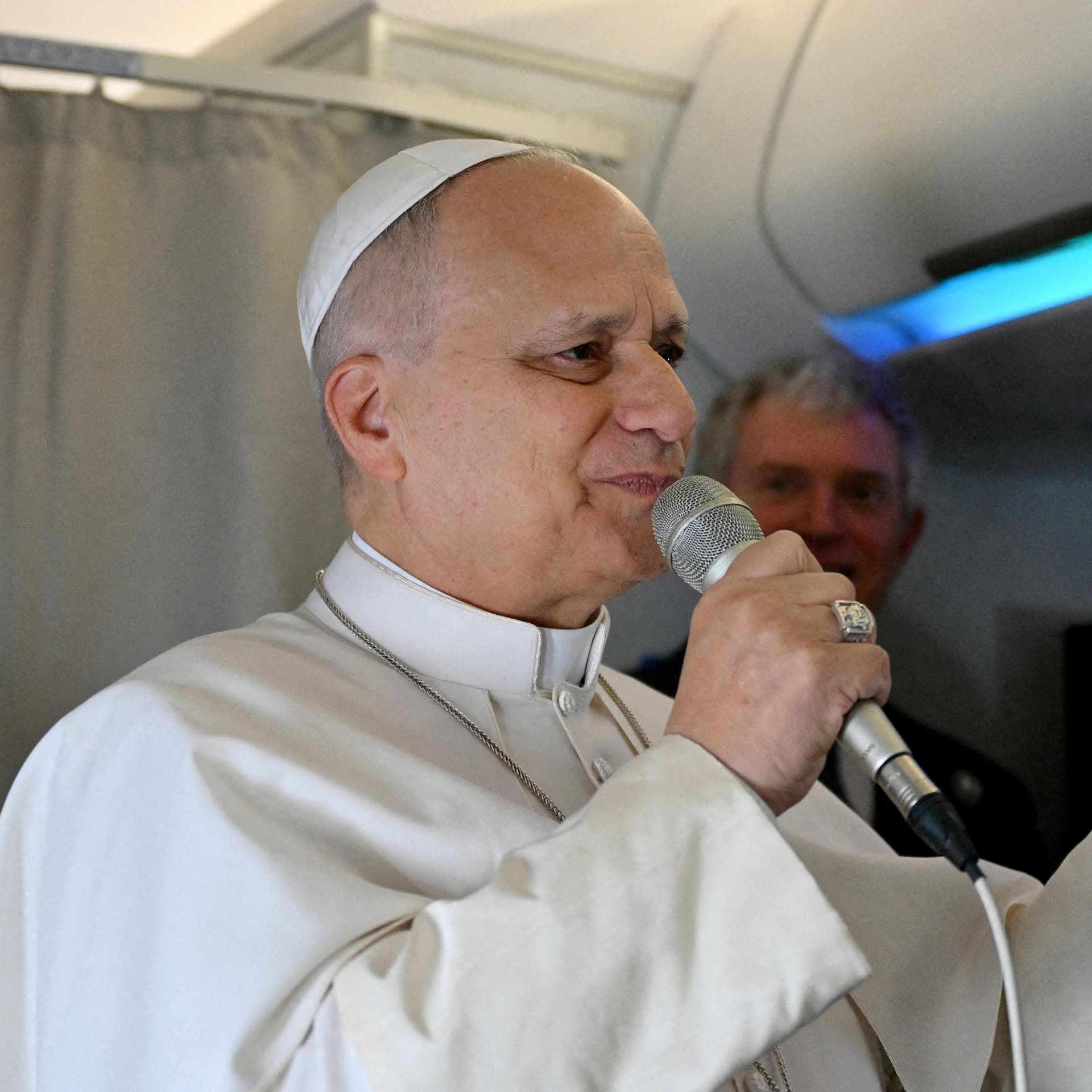
Pope Leo XIV has said he has “no fear of the Trump administration”, after his criticism of the Iran war drew scorn from President Donald Trump.
On Sunday, the US President called the Pope “weak on crime and terrible on foreign policy”, and posted a now-deleted AI image of himself depicted as a Christ-like figure.The posts caused outrage among Catholics and the religious right, but he has said he will not apologise to the Pope.
We speak to BBC presenter and author Edward Stourton, who has reported on religious affairs and US politics for decades, about what happens when an American president takes on an American Pope.
Producers: Sam Chantarasak, Xandra Ellin and Lucy Pawle
Executive producer: James Shield
Mix: Travis Evans
Senior news editor: China Collins
Photo: Pope Leo XIV addresses journalists during the flight heading to Algiers on April 13, 2026. Credit: Reuters/Alberto Pizzoli.