In short
How Larry Ellison—called “CEO of everything”—could gain outsized influence in the US by controlling AI infrastructure, a major share of TikTok, and expanding into legacy media through his son’s Skydance.
Guests
Jake Lahat, senior writer at Wired, covers the White House and focuses on how Trump world interacts with Silicon Valley.
Key claims
Oracle’s “digital plumbing” (servers/data centers) makes Ellison a gatekeeper for AI compute; AI training requires massive scalable infrastructure, so Oracle benefits regardless of AI outcomes. Trump pushed for Ellison to buy TikTok; in September 2025 a US consortium gives Americans an 80% stake, with Ellison leading and taking control of the algorithm. Skydance’s Paramount/CBS deal was facilitated by FCC leverage and Trump administration pressure; Colbert’s show ended as a “casualty.” Ellison-backed plans could merge CNN and CBS, reshaping the news ecosystem.
Notable examples
Oracle’s CIA database origins; Oracle buying AI “real estate”; Trump’s TikTok divest-or-ban threats; FCC approval of Skydance’s $8B Paramount/CBS News bid; Barry Weiss named editor-in-chief of CBS News; reported $70B Warner Bros. Discovery bid.
Written by AI. May contain mistakes. Listen to the episode to check what was said.
Chapters
Tap a time to open that second in VOLarry Ellison: The Shadow President
0:36 to 1:54
Exploration of Larry Ellison’s influence and his connection to Trump.
“What do Beatles member Sir Paul McCartney, YouTube megastar Mr Beast and former Facebook executive Sheryl Sandberg all have in common?”
Interview with Jake Lahat
1:54 to 2:36
Tristan interviews Jake Lahat about Larry Ellison’s background.
“And today on The Global Story, we explore the vast and growing influence of a man who's been called the Shadow President.”
Ellison's Business Strategies
2:36 to 6:28
Discussion on Ellison's investments and unique business approach.
“I started by asking him where Larry Ellison comes from.”
Larry Ellison's Influence in AI
6:28 to 10:01
Analysis of Ellison's role in the AI industry as a service provider.
“So, I mean, one of the things I really wanted to ask you about today is these realms of business that he is really starting to take over in some ways.”
Ellison's Role in the Attention Economy
10:01 to 13:36
Examination of Ellison's impending ownership of TikTok and its implications.
“So he has a huge amount of power over the future of the AI industry.”
Ellison's Expansion into Traditional Media
13:36 to 14:00
Discussion on Ellison's influence in traditional media and legacy businesses.
“He will be the majority holder of this new American version of TikTok.”
Larry Ellison's Influence and Legacy
14:00 to 14:51
Explore the expanding influence of Larry Ellison and his family.
“So that's where the trajectory of the Ellison family dynasty could get really interesting and at a potential unprecedented level of power, at least in modern times.”
David Ellison's Journey from Actor to Media Magnate
15:07 to 17:43
Discover how David Ellison transitioned from acting to leading a media empire.
“So David Ellison is Larry's basically clear heir to the family fortune.”
The Impact of Skydance's Merger with Paramount
17:43 to 22:51
Analyze the implications of Skydance's acquisition of Paramount and its influence.
“The FCC approved Skydance Media's$8 billion bid to acquire CBS News parent company Paramount.”
Media Power Dynamics Under the Trump Administration
22:51 to 24:46
Examine the changing media landscape and power dynamics influenced by Trump.
“Isn't there monopoly competition law in the United States?”
Show all 11 chapters
Comparing Modern Influence to Historical Tycoons
24:46 to 27:30
Explore the parallels between Larry Ellison's influence and historical tycoons.
“I think a good comparison would be what the Ellison family has become to data and attention is what a Vanderbilt family was to the railroads in the U.S.”
Transcript
Automatic transcript. May contain errors.0:00This BBC podcast is supported by ads outside the UK. Hi there, I'm Asma Khalid. And I'm Tristan Redmond. And together we're the hosts of the Global Story podcast from the BBC. For those of you who might be new to our show, we here at the Global Story dive deep every weekday on one big story at the intersection of where the world and America meet. And you can now watch the Global Story on the iHeart app. Catch every brand new episode every weekday. Just tap into iHeart to start watching. And we hope you enjoy the show. What do Beatles member Sir Paul McCartney, YouTube megastar Mr Beast and former Facebook executive Sheryl Sandberg all have in common?
0:43They're all being discussed in the new season of Good Bad Billionaire, the podcast which explores the lives and fortunes of the world's super rich. That's Good Bad Billionaire from the BBC World Service. Listen now and search for Good Bad Billionaire wherever you get your BBC podcasts.
1:00It's been a big few weeks for a man you might never have heard of. A man who's at the center of Donald Trump's vision for America. In the case of Larry, Larry Ellison, it's well beyond technology. He's sort of CEO of everything. He's an amazing man and an amazing business person. Larry Ellison's company, Oracle, has already cornered the market on AI real estate. Now he's preparing to buy TikTok. His son's company owns the movie studio and news giant Paramount. And he's in talks to buy Warner Brothers. Last month, for one day, Larry became the richest person in the world. All of a sudden, Larry Ellison is holding the reins.
1:46He's building an empire which could shape the US and the world for generations to come. From the BBC, I'm Tristan Redman. And today on The Global Story, we explore the vast and growing influence of a man who's been called the Shadow President.
2:17Hey, hey. All right, here we go. Is that Jake? Yes, it is. Hello, Jake. This is Tristan in London. How are you doing? Not too bad. Not too bad. I'm talking to Jake Lahat. He covers the White House for Wired magazine, and he's particularly interested in how Trump world interacts with Silicon Valley. I started by asking him where Larry Ellison comes from. So he's like an OOG, to use an American slang term, or an original gangster. He really goes back in the Silicon Valley scene. So we're talking like 1970s is when he starts getting involved. He ends up coming up with this project where it's a database for the CIA, and the code name for it is Oracle.
3:04And that obviously later becomes the name of the company. What exactly is Oracle, Jake? Like software for hosting various websites, data sets on servers. So I would describe it as the fundamental infrastructure of the internet. I was just actually talking to an NPR host who used the term digital plumbing. And I think I'm going to steal that now. Where whatever your cool startup or product is or whatever your innovation on Wall Street might be with some big fancy model. Ultimately, that data needs to be stored somewhere. It needs to be stored reliably. And Oracle ends up developing a real advantage on this front.
3:45They're also just really good at marketing. They're really good at selling other companies these very expensive software products to make them even more money. But the thing to emphasize about Allison in the 90s is it's a lot of flash. He's buying foreign jets. He likes to fly these jets. He's into yachting. He owns a sail racing team. And he's always making these big, big purchases of big estates or, you know, with Hawaii, buying up more and more of the island of Lanai to the point where it reaches 98%. Are you saying he owns 98 % of a Hawaiian island? Yes, he does. It's pretty crazy. How much did he pay for this island?
4:25$300 million in 2012. $300 million for an island? What does he do with it? You know, this is a trend you see with other folks in Silicon Valley. Like this is just kind of an ego thing that these guys do, because when you get that wealthy, there are only so many purchases you can make that no one else can buy. Right. So he had this kind of larger than life persona that really outshadowed, you know, the kind of nuts and bolts of that server business. And I think part of that's because he's always seen himself as a storyteller. Well, I mean, he sounds like a flashy big spender. One way you can tell how important someone is is how many biographies they've had written about them.
5:03And Ellison has had a lot of biographies written about him. Some of the titles are quite hysterical. Yes. And hint at just kind of how ruthless his ambition has been over the years. And the one title I found funniest of all is what's the difference between Larry Ellison and God? God doesn't think he's Larry Ellison. And then there's another one, which is a bit pithier, called Everyone Else Must Fail. How would you describe his leadership style? What kind of manager of people is he known as? Well, I think to the point about how everyone else must lose, this is a really important strain to understand in how Silicon Valley billionaires have really affected politics in the U.S., especially with how they've taken over the Republican Party in a lot of ways.
5:56which is this belief that essentially if your business isn't some version of a monopoly, it's kind of not worth being in that business. That the nature of the modern economy, especially in tech, is that there is sort of, it's a winner-take-all ecosystem and that someone gets to the new technology first and then they own it. Okay. Well, I mean, you mentioned that his belief is that if you're not in a monopoly, then And it's not worth being in that realm of business. So, I mean, one of the things I really wanted to ask you about today is these realms of business that he is really starting to take over in some ways.
6:37In fact, Trump has described him as the CEO of everything. So I think it would be easier if we separate these regions of his power into kind of buckets of influence. So, first of all, in artificial intelligence. And then secondly, in the attention economy. so social media, and then in traditional media. So let's start with the first one, which is artificial intelligence. What's the story of Larry Ellison's expansion into artificial intelligence? Well, really, this is just because the servers are the lifeblood of artificial intelligence and that the financial boom that he sees from AI starts in the 2020s when you look at the reality of these large language models, which is that they are very, very resource intensive.
7:26And to train each generation of those models requires more energy and a lot more data. And there are simply very few companies in the world that can provide that level of compute and the ability to scale that at the pace that these companies need. But he's not actually trying to compete with his own version of AI. he's providing the infrastructure for AI companies to function. So it's almost like he's providing the football stadium for the players to play in rather than the actual players themselves. Right, right. Or to use a fast food analogy, McDonald's in the US, they're not necessarily in the burger business.
8:10What they're in the business of is real estate because they own the land that the McDonald's franchises sit on. And then they are leasing those to a franchisee. But they're always going to be fine when, you know, no matter what happens with that McDonald's owner's franchise, they have a very valuable plot of land that is useful for any commercial purpose. So he's sort of the AI landlord. Yeah, that's actually a great way to put it, I think. So one of the things that, you know, looking at it from afar, not being a tech billionaire, I mean, I've always assumed that the people who hold power in artificial intelligence are the ones who own and develop the large language models.
8:46So how does Oracle owning the AI infrastructure translate into power in the industry? So that's where I think Ellison has probably the best shake of the deal, no matter where the AI boom goes. Because these companies need to invest a ton of money in data centers and in training these models before they can ever look at making a profit. it. And there's an assumption in the Valley that AI is on this kind of unstoppable track to keep growing and growing and growing. And that you can justify spending any amount of money on building up the infrastructure to train these models when the goal is to beat China and to reach this benchmark of artificial general intelligence.
9:31Now, if none of that happens, Larry Olson still makes a ton of money because they had to invest all this stuff in the data centers, right? But that's where he's kind of cornered that front end of the market. And with this new boom of Trump's second term, highly prioritizing expansive growth in AI, Larry Olson's a huge beneficiary of that because for any of that to start, you've got to pay Oracle to get those servers up and running. Okay. So he's the kind of landlord of AI. He's the guy who gets paid whatever happens to AI. So he has a huge amount of power over the future of the AI industry. I want to turn to our next bucket of influence because it's a big one, the attention economy.
10:16But really, I just mean TikTok because he is now going to be one of the principal owners of TikTok. Can you remind me how we got to this stage? So I think the first flashpoint for TikTok is around 2020, and it all centers around the Chinese company ByteDance and this potential for a backdoor, is what people will call it, for the Chinese Communist Party to look at Americans' data. President Trump is making good on his threat to crack down on two popular Chinese-owned social media apps. We're looking at TikTok. We may be banning TikTok. We may be doing some other thing. Signed executive orders banning TikTok and WeChat from operating in the U.S.
10:59within 45 days, unless they're sold. Mr. Trump says the apps are effectively spyware. So basically, after Trump's order for ByteDance to divest from TikTok, we get a series of punts. And a lot of that is because this is far easier said than done. And a lot of Americans really like their TikTok. President Trump was speaking out this week about the social media app TikTok as he repeatedly pushes back the deadline for the app's Chinese parent company to either divest or face a ban in the U.S. And we're going to watch the security concerns and we have buyers, American buyers, we have American buyers.
11:37We need to know who's going to own it, right? We need to know who in the United States here is going to own it, which seems like the big part of the... Trump extends this essentially like the deadline gets pushed back 90 days over and over and over again. And we get to January of 2025. Well, thank you very much. And it's an honor to be here today. So Trump's getting questions in the Oval Office about whether he wants Elon Musk to buy TikTok. Are you open to Elon buying TikTok? I would be if he wanted to buy it. Instead of running with that, which Trump is often prone to do, he says, I'd like Larry to buy it too.
12:11I want Larry to buy it, as in Ellison. And from that point on, TikTok was seen as Larry Ellison's asset to lose at that point. He was seen as the clear favorite for whatever the U.S. ownership version of this company would look like. Why did Trump want Larry Ellison to buy TikTok? That is kind of unclear other than Ellison really proved his worth as a savvy operator for Trump. I mean, a lot of the credit that he gets from my sources around the president and Trump advisors is that, you know, he stays under the radar. He's not like Elon Musk, sort of just spouting off on hot button issues and getting himself in trouble.
12:58And side note, Oracle has been this whole time has been providing cloud computing and servers for U.S. user data on TikTok. So he's already been making money off of it. And where have we landed then with the ownership of TikTok? So in September 2025, Trump approves this new consortium of U.S. owners to run TikTok stateside. Interesting. Let's see what the deal is. Gives Americans an 80 percent stake in TikTok. Which Americans? Well, you'll never guess. Yes, Larry Ellison is one of them. That they will be part of a group to take over TikTok's algorithm. And Larry Ellison is leading it. He will be the majority holder of this new American version of TikTok.
13:42Yes. Okay. So Larry Ellison, at this point, owns some of the most critical infrastructure for artificial intelligence in the United States. He now owns also one of the biggest social media networks in the United States. But what's he doing with traditional media, with legacy media? How's he expanding his influence here? So that's where the trajectory of the Ellison family dynasty could get really interesting and at a potential unprecedented level of power, at least in modern times. And Larry Ellison, by the way, is 81. He's older than Donald Trump. So like Rupert Murdoch, he has placed a son in a position to carry this business into the next era.
14:50at The Global Story dive deep every weekday on one big story at the intersection of where the world and America meet. And you can now watch The Global Story on the iHeart app. Catch every brand new episode every weekday. Just tap into iHeart to start watching. And we hope you enjoy the show.
15:37Who is his son, David? So David Ellison is Larry's basically clear heir to the family fortune. David Ellison is interesting in the sense that David actually got his start wanting to be an actor. So his big, big shot is this 2006 movie called Flyboys. It's a World War I drama. He co-stars alongside James Franco. About$60 million of the family fortune gets put into this money where David, the son, privately finances it with another executive. and you know it's a it's like an okay movie but david's performance in it doesn't really lead to any future promising work and that's where i mean is it respectable his performance um look if i'm taking my reporter hat on and i'm going back to my days as a uh an art critic for my college newspaper i would say no uh he's performed he looks like a fish out of water in the performance, I got to say.
16:40Okay, so how does he go from being a reportedly failed actor, I'm going to couch that carefully, to being a media magnate? Yeah, so when I spoke to this source of mine who knows the Ellison family, they were basically saying that the movie was a turning point for David where he starts to tell people that he wants to work behind the camera. Now, normally that would mean like, you know, director, producer, a key grip. So somewhere on the crew, right? That's not what he actually means. He ends up having this production company under him called Skydance, and they get very ambitious with their mergers and acquisitions.
17:24So they end up acquiring Paramount. Paramount includes the broadcast network CBS, and they are regulated under this agency called the Federal Communications Commission. So that broadcast license gives the federal government a lot of leverage over these broadcast companies in a way that just hasn't been applied before. But Trump's able to exploit it in terms of kind of weakening the foundation of Paramount to make this merger more appealing for the Trump administration to allow. The FCC approved Skydance Media's$8 billion bid to acquire CBS News parent company Paramount. The stamp of approval from the FCC comes after months of turmoil revolving around President Trump's legal battle with 60 Minutes.
18:06We have Trump suing the CBS network for this interview that Kamala Harris did on 60 Minutes, where they simply edited out a portion of her answer. Mr. Trump accused the CBS news program 60 Minutes of deceptively editing an interview with then presidential candidate Kamala Harris. That is normally not grounds for a libel or defamation lawsuit, but Trump gets them to settle. for around$20 million. This is a deal getting the green light just weeks after Paramount agreed to settle with the Trump administration. What's more is part of the deal Skydance agreed to address the Trump administration's concerns about alleged bias at CBS.
18:45Trump's able to get not just 20 million bucks out of this thing, but also an agreement from CBS to provide this kind of vague form of pro-Trump programming. Then the merger starts moving through. The late night comedian, Stephen Colbert, becomes kind of a sacrificial lamb where around the time of the merger, his show is announced that it's going to end after its run of the current season. And of course, Stephen Colbert is one of the most critical, and I would argue most effective comedians in our country at really needling Trump. And clearly he's been a thorn in his side for years. So the Ellisons want to make this merger happen, but it sounds like the Trump administration has a lot of influence over whether Paramount and Skydance, the Ellisons company, can merge.
19:36Paramount has to agree to paying out for the CBS interview with Kamala Harris. Yep. And they have Stephen Colbert taken off the air for the deal to go through? Is that what you're saying? Colbert was sort of a casualty of the deal, I think is the better way to understand it. But, you know, Colbert has remained outspoken after that announcement was made. That was kind of the clear sign of dominance, I would say, for the fact that like this company must submit for this merger to go through. And there are sort of there was a price that had to be paid beyond the monetary one for the government to allow it.
20:19What happens next for the Ellison's media empire? So for this to be the kind of major force that people worry it might be would require more mergers and steps to happen that aren't necessarily as easy as they may be presented. So the big one on the entertainment front would be this$70 billion bid for Warner Brothers Discovery. The Wall Street Journal is reporting that Paramount Skydance is preparing an Ellison-backed bid for Warner Brothers Discovery. Warner Brothers Discovery has just a really valuable mix of properties that they were about to spin off in the coming year. So those include CNN, which is one of our biggest cable news networks.
21:03They are the cable news network with the largest international presence by far. They also have HBO. That's where shows like The Wire, The Sopranos, Succession. They have a Harry Potter franchise. They have Barbie, which was supposed to have been splitting off or spinning off, I should say. The reason that this the timing of this acquisition would be huge for Ellison is that if they can acquire Warner Brothers Discovery before they were going to spin off these other properties, that would allow the Ellison media empire to merge CNN and CBS, having an even larger share over our news ecosystem. This journalist by the name of Barry Weiss will have a major leadership role.
21:45A major shift in the landscape of TV news. Paramount Skydance announcing that they've made Barry Weiss editor in chief of CBS News. She's known for her outspoken support of Israel and strong takes on polarizing topics, including gun rights, diversity and inclusion programs. She currently runs this newer outlet called the Free Press, which is sort of framing itself as against the excesses of political correctness and liberal bias in U.S. media. So, you know, when we already have only a handful of these companies overseeing most of our news organizations in America, you know, you're talking about a lot of pro-Trump real estate in that landscape if all this goes through.
22:27Okay, so Skydance, the Ellison's company, has said that they are committed to diversity in their programming and that their main journalistic output, CBS's reporting, is still going to be fair and unbiased and fact-based. Nonetheless, there is a huge amount of media power at this point accumulated in the hands of the Ellison family. How is all of that legal? Isn't there monopoly competition law in the United States? How does that happen? There is, but it all depends on who enforces it. It depends on who's in charge of the Federal Trade Commission and then also the Federal Communications Commission with Brendan Carr, who's become one of the big characters of the Trump administration.
23:07FCC Chairman Brendan Carr spoke about the merger and the administration's approach earlier today. President Trump is fundamentally reshaping the media landscape. And the way he's doing that is when he ran for election, he ran directly at these legacy broadcast media outlets, ABC, NBC, CBS. And, you know, he's made it pretty clear that, you know, you're going to have to kind of do a favor for the administration by having the way he'll put it is programming, you know, in the interest of the American people. For years, you know, government officials just allowed those entities with execs sitting in Hollywood in New York to dictate the political narrative.
23:46And he really you're talking about kind of being aligned with the administration's agenda and politics as a prerequisite for having your business go through. Is Brendan Carr the same guy who pressured ABC to cancel Jimmy Kimmel, who pressured Disney to cancel Jimmy Kimmel from his late night show? Yes, exactly. So we've gone through these big buckets of influence that Larry Ellison and his family have amassed over the last few years. So he's got a hold of AI infrastructure. He's about to own TikTok, which has huge political influence. And he's extending his influence into, quote unquote, legacy media, film studios, news channels.
24:31And it just seems to be growing. This is a kind of new level of power and influence in the United States. Is Larry Ellison a modern day robber baron, like a kind of a Carnegie or a Rockefeller? I think a good comparison would be what the Ellison family has become to data and attention is what a Vanderbilt family was to the railroads in the U.S. or the Rockefellers to oil, where it's this combination of business and political influence that is just so large that it's almost impossible for any other individual or organization to try to rival it. where, you know, this could really set the U.S. on a kind of longer term, you know, semi-permanent pro-Republican conservative media apparatus that so far, at least on TV, you know, has really been limited to Fox News.
25:31I mean, there are a number of conservative outlets online, conservative podcasters have been doing very well in the U.S., but that's all disparate and spread out and fractured, right? Like there has not been anything that's been this kind of totalitizing megastructure that seems to be in the works here from the Allison family. Well, you mentioned the Vanderbilts who built US railroads, right? But now you're looking at a man who's in control of the data and attention spans of people of the United States, which, and people who control attention and data in that way, it feels to me like they sort of control almost everything.
26:12You control politics, you control what's popular, you control what sells. I mean, has anybody in the United States ever potentially had as much power and influence as this one man? Hands down, no. And that's the thing.
26:31Attention is, in a lot of ways, kind of the most valuable commodity in our modern era. I mean, And yes, we have rare earth minerals and all these other, you know, physical, tangible things. But the fact is, for each one of us, all of our attention is equally scarce. We only have so many waking hours of the day. And you add in this really, really potent combination of popular entertainment platforms and a large, large chunk of, you know, live video news in an era when just let's face it. younger people consume video first. So that's where if you look at this in the future when millennials and Gen Z are the majority of the population and then they're the ones who are in charge in the US, that's where I think they could be much more affected by the media attention component of this empire.
27:26Jake, thank you so much. Thanks for having me on. Thank you for highlighting Larry Elson. That was Jake Lahat, a senior writer at Wired magazine. Today's episode was made by Sam Chantaracic, Aaron Keller, and Annie Brown. It was engineered by Travis Evans, and I'm Tristan Redman. If you liked this episode, then you might also like our episode from September 23rd on whether Apple can cut ties with China. So do scroll back in the feed and take a listen, and please leave us a review. It helps others to find us. Thanks for listening. We'll be back tomorrow. Cheerio.
28:29dive deep every weekday on one big story at the intersection of where the world and America meet. And you can now watch the global story on the iHeart app. Catch every brand new episode every weekday. Just tap into iHeart to start watching. And we hope you enjoy the show.
From the publisher
The billionaire Larry Ellison could soon control huge portions of America’s AI, attention economy and legacy media. He already owns swathes of AI infrastructure and is preparing to takeover TikTok, whilst his son, whose company already owns Paramount, is preparing a deal to buy Warner Bros. Discovery. So who is this ‘CEO of everything’, and how is his family dynasty becoming the 21st Century’s Rockerfellers?
Producers: Sam Chantarasak and Aron Keller Executive producer: Annie Brown Sound engineer: Travis Evans Senior news editor: China Collins
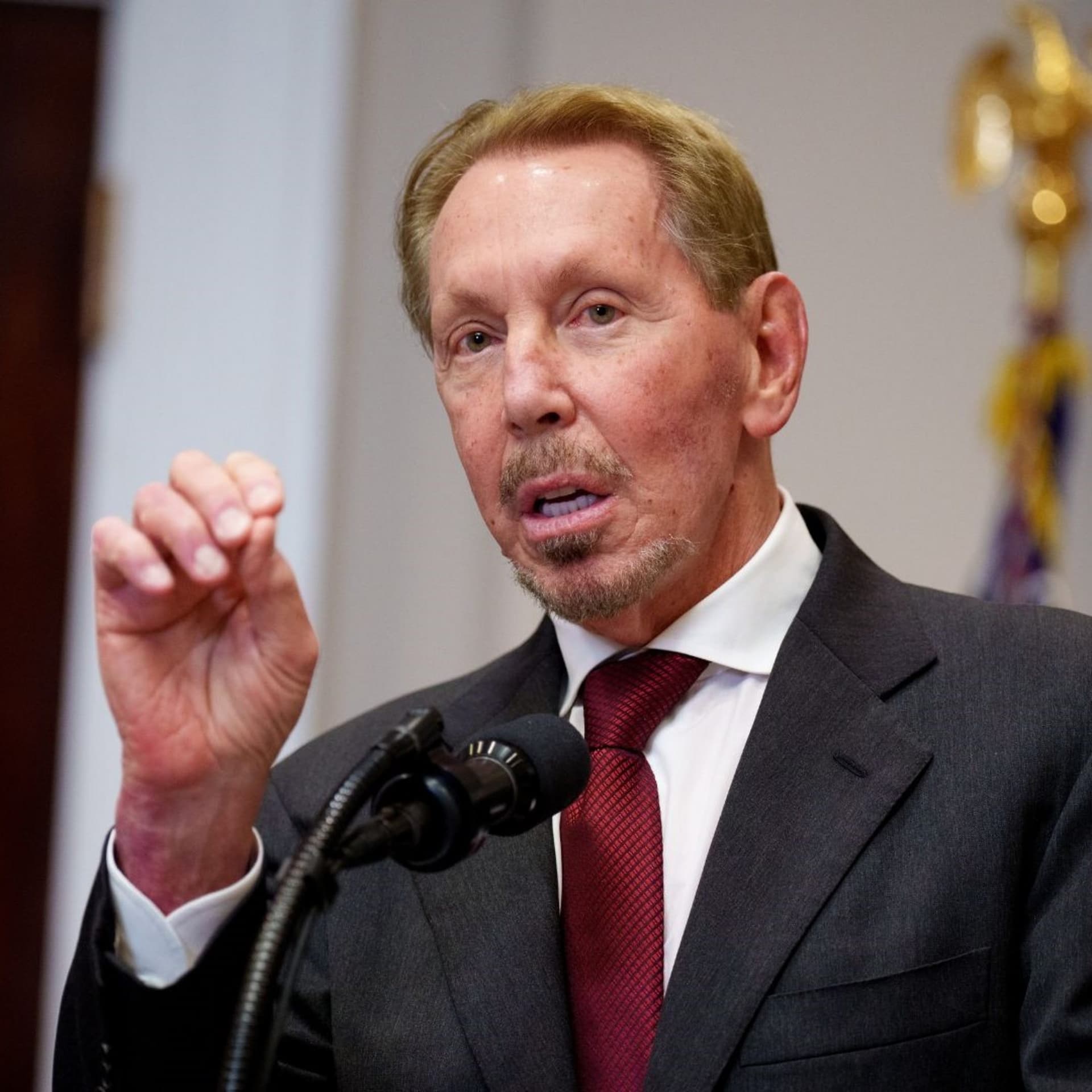
(Photo: Rupert Murdoch and Larry Ellison look on, at the White House, in Washington, US, 3 February, 2025. Credit: Elizabeth Frantz/Reuters)