
In short
A BBC Global Story special marking Donald Trump’s first year back in office, focusing on two landmark policies—tariffs and immigration—through two people affected by them.
Guests and backgrounds
- Sherry Blanchard: bookkeeper and wife of James Blanchard, a fourth-generation Louisiana shrimp fisherman (45+ years in the industry).
- Ani Lucia Lopez-Bellosa: 19-year-old Honduran-born college student; entered the U.S. as a child (Austin, Texas), later studied business at Babson College.
Key claims
- Sherry says Trump’s 50% shrimp tariff on India boosted shrimp prices and profits; she credits tariffs for a 62% price increase (2025 vs 2023).
- Ani says Trump’s administration is enforcing immigration law more aggressively, using less prosecutorial discretion; she was detained at Logan Airport despite being a noncriminal college student.
Notable examples
- Sherry: her husband tied up their boat in 2023 at age 64 when shrimp prices made it impossible to cover diesel, crew, and maintenance; later increased trips and ~$165,000 higher sales revenue in 2025.
- Ani: arrested after TSA screening in November, transferred between ICE facilities, deported to Honduras; a judge later recommended a student visa and the government apologized for not following a 72-hour hold order.
Written by AI. May contain mistakes. Listen to the episode to check what was said.
Chapters
Tap a time to open that second in VOTrump's First Year Reflected
1:02 to 2:36
Hosts discuss Trump's first year back in office and its polarizing impact.
“Now, normally we are not in your feeds on a Sunday with a global story, but we have a special episode for you all.”
Impact of Trump Policies on Individuals
2:36 to 3:40
Introduction of guests affected by Trump's policies, focusing on Sherry and James Blanchard.
“we hear from two people whose lives have been reshaped by those two Trump policies, for better and for worse.”
The Shrimping Industry Landscape
3:40 to 4:36
Sherry Blanchard shares insights on the shrimping industry and competition from imports.
“James trawls the waters off of Louisiana's coast for wild-caught shrimp.”
Shrimping Challenges Over the Years
4:36 to 5:45
Discussion on the decline in the shrimp industry and its challenges over decades.
“And so I asked Sherry to take us back to what life was like during the good old days of being an American shrimper.”
Foreign Imports and Price Decline
5:45 to 7:16
Exploration of how foreign shrimp imports affected local prices and businesses.
“Whenever hurricanes hit, hurricanes always hit here.”
Personal Impact and Turning Points
7:16 to 8:39
Sherry recounts the drastic changes faced by her husband in the shrimping industry.
“You mentioned China and Vietnam a moment ago.”
The Hope for Change with Tariffs
8:39 to 11:28
Sherry discusses the optimism surrounding Trump's tariffs and their effects.
“This man has been a shrimp fisherman for 45 years.”
The Positive Impact of New Policies
11:28 to 12:36
Sherry reflects on the financial improvements seen with new tariffs in place.
“So when the price started to go up a little bit, James, he saw opportunity to try and go back out.”
Evaluating Trump's Presidency
12:36 to 14:00
Sherry shares her views on Trump's overall performance and policies after a year.
“How do you grade the president overall, now that he has been back in the White House for a year?”
Perspectives on Trump's Impact
14:00 to 17:06
Explore various views on President Trump's return to the White House.
“We're not mad at people for wanting a better life.”
Show all 17 chapters
Introduction of New Voices
17:06 to 17:42
Hosts introduce the podcast and tease upcoming stories.
“Thank you, and I appreciate y 'all interest in our industry.”
Ani's Journey: From Honduras to Texas
17:42 to 19:05
Follow Ani's migration story and her experiences in the U.S.
“And together we're the hosts of the Global Story podcast from the BBC.”
Detention Experience
19:05 to 21:44
Ani recounts her shocking arrest and detention by Border Patrol.
“She was the first in her family to go to college.”
Legal Challenges and Deportation
21:44 to 22:44
Understand the legal background leading to Ani's deportation.
“Her lawyer says that back in 2014, Ani and her mom entered the United States through a port of entry.”
Reflections on Deportation
22:44 to 27:20
Ani shares her feelings about deportation and its impact on her identity.
“But Ani says it's more complicated than that.”
Updates on Ani's Case
27:20 to 28:00
Latest developments in Ani's legal situation and potential resolutions.
“It did change, but at the same time, it didn't.”
Key Developments in Ani's Case
28:00 to 28:54
Learn about the recent legal developments regarding Ani's deportation case.
“This month, there have been a couple of key developments in Ani's case.”
Transcript
Automatic transcript. May contain errors.0:00This BBC podcast is supported by ads outside the UK.
0:30for all the great deals happening now. Save big money at Menards. Hi there, I'm Asma Khaled. And I'm Tristan Redmond. And together we're the hosts of the Global Story podcast from the BBC. For those of you who might be new to our show, we here at the Global Story dive deep every weekday on one big story at the intersection of where the world and America meet. And you can now watch the Global Story on the iHeart app. Catch every brand new episode every weekday. Just tap into iHeart to start watching. And we hope you enjoy the show.
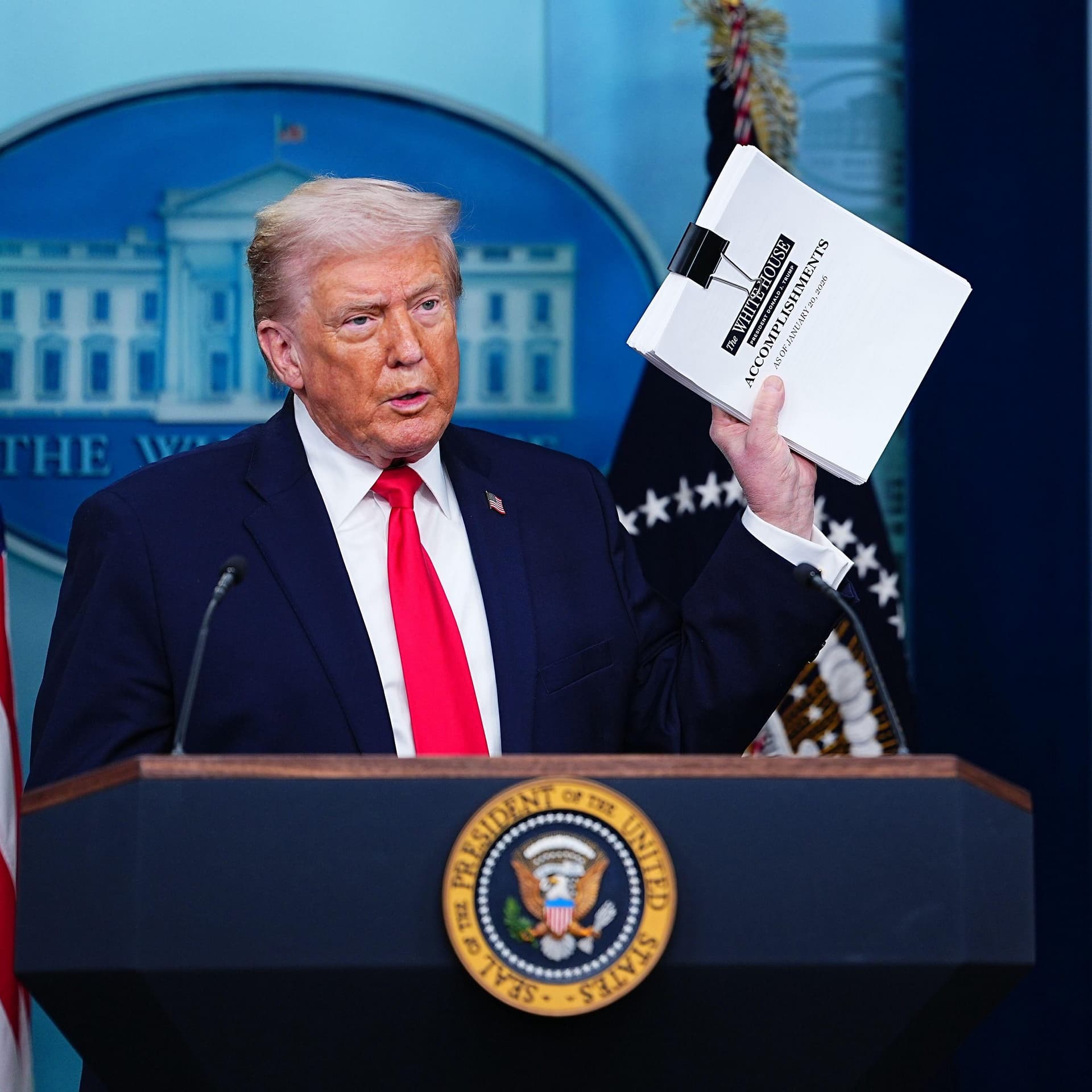
1:07Hey there, this is Asma. Now, normally we are not in your feeds on a Sunday with a global story, but we have a special episode for you all. The last several days were wild with news. Lots happening around the globe. So much that you might have missed this. But last Tuesday, President Trump strode into the White House press briefing room, packed with reporters. Wow, that's a big crowd. That's a lot of people. I think it's like a record. Now, presidents don't regularly attend these press briefings, but this one was clearly special to President Trump because... This is the anniversary, first anniversary.
1:45One year since the inauguration of his second presidency. He would go on to speak for 104 minutes as his press team handed out packets proclaiming 365 wins in 365 days. We have a book that I'm not going to read to you, but these are the accomplishments of what we've produced. All page after page after page, individual things. I could stand here and read it for a week and we wouldn't be finished. Trump's first year back in office has been a busy, albeit polarizing time, especially because of two landmark policies which have rippled across the world. tariffs and immigration. From the BBC, I'm Asma Khalid in Washington, D.C.
2:34And today on The Global Story, we hear from two people whose lives have been reshaped by those two Trump policies, for better and for worse.
2:52Lately here on The Global Story, we have been talking a lot about seismic changes in the world order. We've talked about world leaders, and we've spoken to the BBC's expert correspondents from around the world. But today on the show, we're doing something a bit different because these huge policy decisions, while they can seem remote to many of us, are actually about real lives. Back in 2024, when Donald Trump was running for president, he promised to secure the southern border. And now he seems to have delivered. Illegal crossings are at record lows, according to federal data from the U.S. Customs and Border Protection.
3:29And coming up later in our show, we're going to hear from someone impacted by President Trump's immigration policies. But our first story is about a man named James Blanchard. He's a shrimper. James trawls the waters off of Louisiana's coast for wild-caught shrimp. Cell reception can be spotty, though, on James's boat. And in an effort to reach him, we actually ended up connecting with his wife, Sherry. She keeps the books and knows a lot about this industry. Well, my name is Sherry Blanchard. I am married to James Blanchard, who has worked in the shrimping industry since, I think he said, 12 years old.
4:09He's like a fourth-generation shrimp fisherman. We have been in business 45-plus years. These days, Sherry and James have a lot of competition from other countries. India has been the largest supplier of shrimp to the U.S. But now President Trump has hit India with a 50 percent tariff. So we wanted to know how Sherry Blanchard is feeling about business and how the shrimp industry has changed over the years. And while I may not know loads about shrimping, I do know there was a time period when business was booming here in the U.S. And so I asked Sherry to take us back to what life was like during the good old days of being an American shrimper.
4:50Owning a shrimp boat in the 80s was a good investment. So we had doctors and attorneys here who, they didn't stop being a doctor and attorney, but they would buy shrimp boats. They would have two or three shrimp boats because there was profit in it. And could a shrimper like James support an entire household? Was that enough income to support a family? Yes, yes. I mean, you could support, yes, you could do well to support your family. If you were a shrimper on the bayou, you had a very nice house. You could afford things. People now, if you're a shrimper now, it's just because you love it. So those good days, though, didn't last, those good times.
5:32Do you remember when you all first began to notice a change? It started to really hit us around the late 90s, where we started to see the impact on our prices, the impact on our community. Whenever hurricanes hit, hurricanes always hit here. So whenever a hurricane would hit, everybody would get busy and rebuild. And so we started noticing the late 90s into the 2000s that when a hurricane hit, the rebuilding didn't happen as quickly. So a hurricane would hit and we had three grocery stores. One of them would close. Then we had two. And you're saying that's because there was just a collapse in the price of shrimp?
6:17The price of shrimp in the seafood industry is what ran our bayou. So yes, that's what happened. And why was there that decline in price? Was there not enough shrimp in the Gulf? Was it about foreign imports coming in? We have plenty of shrimp in the Gulf. Actually, there's never a problem with a shortage of shrimp. What happened was around the late 90s, mostly it was in Asia. It was in China and Vietnam and Cambodia. They started developing these shrimp farms. And then that was when we started to get more and more imports. And so these shrimp that were coming, you were saying, produced through shrimp farms in Asia, China, Vietnam.
6:58Exactly. Were coming into the United States and just selling that shrimp at a cheaper price. At a below market price, yes. And so our inventories filled up because they were dumping it here. Sherry, I want to ask you about the politics of this all. You mentioned China and Vietnam a moment ago. And in prepping for this episode, I read that George W. Bush tried to impose tariffs on China and Vietnam back in 2004 for dumping shrimp at artificially low prices. Did that help at all? We would experience a better price, but usually temporarily because, you know, as time would go on, they would negotiate lower terms and lower tariffs and things like that.
7:44And so the effect was not as profound anymore. So just to make sure I understand, it sounds like maybe the Bush tariffs in the early 2000s helped a little bit, but overall, the sector just kept declining and declining. Yeah, that's exactly right. And so for us, it became very drastic toward the end of 2023.
8:11My husband came home from one of his trips, his shrimp trips, and he said, I'm going to have to tie the boat. Even if I fill up our entire freezer hold, I won't make enough money to even pay the diesel. I definitely won't be able to pay the crew and won't be able to do any maintenance on the boat because it's just impossible to make a profit at this price. So we tied up our boat in 2023. So, I mean, he went to a job fair. This man has been a shrimp fisherman for 45 years. How old was he then going to a job fair? He was 64 years old. I mean, and he's smart. So I had no problem believing that my husband was able to.
9:00But still, to start over the career you say he loved from the age of 12, and to re-envision what you're going to do at 64 has got to be just mentally really tough. It was very tough. It was very tough.
9:21Sherry, the situation as a shrimper here in the United States was getting worse and worse. And I want to get a sense from you of who or what do you ultimately blame for that? Listen, I'm a patriot. And I love our country. I think we're the best country in the world. But our own government participated in this mindset that global trade was the way to go. Our own government pushed out funding to countries to compete against our domestic industries. And I think that's what caused our downfall. So you had said in 2024, your husband was realistically considering giving up his livelihood. But also in 2024, we see Donald Trump campaigning for president again.
10:11And I remember that he proposed sweeping tariffs on countries around the globe to protect American industry, a sort of ring around the United States. Did you think at that time in 2024 that something might change in the shrimping sector? Oh, yeah, we absolutely knew that that was going to change our industry. Even before he had come into office, even when he was just out campaigning, you had that sense of optimism? Well, we've had experience with tariffs and the relief that tariffs, you know, in the short term have given us. So we understood what that meant. And we were pleasantly surprised after he was elected in the first term because we paid less taxes, because we had more profit.
11:00So we just knew that we were going to expect at least that in his second. So Sherry, when he wins and then is inaugurated last January, one of the big economic policies the president introduced shortly after he returned to office were these sweeping tariffs. Can you walk us through, as a result of what you've seen from President Trump so far, have you seen the price of shrimp change? So when the price started to go up a little bit, James, he saw opportunity to try and go back out. And so we experienced a 62 % increase in 2025 as compared to 2023. And what do you attribute that change to? Well, that's definitely the tariffs.
11:48That's definitely the tariffs. Because, I mean, 62 % is a huge amount and it's a huge difference in sales revenue. How has that affected your life, James' work? Well, he increased his trips in 2025. Our overall sales revenue went up about$165 ,000 in 2025 as compared to 2023. We were able to do a lot more maintenance and work on our boat that had been neglected because of how low the price had been. And, you know, we were generally able to breathe, just to take a breath and enjoy life a little bit, as opposed to how tight things had been. How do you grade the president overall, now that he has been back in the White House for a year?
12:42Overall, even though people say that he's not behaving in a constitutional way. But the Constitution says that our public officials' duty is to protect citizens from enemies, both foreign and domestic. And he's done that. And while I don't look at all foreign industry, shrimp industry people, as my enemies, I do feel like our president has kept, he's not preferring them over us, I guess is another way to put it. we've had a huge problem with overdose deaths from fentanyl in this country. And I see that border protection is a priority and it has lowered overdose deaths. Sherry, you mentioned the border.
13:31The president has certainly done a lot back in office this first year and not just on economic issues like tariffs and trade. The other big area that you just alluded to there is immigration. How do you feel that he's done on immigration? I know it's a very touchy subject, but I think it's necessary. It has to be done. If people are here and they got here illegally, it's not fair to the people that have gone through the motions to be here legally. And it's not fair to the American worker. My husband and I love people. Of all kinds, we don't differentiate. We're not mad at people for wanting a better life.
14:09You can't blame them. And if you announce, hey, come here, well, they're all going to come. But just like you have locks on your doors and just like you have a limited income that you can use to take care of your family and other people around you that you want to help, our country has that. And we can't afford to support people that we can't accommodate. Do you feel that your life is better now that President Trump has returned to the White House? Definitely. If you were to give a letter grade, what letter grade would you give? I think he's got maybe a B or an A minus. I mean, there's a few things that we don't like.
14:51My husband and I, we don't like the main tweets and all those things. And I think he's improved in that. And I mean, some of the things that I'm hearing, I'm like, really? We're going to own Greenland? Okay. No, we're not 100 % on board with a lot of that stuff. Sherry, it sounds like for your family, for the shrimping sector, the tariffs have been beneficial. But there are some American industries who say that the tariffs have hurt them. Auto manufacturers have said they might have to do some big layoffs. American farmers have said that they've had to decrease their exports because some other countries have put retaliatory tariffs on them.
15:32And I interviewed a small business owner who makes radio speakers in Minnesota. They're the sound system you might hear when you go through a drive-thru window, right? They're like, hello, what would you like to eat? And he imports some of the components because he says American companies don't make those components anymore. So what would you say to a business owner or to a farmer who says that the tariffs have not worked for them? You know, that's unfortunate. And I know that whenever there's a correction made, and I feel like this is a correction that needs to be made, that there will be some repercussions.
16:15My father and my grandfather on both sides were farmers, ranchers. So I understand the farm component, too, and I hate to see that happen. And something that pick up on what you said, they no longer make those parts in the United States. Well, over time, that can be restored again. And it looks like a big ask, but it needs to happen. We need to start making more of our own things here again, making our producing. As the market corrects itself, people will invest back into the industries. and we will see more things come from us instead of importing them in.
17:05Well, Sherry, thank you so much for taking the time and sharing your family's story. Thank you, and I appreciate y 'all interest in our industry.
17:18That's Sherry Blanchard. She's the bookkeeper for her husband, James Blanchard, a fourth-generation shrimper. And coming up, someone whose life has taken a turn for the worse during President Trump's first year.
17:42Hi there, I'm Asma Khalid. And I'm Tristan Redmond. And together we're the hosts of the Global Story podcast from the BBC. For those of you who might be new to our show, we here at The Global Story dive deep every weekday on one big story at the intersection of where the world and America meet. And you can now watch The Global Story on the iHeart app. Catch every brand new episode every weekday. Just tap into iHeart to start watching. And we hope you enjoy the show.
18:15My name is Ani Lucia Lopez-Bellosa. I am 19 years old. Back in 2014, when Ani was 8, she crossed the U.S.-Mexico border with her mom. My family, we're all from Honduras. We migrated to the U.S. when I was 8 years old. She said the family was fleeing violence and persecution. Ani says she was too young to fully understand what was going on, but she knew cousins who'd been killed. Ani's dad, who works as a tailor, crossed separately, and the family settled in Austin, Texas. At first, she missed Honduras, but not for long. Texas grew on her. The water parks, all of it. I just love everything about Texas, like the food, the rodeo.
19:01Everything is just, oh, I miss it. Loki, I miss everything. Ani misses Texas because this past fall, she moved to Massachusetts to begin studying business at Babson College. She was the first in her family to go to college. She loved it. But by November, she was homesick. So she decided to fly back to Texas to visit her family over Thanksgiving break and surprise them. She got to Logan Airport in Boston early on the morning of Thursday, November 20th. That day, I mean, I got to the airport. I passed through security through TSA. I was like, well, it's five in the morning. Like, let me go get a coffee.
19:40And I go get like a little coffee. And then it was boarding time now. And I was in line and then it was my turn for them to scan my ticket. You were about to board the plane. Yes. And they scan it and they're like, they scan it twice. Both times something like appeared on the little computer and then they were like oh go to customer service so I go to customer service and two officers were there waiting for me and they just told me a year and I was like yes and they were like you're gonna come with us and I was like why and then they were like oh you have a lot of paperwork to fill out and I was like what paperwork I was like I have a flight that I have to be on I literally have to be there right now and they were like well I don't think you're gonna make And then they were like, well, come with us.
20:29And when I was walking to them, I was like, well, we might, I don't know, there might be something wrong with my luggage or something like that. But they handcuffed me and told me that they were going to take me to a detention center. Ani had been arrested by Border Patrol agents and was driven to an ICE facility about 30 minutes north of Boston. At that point, she doesn't know why she's being taken just yet. But in the meantime, she says agents collect her belongings, including her wallet, passport and her phone. She was eventually allowed to make a phone call. What did you tell your parents when you were able to speak with them?
21:08I mean, it was a surprise. They didn't know that I was like at the airport or none of that. And it was like, well, Dad, I got me. I'm here at the detention center. I was going home to surprise you guys for Thanksgiving. Like, I'm so sorry that this happened. And what did your dad say? He was like, don't worry, you're going to get out of there pretty soon. We're going to do everything that we can. She says she slept on the ground that night because the facility was too crowded. It's worth pausing here to try to explain why did the government arrest Ani in the first place? Her lawyer says that back in 2014, Ani and her mom entered the United States through a port of entry.
21:55Her mom went on to apply for asylum, but Ani's mother's asylum claim was denied by an immigration judge and an order of removal was issued for Ani and her mom. The family's lawyer at the time appealed this ruling but lost the appeal the next year. We reached out to the Department of Homeland Security, which oversees ICE, Immigration and Customs Enforcement, and we asked them about Ani's story. In a written statement, DHS said, quote, any claim that there are subprime conditions at ICE facilities is categorically false. They also wrote that Ani, quote, received full due process, including a final order of removal from a judge.
22:33And in court, lawyers for the U.S. government say the immigration officials last November were basically just carrying out that previous removal order that should have been followed years ago. But Ani says it's more complicated than that. Yes, she says she knew as she went off to college that she did not have legal status in the U.S. She has no U.S. passport. She doesn't have a visa either. But she told us she didn't know there'd been an order for her removal because she was 10 or 11 when this all was happening. And President Trump's administration is enforcing immigration law differently than previous presidents.
23:08Democrats have vowed mass invasion and mass migration. We are delivering mass deportation, and it's happening very fast. One big change is in the use of prosecutorial discretion. Past administrations, including Joe Biden's, often chose not to pursue cases like Annie's, where the person had no criminal record and was brought here as a child. That's changed since Trump returned to the White House. Back in that detention center north of Boston, the next morning, after breakfast, Ani was put on a chartered flight and flown to a different ICE processing center in Texas. She still had no phone, so she didn't know it yet.
23:49But in the meantime, her family had found a lawyer for her. And the lawyer got a judge to issue an emergency order. That order instructed ICE not to remove Ani from the United States for at least 72 hours. But the next morning, waiting in that ICE facility in Texas, Ani heard her name called. It was just me and somebody else. And we were like, are we getting deported? Are they taking us somewhere else? We were just making up, like, scenarios. Like, we don't know where. They told us, like, you're things, you're leaving. and where do you go to a airport and then we waited there at the airport for like two hours just for like the plane to get there it was me another woman and some like man as well and all from Honduras yes so that's where we were like oh we are getting deported did anybody tell you that?
24:52No. We knew, I knew like officially once like we were on the plane and we ask and they're like, this planes will land in Honduras. Once it really hits you, what goes through your mind? At that point, I lose all my hope, my faith. I was like numb. I was numb. I was like, Is this happening? Am I leaving my parents? I'm leaving college behind. I'm leaving everything that I did behind.
25:29After Anya was deported to Honduras, she moved in with her grandma, whom she loves. But she says it still doesn't feel like home. What was your Christmas like? Horrible. Horrible, horrible, horrible. The worst Christmas ever. It was so sad. I mean, I was crying. Instead of being happy, I was just crying.
25:57I inevitably had to turn the conversation to politics and President Trump. And I mentioned to Ani that there are a lot of Americans who are fans of the president's immigration agenda, who support these stepped-up deportation efforts. And so I asked her what she thinks when she hears that. first everybody has their opinion right but knowing that i'm part of that community like the hispanic community many of us come to the united states because we want a better education because we also want safety seeing how people think about that kind of stuff we're like i'm not like a criminal i am literally like a college student.
Read the full transcript
26:43And if the administration said that they were going to get criminals, why are they not doing that? Because I agree. I mean, there are some criminal Hispanics. I will agree to that. Literally, the Honduran president, why was he pardoned? The former president of Honduras, you're saying that President Trump pardoned recently. Mind-blowing for that. He was convicted of drug trafficking. Exactly, exactly. But you're attacking a lot of innocent immigrants. It just doesn't make sense. So after you got deported, did it change how you feel about the United States in any way or changed how you see the United States?
27:28It did change, but at the same time, it didn't. Like, you know, like me getting deported, like I was kind of like upset, you know? But also it didn't because I was in the United States for more than 10 years. Like, I grew up in Texas. I see Texas as my home, and it's my home. That's where my house is at. I mean, I love the United States. I love everything about it. And Honduras doesn't feel that up for me. Even though it's my country and everything, it just doesn't feel the same. This month, there have been a couple of key developments in Ani's case. First, a lawyer for the government apologized in court and said ICE had made a, quote, mistake in not following that emergency court order to not move Ani for at least 72 hours.
28:17But the government is not dropping the case against Ani, nor has it taken any steps to reverse her deportation. And in another development, the judge recommended the Trump administration issue Ani a student visa. The judge gave the U.S. government 21 days to respond. For now, Ani is still in Honduras.
28:53That's it for The Global Story. Today's episode was produced by Chris Bendrev. It was edited by Bridget Harney. Our senior news editor is Chyna Collins. And a quick note before we go. So if you're looking to keep up with the very latest news from around the world, then we recommend checking out our sister show, The Global News Podcast. You can find it wherever you listen. Thanks for tuning in, and we'll talk to you again tomorrow.
30:01Transcription by CastingWords into iHeart to start watching. And we hope you enjoy the show.
From the publisher
One year into President Trump’s second term, the White House is celebrating what it calls a year of accomplishments. Those achievements stem from significant policy changes that have reshaped life for many Americans.
In this episode, we hear from people directly affected by two of the administration’s most ambitious efforts - tariffs and immigration - and how those changes played out in unexpected ways.
Producers: Chris Benderev and Valerio Esposito
Executive producer: Bridget Harney
Sound engineer: James Shield
Senior news editor: China Collins
Photo: President Trump at a press briefing to mark one-year of second term in office. Aaron Schwartz/EPA/Shutterstock