
In short
Four years after Russia’s full-scale invasion, the episode follows BBC international editor Jeremy Bowen through Ukraine’s front-line conditions and discusses peace talks, territorial demands, and war fatigue. It cites Ukraine’s official losses (55,000 soldiers) and BBC-verified Russian deaths (over 180,000), plus civilian displacement and casualties.
Guest backgrounds
Jeremy Bowen is the BBC’s international editor; he reports from Ukraine, interviewing soldiers, civilians, and President Volodymyr Zelensky.
Key claims
Front-line life is dominated by drones, including FPV attacks countered by fishnet road netting donated by countries like Scotland/France/Norway. Putin demands Ukraine cede occupied territory (notably Donetsk) and Zelensky rejects land concessions, framing victory as preventing occupation. US pressure and deadlines are described as limited leverage; some US aid is said to be conditional, with Europeans providing less of certain systems (e.g., Patriot interceptors).
Notable examples
A Christian minister/relief operator in Donetsk runs a bakery producing about 17,000 loaves weekly and evacuates people; a body-collector organization retrieves Russians and Ukrainians from battlefields. Bowen also describes a soldier surviving months in a dugout under constant mining and drone danger.
Written by AI. May contain mistakes. Listen to the episode to check what was said.
Chapters
Tap a time to open that second in VOFour Years of War: Overview
1:38 to 3:00
An overview of the situation in Ukraine four years after the invasion.
“Four years ago, President Vladimir Putin made a decision that would reshape Europe.”
Journey Through Ukraine
3:00 to 4:12
Jeremy Bowen describes his journey through Ukraine and its impact on civilians.
“Jeremy, you've spent the past few weeks traveling around Ukraine, talking to people who've been living through this war for four years now.”
Defense Against Drones
4:12 to 5:18
Discussing the use of netting as an effective defense against drones.
“There's a lot of really scary video online of these drones actually sometimes chasing individuals, chasing cars, blowing them up, killing them, destroying things.”
Life on the Front Lines
5:18 to 8:06
Jeremy shares experiences from frontline towns and the struggle of residents.
“I mean, it's so fascinating to hear you talk about this type of material being used as a primary defense mechanism.”
Personal Stories of Resilience
8:06 to 10:29
Meet individuals in Ukraine who are making a difference amidst the war.
“There are no safe places in the Donetsk region anymore.”
Current Negotiations and Challenges
10:29 to 12:15
Discussion on ongoing negotiations and the challenges faced by Ukraine.
“It appears that they've been trying to hammer out an end to this war.”
Impact of War Fatigue
12:15 to 14:00
Examination of the emotional and physical toll of prolonged conflict in Ukraine.
“keeps trying to impose deadlines and they don't get anywhere with them is testimony to the limitations on the leverage they have on both sides.”
Life in the Trenches: A Soldier's Story
14:00 to 16:48
Explore the challenging life of a Ukrainian soldier stationed on the front lines.
“which they, you know, will have to adapt to to live the rest of their lives.”
Civilians and Morale in Wartime
16:48 to 18:55
Delve into the morale of Ukrainian civilians and their determination amidst war.
“And that's something that Ukrainians don't agree with.”
Zelensky's Leadership and Negotiations
19:26 to 22:23
Analyze President Zelensky's leadership and the complexities of negotiations with the U.S.
“pleading with members of Congress and frankly, even at times with the American public to continue to support this war.”
Show all 14 chapters
Military Dynamics and Ukrainian Resilience
22:23 to 27:30
Understand the evolving military situation in Ukraine and the country's technological advancements.
“And we understand the cost of such steps.”
Impact of War on Ukraine's Future
27:30 to 28:10
Discuss the long-term impacts of war on Ukraine's society and demographics.
“amongst, you know, the political leadership with Zelensky.”
Ukraine's Demographic Crisis and Ongoing War
28:10 to 29:06
Explore the current demographic challenges in Ukraine amid ongoing conflict.
“People here talk about a huge demographic crisis.”
Insights from Jeremy Bowen on the War's Anniversary
29:06 to 29:42
Gain insights from Jeremy Bowen on the four-year anniversary of the war in Ukraine.
“and sharing it to us, particularly in the midst of being there on the road in Kyiv.”
Transcript
Automatic transcript. May contain errors.0:00Jeremy Bowen:This BBC podcast is supported by ads outside the UK.
0:30Volodymyr Zelenskyy:Come on! Get a load of this guy. Ketchup. On a dog. Yeah, we've got thoughts. Too loud? In Chicago, you're gonna hear it. Because nothing here gets built without conversation. Nothing moves without connection. So, if you think you know AT &T, it might be time to rethink that. Because their network has improved, like, a lot. So Chicago can keep speaking its mind with AT &T Wireless and AT &T Fiber. Chicago won't stop talking. Our improved network backs it up. AT &T. Connecting changes everything. AT &T Fiber. Limited availability in select areas. Hi there, I'm Asma Khalid. And I'm Tristan Redmond.
1:08Volodymyr Zelenskyy:And together we're the hosts of the Global Story podcast from the BBC. For those of you who might be new to our show, we here at the Global Story dive deep every weekday on one big story at the intersection of where the world and America meet. And you can now watch the global story on the iHeart app. Catch every brand new episode every weekday. Just tap into iHeart to start watching. And we hope you enjoy the show.
1:38Volodymyr Zelenskyy:Four years ago, President Vladimir Putin made a decision that would reshape Europe. Vladimir Putin has just addressed the Russian people a moment ago announcing what Putin called the start of a military special operation, in his words, to demilitarize Ukraine. The estimates of just how many people have been killed since Russia launched its full-scale invasion of Ukraine vary. But whichever data point you use, it is undeniable that the death toll is huge. Ukraine has put its official losses at 55 ,000 soldiers. And the BBC has verified more than 180 ,000 on the Russian side. Tens of thousands of civilians have been killed.
2:27Volodymyr Zelenskyy:Millions have fled. For those who've stayed on Ukraine's front lines, what is life like today? We're joined by the BBC's international editor, Jeremy Bowen. He's been speaking to soldiers, civilians, and even Ukraine's president about whether peace is possible. From the BBC, I'm Asma Khalid. And today on The Global Story, Inside Ukraine, After Four Years of War.
2:59Volodymyr Zelenskyy:Jeremy, thanks so much for joining us again on the show. We really appreciate it.
3:03Jeremy Bowen:Good to be with you.
3:04Volodymyr Zelenskyy:Jeremy, you've spent the past few weeks traveling around Ukraine, talking to people who've been living through this war for four years now. Where did you start your journey?
3:15Jeremy Bowen:I've actually been here about three weeks, and we've seen quite a bit of the country. We started off in Lviv in western Ukraine, drove in there from Poland, which is the way in, because of course, because of the war, you can't fly. We filmed in a very large cemetery, which is now full, just hundreds and hundreds and hundreds, probably thousands of flags there on all the graves.
3:37Volodymyr Zelenskyy:And largely soldiers, those graves, or are those civilians as well? Mostly. Mostly soldiers.
3:42Jeremy Bowen:And then after a very long car journey, this is a big country and the roads are long, we spent a week or so in eastern Ukraine working out of Kharkiv and going down to Donetsk, which is probably the area with the most intense fighting going on right now. when you travel through the areas which are within drone range of the the russian side increasingly though all the vulnerable roads are being netted so what this means is they put up poles about every which are about 20 feet high and the nettings it's like makes the road into a tunnel if you like and the idea is that if it gets attacked by one of these explosive drones They're called FPV drones, first-person view, which means they have cameras on them.
4:36Jeremy Bowen:They're directed. There's a lot of really scary video online of these drones actually sometimes chasing individuals, chasing cars, blowing them up, killing them, destroying things. So the idea of the nets is that if the drones try to attack a vehicle on the road, then their rotors will get caught up in the netting. And actually, it's a pretty cheap and effective defense. Quite a lot of the netting has been donated by fishermen in Scotland, in France, in Norway, and other countries as well.
5:10Volodymyr Zelenskyy:It's made of fishnet material. That's what it's made of.
5:13Jeremy Bowen:Some of it is sort of pensioned off fishing nets.
5:18Volodymyr Zelenskyy:I mean, it's so fascinating to hear you talk about this type of material being used as a primary defense mechanism. And here we are in the year 2026, Jeremy. I want to put listeners in a bit of context here. You mentioned spending some time out in the east. Russia now occupies about 20 % of Ukraine, largely in the east of the country, in the Donbass region, where the fighting has been focused on for the last several years. What is life like for people in the cities and towns on the front line? I know, Jeremy, you spent time there on the front line, reporting and meeting with people in some of those front line towns.
5:56Jeremy Bowen:Yeah, we went to a town in Donetsk. The Ukrainians still control 20 % of Donetsk. Now, in that 20 % is several fortified towns on higher ground. And one of them we went to, which is called Slavyansk. And of course, you go down the netted roads to get there. You drive in past through a lot of wreckage, which has happened over the years of the war. And it's a town which just about functions. There are shops open. There are some little supermarkets. There are a few coffee places, but the streets are pretty empty because a lot of people have left. It's dangerous. The issue there is, again, drones.
6:39Jeremy Bowen:So when people go out, if they have to do some shopping, something like that, or if they have a job to go to, you see them hurrying down the road. People don't like to hang around in the open because it's dangerous. And it certainly felt, you know, you feel exposed when you're there.
6:53Volodymyr Zelenskyy:Can you tell us about some of the people that you met?
6:57Jeremy Bowen:Yeah, first of all, a remarkable, he's actually a Christian minister, a sort of beefy middle-aged guy called Ollier who runs his own relief operation. And he goes to really dangerous spots, outlying villages where only the military normally go. and he has set up a bakery which is in this really destroyed industrial area but it's the one building seemingly still functional then you go inside you know outside it's cold there's snow there's ice there's just destruction going to this place it's clean it's warm it's quite welcoming
7:31Volodymyr Zelenskyy:smell of bread and he's still baking things he's able to still bake in the midst of all this and
7:36Jeremy Bowen:it's industrial you know it's not artisanal it's uh he produces 17 000 loaves a week wow he's got an armored delivery vehicle, an SUV, and he drives off to outlying villages with an SUV full of bread. Sometimes he brings out people who want to be evacuated. And he said to me, he said, look, things got much worse in the last few months in Donetsk. The situation has changed radically.
8:03Volodymyr Zelenskyy:There are only very dangerous places and relatively dangerous places in the Donetsk region. There are no safe places in the Donetsk region anymore.
8:13Jeremy Bowen:And I also asked him, as I asked everybody I met there, about the demands being made by Russia's President Putin, which have had some support from Donald Trump and his people. One of Putin's main demands is that this 20 % of Donetsk and some other territory elsewhere further south is basically given up, that the Ukrainians just pull out of it.
8:37Volodymyr Zelenskyy:What more does Putin want? This is my Donetsk region. I was born here. My children were born here. I created my family here. And I should leave all that? What for? We are destroying the values on which this world is built on one person's whim.
8:53Jeremy Bowen:Not only will the villain not be punished, he'll receive a reward too? We saw him, another guy as well, who is a man who goes around, he's got his own organization that goes around collecting bodies from the battlefield. Again, very dangerous work. Some of his colleagues have been killed doing it. And he picks up Russians as well as Ukrainians. He doesn't make any distinctions. But he, again, is very, very much against all of this. And one thing he said to me was the effect of, he said, look, the bad guy comes to your house. You know, If you give me your daughter, I won't bother you again. Do you give him your daughter?
9:34Jeremy Bowen:Promises made by Russia are worth nothing.
9:37Volodymyr Zelenskyy:Just like Hitler's promises that once he took the Sudeten land, nothing else would happen. We all saw what that led to. The Second World War. Now it could lead to a Third World War. If we do not stop and tell Putin that people live here, people who want to live in their own country, on their own land. Each of them has that right. Well, let's talk a little bit more about then what the current situation looks like for Ukraine. We've seen Ukraine's President Volodymyr Zelensky. He's been holding talks with the United States, notably with Steve Witkoff, who's one of President Trump's top advisors, as well as, you know, also talking with European leaders.
10:17Volodymyr Zelenskyy:Ukrainian diplomats are on their way to the U.S. to continue talks on a plan to end the war in Ukraine.
10:22Jeremy Bowen:President Trump has been pushing for a plan to bring an end to Russia's war in Ukraine by Christmas, even as President Vladimir Putin continues to attack civilian targets in the country.
10:34Volodymyr Zelenskyy:It appears that they've been trying to hammer out an end to this war. But despite these talks, where we are, at least as of now, is that the last round of talks earlier this month did not lead to any breakthroughs. After two days of negotiations behind closed doors, talks between Ukraine and Russia have concluded in Geneva. Ukrainian President Volodymyr Zelensky described the negotiations as President Zelensky said the fate of occupied territory in eastern Ukraine and the future of the Zaporizhia nuclear plant were the sensitive issues on which there was no agreement. And so here we are four years into this war.
11:19Volodymyr Zelenskyy:And Jeremy, where does that leave Ukraine? What is the status of Ukraine at this moment?
11:23Jeremy Bowen:Well, yeah, the talks both sides, both Russians and Ukrainians said they were difficult, which I think is diplomatic speak for they got they didn't make any progress on the big issues. They made some progress on minor ones, they said, you know, details about how perhaps a ceasefire might work if there was a ceasefire. But getting to the ceasefire is the hard bit. Look, I think the Americans keep trying to impose a deadline. One thing that has been said here, Zelensky was talking about in a briefing. He was told by the Americans, he says, that they wanted to wrap this up by the summer because then the U.S.
11:58Jeremy Bowen:side wants to concentrate on the midterms. So, you know, from a Ukrainian perspective, tying their war effort to the U.S. political timetable just sounds like insanity. and they won't do it. And I think the fact that the US side keeps trying to impose deadlines and they don't get anywhere with them is testimony to the limitations on the leverage they have on both sides. And they do tend, Trump himself tends to default to putting pressure on Zelensky of Ukraine rather than Putin of Russia. And Putin has been quite open about this. He doesn't think there should be an independent Ukraine. He thinks Ukraine should be, if not absolutely part of Russia, very much in its orbit.
12:41Jeremy Bowen:And of course, that was the case for a long period in the Soviet period and in the Russian Empire before that for Ukrainians. And they had some very, very bad experiences with Moscow, and they do not want to repeat them.
12:54Volodymyr Zelenskyy:Jeremy, you mentioned a moment ago that Ukrainians see this as an existential struggle. Is there nonetheless any sense of war fatigue after four years of fighting now?
13:06Jeremy Bowen:Of course, inevitably. There have been tens of thousands killed. The Ukrainians have talked about maybe 55 ,000 casualties minimum. Zelensky mentioned that number, but even he said it's an underestimate.
13:21Volodymyr Zelenskyy:Meaning it's likely much higher than the 55 ,000.
13:23Jeremy Bowen:Yeah, but they only count the bodies that they collect and identify.
13:27Volodymyr Zelenskyy:Okay.
13:27Jeremy Bowen:And there are an awful lot of missing soldiers. The Russians, the BBC has counted just over 180 ,000 verified names by going through local records, obituaries, and so on of dead Russian soldiers. But again, that is considered to be an underestimate. So you're talking about a lot of dead people. That has had a devastating effect on families. There are tens of thousands, particularly of military veterans, you know, mostly youngish men who have lost limbs and have other, you know, horrendous injuries, which they, you know, will have to adapt to to live the rest of their lives. And here in Ukraine, they find it hard to recruit.
Read the full transcript
14:13Jeremy Bowen:I spoke to one soldier who'd spent more than 100 days in his position. Life in a dugout.
14:23Volodymyr Zelenskyy:Earth on all sides. The air is stagnant. You can't throw anything outside. because it would be noticeable in the landscape. Don't stick your head out unless necessary, never. Through a hole which serves as a kind of ventilation comes the stench of Russians, those who were burned the day before.
14:43Jeremy Bowen:And because it's really dangerous to relieve people, they often don't have rotations that they would want. So he was stuck basically, he said, with his squad in a six meter deep hole dug out on the front line for more than 100 days. The Russians just kept coming.
15:05Volodymyr Zelenskyy:They walked straight through our tree line, and when they saw signs of a dugout and tracks, they would stop and start searching. Everything around us was mined. We were exploding them manually. There was a perfect moment, not too early and not too late, when you detonate and the Russian soldier falls. If you do it too late, the dugout is exposed, and they throw everything they can into it.
15:29Jeremy Bowen:And he only got out because he volunteered to take out two wounded. Now, on the way out to the rear areas, their vehicle was struck. One of the wounded guys was killed along with the drivers. Another vehicle picked them up. They drove over a landmine. But he got out and one of the wounded guys got out. And then the news came back from his original position was that it had been overrun and his comrades left behind were either missing or dead. So he, you know, that's how he's alive today. But for those people who are in uniform and are fighting, there seems to be a kind of grim determination, I suppose you'd say, to keep on going.
16:13Jeremy Bowen:And of course they get tired, they've had enough, that's why they need new recruits and they're struggling to get as many as they need.
16:18Volodymyr Zelenskyy:It sounds like there's a determination on behalf of the soldiers, but what about the civilians? I mean, this war has taken a toll on many civilians as well. Is there this similar sense of need to continue? I mean, I just wonder what the morale is like for people who aren't necessarily at the front lines, who aren't soldiers. The opinion polls suggest that essentially people feel they don't have a choice.
16:45Jeremy Bowen:Yeah, they don't basically want to turn the clock back. And that's something that Putin wants to do, because he feels that if he wants to rebuild the global power that the Soviet Union had, and this appears to be his objective, he's written long articles coming out with all sorts of historical justifications for the things that they do, saying essentially that this, you know, these people are Russians, they should be Russian, they should be part of Russia. And that's something that Ukrainians don't agree with.
17:32Volodymyr Zelenskyy:Chicago Talks. A lot. Hold on, let me step over here. People are talking too much. We debate about food, deep dish, tavern style, who's got the best beef. We yell across rooms, across blocks, across generations. Yes, nice earrings, Grammy. And now we're doing it on our phones, too. Video calls from the L train, group chats that never shut up. Neighbors texting you the score before your TV catches up. Come on! Get a load of this guy. Catch up on a dog. Yeah, we've got thoughts. Too loud? In Chicago, you're gonna hear it. Because nothing here gets built without conversation. Nothing moves without connection.
18:09Volodymyr Zelenskyy:So if you think you know AT &T, it might be time to rethink that. Because their network has improved, like, a lot. So Chicago can keep speaking its mind with AT &T Wireless and AT &T Fiber. Chicago won't stop talking. Our improved network backs it up. AT &T, connecting changes everything. AT &T Fiber, limited availability in select areas. Hi there, I'm Asma Khalid. And I'm Tristan Redmond, and together we're the hosts of the Global Story podcast from the BBC. For those of you who might be new to our show, we here at the Global Story dive deep every weekday on one big story at the intersection of where the world and America meet.
18:49Volodymyr Zelenskyy:And you can now watch the global story on the iHeart app. Catch every brand new episode every weekday. Just tap into iHeart to start watching. And we hope you enjoy the show.
19:04Volodymyr Zelenskyy:As you know, Jeremy, our show is about where the world and America meet. And in the minds of many Americans, Ukraine's resistance to Russia has become somewhat synonymous with its wartime president, Volodymyr Zelensky, who I know you met on this trip there reporting in Ukraine. He has come to Washington multiple times over the course of this conflict, meeting first with President Biden and now more recently with President Trump, pleading with members of Congress and frankly, even at times with the American public to continue to support this war. You went to interview him at his government headquarters there in Kiev.
19:39Volodymyr Zelenskyy:Tell us about that.
19:40Jeremy Bowen:The governmental quarter in Kiev is in a residential district, quite well to do. And people still live inside the security quarter, if you like. You know, you go to interview any national leader, head of state, there's going to be security. And there's a war going on here. And he has been the subject of assassination attempts. So he lives behind a great deal of security. Zelensky himself, I interviewed him actually a year ago, just after his, you know, infamous shouting match with Messrs Trump and Vance in the Oval Office. And he was then and now, I think, remarkably resilient. Mr. President, thanks very much for talking to us.
20:21Jeremy Bowen:Much appreciated. Some people, I think, including President Trump, say Ukraine cannot win this war. Are they correct?
20:30Volodymyr Zelenskyy:Where are you now? Today you're in Kiev. You're in the capital of our homeland. You are in Ukraine. I'm grateful for this.
20:41Jeremy Bowen:Will we lose? Of course not. I actually said to him, look, how much longer can you continue doing this? He said, I've got energy. I still have energy with all of this. If you think back to the very beginning, four years ago when the full-scale invasion was launched, he did a very famous, massively viral video where he stood out in front of the official presidential buildings here in the city with his leading advisors behind him. And he basically said, it was a selfie video, he said, look, we're all here. And at the time, the Russians were saying that they were all trying to get out of the country.
21:15Jeremy Bowen:He said, the generals are here, everyone's here, and we're going to resist. What does victory look like? Today we speak about stopping this war.
21:25Volodymyr Zelenskyy:I believe that stopping Putin today and preventing him from occupying Ukraine is a victory for the whole world. because Putin will not stop at Ukraine. Well, a key sticking point is whether Ukraine will give up any land to Russia to make any territorial concessions. You mentioned this earlier, but President Putin very desperately wants the Donbass, the area you were describing traveling to earlier. There have been reports that the Trump administration is pressuring Zelensky to make some territorial concessions. Does Zelensky, does he seem at all willing to do that? And relatedly, does he feel supported by this Trump administration?
22:04Jeremy Bowen:He said he's not going to give up land. You're not saying that victory means getting all the land back, are you?
22:12Volodymyr Zelenskyy:In any case, we will achieve that. That is absolutely clear. It's only a matter of time. To do it today would mean losing a huge number of people, millions of people, because the Russian army is large. And we understand the cost of such steps. We would not have enough people. We would be losing them. And what is land without people? Honestly, nothing.
22:36Jeremy Bowen:Does he feel supported? Well, I tried to ask him about that, and he wasn't exactly direct in his answers. Donald Trump says different things at different times. But among the things he said is that you are a dictator and that you started the war. It's not helpful, is it, for you? I'm not a dictator, and I didn't start the war. That's it. Can you trust President Trump, say on security guarantees, because he is a man who changes his mind.
23:03Volodymyr Zelenskyy:It's not only President Trump. We are talking about America. As presidents, we have fixed terms. We want guarantees for 30 years, for example. Congress is needed. Presidents change, but institutions stay.
23:18Jeremy Bowen:Zelensky's got, I think, some steel inside him. You know, he tries to say all the right things. At the same time, he's not bending over. and budging on his red lines, despite the fact that Jared Kushner, the other envoy, and Trump himself have told him he needs to do that. Steve Witkoff, Trump's negotiator, goes to Moscow, talks to Putin, he comes back, the messages are then relayed to you. It seems to be, a lot of people would say, that he is absorbing Putin's talking points, Russia's narrative, and they are putting it to you and getting you to agree that they're putting you under a lot of pressure.
23:58Volodymyr Zelenskyy:Today I cannot say that for certain. Do you know why? Because Witkow says the opposite. I met with your group more often than with the Russians. That is what he says. Indeed, I have had many meetings with President Trump, while President Trump has only one meeting with Putin. My opinion, they should stop the Russians, not try to please them, because they will lie anyway. They care only about themselves and their own interests.
24:27Jeremy Bowen:So, look, I think just tangibly looking at the evidence, the level of support that Ukraine gets from the United States compared to how it got at the height of the help it was getting from Joe Biden, it gets way, way less. There have been credible sounding reports, not least in the New York Times, about deals in the Wall Street Journal, deals that are waiting to be done, we're told, between American businessmen and Russian businesses, when and if they can get to a ceasefire and somehow bring Russia back in from the cold. So the evidence is that the U.S. is now a highly conditional ally.
25:13Volodymyr Zelenskyy:Because the Trump administration has essentially stopped a lot of military aid, most of it, right, to Ukraine, there was an assumption that this would in some ways changed the calculus of what was going on on the battlefield. I mean, I understand that the United States continues to sell military aid to the Europeans, to NATO. There are other mechanisms through which some of this aid is getting through. But you describe a situation on the ground of a very active war in which the Ukrainians are not really on the back foot. And that to me is a curiosity given the expectation that if the U.S. stopped this direct military aid, suddenly it was going to put Ukraine in a really, really dire situation.
25:51Volodymyr Zelenskyy:How do you make sense of that?
25:53Jeremy Bowen:The things the U.S. provides, which the Ukrainians really can't do without, are the things that the Europeans can't provide, which is mostly Patriot batteries, anti-missile batteries and interceptors, and some of the long-range artillery and strike equipment as well. But the other thing to remember about the Ukrainians is, you know, this is not like the US military supporting, if you like, the Iraqi army or, you know, pre-Taliban takeover the Afghan army. You know, this was a military that was organized, had a tradition of operating quite sophisticated Soviet-era weapons systems. You know, it's a technologically advanced country.
26:42Jeremy Bowen:They have a high-tech sector. They had an aerospace sector. They built the largest aircraft in the world, not very far from here. So, you know, this is a country which as well has, in the last four years, has done extraordinary things developing its own weapons, particularly drones, not just drones that fly through the air, naval drones, which have essentially, the Ukrainians didn't have a navy. So instead of trying to build ships, they built naval drones, which have sunk a lot of Russian ships and forced the Russians to move their navy away from the Ukrainian coast in the Black Sea. So I think the point is, is the point I'm trying to make, is that there was a military industrial complex here, in fact, in Soviet times in Ukraine.
27:25Jeremy Bowen:And they are trying to get that going again with some success.
27:29Volodymyr Zelenskyy:You've described what the situation is amongst the civilian population, amongst soldiers, amongst, you know, the political leadership with Zelensky. So as a whole, Jeremy, how would you say that four years of war have changed Ukraine?
27:45Jeremy Bowen:Massively. War changes countries. It changes the way they look at the world. It changes the way they assess their friends and their enemies. There's been a huge exodus of people. There are several million Ukrainians abroad as refugees. The longer this goes on and they establish their lives elsewhere, you know, principally in Europe, they might be reluctant to come back, particularly if there's uncertainty about the future. People here talk about a huge demographic crisis. The population is falling. I mean, Ukraine is physically a big country, but its population was in the low 40s million before the war.
28:23Jeremy Bowen:It's less than that now. and they've had a real bruising, more than that, in the last four years. And one thing I would say is that while I don't see any sign that Ukraine is about to collapse, some analysts say that, I don't buy that, I also see no sign that this war is going to end anytime soon. And that's pretty dismal for the people who are engaged in it, because war is exhausting, it takes over lives, it ends lives, and it causes immense destruction, with consequences actually certainly felt across the European continent, this war and beyond.
29:05Volodymyr Zelenskyy:Well, Jeremy, thank you for bringing your reporting and sharing it to us, particularly in the midst of being there on the road in Kyiv. We appreciate it.
29:15Jeremy Bowen:Not at all. Thank you.
29:24Volodymyr Zelenskyy:That was the BBC's international editor, Jeremy Bowen. The BBC is marking the four-year anniversary of the start of the war with a series of articles from inside Russia and Ukraine, talking to civilians and soldiers on both sides. You can read those accounts at bbc.com. That's it from us today. This episode was produced by Hannah Moore and mixed by Travis Evans. The executive producer was Bridget Harney. Our senior news editor is Chyna Collins. I'm Asma Khaled, and thanks as always for listening. We'll talk to you again tomorrow. We'll be right back.
30:28Volodymyr Zelenskyy:style who's got the best beef. We yell across rooms, across blocks, across generations. Yes, nice earrings, Grammy. And now we're doing it on our phones, too. Video calls from the L train, group chats that never shut up. Neighbors texting you the score before your TV catches up. Come on! Get a load of this guy. Catch up. On a dog. Yeah, we've got thoughts. Too loud? In Chicago, you're gonna hear it. Because nothing here gets built without conversation. Nothing moves without connection. So, If you think you know AT &T, it might be time to rethink that because their network has improved, like, a lot.
31:04Volodymyr Zelenskyy:So Chicago can keep speaking its mind with AT &T Wireless and AT &T Fiber. Chicago won't stop talking. Our improved network backs it up. AT &T, connecting changes everything. AT &T Fiber, limited availability in select areas.
From the publisher
This week marks four years since Russia launched its full-scale invasion of Ukraine, the largest and deadliest conflict in Europe since WW2.
Ukraine has put its official losses at 55,000 soldiers, and the BBC has verified the deaths of more than 180,000 on the Russian side, although the true toll is likely to be much higher. Tens of thousands of civilians have been killed or wounded, and millions have been displaced.
In today’s episode, the BBC’s international editor Jeremy Bowen, travels through Ukraine, speaking to people living on the front line, to soldiers, and to Ukrainian president Volodymyr Zelensky, about what they would concede – if anything - for a peace deal with Russia.
Producer: Hannah Moore
Executive producer: Bridget Harney
Mix: Travis Evans
Senior news editor: China Collins
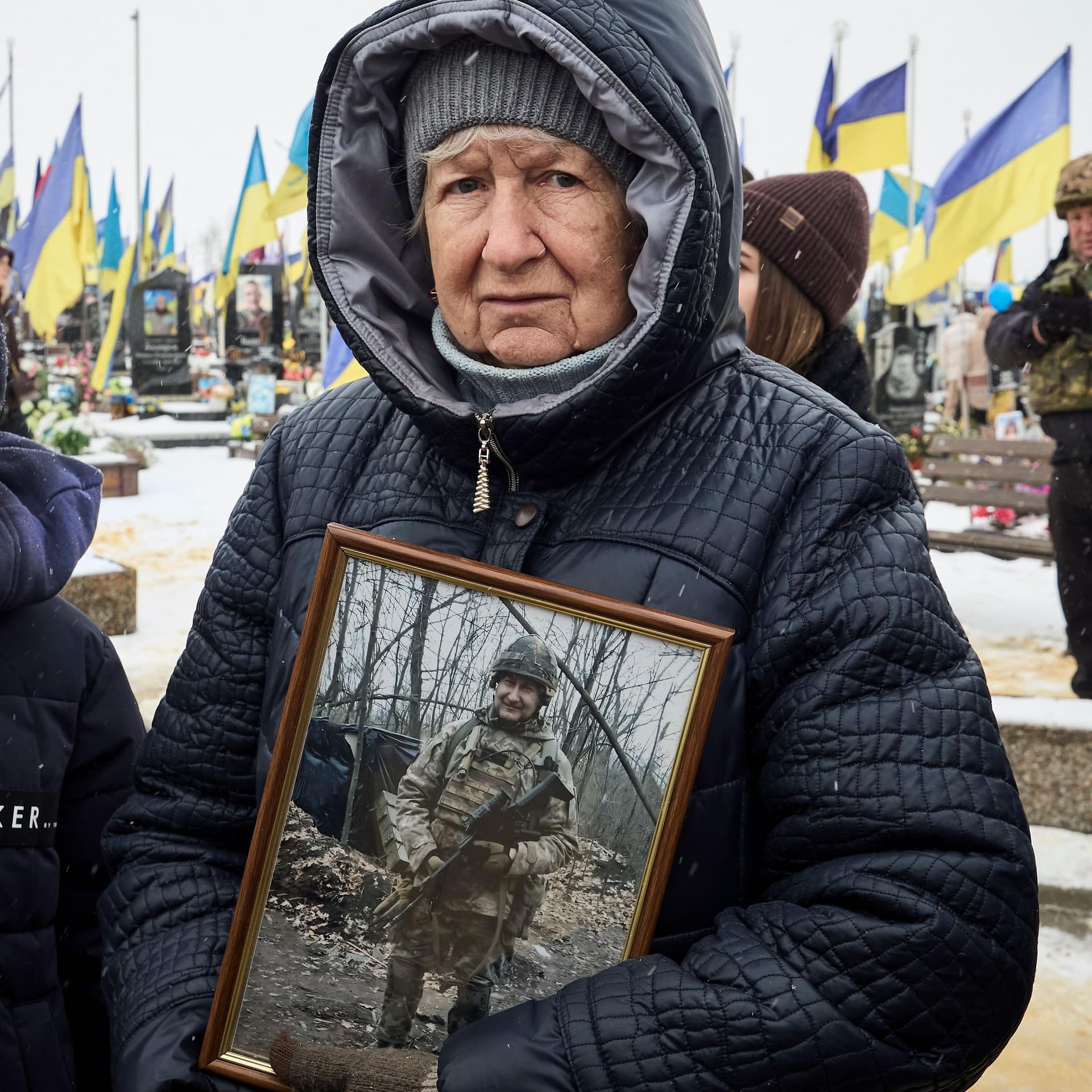
Photo: A Ukrainian woman attends a memorial ceremony for fallen servicemen at the Military Cemetery in Kharkiv. Credit: Sergey Kozlov/EPA/Shutterstock.