
In short
The episode examines the Feb 28 strike on an Iranian elementary school in Minab (southeastern Iran) during the opening hours of the US-Israel-Iran war, and whether it could be a war crime. BBC Verify’s Merlin Thomas uses open-source and satellite imagery to geolocate aftermath footage, verify the school’s proximity to a military base, and assess crater/scorch marks suggesting multiple strikes. Iranian officials claimed up to 168 killed (mostly children aged 7–12) but BBC Verify says the casualty numbers are hard to confirm; they matched a few names from a handwritten list to names on coffins. A key claim: Iranian state media footage shows a US Tomahawk missile detonating near the base, and experts say it implies a US operation and that the school area was likely hit earlier. US officials initially investigated and denied responsibility; later US media (CBS) reported a likely US error without intentional targeting.
Guest
Ona Hathaway, Yale international law professor and former DoD special counsel, discusses how targeting decisions and rules of engagement translate law into practice, when recklessness could support war-crimes theories, and how reduced civilian-harm mitigation staffing could increase risk. Notable examples include the Minab funeral, the crater imagery, and the Tomahawk footage.
Written by AI. May contain mistakes. Listen to the episode to check what was said.
Chapters
Tap a time to open that second in VOThe Attack on the School
1:00 to 2:46
Discussion of the missile strike on an elementary school in Iran.
“And asking you to decide if they're good, bad, or just another billionaire.”
Eyewitness and Verification Efforts
2:46 to 4:51
Exploration of how BBC Verify investigated the incident using open-source intelligence.
“And to get a better handle on everything we know so far, we reached out to Merlin Thomas, one of our colleagues at BBC Verify.”
Casualties and Confirmation Challenges
4:51 to 6:53
An examination of the challenges in confirming the death toll from the attack.
“And so we knew there was a school building, but this military base was right next to the school building.”
Analyzing Satellite Imagery
6:53 to 8:15
Details about the analysis of satellite images related to the strike.
“Well, there's that image, Merlin, of holes in the ground taken from above that many people will have seen.”
U.S. Military's Involvement and Denials
8:15 to 11:21
Discussion on the U.S. military's response and ongoing investigations regarding the strike.
“you can kind of look at old publicly available images of this area.”
Political Reactions and Miscommunications
11:21 to 14:00
Exploration of political responses to the strike, particularly from President Trump.
“So this was the first time we were able to kind of see any clue about what weapon was used, right?”
Initial Reactions to the Airstrike
14:00 to 16:38
The speaker shares their disbelief and investigation into the airstrike's legitimacy.
“I was like, even, I was like, I'm sure this isn't right.”
Understanding Military Targeting Decisions
16:40 to 19:33
A discussion on the military's process and legal considerations when selecting targets.
“Listen now or search for Good Bad Billionaire wherever you get your BBC podcasts.”
Accidental Strikes and War Crimes
19:33 to 21:48
Exploration of whether a mistaken strike could be classified as a war crime.
“The number of innocent civilians continues to rise.”
The Role of Engagement Rules in Military Decisions
21:48 to 24:25
An examination of how rules of engagement affect military actions and civilian safety.
“So a targeting error in and of itself is not a defense if not enough due care and attention has been taken.”
Show all 13 chapters
Consequences of Potential Wrongdoing
24:25 to 28:00
Discussion of possible repercussions for military actions deemed as war crimes.
“If you're writing rules of engagement in a way that is meant to reduce the care that you take in choosing targets and executing them, then you know that you are increasing the likelihood of civilian casualties.”
Discussion on War Crime Investigations
28:00 to 29:20
Learn about the current investigations into potential war crimes and U.S. military protocols.
“have shown a willingness to prosecute war criminals from other countries, because I think there would be a real, a substantial risk.”
Listener Engagement and Episode Announcements
29:20 to 29:59
Discover how listeners can engage with the show and future episode plans.
“We're in fact planning an episode later this week in which we'll be answering some of the questions.”
Transcript
Automatic transcript. May contain errors.0:00Oona Hathaway:This BBC podcast is supported by ads outside the UK.
0:30Oona Hathaway:business needs in one place, saving you time, headaches, and serious money. Stop paying for missing pieces. Go to odoo.com. That's O-D-O-O dot com to learn more.
1:00Oona Hathaway:And asking you to decide if they're good, bad, or just another billionaire. Good, bad, billionaire from the BBC World Service. Listen now or search for Good, Bad, Billionaire wherever you get your BBC podcasts.
1:17Oona Hathaway:A warning before we begin today's show. This episode contains some graphic descriptions of violence. On Saturday, February 28th, in the opening hours of the US-Israel war in Iran, A missile slammed into an elementary school in the city of Minab in southeastern Iran. Saturday is the start of the Iranian work week, meaning school was likely underway when the blast tore through the building. Iranian officials say up to 168 people were killed, most of them children between the ages of 7 and 12. While the U.S. president initially said he thought Iran did it, Last week, there were reports that U.S. military investigators believe American forces were likely responsible, but that they haven't reached a final conclusion.
2:09Oona Hathaway:From the BBC, I'm Tristan Redmond in Paris. And I'm Asma Khalid in Washington, D.C. And today on The Global Story, how did this strike on a school happen? And what questions does this raise about how the U.S. military is waging this war?
2:36Oona Hathaway:Coming up, we'll be speaking to an international law expert who's also advised the U.S. government in the past. First, though, we want to understand how this all happened. And to get a better handle on everything we know so far, we reached out to Merlin Thomas, one of our colleagues at BBC Verify. That's a special unit within the BBC that uses open-source intelligence and satellite imagery to verify video and fact-check information. We asked Merlin to wind back the clock to Saturday, February the 28th. Now, that was the first day of the war. It was the day Iran's supreme leader was killed. And it was also the day that that school in southern Iran was hit.
3:13Merlyn Thomas:The Iranian authorities said that the first strikes had been reported at about 10.45 a.m. So that's around an hour after U.S.-Israel began attacking Iran. And initially, reports had come out that there had been strikes on this school and that there had been damage on the school building. The first kind of videos we were seeing were aftermath footage. So you're seeing people rushing into the courtyard of the school. You can see dark smoke plumes pouring out of the school building. There are scenes of panic as families are kind of trying to figure out what's going on. All of this is footage circulating online.
3:50Merlyn Thomas:And that's where we're getting it from. We're able to verify it using location identifiers, walls, the coloured patterns on the side of the school building, all those kinds of particular details. That's how we geolocated exactly where that is. And that's basically just a fancy term for saying this is where something is. You know, this is how we know where it is and this is how we know it's new. We knew it was authentic. Initially, in the reports, we could see people kind of going through rubble and later, you know, more footage emerge published by state media. And this is when the footage gets more graphic.
4:25Merlyn Thomas:And we're looking at bodies of what appear to be children underneath kind of rubble. And you can see kind of we've seen severed arms. And I'm sorry for kind of going into the detail. But it's important, I think, to say, you know, we at BBC Verify are having to go through the footage of those dead bodies and things like that. Because we see that it is so crucial to verify that who has been killed by these strikes. And so we knew there was a school building, but this military base was right next to the school building. This is all part of the jigsaw puzzle of pieces that we were putting together as footage was emerging.
5:01Oona Hathaway:In those early moments, what was the claim and counterclaim about what had actually happened?
5:07Merlyn Thomas:Iran said that this was a strike by US and Israel. And at the time, the US and Israel had no kind of comment on it initially. and quickly after that there was no real denial or acceptance of responsibility from either side. Israel had said that they were not aware of any operations in the area, but Iran had maintained that this was a US-Israeli strike.
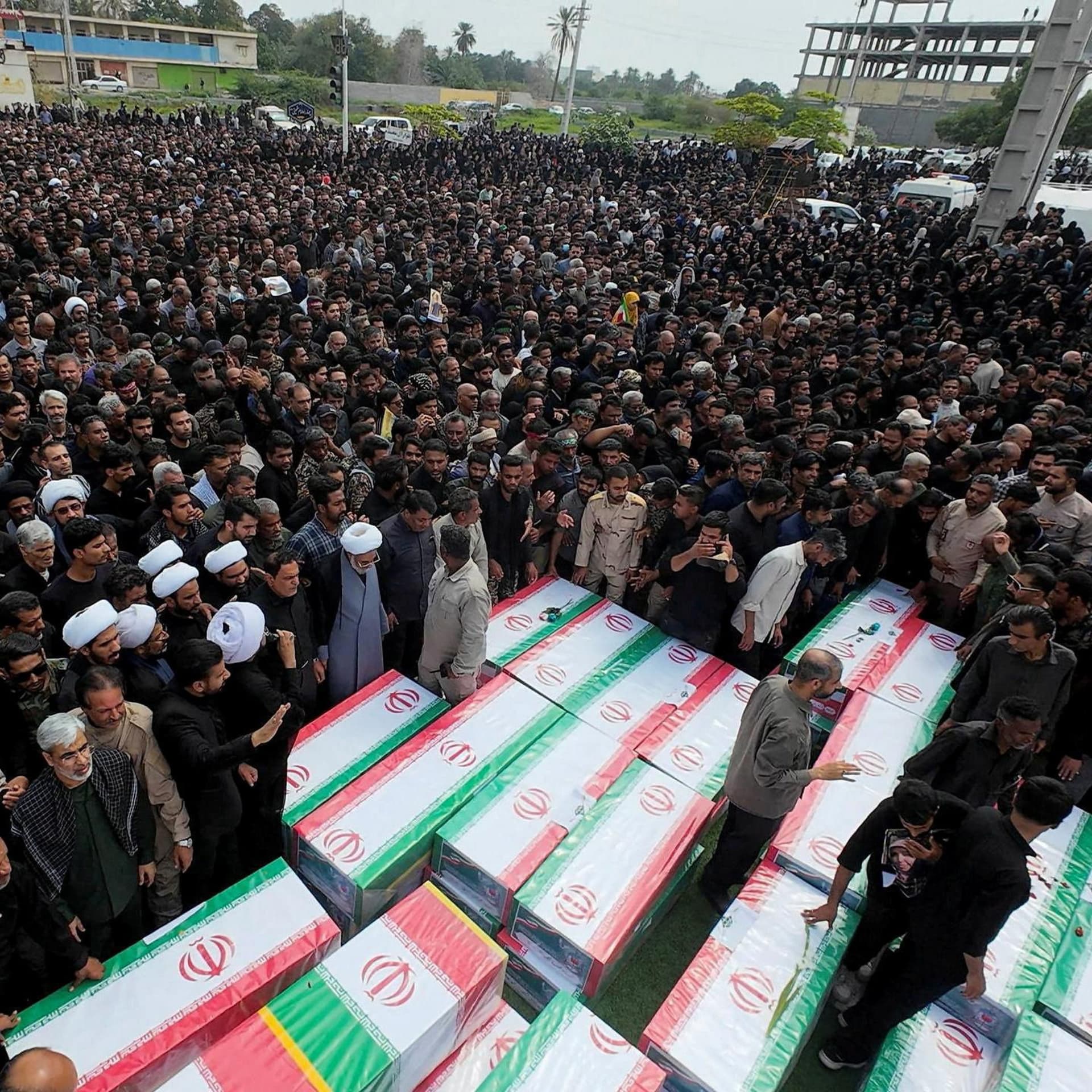
5:33Oona Hathaway:Okay, so on day four of the conflict, so that's Tuesday the 3rd of March, there are pictures of a mass funeral that's held in Minab. Iranian officials have said that there were up to 168 people killed, But how do you actually go about confirming those figures?
5:49Merlyn Thomas:It's really hard. It's really hard to confirm the numbers. And that is just kind of the long and short of it. I mean, Iranian authorities say that 168 people were killed. They say that 110 of them were children. Now, it's really hard to verify those numbers. There was a handwritten list published by Iranian media. So these are names with the dates of birth. Now, 48 of those names were aged between 6 and 11. Now, in terms of those names, there's not that much more we were able to do in terms of verification. But what also emerged when you talk about the kind of broadcast footage of the funeral, there were images of small coffins, adult sized coffins.
6:30Merlyn Thomas:And these coffins had people's faces on, children's faces on, children's names on sometimes. And we were able to match up three names from the list to three names that were on the outside of these coffins. So it's that kind of granular level of detail that we can go through, but it's still far away from the number of 168 people killed and 110 children. But it's worth saying that the education ministry says that the school itself had 264 pupils.
7:00Oona Hathaway:Well, there's that image, Merlin, of holes in the ground taken from above that many people will have seen. Were you able to verify that image and where did it come from?
7:12Merlyn Thomas:Well, this image was the real game changer for us when we were doing our investigation. So you can see scorch marks, you can see the type of impact point they are, you can see whether a crater is particularly down and how that feeds into whether or not what kind of missile may have been used or what kind of weapon may have caused that. And so when we showed that to experts, several experts said that this showed that there were signs of multiple strikes, that this area had been hit more than once. And the proximity of those targets showed that there was an intentionality to the targeting as well, that this had been likely done on purpose.
7:49Oona Hathaway:So when you're looking at the satellite imagery, what does it tell you about the actual area in this town that was attacked?
7:56Merlyn Thomas:So the school building kind of area itself is in the top right hand corner. And then the military base is just to the southwest of it. And it's almost like an L shape. The rest of the compound is the military base. Now, there's been intense speculation about whether or not the school building was part of it. on Google, satellite imagery, so this is available to anyone, you can kind of look at old publicly available images of this area. In 2013, it appears that it was part of the same compound.
8:27Oona Hathaway:The school and the military base were together as one.
8:31Merlyn Thomas:It appears so, yeah, in 2013. And then in 2016, we see that there is a clear wall separating the two, even in historical imagery that there was a wall of separation between the school and the military base.
8:45Oona Hathaway:On Wednesday, March 4th, our colleague Tom Bateman here in Washington, D.C., he asked the Defense Secretary of the United States, Pete Hegseth, about the school. Can you give us an update on what the administration knows, what you know now about the reported strike on a girls' school in southern Iran on Saturday?
9:05Merlyn Thomas:All I know, all I can say is that we're investigating that. We, of course, never target civilian targets, but we're taking a look at investigating that.
9:13Oona Hathaway:Red tie in front. Just on the basis that with the information you would have, your reconnaissance abilities, ability to gather information. I mean, it's several days on now. So is there any clarity on whose munition this was? We're investigating it. Thank you. And then a couple of days later, the president of the United States is on Air Force One. And he suggests that this all could have been carried out by Iran. Mr. President, did the United States bomb a girls' elementary school in southern Iran on the first day of the war in California? No, in my opinion, based on what I've seen, that was done by Iran.
9:50Oona Hathaway:Is that true, Mr. Hicks? It was Iran who did that? We're certainly investigating. Still investigating? But the only side that targets civilians is Iran. We think it was done by Iran. Because they're very inaccurate, as you know, with their munitions. They have no accuracy whatsoever. It was done by Iran. So at this point, the United States is not accepting any responsibility. We have heard the Pentagon say that they're going to conduct an investigation. And Merlin, I know you and your team at Verify are also investigating the story. So as it's all unfolding, what are you seeing? And do you begin to see any indications of who is responsible for these strikes?
10:33Merlyn Thomas:Well, a couple of days after the kind of game-changing satellite image that we were able to analyse, one really key piece of footage came out. This was published by the Iranian state media. It's one of the kind of affiliated semi-official news agency's mayor.
10:53Merlyn Thomas:Just to describe to you, this showed a missile just moments before detonating in what we were then able to verify was the military base. Now, this was crucial because, A, it gives you the chance to look at what kind of missile this was. And we were able to give this footage to munitions experts who were able to slow it down, zoom in, and identify that this was a U.S. Tomahawk missile. So this was the first time we were able to kind of see any clue about what weapon was used, right? So you see the missile coming in, and as the camera pans to the right, you can see that there's already smoke rising above the school building.
11:35Merlyn Thomas:Now, this might seem like an insignificant detail, but it's crucial because it shows that that school building was likely already hit before this missile comes in to hit the military base. And that's also likely why we think that someone was filming. because you might ask why is someone filming over this area at the very moment that a missile comes in to detonate, right? But it's because, I mean, it's kind of human instinct. If something's already happened, you kind of, you know, you then get your camera out to say, okay, is something going to happen next? I want to show the smoke plumes. I want to show something else.
12:11Merlyn Thomas:And at that very moment, that's when the footage shows the missile detonating and the kind of dark smoke plume rises above. This we showed to munitions experts, and obviously they identified the missile itself, but they also were able to say, actually, this shows that this operation, because of the fact that it's a U.S. weapon, a U.S. Tomahawk missile, a very identifiable weapon, it shows that it was likely a U.S. operation. That's what experts told us. The combination of satellite evidence showing the multiple strike points, as well as this footage showing the US Tomahawk missile hitting the military base, that, they said, points to the likelihood that this was a US operation.
12:55Merlyn Thomas:Now, just to be clear, this Tomahawk missile does not land on the school building. That's not what we see. But the experts we spoke to said that this shows that this was a likely kind of targeting of the area. And there's this moment, the day after, you know, this key piece of missile footage came out where reporters were asking President Trump why he was the only one blaming, continuing to blame Iran. And he claims that Iran has tomahawk missiles. Mr.
13:23Oona Hathaway:President, you just suggested that Iran somehow got its hands on a tomahawk and bombed its own elementary school on the first day of the war. But you're the only person in your government saying this. Even your defense secretary wouldn't say that when he was asked, standing over your shoulder on your plane on Saturday. Why are you the only person saying this? Because I just don't know enough about it. I think it's something that I was told is under investigation. But tomahawks are used by others, as you know. Numerous other nations have tomahawks. They buy them from us. But I will certainly, whatever the report shows, I'm willing to live with that report.
13:59Oona Hathaway:What was your reaction when you heard that?
14:01Merlyn Thomas:I mean, I was shocked. I was like, even, I was like, I'm sure this isn't right. I was like, I know this isn't. But I was like, you kind of have to, you kind of start doubting yourself. And so I got on the phone with munitions experts that I work with regularly, and I said, hey, listen to this. And they just kind of scoffed at me. They were like, listen, this is, it's just, that's not possible. Iran are not known to have Tomahawk missiles. I don't know what to tell you. I mean, maybe the president has intelligence that we don't have access to, but that's the only thing that could possibly be the reason.
14:30Oona Hathaway:So who are the countries there, to be clear, who have Tomahawk missiles?
14:34Merlyn Thomas:The countries known to have Tomahawk missiles are the UK, Japan, Australia, the Netherlands, and of course the US. That's it. Not Iran and also not Israel, you're saying?
14:45Oona Hathaway:Exactly. Now, despite what President Trump said, there have been news reports in American media outlets that contradict what he said. In fact, according to the BBC's partner CBS News, a preliminary assessment of the incident by American officials suggests that the U.S. was likely to have been responsible, but that it did not intentionally target the school and may have hit the site in error.
15:09Merlyn Thomas:What did you think when you heard that? When something goes wrong, there are a number of reasons why they may have gone wrong. Now, we can't verify that that is what happened. There are, you know, things like weapons malfunctions. Then there's targeting errors, which is what obviously CBS are reporting, which we can't verify, but those exist too. And then there's just outdated intelligence. Again, none of these are verifiable. I mean, when we went to the U.S. government to put our findings to them, when the experts said that this is a U.S. Tomahawk missile, They just said it would be completely inappropriate for us to comment on an ongoing investigation.
15:45My colleague Tom Bateman has asked when that will be delivered,
15:49Merlyn Thomas:and there's still no end in sight for that, so we don't have a date for when that's going to come. If the U.S. is found to be responsible, it would make it one of the worst single cases of civilian casualty by the U.S. in decades in the Middle East. But we're still waiting to see what happens from the investigation, and we'll see what happens.
16:37Oona Hathaway:Good, bad, or just another billionaire. Good Bad Billionaire from the BBC World Service. Listen now or search for Good Bad Billionaire wherever you get your BBC podcasts.
16:53Oona Hathaway:We want to understand more about how these decisions to strike targets are actually made by the US military in the first place. What sort of legal and moral calculations shape their decisions? So we called up Ona Hathaway, a professor of international law at Yale University, who previously worked as a special counsel to the general counsel at the Department of Defense during the Obama administration.
Read the full transcript
17:17Merlyn Thomas:So I was special counsel to the general counsel, which sounds like something of an oxymoron. But basically, it means I was brought in to help with international law and national security law issues that the Department of Defense face. So I was working directly with the general counsel, who's the head lawyer of the Department of Defense. And I worked on a range of special issues. I had top secret special compartmented information clearance and worked on a wide range of topics while I was there.
17:45Oona Hathaway:When the military are deciding on a target, what's the process that they go through to decide whether or not it's safe to hit that target?
17:55Merlyn Thomas:So it varies depending on the context. You know, if in some cases you have more time to assess and watch the area and to have a sense of pattern of activity, in other cases you don't have that amount of time. If there are questions, there is usually a JAG, a military lawyer who's available to answer questions and provide guidance. There's also what are called rules of engagement. So there's a set of rules that is reviewed, and that's something that I was occasionally involved in. And so it's a kind of translation of the law into kind of concrete rules for people on the ground. And so those are also critical to guiding U.S.
18:35Merlyn Thomas:forces when they're making decisions about targeting.
18:37Oona Hathaway:Is that likely to have been the process that the U.S. military used in selecting targets in Iran?
18:44Merlyn Thomas:Yes, but with a caveat. So there's reporting that U.S. military started using AI to help select targets. Oh. And yes, and that was certainly not true in 2014, 2015. Now, the military seems to have taken the position that they're still always a human in the loop, a human kind of making the final decision. But apparently they are using AI as part of the target selection process or identifying particular targets. So that is new. But exactly how AI is being used and where it's entering in and how humans are then reviewing the decisions that AI is offering up, we have not got clarity about that. That is not something on which there's public information as far as I have seen.
19:32Oona Hathaway:There are people who are saying that the strike on that school may have been a war crime, including the Iranian ambassador to the United Nations in Geneva.
19:42Merlyn Thomas:The number of innocent civilians continues to rise. This is not only an act of aggression. It is a war crime and a crime against humanity.
19:52Oona Hathaway:If that strike on the school were an accident, which is one theory about what it may have been, a targeting error, would it be a war crime in that case?
20:02Merlyn Thomas:So there's disagreement about this, but I believe so if it was reckless. So the question is... What does that mean? Yeah. So did they know or should they have known that there were civilians present? Were there obvious ways in which they could have better vetted the target that would have been best practices for vetting the target?
20:24Oona Hathaway:Yeah, that is a question that I think a lot of people are asking. You have the world's largest military that has a budget of, let's say, a trillion dollars, and you can see these images, in some cases, as our reporter pointed out, via Google. Yeah. How were they not able to see publicly available imagery, the world's best funded and largest military?
20:44Merlyn Thomas:No, I think that's exactly the question we should be asking. What was a process by which they selected and then verified these targets? I mean, from all the public reporting, we're seeing this transition of this building to a school happened years ago. Particularly, I'm concerned about how these targets were verified, given that something like a school is generally pretty easy to tell from satellite imagery because you have people coming and going at certain times a day. And so you don't have to watch that building for very long to know that you see little people going in and out of that school with people who look like parents.
21:21Merlyn Thomas:That's the kind of thing you can very easily see with satellite imagery. And so the fact that they claim not to have known that this was, in fact, a school, and I believe that they did not intentionally target a school. I have to believe that. Then I think there is a need for a war crimes investigation to determine whether, in fact, they were using information that was highly outdated and therefore that this was a reckless decision that gives rise to criminal liability, that it counts as willful killing of a civilian as a result.
21:55Oona Hathaway:So a targeting error in and of itself is not a defense if not enough due care and attention has been taken. Is that right?
22:04Merlyn Thomas:Yeah. I mean, that's my view. That's, I mean, what I should be clear about is that there is some difference of opinion among international lawyers on this question. The U.S. government doesn't take this view of the intent. So if they're conducting an investigation, it seems unlikely that they're going to view recklessness as enough to meet the intent standard. What is their standard? So they would say, if you didn't know what it was and you, therefore, you didn't intentionally target a girl's school, then there's no criminal liability. And generally speaking, when they find that it was unintentional in the sense that they didn't know that there were civilians there, or that it was a school, or that it was a medical facility, or the like.
22:45Merlyn Thomas:They don't hold anybody criminally responsible. They may nonetheless discipline them for not following proper procedures, but they wouldn't use criminal liability.
22:53Oona Hathaway:I want to follow up on that, Ona, because it's not a new problem. I mean, the U.S. military has had, unfortunately, a track record, at least in recent history, I will say, particularly in parts of the Middle East, under successive Republican and Democratic administrations of harming civilians, of killing civilians. And a couple of years ago, the Pentagon did create this new unit to try to address that. And we've seen now a number of American news outlets pointing out that there were cuts to that unit known as the Civilian Harm Mitigation and Response Initiative. Do we know if those cuts at the Department of Defense could have played any role in what happened in Iran?
23:32Merlyn Thomas:We don't know for sure, but it seems likely because it's the people whose job it was to think through how to protect civilians and we're putting systems in place to better and more effectively protect civilians who are being fired or moved. The office that was founded precisely to address this has lost 90 percent of its employees and JAGs are being fired. These military lawyers whose job it is to also ensure that you're taking all the steps necessary to properly vet a target. And we're getting the message from the top. You know, Pete Hegseth and President Trump have said, you know, they want to fight a lethal war.
24:14Merlyn Thomas:No, quote unquote, stupid rules of engagement. No stupid rules of engagement, no nation building quagmire, no democracy building exercise, no politically correct wars. We fight to win and we don't waste time or lives. If you're writing rules of engagement in a way that is meant to reduce the care that you take in choosing targets and executing them, then you know that you are increasing the likelihood of civilian casualties. And this is the inevitable result.
24:48Oona Hathaway:I have two questions here. One is, what do rules of engagement actually mean? And then secondly, can the Secretary of Defense unilaterally change those rules of engagement? Yeah, so rules of engagement are an effort to kind of translate these abstract principles of international law into a set of very specific, clear rules that military
25:15Merlyn Thomas:officers can carry out and that soldiers can carry out. So it'll say something like, you know, how many casualties are permissible for what level of target? You know, it'll say no casualties are permitted generally for a low level soldier. Or it will say, you know, they're just a long list of very specific guidance that's provided in every specific context of like what you can do. And so when you're making a decision, targeting decision, you're referring to these rules of engagement.
25:45Oona Hathaway:So when the defense secretary says no stupid rules of engagement, can he change them?
25:51Merlyn Thomas:Yeah, I mean, he can. Yeah, I mean, he could. You know, Pete Hegseth could come along and say, I think that we should up the level of tolerance for civilian casualties for different levels of targets. And the question is, how much pushback is he going to be getting from the lawyers? Because the military lawyers tend to be fairly cautious, at least when I was there. military lawyers believe in these rules. They believe that we want to protect civilians. They don't want to be responsible for civilian deaths. They want a strict interpretation of the rules. And certainly he's sending the clear message that he wants to be more permissive in favor of more risk tolerance.
26:29But when you do that, it means you're taking less precautions.
26:32Merlyn Thomas:It means that you are not vetting the targets as carefully. It means that you're willing to accept more known civilian casualties and harm to civilian objects when you're seeking to achieve a certain military objective. And that translates into more civilians dying on the ground.
26:50Oona Hathaway:If the investigation were to find wrongdoing here, what are the potential consequences? I mean, I'm thinking especially because the United States is famously not a signatory and a member of the International Criminal Court.
27:02Merlyn Thomas:Yeah. So the U.S. is not a party to the International criminal court, nor is Iran. What ordinarily would happen is an internal investigation and a court marshalling of any uniformed military officers who are responsible for criminal action and potential conviction through the court martial process. It's also the case that any state that is party to the Geneva Conventions, which is to say every state that is party to the UN is obligated to hold to account those who've committed war crimes. And so if it's known that U.S. service members have participated in actions that are war crimes, they could in theory be prosecuted in other countries, in the domestic courts of other countries.
27:48Merlyn Thomas:But it seems highly and likely just given the geopolitical context. If I was advising some of these folks, I would tell them not to travel to countries that have shown a willingness to prosecute war criminals from other countries, because I think there would be a real, a substantial risk.
28:18Oona Hathaway:Well, thank you for bringing your expertise to us.
28:22Merlyn Thomas:Ona, we really appreciate that.
28:23Oona Hathaway:Thank you so much, Ona.
28:24Merlyn Thomas:Thank you so much for having me and for casting a light on these really important issues.
28:31Oona Hathaway:Now, we did put the issues raised in this podcast to the Department of Defense, and they referred us to Pete Hegseth's comments on Friday to reporters. In a press conference, the U.S. Defense Secretary said the investigation will take as long as necessary and that the findings will be shared and also confirmed that U.S. Central Command, known as CENTCOM, has designated an investigating officer and said that person is from outside Central Command. He also said that the U.S. never targets civilians and that Iran does and that the U.S. has a very high-fidelity process when it comes to strikes.
29:11Oona Hathaway:That was Ona Hathaway, a professor of international law at Yale Law School, who's also previously advised the U.S. government. And a big thank you for all the questions you all have been submitting about the Middle East. We're in fact planning an episode later this week in which we'll be answering some of the questions. So keep the questions coming. We really, really like hearing from you all. You can email us at theglobalstory at bbc.com. And if you're also looking for the latest breaking news, then we recommend our sister show, The Global News Podcast. You can find it wherever you listen. Our show today was made by Sam Chantarasek and Arun Keller.
29:46Oona Hathaway:It was edited by James Shield and mixed by Travis Evans. Our studio manager was Mike Regard. Our senior news editor is Chyna Collins. And I'm Asma Khaled. And I'm Tristan Redman. Thanks as always for joining us. We'll talk to you again tomorrow. Cheerio.
30:30Oona Hathaway:Good Bad Billionaire
30:37Oona Hathaway:wherever you get your BBC podcasts.
From the publisher
WARNING: This episode contains some graphic descriptions of violence.
Since an air strike on a school in Iran two weeks ago, the Pentagon has faced mounting questions over the possible involvement of the US military. Iranian officials say the strike killed 168 people, including about 110 children.
US media have reported that military investigators believe American forces were likely responsible for hitting the school unintentionally – but that they have not reached a final conclusion.
Today, Merlyn Thomas from BBC Verify explains what we know so far about the strike. And we speak to Oona Hathaway, a professor of international law at Yale University who previously worked at the US Department of Defence, about the potential legal consequences.
Producers: Sam Chantarasak and Aron Keller
Executive producer: James Shield
Mix: Travis Evans
Studio manager: Mike Regaard
Senior news editor: China Collins
Photo: People attend the funeral of the victims following a reported strike on a school in Minab, Iran, March 3, 2026. Credit: Amirhossein Khorgooei/ISNA/WANA via Reuters.