In short
The episode asks “what if Russia wins?” and argues Europe may already be in a “hybrid war” with Russia, with NATO at risk of failing to respond decisively, especially under nuclear threat.
Guest backgrounds
Carlo Massala, professor of international politics at the University of the Bundeswehr in Munich; author of the best-selling book If Russia Wins.
Key claims
European intelligence expects Russia could be able to attack a NATO country by 2029; Russia uses hybrid tactics (cyber, sabotage, drones) to erode trust and provoke panic; NATO Article 5 may not be invoked if the attack is limited; NATO could “fall apart” if collective defense is not triggered.
Notable examples
Estonia’s 2007 banking shutdown; alleged cyber attacks on German municipalities; fires at defense-related companies in Europe; drone incursions affecting Denmark/Norway and Munich; Belarus-to-Poland drone incidents; a scenario of a Russian seizure of Narva (Estonia) and 17-minute MiG incursions.
Written by AI. May contain mistakes. Listen to the episode to check what was said.
Chapters
Tap a time to open that second in VOCurrent Context of Nuclear Threats
0:30 to 1:49
Discussion on recent nuclear weapon developments and escalating tensions.
“Last week, Donald Trump said that the US would resume testing nuclear weapons.”
The Scenario of Russia Winning
1:49 to 4:50
Interview with Carlo Massala on potential outcomes if Russia wins the war in Ukraine.
“And today on The Global Story, are Russia and the West already at war?”
European Leaders and Russian Buildup
4:50 to 6:17
Exploration of European leaders’ concerns about Russia's military buildup.
“What's happening in Europe, which has led us to a point where it seems like Europe might already be at war in some respects with Russia.”
Hybrid Warfare Tactics
6:17 to 7:58
Analysis of Russia's hybrid attacks on NATO countries over the years.
“Then this is based on Russian documents.”
Recent Hybrid Attacks and Tactics
7:58 to 12:21
Overview of recent hybrid attacks and changes in Russian strategy.
“I mean, the most famous phenomenon, I think 2007, when allegedly the Russians shut down the whole banking system in Estonia.”
The Nature of Warfare in Europe
12:21 to 14:00
Discussion on the distinction between kinetic and hybrid warfare in Europe.
“They don't care about this, you know, leaving the country safely.”
The Landscape of War in Europe
14:00 to 14:51
Explore the current state of warfare in Europe and its implications.
“People were asking, is there more to come?”
Introduction to Carlo's Provocative Book
14:51 to 15:15
Learn about the themes in Carlo's book regarding Russia's future actions.
“And you can now watch the global story on the iHeart app.”
Imagining a Post-War Russia
15:15 to 16:20
Discuss a hypothetical scenario where Russia secures a victory.
“It's against that backdrop of hybrid warfare that Carlo wrote his book.”
The Potential for Conflict in Estonia
16:20 to 18:35
Analyze the implications of a Russian invasion of Estonia.
“And then a younger handpicked successor takes over the Kremlin.”
Show all 18 chapters
The Nuclear Dimension of Conflict
18:35 to 19:26
Examine the risks of nuclear escalation in the event of war.
“And this is the classical narrative of the oppression of Russian minorities living abroad.”
Understanding NATO's Article 5
19:26 to 20:02
Get clarity on the critical defense agreement within NATO.
“they might react in a nuclear way, of course, is frightening.”
NATO's Divisions and Responses
20:02 to 20:38
Explore the differing opinions on how NATO should respond to threats.
“And in my scenario, basically, you have this kind of NATO debates and you have, I would say, three camps of NATO countries.”
Russian Provocations and NATO's Reaction
20:38 to 22:23
Discuss a recent incident involving Russian aircraft and NATO's response.
“So in my scenario, US and France, because I assumed that there will be a new president in France, which is a right winger.”
Assessing U.S. Commitment to NATO
22:23 to 23:06
Evaluate the changing dynamics of U.S. commitment to NATO.
“that maybe, you know, because these were young pilots, they basically missed the international airspace and were in the national airspace, but didn't have any hostile intentions.”
The Future of NATO and Potential Disintegration
23:06 to 24:46
Contemplate the consequences of NATO inaction on its future.
“So, for example, earlier this year, there was a NATO summit where it was thought that maybe he could even withdraw the United States from NATO altogether.”
Preparing for Future Threats
24:46 to 26:17
Discuss the necessity for military readiness and strong messaging to Russia.
“It's the promise that basically everyone comes to your defense.”
Closing Thoughts on the Scenario
26:17 to 26:46
Conclude with reflections on the importance of preparedness against potential threats.
“And I wrote the scenario in order to raise the awareness of what might happen so that we have a chance to prepare ourselves in such a way that it won't happen.”
Transcript
Automatic transcript. May contain errors.0:00This BBC podcast is supported by ads outside the UK.
0:30Just tap into iHeart to start watching. And we hope you enjoy the show.
0:37Last week, Donald Trump said that the US would resume testing nuclear weapons. We don't know exactly what he means yet, but if it's detonating nuclear warheads, these would be the first US nuclear tests since 1992. Also last week, Vladimir Putin announced that Russia had successfully tested two new so-called superweapons. One of them is a nuclear-powered underwater drone that's designed to create a tsunami that could overwhelm a city. All of a sudden, nuclear weapons are on our minds, more than they used to be. Lots of military analysts seem to think we're in a dangerous moment. Some of them say that the NATO alliance is already in a kind of war with Russia, and that Russia is planning a major escalation in that war and it could happen soon.
1:33Russia says it, quote, poses no threat to NATO member states. Today on the show, we'll be talking to a writer who's been thinking a lot about this and who's warning that despite its denials, Russia has the upper hand. From the BBC, I'm Tristan Redmond in London. And today on The Global Story, are Russia and the West already at war? And could NATO be finished unless it toughens up?
2:10At moments of great uncertainty, you'll often see books or films that lay out catastrophic scenarios. What could happen if it all falls apart? Tony! Tony! Tony! In the 1960s, the BBC commissioned a film called The War Game about a fictional nuclear attack on Britain. 9.16am. A single megaton nuclear missile airbursts. The film won an Oscar, but the BBC pulled its transmission because it was, quote, too horrifying for the medium of broadcast. Now then, Dimitri, you know how we've always talked about the possibility of something going wrong with the bomb. Around the same time in the United States, the film Dr.
3:02Strangelove imagined what might happen if a US Air Force commander went rogue. One of our base commanders, he had a sort of, well, he went a little funny in the head. I always thought just being ready is the point. No one starts a nuclear war. The other day I saw a new film called A House of Dynamite and it made me feel pretty anxious. It's a fictional scenario about what might happen if the United States came under a nuclear attack. If we do not take steps to neutralize our enemies now, we will lose our window to do so. Today on the show, we're talking with a man who's written a best-selling book with a scenario of his own.
3:52Ah! Morning. Hello. Good morning. How are you doing? I'm fine. Where are you? I'm right now in Munich in my institute. Carlo Massala is a professor of international politics at the University of the Bundeswehr in Munich, and his book is called If Russia Wins. He imagines that Russia wins the war in Ukraine and goes on to launch an attack on NATO. He says that the tensions between Russia and the West right now have created a precarious moment. We are right now in the most dangerous period since the end of the Second World War. I would consider it as even more dangerous than the Cuban Missile Crisis.
4:32I think that people want to know what might happen. It's a scary time. We want to walk through in this episode your scenario and how you think things could pan out. But first of all, we want to go back a little bit and understand the situation that led to that moment. What's happening in Europe, which has led us to a point where it seems like Europe might already be at war in some respects with Russia. That's what many analysts and strategists believe, that there is a kind of soft war of some sorts happening in Europe. And we want to understand how we got to this point. So when would you say that European leaders began to suspect that something was up between Russia and NATO countries?
5:23Well, I think this started three quarters of a year ago, when basically most of the intelligence services of the European countries came up with their assessment that Russia is in a buildup of its armed forces for the day after. And that by 2029, they might have the capabilities if it's politically wanted to attack a NATO country. So that was the start of also my thinking about the scenario. Could you give us some examples of what that Russian buildup looks like? Yeah. Putin signed some kind of law almost a year ago, where basically he stated that the strength of the future Russian army should be 1.5 million men.
6:11And this is 300 ,000 men more than they had in 2022 when they invaded Ukraine. Then this is based on Russian documents. Russia is producing roughly around 600 ballistic missiles and cruise missiles a year, which we don't see being used in Ukraine. And then you have the number of tanks. This varies between 300 and 500 per year. Put in stocks, the intelligence services came out and said, listen, I mean, they're going to build up an armed force, which at the end of the day is stronger than the one who went into Ukraine in 2022. But then, of course, you have the question of do they have the intention?
6:53And interestingly enough, the German outgoing chief of the external intelligence service, he left his position three, four months ago. In two of his last interviews said there are circles in Moscow who do not believe any longer in Article 5 of NATO and would like to test it. So we have the material capability and we have potentially intentions to at least test NATO in the future. So you're saying that European leaders, really the alarm bells began to ring just under a year ago. But I've been covering as a journalist what leaders in Europe call a quote unquote hybrid war, which is non-classical attacks against parts of Europe, they say, by Russian forces, acts of what they say are sabotage or cyber attacks.
7:49And it feels like these started longer ago than three quarters of a year ago. Could you just tell us the story of Russia's so-called hybrid attacks on NATO countries going back a few years? Take, for instance, cyber. I mean, the most famous phenomenon, I think 2007, when allegedly the Russians shut down the whole banking system in Estonia. So there was a weekend where basically the Estonians were not able to take out any money out of cash machines and so on and so forth. So it took almost a year to find out the IP address of the computer who basically started the attack was an IP address in the US.
8:32Was the computer in the US taken over? Was it a Russian asset in the US who basically started the attack? Where do you have the 100 % proof that this was ordered by the government and not done by a hacking group or some 17-year-old nerd who sits in the cellar with his pizza and his soft drinks and just want to shut down the Estonian banking system? It's difficult to retaliate. You can't retaliate with military means because by international law, this is not equivalent to an armed attack. So this is what hybrid warfare is. It's very attractive for countries because they can achieve certain things without having to face the consequences.
9:18I mean, I take out one event here in Germany. So, recently there had been major cyber attacks in the east of Germany against the IT infrastructure of municipalities. What you're saying is they're attacking local government, essentially. Exactly. They're attacking local government. Yeah, allegedly. So one can now question, why do they attack municipalities? I mean, what's the point? You know, if you attack the German Bundestag, you might get out some spicy emails you can afterwards use to blackmail people. And this is a classical form of espionage. Why are local municipalities attacked? The reason is because ordinary people like you and me won't be able to do things they are used to do.
10:06I mean, you don't get the birth certificate for your child. You can't register your new car, all these things. And people get angry. And the hope is that in the next communal elections, they're going to vote for more radical forces. Mm-hmm. The overall strategy is to basically erode the trust of the people in their own governments. What you're describing, though, is an alleged campaign which has escalated in recent times. Yeah. Could you explain to us how this campaign has intensified over the last couple of years, please? Yeah, of course. I mean, we had this a year ago, something like that, where a lot of companies which in one or the other way are related to defense industry went up in flames all over Europe.
10:59This, of course, specifically was done to prevent Western societies to deliver weapons to Ukraine. When you say went up in flames, Carlo, do you mean there were actually fires in manufacturing plants? Yeah. And one company went up in flames in Berlin. We still don't know why. There were certain companies in Poland, which basically went up in flames, and the shopping center, which went up in flames. And who believes that these are actual targeted attacks? Is this what intelligence agencies are saying? These are all, you know, suspicions by intelligence services that these things somehow are connected to Russian activities in Europe.
11:38The intelligence services are also saying that Russia changed its strategy because previously the Russians used their own, let's say, agents to perpetrate this kind of attacks. And now, since a lot of Russian intelligence service members have been expelled from European countries, the Russians are using the term is throwaway agents. So they're recruiting people through the dark web, telegram, to perpetrate some kind of attacks. While in a classical way, you have to protect your agent. So you make sure that he basically will achieve his goal, but then he can leave the country safely. They don't care about this, you know, leaving the country safely.
12:24So if you get caught, then you get caught. This is why they are called throwaway agents. Well, it feels like these kind of hybrid, so-called hybrid acts have really ramped up over the last couple of months. Could you tell us the story of what's happened with these drone flights, please? You have to say that not every drone which has been spotted near an airport or a military facility or some other facilities is connected to Russia. But in the past weeks, months, the Russians stepped up the drone game.
13:03Denmark says the drone incursions that forced the country to close its airports this week are a coordinated hybrid attack. This we have seen in Denmark. Vladimir Putin's spokesman denies any Russian involvement in the airport closures in Denmark and Norway. This we have seen in Munich. Unexplained drone sightings in German airspace have prompted Munich Airport to close. Now it's balloons which are crossing the border from Belarus to Lithuania. Lithuania has announced a temporary closure of its border crossings with Belarus. Russian drones were shot down in Polish airspace overnight. And then we had the big incidence of 19 drones coming from Belarus into the Polish airspace.
13:52The more drones you have and the more, let's say, helpless you see your national and local authorities, the more you create some kind of panic in the population. People were asking, is there more to come? What is the police doing? This created this kind of, you know, uncertainty, anxiety. And this is exactly what they're aiming for. Is Europe already at war with Russia? Is NATO already at war with Russia? Or is it too much to say that? There are two wars which are currently in Europe. The one is a kinetic war by Russia against Ukraine, and the other one is a hybrid war against our societies. Now, I would put it the other way around.
14:33Russia is already at war with Europe, and they know.
14:50dive deep every weekday on one big story at the intersection of where the world and America meet. And you can now watch the global story on the iHeart app. Catch every brand new episode every weekday. Just tap into iHeart to start watching. And we hope you enjoy the show.
15:15It's against that backdrop of hybrid warfare that Carlo wrote his book. It's not a prediction, but a provocation. Designed to start a conversation about what Russia could do next and whether the United States would really come to Europe's defense. So I don't say this will happen. I say this might happen. The scenario in Carlo's book begins in March 2028. Ukraine has got to a point where it realizes it can't fight any longer and it signs over a bunch of its territory to Russia. The war ends with a treaty, which is signed in Geneva. And basically, Russia gets all the territory it is occupying right now, which is perceived in Russia as a victory.
16:04What happens next is that basically, I wanted to have some kind of surprise element. Suddenly, Vladimir Putin resigns from office. Putin resigns. I mean, he resigns because he won the war. Mission accomplished. And then a younger handpicked successor takes over the Kremlin. A young, smart guy coming from the finance sector who is very adamant on the fact that he does not negotiate about Ukraine, but he wants to restore normal relations to the West. So he makes some kind of charm offensive. And European countries as well, the US, are torn in between whether this guy is Putin but just better looking or if he really represents a new approach in Russian foreign policy.
16:54And thereby, all of our efforts are slowed down in counterbalancing the Russian military threat, which basically leads to the point where we are not prepared if the Russians do something. But this guy actually is a Putin 2.0 but just nicer. He decides to partly invade Estonia, a small country on Russia's western border. But Estonia is also a NATO member. And this new Russian president spots an opportunity to test the alliance. In real life, Russia has always said it has no such plans, that this sort of thing is fear-mongering. But if Vladimir Putin is anything, he's unpredictable. You know, this book was written against the backdrop of, you know, the Russian army could be ready to attack a NATO country.
17:45And then a lot of people were saying, I mean, look at Ukraine. You know, how can they even attack a country like Poland entirely? And NATO is so strong. And my point was, maybe it's not about a large scale war. Maybe it's just about a political test to test whether NATO is determined to invoke Article 5 or not. I mean, I was looking for what Churchill called the soft underbelly of NATO. And I choose a city in Estonia, which is close to the Russian border, Narva it's called, where you have large parts of its citizens are speaking Russian and some have a Russian passport. So Russia decides to take this city in one night and then convey the message to the US and other NATO countries to say, listen, it's just about the city.
18:30It's just about Narva because we have to protect our minorities abroad. Because even Russia needs a narrative to do something. And this is the classical narrative of the oppression of Russian minorities living abroad. So the Russians make very clear it's just about the city. And do you really want to have this major war against us for the liberation of the city? Because we are willing to defend the city by all means necessary, which basically means also nuclear weapons. Do you mean that there is a threat from the Russian side that it could go nuclear? Yes, absolutely. In your scenario? Yeah. I mean, if you start a war against Russia, based on Article 5, of course, there is always the nuclear dimension because Russia is a nuclear power.
19:11And Russia knows exactly, and this we've seen in the past three and a half years, almost four years, that when Russia starts with its nuclear saber rattling, most of the European governments are going to be scared to death. Because this idea that if we do something, they might react in a nuclear way, of course, is frightening. NATO's Article 5 is kind of central to many things at the moment, many discussions. Can you explain to us exactly what NATO Article 5 is? NATO Article 5 states basically that an armed attack against one NATO member is considered as an armed attack against all NATO members.
19:51And all NATO members actually will come to the defense of the member who's going to be attacked. This is Article 5. This is the bad rock of NATO. Yeah? And in my scenario, basically, you have this kind of NATO debates and you have, I would say, three camps of NATO countries. Those who want immediately to fight the Russians to liberate the city. Who are those countries? These are the countries close to Moscow. The Baltics, the Nordics, and Poland. Then you have those countries who basically would like to see whether you can negotiate with Russia, a lot of old Western European countries. And then you have those countries who don't want to take the risk fighting the Russians and risking a nuclear confrontation.
20:33Who are those countries? Well, in my scenario, basically, this was written during the US election campaign. So in my scenario, US and France, because I assumed that there will be a new president in France, which is a right winger. So and they are strongly against risking any confrontation with Russia for the liberation of the city. They don't want to risk it. So at the end of the day, NATO doesn't invoke Article 5. Okay. So your scenario suggests that there are divisions built into NATO that would prevent it from acting decisively. Yeah, absolutely. And this you see partly also today. As more breaking news we're following, three Russian fighter jets have just entered into Estonia's airspace without permission.
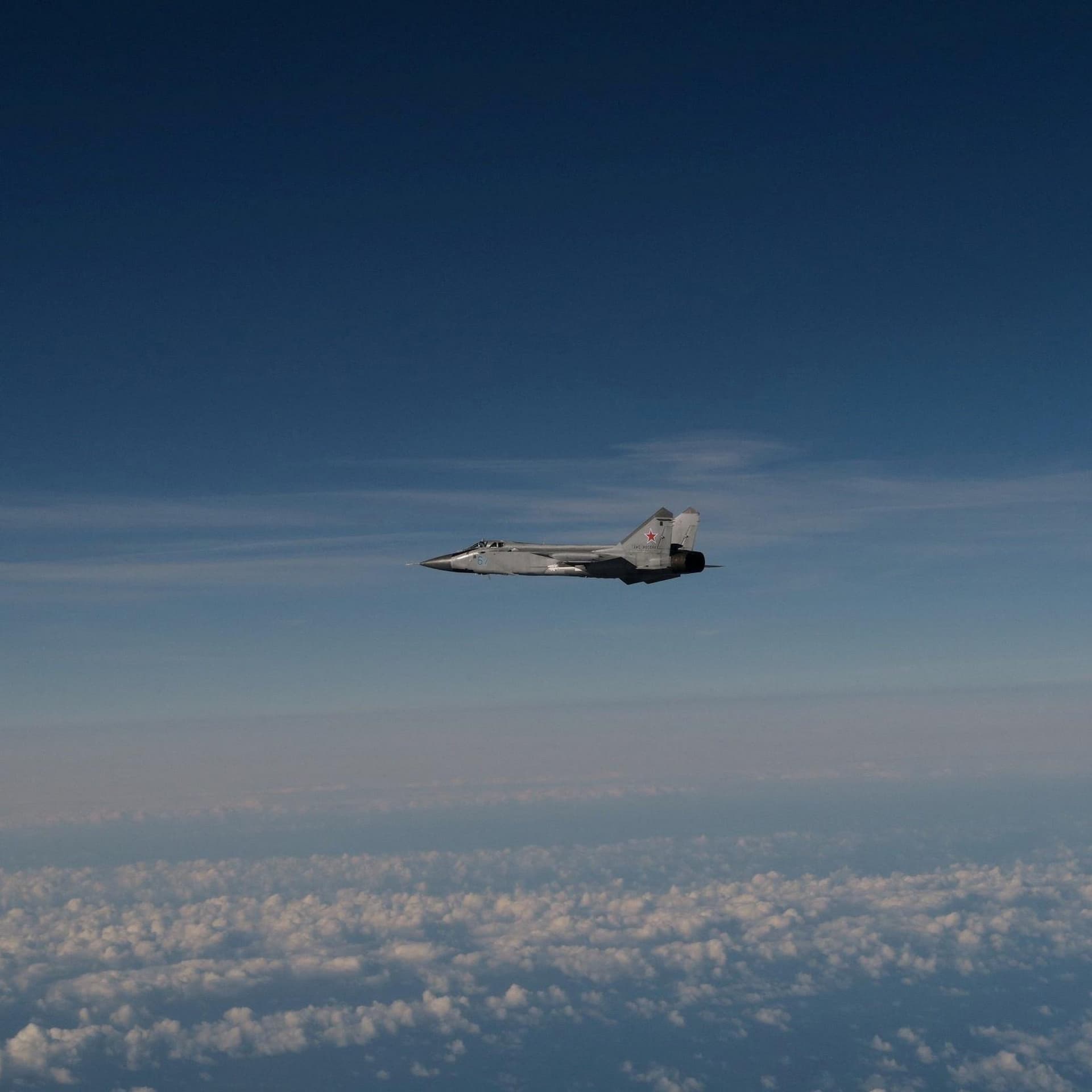
21:21I mean, I just give you the example of the violation of Estonian airspace by Russian fighter pilots. The European Union has condemned Friday's violation of Estonian airspace by three Russian fighter jets. What actually happened that day? Could you just explain to us exactly what happened? I mean, three MiG-30 Russian fighter jets basically went from the international airspace into the Estonian airspace for 17 minutes. NATO fighter jets tracked three Russian MiG-31 supersonic fighters, but the NATO jets did not engage them, and Russia denies its fighters were involved. But the question is now, was this an intentional provocation or really did they deviate from their route?
22:09Firing on a manned Russian jet would be a major escalation. risking a full-blown conflict between Russia and NATO allies, including the U.S. And there were countries in NATO who wanted to make the point just to play the whole thing down that maybe, you know, because these were young pilots, they basically missed the international airspace and were in the national airspace, but didn't have any hostile intentions. And of course, other countries were very adamant to say, listen, three fighter jets for 17 minutes, this is a deliberate action. This is not something which, you know, happens by mistake.
22:44And you see there the division, because the question is, how do you react to that? Okay, so you're describing the United States and France on one side of the division in your scenario. So the two countries that in your prediction would be least likely to want to go to war with Russia over a city in Estonia. Yeah. Since you wrote the book, it feels like there may have been some evolution in Donald Trump's stance towards NATO. So, for example, earlier this year, there was a NATO summit where it was thought that maybe he could even withdraw the United States from NATO altogether. That didn't happen.
23:25How have you seen Donald Trump's stance towards NATO evolve since you wrote the book? I think you have to distinguish, you know, if the Russians were about to attack Poland with six tank divisions, I have no doubt that NATO would invoke Article 5. Because this is the classical state-to-state war. But if there is only a limited incursion, a limited test, I have doubts that the U.S. would basically come to the defense of Europe. We've seen the first draft of the national defense strategy, the first draft. It's not the final one, which states that the two major tasks of the U.S. forces in the future are Homeland Defense and the Western Hemisphere.
24:09Europe is not even mentioned in this first draft. Just so I understand the end of your scenario, Carlo, in a moment when Article 5 is not invoked, so when there is sufficient divisions that there can be no agreement inside NATO for the alliance to come together to defend one member against an attack. Is that for you the moment that the NATO alliance actually disintegrates? Yeah, if this happens, NATO is dead. Because what is NATO for? It's for the collective defense of its member states. And if you don't basically act, if one of your member states is attacked, and even if it's a small part of its territory, then what's the purpose of being in NATO for European countries?
25:00It's the promise that basically everyone comes to your defense. And the moment in such a scenario that Article 5 is not in vogue, NATO falls apart. And for Russia, the end of NATO is the precondition to dominate the European landmass politically and economically. Well, what might happen to prevent this scenario from taking place in your view? I mean, we all need the necessary military capabilities because we have incredible shortages when it comes to Russian capabilities. We need the military capabilities to defend ourselves. Secondly, but this is more important than the material capability. It's the signaling, the constant and strong message to Moscow that in case these things happen, we're going to act and we're going to defend NATO members.
25:53Now, you have to make clear that if he does something, you are ready to strike back. Are you counting the United States in that equation or are you talking about European countries on their own? The point is, we need to do whatever is possible to keep the U.S. engaged in Europe. But we need to prepare at the same time for a situation where the U.S. won't be there if it's needed.
26:23Scenarios are not prognosis. And I wrote the scenario in order to raise the awareness of what might happen so that we have a chance to prepare ourselves in such a way that it won't happen. This might happen and we still have time to prevent it from happening. It's been an absolute pleasure talking with you. Thank you so much, Carlo. Thanks for having me.
26:51That was Carlo Masala, author of If Russia Wins and professor of international politics at the University of the Bundeswehr in Munich. That's it for today's episode of The Global Story. It was produced by Viv Jones, Aaron Keller, Zandra Ellen and James Shield and mixed by Travis Evans. Our senior news editor is China Collins and I'm Tristan Redman. If you're enjoying the show, please rate us wherever you're listening. It helps others to find us. Thanks for listening, folks. We'll be back tomorrow. Cheerio.
27:43Hi there, I'm Asma Khalid. And I'm Tristan Redmond, and together we're the hosts of the Global Story podcast from the BBC. For those of you who might be new to our show, we here at the Global Story dive deep every weekday on one big story at the intersection of where the world and America meet. And you can now watch the Global Story on the iHeart app. Catch every brand new episode every weekday. Just tap into iHeart to start watching. And we hope you enjoy the show.
Read the full transcript
28:15Thank you.
From the publisher
Discussion of nuclear weapons has returned both to our news cycle and to the cultural conversation.
Last week, President Donald Trump said that the US would resume testing nuclear weapons. Meanwhile, several recent films and books imagine a near future scenario where a nuclear attack is threatened or carried out.
Tristan talks to Carlo Masala, professor of international relations at the Bundeswehr University Munich and author of If Russia Wins. His book imagines a scenario where Russia attacks a Nato country to see whether the alliance will respond, risking a nuclear confrontation. Masala believes Russia is already engaged in ‘hybrid warfare’ with Europe, and he wrote his book as a warning to the west.
Producers: Viv Jones, Aron Keller, Xandra Ellin and Valerio Esposito
Executive producer: James Shield
Mix: Travis Evans
Senior news editor: China Collins
Image: A photo published by Swedish armed forces that it says shows a Russian mig-31 fighter jet that took part in the violation of Estonian airspace. Swedish Armed Forces/ Reuters.
Credits:
The War Game (1965) / Dir: Peter Watkins / BBC
Dr Strangelove (1964) / Dir: Stanley Kubrick / Columbia Pictures
A House of Dynamite (2025) / Dir: Kathryn Bigelow / Netflix