
In short
Sudan’s war (since 2023) and why it continues, rooted in earlier Darfur violence; it’s described as a civil war/proxy war with foreign backing, driven by power and resources, and producing mass atrocities and humanitarian collapse.
Guests
Barbara Platt-Usher, BBC Africa correspondent based in Nairobi; previously reported on Sudan and Darfur. Nawal Al-Maghafi, BBC senior investigations correspondent (field reporting from Khartoum).
Key claims
Darfur’s Janjaweed were regularized under Omar al-Bashir (including Hemeti/Mohammed Hamdan Dagalo) into a professional paramilitary force; RSF tactics resemble the earlier “playbook” (mass killings, rape, looting). The current conflict is largely power struggle between General Burhan (army establishment) and Hemeti (RSF), with gold and other resources plus outside support (UAE accused of backing RSF; other states backing the army).
Notable examples
RSF capture of Khartoum (April 2023) and alleged prison/atrocities; army reclaiming Khartoum (March 2025). Khartoum destruction and children’s rebuilding efforts (e.g., Zahir, 12, injured by a drone; Ahmed cleaning a funfair, finding human remains). RSF seizure of Al-Fashir (late October 2024) amid siege, starvation, and alleged executions; satellite imagery from Yale.
Written by AI. May contain mistakes. Listen to the episode to check what was said.
Chapters
Tap a time to open that second in VOThe Context of Sudan's Civil War
0:44 to 2:18
Overview of the humanitarian crisis in Sudan and the complexities behind the ongoing war.
“Standing by his side when he was arrested was Nigel Farage.”
Introduction to Barbara Platt-Usher
2:18 to 2:45
Introduction of Barbara Platt-Usher, BBC Africa correspondent, and her focus on Sudan.
“And today on the show, what is Sudan's war really about?”
Historical Background: The Darfur Conflict
2:45 to 4:21
Discussion of the Darfur conflict and its roots in Sudan's current civil war.
“But Sudan has taken up quite a lot of my reporting time in the past two years.”
Omar al-Bashir's Role and Rise of the RSF
4:21 to 5:38
Examination of Omar al-Bashir's regime and the evolution of the RSF from militias to a powerful force.
“He was both the political leader and the military leader of Sudan for decades.”
The Legacy of Violence in Sudan
5:38 to 6:36
How historical violence in Sudan influences the tactics of the RSF today.
“because you had this separate entity from the Sudanese army.”
Sudan's Uprising and Al-Bashir's Overthrow
6:36 to 8:28
Details of the protests against al-Bashir, leading to his ousting in 2019.
“It says that it sometimes looks into individual violations.”
Power Struggles: Burhan vs. Hameti
8:28 to 11:40
Analysis of the power struggle between General Burhan and Hameti in the Sudanese army.
“Hameti, who we heard about earlier, and Abdel Fatsah al-Burhan, who was and still is the leader of the Sudanese army.”
Humanitarian Crisis in Sudan
11:40 to 13:00
Impact of the ongoing conflict on the Sudanese population and humanitarian conditions.
“Barba, you've had these two forces, the RSF and the Sudanese army, fighting now for two years.”
The RSF's Control and Its Consequences
13:00 to 14:00
Discussion on the RSF's control of Khartoum and the consequences for civilians and journalists.
“but just tearing apart the fabric of the country.”
The RSF's Control and Impact on Khartoum
14:00 to 21:00
Learn about the RSF's takeover of Khartoum and its devastating effects on civilians.
“Soon after the war started, in April of 2023, the RSF captured Khartoum, the capital of Sudan, and it maintained control over the city for almost two years.”
Show all 12 chapters
Children's Resilience Amid War
21:00 to 28:00
Explore the stories of children like Zahir and Ahmed who are affected by the war.
“And in October of this year, they seized control of Al-Fashr, a major city in the Darfur region.”
Introduction to Sudan's War
28:00 to 28:30
Explore the complex background and key players in Sudan's ongoing conflict.
Transcript
Automatic transcript. May contain errors.0:00This BBC podcast is supported by ads outside the UK.
0:30No bouncing between tabs. And best of all, no spreadsheets. Stop managing software and start managing your business with one unified system. Try for free today at odoo.com. That's O-D-O-O dot com. In 2016, a 22-year-old known as Posh George was jailed in the U.S. for wire fraud. Standing by his side when he was arrested was Nigel Farage. Join me, Gabriel Pogan, from The Sunday Times for a wild ride through the worlds of politics, crypto, and crime. It's in our new podcast series, Pos George, the criminal behind Farage. Search for Pos George The Times wherever you get your podcasts.
1:15More than two years ago, a civil war broke out in Sudan. Since then, the United Nations reports over 150 ,000 people have been killed, and about 12 million have been forced from their homes. Sudanese people have been massacred and starved in what the UN describes as the world's largest humanitarian crisis. And before we go any further, I just want to let you all know that this episode contains some distressing details of killings, sexual violence, and the experience of children. After more than two years of fighting, the reasons for this war are still not clear. It's often described as a civil war, but it's also a proxy war where foreign countries are supplying the weapons.
2:00On Wednesday, President Trump posted a message on social media saying that he'll work with other countries in the region to bring these atrocities to an end. But questions remain about why the international community hasn't already done more to try and stop the deadly violence. From the BBC, this is The Global Story. I'm Asma Khalid in Washington, D.C. And today on the show, what is Sudan's war really about?
2:37My name is Barbara Platt-Usher. I am a BBC Africa correspondent based in Nairobi, and so I am supposed to keep an eye on East Africa. But Sudan has taken up quite a lot of my reporting time in the past two years. I imagine. Barbara, when we talk about Sudan, I think the reference point for most listeners is Darfur. So many of us maybe remember the horrific violence that we heard about some 20 years ago. Can you remind us what happened and how any of that might relate or have sown the seeds for what we are seeing now? So Darfur is the western region of Sudan. It's quite a vast region. And it is the home of Arab tribes, but also quite a few non-Arab ethnicities, Black, African and others.
3:27And so what you have with Darfur is quite a complex and painful history. On the one hand, it has been seen as being marginalized by the central government in Khartoum. And you had militias known as the Janjaweed. These were ethnic Arab militias who were attacking the non-Arab tribes. And that started out as a campaign for resources, especially land. But ultimately, those non-Arab tribes, they rebelled. And then the military leader at the time, Omar al-Bashir, he got the Janjaweed militias as part of his counterattack. And they went after them. And it was deadly. They burned villages. They had mass killings, mass rapes, looting.
4:12And the numbers that are out there is that at least 300 ,000 people were killed and some two million displaced. You mentioned al-Bashir, the military leader at the time. He was both the political leader and the military leader of Sudan for decades. That's right. He was basically a military dictator. So he took control. He was a military officer who took control in a coup d 'etat in 1989, but he was allied to an Islamist movement which formed the government. Okay. So Omar al-Bashir had employed the Janjaweed to put down a rebellion in Darfur in the early 2000s. And later on, he found them so effective, especially a young commander named Mohammed Hamdan Dagalo, also known as Hemeti, that he brought him on board for his wider purposes in terms of keeping his base of power against competing elements in the army.
5:07He then went further than that, and he made the Janjaweed a professional paramilitary force, and he made Hamedi the head of it. This was in 2013. He basically gave them training. He gave them authority in law. Basically, Hamedi managed to take control of Darfur's biggest gold mines, smuggling routes, and so on. This is something that happened under Bashir, which gave him an independent revenue source. And these things transformed him from a militia leader into quite a powerful figure, and they sowed the seeds of the civil war because you had this separate entity from the Sudanese army. and therefore this big power struggle.
5:45So just to recap what you're saying and make sure I'm following along here, Barbara, there were these Arab militias during the major conflict that so many of us recall during Darfur several years ago. It was known as the Janjaweed. That eventually becomes the RSF or the RSF is an offshoot of that. So what we are seeing in some ways today did really begin years ago with that conflict. Yes, it's very much rooted in the dark past of Sudan. And you see that also in the tactics that the RSF has now. Now, the RSF is a professional paramilitary force. When Omar al-Bashir regularized the Janjaweed and trained them, they became this professional force.
6:23But they still have elements of irregular Arab ethnic militias. And their methods since the early 2000s have been mass killings and rapes. And that's what you've been seeing during this civil war. It's that same playbook that they have been using. Now, the RSF denies it. It says there's problems. It says that it sometimes looks into individual violations. But, I mean, anybody who's watched Sudan, this looks very familiar. Tragically. The violence in Zarfur really captured a lot of the world's attention in the early 2000s. But then the story of Sudan largely fell off of major headlines for several years.
7:03I do recall hearing about the country quite a bit in 2019, if we fast forward to that point. And Barbara, that is when I recall the country's leader, who you mentioned, Omar al-Bashir, was overthrown. Yeah, it was pretty extraordinary. So what happened was in late 2018, there started to be protests. Now they were about the price of bread because the economy was suffering. So they cut fuel and bread subsidies. It was anger over inflation, which transformed into a movement against the president of nearly 30 years and his regime. But those protests quite quickly morphed into a popular uprising.
7:44And they protested for four months, and eventually they started to sit around the military headquarters and demanded that the military leader go. They were calling for a democratic civilian government. And ultimately, Omar al-Bashir, he asked his generals to fire at the protesters. And they said, no, we'll get rid of you instead.
8:09So that was the moment of euphoria from the protesters, although it dissipated fairly quickly because they saw that there were just other generals in charge.
8:20And so in 2019, in place of Omar al-Bashir, the Sudanese people got another military dictatorship led by two men instead of one. Hameti, who we heard about earlier, and Abdel Fatsah al-Burhan, who was and still is the leader of the Sudanese army. They started off working together, but their relationship soon disintegrated into a battle for control of the country. Since 2023, when Sudan's brutal civil war began, it's been the army fighting the rapid support forces, while Burhan fighting Hameti, general versus general.
9:01But what's complicated about this conflict, and frankly what a lot of us don't understand, is what exactly they are fighting for. There are a few theories I've seen put forth, and I wanted to ask Barbara what she makes of these different explanations. The first is that this is a war of two men's egos. I think it's a war about power. General Hermetti is a very ambitious man. He came from very humble origins, a camel herding family. He then became commander of the Janjaweed, then the head of the RSF, a powerful paramilitary force. He's a wealthy businessman. He's managed to use his opportunities to become probably the most wealthy man in Sudan.
9:43General Burhan, he is the leader of the establishment, the established Sudanese army. That has to do with power also, because the army was in control of the country for 30 years under Omar al-Bashir, right? That has to do with military power and also economic power. Well, that leads us to the next theory I have heard when you mention economic power, and that is that this war is in some ways a war for resources, whether that's gold, which I've heard a lot about, or rare earths. Is this a war over resources? I mean, to an extent, in the sense that I think both sides have economic interests and holdings that they want to keep control of.
10:24You also have the outside powers. Some of them have a great deal of interest in resources. So the United Arab Emirates in particular, which is accused of backing the RSF, which it denies despite copious evidence, has been pushing in Africa actually generally to get ports, to get agricultural land, to get acquisitions. I mean, Sudan has, you know, 400 miles of Red Sea coast. It is very wealthy agriculturally. Both sides deal in gold. I mean, Hamedi has, I think, control of the largest gold mine. All of that gets funneled through the UAE. But the army also exports gold. There's also an international element because both sides are backed by outside powers.
11:06So there's an element of proxy war as well. And if the UAE is supporting Hemati and the RSF on one side of what could be described as a proxy war, who is supporting the other side, al-Burhan and the Sudanese army? Well, there you have a range of countries. You have Egypt and Saudi Arabia, Qatar, Turkey, others, Iran, and not all of them supplying weapons, some of them political allies. I think they're not invested, according to analysts, to the same degree as the UAE seems to be in supporting the RSF. But they are allies with the Sudanese armed forces and have various levels of investment in the conflict.
11:49Barba, you've had these two forces, the RSF and the Sudanese army, fighting now for two years. What has that meant for the Sudanese people? It's meant disaster, basically. It's meant the world's worst humanitarian crisis, as we keep saying again and again. More than half the population is in need of humanitarian aid. You've had more than 12 million people displaced, 4 million of them across borders. So that has had an effect on the region as well. You have more than 24 million people, again about half the population, facing acute food insecurity. and many of them, hundreds of thousands of them at least, are experiencing famine conditions in the conflict zones.
12:29You've had the country's health care system collapse. I think the latest statistic is that more than 70 % of the hospitals have been destroyed. And you've had civilians subject to attacks and atrocities and bombings from both sides. Both sides are accused of war crimes. From the RSF fighters, you've had charges of mass killings, rapes, looting. The army, on the other hand, is accused of indiscriminate airstrikes on civilians and civilian infrastructure. targeting ethnic communities it believes support the RSF. So it's been devastating for the country, not only in terms of the infrastructure and the lack of food, but just tearing apart the fabric of the country.
13:29In 2016, a 22-year-old known as Posh George was jailed in the US for wire fraud. Standing by his side when he was arrested was Nigel Farage. Join me, Gabriel Pogan, from the Sunday Times for a wild ride through the worlds of politics, crypto, and crime. It's in our new podcast series, is PostGeorge, the criminal behind Farage. Search for PostGeorge The Times wherever you get your podcasts.
14:01Soon after the war started, in April of 2023, the RSF captured Khartoum, the capital of Sudan, and it maintained control over the city for almost two years. The paramilitary group turned the city's buildings into makeshift prisons, raped, tortured, and killed tens of thousands of civilians. In March of this year, the army reclaimed Khartoum, posting these jubilant videos from the presidential palace as they stormed it. In all that time that the RSF controlled the city, journalists were not able to report freely from Khartoum. Many Sudanese journalists were attacked and foreign outlets couldn't get in.
14:40But with the change of control, the city began opening up somewhat, and reporters were able to witness just how far the RSF had gone in destroying the city as they left. Our colleague Nawal Al-Maghafi is a senior investigations correspondent for the BBC. And this summer, she went to Khartoum to find out how people, especially children, are trying to rebuild their lives. And a note again, you might find some of these details upsetting. I don't even know how to put it into words, but I've been to many war zones and I've never seen anything like it. There isn't a single building in Khartoum that has not been touched by the fighting that went on there, you know, and either they're flattened or they have bullet holes all over them or they were burnt down.
15:27We went street after street and it's as if the RSF sprayed the entire, like street after street with fire before they left. So there's no infrastructure to open up schools yet in Khartoum. And also, there's a brain drain. A lot of the teachers that teach in these schools have left. You know, they're now in Egypt or they're displaced in Chad. And so one of the head teachers that we met there said, you know, it's really hard for us to even reopen the schools because our teachers are gone or they've been killed, sadly. And so it ended up being a story about children and how they are trying to rebuild their lives despite everything they've seen in the last couple of years.
16:13And we met some incredible children along the way. Amid the silence of destruction, the voice of 12-year-old Zahir. I'm coming home, he sings. I can no longer see my home. One of the ones that we met intentionally was a little boy called Zahir. His mother told us about how afraid they were at home when the RSF took over Khartoum, how they would shower in the dark, they would try to be as silent as possible because they were so scared. Twelve-year-old Zahir was selling lentils with his mother when a drone struck. I looked at him and he was bleeding. There was blood everywhere. They were carrying him like a dead body.
17:01It took hours for them to reach the last remaining hospital. By then, both legs were infected.
17:10He kept waking up and asking, why did you let them cut my legs? I couldn't speak. And so, you know, it was a horrific story, but this boy, you know, we all fell in love with him. He was the sweetest little boy. And he is the epitome of resilience because he was so upbeat. He adores football and, you know, took us outside to the field that still has scars of the fighting. But, you know, he and his friends play football there every single day. He doesn't have prosthetics. So he plays on his stubs and it's incredibly painful. But, you know, he's like, I want to carry on playing football. They're not going to stop me.
17:55On a football pitch scarred by the conflict, Zahir runs on his knees, stubbing them painfully on the hot ground. What team do you support, I ask?
18:13As we were travelling across Khartoum, I really wanted to film what we call cutaways, you know, shots to kind of build around the story and the film. And so I saw this funfair that's completely deserted and destroyed. And I thought, we should go there. You know, this is a story about kids. Let's go film in the funfair. I'll do some pieces to camera. And we went and we saw this young boy called Ahmed who had this single mattress in this funfair. He's clearly been living there for a while. Ahmed lives and works in this playground he used to play in. A young victim of war forced to clean what it left behind.
18:56Ever since the war began, I've been sure that I'm destined to die. I've stopped thinking about my future. He took us around this funfair, showing us around, and he told us that he works there. The guy who owns it has hired him to clean up this funfair because he wants to open it one day. And so he works 30 continuous days for$50. I mean, it blew my mind. And then he took us around and he showed us, he was like, I need to show you what I've been clearing up. And he picks up this jaw. It's, you know, human jawbone. And it really, you know, it took me by surprise. And he said, you know, I found the body parts of about 15 people since I started here.
19:46Oh, gosh. Oh, gosh. You know, he smiled and laughed, and it's because he had that innocence of a child that he doesn't quite comprehend what he's finding and how these people could have ended up here. And, you know, we heard stories of people being tied to some of these rides and left to die, prisoners of the RSF. How did you feel when you found this, I ask him?
20:15It really shook me. What is this? Are you the one who found this, I ask? This is a leg bone. Like mine. And I think what really upset me about that interview is him telling me how he and his brothers used to come play in this funfair. And you know how, through no fault of his own, his reality is so different now.
20:52And so at this point, the RSF had been forced out of Khartoum, but they hadn't given up fighting. Far from it. In the west of the country, more than 600 miles away, they were already mobilizing. And in October of this year, they seized control of Al-Fashr, a major city in the Darfur region. Again, the RSF forced tens of thousands of people from their homes and massacred thousands who remained. By now, you may have seen these satellite images of El Fasher that a specialist team at Yale University has put out. On the sand, visible from space, are clusters of what analysts think are dead bodies, and near them, reddish patches of what is thought to be human blood.
21:37It's these images that have perhaps more than anything in the course of this long war gained the world's attention. It's not clear to me why the RSF targeted this part of Sudan specifically. And so I turned again to my colleague Barbara Pletarsher. Well, the RSF had basically gained control of most of Darfur. It's quite a vast region. But there was one city where the army still had a foothold. And this was the city of Al-Fashur, a very strategic city in terms of its location and its roots and so on. And the RSF had started to besiege it in April or May of 2024, so for a good 18 months. And they were quite determined to get it.
22:24And that meant bombing by artillery and by drones. It also meant that it was just really impossible to get food in anymore. And so the situation for civilians became very, very dire in the run-up to the RSF finally taking over. And it did finally manage to take over the city in late October. And we've had a communications blackout there since, but there have been quite a lot of reports, Asma, of the kinds of atrocities that the RSF fighters have been accused of carrying out at different times during the war, but also they were videoing themselves carrying out executions of unarmed civilians. We heard about gang rapes.
23:02We heard all kinds of terrible stories. The RSF filmed these prisoners on the ground and then they shoot them.
23:13These soldiers surely indicting themselves of war crimes. And by filming this, by posting it on social media, they show they don't care. What's the RSF saying about those reports and videos? So the RSF has created a government. It's brought in civilian actors, other armed groups, a coalition. and they have been putting out messages, especially during the fall of Al-Fashur, to counter what we've been seeing on these videos. They have said they're calling for the protection of civilians. They have said there were some people who committed violations. They have been arrested. There are investigations, but the whole thing's being exaggerated.
23:54So they're very eager to change the narrative about what has happened. You know, here in Washington, it doesn't feel like the political leadership has really wanted to expend a whole lot of capital on trying to end the war in Sudan. I mean, we know that the president really prides himself on trying to end wars. What focus have you noticed from this White House on the conflict in Sudan? Well, the White House has talked about Sudan as one of the wars that President Trump is going to solve, but they have taken action. There is this group which has been in existence for some years called the Quad or the Quartet, which involves the U.S., the United Arab Emirates, Saudi Arabia and Egypt, so the U.S.
24:36and the main backers of the two parties. And they've met before. They have come up with a proposal to end the war. So it involves a three-month humanitarian truce, then it involves a ceasefire, I think, for nine months, and then moves towards establishing a government, a civilian. Now, the RSF has accepted the humanitarian truce, although only after it captured al-Fashir. The Sudanese armed forces haven't officially responded to the proposal, But they continue to talk about fighting the RSF. They've always been quite clear that they don't want to negotiate peace with what they say is a militia that mutinied, a terrorist militia, they call it.
25:11So since the fall of Al-Fashir, Marco Rubio, the U.S. Secretary of State, has spoken out more strongly on the war than before. Last week, he said that the RSF had carried out horrifying atrocities against women, children, innocent civilians of the most horrific kind. And I think something needs to be done to cut off the weapons and the support that the RSF is getting as they continue with their advances. And when he was asked about the UAE's role, he said, we know who the parties are that are involved. He didn't name them, though. I don't want to get into calling anybody out in a press conference today because what we want is a good outcome here.
Read the full transcript
25:44This needs to stop them. I mean, they're clearly receiving assistance from outside. And Mr. Rubio also poured doubt on the idea of the RSF keeping to the humanitarian truce put forward by the quartet, even though it did publicly accept it. We started this conversation by talking about the violence in Darfur in the early 2000s. And I remember at that time, we saw celebrities like George Clooney, Angelina Jolie using their platforms to advocate for the people of Sudan at that time. And it sort of, you know, helped shine a light on what was going on. It focused the world's attention. And it feels like for the last two years, this war in Sudan has not gotten that kind of attention.
26:29How do you make sense of that? I don't know, actually. And I've been trying to make sense of it. On the one hand, you could say conflicts in Africa don't get the kind of attention that ones in the Middle East, which is very strategic. And also the U.S. has a longstanding support for Israel there. So that's always amplifies what's going on there. You know, Ukraine, it's Europe feeling threatened by Russia attacking Ukraine and the Western world order. It's a different time, too. And I'm still thinking about this. You know, I went to see this musical when I was in the UK about Live Aid and how celebrities mobilized to deal with the famine in Ethiopia.
27:08And I was I almost I cried, actually, because I was thinking that's not happening. That's not happening anymore.
27:22That was Barbara Plett Usher, a BBC Africa correspondent. And earlier we also heard from Nawal Almagafi, a senior investigations correspondent at the BBC. If you appreciated today's show, please take a moment to rate us. It really helps other people find the podcast. And if you have any thoughts or questions or suggestions for us all, feel free to drop us a note at theglobalstory at bbc.com. And that is it for today's show. This episode was produced by Hannah Moore. It was edited by James Shield and engineered by Travis Evans. Our senior news editor is Chyna Collins, and we'll talk to you again tomorrow.
28:30In 2016, a 22-year-old known as Posh George was jailed in the US for wire fraud. Standing by his side when he was arrested was Nigel Farage. Join me, Gabriel Pogan, from The Sunday Times for a wild ride through the worlds of politics, crypto, and crime. It's in our new podcast series, Pos George, the criminal behind Farage. Search for Pos George The Times wherever you get your podcasts.
From the publisher
** This episode contains some very distressing details, including of killings, sexual violence and the experiences of children in war**
More than 150,000 people have been killed and about 12 million have been forced from their homes since Sudan's civil war began in 2023. But more than two years on, the reasons for the conflict are still not clear. And there are questions about why the international community - including the United States - isn’t doing more to try and stop the supply of weapons to Sudan, and to bring the fighting to an end.
On today’s episode, we are joined by BBC Africa correspondent Barbara Plett Usher, who has been reporting on Sudan since the 1990s, and Nawal Al-Maghafi, a senior investigations correspondent, whose recent reporting from Khartoum has brought to light the particular tragedy facing children in this war.
Producer: Hannah Moore
Executive producer: James Shield
Mix: Travis Evans
Senior News Editor: China Collins
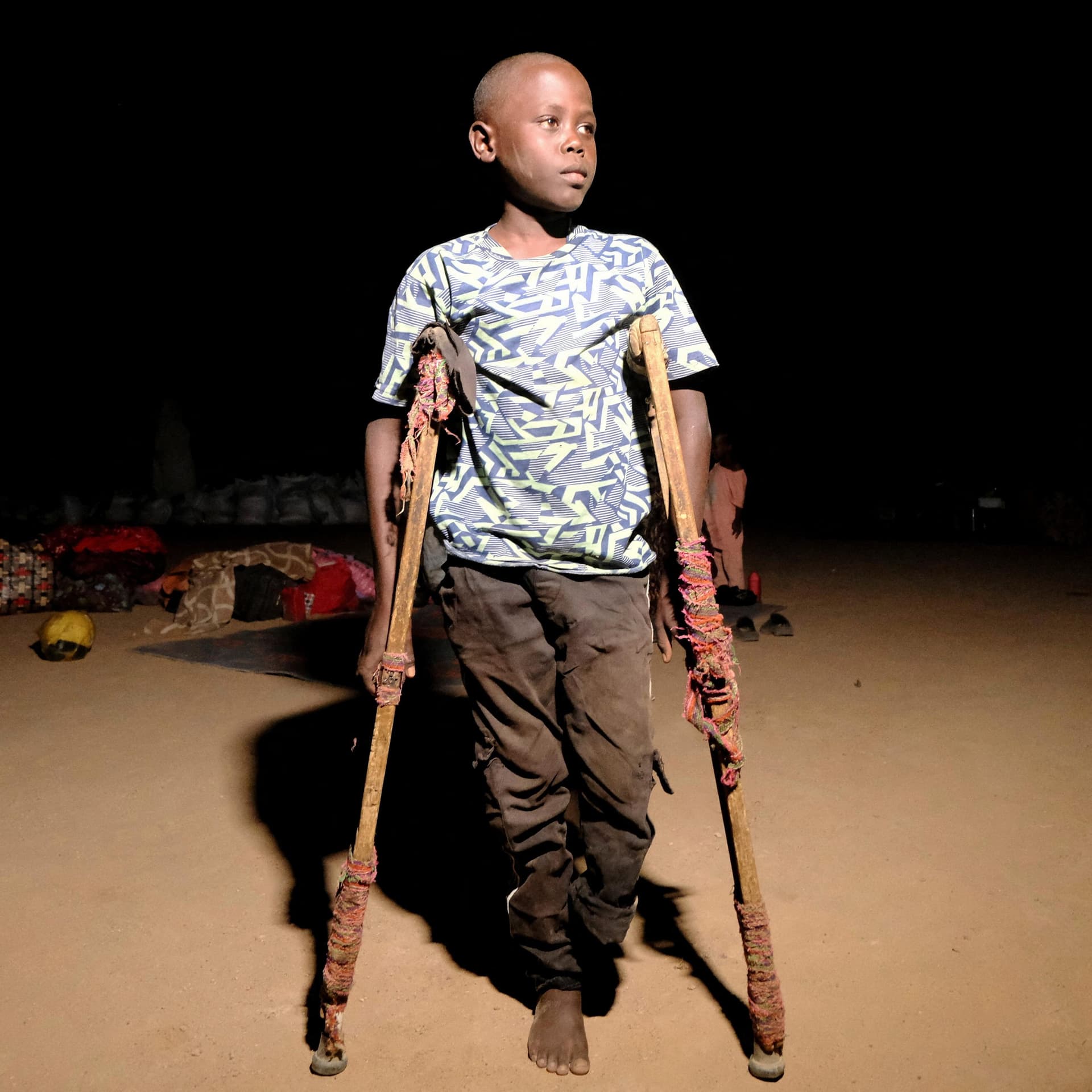
Photo: A child who lost his leg due to artillery shelling by the Rapid Support Forces (RSF), stands at a displacement camp in Al-Dabbah, Sudan. Credit: El Tayeb Siddig/Reuters.