In short
The strained U.S.–Colombia relationship under Donald Trump and President Gustavo Petro, framed through decades of U.S. anti-drug policy and Colombia’s evolving armed groups.
Key claims
Trump says Colombia isn’t cooperating and calls Petro’s government “drug dealer” and “drug den”; Colombia’s Petro accuses U.S. officials of trying to orchestrate a coup. The U.S. decertified Colombia for drug cooperation (symbolic, but affects funds/visas), imposed a 25% tariff after deportation-plane disputes, and tensions escalated after Petro criticized U.S. officials and Rubio.
Notable examples
Pablo Escobar/Medellín cartel era; Plan Colombia (Clinton/Pastrana); 2016 FARC peace deal with dissidents; DEA data that ~90% of U.S. cocaine comes from Colombia; Colombia seized 1,000+ tons while production rose (UN: +3% coca cultivation; 2,600+ tons cocaine).
Guests
William Marquez, BBC Mundo journalist (Colombian; BBC since 1991; covered Colombia for decades, including Escobar years).
Written by AI. May contain mistakes. Listen to the episode to check what was said.
Chapters
Tap a time to open that second in VOU.S.-Colombia Relations and Trump's Accusations
0:37 to 2:01
Exploring the history and current tensions in U.S.-Colombia relations.
“military attacks off the coast of Venezuela.”
The Legacy of Pablo Escobar
2:01 to 3:50
Discussion about Pablo Escobar and his influence on Colombia's drug trade.
“William Marquez is a journalist with BBC Mundo.”
Life in Colombia During Escobar's Reign
3:50 to 5:44
Personal reflections on living in Colombia during the Escobar era.
“You grew up in Colombia, you're Colombian, you were there during that time period now?”
Escobar's Downfall and U.S. Involvement
5:44 to 6:38
The U.S. response to the drug crisis and the downfall of Escobar.
“Well, I was going to ask, William, how was the U.S.-Colombia relationship during this time period, during the Escobar period?”
The Rise of FARC Post-Escobar
6:38 to 8:00
The emergence of FARC as a major player in Colombia's drug trade after Escobar's death.
“when Luis Carlos Galán, the liberal candidate, the person who everyone thought was going to be the next president, was assassinated during a political rally.”
Plan Colombia and Its Impact
8:00 to 11:47
An overview of Plan Colombia and its outcomes in combating drug trafficking.
“But when I read about the aeroplane blowing up, I realized that the pilot was married to a friend of my then wife.”
The 2016 Peace Deal with FARC
11:47 to 13:44
The significance of the peace deal signed with FARC and its implications.
“But then that created also a large and very deadly paramilitary force in Colombia as well.”
Tourism Boom in Colombia
13:44 to 14:00
How perceptions of Colombia have shifted, making it a tourist destination.
“that the FARC were all of a sudden being able to be candidates it's for the Senate and the Congress.”
Colombia's Evolving Image as a Tourist Destination
14:00 to 15:54
Learn how Colombia transformed its image and became a popular travel spot.
“Department's list of foreign terrorist organizations.”
Trump's Diplomatic Tensions with Petro
15:54 to 18:48
Explore the strained relations between Trump and Colombian President Petro over immigration policies.
“and now they're hunting down immigrants to deport them.”
Show all 14 chapters
The Impact of Drug Certification on Colombia
18:48 to 22:24
Understand the implications of the U.S. decertifying Colombia's drug cooperation status.
“And then there's been a sequence of things that have increased the tension between the two.”
Confrontation Between Two Impulsive Leaders
22:24 to 24:48
Analyze the clash of personalities between Trump and Petro amidst drug trafficking concerns.
“We've heard President Trump explicitly resay, and these are his words, he's a drug dealer, the president of Colombia is a drug dealer.”
Continuing Challenges in Colombia's Drug Trade
24:48 to 27:23
Discuss the complexities of Colombia's drug production and the U.S. response.
“The problem with Petro is that Trump is carrying the big stick.”
Viewer Engagement and Contact Information
28:00 to 28:26
Listeners are encouraged to share questions or story ideas with the show.
“And by the way, if you want to get in touch and have any questions or story ideas for us, please send us a note at theglobalstoryatbbc.com.”
Transcript
Automatic transcript. May contain errors.0:00Gustavo Petro:This BBC podcast is supported by ads outside the UK.
0:07Gustavo Petro:150 years ago, they were hunting us down to kill us and now they're hunting down immigrants to deport them. This is First America, the true story of how the United States came to be and how we got to this present moment. Listen to First America wherever you get your podcasts.
0:36Gustavo Petro:The other day here on this show, we covered the U.S. military attacks off the coast of Venezuela. Today, we're talking about Colombia. And you might think this sounds familiar. President Trump clashing with another leftist leader from Latin America. But this is a very different story. For decades, Colombia has been one of the United States' closest allies in the region, working side by side with Washington in the war on drugs. And over the years, that relationship has grown, with Colombia becoming a hot tourist destination for many Americans. But now that friendship is under serious strain.
1:14William Marquez:They are a drug manufacturing machine, Colombia. And we're not going to be part of it. So we're going to drop all money that we're giving to them. The U.S.
1:24Gustavo Petro:government says Colombia is officially not cooperating in what it calls the war on drugs. Trump has accused Colombia's president of being a drug dealer. And Colombia's president has accused U.S. officials of trying to orchestrate a coup against him.
1:42Gustavo Petro:From the BBC, I'm Asma Khalid in Washington, D.C. And I'm Tristan Redmond in London. And today on The Global Story, if the U.S. and Colombian presidents fall out with each other, who stands to lose most?
2:00William Marquez:Well, I will start briefly and trying to skip through the decades.
2:07Gustavo Petro:William Marquez is a journalist with BBC Mundo. That's the Spanish language arm of the BBC World Service. He's from Colombia himself, and he has been covering the country for decades.
2:18William Marquez:I'm 71 years old. I started with the BBC in 1991, first as a freelancer. And you can tell he's a radio man because he's got an incredible voice.
2:29Gustavo Petro:You should have a sort of a kind of evening storytelling show, I would say,
2:34William Marquez:where you just read, you know, great stories so people can listen to them when they're going to bed. I would listen to that. All right. I'll make you my agent. Okay.
2:44Gustavo Petro:William, for many Americans, Colombia really registered on their radar in the 80s and the early 90s during this period of Pablo Escobar. Right. A lot of Americans may have heard of Pablo Escobar, but can you just remind us, who was he?
3:00William Marquez:Pablo Escobar was the biggest drug lord the world has ever seen, I would say. Perhaps nowadays someone in Mexico has taken up that mantle. but Pablo Escobar dominated the drug trade in Colombia. He was the head of the Medellín cartel. He had armies at his disposal. He had a huge zoo with wild animals that he opened up to the public. He had a fleet of airplanes that flew cocaine to the U.S. He managed to be elected to the Colombian Congress. He had political power. It was throughout a decade that he dominated the Colombian scene in every way from the early 80s to the early 90s when he was killed.
3:51Gustavo Petro:What are your memories of that period? You grew up in Colombia, you're Colombian, you were there during that time period now?
3:57William Marquez:I grew up in Colombia. I left when I was 19 to go to university. But I did return to work in Colombia from the mid-80s to the late 80s, which were the very difficult years during Pablo Escobar's reign. And I can tell you it was a very, very difficult period of daily killings, massacres, shootouts on the streets. It was – I remember one time going to work and all of a sudden traffic stopped. and two or three minutes later you would see all this debris on the road because a bomb had just gone off. The cartels had ordered the killing of a police chief. And that happened all the time. Was it frightening to live in Colombia at that time?
4:40William Marquez:I mean, you sort of get used to all of that stuff. But, I mean, it was just something that happened every single day. And so the drug cartels had the sort of informal private army of these youngsters that would kill for money. and that happened all the time. I remember being in Medellin one time and you could smell the fear and the danger in the atmosphere. After five o 'clock in the afternoon, you wouldn't be caught dead in the city because they were killing one person every hour there. I mean, drugs, the drug trades have permeated every single sector of society and of government, even the church in Colombia.
5:24William Marquez:I mean, people close to you might have been involved in drug trade. And you just, you know, you would just point them out, you know, that guy, that guy's a narco, you know. And everyone would, you know, sort of laugh. Oh, really? The little gossip and that. But that was it. No one really paid attention to what was happening because it was all over the place. And it was horrible. And obviously, this became a U.S. problem.
5:47Gustavo Petro:Well, I was going to ask, William, how was the U.S.-Colombia relationship during this time period, during the Escobar period?
5:54William Marquez:Well, it became a problem for the U.S. because it realized that its streets were being flooded with drugs. And where were they coming from? They were coming from Colombia. So there were agreements struck between both countries to try and curtail this and try and go after the drug lords. This became a central part of the government's operation in 1989. That was a year when a lot of presidential candidates were assassinated. And the government hadn't really done anything because most of those candidates were left-wing, the people who had been killed, until around August of 1989, when Luis Carlos Galán, the liberal candidate, the person who everyone thought was going to be the next president, was assassinated during a political rally.
6:49William Marquez:That's when the president at that time, which was Virgilio Barco, declared war against the cartels. Bush's father, President George H. Bush, flew to Colombia, met with Barco, and that's where they started a strategy to try and hunt down Pablo Escobar.
7:10Gustavo Petro:Colombia's drug bosses struck back today, bombing and burning buildings and homes in Medellin. Among the first targets, the party headquarters of the late Senator Luis Galán, who was murdered by drug assassins last week.
7:24William Marquez:But after that, the Medellin cartel retaliated with putting bombs at a large secret police facility. Police also found and disarmed 40-pound bombs
7:38Gustavo Petro:at two of the country's biggest radio stations. And just outside Medellin, the estates of another Colombian senator and a leading industrialist were burned to the ground.
7:50William Marquez:They also bombed an aeroplane. They bombed it because they thought a presidential candidate was on it. And I remember I was living here in London. But when I read about the aeroplane blowing up, I realized that the pilot was married to a friend of my then wife. Oh, wow. And I also, reading the list of the passengers, there was someone I had gone to school with. So in many, many ways, all of this really not only touched me, but it touched a lot of people. Well, the United States eventually did get Escobar in 1993.
8:36Gustavo Petro:Good evening. The Colombian drugs baron Pablo Escobar has been killed in a shootout with security forces in the city of Medellin.
8:43William Marquez:They cornered him. There was a shootout.
8:46Gustavo Petro:Reports from Colombia say he was shot after a gun battle involving 500 police. The government will be hoping the problem has finally been solved. Colombia, though, holds its breath.
8:57William Marquez:After that happened, who filled the vacuum in Colombia in terms of power and influence? All right. So when Escobar was killed and the Medellín cartel basically disbanded, the drug trade didn't go away. It atomized into small parts and several different people started controlling the trade. And one of those groups that started controlling the trade were the FARC. FARC stands for Fuerzas Armadas Revolucionarias de Colombia, Colombian Revolutionary Armed Forces. They were a group that started in the early 60s with a left-wing group that started in a small town that grew into the largest guerrilla group in Colombia.
9:44William Marquez:and it sustained a confrontation with the government for over 40 years. The thing with the FARC was that the FARC realized that the cocaine trade was a rather good source of income, number one. Number two, most of the territories where the crop was being cultivated were areas that they controlled. So they already knew the system. They already knew the trade. They knew what was going on. So this coincided with the fall of the USSR. The USSR gave support to the FARC. And they found that this was, you know, an enormous source of income for them. And they switched over from becoming an insurgent group to becoming drug traffickers, basically.
10:38William Marquez:And what's the U.S. response to this kind of evolution of the drug trade? Well, in 2000, President Clinton came to Colombia.
10:48Gustavo Petro:Our program is anti-drugs and pro-peace.
10:53William Marquez:The president at that time was Andrés Pastrana. And they came to an agreement and they had, the Colombian government had elaborated a plan called Plan Colombia, the Colombian plan.
11:04Gustavo Petro:I reject the idea that we must choose between supporting peace or fighting drugs. We can do both. Indeed, to succeed, we must do both.
11:14William Marquez:That included a lot of military aid, armaments, strategy, education, but also it had sort of a social development side to it. All of that, all of those elements. And that went on for about 10 years. It was billions of dollars. Colombia became the largest recipient in the hemisphere of U.S. aid. So the armed forces got a lot of support, the police as well. But then that created also a large and very deadly paramilitary force in Colombia as well. and during that time, Colombia suffered a lot of human rights violations. There were massacres because the whole thing is about controlling the areas where the cocos grew and controlling the routes to export cocaine and the cocaine labs and all that.
12:13William Marquez:So it depends who you ask whether the Plan Colombia had any good results. Well, maybe during some period, it strengthened the Colombian army, But in terms of cocaine production, well, you know, you can see that the results haven't been that positive. Can you explain to us, please, what happened in 2016? Because there was a peace deal, wasn't there, with the FARC?
12:36Gustavo Petro:And to what extent that contributed to a kind of calming of the situation generally in Colombia?
12:42William Marquez:So in 2016, there was a big turning point in Colombia when President Santos signed a peace treaty with the FARC. It had taken a very, very long time to arrive at that. And the members of the movement disarmed and were reintegrated. And there's a process of establishing justice and culpabilities. But there was a dissidence that rejected the process. And they continue to be active. Plus, there's also another group called the Ejército de Liberación Nacional, the National Liberation Army, that also has yet to disarm, and they also are involved in all sorts of violence and drug trafficking. And so that's what the situation is at the moment.
13:33William Marquez:But definitely there was a change in 2016. There was a sort of a sigh of relief, even though a lot of people found it hard to swallow, that the FARC were all of a sudden being able to be candidates it's for the Senate and the Congress.
13:51Gustavo Petro:And William, I recall if we fast forward a few years later, in 2021, when Joe Biden was president, his administration removed FARC from the State Department's list of foreign terrorist organizations. It seemed like the relationship between the U.S. and Colombia was on kind of a progressive upswing over the years. And from the American perspective, it's also meant that Colombia has become a really attractive tourist destination. I mean, I know so many people who go and want a vacation there. You see U.S. hotels, American various airlines making trips there. How does that translate with what we've seen?
14:27Gustavo Petro:Because I would say in decades past, Colombia might not have been as hip and hot of the destination for Americans.
Read the full transcript
14:33William Marquez:Yeah, right. When I was a young man, when people thought about Colombia, they would say, oh, yeah, coffee and bananas. Then later on, oh, yeah, cocaine and guerrillas, guerrillas. And then it became this fantastic place to visit. Why? In part because of the effectiveness of the Uribe government in debilitating FARC, number one. Two, in the peace process that the subsequent president Santos started and was more or less successful at achieving with the FARC and demobilizing most of their members. And also because Colombia invested a lot with a big publicity agency to change its image completely.
15:24Gustavo Petro:There's a place where people never believed impossible was a word.
15:29William Marquez:There was a very, very strong tourist campaign.
15:32Gustavo Petro:The most beautiful people in the world. You feel alive, and you realize that Colombia is not what you thought it was.
15:39William Marquez:One of their slogans was... Colombia.
15:41Gustavo Petro:Colombia. Colombia. Colombia. The only risk is wanting to stay.
15:53Gustavo Petro:150 years ago, they were hunting us down to kill us, and now they're hunting down immigrants to deport them. This is First America. the true story of how the United States came to be and how we got to this present moment. Listen to First America wherever you get your podcasts.
16:31Gustavo Petro:In 2022, Colombia elects a new president, Gustavo Petro. He's a former Marxist guerrilla fighter, and his election marks a huge shift in Colombian politics.
16:44William Marquez:Pat was elected in 2022, and he became the first left-wing president in Columbus history. His first two years were when Joe Biden was president.
16:57Gustavo Petro:And how would you characterize the relationship with the U.S. during that period?
17:00William Marquez:Cordial relationship. It was really a cordial relationship. Things turned around as soon as Trump was elected. Within days of Trump coming into power, he started these massive deportation of undocumented migrants. And there were a couple of plane loads of Colombian undocumented migrants taken back to Colombia. And the image that was shown were of these migrants being handcuffed and taken to the aeroplanes under armed guard. To Colombian eyes, seeing people being handcuffed and escorted under armed guard onto a plane is very impactful in general to Colombians, really. Petro grabbed onto that.
17:53Gustavo Petro:It was this footage of migrants shuffling in shackles, being unloaded in Brazil from the US, that caught the attention of Colombia's president, who in turn refused migrant planes headed to his country too.
18:10William Marquez:And he refused permission for those planes to land. They're sent back. And that creates this impasse between Trump and Petro. and Trump imposes sanctions on Colombia. Earlier today, President Donald Trump announced
18:27Gustavo Petro:that he would slap a 25 % tariff on all imports from Colombia. The move came after Colombia refused to accept two U.S. military planes deporting migrants.
18:40William Marquez:Luckily, through diplomatic channels, they managed to calm things down. The planes are later sent back to Colombia and they eventually do land. And then there's been a sequence of things that have increased the tension between the two. In April of this year, Trump sent his Homeland Security secretary, Christy Noam.
19:05Gustavo Petro:Well, thank you. And I want to thank the Minister of Foreign Affairs for welcoming me here today.
19:10William Marquez:To try and work out a deal.
19:14Gustavo Petro:We're committed to working hand in hand with our Colombian partners to enhance not only border security, but also that we will support the enforcement of our immigration and our criminal laws.
19:24William Marquez:But when she goes back to the U.S., she starts saying all Petra did was badmouth the U.S.
19:31Gustavo Petro:I would say that even my visit to Colombia with the president there was contentious. Started with him criticizing our government for about a half hour and talking about how TDA members were misunderstood.
19:43William Marquez:And also praising the Tren de Aragua, this transnational criminal organization from Venezuela, which Trump had designated as a terrorist organization.
19:54Gustavo Petro:And so I told him clearly that, listen, we will never legalize drugs in our country. Cartel members, if they are your friends, we will kill them.
20:03William Marquez:And that again lit up the flames. Then after that, in July, Petro accused the Secretary of State, Marco Rubio, of plotting a coup against him. And that created another diplomatic situation.
20:21Gustavo Petro:I think the Colombian authorities, when it comes to their military and their police, are still very pro-American. The only problem in Colombia is a lunatic president. The guy's a lunatic. He's a lunatic. And he's not well. And everybody knows he's... Then after that, Colombia was decertified.
20:35William Marquez:Dissertification is something that they do when the U.S. considers that a country that is known for drug production does not cooperate fully in trying to curb it. Just basically the U.S. said that manifestly it was in breach of its commitments in its war against drugs.
20:57Gustavo Petro:When did Colombia first become certified as a drug partner?
21:01William Marquez:I can't remember. It's been years.
21:03Gustavo Petro:Okay.
21:04William Marquez:Yeah. You caught me on that one.
21:06Gustavo Petro:But can you tell us, is this the first time in about three decades then that this has happened?
21:12William Marquez:Almost three decades. And only now, this year, has it been decertified. But it's more of a symbolic gesture, and it has to do more about the clash of personalities between Trump and Petro. And what are the consequences of being decertified in that way? It's just that they don't receive funds. And Colombia is a big recipient. Colombia has been. And there's a lot of military assistance in arms, in strategy, in presence. There's a US military presence in Colombia. Now, certain analysts have said, well, there's a hard decertification and there's a soft one. And apparently, the one that Trump imposed was a soft one.
21:59William Marquez:So he might sanction certain members of government, cancel their visas, but still the aid, the military aid is still there. That money is still going there. And it's crucial for the U.S. to have that presence and to have these deals in place in order for them to stem the flow of drugs to the U.S. The Trump administration considers Petro to be directly involved with the narco-traffickers.
22:30Gustavo Petro:We've heard President Trump explicitly resay, and these are his words, he's a drug dealer, the president of Colombia is a drug dealer.
22:37William Marquez:A few weeks ago, Petro was interviewed by the BBC. President Petro, thank you for talking to the BBC. And he said, yes, Trump has accused me of being a drug dealer, Trump has accused me of being a terrorist, from the very beginning.
22:56William Marquez:He denies it. I don't know what proof Trump has, but he hasn't shown it.
23:03Gustavo Petro:One thing we hear here in Washington so frequently is President Trump refers to Colombia as being a drug den. Those were his words. He has repeatedly said that Colombia just hasn't been taking the drug trade very seriously. And we did look up prior to this interview the stats through the Drug Enforcement Agency. And according to their data, 90 percent of cocaine in the United States comes from Colombia. So I want to ask you about what the current state of the drug trade looks like at this moment.
23:32William Marquez:Well, Colombia is the largest producer of cocaine in the world. According to U.N. figures, the lands that are cultivated with cocaine have grown by 3 percent. Also, the amount of cocaine coming out of the country has grown. Now it's over 2 ,600 tons. The thing is, is that from the Petro perspective, he says, and it's true, that he has seized over 1 ,000 tons of cocaine. There have been seizures. There have been extraditions of mafia people. and he says that that's how he's being repaid, by being the president who has seized more cocaine in the history of the country, and he says he's being repaid with all these sanctions.
24:21William Marquez:But it is true that that has happened.
24:23Gustavo Petro:So just to be clear on what you're saying, both of these statements are accurate, that indeed a vast majority of cocaine coming to the U.S. comes from Colombia, but also that the current Colombian government has seized more cocaine than previous Colombian governments.
24:37William Marquez:That's absolutely true. The thing is this. Obviously, Trump has made drug trafficking, especially drug trafficking from Venezuela and Colombia and Mexico, let's say, one of his biggest issues. But you have here a confrontation between two very similar personalities, Petro and Trump, who are very impulsive, who speak off the cuff, who are headbutting each other, and who each one of them has to want the last word. The problem with Petro is that Trump is carrying the big stick.
25:19Gustavo Petro:You know, we've been chronicling what the U.S.-Columbia relationship has looked like over the last three to four decades. And so as we look at where we are now, what do you see being at stake?
25:32William Marquez:The problem with the drug trade is you have an endless supply and an endless demand. It's what they call the balloon effect. You know, you may squeeze it on one side, but the air just flows to another and it bulges in another area. And that's what's been happening. Because after all this money, after all these billions of dollars, and now Colombia is still producing more cocaine than ever before. And that's why the U.S. realizes they can't completely cut off the aid to the military. It would be counterproductive. And I'll tell you one thing, the violence is coming back. And the people who are caught in between are just the peasants because they're under the yoke of these forces under which they're obliged to grow coca plants and produce for them.
26:33William Marquez:So they're the ones who suffer the most. And also, one of the big problems that the U.S. has is not with cocaine, it's with fentanyl. And that's not produced in Colombia.
26:46However, the U.S. will still have a stake in Colombia, so the relationship is still going to be there.
26:57William Marquez:What you need is two governments that more or less have a cordial relationship and come up with a credible, practical, feasible plan. that also includes trying to tackle the demand and consumption in the U.S.
27:22Gustavo Petro:Well, William, thank you very much for taking the time to speak with us. We appreciate it.
27:26William Marquez:Thank you so much, William. Thank you, Asma. Thank you, Tristan.
27:37Gustavo Petro:That was William Marquez with BBC Mundo. That is it for the global story for today. If you enjoyed our episode today, please take a moment to rate us wherever you listen to the show. It really helps other people find us. This episode was made by Aaron Keller and James Shield, and it was engineered by Travis Evans. Our senior news editor is China Collins. And by the way, if you want to get in touch and have any questions or story ideas for us, please send us a note at theglobalstoryatbbc.com. See you tomorrow. Cheerio.
28:26Gustavo Petro:150 years ago, they were hunting us down to kill us, and now they're hunting down immigrants to deport them. This is First America, the true story of how the United States came to be and how we got to this present moment. Listen to First America wherever you get your podcasts.
From the publisher
For years, Colombia has been one of the United States’ closest allies in the region – a key partner in the war on drugs. But now this relationship is coming under strain amidst a personal feud between President Trump, and Colombia’s president Gustavo Petro.
In today’s episode, we speak to BBC Mundo’s William Marquez to examine the history of the US-Colombia alliance, and what might be at stake if it falls apart.
Producer: Aron Keller
Executive producer: James Shield
Mix: Travis Evans
Senior news editor: China Collins
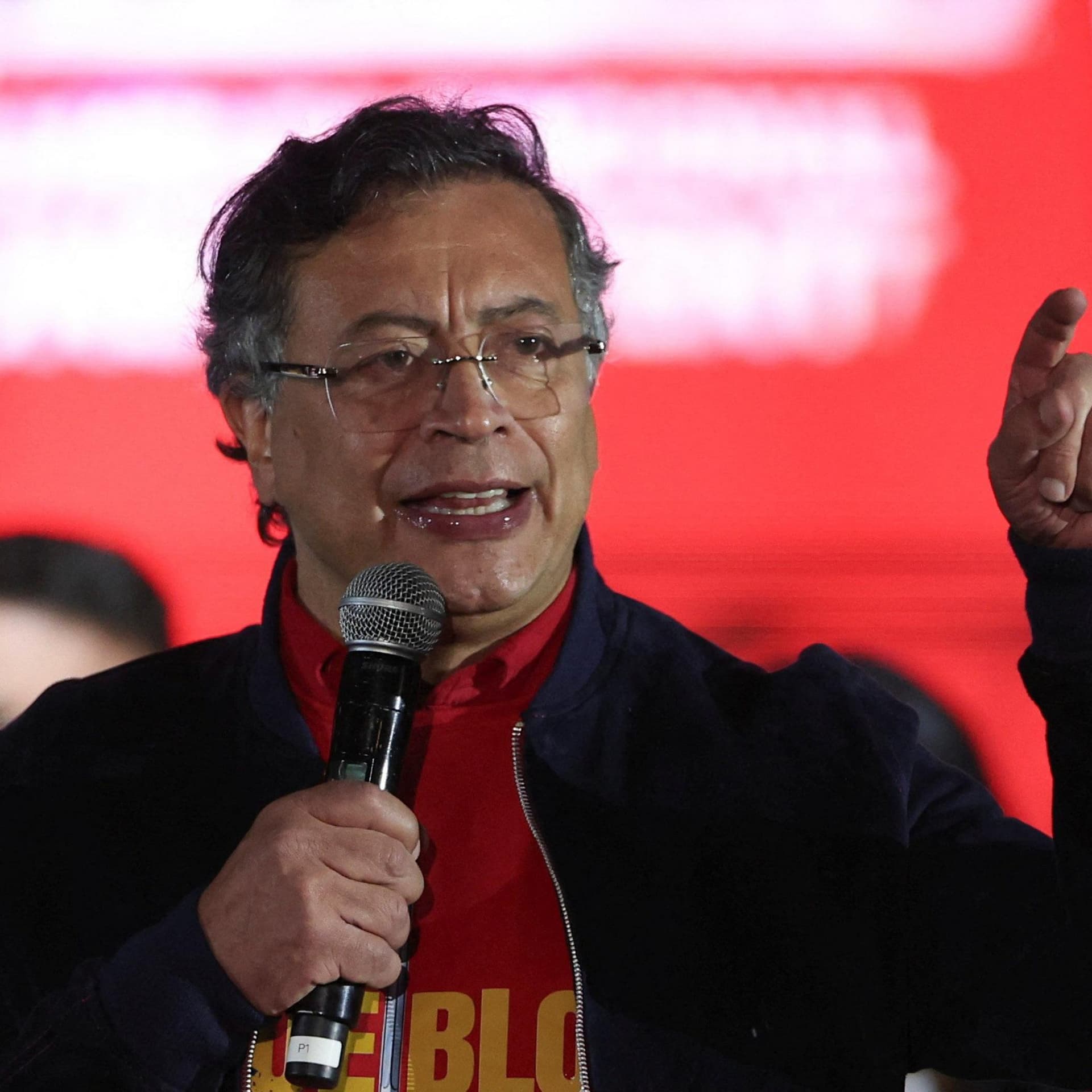
Photo: Colombian President Gustavo Petro. Credit: Reuters/Luisa Gonzalez