In short
How popes use moral authority and diplomacy to shape politics, focusing on Pope Leo (formerly Robert Prevost) and comparisons with Pius XII, John Paul II, and Francis.
Guests
Edward Sturton, BBC broadcaster since the 1970s and author who writes about the Catholic Church and other subjects.
Key claims
The papacy can influence international affairs even without direct political power. Pius XII was criticized for not condemning Nazism loudly enough, yet the Vatican sheltered Jews and Allied personnel. John Paul II’s 1979 Poland visit helped undermine “inevitability” of communism and boosted opposition like Solidarity. Francis’s Laudato Si influenced climate talks (including Paris Accord) and angered some conservative U.S. Catholics.
Notable examples
Vatican refuge in WWII; Brezhnev call allowing John Paul’s Poland trip; U.S. deportation/ICE detention and bishops’ strong condemnation; Leo’s first trip to Turkey and Lebanon as “Francis Mark II” continuity.
Written by AI. May contain mistakes. Listen to the episode to check what was said.
Chapters
Tap a time to open that second in VOPope Leo's Political Stance
0:30 to 0:45
Discussion on Pope Leo's unexpected emergence and political comments.
“Because Schwab knows that when it comes to your finances, choice matters.”
Pope Leo's Political Stance
0:48 to 2:29
Discussion on Pope Leo's unexpected emergence and political comments.
“This is the Vatican back in May of this year.”
Historical Context: Pope Pius XII
2:29 to 3:38
Exploration of Pope Pius XII's role during World War II and perceptions of his actions.
“And today on The Global Story, how popes have taken on politics.”
The Vatican's Discreet Diplomacy
3:38 to 5:23
Discussion on the Vatican's covert efforts to assist during the war.
“that the Vatican was an incredibly vulnerable position.”
Pope Pius XII and Communism
5:23 to 7:17
How Pope Pius XII viewed communism as a major threat post-war.
“That said, the argument that the Vatican made was that they were actually doing quite a lot to save Jews in all sorts of ways and that that was more effectively pursued quietly and without a drama.”
The Significance of John Paul II
7:17 to 9:59
Analysis of John Paul II's impact on the Catholic Church and global politics.
“And the Cold War being important, we get to John Paul II in the late 70s.”
John Paul II's Visit to Poland
9:59 to 13:14
Exploring the significance of John Paul II's visit to Poland and its impacts.
“The fact that the Polish authorities simply couldn't say no to him.”
Pope Francis and Modern Diplomacy
13:14 to 14:01
Discussion on Pope Francis's role in global diplomacy compared to his predecessors.
“I would like to trot on, please, to Pope Francis, who was elected in 2013, first pope from the Americas, Argentinian.”
Pope Francis' Legacy and Environmental Activism
14:01 to 17:06
Learn about Pope Francis' influence on climate change and Vatican diplomacy.
“And his focus was very much on the historic heartland, as he saw it, of Christianity and Catholicism, i.e.”
Election of Pope Leo and Historical Significance
17:07 to 18:52
Explore the significance of the election of Pope Leo and his connection to past popes.
“They elected an American cardinal called Robert Prevost, who announced that his papal name would be Leo.”
Show all 14 chapters
Pope Leo's Political Stance and Immigration
18:53 to 20:59
Discuss Pope Leo's positions on immigration and his relationship with the Trump administration.
“And Cardinal Prevost went online or went onto social media to say that J.D.”
Catholic Bishops' Response to Immigration Policies
21:00 to 23:02
Understand the Catholic bishops' strong response to the administration's deportation policies.
“Someone who says I'm against abortion but says I'm in favor of the death penalty is not really pro-life.”
Pope Leo's International Focus and Strategy
23:03 to 24:48
Examine Pope Leo's choice of international trips and his diplomatic approach.
“We came out in great strength in numbers today.”
Potential Influence of Pope Leo on American Politics
24:49 to 26:18
Analyze how Pope Leo might influence American Catholics and politics under Trump's administration.
“So it's more a question of how this plays in Congress and of the degree to which Republicans think they actually do themselves harm if they're found to be standing against the Pope.”
Transcript
Automatic transcript. May contain errors.0:00This BBC podcast is supported by ads outside the UK.
0:30Schwab offers. Because Schwab knows that when it comes to your finances, choice matters. No matter your goals, investing style, life stage or experience, Schwab has everything you need, all in one place, so you can invest your way. Visit schwab.com to learn more. Annuncio vobis gaudium magnum. This is the Vatican back in May of this year. The white smoke has just appeared and the cardinal is on the balcony. There's a huge cheer in St Peter's Square. A few moments later, we hear the new pope's name. And the cheer is a little muted. Maybe because Robert Prevost was a surprise and people didn't even know his name yet.
1:26But I was in the square that day and some people told me there were nerves that for the first time the new Pope was an American.
1:38Pope Leo hasn't exactly burst onto the world stage since then. He's been pretty discreet. He's getting out there now. He's on his first trip abroad this week. But recent comments about his home country have raised some eyebrows. New criticism of conservative policies are coming from what some might consider an unlikely source, the Pope. This morning, Pope Leo and the White House engaging in a thinly veiled battle over what it means to be pro-life. Pope Leo seeming to criticize the Trump administration over the president's immigration policies. It wouldn't be the first time that a Pope has weighed into earthly matters.
2:16Leo's predecessors haven't exactly stayed on the sidelines. From World War II to the Cold War to climate change. From the BBC, I'm Tristan Redmond in London. And today on The Global Story, how popes have taken on politics. And could Pope Leo do the same?
2:41Hello, Ed. It's great to meet you. Nice to meet you. Nice to meet you. Could you introduce yourself, please, for us? I'm Edward Sturton. I mostly broadcast on radio, having knocked around in broadcasting since the 1970s. Goodness me. And I write books, including books on the Catholic Church, but on all sorts of subjects. Well, it's great to have you with us, Ed. We wanted to talk to you today about what we know about what kind of Pope Leo might be. But before we get to Leo, we also want to understand what kind of power the Pope actually has to change things in the world. So if we were to look at some of the key moments of diplomacy that might be a model for a modern Pope like Leo, one of the big ones is Pope Pius, who was in office during World War II.
3:29Why was he so significant? He became Pope in the spring of 1939. And at that point, you have to remember that the Vatican was an incredibly vulnerable position. It was first a tiny square of neutrality in the capital of a fascist state, of Mussolini's Italy. And then later, when the Germans moved across Italy as a whole, it's isolated and surrounded by the German sort of system, if you like. And the Pope is in a really, really difficult position. and he was much criticized by a lot of people for failing to speak out against Nazism as directly as many people thought he should and equally for failing to speak out particularly about what was happening to Jews during that period which the Vatican which has an incredibly effective intelligence service knew quite a lot about so that compounded this sense that he was in some way sympathetic to Nazism.
4:34He wasn't, but that impression has been allowed to take hold. And I feel rather sorry for Pius XII in a way because he became known in the title of a very famous and actually very good, if a little unfair, book. He became known as Hitler's Pope. What did it mean for the Vatican, deliberately or not, to look as though it was recognising or sympathetic towards the Nazis. Would it have changed anything if the Pope had been stronger in condemning the Nazis? A lot of people feel that if he'd been stronger, particularly on the subject of the Holocaust, the kind of moral suasion, the enormous power that the papacy can bring in international affairs still today would have had a real impact.
5:23That said, the argument that the Vatican made was that they were actually doing quite a lot to save Jews in all sorts of ways and that that was more effectively pursued quietly and without a drama. What were they doing? Can you give examples? Well, thousands of Jews took refuge in the Vatican or in Catholic churches, Catholic buildings all over Rome on the Pope's instruction.
5:53The Vatican also served as a refuge for Allied service personnel fleeing the Germans. The Pope, who remained in the Vatican City during the hard-fought battle for Rome, granted an audience to Allied troops after the occupation and gave them his blessing. In 1943, the Pope ordered the opening of his summer residence, Castel Gandolfo, and again thousands of people crowded into the palace and into the grounds. The Vatican itself was an incredibly claustrophobic place at this period because the German commander in Rome drew a chalk line round the boundary and threatened to arrest anyone who crossed it.
6:31The war, of course, once it ended, ended the threat of fascism, but it left him facing what he saw as big a threat, which was communism. The Catholic Church under Pius XII was deeply involved in trying to defeat the Communists in Italy in the late 1940s. Pius put out a ruling that you couldn't be a good Catholic at the same time as being a Communist. And people forget today, because Communism doesn't have the power it once did, But it was regarded as a kind of almost a rival religion to Roman Catholicism in the 40s and 50s and the early years of the Cold War. Okay, so we're in the Cold War. We're going to carry trotting along our sort of yellow brick road of 20th century popes.
7:23And the Cold War being important, we get to John Paul II in the late 70s. how did he become such a significant figure not just in the catholic church but all around the world his election of course followed a terrible trauma which was the very brief pontificate of john paul the first who lasted i think it was about three months and then was found dead in his bed by the nun who looked after him so there's a slightly sort of um uneasy feeling when the cardinals gather again to choose a new pope. And they did something very radical, which is for the first time for many hundreds of years, they chose a non-Italian pope, and who had been formed by the struggle with communism.
8:17Just a brief sort of history of his life. He was a young man in occupied Poland during the Second World War, and he came of age in the church, which was persecuted. Well, I'm just wondering, Eddie, can you explain for our listeners why a Pope who comes from a country behind the Iron Curtain, a communist country like Poland, why that was so significant? Well, it meant that you had a completely different view, or he had a completely different view of history. So John Paul comes to office with this very strong sense that Europe has been divided by a great wrong, the Cold War, the Iron Curtain, and that his job is to change that and to reunite Europe.
9:04It's also worth remembering the very particular sort of quality of the Polish church, where Catholicism is very strongly linked with a sense of nation, a sense of history, all the things that under communism were being suppressed. So it's a kind of uniquely powerful church, if you like, uniquely qualified to play the role it then did under his leadership as Pope. When he insisted, and he did insist, on returning to visit his homeland in 1979, so almost immediately after being elected... This is the arrival of Pope John Paul II in Victory Square. It was the first crack in the Iron Curtain, the first chink in the system of control that communism had exercised in Central and Eastern Europe.
10:08The fact that the Polish authorities simply couldn't say no to him. There was a telephone call between Brezhnev, who was the leader of the Soviet Union, and Edvard Gierak, who was the communist leader of Poland at the time, when Gierak said to Brezhnev, look, I can't stop him coming. I'm simply not powerful enough. You'll have a revolution here if I do.
10:38And that's the first time people suddenly thought, well, actually, communism doesn't control everything in quite the way that people assumed it had. I mean, if you were in Czechoslovakia, for example, or Hungary, you'd seen your attempts to revolt suppressed by Russian tanks. And he was able to say, I'm coming to Poland, and you can jolly well lump it. I think it was really exciting to see our Pope in Poland, and the people feel about it really enthusiastic. I liked it, really, and the people are happy all over. The other thing that was very striking is that when he did arrive, literally millions of people turned out to see him.
11:23What did you think of it this afternoon? Very good. Very beautiful, fantastic, wonderful. Very fantastic. And the organisation of the visit fell into the hands of the church, not the communist authorities. And you've got to remember in those days, communist authorities in Eastern Europe controlled absolutely everything, from the most intimate parts of people's private lives to everything that happened in public. And suddenly, for this amazing period, control of this event is taken over by the church. And I think that had a, well, it certainly had a very profound effect in Poland, because it led in the end to the rise of the Solidarity Trades Union, the strikes in the Gdansk shipyards and all that.
12:09But I think more broadly, in the Soviet bloc, it suddenly made people think, gosh, you know, It doesn't have to be like this all the time. And I interviewed Spigniew Brzezinski, Polish origin. Who was the national security advisor. Exactly, under Jimmy Carter. And he simply said, before John Paul went to Poland for the first time as Pope, communism was regarded as inevitable. And after he'd been, it no longer seemed inevitable. And that was the sort of massive change.
12:49In his address, he appealed for people everywhere to come together. We must open the frontiers, he said twice. There's no imperialism in the church, only service. There's a famous quote from Stalin, how many divisions has the Pope? Well, John Paul much later answered, well, maybe not many divisions, but boy, we can make a difference. And I think that's, you know, Returning to the subject of our discussion, that's an amazingly powerful illustration of what the church can do sometimes in international affairs, and not just spiritually, but in terms of politics. I would like to trot on, please, to Pope Francis, who was elected in 2013, first pope from the Americas, Argentinian.
13:41How much would you say that he took over the role that John Paul II forged as a pope who had an important role to play in global diplomacy? Very different figure. And we ought just briefly to say something about his predecessor, because, of course, between John Paul and Francis, there is Benedict. And his focus was very much on the historic heartland, as he saw it, of Christianity and Catholicism, i.e. in Europe. But towards the end of his time, there was a terrible sense that he'd lost control of this extraordinary sort of vast edifice that is the Catholic Church. The abuse scandals just kept on coming.
14:24So when he returned, and of course that was something that had very little precedent when it happened, there was a sense, I think, of real crisis in the church and a feeling that they needed something new.
14:48And that's what Francis brought. He was activist, and in diplomatic terms, certainly one of the things he will be remembered for is his encyclical Laudate Si, which is a quotation from a prayer of St Francis of Assisi, which was a really comprehensive statement of the Christian duty to look after the planet. I was speaking to you from a house in France and I remember in the village here finding a copy of Laudate C in the newsagent you know as if it was a new best bestseller and I in Catholic countries it had that it had that impact and it had a profound impact I think globally. A lot of people credit him with having influenced the Paris Climate Accord.
15:40And I think that changed the atmosphere at those talks in a very profound way. When I did his obituary for the BBC, we talked to some of those who'd been there, and they said, you know, yes, I think that the delegates were informed by this document. And it's an illustration of the way that part of Vatican diplomacy is that they have this, popes have this hugely powerful pulpit. It also had an impact, which I think we're still seeing ripples from today, of making a lot of American Catholics deeply suspicious because a lot of Americans thought Laudate C was basically a kind of form of communism wrapped out to sign nice and cuddly.
16:29Explain that to us. Well, he took on the whole sort of capitalist idea and argued, you know, you can't just worry about profit, we have to worry about the planet. That's a gross oversimplification of what he said. But it directed people to think more carefully about the morality of what they were doing and what it meant for the planet. And a lot of people in the United States, conservative Catholics, saw that as a challenge to the whole capitalist system, and were very upset by it.
17:07Well, Pope Francis died earlier this year, and I remember the expectation from some at the time was that there would be a kind of political reaction to his tenure, that some people saw him as rather liberal, that the pendulum would then swing the other way, and that the cardinals would elect a more conservative pope. They elected an American cardinal called Robert Prevost, who announced that his papal name would be Leo. Now, why is that name Leo so significant? What does it tell us about him? Yes, I mean, it's a reference back to Leo XIII, who was the last Leo we had. And he produced a famous document called Rerum Novarum of the new things, which developed ideas about the rights of workers, which built on the idea of a moral dimension to the way economies work, and took the church's view of kind of the 20th century economy and capitalism to a new step and said, you can't simply accept this.
18:06You have to think of the morality of all this. And it is widely expected this Leo will produce a new version of that quite soon in his pontificate and develop it to take account of things like AI and technology and so forth. And that's why he chose that name. Well, when it was initially announced that there was to be an American pope, people were all trying to work out where this pope would stand politically. There were these reports that emerged that pre his election, he reposted articles on social media when he was a cardinal, criticising J.D. Vance, the vice president, who's also a Catholic.
18:47Can you tell us about that, please? Well, he was actually criticising a specific point that Vance argued, which was to do with something called the Ordo Amoris, the order of love. It's a traditional Catholic teaching, and Vance used it to justify, I suppose, the America a first agenda, if you like, because he argued that what it says is that you care first about those closest to you, your family, and then you care about your friends, and then you care about your community, and last you care about people out there in the wider world. And Cardinal Prevost went online or went onto social media to say that J.D.
19:28Vance had completely misunderstood what the teaching was all about, and that he ought to think more about the parable of the Good Samaritan, who finds a man on the road in distress and looks after him, even though the man in distress is a Jew and he's a Samaritan. And you can't sort of care less about people simply because they're a long way away. Well, Leo seems to have been fairly discreet on the world stage since he was elected. But can you talk us through, please, what has his relationship been like with the Trump administration? He's an interesting figure because he's quite careful. He's quite diplomatic in lots of ways.
20:05I think he'll be careful about how he plays it with the Trump administration. But you see absolutely no sign of compromise on the fundamental principles of believing in the human dignity of refugees. We're going to be asked, you know, how did you receive the foreigner? Did you receive him and welcome him or not? and I think that there's a deep reflection that needs to be made in terms of what's happening. I think you can see his instincts about what's happening with the deportations in these comments he made about an ICE, that's the Immigration and Customs Enforcement Facility in Illinois. Many people who've lived for years and years and years, never causing problems, have been deeply affected by what's going on right now.
20:56Back in earlier this autumn, Leo very deliberately made it clear that the question of being pro-life isn't something that's limited to the question of abortion. Someone who says I'm against abortion but says I'm in favor of the death penalty is not really pro-life. So someone who says that I'm against abortion but I'm in agreement with the inhuman treatment of immigrants who are in the United States, I don't know if that's pro-life. Well, that's actually something that Caroline Levitt, the White House press secretary, was asked about. You've been very open about your Catholic faith. How do you respond to that?
21:32I would reject there is inhumane treatment of illegal immigrants in the United States under this administration. This administration is trying to enforce our nation's laws in the most humane way possible. And we're upholding the law and we're doing that on behalf of the people of our country who live here. When he was elected, there were concerns from some parts of MAGA, including from Steve Bannon, a former advisor to Donald Trump, who is Catholic. Steve Bannon called Pope Leo, quote, the worst pick for MAGA Catholics. But has Leo taken any other positions publicly which have caused particular friction with the White House?
22:13Well, I think only on this question of immigration. The bishops in the United States, united in our concern, will continue to stand with migrants and defend everyone's right to worship free from intimidation. Strikingly, since we're talking shortly after the Catholic bishops of America met, they, having in many ways over the years been very divided between left and right, the American bishops, they issued an extraordinarily strong statement condemning the Trump administration's deportation policies of a kind that really hasn't been used before, using really strong language. Policy changes that are intimidating and dehumanizing the immigrants in our midst, regardless of how they came to be here.
23:02And of course, it's feeding through to what's happening on the ground. We came out in great strength in numbers today. Catholics from all around Chicagoland have come out to support our sisters. In Chicago, for example, which is the Pope's hometown, there have been regular services held outside a detention facility where people are being held for deportation because priests aren't being allowed in to give them communion. Very clearly, there are no strangers. We are all brothers and sisters in Christ. And so there is an absolutely direct confrontation between the church and the state unfolding as we speak on the streets of Chicago.
23:52So I think in a curious way at the moment, we've got the two most powerful Americans on the planet, the Pope and the President, heading for confrontation on this absolutely crucial issue. Pope Leo has chosen Turkey and Lebanon as his first trip abroad, not the United States. Both of these are predominantly Muslim countries. What might that tell us about how he sees the role of Pope on the global stage? I think that his choice of destinations for his first trip actually owes more than anything to his desire to be seen to be acting in continuity with his predecessor. Because, of course, these were trips that had been planned for Pope Francis and he wasn't able to carry them out because he died.
24:38So I think that is more about signalling I'm Francis Mark II than about signalling I've got a new agenda of my own. I wonder, Ed, considering the conversation that we've had, if Leo is to have his own agenda, whether one of the things we'll see is him taking more of an interest than his predecessors in what is happening in America, particularly under Donald Trump. if he were to do that does he have the influence to change how american catholics actually vote i think there is a natural sympathy for the position that um the vatican and pope leo in particular takes on the whole question of immigration among a lot of american catholics many of whom are very liberal but of course there is also a powerful maga wing to the catholic church I'm not sure that votes, of course, at this stage, are really the issue because Donald Trump can't stand again.
25:39So it's more a question of how this plays in Congress and of the degree to which Republicans think they actually do themselves harm if they're found to be standing against the Pope. The Pope does have still today a unique ability to influence the moral climate of politics. And Leo, he doesn't have the same charisma that Francis has. He doesn't catch the headlines in the way that Francis did. But he's still a very powerful voice. So I think if I was in the White House, I think I'd be saying, you know, don't cross him too quickly. Be careful, Mr Trump, Mr President, because it's still a very, very powerful voice.
26:38Ed, thank you so much. It's been a real pleasure to talk this through with you. Pleasure. Pleasure, pleasure.
26:47That was author and BBC presenter Ed Sturton, who has extensively covered religious affairs and the United States. Today's episode was produced by Sam Chandrasak and Lucy Paul. It was edited by Bridget Harney and mixed by Travis Evans. And I'm Tristan Redman. You can get in touch with us by emailing theglobalstory at bbc.com. And if you're enjoying the show, please leave us a review. It helps others find us. Have a great weekend. We're back on Monday. Cheerio.
27:45personalized service and more aboard spacious all-suite ships. Visit rssc.com to experience the unrivaled.
From the publisher
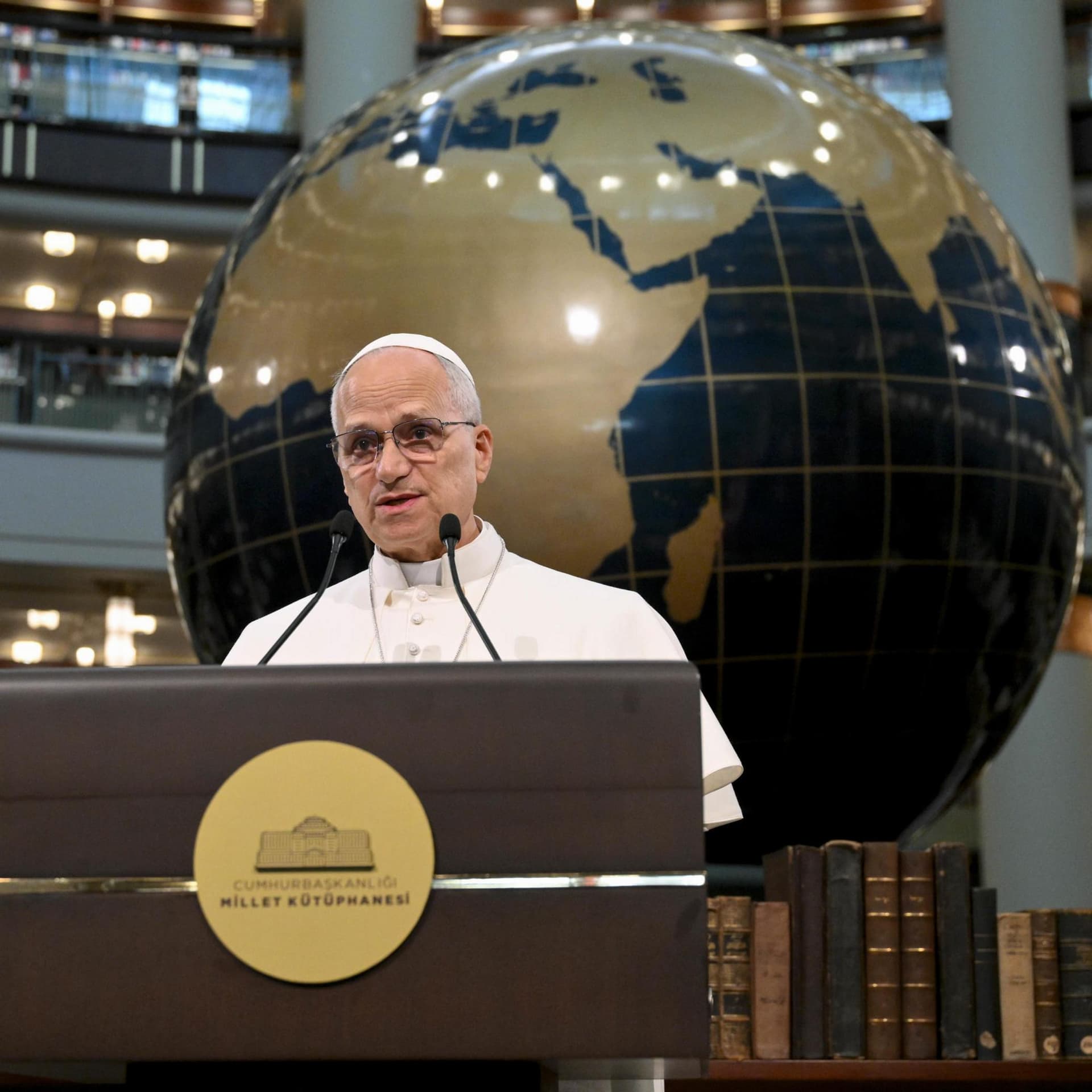
Pope Leo is on his first official visit abroad, and there are already signs he’s willing to use his position to speak out on controversial matters. His recent comments about abortion and the rights of migrants have created headlines in the United States, and raised eyebrows from some conservatives who see the first American pope challenging President Trump’s policies.
It wouldn't be the first time that a pope has weighed in on politics. From Nazism to communism and the Cold War, from refugees to climate change, popes have used their position to influence global affairs.
In this episode we speak to author and presenter Edward Stourton, who has covered religious affairs and the USA extensively for the BBC, about what power Pope Leo XIV has, and what lessons he can learn from his predecessors.
Producers: Lucy Pawle and Sam Chantarasak
Executive producers: James Shield and Bridget Harney
Senior news editor: China Collins
Mix: Travis Evans
Image: Pope Leo XIV visits Ankara, Turkey on 27 November. Vatican Media Handout/EPA/Shutterstock