In short
The BBC Global Story episode analyzes the first in-person meeting in six years between Donald Trump and Xi Jinping in South Korea, focusing on trade-war optics, partial concessions, and what was left unsaid.
Guests
Laura Bicker, BBC China correspondent based in South Korea; Asma Khalid, BBC host in Washington, D.C. (co-host/host role).
Key claims
Trump portrayed the meeting as a “12/10” and said China agreed to buy massive U.S. soybeans and that U.S. tariffs tied to fentanyl would drop from 20% to 10%. Xi’s side was described as subdued, offering few details and signaling negotiation without capitulation. China’s rare-earth controls were said to be lifted temporarily for one year.
Notable examples
South Korean anti-China and anti-Trump protests; a state gift of a replica 1,500-year-old crown and a “peacemaker brownie” at a state dinner; a 49-second awkward handshake; fentanyl chemical-export dispute; rare-earths used for smartphones, wind turbines, electric cars, and U.S. military equipment; TikTok and Taiwan reportedly not raised.
Written by AI. May contain mistakes. Listen to the episode to check what was said.
Chapters
Tap a time to open that second in VOThe Context of the Meeting
0:38 to 1:30
Overview of the recent meeting between Trump and Xi, highlighting their strained relationship.
“Donald Trump met his Chinese counterpart Xi Jinping in person.”
On-the-Ground Vibes in South Korea
1:30 to 2:26
Discussion about the protest culture in South Korea ahead of the meeting.
“From the BBC, I'm Asma Khalid in Washington, D.C.”
The Crown Gift to Trump
2:26 to 4:21
Details about the ceremonial gifts given to Trump by South Korea, including a crown.
“both towards Trump and Xi ahead of this big meeting?”
Symbolism of the Meeting
4:21 to 6:06
Examining the expectations and symbolism of the Trump-Xi meeting amidst a trade war.
“You presented to me today and to be the first president of the United States that got that was really something very special.”
Handshakes and Power Dynamics
6:06 to 7:11
Analysis of the handshake between Trump and Xi and its implications.
“This time, they'd really planned and prepared for this trade war.”
Initial Meeting Remarks
7:11 to 11:04
Overview of the first remarks made by Trump and Xi during their meeting.
“I want to sit in that for a moment and ask you about the power dynamics.”
Fentanyl Trade Discussion
11:04 to 13:12
Discussion on the U.S.-China relationship regarding the fentanyl trade.
“And in this case, in very classic President Trump style.”
Rare Earth Minerals and Trade
13:12 to 14:00
Examination of the discussion on rare earth minerals between the U.S. and China.
“Donald Trump announced the tariffs and said that it was to do with the fentanyl trade.”
The U.S.-China Trade Dynamics
14:00 to 18:15
Discusses the implications of Trump's approach to tariffs and rare earth minerals.
“So those extra tariffs that we've seen within the last six, seven months of the Trump administration, those will be dropped.”
TikTok and Taiwan: Key Issues Ignored
18:15 to 20:44
Explores the significance of TikTok and Taiwan not being discussed in the recent meeting.
“And Laura, there are two important topics that it seems were really not talked about much, and that is TikTok and Taiwan.”
Show all 13 chapters
Trump's Nuclear Weapons Post
20:44 to 22:08
Analyzes Trump's social media post about nuclear testing before meeting Xi Jinping.
“Laura, there was a reporter on Air Force One that asked President Trump about this truth social post that he put up on social media just before he went into the meeting with Xi Jinping.”
Xi Jinping's Rising Influence
22:08 to 24:53
Discusses Xi's emerging leadership role in global affairs following his meeting with Trump.
“we were all a bit kind of stunned by that message.”
American Allies' Dilemma
24:53 to 26:13
Examines the challenges faced by U.S. allies between the superpowers.
“There are many countries, including the one that I'm sitting in right now, including South Korea, who are caught between basically a rock and a hard place.”
Transcript
Automatic transcript. May contain errors.0:00This BBC podcast is supported by ads outside the UK.
0:30Just tap into iHeart to start watching. And we hope you enjoy the show.
0:37This week, for the first time in six years, Donald Trump met his Chinese counterpart Xi Jinping in person. Their relationship has not been the smoothest lately. The U.S. and China have been in a trade war. And it was difficult to see how the world's two biggest economies might find a truce. I guess on the scale of from zero to 10, with 10 being the best, I would say the meeting was a 12. The American president was effusive about it all. He said that China's agreed to buy massive amounts of soybeans from the United States, ending a boycott. And he said his administration will reduce tariffs on China.
1:17Beijing was more subdued, offering few details beyond the fact that the two countries had reached a consensus. So what have we learned from what was said and what's gone unspoken? From the BBC, I'm Asma Khalid in Washington, D.C. And today on The Global Story, what exactly happened when the two most powerful men in the world sat down in South Korea?
1:47I am Laura Bicker. I'm the BBC's China correspondent. And currently I am in South Korea where we've been watching the political theatre between President Xi and Donald Trump as they try to come to a trade deal. Political theatre. That's such a lovely and I would say accurate phrase to use here. By the way, I love your accent. Scottish? Yes. I'm hoping that you can understand me all the way through because if you're Scottish and you're talking about a trade war and tariffs, it's brilliant. You can just keep rolling those R's all day. I love it. I love it. Well, it's such a treat to have you on the show.
2:25Thank you for coming on. So I'd love to get a sense from you of what's the vibe been like in South Korea, both towards Trump and Xi ahead of this big meeting? Well, one of the things you have to realize about South Korea is they have a very vibrant protest culture. They have a voice and they are very keen to use it. So last Saturday, ahead of both President Trump's visit and President Xi Jinping's visit, what we saw were clashing protests. On one hand, right at the top in front of one of the main palaces we had an anti-China protest. So we saw them marching, shouting CCP, you know, Chinese Communist Party out.
3:05And then we had a little wander down through the square and there were a number of anti-Trump protesters and they were vehemently chanting Trump out, Trump out. Trump out! Trump out! And that's what we've seen on the streets at the weekend. It's been very small by South Korean protest standards, but it is there. Got it. And how was Trump welcomed by the South Koreans? Well... By the South Korean government, I should say. Yeah. Well, did you see the crown? I heard about this. Tell us. Tell us more. So this is a replica of a crown, a 1 ,500-year-old crown. Now, it's gold and it's enormous. And they gifted him this crown.
3:46I'd like to wear it right now. How big is it? Right, so I would say it's much bigger than my head and shoulders. Oh my gosh, so can you actually wear it? Yeah. Look, I'll have a go at wearing it if you want. Put it this way, it's not going to, you know, you're not going to fit it in a picture unless you step way back. Oh, wow. So, yeah, yeah. Wow. So it sounds like there's a bit of disconnect. You're saying there are some small protests, but the government of South Korea, it seems, really is rolling out this red carpet, gifting President Trump this crown. You presented to me today and to be the first president of the United States that got that was really something very special.
4:27So I appreciate it very much and I won't forget the trip. There's another really wonderful detail I had heard about, about how the South Korean government gave him some sort of peacemaker brownie. Is that right? It sounded delicious, actually. But yeah, on the menu at this massive state dinner that they had was a peacemaker brownie. Now, the reason they're calling it a peacemaker brownie is there's flattery going on here. They're hoping that Mr. Trump can bring peace to the peninsula. Between North and South Korea, you're saying? Yeah. This is a country officially still at war. We've still got an armistice, not a peace agreement between North and South Korea.
5:05Now, the message or the flattery that's coming from the South Korean government is, look, here we've given you a crown, we're given you this medal of honor because we think perhaps you're the man. We've seen you end other wars. Well, I have a lot of questions about why a brownie is considered a peacemaking dessert. I love brownies, but... Anything to do with chocolate is going to help, right? Yeah. Well, Laura, you mentioned and you alluded to this meeting. I will certainly say, from our perspective here in Washington, the most anticipated part of President Trump's big trip to Asia has been this meeting between Trump and Xi.
5:40They have not met in person for six years, dating back to 2019. What were the big questions ahead of this meeting? Well, I think we were all waiting to see how they would react to one another. This has been quite a tense year. These countries have been on the brink of creating a global trade war. And so I think world markets particularly will have been looking at this going right how is this going to go are these two actually going to get along laura it sounds like what you're saying is that the big question ahead of this meeting was how trump and she would relate to one another it was the symbolism of seeing what i would argue are the two most powerful men in the world sitting across the table from one another so yeah china is they've gone into this meeting willing to negotiate but not capitulate.
6:32This time, they'd really planned and prepared for this trade war. What they'd done way ahead of Donald Trump becoming president is go to think tanks in Washington. They had listened to everything anybody had to offer on Donald Trump. So when the trade war started, they calmly reciprocated. They went tit for tat, toe to toe with Donald Trump for the last few months. They decided we are going to fight back. And the words that we heard from all of the ministries where we will fight to the bitter end. So instead of gifts, instead of gold crowns, instead of Nobel Peace Prize nominations, China has, right from the offset, decided that this is the way that it's going to go.
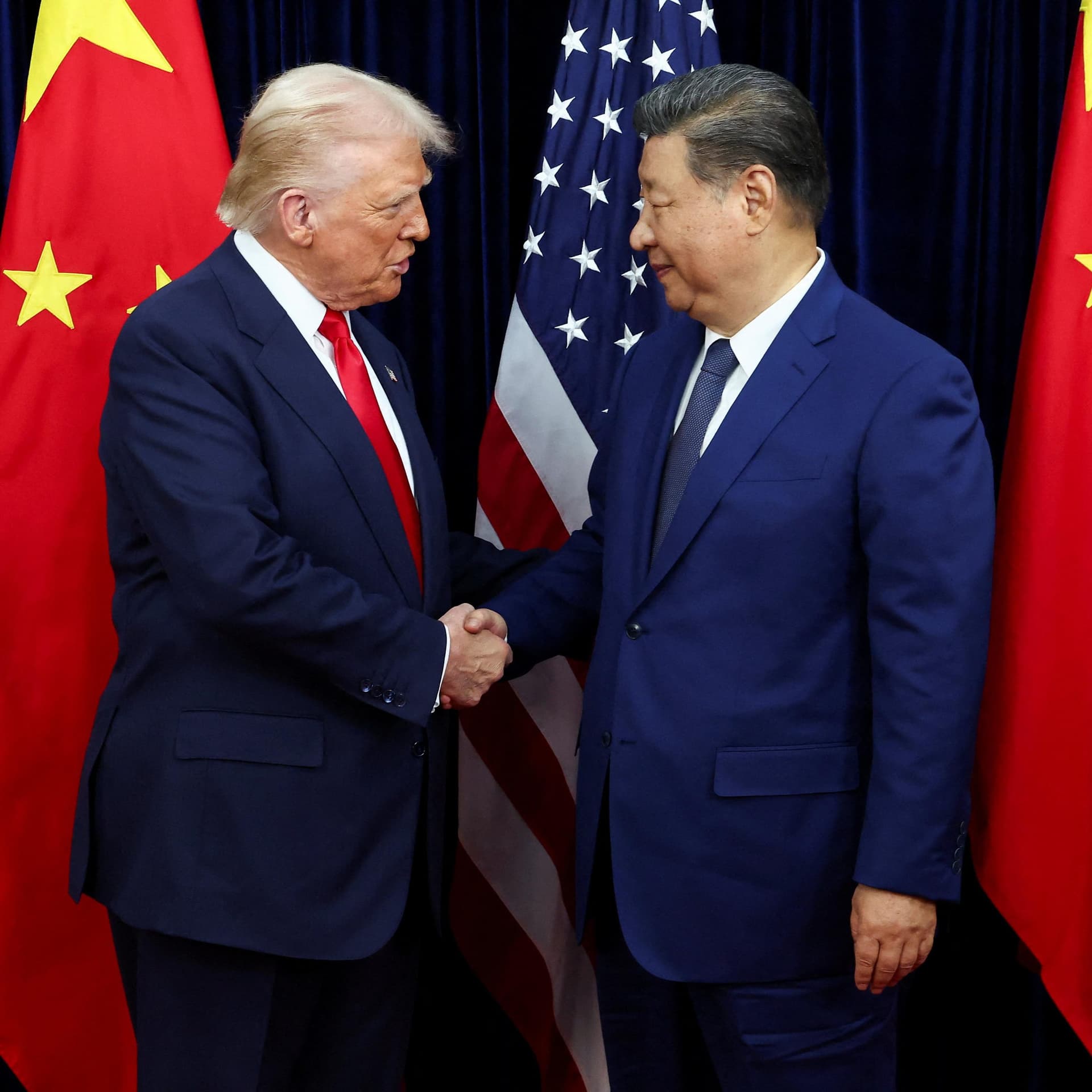
7:11I want to sit in that for a moment and ask you about the power dynamics. And if I could ask you specifically about their handshake. We spoke with our colleague Stephen McDonald the other week, the BBC's Beijing correspondent, and he told us how important the optics of these moments are and how Xi generally allows other leaders to lean in towards him to shake hands, meaning that Donald Trump would have to cross over his own body. And I will say, Laura, now I can't unsee it. I was looking at the photos and the videos, and that is what I now see from all this imagery. But what did you see there? I think what you always see with China is planning and precision.
7:47So right at the start, Mr. Trump appeared on the kind of stage with the flags behind him on his own. Hello, Mr. President. which, you know, it made it look like President Xi was the guest of honor.
8:06And again, yes, Mr. Trump crossed his body to do the handshake.
8:14When you look at this handshake, it is 49 seconds long. Doesn't sound like long, but when you're watching them shake hands... That is awkward. I don't think I could shake someone's hands for 49 seconds. OK, listen, give it a go later. 49 seconds long of the handshake. And you can see President Xi just holding the hand, shaking away, whereas President Trump looked a little bit nervous, not as confident as his counterpart. We know each other well. And he did say at the time, you know, Mr. Xi is a tough negotiator. Mr. President, do you plan to sign a trade deal today? Could be. I think we have a great understanding.
8:55We have a great relationship. We've always had a great relationship. So after the handshake, after that 49 seconds of contact between the two world-leading economies, they then moved into this room where they're sitting across from one another. Well, thank you very much. It's a great honour to be with a friend of mine, really for a long time now, if you think about it. And you can see that they're clearly eyeing one another up. Right in the middle of the table, you've got President Xi making absolutely no facial expression whatsoever. On the other side, you have President Trump, who is clearly eager to flatter his counterpart.
9:35But President Xi is a great leader of a great country. And I think we're going to have a fantastic relationship. And eager to try to get a deal done. And we will be having some discussions. I think we've already agreed to a lot of things and we'll agree to some more right now. But there was absolutely no moving President Xi from his script. President Trump, it is a great pleasure for me as well to meet you. And it feels very warm seeing you again because it's been many years. He spoke through a translator about the two leaders being at the helm of a ship during stormy seas. Given our different national conditions, we do not always see eye to eye with each other.
10:20And it is normal for the two leading economies of the world to have frictions now and then. It was low key, but it signaled to me that the Chinese were there, as I said, to negotiate, but certainly not capitulate. I look forward to exchanging views with you on questions important for our two countries and the world. Well, then these were very brief remarks they made. And then she and Trump thanked the reporters. And that signaled that the open part of this all was done. And that's when the real discussions began. And I will say, like a lot of these kinds of bilateral meetings, the discussions don't happen under the eyes of reporters.
11:00And we have to wait and see what actually transpired. And in this case, in very classic President Trump style. I'm going to tell you, this is a rough flight. You could have waited an hour, maybe. He goes on Air Force One afterwards on his way back home to the United States and essentially, you know, live streams a press gaggle about the meeting. They're going to be watching Trump. They're going to say he didn't look too good. He's got the shakes. I don't have the shakes, but people are going to think I do. And we learned a lot about what he thinks transpired. I thought it was an amazing meeting.
11:44Hi there, I'm Asma Khaled. And I'm Tristan Redmond. And together we're the hosts of the Global Story podcast from the BBC. For those of you who might be new to our show, we here at the Global Story dive deep every weekday on one big story at the intersection of where the world and America meet. And you can now watch the Global Story on the iHeart app. Catch every brand new episode every weekday. Just tap into iHeart to start watching. And we hope you enjoy the show.
12:16Well, I want to ask you, Laura, you know, in terms of even a deal, all we really know is largely from the words of President Trump. We've come to conclusion on many very important points. And I think it's worth taking through one by one some of the key topics that came up during his press Q &A on the play. So if I can, let's begin with fentanyl. We, on fentanyl, we agreed that he was going to work very hard to stop the flow. You know, it's a very complex subject. That was one of the first issues that reporters asked him about. And I wondered if you could give us a sense of what the status is between the United States and China around fentanyl.
12:54So the problem that America sees is they believe that China provides or is certainly exporting the chemicals needed to make fentanyl to the likes of Mexico and elsewhere. And then, of course, it's made into the drug and heads to the United States. Right from the offset way back when Donald Trump announced the tariffs and said that it was to do with the fentanyl trade. This was shortly after he was inaugurated. Yeah, I mean, it was just a few days afterwards. So China put on a press conference where we were all handed this pack on what they were doing to crack down on the fentanyl trade. So they have refuted this all along.
13:32They say that they are doing what they can, that they are cracking down on the gangs that are smuggling these chemicals out, that they're doing the best to monitor them. That is what the Chinese government believe they're doing. As you know, I put a 20 % tariff on China because of the Penta-Roll coming in, which is a big tariff. And based on the statements today, I reduced it by 10%. As a result of that, we saw President Trump tell reporters that instead of the 20 % tariff on China because of fentanyl, he has reduced it down to 10 % because of the conversation he had with Xi Jinping. That's right.
14:11So those extra tariffs that we've seen within the last six, seven months of the Trump administration, those will be dropped. It's interesting, though, that Trump seems to be agreeing to lower tariffs here without a specific concrete commitment from the Chinese government that we know of. What do you make of that? I think there's an expectation that politics will be open in China. It is incredibly and always incredibly opaque. So I think it's hard to know what China has agreed to unless they're willing to, and perhaps they will, agree to release the details in the near future. Let me shift to another big topic of discussion, and that is rare earth minerals.
14:58But all of the rare earth has been settled. And that's for the world, you know, worldwide. This is a phrase, I will say, that was not really used in the American lexicon much at all, but it feels like we talk about it a lot nowadays here in Washington. So we continue to produce the rare earths and buy the rare earths and everything else, you know, when you see from other countries. But China is, that whole situation, that roadblock is gone now. I know you've done some really interesting reporting around rare earth minerals in China. could you explain what in fact we're actually talking about? So China is the biggest processor of rarests.
15:3690 % of all processed rarests come out from China. So what are they? So when you go, basically, it is a huge mine that they dig deep down and extract these minerals. And these are the kind of minerals that are needed for everything from the smartphone you have in your pocket, the Bluetooth headphones that you might be wearing, wind turbines, electric cars. And of course, I think crucially for the United States, military equipment. Now, anybody who makes anything will need some of these elements to produce these modern items that we now really can't do without. All of that is within China's control.
16:16And when you speak to analysts, they'll say that China slowly over the last 10 years has created a stranglehold over these rare earths. President Xi seems to have realized the leverage and the economic weight that these rare earths mean to the world. And so they restricted access to many US manufacturers. And within the last month alone, they put out a message saying that anybody who wanted these rare earths would actually have to come and ask the Chinese government for permission. So if you're a company, for instance, you have to tell them exactly what you're going to use these rare-ass for and ask permission.
16:54It does seem, according to Donald Trump, that those rare-ass limits have now been removed. And we've had, just to give you some hope that we do get information from the Chinese government, we have had information from them that they will lift those restrictions. Ah, OK. But for one year. One year. So it's a temporary truce. I would say it's a temporary truce. This is not a trade deal. Every year this is going to have to be renegotiated. So we're looking into a very different situation perhaps in one to two years' time than we are now. Do you have any sense of why this temporary agreement was reached?
17:34I think from Beijing's perspective, they're being pragmatic. As I said, they are willing to negotiate. They're just not willing to cow-tow to Washington. But I think internally they're facing domestic challenges, economic challenges that they need to overcome. So I think from China's perspective, it makes sense to do a deal. From Washington's perspective, they really need these rare earths. They really need China's minerals for now. Okay. So this seems to be an actual concrete development, that the controls that the Chinese government had put on exporting some of these rare earth minerals that are so coveted to make so many different things, that those controls have been lifted for one year.
18:19That's right. And Laura, there are two important topics that it seems were really not talked about much, and that is TikTok and Taiwan. Can I first ask you about TikTok? Because TikTok makes a lot of news here in the U.S., and we know there has been bipartisan in consensus over the months to ensure that TikTok is not a Chinese-owned company. When it comes to TikTok, I think that's an easy win for China. I think at the start, they've made a lot of noise about not wanting to capitulate. But I think when it comes to the ownership of TikTok, I think there will be a deal. They've been negotiating it for months now.
18:57So what do you make about the fact that it just didn't seem like it was brought up or we didn't hear about it. What you've got to understand is all of these issues have been discussed thoroughly by teams before the two presidents have come in the room. China doesn't do top-down diplomacy. It doesn't do president-to-president diplomacy. It likes lots of groundwork. So basically all the documents will have been prepared for both leaders to kind of quickly discuss and go through the final point. When it comes to TikTok, I think China has said it will facilitate where it can. So I think we'll need to, it's not a done deal, but it's on its way to being a done deal.
19:38Okay. Well, let me ask you about the other, I would argue, very high stakes issue that was not discussed according to President Trump, and that is Taiwan. Why would that have not been discussed? I would say that's a win for China. I mean, when you look at the number of military incursions, China has been making into Taiwanese airspace and around the seas on the Taiwan Strait, the US didn't bring that up. I think the win for China is that it wasn't part of the discussions. But also the win for the United States is that in not bringing it up, it doesn't give China a chance to push Washington to stop selling military aid to Taiwan.
20:22Yeah, I have recalled over the years, American presidents, it seems, have always taken the opportunity to bring up Taiwan. I traveled with President Biden when he met with Xi Jinping, what was it, just last year, November of 2024. And he did bring up Taiwan. It's something that I felt like American presidents felt like it was their obligation to just make sure that the Chinese government knows where it stands. Ah, Mr. Trump said it wasn't discussed. Fascinating, fascinating. Laura, there was a reporter on Air Force One that asked President Trump about this truth social post that he put up on social media just before he went into the meeting with Xi Jinping.
20:58Why did you write your truth social about nuclear testing? What about resuming nuclear testing? What prompted you to do that right before the meeting? And let me read it to you briefly here. The president just posted this evening, a couple of moments ago, actually. President Trump said the United States has more nuclear weapons than any other country. Quite a significant social media post saying that the United States has more nuclear weapons than any other country. He goes on to say that Russia is second, China is a distant third, but will be even within five years. The president says he's instructing the Department of War to start testing our nuclear weapons on an equal basis.
21:36And he says that process will begin immediately. Why did he post this? seem to be a bit of a thing to needle China right ahead of the meeting to post this. I'm not sure it needles China. China's actually ahead on the likes of developing nuclear power, if not nuclear weapons. I think when it comes to this kind of post, I think testing nuclear weapons, was it an indication or was it an attempt by President Trump to show strength, to show the U.S. military strength, to say, look, you know, we're much stronger than you on this? we were all a bit kind of stunned by that message. We're not quite sure what it was aimed at.
22:20And I think when it comes to those aspects of military testing, what message does that send to China? If the US is lifting its moratorium on nuclear testing, can China say, well, yeah, OK, we'll do that too. What message does it send to Kim Jong-un, who hasn't done a nuclear test for several years? If the US can test nuclear weapons, can we do that too? So it's an interesting message to send at this time. But overall, I guess on the scale of from zero to 10, with 10 being the best, I would say the meeting was a 12. I think it was a 12. Trump called the meeting a 12 out of 10. We, of course, have to wait and see if Xi agrees with Trump's assessment.
22:58Do we know if he agrees with that assessment? We're not going to hear from President Xi now. I think he may reference the meeting, but that's not the way China works. So we're not going to see a live streamed press gaggle from Xi Jinping? Absolutely not. He said on remarks that were put on state media that the two sides had reached a consensus. That's perhaps as excited as China will get about this for now. So President Trump had this meeting with Xi Jinping, and then he flew out immediately. He's now here back in Washington. How has he left Xi there in Asia? I think this is one of the interesting points.
23:36So President Trump did his fist pump, got on Air Force One, made all these remarks about how the trade deal had gone. And of course, now he's back in the United States. Meanwhile, President Xi's motorcade is now making its way through the streets of South Korea. He will attend this summit. You're talking about this APEC summit. The APEC summit, which is around 60%. The world leaders make up about 60 % of the world's GDP. And I think when you're looking at where China is now, it is increasingly at the centre of these global gatherings. You are seeing China emerging as a far more confident world leader.
24:20And now, over the next few days, you will see President Xi alongside these world leaders at the APEC summit while there is a seat absent because President Trump hasn't stayed for the summit. He came, said a few words at the start, and he's left. He's left ahead of all of this gathering. That is fascinating. So it sounds like President Trump and the United States is kind of conceding the terrain, you're saying, to China, that this is a big summit, of which the United States is a part of. But Trump had his meeting with Xi, waved goodbye, and is on his way now. There are many countries, including the one that I'm sitting in right now, including South Korea, who are caught between basically a rock and a hard place.
Read the full transcript
25:05They're caught between the two superpowers. And in the past, being an American ally was something that was reliable. And now I think many people are asking questions, including, as I said, we've seen protests on the streets of a key US ally here in South Korea. Many American allies are looking at where they stand, not just with America, but also now with China. Yes, they're never going to turn their back on the United States, but they're also pragmatic. They want to reach the hand of friendship and perhaps do business with China. And I think that's going to be the narrative going forward, especially as the Trump administration moves away from areas like Asia.
25:51Yes, he's had his grand tour right across Asia. Yes, he's been welcomed with open arms. But the truth of the matter is, whether it's Southeast Asia, whether it's Japan or South Korea, they need both superpowers and they need both superpowers to get along. And at least with this meeting, it is a start.
26:12Well, Laura, thank you very much for taking the time to speak with us. I know you've had a very busy few days and sounds like it's going to continue to be some busy, busy days in South Korea, whether or not President Trump is there. Yep, we've got a busy few days and then I head back to China where we hope to see maybe one day you can come and visit. That was Laura Bicker, the BBC's China correspondent. And folks, before we go, we have got a quick update from London on a story we covered last week. King Charles is stripping his brother Andrew of his royal title as prince. Andrew, who has always denied any wrongdoing, has been under mounting pressure to explain his relationship to the convicted pedophile Jeffrey Epstein.
26:58The King and Queen said their thoughts and utmost sympathies have been and will remain with the victims and survivors of any and all forms of abuse. If you want the backstory on all of this, I encourage you to check out our episode from October 22nd with Emily Maitlis. She did a remarkable interview with the now former prince. And folks, that is it for today's episode of The Global Story. This episode was produced by Hannah Moore, Zandra Ellen, and Annie Brown. It was engineered by Travis Evans. And our senior news editor is Chyna Collins. We want to wish you a happy Halloween from here in Washington, D.C.
27:37We hope you have a wonderful weekend. Thank you as always for listening, and we'll speak to you again on Monday.
27:59Hi there, I'm Asma Khaled. And I'm Tristan Redmond. And together we're the hosts of the Global Story podcast from the BBC. For those of you who might be new to our show, we here at the Global Story dive deep every weekday on one big story at the intersection of where the world and America meet. And you can now watch the Global Story on the iHeart app. Catch every brand new episode every weekday. Just tap into iHeart to start watching. And we hope you enjoy the show.
From the publisher
On Thursday, Donald Trump and President Xi Jinping of China held a closed-door meeting in South Korea. The subjects of negotiation ran the gamut — from rare earth minerals, to fentanyl, to computer chips — and, according to President Trump’s subsequent news conference, the two parties reached a long-awaited deal. But exactly what did the world’s two most powerful men agree to? The BBC’s China Correspondent, Laura Bicker, joins us to discuss.
Producers: Hannah Moore and Xandra Ellin
Executive Producer: Annie Brown
Senior News Editor: China Collins
Mix: Travis Evans IMAGE: U.S. President Donald Trump shakes hands with Chinese President Xi Jinping as they hold a bilateral meeting at Gimhae International Airport, on the sidelines of the Asia-Pacific Economic Cooperation (APEC) summit, in Busan, South Korea, October 30, 2025. REUTERS/Evelyn Hockstein.