
In short
Life in Gaza after the first phase of a ceasefire (starting Oct 2023) and what’s blocking the second phase, amid shifting global attention to Iran and Lebanon.
Guests
Yolande Nell, BBC Middle East correspondent (reporting from Jerusalem; interviews and analysis based on sources and a freelancer in Khayunas, southern Gaza).
Key claims
More than 760 Palestinians have been killed since the ceasefire began; about 72,000 killed since Oct 7, 2023. Humanitarian aid and debris removal remain limited because Israel restricts “dual-use” equipment (e.g., rubble-removal tools, sewage/water/electricity parts). Winter conditions are dire: tents, sewage problems, rats/rodents, scabies outbreaks; medical evacuations via Rafah are only a trickle. Hamas is reasserting control: policemen patrolling, checkpoints after 9pm, taxes on goods/services, partial salaries, and recruitment; Israel still controls over half of Gaza via a “yellow line.”
Notable examples
People say “nothing’s changed” (shelling continues; high prices; living off soup kitchens). Iran war effects: inflation and supply disruptions from Israel. Phase two: a technocratic committee and an international stabilization force are not operating inside Gaza; disarmament is the major sticking point. Hamas rejects Nikolai Mladenov’s disarmament framework; Israel insists Hamas must be disarmed or war will restart.
Written by AI. May contain mistakes. Listen to the episode to check what was said.
Chapters
Tap a time to open that second in VOIntroduction to the Situation in Gaza
0:42 to 0:57
Overview of the ceasefire in Gaza and shifting global attention.
“With the new Schwab Teen Investor Account, teens can gain hands-on investing experience and build positive money habits.”
Introduction to the Situation in Gaza
1:00 to 1:55
Overview of the ceasefire in Gaza and shifting global attention.
“In October of last year, the first phase of a ceasefire in Gaza went into effect.”
Listener Feedback and Episode Overview
1:55 to 2:58
A listener's request prompts a discussion on Gaza's current conditions.
“So the other day, we got a message from a listener of our show.”
Life in Gaza Post-Ceasefire
2:58 to 4:15
Discussion on the ongoing humanitarian crisis and living conditions in Gaza.
“And to help us do that, I've called up my colleague Yolande Nell, the BBC's Middle East correspondent, who's speaking to us today from Jerusalem.”
Challenges in Humanitarian Aid
4:15 to 5:48
Exploration of the difficulties faced by aid agencies in delivering assistance.
“They haven't managed to get in the caravans that people were hoping for.”
Impact of Regional Conflicts
5:48 to 7:40
Analysis of how the Iran war and other conflicts affect Gaza's situation.
“Aid agencies are still having a lot of difficulties, as we've covered in recent months, when it comes to access to Gaza.”
Hamas's Control and Influence
7:40 to 12:12
Examination of Hamas's reassertion of control and public perception in Gaza.
“And there's a lot of uncertainty about where things are going.”
Phases of the Ceasefire Agreement
12:12 to 14:00
Clarification of the different stages of the ceasefire agreement and its implications.
“So they still have some of the infrastructure, you're saying, some of the political infrastructure there as well.”
Ceasefire Stages and Challenges
14:00 to 16:46
Learn about the stages of the ceasefire and the challenges faced in Gaza.
“So, I mean, first of all, loosely speaking, the first stage of the ceasefire was when the Israeli hostages were being released in exchange for Palestinian prisoners and detainees being released by Israel.”
Role of Nikolai Mladenov in Peace Efforts
16:46 to 18:08
Discover Nikolai Mladenov's role and efforts in the peace process for Gaza.
“And does Israel and Hamas see this as being part of phase two?”
Show all 12 chapters
Disarmament Dilemmas
18:08 to 21:06
Understand the complexities surrounding Hamas's disarmament and its implications.
“My office, together with the guarantor states, the United States, Egypt, Turkey and Qatar, has developed a comprehensive framework for the decommissioning and reintegration of armed groups in Gaza.”
The Future of Gaza Amidst Political Shifts
22:22 to 27:46
Explore the future of Gaza amidst shifting political dynamics and hopes for reconstruction.
“Visit We Feed Raw at wefeedraw.com to get started today.”
Transcript
Automatic transcript. May contain errors.0:00This BBC podcast is supported by ads outside the UK.
0:30No bouncing between tabs. And best of all, no spreadsheets. Stop managing software and start managing your business with one unified system. Try for free today at odoo.com. That's O-D-O-O dot com. With the new Schwab Teen Investor Account, teens can gain hands-on investing experience and build positive money habits. It's an account co-owned by you and your teen, so you can monitor and engage with the account while your teen learns how to invest and manage money. Learn more at schwab.com. In October of last year, the first phase of a ceasefire in Gaza went into effect.
1:09At the time, there was a sense of relief that the daily destruction in Gaza might end, that the remaining Israeli hostages held by Hamas since October 7th would be released. President Trump spoke about peace and prosperity. And even if some in the region felt his plans were unrealistic, his team was nonetheless focused on the region. But in the months since, with Venezuela, then Iran and Lebanon, Trump, his diplomats, frankly, the world's attention, have all been diverted elsewhere. What does that mean for the people in Gaza and the international pressure for a lasting ceasefire? From the BBC, I'm Asma Khalid in London.
1:53And today on The Global Story, with all eyes on Iran and Lebanon, we ask what's been happening in Gaza.
2:05So the other day, we got a message from a listener of our show. Hello, Asma and Tristan. I'm so happy to be writing to you. Randolph emailed us at theglobalstory at bbc.com with an idea. I was wondering whether it might be possible for you to make an episode about the current situation in Gaza and what lies ahead. It seems international attention has shifted away from Gaza. That's why I would really appreciate an episode exploring the current situation there, the daily lives of civilians, and the latest development regarding the second phase of the ceasefire. Thank you, Asma, Tristan, and all the fantastic producers.
2:48Love you. Cheerio. Well, thanks for messaging, Randolph. You asked, and we shall deliver. Today on the show, we're going to explore what is going on in Gaza these days. And to help us do that, I've called up my colleague Yolande Nell, the BBC's Middle East correspondent, who's speaking to us today from Jerusalem. Hello, Yolande. Hi, Asma. Can you hear me? Hi. Pleasure. Yes. Thank you. Thank you.
3:17Yolande, when the ceasefire was first announced, it seemed like there was relief amongst many Gazans. Now, here we are having this conversation more than six months later. And I just want to begin with a really broad question, which is what is life like now after some of that initial relief died down and some of the world's attention has indeed shifted away? To tell you the truth, I mean, important to begin with, you know, this is not a full ceasefire that has been in place for the past just over six months. And according to the Hamas-run health ministry, more than 760 Palestinians have been killed in the course of this last period of time.
3:54And that brings us to more than 72 ,000 people. The number have been killed since the deadly Hamas attacks on Israel on the 7th of October 2023, which triggered the war in the first place. And what we're hearing from people on the ground is just dire in terms of the humanitarian situation. It's been a really harsh, wet winter. People are still living in these makeshift tents. They haven't managed to get in the caravans that people were hoping for. And they're telling us that there are problems with the sewage systems. There are now these infestations of rodents, of rats, and people saying there are outbreaks of scabies.
4:29Thousands of people waiting to leave Gaza to go for medical treatment overseas. Although the Rafa crossing with Egypt is open for some of those medical evacuations, you only get a trickle of people who are going out. Yeah, I was going to ask, one of the key aspects I recall of the ceasefire was that more humanitarian aid would get into Gaza. Has that happened? I mean, one of the complaints of aid agencies saying they're still missing a lot of key equipment. There's not enough equipment to remove the rubble in Gaza. They're not able to get in replacement parts for some vehicles and to fix infrastructure like for water and for sewage and for electricity.
5:06And that is because, although that was promised as part of the initial stage of the peace plan, a lot of the individual items that they're asking for, Israel considers them to be dual use, meaning that they could be used by Hamas perhaps to rebuild their tunnels. So that is an ongoing difficulty. You know, a huge amount of our effort is spent negotiating for the smallest crumbs. Bushra Khalidi from Oxfam says the work of aid agencies is impeded. like a crossing to reopen or a few litres of fuel. So progress towards recovery is limited and almost not there, really. We're not seeing large-scale debris removal, and there's still nowhere near enough fuel to run power systems.
5:48So this is basic survival in Gaza. Aid agencies are still having a lot of difficulties, as we've covered in recent months, when it comes to access to Gaza. Journalists are still not able to go into Gaza from outside. The Israeli authorities are not allowing that. We've got an ongoing court case to challenge that. And then markets have food. We can see that in some of the footage that is sent to us, that private merchants are able to bring in large amounts of food. So the markets look much more well-stocked than they did at certain points during the course of the war. But what people are saying is, of course, prices are high and for most people, work is hard to come by.
6:24Many people just can't afford those basic goods. We eat the food available from the soup kitchen. We live off it. I swear, nothing's changed since the ceasefire. We were only happy because the constant bloodshed had stopped.
6:43Yolanda, I know that your team has been out on the streets in Gaza speaking to people for the global story. Can you give us a sense of where they went and what all you asked them, what you heard? So we asked one of our regular freelancers in Khayunas in southern Gaza to go out and speak to people and ask them how their lives have changed since the October ceasefire. came into effect. And actually what we heard from many of them is quite depressing.
7:11The shelling is still ongoing and prices are still high. Everything remains the same. Nothing has changed. They have fleas there and mosquitoes biting them now that the weather is getting warmer as well as these rats. It's much harder than before. There is no life. My child wakes up at night and keeps scratching because of mosquitoes, fleas, weasels passing by or rats. There are insects everywhere. And there's a lot of uncertainty about where things are going. And that's been caused by the Iran war as well and regional attention really sort of being diverted away from Gaza. The Iran war has not changed anything.
7:55In fact, it has made the situation worse for us. Goods have decreased. The Iran war has driven prices up and caused even more shortages. It has not brought us peace or anything new. Rather, the situation has deteriorated further.
8:13People are extremely worried right now, and it's just a very sort of vivid picture of how tough living conditions are for people. You alluded there to the fact that the Iran war has changed the situation in Gaza. How would you say so? I mean, there are some immediate ways in which it affected everybody's lives in terms of inflation. So prices went up for foods in the market. And we actually spoke to some small business owners and they were saying one of the issues they were having is that the war actually caused a lot of disruption inside Israel, where they're having to import goods from. And transportation became much more difficult because of the Iranian attacks that were taking place.
8:54And so that led to disruption of supplies going into Gaza. That pushed up the prices. We've also had NGOs talking about how, because they are buying their foods in Gaza and using fuel there as well, they're saying that the cost of all these going up also made them sort of less able to sort of meet the needs of people. You now have in the region, just not very far away, another humanitarian catastrophe demanding attention as well, diverting attention away from Gaza. When you look at what's happening in Lebanon, with more than a million people displaced by the fighting between Israel and the Lebanese armed group Hezbollah.
9:30And at the same time, resources and attention have shifted too, because a lot of the key players in this region, Egypt, Turkey, the Gulf Arab states, they were all caught up in the last six weeks or so in dealing with the situation with Iran. And of course, in the case of the Gulf Arab countries, they found themselves on the front lines of this war. I've been reading in some of your reporting, some of our colleagues reporting there in the region, that Hamas has been reasserting control in Gaza. How do you all see that showing up? Is that happening in the form of territory gains or territory regains?
10:06Is that happening in the form of police and security controls? How are you seeing Hamas reasserting control? I mean, this is something that people that we work with in Gaza have been telling us is very visible, that you start to see Hamas policemen on the streets patrolling and that after nine o 'clock at night, there are often these checkpoints that are set up where people are stopped. We heard from business owners that Hamas is also putting taxes onto some services as well as basic goods in an order to gain some funds. And it does really seem that Hamas has been using this moment with attention diverted elsewhere to reassert its authority.
10:47And we're also hearing of municipalities and ministries, Hamas trying to get its services back up and running again to kind of show to people that it remains there as a force to be reckoned with. Just at this very sort of tricky stage when international actors are putting pressure on Hamas to disarm for the next stages in President Trump's 20 point peace plan to be advanced. And how much of the territory in Gaza does Hamas currently control? I mean, my understanding is that when Israel came in, they also do maintain control of a vast amount of Gaza as well. So yes, under the terms of this peace deal, Israeli troops withdrew, but they're still controlling more than half of the Gaza Strip.
11:33They've set up what's been called this yellow line inside Gaza, and that is the north, the south, and the edge of Gaza, where it neighbors Israel. And then Hamas is largely sort of in the other sort of towns and cities, densely populated places, where you find most of the two million population of Gaza living right now. They're less obviously visible before they were basically the government of Gaza, but they are still there very present. And what we hear from people also is that continuing to pay thousands of workers who were working for them in sort of different government roles. They're still getting at least partial salaries.
12:14So they still have some of the infrastructure, you're saying, some of the political infrastructure there as well. Indeed, and it looks like they've also been trying to recruit more of these Hamas police officers in recent weeks. And it's very much Hamas police who have been a target of Israeli airstrikes, although civilians have also been killed in recent weeks. Israel says it's targeting Hamas. It's going after both commanders of its military wing who are still there, but also very often we hear about, you know, police, groups of police who have been targeted. Are people speaking to you openly about Hamas?
12:51I mean, you say that they are reasserting control. Do you have any sense of whether the group is popular amongst the population there? Certainly what happened after the start of the war is we had a lot more people coming out criticizing Hamas for its actions in Gaza, people blaming Hamas for the dire state of affairs, as well, of course, as Israel. And polls suggested a real drop off in support, particularly in Gaza. People are now in a position, I would say, being less able to be sort of vocal about what they think of Hamas. That's the sort of sense that I'm getting when I'm speaking to people that I know there.
13:31But at the same time, they will, of course, have their supporters, people still in place who are stuck by Hamas, who are aligned with them ideologically. I recall when the ceasefire was first announced, there were three phases of this deal. And in January, we heard President Trump's Special Envoy Steve Witkoff announced the start of phase two. Can you remind us exactly what that means and whether or not, in fact, all the parties here are in agreement about whether we are indeed in phase two? Yeah. So, I mean, first of all, loosely speaking, the first stage of the ceasefire was when the Israeli hostages were being released in exchange for Palestinian prisoners and detainees being released by Israel.
14:16and that was a slow process to get the return of all of the bodies of deceased Israeli hostages but finally that happened and then it was supposed to see also as we mentioned the resumption immediately of a full aid to Gaza. One of the criticisms of Palestinians and of Hamas as a party here is they say that there has not been that full aid that was promised and in particular to rehabilitate the vital infrastructure in Gaza. The second stage of the peace plan was really supposed to be moving into the demilitarization of the Gaza Strip. And seeing this technocratic committee, Palestinians going in to govern Gaza day to day, they're an independent group, as yet they have not gone into Gaza to take up their role.
15:04So that technocratic committee is not at all in Gaza? Exactly. It exists, but it's not in Gaza on the ground. And there's also supposed to be at this stage an international stabilisation force to work with that committee. Now, countries were slow in coming forward to join up to that, but we have heard that there's been commitments from a handful of countries, Indonesia in particular, and that they will send troops to be part of that force. They're not there yet either. What you do have is this civil military coordination centre in the south of Israel, not far from Gaza, where they have been to visit there and they have this huge screen where they can see on the ground what's happening in Gaza in terms of trucks going in.
15:45They can use satellite pictures to zoom in and see what's happening. You have troops represented from different countries around the world, not just those who are saying they're going to go in there on the ground, all trying to support this initiative, which is really US-led, this big Israeli military presence there as well. But at the moment, yeah, on the ground in Gaza, those forces have not gone in. And so we're not seeing really, you know, the momentum to carry things through into the next stage. And the third stage, which still seems far off, is supposed to deal with reconstruction of Gaza, a large scale, a sort of conditions written in there, very conditional sort of points in President Trump's plan about acceptance of Palestinian self-determination as well and a pathway to recognition of Palestinian statehood.
16:37So when we hear the Trump administration talk about the fact that we are now in phase two, is that a reality on the ground? And does Israel and Hamas see this as being part of phase two? I mean, it's pointed out that there are still these issues related to phase one that have not been resolved, but you get the sense very much that the important players here want to move on to phase two. Hamas really having accepted that this technocratic committee would come in to Gaza now is, as I said, trying to kind of reassert its authority. You can see there's a real conflict of interest going on there. One of the other things that's happening is that Egypt and Jordan, as supporters of the whole process, have been training up thousands of Palestinian police officers.
17:24New police officers are supposed to be going into Gaza. And as I mentioned, Hamas has been getting its own police officers, even new recruits out there on the streets in Gaza. So that is a real issue. And the thorny issue for this stage is really about Hamas disarmament. It's been said from the beginning that that was going to be a big, complicated, difficult subject. And that is definitely proving to be the case. I now give the floor to Mr. Mladenov. Welcome. What the head of the Board of Peace, a special representative, a high representative, I think it's called, Nikolai Mladenov has been saying, is that he has drawn up a comprehensive framework working with the technocratic committee for Hamas disarmament.
18:08My office, together with the guarantor states, the United States, Egypt, Turkey and Qatar, has developed a comprehensive framework for the decommissioning and reintegration of armed groups in Gaza. Saying that that will lead ultimately to reconstruction, to the Israeli troop withdrawal from Gaza that people so desperately want to see. Nikola Mladenov, he seems really key to this U.S.-led effort, this board of peace. Who exactly is he? He's actually quite a familiar face in these parts. Originally, the Bulgarian foreign minister had roles in Europe before going to work for the UN. And then he had a UN position in Iraq.
18:45And then he was here in Jerusalem working as the UN special coordinator for the Middle East peace process. And, you know, he was here at a crucial time from the aftermath of the 2014 war in Gaza to sort of try to coordinate reconstruction. So he went into Gaza several times. He was actually seen when he finished his role after a few years as being somebody that the Israelis and the Palestinians could work with, somebody who was quite pragmatic. At that time, I have to say, I interviewed him quite frequently. He was very accessible. But unfortunately, he's not been so accessible since because I think, you know, there's so much going on where they think it's just not helpful to open up to media scrutiny and to further public scrutiny.
19:29He's kind of working quite quietly at the moment, trying to get things done. What's the hang up specifically around the issue of disarmament? So, first of all, you get those within Hamas who will point out that there are all these Israel-backed militia on the grounds in Gaza. They have their own enemies. So when it comes to small arms, there's a lot of resistance in giving those up. The comprehensive plan agreed by the parties establishes the principle of one authority, one law, and one weapon. That principle applies to all armed actors in the Gaza Strip without exception. But what Nikolai Mladenov said when he was speaking to the UN Security Council recently, updating them, is that in the framework that he saw, it would basically be Hamas giving up, first of all, its rockets, its explosives and assault rifles, and the kinds of weapons that Israel, of course, sees as being the biggest threat.
20:22That is the choice before the parties. And that is the choice before this council, too. A renewed war or a new beginning. The status quo or a better future. There is no third option. Of course, for Hamas, this is also about power. We're starting to hear a lot more resistance from members of Hamas when it comes to going ahead with this next stage. They've criticized Nikolai Mladenov a lot. They had a meeting with him and with US officials just recently in Cairo, we understand. Although there weren't big statements afterwards, The BBC heard from its sources that Hamas rejected this framework that Nikolai Mladenov has put forward.
21:06What they have said publicly, some Hamas leaders, they're accusing him really of working in Israel's interests, trying to sort of change the terms of the original ceasefire deal. Things do really seem to be at the moment at this really sort of critical stage, and they appear to be stuck.
21:57Yolande Knell:We Feed Raw nutrition experts. No fillers, no artificial preservatives, just real ingredients that support your dog's whole body health. That's why many pet parents see real changes after switching to We Feed Raw's fresh meals. If you want to feed your dog one of the healthiest diets possible, We Feed Raw makes it simple. Right now, new customers can get 40 % off their starter box, plus free shipping. Visit We Feed Raw at wefeedraw.com to get started today. You mentioned that Hamas has had some criticism of this envoy, Mladenov, of his plan, that they seem skeptical of it. What is Israel's viewpoint?
22:38I mean, Israel has been very clear that Hamas has to be disarmed. Otherwise, it will disarm Hamas, meaning that it will renew its military offensive in Gaza against Hamas, that the war there could basically restart. And that is one of the reasons why people in Gaza are so worried. I mean, the Americans have actually picked up some of the same phrasing from the Israelis as saying that, you know, if they don't agree, then they'll have to be made to give up their weapons. That demilitarization of Gaza will happen regardless. So the stakes really are very high at the moment. And one of the other considerations is, of course, that as Israel may, under U.S.
23:19pressure, Iranian pressure, as there's moves for a sort of wider regional peace deal, that Israel's military may turn its attention back to Gaza more. And that could see new military offensives there, more airstrikes. That's certainly something that people have been saying that they're worried about and that they're mentally trying to prepare themselves for. Yolanda, we're having this conversation more than six months after the initial ceasefire deal was announced. And I really do recall at that moment, there was an initial sense, it felt, of hope that something might change here. And now we're having this conversation in the context of so many of the headlines, so many of the stories shifting away and focusing on Iran, focusing on what's going on elsewhere, say in Lebanon.
24:10on. What's your sense of what's next for Gaza and whether that immediate sense of hope still exists? I mean, a big fear for people is going to be, is there that kind of money there still that was being talked about? Arab countries giving millions of dollars in terms of reconstruction when they now have to rebuild some of their own infrastructure that has been under fire over the past, you know, more than a month now. And then on top of that, is the Trump administration going to be focused on other things, even in the Middle East? And obviously, it is that very personal involvement of key officials in the Trump administration that has helped sort of push things through, helped advance them up to now.
24:56You know, I've been wondering that very point. We see big U.S. players like Steve Witkoff, Jared Kushner, who are now very involved in other talks as it pertains to Iran. And you've got to wonder when those senior figures, very trusted by President Trump, are not really as focused on this all, what that means when the attention and the dynamics change. Yeah, I mean, because they laid out whether or not it was realistic. A lot of people were debating that at the beginning of the year. But, you know, it's not so long ago that they were laying out these grandiose plans for skyscrapers and rebuilding Gaza in quite a systematic way.
25:31There was that big meeting that followed on of heads of state and senior officials for the Board of Peace with President Trump presiding over that. Even then, that seemed very sort of jarring when you looked at some of the pictures that were on the ground, have this sort of glittering event versus the kind of grim reality. But I think, you know, people are very cynical after all that they've been through, after all the setbacks that they have had. But there are some things to find hope in, particularly in the last few months. There's these big moves to get a couple of hundred thousand caravans into Gaza so that people can live in those and start to improve their living conditions.
Read the full transcript
26:09You feel that if some small things could happen, if attention does come back to Gaza in a more positive way, then things could progress. At the moment, there is also an internal division, it seems, within Hamas itself. and the Iran war has added to that because there are leaders of Hamas who have spoken out very much in favour of Iran. Other countries in the region that had previously hosted them, like Qatar, increased hostilities with them and there's sort of lots of dynamics shifting. That's how it feels. I mean, in terms of what's next for Gaza, you really feel that there has been this lull in violence, even if it hasn't stopped altogether.
26:50And it's given people a glimpse of hope And although there are so many depressing pictures that come out, some of the most hopeful ones, some of the most inspiring ones I've seen are the pictures of children who are going back to school, restarting their education, having some structure once again in their lives, having an ordinary child's focus in their daily life beyond just survival, which is how it has felt for much of the past two years.
27:21if only international attention can come back in this direction it's quite sort of tantalizing that there is a framework there to return to and you just think that there is in these kids there is hope there for the future
27:43well Yilan I know you need to run so thank you so much though for for sharing your reporting and your analysis with us. Okay, thanks a lot.
28:02That was the BBC's Middle East correspondent, Yolande Nell. And a special thank you to Randolph for writing in. As you can tell, we love hearing from listeners and we do read the messages, so please keep them coming. If you have any ideas or questions for us, you can send us a note at theglobalstoryatbbc.com. And a quick note, please don't forget to rate the show and review us if you enjoyed listening. It really helps other people find us. Today's episode was produced by Sam Chantarasek, Lucy Paul, and Zandra Ellen. It was edited by James Shield and mixed by Travis Evans. Our digital producers were Matt Pintus and Tom Bage.
28:39Our studio managers were David Evans and Mike Regard. Our senior news editor is Chana Collins. And I'm Asma Khalid. Thanks as always for tuning in, and we'll talk to you again tomorrow.
From the publisher
When the ceasefire deal was announced more than six months ago, there was celebration and relief in Gaza and Israel. But since the US-led Board of Peace announced plans to rebuild Gaza, the Trump administration’s attention has been occupied by other matters.
The success of the ceasefire deal hinges on Hamas disarmament and the full withdrawal of Israeli troops. So what progress has been made?
We speak to Yolande Knell, the BBC's Middle East correspondent, about life inside Gaza since the Iran War began.
Producers: Sam Chantarasak, Lucy Pawle and Xandra Ellin
Studio managers: Dafydd Evans and Mike Regaard
Executive producer: James Shield
Mix: Travis Evans
Senior news editor: China Collins
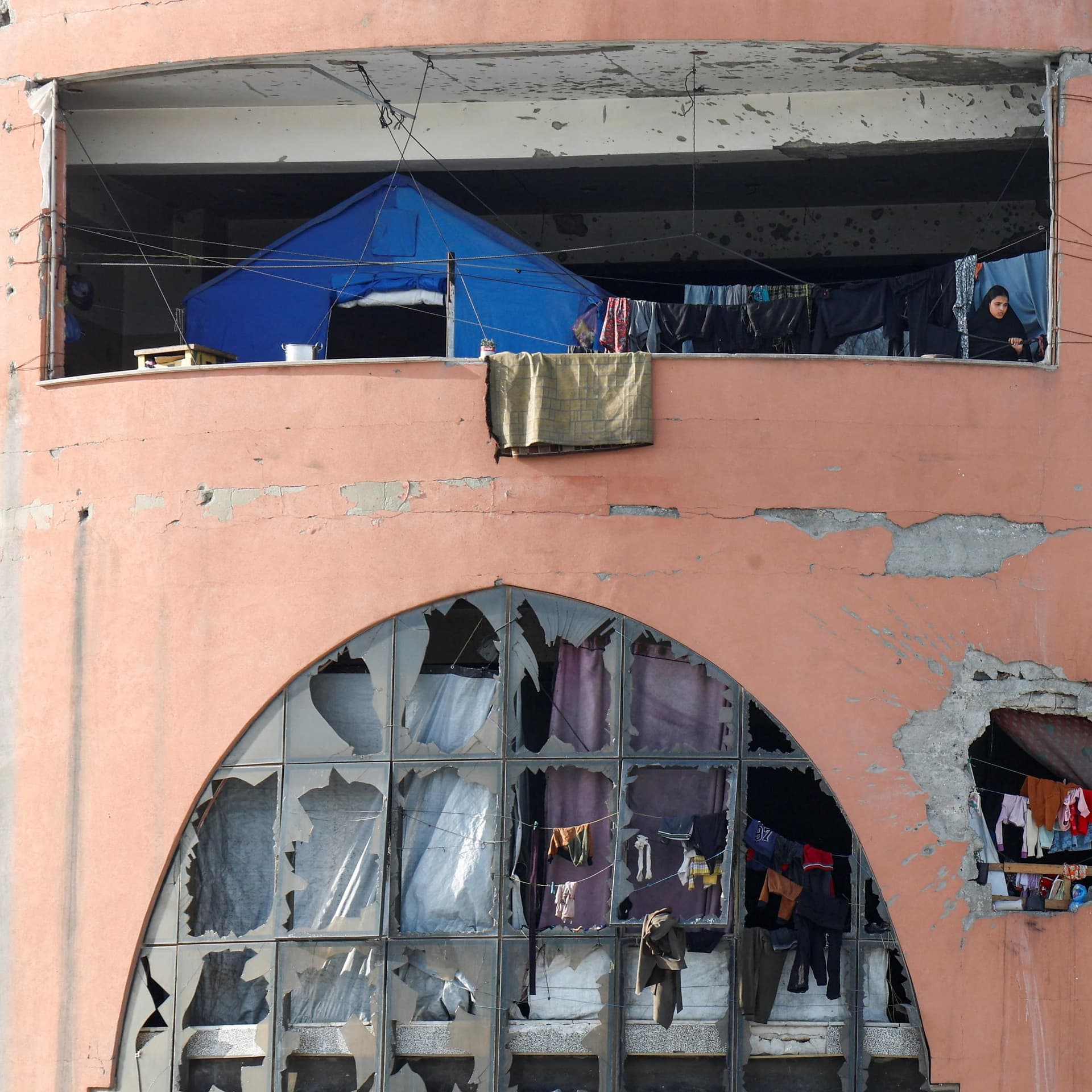
Photo credits: A displaced Palestinian woman stands on a balcony inside a building damaged during the war at Al-Aqsa University, now used as a shelter, in Khan Younis, southern Gaza Strip, April 5, 2026. Photo: Reuters/Haseeb Alwazeer.