In short
After Venezuela’s June 24 double earthquake, the episode asks “who is really running Venezuela?” It links disaster response and political control, arguing U.S. influence—especially via oil revenue—shapes decisions even after Nicolas Maduro’s removal.
Guests
Will Grant (BBC reporter; inside Venezuela after the late-June earthquake; interviews residents and officials; reports on U.S. aid and political oversight). Also referenced: Gabriel Becker (World Central Kitchen distribution manager) and U.S. officials (e.g., CENTCOM, State Department).
Key claims
Venezuelans see the U.S. as effectively directing major decisions through oil control; Delcy Rodríguez is viewed as operating under Washington oversight. Disaster response is criticized for slow initial rescue and heavy machinery delays, with resentment toward government leadership.
Notable examples
Playa Pirata rescues; fisherman Victor Calderon (home destroyed; 26 family members lost); Hernán Gil pulled from rubble after eight days; Laura Barrios’ family searching after machinery was withdrawn. Dead estimates: official deaths just over 5,000; belief up to 40,000–50,000.
Written by AI. May contain mistakes. Listen to the episode to check what was said.
Chapters
Tap a time to open that second in VOThe Aftermath of the Earthquake
1:12 to 3:30
Will Grant shares his observations of the devastation and chaos in Venezuela following the recent earthquakes.
“And today on The Global Story, the BBC's Will Grant joins us from inside Venezuela.”
Personal Stories of Loss
3:30 to 6:15
Will recounts harrowing personal stories of Venezuelans affected by the earthquake, highlighting the human impact of the disaster.
“And they ran towards the buildings or they ran towards...”
Community Support Amidst Tragedy
6:15 to 9:11
Exploring the community support systems that have emerged in Venezuela following the earthquakes, amidst government shortcomings.
“A man had been pulled from the rubble, a security guard, in a small shopping center, a small mall beneath residence.”
U.S. Involvement in Disaster Relief
9:11 to 10:40
A discussion on the United States' role and involvement in the disaster recovery efforts in Venezuela.
“That was from the Ministry of Public Works.”
Political Implications of Aid
10:40 to 14:00
Analyzing the complex political dynamics between the U.S. and Venezuela in the context of disaster aid and recovery.
“Where with him, he might have just put up barriers saying, no, they're not our allies.”
U.S. Support and Political Dynamics in Venezuela
14:00 to 16:43
Discusses the U.S. support for Venezuela and the complex political relationship.
“So it's hard to know what's going on behind the scenes.”
Oil Industry and U.S. Influence
16:43 to 19:45
Explores the relationship between Venezuela's oil industry and U.S. foreign policy.
“as we've often heard the Trump administration suggest?”
Humanitarian Crisis in Venezuela
19:45 to 23:14
Describes the severe humanitarian conditions faced by the Venezuelan population.
“But exactly when and under what conditions, and if it's through the front door or through some kind of mercenary group that she used to get out.”
Reporting from the Ground in Venezuela
23:14 to 25:58
Shares personal accounts and experiences from people affected by the crisis.
“I mean, there are people who are sitting beneath the crumbled ruins or the very cracked and damaged ruins of their homes in tents with kids and barefoot and, you know, nappies.”
Transcript
Automatic transcript. May contain errors.0:00Will Grant:It was a little after 6 p.m. in the evening on June 24th when the ground began to violently shake. It was a national holiday in Venezuela. 38 seconds later, a second, even more powerful earthquake struck, collapsing buildings, killing thousands and leaving many more homeless. They were two of the most devastating quakes to have hit Venezuela in perhaps a century. And they came at a particularly challenging and uncertain political moment for the country, after the U.S. removed the country's former president, Nicolas Maduro. In fact, this week, Maduro appeared in a New York courtroom, dressed in a beige prison uniform, facing charges of narco-terrorism, which he denies.
0:48Will Grant:When the U.S. first captured Maduro, at the time, President Trump said his administration was essentially in charge. We're going to run it, essentially, until such time as a proper transition can take place. These days, though, it's not really clear what the U.S.'s role is, particularly as Venezuelans continue to sift through the rubble from the earthquakes. From the BBC, I'm Asma Khaled in Washington, D.C. And today on The Global Story, the BBC's Will Grant joins us from inside Venezuela.
1:22Will Grant:Will, welcome back to The Global Story. Always a pleasure to have you on. It's always a pleasure to be with you. You're joining us today from Caracas in Venezuela. You were also in Venezuela immediately after the earthquake in late June. And I want to begin by just asking you, what were your questions in returning to the country at this moment now? It's been about a month since those earthquakes. Yeah, I think I wanted to see exactly how the process has moved from the immediate aftermath of that double earthquake. There's been obviously a lot of criticism of the government's response in the immediate aftermath.
1:59Has that gotten any better? Is there any evidence that there's any sort of coordination or joined up thinking about how best to attend those who've left homeless and those who are still digging? And I think that has been one of the earliest impressions was just there are still so many families digging for so many victims still under the rubble. Their stories really left an impression. The devastation is extraordinary. And now there are fewer people there. But in that first week, it was overwhelming. You didn't really know where it was. So overstimulating, you couldn't really take it all in. This is slightly stepped back.
2:38There's a little more calm. There's a little more sort of space to think. It's still chaotic, don't get me wrong. There's dust everywhere and there's police everywhere and there's, you know, heavy machinery and earth-moving equipment at work. But it feels slightly easier to take a beat and it has led me to going to places that I hadn't seen in that first eight days. I stood on this one beach called Playa Pirata. So you're on this sort of 400-meter stretch of beach, which because when the earthquake struck, it was on a public holiday. It was pretty full at the time. And then suddenly everybody felt the ground move and looked up and saw these big buildings that they lived in coming down and started to run, knowing that their family members, some of their family members were still inside hugely traumatic events.
3:29Oh, my gosh.
3:30Will Grant:And they ran towards the buildings or they ran towards... Towards the buildings to try and do something. they. So many, many harrowing stories. One man, for example, I met a guy called Victor Calderon, a fisherman. He'd been at sea. He'd gone out to sea for, he'd been 18 days out at sea.
3:54And they got the radio call that this had happened. It took him two days to get back. and he found that his home was gone. But more to the point, 26 members of his family had gone. Oh, my gosh. Including his two sisters, their children and their grandchildren and his stepfather and just nine cousins. I mean, it's tough to fathom just how huge that is. Coming back a month after the event, you know, we're finding out these stories now.
4:32And of course, trying to marry that with exactly what the official response has been, which family members remain. I want to say furious, but it's a sort of quiet anger. It's sort of understated.
4:44Will Grant:Anger at who? I think anger at the fact that in that initial period, it felt to so many family members who could hear the voices of their loved ones inside the rubble, that the heavy machinery wasn't on site quick enough, that soldiers were just standing at the side of the road with their rifles directing traffic with pristine uniforms. So that created real resentment. And of course, that resentment is transferred to the politicians themselves, because this hasn't happened in a vacuum. This has happened after decades of corruption and inept rule by, you know, the Chavez, Maduro and Delci Rodriguez governments, and they see Delcey Rodriguez ultimately as simply an extension of those earlier two administrations.
5:33One woman said to me, she's sitting outside this utterly destroyed housing block. And she said they were still waiting to find her sister's body, that we don't have a president. As far as she was concerned, we don't have a president anymore.
5:49Will Grant:Well, you've described really heartbreaking stories that you are witnessing now one month from these earthquakes. Is there anything you saw that gave you a glimmer of hope? There is hope in the sense that there is support and aid. And more than anything, the support between Venezuelans has been heartwarming. We went to a place where there had been a very, very positive story. A man had been pulled from the rubble, a security guard, in a small shopping center, a small mall beneath residence. And it all collapsed. And he was in an underground car park at the time. He was in his little cabin. And that sort of protected him.
6:34So they knew he was there talking to him.
6:36Will Grant:He was pulled out after how many days? And was pulled out after eight days in there. So that at the time was a real moment of celebration or at least of positivity for, of course, the rescue teams involved. The guy's name was Hernán Gil. And when Hernán was brought out, it was a moment of positivity, not just for the rescuers, but for all of Venezuela, in a sense. It really buoyed their spirits in a dark day. But we went back to that building, and there are people still looking for their family members. Laura Barrios. I spoke to Laura Barrios, whose brother-in-law was in the car park too. Hernán had just seen him.
7:25And the children and his wife of this brother-in-law were upstairs. They'd just driven in from Caracas. And one of the children had spilt cereal on the back seat of the car. and so he'd gone down with a little hoover to clean it when everything happened. Now, the sister-in-law has found the bodies of her sister-in-law and the two nephews who were ten and three and they're still looking for the brother but the heavy machinery has been pulled away.
8:05And she said with such emotion that it was just recently the Day of the Child in Venezuela and that they have no children to celebrate anymore.
8:19You asked me about the positivity. She was the one who said there have been glimpses, there have been moments where people have shown us a prayer or a hug or a gesture or some food. You know, it was very, very moving and she was eloquent and so exhausted because she has been as strong as she can for her husband, who is the brother of the man in the underground car park. How does she go and tell him that the heavy machinery is being pulled out now because it has to go somewhere else? So they're back to pickaxes and shovels.
9:01Will Grant:And this is just individual Venezuelans doing this on their own? There's no sort of government infrastructure or support system helping folks? Well, that heavy machinery came. That was from the Ministry of Public Works. I see. But it's also now being told it needs to go somewhere else. There's nothing more we can do here. And of course, there are people who've still got family members in there when that order comes. It's a very, very complex and mixed picture. And you find as well that there are people who are pumping the brakes a little on the criticism because they're aware that homes will eventually be given out by the government.
9:39And they are scarred from years of saying the wrong thing had consequences in Venezuela and still may do. They don't really know with Delcy Rodriguez if she's with the Americans or she's still a socialist from the Chavez mold. She talks about being the Bolivarian Socialist Republic of Venezuela, and yet she's working hand in glove with Donald Trump. So they're reticent to criticize too powerfully. People said stuff to me in the queues for food that they wouldn't then say on tape because of exactly that. And Nicolas Maduro, the deposed former president, is still facing drug trafficking charges in New York.
10:24And I asked people about that and what the response would have been like if he was still in power. And they turned around and said things like, it would have actually been worse because at least we could count on the Americans, the Spaniards, the Brits, the Canadians, all these other countries. Where with him, he might have just put up barriers saying, no, they're not our allies. You know, it's us and Cuba. But bear in mind that this housing blocks that came down in Catia la Mar and in La Guaida, these big, big social housing complexes. And of course, the accusation was by many family members who've lost people, lost their homes, survivors, that these buildings were not up to scratch, that they were too flimsy.
11:07They were shoddily constructed. Something that I was able to put to the Minister of Public Works when he appeared at the housing project in Los Cocos and put some of those accusations directly to him. I say, were these things not up to scratch? And he says this was a double earthquake, which happened almost simultaneously, moving in different directions that didn't discriminate against public and or private housing.
11:45Will Grant:Well, I want to ask you about the United States' involvement in disaster recovery. And the reason I am particularly interested in this is because, as many listeners might recall, after Nicolas Maduro was ousted as the leader of Venezuela, President Trump very famously said that the United States would run Venezuela in the interim, He said, until a sort of proper transition can take place. You've mentioned Delsi Rodriguez, who is now leading the country. The United States' exact involvement in Venezuela politically is still very unclear to me. But let's talk about disaster relief. Has the administration been providing support?
12:32Has it been providing aid, food distribution? They provided an initial$300 million in aid, and I think that figure went up subsequently. But it is hard to know. I think there's a lot of stuff happening at the airport that we haven't had access to, but does involve a figure that I saw of around 900 US soldiers. Now, exactly where they are and what they're doing, I wouldn't say that I have suddenly seen US soldiers in the street. I'll give you the examples of US-based aid and support that I have actually seen. rescue teams from Los Angeles and from California and from other parts of the U.S., those I saw and those I spoke to.
13:18Organizations like World Central Kitchen and José Andrés, the chef, and his organization that's run out of Washington, D.C., very much on the ground. My name is Gabriel Becker, and I'm the distribution manager for the operation we have here in Venezuela. Gabriel, what have been the biggest challenges during this month? I would say one of the biggest challenges was the constantly changing environments. So there was constant road closure, then there were heavy machines coming in, and there were also a lot of migration of people, groups moving from one place to another. So we had to adjust to that.
13:51We have seen updates and reports from CENTCOM about exactly the US's involvement, but I haven't therefore been able to translate that to seeing evidence on the streets. There's been videos released and so on. So it's hard to know what's going on behind the scenes.
14:10Will Grant:And we've heard rhetorical support, right? I mean, we've heard the, was it the Chargé d 'Affaires at the U.S. Embassy in Caracas? He offered words of support. We are with Venezuela today and we will be with you tomorrow. I don't know how much you're seeing evidence of that translate down on the ground. at this point, Will. I think it's certainly being appreciated within the Venezuelan population that's been affected or has had some contact with that support. But it's the continuity of it. What exactly is it? How long will it last? How much is it? Has this been a full reset politically between Caracas and Washington?
14:49People don't know the answers to that and it's difficult to know.
14:52Will Grant:I was going to ask you, Will. I mean, do you see evidence of that or signs of how this relationship between the U.S. and Venezuela is actually operating on a day-to-day basis. No, one can't tell what's happening without, you know, genuine access to diplomats on both sides, you know, off the record and on the record briefings. And we're not getting those, or at least I'm not getting those. So, Will, I mean, do you know how autonomous this leadership in Venezuela is? You mentioned a moment ago Marco Rubio. There's been some suggestion in the New York Times recently that, you know, Marco Rubio, the Secretary of State, is directing Delce Rodriguez.
15:35Will Grant:Do you have any signs of how autonomous Rodriguez is or how autonomous her government is? All of the sourcing suggests that that is the case, that there is real oversight from Washington to all of the major decisions in terms of where Venezuela is going at the moment. We know that there's complete kind of control by Washington of the oil industry. And once you have the oil industry, then you have the Venezuelan government in many ways. I think we can safely say, if I had put to a member of the cabinet under Nicolas Maduro or Chavez that the Americans were running the show, I would have had a lot of pushback there and then.
16:22They would have dismissed me out of hand. The public works minister didn't.
16:36Will Grant:You mentioned a moment ago, Nicolas Maduro. He's been back in court this week in New York. Is there a sense there in Venezuela that the United States has achieved regime change, as we've often heard the Trump administration suggest? No, I don't think there is. I think there's very much a sense that it hasn't achieved regime change. It might have changed the regime, but it hasn't achieved regime change. The regime has changed sufficiently for Trump to be able to be perfectly content to work with Delcey Rodriguez as long as he seems to be getting what he wants, which is, you know, major dividends from the oil industry.
17:12He even said we've paid for the war in Iran several times over. And I think what's interesting is that at some point, I think that has to give after all of the rhetoric and all the reasoning for removing Nicolas Maduro from power and so on. You can't sort of have the status quo endlessly requested.
17:31Will Grant:And is Joseph Rodriguez really viewed as an interim government in Venezuela? Or do people just sort of feel this is the new normal? I mean, it's a person in charge. She's the person in charge with the generals, still the same generals. And this is a nation in which one... But the idea of some sort of opposition parties and further election doesn't really look like it's on the horizon to most folks? Well, the first step on that is due in August, which is conversations, negotiations between the two parliaments, essentially. that there's an original one which was democratically elected. And then to override that, Nicolas Maduro created another one, bypassed them completely in the moment, creating a National Assembly that was sort of his.
18:20That needs to come to some agreement. And they are in conversations between a key opposition leader and Deshud Rodríguez's brother, Jorge Rodríguez, who's the head of the Chavista one. They seem to be talking, which is step one. It is being overseen by, again, the State Department, as we understand. And there is comments from the State Department and from Marco Rubio that essentially the process of lifting sanctions will get underway once that process gets further down the track. So that is, I think, the biggest nod so far towards, yes, we acknowledge that at some point this needs to move into another phase in which presumably Delcey Rodriguez can run or, you know, another proxy.
19:15And we will see, one would expect a full opposition victory given everything that's happened to this point. But who knows? And of course, the name that we haven't mentioned yet is Maria Corina Machado, the Nobel Peace Prize winner, and whether or not she can even get back. She has apparently wanted to, tried to. There was this sort of moment of conflict with the Trump administration about her attempts to do that. She was told in no uncertain terms that the timing was off. She is still absolutely hell-bent on coming back, and I assume she will. But exactly when and under what conditions, and if it's through the front door or through some kind of mercenary group that she used to get out.
19:52Again, questions that we simply don't have the answers to.
19:56Will Grant:Will, you've mentioned the oil industry a couple of times. And I want to better understand what the exact oil arrangement is between the Trump administration and Venezuela. Because my understanding is they seem to have some sort of highly unusual custodial arrangement around the revenue of oil sales. It's been reported this was happening first through an account in Qatar. Now it is via the U.S. Treasury. We have heard the Trump administration say that they are not stealing anyone's oil, that they are intending to do this all in a way that benefits the Venezuelan people. But what do we know about the amount of oil revenue that's actually being collected?
20:42Will Grant:And who is going to? I mean, that is a good overview. That is essentially what we do understand. And we do understand that it's into the tune of several hundreds of millions of dollars thus far. The FT, I think, has the number of 13 billion. But the Trump administration has taken that and has it in U.S. Treasury reserves now and reserves the right, if you like, to administer it, which is extraordinary. But I think that the government in Venezuela, after everything that happened in January, and given, as it were, the knife to their throat in every possible way, whether or not that's personally in terms of sanctions against specific leaders, in terms of militarily, after they saw the pure might of US military against the country using sophisticated weapons to take out their air defense and so on.
21:33The message couldn't have been clearer how easily the U.S. could crush Venezuela if it so chose. So I think in that context, when Donald Trump has spoken and Marco Rubio has spoken of they're doing everything we want them to, it has included this sense of like, OK, you take the oil and it's almost like an oil for food program and you give it to us for the things that we request. And then it has to pay for those things through means that won't, according to Washington, enrich the generals and enrich the corrupt officials en route.
22:08Will Grant:Will, as you were going out talking to people in Venezuela, did anyone ever mention oil, Venezuela's oil, the Trump administration to you? Does this ever come up in conversation? Well, when I talk to anybody about anything, it's rarely any further than today, right now. What's happening, what you're surviving, what you're going through, where your family members are, you know. This is a month on and that feels like, you know, quite a long time. It's an incredibly short amount of time. So you can mention these things. And I obviously, like I say, I speak about them with other journalists and so on.
Read the full transcript
22:42There's lots of thoughts between, you know, Venezuelan journalists and other people I've spoken to. But most people, when I'm down in the area where I really am talking to people about what's going on in their lives, don't have space to think about the oil industry and Delci Rodriguez and Nicolas Maduro and Donald Trump. They simply have.
23:01Will Grant:It's very humbling to realize and remember that, as you're saying, so many people are just thinking about survival, that the politics of the moment that perhaps we focus on here in Washington just is not front and center for people, understandably. Not even vaguely. I mean, there are people who are sitting beneath the crumbled ruins or the very cracked and damaged ruins of their homes in tents with kids and barefoot and, you know, nappies. is just, you know, the humanitarian crisis of this thing, of the dimensions of it, I think, haven't always been fully appreciated. Yes, in that first week, everybody was like, this is huge.
23:34But it sort of trundled away, and in part because the government has only recognised the number of actual dead bodies they have, which is around a little over 5 ,000 at the moment that we're speaking. There's belief, though, of course, it could be as many as 40 or even 50 ,000. Wow.
23:52Will Grant:Will, we appreciate you bringing your reporting to us and just continuing to pay attention to this story. As you say, as many people perhaps around the world, their attention has turned elsewhere. Do the people you spoke with feel like they have been forgotten by their government, by the world, by others? Do they have that sense at all? Yeah, I think quite often they do. You get thanked a lot to the point that it's almost too much. You think, well, I'm not really doing anything. And they're like, no, no, no, you are. They really do say that, you know, you are, which is quite touching because I don't feel like I am doing anything particularly useful except being here and reporting.
24:40You know, this one guy, when we saw the three bodies come out, and he's sitting there as they're burrowing into the darkness at a little spot next door, and we all stopped, took our caps off, and just let these bodies come past. And the father of the 11-year-old girl is heaving with grief, just heaving with grief. Then a friend just said, this is soul-crushing. He said, tell the world what's happening because this is soul crushing. He's not even a family member. He's a friend of somebody who's a family member who's lost his grandchildren. And he was so overcome, you know, with just quiet tears, you know.
25:24So I don't know what the next few years look like for Venezuela, but in a sense, despite the harrowing month that they've had, this is the hardest part now.
25:40Will Grant:Well, thank you, Will, for being there and for bringing your reporting to us. We appreciate it. Very, very welcome.
25:53Will Grant:That was the BBC's Will Grant speaking to us from Venezuela. And as always, we really appreciate hearing from you all who are listening to the show. So if you have any thoughts or story ideas for us, please get in touch. You can send us a note. Our email address is theglobalstory at bbc.com. And a reminder that we here at The Global Story go deep every weekday on one big story about where the world and America meet. If you're also looking for a way to catch up on the latest news from around the world, then check out our sister show, The Global News Podcast. And that's it from us today. Our episode was produced by Kat Farnsworth and Aaron Keller.
26:30Will Grant:It was edited by James Shield and mixed by Travis Evans. Our digital producer is Matt Pintis. Our senior news editor is Chyna Collins. And I'm Asma Khaled. We hope you all have a nice and relaxing weekend, and we'll talk to you again on Monday.
From the publisher
Venezuelans are still searching through the rubble a month after two devastating earthquakes, which left thousands dead and tens of thousands more still missing.
The disaster came at a moment of acute political and economic uncertainty, following the toppling of president Nicolas Maduro. The new government is led by Delcy Rodriguez, with US oversight, and the Trump administration has taken control of Venezuela’s lucrative oil industry – to the tune of billions of dollars. But where is that money now?
The BBC’s Will Grant reports from Venezuela, and has spoken to survivors, grieving families, and government officials leading the response.
Producers: Cat Farnsworth and Aron Keller
Executive producer: James Shield
Mix: Travis Evans
Senior news editor: China Collins
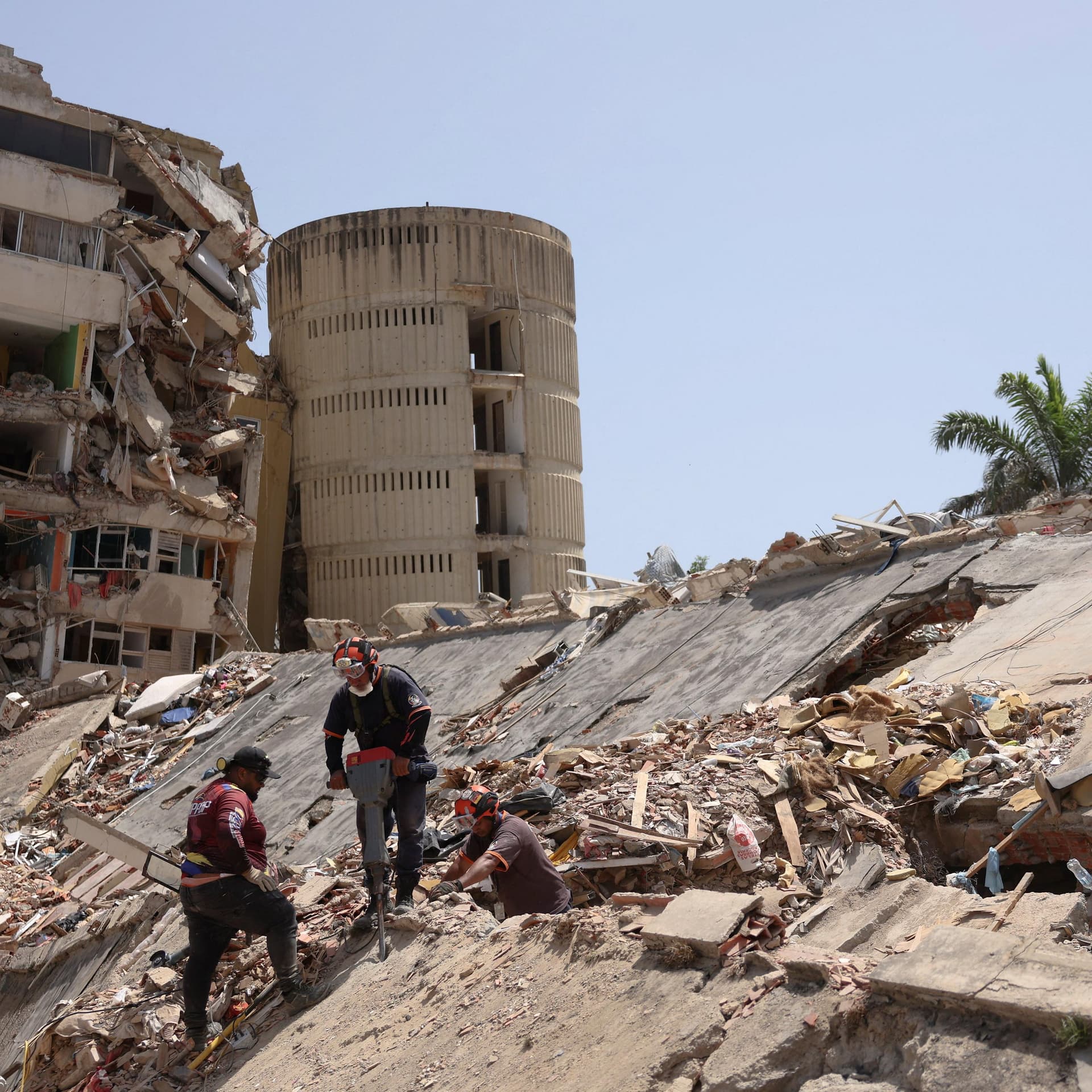
Photo: Workers use a jackhammer on debris from a collapsed building, in Caraballeda, La Guaira, Venezuela. Credit: Reuters/Leonardo Fernandez Viloria.