
In short
The BBC Global Story episode examines the sudden surge of migrants crossing from Morocco into Spain’s North African territory of Ceuta, the ensuing political blame game across Europe and the US, and what (if anything) Spain’s migration policy has to do with it.
Guests/backgrounds
Sarah Rainsford, BBC Southern and Eastern Europe correspondent, interviews Asma Khalid (host, BBC) about what happened on the Morocco–Ceuta border.
Key claims
The crossing was unusually large (about 60,000 in a day) and fast, with many returning within 24 hours. There appeared to be no Moroccan border guards visible; migrants reported being waved through. A social-media misinformation campaign (“Spain is open,” posts showing easy swimming) likely drove timing. A Spanish Supreme Court ruling was misrepresented online. Spain’s migration regularization policy is controversial but not directly linked to Thursday’s arrivals. Politicians exploited images for domestic and transatlantic politics.
Notable examples
Ceuta’s sea-border fence/jetty route; abandoned shoes/wetsuits; Italian PM Giorgia Meloni’s party using the images; Pedro Sánchez calling it an “attack” on sovereignty and blaming smugglers while criticizing EU opportunism.
Written by AI. May contain mistakes. Listen to the episode to check what was said.
Chapters
Tap a time to open that second in VOThe Migrant Surge at Ceuta
1:38 to 3:00
A discussion on the recent influx of migrants at Ceuta and its implications.
“By now, I'm sure you all have probably seen the images.”
Unraveling the Border Crossing
3:05 to 6:30
An exploration of how tens of thousands crossed the border and the circumstances surrounding it.
“My name is Sarah Rainsford, and I'm the BBC's Southern and Eastern Europe correspondent.”
The Rapid Return of Migrants
6:30 to 7:58
Insight into the quick return of migrants to Morocco after the surge.
“So you could see some Spanish border guards.”
Social Media's Role in the Crisis
7:59 to 10:50
Examining how social media influenced the migrant surge towards Ceuta.
“There is no opportunity there in Morocco.”
Political Context and Court Rulings
10:50 to 14:00
Analysis of the Spanish Supreme Court ruling and its impact on immigration policy.
“Sarah, do you know who was behind that information, misinformation campaign?”
The Political Landscape of Migration in Spain
14:00 to 14:21
Explore how political narratives shape perceptions of migration in Spain.
“because that campaign has already finished.”
Morocco's Role in the Border Crisis
14:21 to 16:57
Understand Morocco's influence in the current migration crisis at the border.
“political class who wants to criticise the Spanish socialist government for its policies.”
Spain's Prime Minister Responds
16:57 to 19:26
Learn about the Spanish Prime Minister's response to the border crisis.
“But to be honest, the similarities between what happened and what happened back in 2021 are really striking.”
European Political Reactions to the Crisis
19:26 to 22:00
Analyze how various European leaders are politically capitalizing on the crisis.
“He was trying to understand, I think, and trying to challenge the idea that the way Spain treats migration could possibly be such a huge pull factor that 60 ,000 people tried to cross the border in one go.”
Comparing Migration Trends in Spain and Italy
22:00 to 24:24
Discover the differences in migration challenges faced by Spain and Italy.
“I also want to understand what the migrant issue itself looks like in Spain.”
Show all 11 chapters
Narratives and Perceptions of Migration
24:24 to 27:08
Examine how migration narratives are shaped and used politically in the U.S. and Europe.
“at levels that made Spain look small-time.”
Transcript
Automatic transcript. May contain errors.0:00This BBC podcast is supported by ads outside the UK.
0:30No bouncing between tabs. And best of all, no spreadsheets. Stop managing software and start managing your business with one unified system. Try for free today at odoo.com. That's O-D-O-O dot com. Ever wonder why we make the choices we do? And how to make smarter ones? Introducing Choiceology, an original podcast from Charles Schwab. Join Wharton Professor Katie Milkman, an award-winning behavioral scientist and author of the best-selling book, How to Change, as she shares true stories from Nobel laureates, authors, athletes, and everyday people about why we do the things we do and how to make better choices to help avoid costly mistakes.
1:14Each episode covers the latest research in behavioral science and dives into themes like the power of self-control, shaping your mindset for success, navigating new beginnings, and why starting over can feel so hard. Listen to choiceology at schwab.com slash podcast or wherever you listen.
1:38By now, I'm sure you all have probably seen the images. Tens of thousands of migrants from Morocco streaming into this tiny Spanish territory in North Africa called Ceuta. People running through a gate in a border fence, swimming to shore. Do you want to tell me a little bit? You just swam here from Morocco. So you just got out. How long was that swim? Two. Two what? Two miles? No. How long? Two days. Two days? Two days. You've just been swimming for two days and you just came ashore. It's estimated that some 60 ,000 people rushed across the Morocco-Spain border last Thursday. And although most have returned home and the immediate crisis has calmed down, the political story has not.
2:20European governments are holding emergency talks today after the situation in Ceuta ignited fresh immigration debates across Europe. The story has traveled around the world. I watched the catastrophe that took place. It looks like an invasion of a country. Just the other day, the president of the United States spoke of Spain as a cautionary tale of what could happen here if Democrats take control in the midterms. By hundreds of thousands of people. And that same thing's going to happen to us if the Republicans don't get elected. Except worse. From the BBC, I'm Asma Khalid in Washington, D.C. And today on The Global Story, what actually happened in Siota?
3:04And who's to blame?
3:15My name is Sarah Rainsford, and I'm the BBC's Southern and Eastern Europe correspondent. Sarah, we have seen some of the images, some of the footage of what is tens and tens of thousands of migrants from Morocco appearing to rush the border to enter into the Spanish territory. Can you explain what exactly happened? This was last Thursday. How did the scene unfold? Yeah, I think it's a really good question because I think until this time, we still don't really know exactly what happened and why. So the first images I saw were posted, in fact, in Italy by the government. And they were pictures of a group of, I'd say, hundreds at that point of mainly young men rushing through the streets of Ceuta, which is a Spanish territory in North Africa.
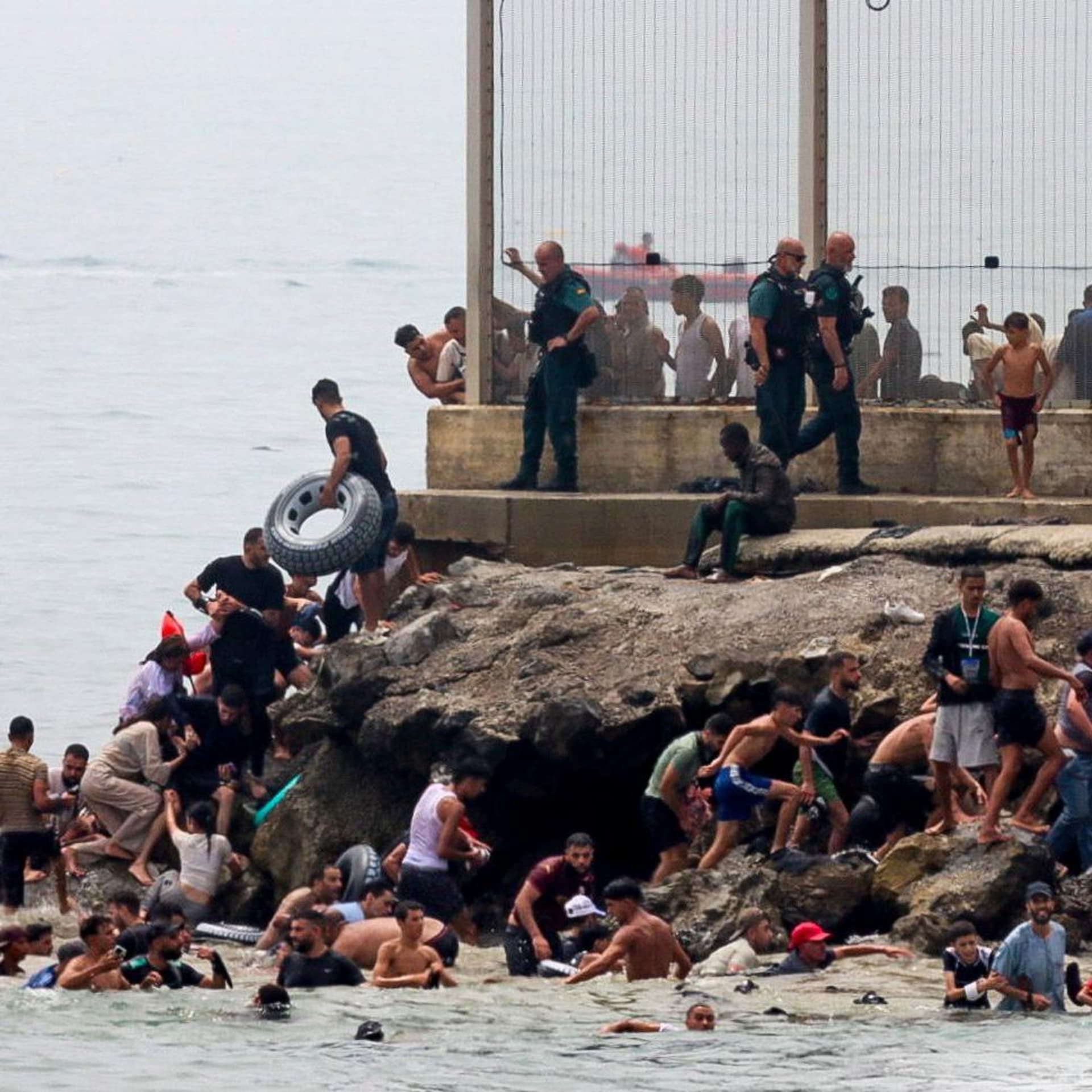
4:06So it's a Spanish territory on the continent of Africa. That's right, yeah. It's just a small kind of tip of Morocco, which belongs essentially to Spain. And what transpired was a huge number of people all at once getting around the border between Morocco and Suta, so from Morocco into Spanish territory, by getting very close to the border fence and then following it out to sea. So the border is a sea border, essentially. It's a fence and then the fence goes out to sea a short distance along the jetty. And so you have to swim to come in. You have to swim. And it's a well-known route for migrants who are trying to get to Europe.
4:48But what was happening on Thursday morning in particular was that people were somehow able to get right up to the border fence and then to sort of walk out onto the rocks and go down to the jetty swim a pretty short distance to get from the Moroccan side onto the Spanish side, Ceuta.
5:10And then what we saw was this sea of inflatable rings and flippers and people's shoes just abandoned on the beaches, wetsuits as well, pieces of clothing, as thousands and thousands and more and more people during the day began to come to shore. And you could see them, Lots of them exuberant, really happy, excited. Running up to TV cameras, making V signs for victory.
5:45Saying Viva España, extremely happy apparently to have made it to Spanish territory. And during the day, by the end of the day, the authorities in Ceuta were saying around about 60 ,000 people had actually made that crossing. So really, really unusual and really striking scenes and still quite mysterious, frankly, as to how exactly that transpired. You mentioned that 60 ,000 people were able to enter in from that Morocco-Seuta border, but I mean, Seuta's tiny, right? The population's 85 ,000 normally, so 50 ,000, 60 ,000 people flooding into Ceuta was really something, obviously for the local population.
6:29And I think one thing that's just worth stressing right away is that it seems, from all of the images I was looking at, and I was looking at a lot of them throughout the day, there seemed to be no sign whatsoever of the Moroccan border guards on the Moroccan side of the fence. So you could see some Spanish border guards. And essentially what I saw was them helping people up onto the rocks, helping them out of the sea, because there's nothing much else they could do at that point. But on the Moroccan side, there seemed to be nobody. And that was something that we kind of dug into a bit further as the days went on.
7:01And I think that's kind of a key point. You know, where were the Moroccans? How do you interpret that? There didn't appear to be anyone there stopping them. And reports that we've heard since then have suggested from the migrants themselves that in fact they were even waved towards the border by Moroccan authorities. Now, I haven't spoken to anybody in the Moroccan government officially myself or to any border guards. I can't confirm that. I didn't see it for myself. But certainly many migrants have talked about essentially being waved through. And at this point now, there are not additional people coming in from Morocco.
7:37My understanding is that, in fact, a number of people have begun returning home. Well, not just that, actually, tens of thousands of people returned home within 24 hours. Within 24 hours. Yeah, I think that's why this is so extraordinary, because you have a huge number of people crossing the border in unexplained circumstances within 24 hours. And within another 24 hours, they've gone. There is no opportunity there in Morocco. So that's why I come to here. But also here, I didn't find any opportunity, so I should go back to home. The vast majority of them have disappeared back to Morocco. The arrangement that Morocco and Spain have about that border is that essentially Spain pushes people back and Morocco takes them back.
8:23And if you're a Moroccan who's come over without documents from Morocco, there is no physical way to get from Ceuta to mainland Spain without being checked by some official, some border authority. So it's not like you've landed in southern Spain and you can then get on a train or a bus or walk or whatever and go north through France to Britain or wherever. That's not possible. I want to understand why it was we saw this surge of people move. I mean, this to me is the fundamental question I have yet to really fully understand here in this story. I, of course, know that many people migrate across the world all the time for better economic opportunities.
9:04But what you have described was 60 ,000 people in mass through some sort of, it seems, coordinated effort or at least coordinated time simultaneously moving towards Ceuta. And I want to understand why this happened at that particular moment. I think it's worth mentioning that in the run up to the day, if you like, Thursday, there had been an increase in the number of people who had been making that journey, but at a very low level. And then in the days before Thursday, there was a significant increase. So enough that it registered, I think, as abnormal and an anomaly on the radar of the authorities in Ceuta.
9:48And by Thursday afternoon, that's when this huge influx of people began. And that's when there were so many people that people were being crushed on the rocks and people were losing their lives at sea. So there's obviously a trend to it. And I think in answer to all of the questions, one of the key answers is social media, quite clearly. The migrants who described and explained a little bit about what had happened themselves, all of them talked about seeing posts on social media that were telling them that Spain was open, telling them that the border was open, telling them they could get to Ceuta, telling them that they needed to buy flippers and wetsuits and lots of videos with music of people with selfie sticks filming themselves swimming at sea and pointing towards Ceuta.
10:37And then pictures of people, whether they were real or not, I don't know, pictures of people in Suta or in mainland Spain, essentially presenting this picture, this image of a very easy journey that people should be encouraged to take. So there was clearly... Sarah, do you know who was behind that information, misinformation campaign? It's a really good question. I wish I could answer that. Right now, I don't. But I've seen some of the accounts online, particularly on Instagram and on TikTok. They all have a similar name and they all post very similar images. And most of them are accounts that have only existed for a few weeks.
11:10So three or four weeks. That is intriguing. And they have a lot of likes. So they've got a lot of traction, like tens of thousands of likes. So people were seeing those posts. Who created them? Who conceived of all of this, whatever this was? That's not clear. That's something to be investigated and still a very much open question. Sarah, there's another narrative I have heard that part of this border crisis story is tied to what is perceived by some as a soft touch that Spain's government takes toward immigration, and in particular, a recent ruling from the Spanish Supreme Court. Can you explain that?
11:47What was that decision and why at all would it have been an impetus for Moroccans to come over? I think those are two separate things. The Spanish court is obviously independent, So that's not the government. But the court made an important ruling not long before this crisis began. The Supreme Court ruled that it was not legal for the Spanish authorities to immediately and automatically push people back to Morocco if they crossed by swimming. It's about if they didn't overcome a physical barrier in order to enter a territory, then they couldn't be pushed back behind a barrier because they hadn't crossed one in the first place.
12:23So it's a bit complicated, but essentially it was being interpreted by the social media campaign, particularly as Spain is open. That was false. That was never the court's ruling. And this was how recent? This was in just July. Very recent, three, four weeks ago. OK. Yeah. But in terms of you asked as well about the government policy. Yes, the sort of approach that it has a softer touch on immigration and that perhaps that is luring more migrants into Spain. I've certainly heard that narrative as well. Yeah, I mean, again, there's a lot to those kind of comments and a lot to sort of unpick. I mean, one is that the number of migrants going to Spain has actually fallen recently.
13:00So to argue that there's a pull factor because Spain is soft on migrants doesn't really match up with the actual statistics. But it's certainly true that Spain in the last few months has initiated a policy whereby it's allowing, it has allowed hundreds of thousands of irregular migrants, so undocumented migrants who are living in Spain currently, people who arrived there before December, to apply for, they call it regularization. but it means basically to get a work permit and a residence permit with some limitations, but still a much better status than being undocumented and unable to work in Spain.
13:37So hundreds of thousands of people have applied for that, but it is deeply controversial within Spain, particularly with the right wing, and also within Europe as a whole, where there is a lot of hostility towards too soft, in inverted commas, policies and politics on migration. So I don't think in all of this, I can't believe that any migrant who crossed that border on Thursday into Ceuta was thinking that they were going there to apply for a program to regularize their status in Spain, apart from anything else, because that campaign has already finished. So I don't think there's a direct factor.
14:17It's for people who you were saying were already living in Spain, correct? Yeah. And also, I think what's happened really with that is that this crisis and particularly the images that were being shared on social media of people rushing across the border, those images have been leapt on by the political class who wants to criticise the Spanish socialist government for its policies. So there's a clear divide in Europe between sort of more lenient and less lenient policy on migration. And those who are less lenient on the populist right in particular have jumped on these images to jump on the government of Pedro Sanchez in Spain because his policies are already controversial within Europe.
15:02I do want to ask you about that. But just ever so briefly, Sarah, first, I want to understand this idea of migrants going in from Morocco into Ceuta. So you say it was already a known route. And I had heard that a similar surge of migrants entered the territory. It was in 2021, I believe, and it was related to some sort of diplomatic disagreement that Morocco had with Spain. And can you help me understand that? I mean, is there sort of a turf war over who actually controls this territory? Yeah, you're right. About five years ago, there was a similar incident to what we saw last week, but on a much smaller scale.
15:38And on that occasion, around about 8 ,000 migrants were able to make it through the border en masse, again, in a kind of sudden surge. And again, at that point, there were big questions about how that was possible and where the Moroccan border guards vanished to. And at that point, the consensus was that Morocco was using that border and the pressure it could exert through that border by essentially allowing people through to pressure Spain over that particular diplomatic and political crisis of that moment. This time around, have you heard anything from the Moroccan authorities about what might have happened?
16:15I haven't been able to speak to them directly personally, but the only quotes I've seen have been of the Moroccan authorities blaming criminal gangs. It's also interesting that the Spanish government has been loath to point their finger towards Morocco. And in fact, the government's opponents within Spain have criticised that. But the government has instead stressed that Morocco is an ally of Spain and criticised and blamed people smugglers instead, which is a little bit difficult to understand because I think it's quite clear that there were no smugglers involved because there was no need to pay anybody to take you to the border if you could just walk there yourself.
16:51So I don't think this was about smuggling. Everyone's officially keen to sort of play down the idea that this might have been some kind of hybrid attack by Morocco or some kind of weaponization of migrants by Morocco. But to be honest, the similarities between what happened and what happened back in 2021 are really striking.
17:51it seems, have actually gone home. But even though the situation, it seems, on the ground has perhaps calmed down somewhat, the border crisis itself did provoke a strong reaction amongst a number of European leaders. It also provoked, I would say, a fairly strong response from the prime minister of Spain himself. So let's start there before we move on to the rest of Europe. What have you heard from the prime minister of Spain? The Spanish prime minister was quick to head to Ceuta himself, actually, to be there in person. Definir lo que ha sucedido en el día de ayer como un ataque, una violación de la integridad territorial de España.
18:30He called what happened an attack on Spanish sovereignty and on Spanish territory. Ceuta es una ciudad española. He blamed smugglers for tricking people. But he also was extremely angry at those within the EU who he felt were exploiting what had happened for their own political gains. He wrote an open letter criticizing some in Europe for what he called their selfish response, their political point scoring that he accused them of doing and a number of other quite strongly worded phrases. I think he felt very quickly under attack from right wing parties, especially within Europe, but not just the right wing, others who were critical of Pedro Sanchez.
19:15It felt like there was pretty unanimously a rather strong critical response in many parts of Europe. Yeah, I think there was. But I think Pedro Sanchez's question back was kind of like, why is my migration policy to blame for this complete anomaly? He was trying to understand, I think, and trying to challenge the idea that the way Spain treats migration could possibly be such a huge pull factor that 60 ,000 people tried to cross the border in one go. So I think he was quite clear that this was something else. Something else is going on. And I think looking at it objectively, he has to be right that this wasn't normal.
19:53In any sense, this was not normal. You say that Pedro Sanchez, the prime minister of Spain, had really strong words for some of his other European leaders that he felt were being particularly unfair in this moment. And we have seen a number of European leaders, I would say, use some strong words and take some rather strong tactics and approaches to how they wanted to respond. What stood out to you from what you saw amongst various European nations? The Italian government was very quick to talk about what was happening in Ceuta and to respond to it. This is the government of Georgia Maloney. That's correct, yeah.
20:32Who is known to be on the right politically. Hard right, politically. And so her party, Fratelli d 'Italia, the brothers of Italy, they posted this video and underneath it, it said, this is the result of the government of Pedro Sanchez. If you vote for the left in Italy, this is what you're going to get. So they immediately were using those images for domestic political capital. The context of that, which is absolutely critical, is that there is an election next year and Maloney's coalition has been losing support to a new party on the further right, if you like, further right than hers. Further right even than hers, okay.
21:09much more virulently anti-immigration and really making that sort of front and centre of their policy. So she is, I think, is trying to keep those voters in her camp. She's trying to appeal to the even harder right not to lose them and to keep her power, essentially, at the next election. So obviously this image from Ceuta was something that her party was exploiting domestically. But also, you know, appealing to a broad specter of opinion within Europe, which agrees with her on migration. And she used it to talk about the need for securing our borders, for firmer policies, and to slam the socialist government of Pedro Sanchez in Spain, which is a favored topic.
21:58Sort of diametrically opposed to her politics. Yeah, I was going to say, presumably they don't see eye to eye on a range of topics. I also want to understand what the migrant issue itself looks like in Spain. It is absolutely ridiculous and completely irrational. Because I was listening to our sister show, the Global News Podcast, the other day, and they spoke to Gerald Naus from the European Stability Initiative. Spain has had less arrivals of irregular migrants in the last three years than Italy. Who had said that Spain is not the country that actually has the biggest migrant problem in Europe.
22:34And this crisis in Ceuta is not due to Spanish policy, but to the failure of Morocco to control or take back people quickly. I guess I just want to understand, Sarah, because I think that amongst the right, even in the United States, Spain and Pedro Sanchez are seen as being the most problematic nation in the eyes of conservatives here in the U.S. when it comes to migrants. I mean, OK, I've got the numbers here for this year. These are from the UN and official tallers. So in terms of the arrivals between January and June this year, down 32 % on the same period last year. And the number is around about 12 ,000 in six months.
23:21OK. Irregular arrivals in Spain. Into Spain. OK. Yeah. Spain and Italy essentially tackle the same problem, which is the arrival of boats from Africa from various different points on the continent. What's different is the language, the tone, the way that the conversation goes. And it's also important to say that when you're talking about, for example, in Spain, the regularization of huge numbers of migrants, the vast majority of those people, not all of them, but a lot of those people are people who have entered Spain legally with visas to work, usually from Latin America. Spanish speakers, and then have essentially outstayed their visas, stayed on in Spain, become undocumented in that sense, and have now applied to become legal within the continent.
24:04Sarah, our show is about where the world and America meet. And these images, the storylines out of North Africa in the last week, they are being seen as a warning of what could happen here in the U.S. if Republicans don't keep control of government. If we're not in office, our country will be invaded at levels that made Spain look small-time. I mean, it is very clearly being spoken of in this way by the president of the United States. And what that is is weak law, bad management, but very liberal law. Trump, he has long campaigned on tougher immigration. That was, I would say, one of his signature policies when he first ran for the White House in 2016.
24:54And we are seeing him see it. He even said himself as a possible talking point that could boost Republicans now. That's going to be a talking point for the midterms, because when you look at what happened to Spain, they don't know what to do. And it's happening again today. I'm already seeing this story make these political waves here in the United States. How do you interpret that? I think it's really easy to present a picture and a narrative and then just forget about what the reality is. And that's obviously what's happening in the US and within Europe too. I mean, the images, for those who want them to, speak for themselves.
25:30Lots and lots of people entering without restraint into the EU, effectively. The reality, of course, is that the only reason they entered was not because Spain's migration policy is so lenient, but because somebody let them in. So something happened to allow a huge number of people in for whatever reason. And now that image, which suits a certain political narrative, is being used for that political narrative. You don't need to explain to people what really happened, the full nuances of actually the situation. They will still think there are 60 ,000 undocumented young men from Morocco within Europe.
Read the full transcript
26:04That's not true. And then on the other side, you have to remember the other part of the politics, which is that Donald Trump isn't very happy with the Spanish government right now for multiple reasons, but primarily because the Spanish government didn't support his war on Iran. And Spain has been very outspoken about what's been happening in Gaza in particular. So Donald Trump is no fan of Pedro Sánchez. He's actually been very outspoken about him and his policies in many senses. And certainly this is feeding into that politics as well. So there's a lot going on. Important to keep in mind. Yes.
26:35Yeah. But it's also, I think, that this began on social media, as far as I can tell, and it's being spread on social media.
26:45And everyone will take whatever images they want and post whatever they want to beneath it, because people don't dig beneath those images, don't dig beneath the slogans. and that's enough. So the job is done and the narrative is there that Spain is weak on migration, that that border is dangerous, that Europe's external borders are not protected, that Europe is weak and that Europe is divided, polarised and fundamentally chaotic. So I think there's a lot of people who potentially stand to gain from that being the case. But it is absolutely intriguing to try at some point to get to the bottom of who it was that sent out the message that this border was open come across, because I think that's still, you know, not 100 % clear yet.
27:34Well, Sarah, thank you for helping us try to dig a little deeper in this conversation. We appreciate it. Thank you. I tried.
27:50That was Sarah Rainsford, the BBC's Southern and Eastern Europe correspondent. And as always, a reminder that we love hearing from you all, our dear listeners. So if you've got a story idea or questions for us, you can drop us a note. Our email address is theglobalstory at bbc.com. And likewise, I will say that if you all appreciate what we are trying to do here on The Global Story, bring you one big story every weekday about where the world and America meet, then we'd really appreciate if you could take a moment and rate us or write a review. It actually really does help people find the show.
28:22Our show today was produced by Kat Farnsworth and Arun Keller. It was edited by James Shield and mixed by Travis Evans. Sam Gruet was our digital producer. Our senior news editor is Chyna Khalids. And I'm Asma Khalid. Thanks as always for spending some time with us and we'll talk to you again tomorrow.
From the publisher
Why did tens of thousands of migrants from Morocco suddenly attempt to cross into the Spanish enclave of Ceuta by sea last week? In the days since the sudden border crisis left at least 72 people dead, a variety of theories have circulated.
The Trump administration blamed the incident on “radical left-wing globalist policies”, and many European leaders condemned what they say is Spain’s lax immigration policy. Spanish Prime Minister Pedro Sanchez denied those claims and blamed trafficking gangs. Others have blamed Morocco, and accused it of ‘weaponising’ migrants for political purposes.
We speak to the BBC’s Southern and Eastern Europe correspondent, Sarah Rainsford, to find out how and why the Ceuta crisis happened.
Producers: Aron Keller and Cat Farnsworth
Executive producer: James Shield
Mix: Travis Evans
Senior news editor: China Collins
Photo: Hundreds of migrants swim across to Ceuta, Spain from Morocco. Credit: Reduan Dris / EPA/Shutterstock