
In short
After the Bondi Beach anti-Semitic massacre, the episode examines why Australia’s gun laws—often cited as a “gold standard”—may not be as strong as assumed, focusing on legal frameworks, rising firearm numbers, and how guns were legally obtained.
Guests (and backgrounds)
Ariel Bogle, investigations reporter for Guardian Australia, who previously reported on how gun ownership is increasing; co-hosts Tristan Redman (BBC, London) and Asma Khalid (BBC, Washington, D.C.).
Key claims
Australia treats gun ownership as a privilege requiring a “genuine reason” (no self-protection category). Despite the 1996 Port Arthur crackdown, registered firearms have risen (over 4 million now vs about 2.2 million in 2001). License holders average more than four guns; some individuals hold very large arsenals. Bondi’s alleged shooter Sajid Akram had a recreational hunting license and legally acquired six long guns; his son Naveed had no license.
Notable examples
Port Arthur massacre (Martin Bryant killed 12 in 15 seconds; 35 dead total) leading to semi-automatic/automatic bans and a national buyback; 2022 Wieambilla shooting (two policemen and a neighbor killed).
Written by AI. May contain mistakes. Listen to the episode to check what was said.
Chapters
Tap a time to open that second in VOThe Impact of Mass Shootings on Gun Laws
1:28 to 4:12
Discussing the influence of mass shootings on Australia's gun laws and the comparison with the U.S.
“And so as we were thinking about the attack that happened at Bondi Beach over the weekend, it was sadly hard not to think about the frequency of mass shootings here in the United States.”
Ariel Bogle on Australian Gun Culture
4:12 to 6:18
Ariel Bogle explains the nuances of gun ownership as a privilege in Australia.
“because the story is actually a lot more complicated than people might realise.”
The Port Arthur Massacre and Its Aftermath
6:18 to 10:46
Exploring the Port Arthur shooting and the subsequent changes in gun laws in Australia.
“broader public interest in terms of ownership.”
Gun Ownership Trends in Australia
10:46 to 11:42
Discussing the rise in gun ownership in Australia despite strict gun laws since 1996.
“But we found in fact, and other reports have also found now, that gun numbers are on the rise.”
Revisiting Gun Control After Bondi
11:42 to 14:00
Reflecting on the implications of the Bondi shootings and the future of gun control in Australia.
“Errol, you and your colleague Sarah Martin were way ahead of the curve in many ways on reporting on gun control and gun restrictions in Australia.”
Gun Ownership Trends in Australia
14:00 to 17:35
Explore the rising number of firearms owned by fewer individuals in Australia.
“Of course, in the wake of the Port Arthur crackdown, Australia's population has grown and you might regard the growing number of firearms as commensurate with that population growth.”
Government Response to Gun Control
18:12 to 23:26
Analyze the Australian government's actions following the Bondi attack.
“AT &T Fibre, limited availability in select areas.”
Comparing Gun Control in Australia and the U.S.
23:26 to 27:06
Delve into the historical and cultural differences influencing gun laws between Australia and the United States.
“Very sadly, in the United States, mass shootings are quite common.”
Transcript
Automatic transcript. May contain errors.0:00This BBC podcast is supported by ads outside the UK.
0:30learns how to invest and manage money. Learn more at schwab.com. In the days since at least 15 people were murdered in an anti-Semitic massacre on Bondi Beach in Sydney on Sunday, Australia has been reckoning with some big questions. Among them, how was it possible for this tragedy to happen in a nation that has had to deal with mass shootings in the past and specifically changed its laws to control who can own a firearm? And why are there now more registered firearms in Australia than there were 30 years ago? From the BBC, I'm Tristan Redman in London. And I'm Asma Khalid in Washington, D.C. And today on The Global Story, why gun control in Australia is more complicated than many people think.
1:27Our show is about where the world and America intersect. And so as we were thinking about the attack that happened at Bondi Beach over the weekend, it was sadly hard not to think about the frequency of mass shootings here in the United States. Australia had a major mass shooting in 1996, and it led to a big change. Within 12 days, 12 days, there was a ban on semi-automatic weapons. There was a national gun buyback program and hundreds of thousands of guns were handed in. And Australia has made it illegal to own an unregistered firearm in Australia. That sort of change just seems inconceivable from my vantage point here in Washington, D.C.
2:09There is no federal assault weapons ban here in the U.S., nor is there a national gun buyback program. In fact, in the years since that shooting in Australia back in the 1990s, there's been a long list of shootings here in America. Columbine happened when I was in high school, and there have been so many others in the years since. I think of Sandy Hook, Parkland, Uvalde, the Pulse nightclub shooting, Mother Emanuel Church, the Tree of Life synagogue, the Sikh temple in Wisconsin, Las Vegas, El Paso, Buffalo. I mean, frankly, I could go on and on. It's a really long list. And Americans who want more gun regulation often hold up Australia as the gold standard on gun control.
2:55President Obama said as much back in 2014. A couple of decades ago, Australia had a mass shooting similar to Columbine or Newtown. And Australia just said, well, that's it. We're not doing we're not seeing that again. And basically imposed very severe, tough gun laws. And they haven't had a mass shooting since. I mean, I remember Obama saying this and I remember it feeling thoroughly uncontroversial to people sitting in Europe that President Obama might say something like this. Whereas I think maybe looking back on it now for many Americans, it seems like quite a controversial and radical thing to say for Europeans.
3:38It just kind of felt like common sense. Well, Tristan, it's all very partisan here in the U.S. after so many mass shootings, particularly those that take place in schools, we hear the same plea from many parents. They'll say, do something, do something to lawmakers. And yet, generally, no new laws are actually passed. You know, Americans who oppose gun control regulation see mass shootings like the one that occurred in Australia over the weekend as evidence that laws are not the solution. Well, we wanted to find out more about how the Australian model for gun control works. because the story is actually a lot more complicated than people might realise.
4:16So The Guardian newspaper has two investigative reporters in Australia who did a lot of in-depth reporting on this earlier in the year. So I called up one of them to find out more about it. My name is Ariel Bogle and I'm an investigations reporter with The Guardian in Australia. Ariel, I know you've been reporting on the Bondi Beach shootings over the last few days. You wrote a series of stories as well in the summer that were sadly very prescient about what's happening right now. You wrote about how gun ownership in Australia is increasing and why. How present would you say that guns are in Australian culture?
4:56One of the key kind of themes of Australian gun control is that gun ownership is not a right. It's not considered a right like it might be in the United States and some other countries. Instead, it's regarded legally as a privilege, and so it's subject to quite stringent public interest tests. And one of the key differences from other gun control regimes globally is that you need what's called a genuine reason to have one. When you look at the groups that advocate around gun ownership, they are often focused on rural and agricultural areas. There is a strong need in Australia in farming communities to have access to certain types of weapons for the control of feral animals, rabbits, deer, wild boar, things like this.
5:39Of course, it is a sport in some ways. There's sport shooting of various types. And there is also this category of hunting or recreational hunting as well. So I think that's recognised that firearms can be safely part of the broader community, both in rural areas and in the city as well, but there is certainly no category for self-protection, which makes it quite different from other gun control regimes. And I think that difference between a privilege and a right is very central and it's words that have been echoed in the public discourse by politicians who want to revisit gun control in the wake of the Bondi terrorist attack.
6:17And it is subject to the broader public interest in terms of ownership. So on Tuesday on the show, Ariel, we were speaking to the Australian journalist Hamish MacDonald, and he mentioned to us as a kind of watershed moment in recent Australian history, the 1996 Port Arthur massacre, which was a terrible shooting, which led to gun controls in Australia. Can you explain to us what actually happened in Port Arthur and why it's been such an important moment in recent Australian history? Port Arthur is a historic site in the state of Tasmania in the south of Australia. It's a tourist site. People visit to see these sort of convict ruins.
6:59There are cafes there. A man named Martin Bryant went to that area. He pulled out a semi-automatic rifle and killed 12 people in 15 seconds in one of the cafes on that site and went on to kill 35 people as part of that massacre and wound a further 23. We've had a gunman run amok on the Port Arthur historic site. A siege is underway in the Tasmanian town of Port Arthur. When the first shots were fired, it was the beginning of a massacre which stunned the world. There are at least 12 confirmed dead, if not 22. Shot by a crazed gunman who is now holding police at bay and is believed to have a hostage.
7:35In the wake of that, there was shock not only that he had been able to kill so many people in such a quick amount of time, but that this person was able to get his hands on weapons of this calibre, of this power. 29-year-old gunman, a local with a psychiatric history, opened fire on a crowded cafe at Port Arthur. In just minutes, he'd killed 20 people. Suddenly heavy, rapid, rapid fire from obviously a pretty powerful rifle. It was just thud, thud, thud. And so after that, John Howard, who was the Prime Minister at the time, leader of the Conservative Party, put together this National Firearm Agreement.
8:13The Prime Minister, John Howard, tonight, detailed sweeping plans to reform Australia's national gun laws. We need to achieve a total prohibition on the ownership, possession, sale and importation of all automatic and semi-automatic weapons. In the face of a strong opposition from gun rights groups, from some farming lobbies and other groups, and some parts of Howard's own conservative coalition, and he decided to attend some of these pro-gun rallies to kind of personally explain why there was a need for these laws to these members of the public which were extremely against what he was proposing.
8:51I'm sorry about that, but there is no other way, there is no other way. And there is this famous photograph of him wearing a bulletproof vest while addressing a crowd, I think, in the Victorian town of Sale. This was the milieu in which Howard was trying to sell this idea broadly of gun reform because he wanted to bring the country with him. It was difficult, but it was pushed through. And I now think it kind of takes a symbolic place in Australia's political history. You know, a lot of people point to that as a moment of true bipartisanship, a moment where the country really came together and decided, no, it was not acceptable for people to have access to firearms that had that much power, that could kill that many people so quickly.
9:35That bulletproof vest image has become so iconic. Many of the photos too of the gun buyback that came in after the reforms were passed. Semi-automatic and automatic weapons became largely illegal. All those weapons in general had to be passed in and people could hand in weapons that were now illegal or they could pass in weapons that they no longer wanted or could legally own in exchange for some financial compensation. And so there's these iconic images of huge bins full of guns and metal detectors at tips sort of carrying the weapons across really extraordinary imagery. It was also after that that this genuine reason for owning a firearm came in.
10:16So the idea that you could just own firearms without having to explain why you needed them or for some loose idea of self-defence that was done with. How successful have the restrictions on gun ownership in Australia been since 1996? Because we are what now, approaching 30 years since that law was enacted. I think by and large they are regarded as a significant success if the benchmark is a lack of mass shootings. So since 1996, there have been very few mass shootings and certainly none on the scale of Port Arthur where 35 people were killed. But we found in fact, and other reports have also found now, that gun numbers are on the rise.
10:57And there are, in fact, more than 4 million firearms in the community now, almost double the 2.2 million weapons recorded back in 2001. And that's after the National Firearms Agreement brought in after Port Arthur. So those kinds of numbers, I think, were surprising to people. And there have been shootings since then, of course. One recent significant event was the Wee and Biller shooting in 2022, which left two policemen and a neighbour dead on a rural property in the south of Queensland. So there have been these flashpoints where the gun control regime is revisited, but I think in the wake of the Bondi attack due to the sheer scale of it and the fact that one of the alleged perpetrators did legally own six firearms, had a license for those weapons, there'll be many more discussions to come.
11:43Errol, you and your colleague Sarah Martin were way ahead of the curve in many ways on reporting on gun control and gun restrictions in Australia. You must have been particularly shocked, therefore, on Sunday when you heard the news of this shooting in Bondi. What's that been like? Yeah, so we put out this series of stories back in August and when we started that series, it was really to answer the question about where the guns were coming from that were involved in some street shootings in Sydney at the time. These were largely linked to crime, but the question was put to us by our editor, where are these guns coming from?
12:18I thought we had gun control in Australia and it set us down this path to looking at all facets of how our gun control regime may be getting more lax or being undermined in various ways. So when the news started to come out of Bondi, it was just horrific to hear. There was so much footage of the shooters. You could see the power of their weapons, how quickly they were able to reload. It immediately raised questions about how they had got their hands on those weapons, whether they had been legally acquired and why they were able to commit this horrendous act. And, of course, it's hit so many of us extremely personally.
12:56I had friends there, everyone. You know, it's a big city but a small city here in Sydney, so the effects and the questions raised were immediate. I know that in your research you have found that the number of firearms registered in Australia is increasing, including in suburban areas, which suggest that these weapons are not just being used for farming or possibly even hunting. What have you discovered exactly? What are they being used for if not for these things? So one issue with the whole gun control regime in Australia is the lack of data, I think, about exactly where people have firearms and for what reason.
13:36So we were quite limited for that reason to the state of New South Wales, which at least has some gun ownership numbers and statistics broken down by area so that we could see that in New South Wales there had been a 10 % rise in firearm ownership over the past five years. And overall, there were at least 2 ,000 new guns lawfully entering the community every week. Of course, in the wake of the Port Arthur crackdown, Australia's population has grown and you might regard the growing number of firearms as commensurate with that population growth. But in fact, the issue is that gun license holders per capita has gone down as Australia's population has soared, but there is now a larger number of guns in the community per capita.
14:19So that's because a lot of owners have a lot of guns. The number of guns each license holder has has gone up. And so gun owners now average more than four firearms for each license. And in Sydney, there were more than 70 individuals who owned more than 100 firearms, including one person who owned 385 guns and a lot of that was in suburban areas and to be clear this is not collecting guns this is where guns have been decommissioned these are active fireable weapons those kinds of numbers were quite eye-watering to see and I think raised questions about exactly how people were able to accumulate arsenals of that sort.
14:56There are two alleged shooters in the Bondi shootings, Sajid and Naveed Akram, a father and a son. Sajid, who was 50 years old, has been killed by police. Naveed has now been charged with 59 offences, including 15 counts of murder and one of committing a terrorist act. Now, Sajid had a firearms license and owned six guns. Do we know why he had that license and what types of guns did he have? So this week, police told us that Sajid, the elder, the father who was 50 years old, had a firearm license. They said it was in a recreational hunting category and that he had legally acquired six weapons and that they were long arms.
15:45So I think various types of rifles and shotguns. The younger who has now been charged with various crimes, including the committee with a terrorist attack, he did not have a firearm license. So of the two alleged shooters in Bondi, one of them, Naveed, was already known to police for fears that he might be radicalized. What is the response in Australian society to the fact that on the one hand, you have this guy who is known to the police, and on the other hand, you have someone closely link to him, his own father, who has so many weapons. Yes, it's definitely an area of inquiry and has been the subject of a lot of media attention this week.
16:26So Prime Minister Anthony Albanese this week did confirm that Naveed Akram first came to Intelligence Services' attention in 2019 and was under investigation for, I think, a period of six months. But there was an assessment at that time that he posed no ongoing threat.
16:46Another thing that police have said this week is that Sajid Akram had acquired his firearm license in 2023. So that's after this intelligence report. So there is not quite clarity at the moment about exactly what has happened. And certainly I can imagine it will be an area of inquiry.
17:35Ariel Bogle:We'll be right back. Group chats that never shut up. Neighbors texting you the score before your TV catches up. Come on! Get a load of this guy. Catch up. On a dog. Yeah, we've got thoughts. Too loud? In Chicago, you're gonna hear it. Because nothing here gets built without conversation. Nothing moves without connection. So, if you think you know AT &T, it might be time to rethink that. Because their network has improved, like, a lot. So Chicago can keep speaking its mind with AT &T Wireless and AT &T Fibre. Chicago won't stop talking. Our improved network backs it up. AT &T, connecting changes everything.
18:12AT &T Fibre, limited availability in select areas.
18:20Inevitably, the tragic events in Bondi this week have got people talking once again about gun control in Australia. What is the Prime Minister, Anthony Albanese, saying ought to be done? So following the attack in Bondi, which took place Sunday evening, things have moved quite quickly.
18:37Ariel Bogle:This afternoon, there has been a devastating terrorist incident at Bondi at the Harnica by the Sea celebration. This is a targeted attack on Jewish Australians on the first day of Harnica. On Monday, the Prime Minister, Anthony Albanese, announced a meeting of National Cabinet to discuss whether there needed to be changes to Australia's National Firearm Agreement on the table. The government is prepared to take whatever action is necessary. Included in that is the need for tougher gun laws. And in the following days, he did post a series of options. These include limits on the number of firearms that people can have, making sure that people that are not citizens cannot acquire a firearm licence or firearms.
19:24Ariel Bogle:I appreciate you all being here. Thank you. I'm also joined with you. And then on Wednesday, the Premier, Chris Minns in New South Wales, also held a press conference. On the 22nd and 23rd of December, the government will call back the New South Wales Parliament to deal with urgent legislation. Saying, in fact, that although Parliament had dispersed for the Christmas period, he was going to be bringing it back early next week to pass quickly a series of different firearm reform options. So it's all moved very swiftly in the days after that horrible attack on the beach. It sounds like there's a certain momentum building at this point towards greater regulation restriction of guns in Australia.
20:06Is Anthony Albanese getting pushback on this? And I just want to add a note from my co-host, Asma Khaled, who mentioned to me that when shootings happen in the United States, there's usually a call from people on the right often that, quote, you know, we need more guns, not less, that a good guy with a gun can stop a bad guy with a gun. Is that sort of discourse part of the debate right now in Australia? No, this idea that a good guy with a gun could have stopped the attack is not really part of the discussion. You know, there are questions that are being asked about the police response on the day, whether there was sufficient police on the ground, enough security measures to protect the event.
20:46But certainly that kind of discourse that you see in the United States, I haven't really observed it here. But, you know, it's an interesting conversation. I do see pushback, especially in rural communities, against some of these proposed gun reforms. There is a feeling that, you know, responsible firearm owners are, quote unquote, being punished for the actions of these individuals. You know, this is a common narrative as well, that responsible gun owners are taking the brunt of the punishment for the actions of a few people that are taking these horrific actions. So this is part of the narrative too.
21:21The Conservative Party here is not exactly saying that there is no need for gun reform. However, they're saying that is more important, perhaps, that the government address the causes of anti-Semitism, radicalization, and saying that that should be the focus right now rather than these gun control measures. And that is, you know, somewhat different from the reaction after Port Arthur, where there was this bipartisan notion that there's something needed to be done. The two major parties here are not quite in lockstep right now. This push for gun reform, is that a destruction, you believe, from the bigger issue?
21:59Of course it is. Let me just make it very clear. David Littleproud of the National Party, which traditionally represents regional and rural areas here in Australia, has said this isn't really a gun problem, it's an ideology problem. Beyond gun reform, is the bigger picture here Islamic extremism? Do you believe that that has flown under the radar? Yes, you've got to call it out for what it is. Is he a prominent political figure? Yes, he is, but he's not in government right now. How does that kind of discourse go down at this particular moment, which is a very sensitive moment in Australia? It'll be interesting to see exactly what is put on the table.
22:35Chris Minns, the Premier of New South Wales, did earlier this week suggest that these reforms were not aimed at affecting the firearm ownership for people that needed them for legitimate purposes like in agriculture. So we might see a carve out of some sort from some of these restrictions. We'll have to see. I think the Labor Party here, which is in control of government, won't want a fight with the farmers because it's not a kind of fight that they want, but they do feel that perhaps is a popular sentiment in favour of some changes after the shock of what happened on the weekend. And I I think the shock of the fact that the guns, as police have said, were legally acquired and legally owned, there will be some appetite.
23:15But I think the opposition parties here will potentially see some ground to be made here in pushing back on that. Many of our listeners, Ariel, are in the United States. Very sadly, in the United States, mass shootings are quite common. In Australia, they are much less common. There's this one in 1996 that you've already told us about in Port Arthur that led to quite stringent regulations. And then this Bondi shooting now, which may lead to the same thing. I guess a lot of Americans might wonder, what is the difference between a place like Australia, where very few mass shootings lead to stringent regulations, and the United States where one thing does not follow the other.
24:07What's your view on that difference? Why does it exist? It's really interesting to contemplate. I mean, one really obvious point of difference is that we don't have a right to bear arms enshrined in our constitution. That is not something that has been baked into our history in any fashion. I think too, there's just a different type of history here. Australia has not had active wars perhaps on its own territory in terms of the United States fighting against the British and then, of course, its own civil war and actions like this, where the idea of needing weaponry to protect yourself from the state or an unfriendly state is kind of baked into your history and baked into your common understanding of why a firearm might be needed.
24:52Instead here, because Australia, although it has this strong rule underpinning in its history and continues to have that as well, the majority of Australians live in cities and they don't see firearms, they don't have firearms, they've not experienced one, they've never shot one. So it's just not baked in in the same way. You mentioned the constitutional right to bear arms in the United States, but I grew up in the US and although you can't tell it from my accent, and American views on guns are wrapped up in a lot of different things. The constitutional right to bear arms is one of them. But there is also this idea of the United States being a frontier society where guns are a necessary part of living on the frontier.
25:34Now, Australia and the United States are very similar potentially in that respect. Australia is also a frontier society. It's a huge place with a relatively small population that doesn't fill the place. And you guys live on the frontier in many respects. I wonder how you account for the different attitude towards guns in that context. You know, it's incumbent on me to point out too, although Port Arthur is pointed to as this really significant mass shooting, this massacre in Australian history. There was a frontier war against Australia's Indigenous population. There were mass shootings of Indigenous people in that colonial period as settlers pushed into the territories across the country, these expansive places to build farms and build cities.
Read the full transcript
26:20So that is part of our history too. But yeah, it's an interesting thing to think about why firearms did not become baked in in the same way. I think perhaps our history to the messiness of a federation where each state and territory has its own point of view. That does exist in the United States too, but it's just a smaller population perhaps as well. It makes it easier to push through legislation on this level. Yeah, there'll be probably many things to think about in sort of trying to tease out why there is that difference. I think it's fascinating because although you could not say that Australia and the United States are siblings.
26:59They are similar enough in many ways perhaps to be considered as cousins, but on the issue of gun control, there is divergence and great differences.
27:13Really appreciate you talking through this with us, Ariel. It's been so interesting to get an understanding from somebody who knows so much about the issue of guns in Australia at this particular moment. And I'm sorry we're talking in the wake of such a terrible thing. Yes, well, thank you for having me. Pleasure to talk with you. Thanks, Ariel.
27:35That was Ariel Bogle, an investigations reporter with Guardian Australia. Today's episode was produced by Hannah Moore and Zandra Ellen and edited by James Shield. It was mixed by Marty Peralta and our senior news editor is China Collins. I'm Tristan Redman. Thanks for listening. Speak to you again tomorrow. Cheerio.
From the publisher
After the Port Arthur massacre in 1996, Australia tightened its gun laws, and has since been considered a world-leading example by gun control advocates of how to lessen the chances of mass shootings occurring.
However, the mass murder of at least 15 people in an antisemitic attack at Bondi beach on Sunday has again raised the issue of gun access, and Australian prime minister Anthony Albanese has said he is “ready to fight” to strengthen the laws again.
On today’s show, Ariel Bogle, an investigations reporter with Guardian Australia, explains why the number of guns in Australia has been rising, and how stricter laws might be received in the country.
Producers: Hannah Moore and Xandra Ellin
Executive producer: James Shield
Mix: Marty Peralta
Senior news editor: China Collins
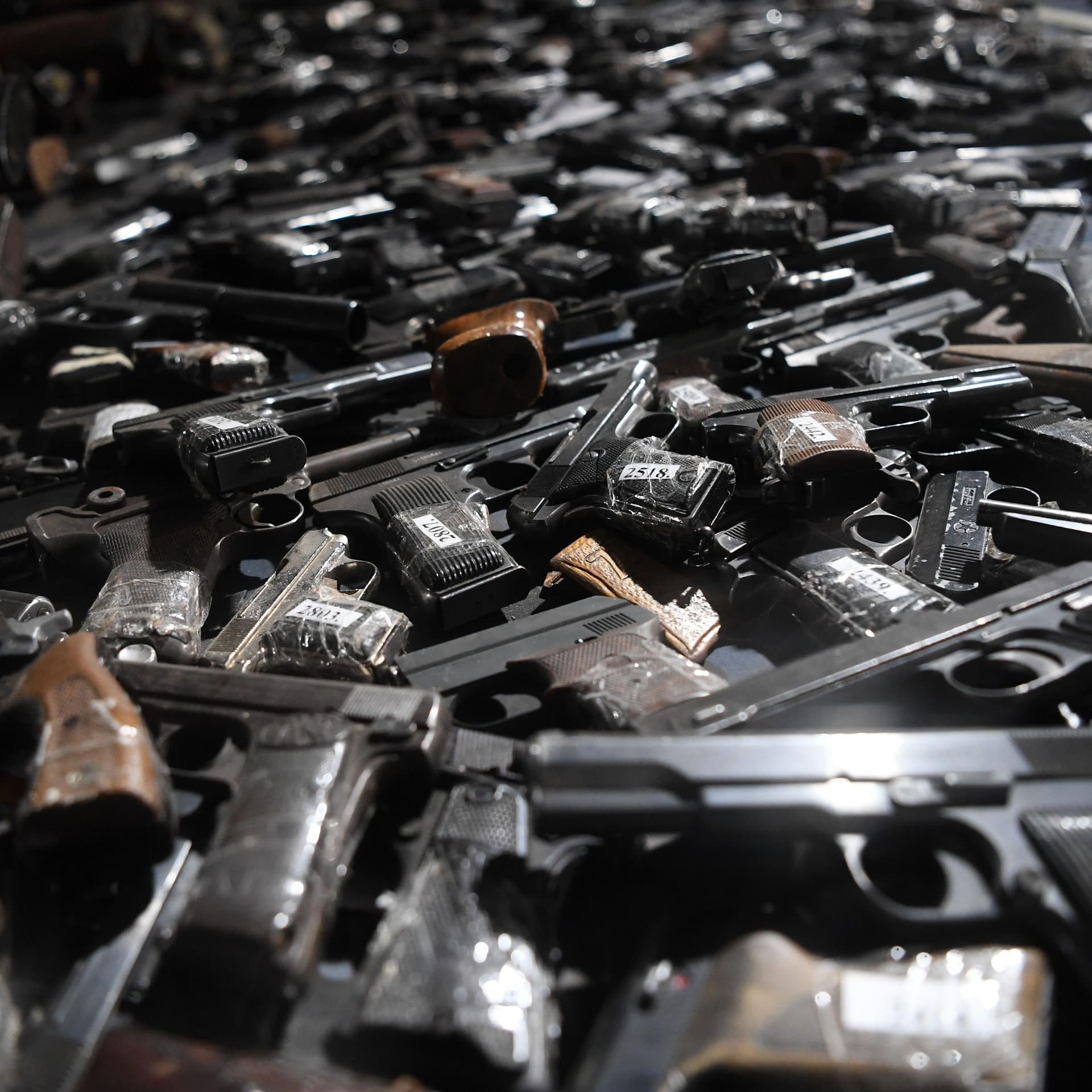
Photo: Photo of unregistered handguns that were returned to police, near Smederevo, Serbia. Credit: Dimitrije Goll /EPA-EFE/REX/Shutterstock