In short
Vladimir Putin’s government has imposed sweeping restrictions on Russia’s internet, including a March blackout affecting mobile service and blocking popular apps, raising fears of a “digital iron curtain” and tighter state control of information.
Guests
Steve Rosenberg, BBC Russia editor and veteran journalist who has covered Russia for 30 years.
Guest backgrounds
Long-term Russia correspondent/editor at the BBC; reports on Kremlin policy and information controls.
Key claims
The crackdown is primarily about control of information, not public safety. Measures include blocking Facebook/Twitter/Snapchat, restricting Telegram/WhatsApp, encouraging use of the state-backed app “Max,” blocking VPNs, and intermittently shutting down mobile internet so only state-approved sites work.
Notable examples
Telegram used by ~90 million Russians; March mobile internet shutdown prevented navigation, taxi booking, payments, news, and messaging; people protested by petitioning Putin’s administration; rallies were denied due to “COVID,” legal issues, or unrelated events; taxi drivers got lost when sat-nav failed.
Written by AI. May contain mistakes. Listen to the episode to check what was said.
Chapters
Tap a time to open that second in VOUnderstanding Russia's Internet Control
0:00 to 0:45
Exploration of how Putin's government has historically targeted information flow.
“This BBC podcast is supported by ads outside the UK.”
Understanding Russia's Internet Control
1:48 to 2:16
Exploration of how Putin's government has historically targeted information flow.
“Okay, so here at the BBC, when you have a question about Russia, you call up Steve, meaning the BBC's Russia editor, Steve Rosenberg.”
Recent Developments in Internet Restrictions
2:18 to 4:00
Discussion on the escalation of internet restrictions post-Ukraine invasion.
“I mean, this story goes back, I would say, a quarter of a century, when Vladimir Putin came into power in the year 2000.”
Kremlin's New Strategies on Messaging Apps
4:18 to 6:00
Overview of the tactics used by the Kremlin to suppress popular messaging apps.
“What has changed in just the last couple of weeks, couple of months?”
Impact of Internet Blackouts on Daily Life
6:07 to 8:14
Analysis of the effects of internet shutdowns on mobility and communication.
“And there was no kind of communication from the authorities, no explanation really of why suddenly this was happening.”
The Popularity of Telegram in Russia
8:35 to 10:46
Insight into why Telegram's restrictions are significant in the Russian context.
“Steve, earlier you mentioned a specific messaging app, Telegram.”
Motivations Behind Internet Control
10:48 to 12:00
Speculations on the Kremlin's reasons for increasing internet censorship.
“Some people fear that there could be another wave of mobilisation coming along, that perhaps the authorities could do what they did in September 2022, when people were called up and sent down to fight in Ukraine.”
Public Reaction to Internet Restrictions
12:02 to 14:00
Exploration of how Russians are responding to the increasing internet controls.
“Yeah, there's a daily conference call that we dial into with the Kremlin.”
Public Response to Internet Restrictions
14:00 to 17:24
Learn about the public's growing dissent against internet restrictions in Russia.
“And he accepted that this was causing disruption to people.”
Challenges of Protest in Russia
17:24 to 20:29
Explore the obstacles faced by activists trying to protest internet censorship.
“The other thing that's happened in a couple of dozen Russian towns and cities recently, there was an attempt to hold street protests against the internet restrictions.”
Show all 13 chapters
Discontent with Putin's Government
20:29 to 22:22
Understand the rising frustration among Russians towards their government.
“It's now down to, I think, 65%, something like that.”
Comparing Internet Censorship: Russia vs. China
22:22 to 24:06
Learn how Russia's internet restrictions compare to those in China.
“I remember speaking to Russians a couple of years ago doing vox pops.”
The Future of Russia's Political Landscape
24:06 to 26:02
Discuss the potential shifts in Russia's political climate amid current challenges.
“And suddenly that's been sort of taken from them.”
Transcript
Automatic transcript. May contain errors.0:00This BBC podcast is supported by ads outside the UK.
0:30Because Schwab knows that when it comes to your finances, choice matters. No matter your goals, investing style, life stage or experience, Schwab has everything you need, all in one place, so you can invest your way. Visit schwab.com to learn more. It's been well reported that Vladimir Putin's government has been cracking down on dissent and public protests for years. But recently, Russians began noticing something different. Something that fundamentally changed their connection to the outside world and each other. This past March, the Kremlin instituted sweeping new restrictions on Russia's internet, blocking its most popular social media app.
1:16And for three weeks, there was an internet blackout in huge swaths of the country. Meaning people could not use their cell phones for the things we've grown so accustomed to using our phones for. The BBC's veteran journalist in Russia, who's covered the country for 30 years, says these latest internet restrictions are like nothing he's ever seen. From the BBC, I'm Asma Khalid in Washington, D.C. And today on The Global Story, why is Vladimir Putin choking off Russia's internet? And is he creating a sort of digital iron curtain?
1:57Okay, so here at the BBC, when you have a question about Russia, you call up Steve, meaning the BBC's Russia editor, Steve Rosenberg. He's reported from that country for a long, long time. And he started our conversation by explaining how the Russian government's limits on information got to this point. Let me give you some context here. I mean, this story goes back, I would say, a quarter of a century, when Vladimir Putin came into power in the year 2000. And it was clear that Russia suddenly had a leader who was quite keen to control the flow of information. And in the early years of Vladimir Putin as president, we saw him trying to control television, most of all.
2:45Then we saw street protests. More than 600 protesters were detained and over a dozen faced criminal charges. Big street protest in Russia in 2011-2012. Online, it's being dubbed a Slavic spring, fuelled by uncensored images like these posted on social networks. This video of an elderly woman voting in Siberia went viral. She's shown confused, being helped by an election official who marks her voting slip for the government. That was a watershed moment. Social media is once again showing its influence and power. And after that, the Kremlin turned its attention to the internet. And so there was an internet blacklist law that was passed that gave the authorities the right to close down various sites that it thought were bad.
3:36So it was clear then that attempts will be made to control the internet. But really, things sped up in 2022 after the full-scale Russian invasion of Ukraine. And after that, we saw heightened attempts by the Kremlin to try to control cyberspace. So, for example, Meta was declared an extremist organisation. So Facebook was blocked. Twitter was blocked. Snapchat eventually was blocked. But what we've been seeing in recent months has taken things to up to a whole new level in terms of the state's attempts to control cyberspace. Steve, I want to ask you about that because it was striking to me in your reports that these latest round of Internet restrictions seem like something different.
4:27What has changed in just the last couple of weeks, couple of months? What was the specific change? I think there are three main things to talk about here. The first thing is the Kremlin's attempt to restrict access to very popular global messengers, things like WhatsApp and Telegram, which is a really popular app here in Russia. And the authorities have been encouraging very strongly Russians to basically ditch those and use something called Max, which is a Russian created state backed messaging app. No, you haven't heard of it. And many Russians don't want to use it, I have to say. But so messengers, that's the first thing.
5:17The second thing is that's kind of new is this sort of crackdown on VPNs. these virtual private networks that people can use to get around internet restrictions so you you know you may be using a vpn to access sites that are restricted then the state will block that vpn you go to try and use a different vpn the state might try and block that vpn so there's this cat and mouse kind of going on in terms of vpns and the third thing that's happening is across the whole country, in many towns and cities, certainly over the last few months, mobile internet services have from time to time been switched off completely, at other times restricted, so that, as I say, only limited sort of state-approved sites can come up on your phone.
6:06Now, the mobile internet shutdowns and restrictions, I would say, became quite common last year in many parts of Russia. In Moscow, mobile internet went off for three weeks earlier this year, in March, and that kind of shocked people in the Russian capital because I think many people here in the capital thought that they were immune to all of this, that the authorities wouldn't kind of move against mobile internet in Moscow because so many businesses depend on it, so many lives depend on it, Russian officials, you know, depend on it. But no, it happened. And there was no kind of communication from the authorities, no explanation really of why suddenly this was happening.
6:52And it caused a huge amount of disruption and a huge financial loss for businesses. Steve, you have lived in Russia for 30 years. That internet blackout that you mentioned that happened in March, have you experienced that before? No, I haven't. That was the first time that I'd experienced such a long shutdown of mobile internet. You couldn't use the sat-nav on the phone. You couldn't book a taxi. You couldn't use your phone to pay for anything. You couldn't get any sort of news websites on your phone. Messaging people was impossible. So it was a very strange feeling. How did that look, Steve, on the roads?
7:35I mean, I had read some reporting that the, you know, with taxi apps, say, rendered useless, people were hitching rides. Is that accurate? Some people were. There were lots of angry taxi drivers losing their way because their sat-navs weren't working on their phones, in the car, and they couldn't actually find it. Nobody knows how to do a map, old school map, right? Get around anymore. Yeah, although there were reports that, you know, sales of paper maps had suddenly increased because what do you do? You know, we need some kind of maps. There were reports that sales of landline phones went up as well.
8:13There were also reports in the Russian newspapers that sales of pages went up, which is very odd because paging services kind of stopped a few years back. But, you know, certainly, you know, our lives are digital. We depend on digital, right? And when digital stops working, that causes a lot of problems. Steve, earlier you mentioned a specific messaging app, Telegram. Here in the United States, Telegram seems a bit niche, right? It's not a hugely popular platform. But can you help us understand why the restrictions on Telegram in particular were such a big deal in Russia? Telegram is a really popular app in Russia.
8:57I think about 90 million people use it, you know, in a country of 145 million people. And the reason it's so popular, well, there are several reasons, really. It's kind of an all-in-one service app. So people use it for messaging. It's considered to be pretty secure. And so people trust it for private messaging, but also as a source of news. And not only pro-government news, sort of propaganda, but also independent news, sort of non-government connected news services as well. People go to Telegram to find out what's happening in the world. So, Steve, given the popularity of Telegram, I am still really befuddled as to why the Russian government would want to do this.
9:47if if if Vladimir Putin was sitting where I'm sitting now he would tell you very clear this is all about making the Russian public safe he would probably tell you that messaging apps messaging services like telegram and whatsapp have violated Russian law he would possibly tell you that Ukrainian attack drones that have been attacking Russian cities use mobile internet to locate targets and therefore the authorities have to shut off mobile internet from time to time. But I think really this is about control. This is about control of information. And in a country where the authorities are trying to tighten their control of all aspects of life, controlling information, controlling the information space, has become such a priority now.
10:46Why is this happening now? Why has there been an upswing in control? We can only speculate. Some people think that this is being done now, ahead of parliamentary elections in the autumn, which is quite an important moment for the Kremlin, And even though the Kremlin basically controls the whole political system here, it doesn't want to take any chances. That could be one reason. Some people fear that there could be another wave of mobilisation coming along, that perhaps the authorities could do what they did in September 2022, when people were called up and sent down to fight in Ukraine. Some people speculate that this could be a sign that the war could be coming to an end, Because if the war does end, you're going to have a huge number of traumatized Russian soldiers coming back from the front to their homes, to Russian towns and cities.
11:47And the authorities logically will want to make sure that they are in full control of the situation and the messaging. We don't know what the specific reason is right now. Maybe we'll find out soon. I know in your reporting, you reached out to the Kremlin for comment. What was their official explanation? What did they have to say? Yeah, there's a daily conference call that we dial into with the Kremlin. BBC News. With Vladimir Putin's spokesman, Dmitry Peskov.
12:26And so I called into that and I asked him, does the Krandon realize the strength of feeling amongst the public about this, about these internet restrictions?
12:41And doesn't he think that, you know, all these restrictions and blocking messengers and restricting mobile internet, isn't that a kind of a road back to the past? It's not a path in the past.
13:22that actually the new normal for Russia is a world of restrictions, a world of prohibitions when it comes to the internet. It's hard to see a moment when the Kremlin will say, okay, you know, threats have passed. We're now going to open the internet and you can have all your freedoms back. So I'm likely to see that happening. Have you heard anything from President Vladimir Putin himself, has he addressed these restrictions? I mean, you say that they are not popular with the public. So presumably this puts pressure on him to say something. Yeah, he recently made his first comment about the internet restrictions.
14:07And he accepted that this was causing disruption to people. You know, he said there was no sense that he was apologizing for that. He made it clear that as far as he's concerned, this was to keep the public safe. This was all about national security. And he called on the law enforcement agencies to be creative, which is an interesting way of putting it, in how they deal with things. But no, there was no sense of any U-turn from Vladimir Putin. You've alluded to the fact that these internet restrictions are deeply unpopular amongst the Russian public. But how have you seen Russians responding? Well, the first thing to say is what's really noticeable is that people have been making their voices heard.
15:00In terms of the war in Ukraine, you don't see public protest. It's very dangerous to protest. There are lots of laws that can be used against you if you go onto the street to express your opposition to the war. In terms of the Internet, we have seen people trying to protest. For example, we went down to the presidential administration office a few weeks back and there was a group of people, several dozen, who had come there to sign a petition, handed in a petition to President Putin, calling on him to basically end internet censorship, the blocking of messengers, the mobile internet restrictions and things like that.
15:44And they were queuing up one side of the street. On the other side of the street, you had a row of security officers filming them on their mobile phones. and we spoke to a couple of people in the queue about why they'd come there, weren't they frightened? And while we were interviewing people, the security officers came over and quite demonstratively were filming right in our faces as we were speaking to people in the queue. They were acting absolutely legally, these people who'd come to hand in a petition. They have the right to do that in Russia, but still it really is quite brave, I think, to basically come out and show that you're in opposition to a government policy, cracking down on the internet.
16:31But such was the strength of feeling. I spoke to one lady who owns a catering company in Moscow. My business is entirely on internet. And each time, it's a huge loss for me. And I'm supporting families of my employees. And we are losing money every time there is a blockage of internet, There is a blockage of Telegram. We are losing, losing, losing, losing, and no one is caring about me. So I need to care about myself here as well. Aren't you frightened? Aren't you scared? I'm wary. I'm shaking. I'm very scared. Do you think that coming here today will make a difference? I don't know. Probably not.
17:15But it's what I can do. So that was something unusual to see people doing that in an increasingly authoritarian country. The other thing that's happened in a couple of dozen Russian towns and cities recently, there was an attempt to hold street protests against the internet restrictions. And people in different towns submitted requests, applications to the local authorities to hold rallies against the internet restrictions. In every case, they got turned down for different reasons. So sometimes the local authorities would say, sorry, you can't have a protest because of coronavirus restrictions.
17:59Or in some places they would say, no, you can't hold a rally because this goes against the law. In one place, one town, they said you can't have a rally because there's a roller skating masterclass that's going to be going on in the location you requested. And we went to the city of Vladimir and spoke to an activist who had put in an application to hold a protest. And she suggested 11 different locations for holding that rally. And she got a reply back from City Hall saying, oh, very sorry. On that particular day, at all 11 locations, we're going to be cleaning the streets. Oh, wow. You can't hold your protest.
18:42We can offer you a different day, a different time. It was a very bad time. But she agreed to that. And then they said, oh, sorry, we can't even agree to that because of the danger of drone attack, attack from Ukrainian drones. So it didn't work out for her. But she felt that she had to try and do this to hold this rally because she felt very strongly that the attempt to restrict the Internet was wrong. And so life has been disrupted. And this has all come together and it's sort of fueling a sort of discontent in the country. A discontent towards who? Towards Putin himself? A general discontent.
19:25When you chat to Russians, you rarely hear people say, we blame the president. The president is to blame. Many people blame people around the president or local officials. But what's interesting is in recent weeks, some individuals have gone public with their criticism of Vladimir Putin. From business figures to former supporters of the Kremlin, from time to time, you hear these voices making themselves heard. And that's unusual. The other unusual thing is that a state-run polling agency has recorded for seven weeks now a falling rating, falling approval ratings of Vladimir Putin. And I say this is a state-run agency.
20:16A state-run agency. That's a curiosity. Which is a curiosity, isn't it? And we shouldn't focus too much on the actual numbers because I'm not sure whether the numbers are accurate. But back in March, this agency was putting his approval rating over 73%. It's now down to, I think, 65%, something like that. The trend is interesting. The trend downwards.
20:54You say that it's unusual to see this level of criticism in public directed towards the Russian government. And so that leads me to wonder, is this an existential crisis for Putin? It seems different, you're saying. The war doesn't always matter. Other, even maybe perhaps economic issues may not always matter. But this seems to have triggered a deep frustration, you're saying, in Russia. I think it has triggered a frustration. And whether it's existential, I don't know. But I think this is certainly an extremely challenging moment for Vladimir Putin, because it's not just the frustration with the Internet restrictions.
21:38It's frustration at the economic condition of Russia at the moment. after more than four years of war and more than four years of sanctions. Russians can feel the economic effects now. Life is getting more expensive. Taxes have gone up. Their electricity bills have gone up. Their water bills have gone up. The economy is stuttering. Even though the federal budget has been earning a lot more money in the last few weeks because of high oil prices, because of America's war in Iran, Even so, the economy is not in great shape here and Russians are feeling that. But also add to this fatigue with the war.
22:18More and more Russians can feel the effects of the war. I remember speaking to Russians a couple of years ago doing vox pops. And it was very rare that you'd speak to people who felt directly involved in the war or knew people who were fighting there. That's different now. Very often we speak to Russians on the streets and they say, oh, yes, my neighbor is fighting in the war or my cousin was fighting in the war and was killed or my brother. So many Russians have been fighting there. So many Russians have been killed there. And that is affecting, I think, people's mood and perception of what's going on in the country.
22:58Russia is certainly by no means the only country that has a leader who is widely considered to be authoritarian, a leader who is putting strong restrictions on the Internet. How does the situation in Russia compare to a place like China, which also has heavy restrictions on outside websites? I think in the case of China, they began their restrictions much earlier. They built their sort of system with restrictions sort of built in. So the Great Firewall appeared much earlier. But Russia is playing catch up. So in Russia, the internet was sort of connected internationally, globally. Russians felt this connection to a global network.
23:46And what the Kremlin is doing now is trying to rein that in. After Russians had got used to being connected. They had tasted the internet. They tasted that, yeah. And they liked the taste of it. They liked the taste of it. It was very convenient. It was great. And suddenly that's been sort of taken from them. And that's why it's causing such sort of frustration, yeah, in the populace. Absolutely. Absolutely. Steve, there was a belief, certainly here in the United States, for a number of years, and this is a while back, but let's say, you know, if you look at 2010 under President Obama, in which the United States was pursuing this policy of, quote, reset with Russia, there was this sense that in some ways Russia would really connect with the West and with the rest of the world.
24:40That idea now I know has certainly been dormant now for a while. But do the latest Internet restrictions feel like to you the nail in the coffin? I mean, it sounds like you're describing a situation in which Russia is going backwards. It does feel that Russia is going backwards or going forwards to the past, in a sense. because I remember the Soviet past when the Soviet authorities tried to stop foreign broadcasters broadcasting into Russia. Signals were jammed. And in a sense, this is the modern-day version of it, cutting, disconnecting Russia from the rest of the world, particularly from the West.
25:24Whether it's the last nail in the coffin, I wouldn't say that. There's a famous Russian story by Alexander Pushkin called The Coffin Maker. And basically in that story, the dead come back. You know, the dead who were in the coffin, they come back. So I think that things change in Russia, basically. And the last hundred years of Russian history shows us that just when you think that the country has gone one direction, suddenly it changes and suddenly I mean suddenly it changes and it goes another direction and then after a number of years it changes again it goes back in the other direction so I think over the next few months we have to watch closely what's what's happening but I'm always reminding myself that things change I've seen a lot of change in 30 years and I expect there'll be more change
26:23Well, Steve, that's why we enjoy having you on the show, because you bring that expertise in addition to the brilliant reporting. So thank you so much. I really appreciate you taking the time. That's very kind of you. Thanks. It was a pleasure.
26:46That was Steve Rosenberg, the BBC's Russia editor. And if you want to see what life has been like in Russia during this internet crackdown, then you should check out Steve's mini-documentary about it. It's on the BBC News YouTube page. And as always, we really appreciate hearing from listeners. So if you've got thoughts, questions, or ideas, you can email us. Our address is theglobalstory at bbc.com. And just a reminder that we here on The Global Story, we go in-depth every day on one big story. But if you're also looking for a way to catch up on the latest news from around the world, then check out our sister show, The Global News Podcast.
27:22You can find it wherever you listen. Our episode today was produced by Chris Benderev and Hannah Moore. It was edited by Bridget Harney and mixed by Travis Evans. Our senior news editor is Chyna Collins. Our digital producer is Matt Pintis, and I'm Asma Khalid. Thanks as always for tuning in, and we'll talk to you again tomorrow.
From the publisher
In recent months, the Russian government has been restricting access to messaging apps such as Instagram, Facebook and Snapchat, and at points, even shutting down internet access completely.
Russian officials insist that curbs on communication are in the interests of public safety. They claim that mobile internet blackouts disorient Ukrainian attack drones, although such attacks have continued even in areas where the internet has been switched off.
How have these blackouts been affecting peoples’ ability to access news, communicate, even find their way around? And how are people reacting to the restrictions on their freedoms?
BBC Russia editor Steve Rosenberg joins Asma to discuss.
Producers: Chris Benderev and Hannah Moore
Executive producer: Bridget Harney
Mix: Travis Evans
Senior news editor: China Collins
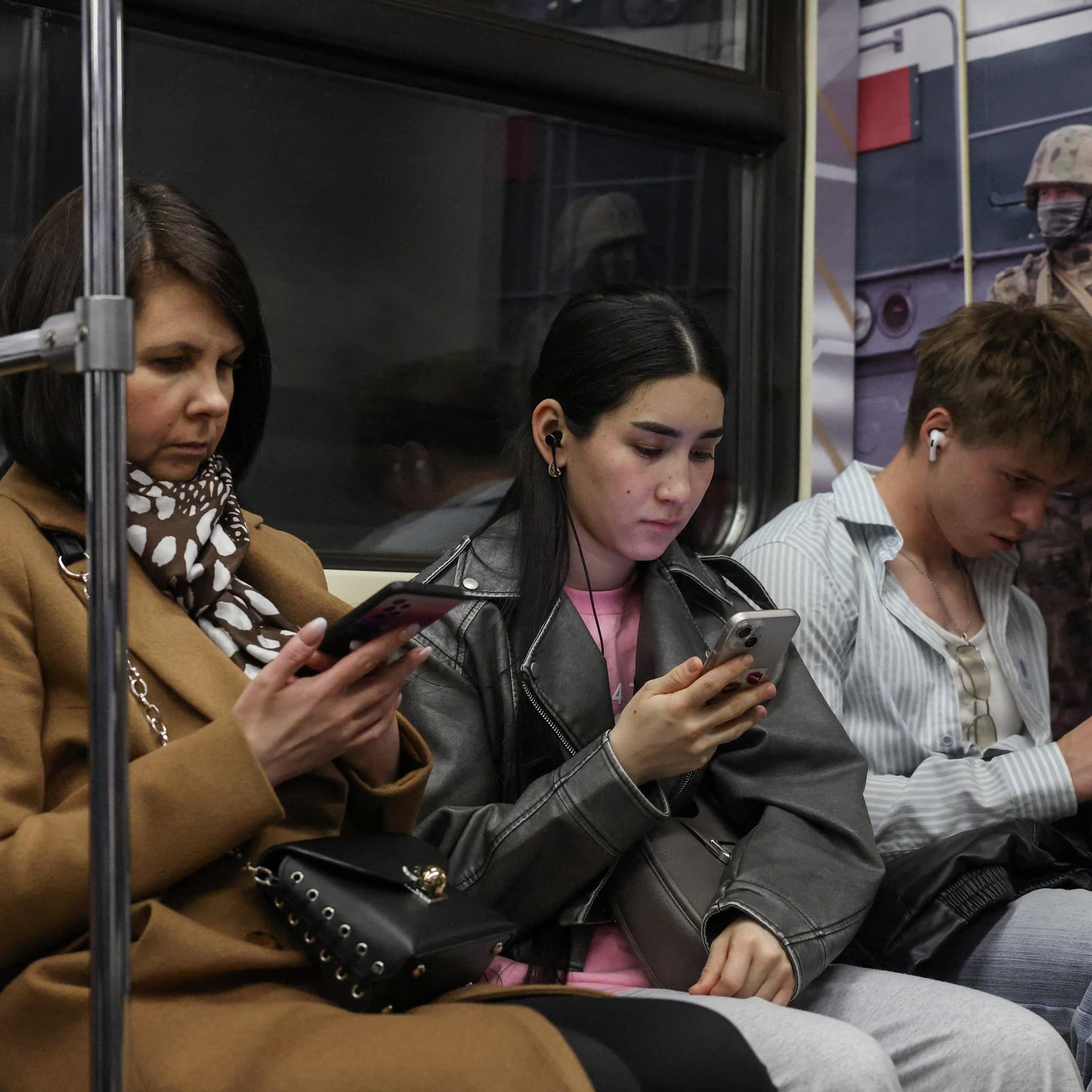
Photo: Passengers use mobile phones aboard a themed metro train honouring the Russian National Guard in Moscow, Russia, March 31, 2026. Credit: Reuters/Ramil Sitdikov