
In short
The episode examines why U.S. immigration authorities (ICE) raided and detained hundreds of workers at a Hyundai/LG Energy Solution electric-battery construction site in Ellabell, Georgia, and how that clashes with recent U.S. government messaging promoting American manufacturing investment.
Guests
Nick Beak, BBC Verify correspondent in the U.S., who visited the site and reviewed ICE video; Asma Khalid and Tristan Redman, BBC reporters moderating; Ruby, a South Korean American community leader in Savannah; Jake Kwon, BBC producer in Seoul, reporting South Korean media and government reaction.
Key claims
the raid involved masked agents and multiple agencies, detained 475 (over 300 South Koreans), and halted work; authorities say some detainees were in the country illegally, but visa details aren’t public.
Notable examples
Biden’s 2022 praise of Hyundai’s $10B investment; Trump’s “America first” enforcement; South Korean headlines calling it “national humiliation” and “betrayal,” plus South Korea’s foreign minister negotiating detainee releases.
Written by AI. May contain mistakes. Listen to the episode to check what was said.
Chapters
Tap a time to open that second in VOInvestment in American Manufacturing
0:50 to 2:47
Discussion on the announcement of Hyundai's investment in Georgia.
“Tristan, you know, the first time I heard about this manufacturing facility in Georgia was three years ago.”
ICE Raids on the Hyundai Plant
2:47 to 5:05
Details surrounding the ICE raid on the Hyundai factory and its implications.
“This was an operation that was months in the planning, and we've been able to build up a picture of it by a few sources.”
Community Impact and Reactions
5:05 to 7:54
Exploration of the local community's reaction and the impact of the raids.
“And we also got an insight through talking to this South Korean worker who was there and he described this sort of panic.”
Immigration Policy and Worker Visas
7:54 to 11:28
Discussion on immigration policies affecting South Korean workers and visa issues.
“Today, I'm proud to announce Hyundai Motor Group and LG Energy Solution are doubling down on their commitment to the largest economic development project in Georgia history.”
Economic Concerns and Manufacturing
11:28 to 14:01
Analysis of the economic implications of the raids on manufacturing.
“So it does seem that the authorities here have taken a really, really tough view on this.”
The Impact of Immigration Laws on Manufacturing
14:01 to 18:28
Explore the complexities surrounding immigration laws and their effects on factory operations in the U.S.
“It would seem that the Trump administration is saying, no, you've got to play by the rules at the moment.”
Reactions to the Raid from South Korea
18:29 to 22:30
Learn about South Korean reactions to the recent immigration raid and its implications for U.S.-Korea relations.
“Coming up, South Korean companies have invested more in the U.S.”
The Future of South Korean Investment in the U.S.
22:31 to 26:04
Understand the potential long-term effects of U.S. immigration policy on South Korean investments.
“The media here has described it as treating Korean people like low criminals.”
Trump's Message to Investors
26:05 to 26:52
Analyze President Trump's stance on immigration and its implications for foreign investors in the U.S.
“On Monday, the Secretary of Homeland Security, Kristi Noem, told reporters in London that President Trump had sent a powerful message to investors and their employees.”
Transcript
Automatic transcript. May contain errors.0:00This BBC podcast is supported by ads outside the UK.
0:30how to change as she shares true stories from Nobel laureates, authors, athletes, and everyday people about why we make the choices we do and how to make better ones to help avoid costly mistakes. Listen to choiceology at schwab.com slash podcast or wherever you listen.
0:50Tristan, you know, the first time I heard about this manufacturing facility in Georgia was three years ago. It was back in 2022. I was then covering the White House, and President Biden took his first big diplomatic trip to Asia. And the first stop he made was South Korea. He was visiting a number of manufacturing facilities, and I remember he made this specific announcement. It's great to be here to announce more than$10 billion in new investment in American manufacturing. A pledge from the carmaker Hyundai that it would be making electric vehicles in Savannah, Georgia. Investment opened a new factory near Savannah, Georgia.
1:34It's going to create more than 8 ,000 new American jobs. And that that plant would, in theory, bring thousands of jobs to the United States. The workers in Georgia who will build these plants and manufacture this new electric battery technology means economic opportunity for an awful lot of Americans. President Biden, thank you so much for taking the time on your visits to Korea. And this was the image of the U.S.-South Korea relationship. South Korea was investing more money in the U.S. economy than any other country. And it seemed like the future would just bring more and more of those investments.
2:19And this manufacturing plant was the one raided last Thursday, when ICE agents detained hundreds of workers, and the majority of them was South Korean.
2:34From the BBC, I'm Tristan Redman. And I'm Asma Khalid. And today on The Global Story, why is the Trump administration deporting workers who are building American factories? And in the process, is it jeopardizing the plan to lure companies to American soil?
3:04This was an operation that was months in the planning, and we've been able to build up a picture of it by a few sources. Nick Beak is the BBC Verify correspondent in the United States, and he visited Elabel, Georgia over the weekend. First of all, ICE themselves, they filmed it. So we got a really vivid illustration of what happened. What we saw was this convoy of federal vehicles. It was almost like an army arriving en masse. There was this snaking, basically procession of cars making their way to this huge Hyundai plant. And when they got there, the federal agents got out of their vehicles. A lot of them were masked.
3:44GSP in position, no sign. And it wasn't just people from ICE. you had people from the the dea the fbi were there homeland security our homeland security we have a search warrant for the whole site and this one video that was taken inside we think maybe by a worker showed a masked agent saying that you need to shut down this site we need construction to cease immediately we need all work to end on the site it needs to stop immediately that they were going to carry out a search
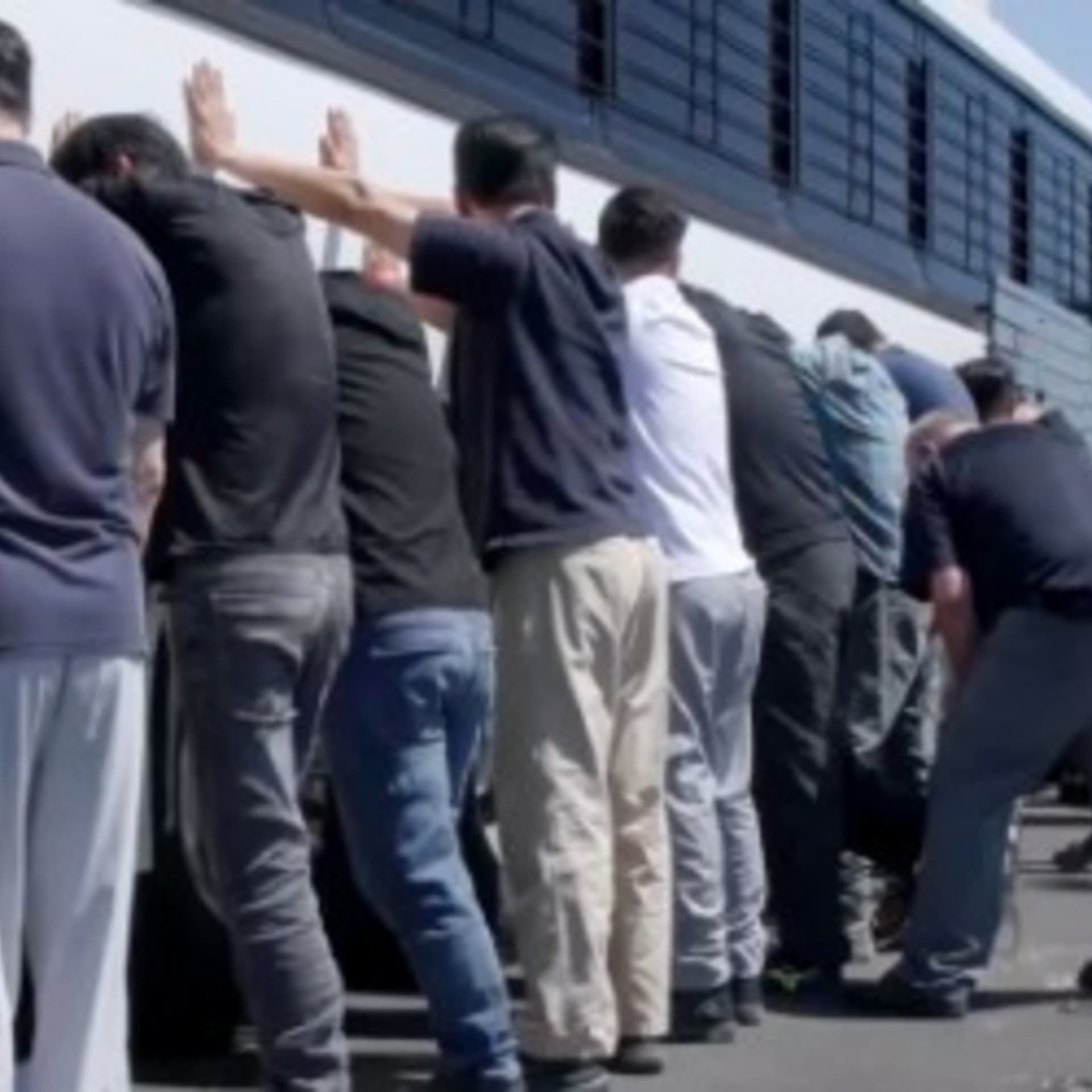
4:16you had people being lined up against the wall hundreds of people 475 in all more than 300 of them were south koreans but then you saw images of people being handcuffed some had chains around their legs they were being basically marched onto buses and taken away there was this extraordinary bit of video which ice put out and it showed two men who apparently tried to get away by jumping into a swamp and you had the sight of these agents on the side of the the bank calling out to them in spanish it seemed that the audio was very low but eventually they seemed to be moved out by the ICE agents and they too were taken away.
5:08And we also got an insight through talking to this South Korean worker who was there and he described this sort of panic. And then a bit later on, he said that he was aware of these mobile phones ringing and he thought, what's this? And what happened was that all the men who were detained, they had to leave their phones behind. And, you know, as you can imagine, shortly afterwards, their families are trying to get hold of them. They don't know what's happened to them. And so these phones were ringing, but all the cell phones were locked away. And so their colleagues couldn't answer them. So what we saw afterwards was that nearly 500 people were detained.
5:43Nick, you said the site is vast. Can you just paint a picture for us of how big it is? Yeah, well, we went there over the weekend, Tristan. And, you know, when you come off the highway, you see it in the distance and it completely dominates the skyline. The whole landscape is this Hyundai factory. And it's interesting because just a few years ago, you would have seen open fields because this is a new initiative. Three years ago, there was nothing to see at all, but we were driving around it. And it's one of those places where you kind of think, when's it going to end? Because there's one huge building that greets you at the start and you see the Hyundai sign in English.
6:19But then you go around and you get an indication of what's being planned there, because these raids relate to this specific area where they were building the batteries for electric vehicles. And so you see cranes, you see diggers. And what's happened is when we went there, everything had sort of completely come to a halt. It was almost silence. The only sort of noise we heard was when we were getting some shots and two security cars came up to us and basically asked us to leave. You know, Nick, one of the things I find so confusing about this story is how this particular facility became the focus of sort of this harsh immigration crackdown.
6:58I remember going on President Biden's first trip to Asia. His first stop was South Korea, and he visited a whole bunch of manufacturing facilities. And he very specifically lauded this investment. And it was really a symbol of the strong manufacturing, healthy economic relationship between the United States and South Korea. And I don't understand how it went from being that to now being the scene of this immigration raid. You know what, Asma, I think a lot of people don't understand how we've seen this progress, because to a lot of people, it doesn't make sense. As you say, this was a project that came about while Joe Biden was still in the White House.
7:40This was a project that was a beneficiary of the bill he got through in 2022. This huge green investment, if you remember that, all this money that was going to be made available for cleaner types of energy. And the interesting thing is, obviously, you had Joe Biden as a Democrat, but lots of Republican states really saw a lot of investment. Today, I'm proud to announce Hyundai Motor Group and LG Energy Solution are doubling down on their commitment to the largest economic development project in Georgia history. And so you've got Governor Brian Kemp in Georgia, where this Hyundai factory is, and he was talking about it as the biggest investment of its type in the state's history.
8:21This major investment will strengthen communities through good paying jobs, improve schools and infrastructure. He said, you know, this will bring thousands of jobs in years to come. This is absolutely the sort of thing we should be doing. Thank you to Hyundai Motor Group and LGES for continuing to choose the number one state for business. And it was only a few weeks ago that the South Korean president was in the White House. He was welcomed there and he said he was going to be bringing lots of investment in the years to come. How surprised were you, Nick, that this raid happened so soon after the South Korean prime minister visit to Washington?
8:56Yeah, I think the timing seems incredibly swift. We made contact with a woman called Ruby who came to the US many years ago. She's South Korean and she became an American citizen in the 80s. And she basically is the president of the Korean American Association of Savannah, Savannah being the biggest, nearest city. And she was saying that this set up in 1974 and actually it dwindled to nothing. They didn't really have members. They weren't really doing anything. But with this influx of workers, with this injection of cash and all the people coming to work at the Hyundai plant trying to set it up, their organisation got a sort of a new lease of life.
9:36And she said they were looking after lots of people. They were trying to give them sort of education in the way you sort of get on in the States. There was lots of practical information. And she said she was completely shocked by this because it sort of flew completely in the face of what she thought was a really strong partnership and this project that was going from strength to strength. So it sounded like you were saying, Nick, at the outset here, Democratic and Republican politicians in the state of Georgia at a national level were excited about these investments and thought that it would mean a real big boost in American manufacturing.
10:13What do we know about how the relationship between the government and this particular factory changed over the last year to get to the point where we're witnessing a raid take place by ICE? I think the honest answer is we don't know what's gone on behind the scenes. ICE made very clear that this was a big operation that they'd been planning, certainly they suggested, for most of this year, most of 2025. they said it wasn't a case of them sort of knocking on the door going in and seeing what they found and just rounding up people we don't know i mean they also said that they hadn't charged anyone so there were no immediate sort of consequences of these people being detained and we know some people were allowed to to go we also spoke to one man who was on the site at the time we managed to get to talk to us anonymously he was saying that he thought about 90 of the people who'd been arrested were construction workers.
11:08And he made the point that they're not just people who are sort of doing basic stuff. They're specialists. They were putting together these production lines for electric batteries, that they've got very specialist knowledge and expertise. And also he thought about 10 % of those who'd been detained were from head office in Seoul. So they were doing seminars and they were doing other sort of training. That was his estimation. So it does seem that the authorities here have taken a really, really tough view on this. What have you been able to confirm about who the South Korean workers were and what specific visas they were on?
11:44In terms of the visas, we don't know. And they haven't given any more information, the authorities, about the sort of breakdown of who was on what visa. They also said, ICE in particular, that some of the people detained shouldn't have been in the country at all. So illegal aliens, as they were saying. But again, we haven't got numbers. So, I mean, this is a big raid which has grabbed the headlines. But so much of the detail is yet to come out. And I just wonder whether we will ultimately ever get that, whether this is such a big operation, which, you know, is trumpeted by the White House as the biggest immigration raid of its kind, whether it leads to a lot of charges or whether, if not Peter's out, is sort of not quite as big as it was presented at the start.
12:31So Nick, after the raids happened last Thursday, did you get a sense in the town that people's reaction was somebody needs to step in and do something? Or were people more shocked? The worker who we spoke to, he said he was shocked, but it didn't come as a massive surprise to him. And when he said that, I said, what do you mean by that? And he said, well, it's kind of an open secret, really, that some companies, he says South Korean and others, have actually been sort of playing a bit fast and loose with the visa rules. And I think this is really interesting because what we're hearing from big companies, not officially, but certainly sort of sources are saying that it's taking so long to get the visas that they need to get into the US for their workers, that some companies have been pursuing an easier route.
13:22So, you know, they just arrive on a 90 day tourist visa or there's this B1 visa you can get when I think you can be here. You could be doing sort of conferences, but you can't be doing any sort of construction or hard labor. And certainly what our insider was saying was that he believes companies are getting people in to do this work because they've got massive contracts, because it's the sort of project that's lauded by politicians of all political colors in the US. So his thought was these big South Korean companies are thinking, look, we've got the contract we need to deliver. And if this is a system and we're kind of working within it, you know, surely that's the right thing to do.
14:01It would seem that the Trump administration is saying, no, you've got to play by the rules at the moment. I imagine, too, Nick, this pressure has been going on for some time because I went on a reporting trip a while back to Phoenix, Arizona, where TSMC, this Taiwanese semiconductor company, was building a massive chip facility. And there was a lot of tension there between the labor unions and a lawsuit underway because TSMC had brought in a whole bunch of Taiwanese workers to, as you say, similarly put in technical manufacturing specifics that they said only these workers from Taiwan knew how to do.
14:35And it's this pressure of quickly manufacturing, get a facility up, and them saying, hey, we don't actually have American workers here who know how to do this. I've heard that myself in my reporting, which makes me think, OK, well, maybe this is a legitimate economic concern. Yeah, I think this is something which cuts to the heart of this story, too, because you had one union saying that, you know, this idea that they're bringing in specialist workers from South Korea is nonsense. They've got jobs that need to be done where there's welding, there's other sort of electricity work, that they've got loads of great workers nearby in the state of Georgia, living in and around Savannah.
15:12They could easily do that. So some people have been pushing back at that idea. What have you heard from the companies that presumably employ these workers, Hyundai and LG? Well, they both put out statements in the hours after the raid. And Hyundai was saying that none of their workers, as far as they were aware, had been arrested. And so the interpretation is that people who are employed by them directly, an LG Energy Solution basically gave a similar sort of explanation. And the inference I think everyone drew from that was that these were contractors. And certainly the worker we spoke to, he said that these were other companies that were coming in, that they were recruiting this specific workforce.
15:54And so, you know, if you look at their badges, or if you look at their paycheck at the end of the month, it wouldn't have said Hyundai or LG Energy Solution, it would have been another company. And so, I mean, if you're taking the perspective of these big companies, Hyundai and LG Energy Solution, they say they place their trust in subcontractors, contractors, to bring in the relevant people. And they would assume that they would do all the necessary checks on the staff they're recruiting. What have you been hearing from the Department of Homeland Security and the Trump administration in response to who was picked up?
16:32President Trump was asked about this raid just a few hours afterwards. I just heard about that a little while before the news conference. Initially, when he was asked at the White House, he said... But we had a lot of illegal aliens working there, so, you know, look, they're doing their job. That's what they have to do. These are people that came through with Biden. They came through illegally. They came into our country, so we have to do our job. And he sort of expanded on that over the weekend. We're going to let them along and let some people come in and train our people to do, you know, complex things, whether it's battery manufacturing or computer manufacturing or building ships.
17:10So we're going to look at that whole situation. We have a lot of industries that we don't have anymore and we're going to have to train people. And the way you train people is bring people in that know what they're doing and let them stay for a little while and help. So I'm going to look at that. It's a very interesting situation that took place. But he said, at the same time, they've got to respect our nation's immigration laws. And it was really interesting. One worker that we spoke to, he was saying he had great sympathy for his colleagues who were there. But he said, you know, what do you expect?
17:43He said, if you look at this administration, and it's worth pointing out, actually, that he had a legal right to be in the United States and to work here. But he was saying, look, it does exactly what it says on the tin.
17:58because he says if you listen to the White House today, they say America first, and that means if you want to come here, you want to work here legally, you won't have any problem. And he said, you know, that might be a slightly simplistic approach, but to him, the writing's on the wall. If you play within those rules, and they might be very, very strict rules applied in a very rigorous way that a lot of people around the world are shocked by, nonetheless, you can work in the United States. That was his take. Thank you, Nick. Cheers, guys. Take care. See you.
18:34Coming up, South Korean companies have invested more in the U.S. economy than any other country. But could Thursday's raid put that relationship in jeopardy?
18:53Jake, can you just tell us where you were when you first heard about this raid in Georgia? I was in Yogyakarta. I was on my vacation. I was traveling. It's never a good sign when you get multiple news notifications on your phone, one after another. Jake Kwon is a producer at the BBC's bureau in Seoul, South Korea. To see that video of people getting marched into the buses, people who look like me, Korean people who look like just technicians and engineers, being put in chains and handcuffs by these people who are heavily, heavily militarized was very striking.
19:37Jake, what is the kind of tone of the news that's coming in from South Korea? Well, when South Koreans kind of wrapped their head around what was happening, the headlines, you know, it was a very emotional response. This place where this raid happened, Georgia, is sort of a symbol of U.S. and South Korean alliance in terms of economy and cooperation. And at the very heart of it, we see this raid happening using armored vehicles and helicopters, you know, people in bulletproof vests coming in and agents, you know, putting these people in cuffs. And the headlines in South Korean media, the major newspapers are, you know, we see words like national humiliation, shock, outrage.
20:21I mean, I can read you some of them right now. Yes, please do. I want to. Yeah. What were the headlines saying? So Chosun Il-bo, this is the largest newspaper, and it's quite conservative. It tends to be quite pro-United States. And it said it had collapsed South Korean trust and covenant with the U.S. And Korea now fundamentally questions what alliance means with the U.S. And Jung-ang, a more centrist paper, was saying that Korean people are shocked and outraged, and this had harmed the trust in the alliance. And I really need to point out that Korea is probably one of the most pro-United States country in the world.
20:58If you look at international polls on how people feel towards the United States, Korea almost always ranks at the top. And there is a feeling of national debt to the United States since the Korean War and the economic rise in South Korea that South Korea owes its security and prosperity to Washington. So some of the sentiment that I was seeing in South Korea was one of betrayal. There were even media that was describing what happened as treachery. Treasury? I mean, that's a very strong word. Can you say more about that? So this raid happened only 10 days after the South Korean president went over to Washington.
21:30Mr. President, let me begin by thanking you on behalf of the Korean people. I would like to thank you for giving your time. And the South Korean president was also being very effusive in his praise of President Trump. And I heard that you recently redecorated the Oval Office. And I would like to say that it looks very bright and beautiful. And it has the dignity of America. So he pledged, you know, all kinds of bountiful investment. I look forward to your meeting with Kim Jong-un, German Kim Jong-un, and construction of a Trump Tower in North Korea and playing golf at that place. I mean, South Korea had pledged, what, half trillion dollars in investments into the United States this year alone.
22:15Half a trillion dollars. I mean, that's a huge amount of money. It is a huge amount of money. And, you know, in 2023, South Korea was the largest investor in the U.S. in terms of the amount of dollars that was pledged. So the South Korean president was really bending over backwards to make Americans happy. And what South Korea saw only 10 days later is South Korean people being put in cuffs. The media here has described it as treating Korean people like low criminals. What's the first reaction from the South Korean government? How does it respond? There was an almost immediate reaction from the very top level.
22:49The foreign ministry actually issued a statement saying that it found what happened regrettable, which is quite a strong language for South Korea to issue towards Washington, which it considers its closest ally and friend. But then presumably at the same time, they've been engaging in some sort of diplomatic conversations with the Trump administration because we saw a bit of a breakthrough over the weekend. Certainly. So Cho Hyun, the South Korea's foreign minister, is flying to Washington to negotiate with the American counterparts to resolve this issue. And they were able to negotiate the release of the detainees.
23:23South Korea has chartered a flight to make sure they're not spending too many days in this detention facility. They said that they're now focusing their effort to make sure that these hundreds of South Korea's really top engineers in terms of the battery technology to make sure that they're not penalized any further. Because if you think about it, what we understand is that these people are mostly technicians and engineers who are there to help set up the state-of-the-art battery factory in Georgia. A lot of the equipments that are going to be installed here are from South Korea. And who's most familiar with these equipment?
23:58South Korean workers whose job is to install these things. So these are not people that are easily found. You had mentioned earlier that there has been massive investment by South Korean companies in the United States of$22 billion in 2023. And so the question that has been on my mind is how much this raid could affect the dynamic between the United States and South Korea. Yes, any industry experts will tell you that this will certainly dent in South Korean companies their sentiment to invest in the United States. They feel like, you know, it is going to be quite unpredictable what is going to happen to their workers as well as their investments.
Read the full transcript
24:41You know, without predictability, it's difficult to do business. In terms of South Korean people's sentiment towards the United States, it is going to have a longer lasting impact among South Korean people's psyche. I mean, if you look at, you know, South Korea's adversary, North Korea, if you look at their propaganda, they always characterize South Korea's relationship with the United States as some kind of subservient, you know, a master and slave kind of relationship. And this single image really damages South Korea's confidence towards Washington more than any of these propaganda that North Korea was able to put out over the past decades.
25:17Jake, our editor James was wondering if this factory stays half finished because the workers had to go home and just kind of remains unfunctioning, whether it's almost there almost as like a physical monument to the tension between on the one hand, bringing back manufacturing in the United States and reducing immigration on the other. I just wonder what you thought about that. I mean, until now, it has been the monument to South Korea's alliance and cooperation with the United States. It is difficult to imagine this project being completely abandoned. It really doesn't benefit Washington to simply stop this factory from being built, because once it was finished, it was going to hire thousands of the American workers there.
26:05But the image of South Korean workers being put in chains, that is going to be a long-lasting kind of symbol that, you know, no matter what relationship that Washington and Seoul had enjoyed so far, this is no longer the alliance that we remember.
26:28Jake, thanks so much. Hey, thank you for having me.
26:36On Monday, the Secretary of Homeland Security, Kristi Noem, told reporters in London that President Trump had sent a powerful message to investors and their employees. His message today that he sent to the world was, listen, our laws will be enforced. And we're encouraging all companies who want to come to the United States and help our economy and employ people that we encourage them to employ U.S. citizens and to bring people to our country that want to follow our laws and work here the right way. Folks, that is a wrap for the global story for today. Thanks so much for listening. And we'll talk to you again tomorrow.
27:14www.choiceology.org
27:44ones to help avoid costly mistakes. Listen to Choiceology at schwab.com slash podcast, or wherever you listen.
From the publisher
Hundreds of workers, most of them South Korean nationals, were detained last week at a Hyundai plant in Georgia after the largest immigration raid of Trump’s second term. The raid puts two of the administration’s key priorities to the test - cracking down on illegal immigration and bringing manufacturing back to America - but has it exposed a conflict between the two policy goals?
We speak to BBC Verify US Correspondent Nick Beake who has been to the site, and to Jake Kwon from the BBC Seoul bureau, about whether this has jeopardised relations between the US and one of its major trading partners.
Producers: Sam Chantarasak and Xandra Ellin Executive producers: James Shield and Annie Brown Mix: Travis Evans Senior news editor: China Collins
Image: US immigration raid at Hyundai-LG plant in Georgia. Shutterstock/EPA