In short
A BBC crisis over a disputed Panorama documentary edit of Donald Trump’s Jan 6, 2021 speech, escalating into a $1 billion lawsuit threat by Trump and resignations of BBC leadership.
Guests and backgrounds
Katie Razzle, BBC World Service culture and media editor; Tristan Redmond, host reporting from BBC headquarters in London.
Key claims
Trump’s lawyer letter demands an apology, full retraction, and compensation over “false, defamatory, disparaging and inflammatory” statements in Panorama. Critics say the BBC combined two separate parts of Trump’s speech 54 minutes apart without signaling, implying he urged the Capitol riot. Another criticism: Proud Boys are shown marching after the speech though they marched before.
Notable examples
Panorama (flagship documentary like “60 Minutes”); leaked board memo; Telegraph coverage; Gaza-related BBC documentary controversies; Glastonbury set by Bob Vilan chanting “death to the IDF.”
Written by AI. May contain mistakes. Listen to the episode to check what was said.
Chapters
Tap a time to open that second in VOThe BBC's Leadership Crisis
0:54 to 1:41
Discussion about the turmoil at the BBC and the resignations of two top bosses.
“Good Bad Billionaire from the BBC World Service.”
Trump's Lawsuit Threat
1:41 to 3:08
Analyzing Trump's threat to sue the BBC for a billion dollars over a mistake.
“The BBC has admitted to it over an edit, an internal edit of something that he said in his speech on the 6th of January 2021.”
BBC's Impartiality and Bias Debate
3:08 to 5:36
Exploring the implications of the BBC's perceived bias and Trump's involvement.
“Katie Razzle is the BBC's culture and media editor, and she's one of the busiest women in British journalism right now.”
Understanding the Lawsuit's Context
5:36 to 6:41
Breaking down Trump's demands in the lawsuit and the significance for the BBC.
“Then there are other people who say this is a political campaign against the BBC by various forces, including newspaper magnates, politicians on the right.”
Overview of Panorama Program
6:41 to 7:49
Explanation of the Panorama documentary and the dispute surrounding its edits.
“And I want sufficient compensation for what they're calling false, defamatory, disparaging and inflammatory statements are made about President Trump in this documentary made by Panorama.”
Editing Controversies in Panorama
7:49 to 10:10
Discussing the controversial editing of Trump's speech and its implications.
“This was a program focusing around Donald Trump's supporters.”
Timeline of the Controversy
10:10 to 11:28
Narrative of how the controversy around the Panorama program developed over time.
“this person had actually been covering January the 6th in America himself.”
Repercussions of the BBC's Editorial Decisions
11:28 to 14:06
Examining the impact of leaked letters and accusations of bias within the BBC.
“So the documentary is broadcast in the run up to the 2024 election just over a year ago.”
BBC's Coverage Controversy
14:06 to 17:27
Explore the allegations against the BBC's impartiality and Trump's edit response.
“And the Telegraph starts running stories.”
The Escalation of Tensions
17:27 to 21:36
Understand how the situation escalated to involve Trump and UK politicians.
“And I think Nigel Farage was talking earlier this week about having been on the phone to President Trump and President Trump was saying, how do you deal with these guys, these awful BBC, essentially.”
Show all 12 chapters
Leadership Crisis at the BBC
21:36 to 24:45
Examine the resignations of BBC leaders in response to the backlash.
“So then on Monday, we get Donald Trump's legal letter, the one we mentioned a little bit earlier, which is four pages.”
Public Sentiment and Future of the BBC
24:45 to 27:49
Discuss public perceptions of the BBC and potential impacts on its funding model.
“But it later turned out after transmission that the child narrator was the son of a Hamas official and that hadn't been made clear.”
Transcript
Automatic transcript. May contain errors.0:00This BBC podcast is supported by ads outside the UK.
0:07150 years ago, they were hunting us down to kill us, and now they're hunting down immigrants to deport them. This is First America, the true story of how the United States came to be and how we got to this present moment. Listen to First America wherever you get your podcasts.
0:53and asking you to decide if they're good, bad or just another billionaire. Good Bad Billionaire from the BBC World Service. Listen now or search for Good Bad Billionaire wherever you get your BBC podcasts.
1:10Well, Asma, I'm talking to you from the BBC headquarters in London, where the place is in a bit of a turmoil today, I'm afraid. There's been a showdown and the two top bosses of the BBC have resigned from their jobs. I'm sure this has crossed many people's radars already in the United States. Yeah, we've heard about it. So Donald Trump is threatening to sue the BBC for$1 billion unless he gets an apology for a mistake that was made. The BBC has admitted to it over an edit, an internal edit of something that he said in his speech on the 6th of January 2021. And it's an important moment for the BBC right now.
1:55You know, Tristan, the way that this story is largely being framed here in the US is through the lens of President Trump's long ongoing history of suing various news outlets for coverage that he does not like. He's filed lawsuits against The New York Times, The Wall Street Journal, ABC, CBS News. And the way that many people see what's happening right now with Trump threatening to sue the BBC for a billion dollars is within that broad frame. In part because President Trump's team was on social media taking a victory lap after we saw those two senior leaders resign. And this is being perceived as Trump's influence leading to the resignation of these two leaders at the BBC.
2:40But, you know, the sense I've gotten, Tristan, from conversations with you, with other colleagues, British colleagues based in London, is that that's not the whole story. Well, on this occasion, the BBC may have bigger problems than Donald Trump. It's a far reaching and complex crisis for the BBC. And we're going to explain that to you today. I'm Tristan Redmond in London, and today on The Global Story, why is Donald Trump in a dispute with the BBC? And how is this different from his confrontations with US media companies?
3:25I don't need to wear these, right? No. What, your glasses? No, headphones. No, you don't. This is just me. So they can shout at me.
3:35Katie Razzle is the BBC's culture and media editor, and she's one of the busiest women in British journalism right now. Really grateful that you stopped by. Thank you. Well, thank you for asking me. Katie, why is this story such a big deal? I mean, journalistic organisations make mistakes. Can you explain to us why this has been a story for days on end, why the President of the United States became involved? What is it particularly about the BBC that makes the consequences of an editorial mistake like this different? I mean, there are so many different ways to answer that question. But if I started with a sort of big picture, the BBC is the UK's national broadcaster.
4:22That's how it's perceived. There are obviously other public service broadcasters here in the UK. there's ITV, there's Channel 4, there's Channel 5. But the BBC is the big one. And it is funded by what's called the license fee. And that means everybody who wants to watch television has to pay a license fee. And that money comes in to the BBC to fund it. So there's no adverts, at least not in the domestic channels. You know, across the world, it's slightly different. But in terms of the UK there are no adverts it's funded by the license fee and the idea is that everybody in Britain has a part of the BBC if you like and it is an impartial broadcaster certainly when it comes to news that's the whole defining point of the BBC is trusted impartial journalism and it is fought over an awful lot and I think that's why I say the answer to that question that you asked me at the top, it depends on your perspective, because there will be people who say the reason why this story matters, the one we're about to talk about, is because the BBC, as they see it, has not remained impartial, has become somewhere that is institutionally biased, and that it matters for that reason.
5:36Then there are other people who say this is a political campaign against the BBC by various forces, including newspaper magnates, politicians on the right. Yeah, there's a lot swirling around this story. And then obviously, when Donald Trump gets involved, it ramps up 3 ,000 million percent. Well, I want to get into that because on Monday, Donald Trump wrote a letter in which there was a threat of a$1 billion lawsuit made against the BBC, unless certain conditions were fulfilled, including making an apology. How big of a deal would a$1 billion lawsuit be to an organisation like the BBC? Well, absolutely huge.
6:19The licence fee money that comes in every year is about$3.8 billion. Then there's a bit more that comes in from the sort of commercial side of the operation. This letter, which came from Donald Trump's lawyer, he's threatening to sue the BBC for a billion. But actually what he's saying is, what you need to do in order for me not to sue you for$1 billion is that by Friday, November the 14th, I want three things to happen. I want an apology. I want a full retraction. And I want sufficient compensation for what they're calling false, defamatory, disparaging and inflammatory statements are made about President Trump in this documentary made by Panorama.
6:57So he wants something that will compensate him for the harm, as it's described, that this program caused him. Can you explain to us, first of all, what is Panorama as a show and what was it about this episode that is now so disputed? So Panorama is one of the BBC's flagship documentary programmes. And it's one of those programmes that if you have watched the BBC forever or loved the BBC, you will have heard of Panorama. It's kind of equivalent to 60 Minutes, I guess, isn't it? Exactly. I think that's exactly right. And they win awards that have done really groundbreaking, brilliant journalism over the years and still do.
7:37So that's the first thing to say about it. So, I mean, a lot of this story centers around a particular edit that was made in a particular episode. Could you explain to us what the critics of this edit have said? This was a program focusing around Donald Trump's supporters. It was broadcast in October 2024 ahead of the election, the second time he won as president. But it concerned events much earlier. And the key bit of this program that has now caused so many difficulties concern a speech that Donald Trump was making on January the 6th, 2021. So that's the day of the Capitol Hill riots. and how that speech was edited together.
8:19So two sections of the speech were put together. They were more than 50 minutes apart, 54 minutes apart actually in the speech. And they were put together and watching the program, there was no way of knowing that these were two different parts of the speech. What we heard him say, Donald Trump, on the Panorama program, we heard him say, we're going to walk down to the Capitol and I'll be there with you and we fight. we fight like hell. And this is obviously in the context of there are about to be riots on January the 6th at the Capitol. But actually, it's an extract of two bits of his speech.
8:51And in the first bite, he says, we're going to walk down to the Capitol. We're going to walk down to the Capitol. And we're going to cheer on our brave senators and congressmen and women. And we're going to cheer on our brave senators and congressmen and women. Now, it isn't unusual to take clips from different places and edit them together. It is more unusual, and some would say goes against BBC editorial standards, to not signal to the audience that you've got two different clips. When you say signal, how would you do that? Well, so you could do it by putting a white flash. People might be used to seeing a sort of white flash or a bit of voiceover between or a wipe.
9:34Sometimes you get a sort of swipe that goes across the screen that just shows this is a new bit of tape. Now, obviously, there is some context to this, which is at the point at which this program was going out, a congressional committee had already said that Donald Trump was guilty of inciting the riot on January the 6th. And supporters of Donald Trump would say that that congressional committee was partisan because it was majority Democrat, right? Exactly right. So this, at the time when the documentary went out, nobody complained. And in fact, my understanding of why it did come out is because much later, a particular person at the BBC, somebody I used to work with, actually, was tasked with looking at the BBC's American coverage.
10:23this person had actually been covering January the 6th in America himself. So he was a bit more across the context of the speech and also the order of things than the way it happened. So therefore he was more able, more likely to pick up that this had been perhaps a misleading edit. Was there not also a problem with the chronology as presented in that episode of Panorama about what times various things happened during the day? Could you explain that to us, please? Yes, this was one of the other things that was picked up about that panorama and claims that it had distorted the events of that day.
11:00Because the Proud Boys, they are shown marching to Capitol Hill in this documentary after Donald Trump has made the speech. But in fact, the Proud Boys marched towards Capitol Hill before the speech. So the argument, if you think that there's bias here, is that there was implied causation, as you say, exactly, that you'd watch the program as a normal viewer and you would think Donald Trump said that and that sparked these people walking to the Capitol and then there were riots. All right. So the documentary is broadcast in the run up to the 2024 election just over a year ago. There are no complaints at the time.
11:46But what has happened in the year since it's led up to this great furore this last week? So the way the BBC works is that there's the executive side, the people running news, for example, or the controllers of drama or whoever it might be. And then there's a BBC board whose role it is to sort of think about the future strategy of the BBC, ensure, for example, that it, you know, delivers value for money, make sure it upholds its editorial standards, all of that. And then there are various sort of subcommittees that look into things. And there's one committee that looks at sort of editorial standards and guidelines.
12:22And it has some board members on it. It had some independent members on it. And one of those independent members is somebody called Michael Prescott, who has since left. Michael Prescott, as we understand it, got so fed up with, as he characterizes it, the BBC doing nothing about the Donald Trump edit, but also his claims more widely that the BBC suffers from institutional groupthink and bias, that he took it to the board. As we understand the sort of sequence of events, in January 2025, so what's that, three months after the Panorama's aired, that's the first time that concerns are raised at this editorial standards subcommittee.
13:03about the Panorama programme. And it's raised again in May. So twice they talk about it. And Michael Prescott, this independent standards advisor, he left that committee in June. But in January and May, he's been aware that these conversations have been had on the board. And the way he characterises it is that the executives, so these people from news who are also on the board, were very defensive about it, didn't accept that there was a problem, said they weren't attempting to mislead the audience. It was normal practice to edit speeches. And as he puts it in this memo that got leaked, he talks about things like shocking failure and a shocking set of issues uncovered, as he puts it.
13:48So what happens next? So he sends the memo to the board. And my understanding is the board had a meeting and talked about it. It then leaks in some form, who knows how, to the Daily Telegraph, which is one of the big newspapers, right-leaning newspapers here in the UK. And the Telegraph starts running stories. It begins with the Donald Trump edit and also makes wider claims that the BBC has been biased, for example, in its coverage of the Israel-Gaza war and has been way too pro-Palestinian. It makes claims that the BBC's coverage of trans issues has been hijacked by trans activists, as it's characterised, and various other claims about a lack of impartiality in various parts of BBC News.
14:38And The Telegraph begins publishing these allegations from a leaked letter last Monday. So that's the 3rd of November. Yes. OK. And the thing that astounded me, the minute I saw the President Trump edit, I thought this looks very bad because it's very hard to defend that edit. But if you want to defend that edit as the BBC, you've got to come out and do it. And what the BBC did not do is get on the front foot here. All the BBC was doing was saying, well, we don't comment on leaked documents. We, you know, receive feedback. We consider it carefully sort of thing. And into this vacuum is a newspaper that is publishing these damaging stories where not only are we hearing about a President Trump edit that sounds absolutely dreadful, but we're also hearing a load of other allegations and claims about the BBC being completely biased, is how it was being characterized.
15:31And the BBC doesn't seem to be coming out and defending itself. So what did they do? Well, it turns out quite a lot was going on behind the scenes. Of course it was. But on the face of it, they didn't do much. and it was seeming very weird to me. Why are they not fighting? Why do they seem quite relaxed about this? And I couldn't understand it. And now that I know a little bit more about what was going on behind the scenes, it makes a bit more sense, which is it looks like there has been a complete breakdown in relations between some people on the BBC board and the head of the news operation. So essentially what it looks like is that people on the board were accepting that the BBC had a problem with impartiality in certain areas.
16:16And the news people were saying that's not true. And I now learned that the news people had wanted to put out a statement apologizing for the Donald Trump edit very early on that week, sort of almost the day after The Telegraph started publishing. They had a statement ready and they were blocked from doing so by the board. And here in Britain, Parliament has a committee called the Culture, Media and Sport Committee. And that committee, which scrutinises all sorts of areas, but including scrutinising the BBC, had written a letter saying we need answers on this, on the Donald Trump edit, but more broadly on impartiality at the BBC.
16:52And the decision was taken by the chair of the board, who's called Samir Shah. The decision was taken by him that we're going to soberly work out what the answer is to all these things, and then we're going to answer that letter. But that took some time, and it created a vacuum. But how does it go from that to being something which is being picked up, first of all, by the White House press secretary and then by Donald Trump? Can you describe to us that escalation? I don't know exactly why that happens, apart from the fact that there are plenty of people here in the UK, including the leader of reform, Nigel Farage, who have good links with President Trump.
17:30And I think Nigel Farage was talking earlier this week about having been on the phone to President Trump and President Trump was saying, how do you deal with these guys, these awful BBC, essentially. So all week it just ramped up and ramped up. So we had, for example, Boris Johnson, former prime minister, still a big figure here. He did an interview with The Telegraph where he said he was going to stop paying the license fee unless Tim Davey, the director general, explained the bias row. And that was the row, not just about President Trump, but these claims about one-sided reporting over Gaza, censorship of the trans debate.
18:05That piece came out on Friday and it was on Friday that President Trump's spokeswoman called the BBC 100 % fake news. I'm just going to read you some of the things that Carolyn Levitt said that Friday. She said this purposefully dishonest, selectively edited clip by the BBC is further evidence that they are total 100 % fake news. And she also said that while on trips to the United Kingdom, watching the BBC, quote, ruins her day. And she also said that taxpayers were being, quote, forced to foot the bill for a leftist propaganda machine. if it hadn't really dawned on BBC directors before then, to what extent does it start hitting home when the White House is saying things like this?
18:55It was already making headlines here. It was starting to ramp up in America, and that proved quite how big it had got. And then, of course, we had this dramatic weekend, behind the scenes weekend where we only found out on Sunday when the resignations were announced. Hello, good evening. Tim Davey has tonight resigned as Director General of the BBC along with the CEO of BBC News, Deborah Turness. A crisis unprecedented in the long history of the BBC. Two of the corporation's top bosses announcing their resignations. Tim Davey said there have been some mistakes made and as Director General, I have to take ultimate responsibility.
19:39OK, so on Sunday night, the director general and the head of news at the BBC both resign. What happens next? Well, I was getting ready to do a live on the news and someone said Donald Trump's posted. And sure enough, on Truth Social, he put this post up where he said the top people in the BBC, including Tim Davy, the boss, are all quitting slash fired because they were caught, in inverted commas, doctoring my very good, brackets, perfect speech of January the 6th. Thank you to The Telegraph for exposing these corrupt journalists. He puts journalists in inverted commas. These are very dishonest people who tried to step on the scales of a presidential election.
20:19On top of everything else, they are from a foreign country, one that many consider our number one ally. What a terrible thing for democracy. And he posts a link to one of The Telegraph stories. So the president himself personally got involved at that point in the story. OK, so on Monday morning, things are in all sorts of turmoil. What happens then? On Monday morning, Deborah Tarnes, the CEO of News, arrives at work. So she's now the outgoing head of news and she arrives at the BBC. Deborah, have you failed the BBC? To be faced with, you know, we call it a doorstep. I mean, it wasn't actually on her own door, but, you know, A journalist sort of chasing her along the street as she speaks.
21:00I stepped down over the weekend because the buck stops with me. But I'd like to make one thing very clear. BBC News is not institutionally biased. She comes out very firmly defending the BBC. Do you think that the journalists are institutionally corrupt like President Trump does? Of course our journalists aren't corrupt. Our journalists are hardworking people who strive for impartiality. She basically made the case for why this was a mistake that she felt she had to take the rap for. But more widely, BBC News was in the right place. So then on Monday, we get Donald Trump's legal letter, the one we mentioned a little bit earlier, which is four pages.
21:46Of course, you know, I hate the word unprecedented, but that certainly is unprecedented for the president of the United States to be threatening to sue the BBC. You know, we know the history of quite how many American media companies have settled with Donald Trump in legal cases recently rather than go to court.
22:07I don't know, of course, anything about BBC's decision making on this. But you would imagine, based on what Americans have done, would they be likely to settle? And if they are having to give public money, so license fee payers money to pay millions of pounds to Donald Trump will not be a good look for the BBC if it has to happen.
22:44150 years ago, they were hunting us down to kill us, and now they're hunting down immigrants to deport them. This is First America, the true story of how the United States came to be and how we got to this present moment. Listen to First America wherever you get your podcasts.
23:21new season. From sporting superstars to music moguls and celebrity CEOs. We'll be taking a closer look at the lives and fortunes of some of the world's richest people. And asking you to decide if they're good, bad or just another billionaire. Good, bad billionaire from the BBC World Service. Listen now or search for Good, Bad, Billionaire wherever you get your BBC podcasts.
23:48The director general of the BBC, he mentioned in his resignation note that it was not just this series of events that's led to his resignation. It's a confluence of a number of things. I mean, there are other allegations made in this report. Could you just run us through some of the things the BBC's had to deal with in the last six months, say. Yes, it has felt in my day job in news that I have been covering a lot of BBC controversies. And sometimes I push back on them and I say, look, the BBC self-flagellates too much. So sometimes I push back on them, but these ones have not been pushbackable upon, if you like, because they've been really important.
24:28So they've got into trouble twice over Gaza documentaries. One was a documentary about the children of Gaza and the experiences they were having. Right here used to be my grandfather's house. About 40 people were here, including me and my family. But it later turned out after transmission that the child narrator was the son of a Hamas official and that hadn't been made clear. It turned out the BBC actually didn't know that. It was made by an independent production company and the BBC didn't know that that was the case. but still there's all sorts of editorial failures there so that was a problem then there was another documentary made that actually never got played on the bbc and ended up running on channel four because the bbc thought it was partial but that was a huge story then there was a set at glastonbury the glastonbury festival which the bbc always broadcast it's the controversial performance that's dominated the headlines and sparked massive debate and controversy there was a set by a duo called Bob Villain.
25:31Bob Villain went on to lead the crowd or parts of it in a chant of death, death to the IDF, Israel's army. The backlash was immediate, with some calling it a deeply offensive and anti-Semitic sentiment. The BBC said it would not be making the set available on demand, calling some of the comments made during it deeply offensive. I mean, that's a lot of crises for one organisation to deal with in a relatively short period of time. What's the reaction been domestically to all of this? there are a really wide range of feelings about the bbc here in britain you know on the one end of the political spectrum you've got people who think the bbc should be much smaller there are people and the numbers are growing uh people who are refusing to pay their license fee because they don't believe the bbc speaks for them and that ties into this bigger picture stories about you whether the BBC is truly impartial or whether it, as some accuse it, has this sort of metropolitan bias, this left-wing bias, this groupthink that goes on, which the BBC very much pushes back on.
26:36So you've got all those people. Then you've got a whole load of other people for whom you accept that the BBC makes mistakes and in a way they love the BBC, they don't want it to make mistakes, but they would champion it as a really important part of British cultural life. How could the media landscape in the UK change as a result of this scandal? Well, I don't know if it was going to change as a result of this scandal. Perceptions of the BBC might change. And if perceptions of the BBC change, if it takes hold that the BBC is biased, for example, and many millions of people stop paying their licence fee, then obviously that's existential in the end of the BBC, where the whole funding model of the BBC might change because there are conversations about how to fund the BBC and whether the license fee is the best model.
Read the full transcript
27:23It only exists because of what's called the charter that is drawn up every 10 years or so. The government decides how it's funded, what its strategy is, all of that. And those conversations are starting to happen again. And I would say in terms of this story, the damage for the BBC potentially for this story is actually that the BBC is trying to get bigger in America. And the president of America now is taking on the BBC. That might be problematic.
27:56Katie, thank you so much. Thank you.
28:08That was Katie Razzle, the BBC's Culture and Media Editor. And that's it from us for today. If you'd like to share your thoughts and story ideas with us, you can email us on theglobalstory at bbc.com. And if you'd like to hear more from Katie Razzle on this, she presents a weekly BBC podcast called The Media Show. See you tomorrow. Cheerio.
28:49150 years ago, they were hunting us down to kill us, and now they're hunting down immigrants to deport them. This is First America, the true story of how the United States came to be and how we got to this present moment. Listen to First America wherever you get your podcasts.
From the publisher
The BBC has this week been rocked by a series of controversies, leading its Director General and Head of News to resign, and President Donald Trump threatening to sue the corporation over an edit it made to his January 6th, 2021 speech in one of its programmes, which the BBC admits was misleading.
How did the management of the world’s most trusted news broadcaster reach crisis point, and what does this tell us about today’s media landscape?
BBC culture and media editor Katie Razzall explains.
Producers: Viv Jones, Xandra Ellin and Hannah Moore
Executive producer: James Shield
Sound engineer: Travis Evans
Senior news editor: China Collins
This podcast was edited on 12 November 2025. We removed a reference to Donald Trump “threatening to remove BBC journalists’ access to his press conferences". This statement should have been attributed to a reported briefing by a senior White House official.
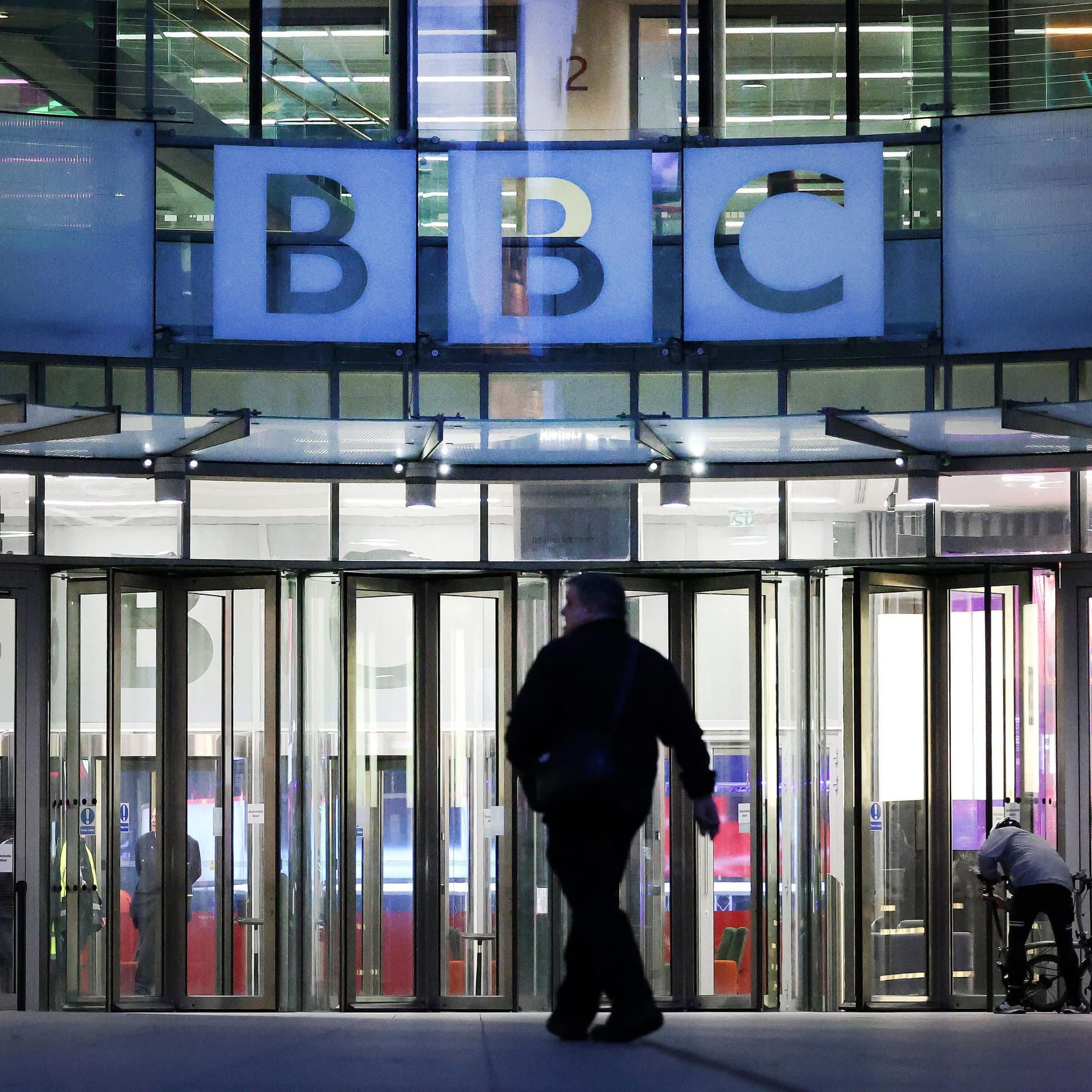
(Photo: BBC headquarters in London. Credit: Andy Rain/EPA/Shutterstock)