
In short
King Charles’s state visit to the US is dividing Britons amid tense UK-US relations under Donald Trump, plus scrutiny of the royal family at home.
Guests
Daniela Ralph, BBC senior royal correspondent (covers royal day-to-day ups/downs). Tristan Redmond and Asma Khalid host/discuss.
Key claims
The trip was planned before Iran-related events; UK government (No.10/Foreign Office) chose it as “soft diplomacy” after Trump’s UK visit in September. If the royals cancelled, it would be more political than going. Trump’s personal praise of the king contrasts with hostile comments about the UK (tariffs, NATO/UK troop bravery, Chagos, London/Sadiq Khan). The king must stay apolitical while still representing “brand UK,” using diplomacy rather than direct criticism.
Notable examples
250th anniversary of US independence; Trump’s Afghanistan troop remark and later praise; Andrew and Jeffrey Epstein revelations (Andrew denies wrongdoing; an active police investigation); Congress speech planning said not to reference Epstein due to legal process. Historical parallel: 1939 “hot dog diplomacy” with FDR.
Written by AI. May contain mistakes. Listen to the episode to check what was said.
Chapters
Tap a time to open that second in VOKing Charles' Upcoming Visit
0:34 to 2:10
Discussion about the divided opinions on King Charles' state visit to the US.
“King Charles will travel to the United States later this month for a state visit and Britons are divided on whether he should even be going.”
Context of the Visit
2:10 to 4:20
Exploration of the historical and political context surrounding the royal visit.
“Can you introduce yourself for us, please?”
Significance of Independence Celebration
4:20 to 6:20
Analysis of the implications of celebrating American independence with a royal visit.
“There is a suggestion that the Prince and Princess of Wales, William and Catherine, may go over during that World Cup period to the US as well.”
Trump's Relationship with the Royals
6:20 to 8:16
Insights on President Trump's views towards the royal family and their dynamics.
“I mean, he certainly does adore the queen and it said so.”
Tensions in UK-US Relations
8:16 to 10:43
Review of tensions and criticisms that have arisen in UK-US relations since Trump's presidency.
“When they are standing next to each other and interacting, and you're observing that as I was.”
Role of the Royal Family
10:43 to 13:01
Discussion on the apolitical role of the royal family and their diplomatic responsibilities.
“And actually, the president's mood just a couple of days later softened in some of his social media posts about the role of Britain.”
Queen's Historical Speech
13:01 to 14:00
Reflection on the Queen's previous addresses to Congress and their significance.
“Daniela, Asma and I were talking earlier on and the Brits on the team were saying that the royal family have centuries of experience in not saying anything political at all.”
Queen's Speech and Its Legacy
14:00 to 16:48
Discussing the impact of the Queen's 1991 Congress speech on current politics.
“saying anything, if that makes sense at all.”
Shifting British Attitudes Towards the Monarchy
16:48 to 19:44
Exploring the changing perceptions of the royal family among British citizens.
“Well, Daniela, we're very lucky to have Asma here in London with us this week.”
The Context of the King's Upcoming Visit
19:44 to 22:24
Analyzing the significance of the King's visit to Washington and its challenges.
“And that is because here in the UK, there is a live legal process.”
Show all 12 chapters
Royal Relationships and Family Dynamics
22:24 to 24:24
Discussing King Charles's family relationships amid his diplomatic duties.
“We were told that during a private element of that visit that President Franklin D.”
Balancing Diplomacy and Personal Feelings
24:24 to 25:55
Examining the challenges King Charles faces in maintaining relationships.
“That isn't going to be happening because there is still an immense lack of trust in the relationship.”
Transcript
Automatic transcript. May contain errors.0:00This BBC podcast is supported by ads outside the UK.
0:30how to invest and manage money. Learn more at schwab.com. King Charles will travel to the United States later this month for a state visit and Britons are divided on whether he should even be going. I think it's an acute embarrassment. No, I don't think it's a good idea.
0:50Asma:I think to not go would be, what's it saying, cutting off your nose to spite your face. By sending the king over, what we're saying is our relationship is great and growing. Now, under normal circumstances, a visit by a British monarch to address Congress and meet the American president would be utterly uncontroversial. Except Donald Trump has said some things like this. The UK is way out of line. I've just seen a true social post from the president. The UK giving away extremely important land is an act of great stupidity. I look at London where you have a terrible man, terrible, terrible man.
1:28They'll say they sent some troops to Afghanistan or this or that. And they did. They stayed a little back, a little off the front lines. And Charles is facing questions at home, too, about the future of the royal family, especially after revelations over his brother Andrew's relationship with Jeffrey Epstein. Andrew has consistently denied any wrongdoing. From the BBC, I'm Tristan Redmond.
1:56Asma:And I'm Asma Khalid. And today from London on The Global Story, can King Charles save this special relationship in Washington and the royal family back home?
2:09Daniela, it's so great to have you with us. Can you introduce yourself for us, please? Yes, I'm Daniela Ralph and I'm the BBC's senior royal correspondent. So it's my job to basically follow the royal family on all the ups and downs of what they're doing day to day.
2:24Asma:Daniela, we're having this conversation in the context of what I would describe as a particularly tumultuous moment in the U.S.-U.K. special relationship. And I want to understand from you, given how tense the relationship between these two countries has been, why is the king going to Washington, D.C. at this particular moment? Well, he's going because the relationship is so tense. I think it's important to say that the planning for this trip to the United States happened way before the offensive in Iran started. So this isn't the case of the king and queen waking up one morning and thinking, why no, we haven't been to America for a little while.
3:04Let's organize a trip over there. I quite fancy a couple of days in Washington and New York. They go because the UK government wants them to go. It is the UK government. It is number 10. So it is the Keir Starmer has asked him to go. Correct. Number 10 and the Foreign Office look strategically at UK relationships around the world and decide where they would like to deploy the soft diplomacy of the royal family. It was decided last year that they would do a return visit after President Trump came to the UK in September. There was an offer from the US for the king and queen to go there. April was put in the diary and that was fixed in.
3:41There were a number of factors at that point why the trip had to happen then. I mean, the reason for the visit is to celebrate the 250th anniversary of American independence. Can we just pause on that?
3:52Asma:Because I, as an American, find this such a curiosity that we are celebrating our independence from the Brits and therefore we are inviting the king back. Oh, well, bygones are bygones. Exactly right. I mean, I think that's what Buckingham Palace say. That's what the king will say. And he'll probably reference it when he's there. But, you know, that's in the past. We're all friends now as a message. So, yeah, I know, as strange as it may seem. So the theme of the visit is to celebrate the 250th anniversary of independence. There are a number of other factors in play as well. There is a World Cup in the US and the visit couldn't clash with that.
4:22There is a suggestion that the Prince and Princess of Wales, William and Catherine, may go over during that World Cup period to the US as well. So all these things are at play as well as, of course, the diary of President Trump. So it was felt that really this period of time was the best time for the king and queen to go. Daniela, can I just check in with you on a little sort of split screen moment I had yesterday, because I'm interested to know if you had the same one. So I had two sets of notifications on my screen yesterday at almost exactly the same time. On the one hand, I had a news notification from Donald Trump saying that Britain needed to go and get its own oil.
5:01And then almost exactly the same time, I had another one announcing this state visit. Did you have that? And if so, what was your reaction when you saw these two things dropping at the same time? I did. And it was a brilliant way of perfectly illustrating the dilemma that the UK government and to a degree Buckingham Palace has had about should we be going on this trip? You know, it is a conversation that has been very live in recent weeks, which doesn't often happen in the weeks ahead of a state visit. Do you go and visit a president and have a state visit there with all the pomp and ceremony that comes with that when he is being so personally hostile to the country where you are head of state.
5:40I think ultimately, the decision came down to the fact that if they decided not to go, if they decided to pull out of this visit, that is a much more political decision than going in many ways. And I think ultimately... It's a diplomatic no-go. You don't pull out of royal visits.
5:53Asma:It's a diplomatic no-go. That is a big move to suddenly go, we don't like the tone of what the president has said. We are pulling back from this. The government, ultimately, whatever The discomfort, and I think that's fair to say Buckingham Palace have got about this trip, the UK government were pretty clear they want the king and queen to go. And he could be the king at his most useful during this period of time, especially, of course, when who do you have sitting in the White House? A president who is a monarchist, a raging monarchist, I think it would be fair to say. I mean, he certainly does adore the queen and it said so.
6:26Asma:I remember speaking to a former advisor to the White House who said that there are few people Trump sees as a peer. Amongst them are Putin of Russia, Xi Jinping of China and the royals. Yeah. And, you know, when he was here in September, I was one of the reporters traveling around with the president and the king. You know, he kept repeatedly saying, President Trump, what a great man the king is. He is what a brilliant person he is. You were with President Trump and the king when they last met here in the UK. Trump has been here twice, I believe, right, for state visits. What was the scene like?
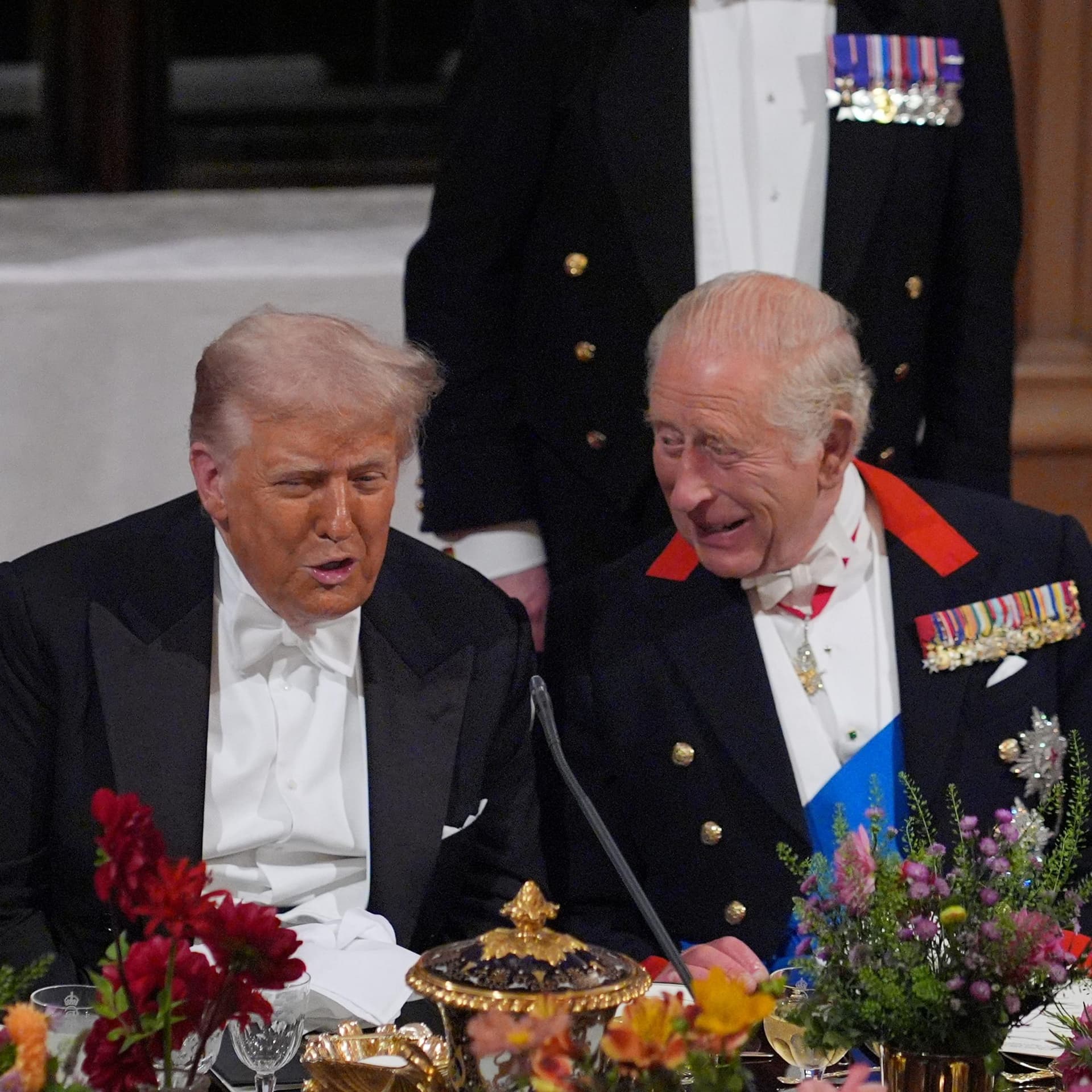
7:03Asma:It was at Windsor Castle. It was the ultimate in royal hospitality. A day of dazzling displays of processions. There were a number of engagements when President Trump came over that were within the castle walls. To top it off, a lavish state banquet with 160 guests gathering in Windsor Castle. I think it's important to say it wasn't that they didn't get on. I wouldn't say that about them. It's just that you are fundamentally different human beings. But this is truly one of the highest honours of my life. President Trump, he is bombastic. He's overt. He speaks his mind. He doesn't seem to really sort of think too much about what he's going to say.
7:41And he was very keen to lavish praise on a personal level on the king and queen. Such respect for you and such respect for your country. King Charles, on the other hand. Our countries are working together in support of crucial diplomatic efforts. He is quite a quiet person, probably instinctively quite shy. I would say he is a restrained human being. Not least of which, Mr President, is your own personal commitment to finding solutions to some of the world's most intractable conflicts. He's not someone to heap praise on people very openly. He is not emotional. When they are standing next to each other and interacting, and you're observing that as I was.
8:20You can just get a sense of how they are two very different human beings. But the thing with the king to remember is that the head of state, the monarch here in the UK, is supposed to be an apolitical figure. He's not a political figure. He is a constitutional monarch there to represent the government. It is not for him to make personal judgments on individuals. It's not for the king to say, I don't want to go to America. It is his job to do what the government want him to do. So let's have a little trot through some of the kind of moments of tension that have presented themselves since Donald Trump came back to the White House, because there have been quite a few of them.
8:56Back in February 2025, Donald Trump won't have been back in the White House very long at that point. On the subject of tariffs, he said the United Kingdom is out of line on its trading relationship with the United States. And then fast forward a little bit to September 2025.
9:12Asma:I remember this one well. This was at the United Nations. where he publicly reprimanded and scolded Europe, said that their countries were going to hell and singled out the mayor of London, Sadiq Khan. In that same month, September 2025, he was talking about the so-called special relationship. He said that the United Kingdom is no longer a priority ally and the UK needed to stand on its own two feet. In January 2026, there's Chagos. Chagos Islands, yes. And so the president singled out the deal for the UK to hand the Chagos Islands back to Mauritius. He has been repeatedly frustrated with what he views as the United Kingdom's decision to give those islands up, which he thinks are important for national security purposes.
9:56Now, in that same month, and I'd like to ask you about this one in particular, Daniela, Donald Trump told Fox News he was critical of the role of NATO troops and he said of UK troops, they'll say they sent some troops to Afghanistan and they did, but they stayed a little back, a little off the front lines. What was the blowback, if any, that you encountered from the royal family of those comments about the military? There was definite blowback about that one particular comment. The implication was that somehow they hadn't quite been brave enough in Afghanistan, hadn't sort of been courageous enough, hadn't been the same as the Americans.
10:33That caused an absolute furore behind the scenes, particularly among the king's closest advisors and the king himself at Buckingham Palace. You know, you have to remember that the king is the head of the armed forces in the UK. And although they would not openly or on the record get involved in contradicting what President Trump had said or in any way publicly directly admonishing him, they made it very clear through back channels and through other conversations that were had that that was something that they were deeply unhappy with and did not want to hear again. And actually, the president's mood just a couple of days later softened in some of his social media posts about the role of Britain.
11:11And he went on to praise British soldiers in that moment.
11:15Asma:Nonetheless, though, the president's mood hasn't softened when it comes to the British Prime Minister Keir Starmer, because he went on to say that he's no Winston Churchill. He has been repeatedly very critical of Starmer. Well, factually, it is technically true. He is not Winston Churchill. True. Very valid point. But I mean, he's gone on to say, and I think you've seen this more so even with now the U.S.'s real war in Iran. He has been frustrated that he feels the U.K. has not helped and been this partner and ally that he feels like the United States is due. This is a chance in a way to get a little bit inside President Trump's mind.
11:49And how does he view things? What strikes me, I think, is he sees, I think probably wrongly, the U.K. royal family as something that sits completely apart from the rest of the country. So it's almost as if when he's criticising the prime minister, he's criticising the British Armed Forces, the mayor of London, British society in general, that somehow in his own mind, he seems to be able to separate that from the royal family itself. He doesn't seem to almost register that they represent all of those things here in the UK. And they sit very separately in his mind.
12:23Asma:Can I just pause on something you said? Earlier, you had mentioned that the role of the royal family is to be apolitical. And I don't really understand that if they're supposed to be apolitical, how they can at the same time be diplomats for the British government. I suppose in apolitical, what you're saying is that they are not party political. They wouldn't get involved in party political campaigns here. They wouldn't get involved in election time. They wouldn't say what they think about what a particular government or a particular party is doing around policy. the king and the wider royal family would see themselves as a representation of brand UK I suppose and wanting to support the UK whatever government was representing it that is what the king's role is as a constitutional monarch but that isn't to say that if he feels there are moments when the UK should be defended or supported then he would say something so he may make his point by not being critical of his host, but by perhaps emphasising a particular point about the UK he will want made.
13:26Daniela, Asma and I were talking earlier on and the Brits on the team were saying that the royal family have centuries of experience in not saying anything political at all. Would you concur with that assessment? Oh yeah, 100%. They are absolutely gifted at almost going there, but not quite, which could be quite frustrating when you're reporting on them sometimes because you think, oh, is this going to be something amazing and quite controversial they're going to say here? And then they sort of pull it back at the last moment. Yeah, they are, as you say, they are experts at sort of saying something without upsetting anyone and not really saying anything, if that makes sense at all.
14:03But yet it can have power and influence, even though it is perhaps very careful in the way it's worded and the way it lands.
14:12Asma:In prepping for this episode, we went back to the 1991 speech that the Queen had given to Congress. I do hope you can see me today from where you are. Mr. Speaker, Mr. President, distinguished members of Congress. I know what a rare privilege it is to address a joint meeting of your two houses. And saw snippets of that where she spoke, it seemed, about fairly mundane common values, things like democracy. Our societies rest on mutual agreement, on contract and on consensus. A significant part of your social contract is written down in your constitution. Ours rests on custom and will. The spirit behind both, however, is precisely the same.
15:07It is the spirit of democracy.
15:09Asma:But those big shared values have become increasingly polarised and partisan debate issues in the United States. And I am very curious to see how the king navigates the very changed environment that American politics are in. OK, so imagine the following hypothesis. If King Charles went to Washington, D.C. and stood in front of Congress and gave a speech about democracy, would that be considered to be provocative in some way? I think it would depend what he says. But I just imagine that we are living in such a far more polarized political climate in the United States, in which the idea of some of the common shared values might translate really differently in the year 2026, just given our American political debates.
15:56Just on that, he will want to make a point, I think. But it's how he does it diplomatically. And that is where the soft royal diplomacy comes in.
16:09He's not going to do it by saying, President Trump, I really hated what you said about the armed forces. I don't like how you talk about our prime minister. Instead, he will say, you know, it is very important that we work together. Both our governments need to be aligned at a bumpy time in global politics. You know, it is the relationship, the transatlantic special relationship needs to stay special. He will use that kind of language, I think, as opposed to direct criticism.
16:53Well, Daniela, we're very lucky to have Asma here in London with us this week. She's not always here with us. Normally she's in Washington. And I think it's important to talk as well about the context of how the monarchy is perceived in Britain, because not everyone in this country is a fervent monarchist. Daniela, how would you describe British attitudes right now to the royal family and how have they been changing recently? I think the popularity of the royal family has been in a slow decline, not helped, as you could imagine, by the situation around Andrew Mountbatten-Windsor and the revelations that have emerged around his relationship with the convicted sex offender Jeffrey Epstein.
17:35Now, that has been incredibly damaging for the royal family, for its reputation and for how it is viewed by the public. And in some of the more recent polling, you can see that some of the numbers show that there is a little bit more concern about the royal family and what it's there for. But what there hasn't been is a monumental fall off of numbers. And I think that is because, as Tristan has said there, we exist here in the UK where you have a small number of people who are ardent Republicans, a small number of people who are fervent monarchists. In the middle, you have a sort of British shoulder shrug about the royal family by a vast amount of people who are kind of like, you know, I don't really care enough about it to think we shouldn't have it.
18:17But I'm not going to be, you know, standing outside the reigns of Buckingham Palace, you know, watching for the king and queen to come and go. So there is a sort of indifference in the middle, but it is important that those indifferent people who kind of quite like the monarchy around a big event and a big occasion stay relatively loyal and relatively happily indifferent. And I think the problem with the situation around Andrew Mountbatten-Windsor, it has caused a lot of people to question, well, what's the royal family for? How transparent is it? How do we know what's going on? Who's protecting them?
18:47People are a little bit more sceptical and asking a few more questions. And that is a slightly difficult situation for the royal family.
18:55Asma:Danielle, you mentioned Andrew and his relationship with Epstein. And the king will be coming to Washington, D.C. in the context of a really live debate around the Epstein files. You know, we talked about him giving a speech to Congress. Presumably there will be members of Congress there who want to see more transparency around the Epstein files. Some who have wanted to see Andrew, for example, testify. In Congress, you have a Congressman Ro Khanna of California who's been really leading this initiative in some ways, who I believe wrote a letter, the BBC said, encouraging the king to meet with some of the Epstein victims when he comes to the United States.
19:32Asma:Do you have any sense of how that might factor into the king's visit? Yeah, I think perhaps that address to Congress will be one of the more uncomfortable moments for the king during his trip to America. Because as you say, there will be lawmakers, politicians listening to the king's speech who've also called on his younger brother to come to the States and to give evidence to Congress about his relationship with Jeffrey Epstein. It is an awkward moment. But I've spoken to a number of people now who've been involved in planning the trip and around Buckingham Palace about whether in that speech, will there be any reference even mildly to the situation and the fallout from the Epstein files in particular and the stories of victims and support for victims?
20:14I am told that won't happen. And that is because here in the UK, there is a live legal process. Andrew Mountbatten-Windsor, the King's brother, was arrested in February. There is still an ongoing police investigation into his behaviour in public office when he was a UK trade envoy. that is very much an active police investigation. And those around the royal family do not want to say anything that could in any way, in their view and on their legal advice, cause a problem for the wider police investigation.
Read the full transcript
20:45Asma:Daniela, it's now been roughly 20 years since a royal has come to Washington, D.C. for a proper royal visit. I believe the queen came in 2007. And I want you to help us understand what the role is of the royal family, specifically in the context of the United States. We've been talking about the king coming at this moment of a really tense relationship between the U.S. and the U.K. What's the circumstances of when they've come in the past and have there been similarly tense moments when these trips were made? Yeah, if you do a dip into the Royal Archive, you can see that there have been other moments when the royal family came to America and was used as a means of perhaps shoring up a slightly tricky, bumpy relationship at the time of their visit.
21:35Asma:Eyes of the world are on Washington as Secretary of State Hall welcomes Great Britain's King George VI and Queen Elizabeth. There was the visit that the late Queen, Queen Elizabeth, made with her father, King George VI, in 1939, before the Second World War. While the Queen and Mrs Rodenwell wave friendly greetings to the crowds. Spaced every four feet, soldiers stand and present arms, and the King acknowledges the cheering throngs as the cars roll past. That was seen very much as trying to really strengthen the alliance between the UK and the US during that period ahead of the war. The four-mile trip from the station consumed an hour that belonged to the crowds.
22:15Asma:But here the gates are closed and the public excluded as the royal couple become guests of the president and Mrs. Roosevelt. That became a trip that was referred to as the trip of hot dog diplomacy. We were told that during a private element of that visit that President Franklin D. Roosevelt took the royal family that were visiting to his private home in New York and gave them their first taste of hot dogs. Did they like it? That's the question. Apparently they loved it. King George VI loved it. Who wouldn't like a hot dog? The reports from the times that the king had two hot dogs and a beer and that Princess Elizabeth absolutely loved having a hot dog.
22:54And it became just one of those moments during a more serious-minded trip that seemed to capture the public attention.
23:00Asma:And this was prior to the United States entrance, you're saying, into World War II. Yes, it was. And was the mission of the trip to encourage the United States to join horses Was there a diplomatic mission? Yeah. I think, I mean, there would have been in the background, of course, but I think it was more about just shoring up that relationship. So when that moment came, there was an influence that the UK could perhaps exert. I feel like I ought to ask the American-oriented question, and that is that the king's younger son, Harry, lives in the United States. My understanding from the reports that we've read is that the king has only met his granddaughters at one time before.
23:37Asma:And I am curious if he's going to meet his son while he's there. I mean, I imagine there is not just the diplomatic dance he has to have on a very grand scale when we're talking about Trump and Congress, but there's the diplomatic family dance he has to navigate. I think on a personal level, as a human being, a lot of people will maybe thinking that, you know, if you're somebody whose family lives in a different country, you're going to that country. You know, you're going to visit that country to do some work. would you not have found time in your schedule to either go and visit them or for them to come and visit you it gives you a flavor of the tension that still surrounds a relationship between father and son and also how the royal family doesn't really quite operate like other families as well so if you're looking at it from a you know for want of a better phrase a normal human being perspective you think well of course you'd for you build in a couple of extra days you'd go and see Harry and Meghan in California, you get Harry to come and see you in D.C.
24:37That isn't going to be happening because there is still an immense lack of trust in the relationship. It's not going to happen. It's not going to happen as things stand. Yeah. I mean, it strikes me that when King Charles goes to Washington, D.C., he's treading a bit of a tightrope. What is his toughest task here? Is it saving the so-called special relationship or saving the image of the monarchy back home in Britain? I think it's a bit of both. And in addition to try and actually restrain his own personal views in the situation he's going to find himself in, because the king is someone who is, although he is quite a quiet, restrained character, he knows what he thinks.
25:18And he will not at all like the tone that Donald Trump has used to talk about the prime minister and the UK more generally in recent months. But he is going to have to find a way of parking those personal feelings. He is very much doing a little bit of, I suppose, a bit of mediation, you could argue, a bit of therapy work, the king, for both the president and the prime minister to try and see if despite the difficulties, despite the differences in approach, we can get that relationship back on an even keel.
25:58Asma:well thank you it's been a real pleasure speaking with you thank you so much daniela it's been great no my pleasure thanks very much
26:07will you be going daniela yeah i'm going but they're also going to bermuda at the end of it which is quite a nice way to round it off so don't tell anyone so we'll get a little sort of We'll get a bit of a nice sunny end to the trip after all the kind of slightly fought politics, I think. We won't tell anyone apart from all the people who are listening.
26:35And that's it for today's episode. Please send us your thoughts and ideas on theglobalstory at bbc.com. And please rate us wherever you listen. It helps others find us. Now, a quick record before we go. Here at The Global Story, we bring you one story every day where the world and America meet. For the very latest news headlines, listen to our sister show, The Global News Podcast. You can find it wherever you listen.
27:00Asma:Today's episode was produced by Kat Farnsworth and Zandra Ellen. It was edited by James Shield and mixed by Renee Park. Our studio engineer was Devith Evans and Mike Regard. Our digital producer is Matt Pintus. And our senior news editor is Chyna Collins. I'm Asma Khaled. And I'm Tristan Redman. Thanks very much for listening. Cheerio.
From the publisher
King Charles and Queen Camilla will visit Washington DC this month at a time when the transatlantic relationship is at its lowest point in decades.
The King is facing a difficult time at home in the UK too, with significant public opposition to the visit and anger over his brother Andrew’s association with Jeffrey Epstein. Andrew has consistently denied any wrongdoing.
Can the King and Queen sprinkle some royal magic on President Trump and improve the royal image at the same time? Asma and Tristan are joined by the BBC’s senior royal correspondent, Daniela Relph.
Producers: Cat Farnsworth and Xandra Ellin
Executive producer: James Shield
Mix: Renee Park
Senior news editor: China Collins
Photo: President Donald Trump and King Charles III at a state banquet at Windsor Castle, in September 2025.