
In short
The episode explains how US-Canada relations deteriorated during Trump’s second term, focusing on tariff escalation and a provocative Ontario-funded US ad using Ronald Reagan’s words, which reignited a trade feud.
Guest backgrounds
Nadine Youssef, BBC senior Canada reporter based in Toronto, covering Canadian stories.
Key claims
The US and Canada are uniquely intertwined (longest undefended border; heavy trade; existing trade deal), but Trump’s “51st state” rhetoric and new tariffs triggered Canadian backlash. Ontario’s $75M ad misrepresented Reagan’s anti-tariff message, prompting Trump to say he would terminate deals and raise tariffs again. Doug Ford’s province became the most vocal actor, using defiant anti-tariff messaging aimed at Americans.
Notable examples
Canadians booed the US anthem at hockey games; boycotted US products and travel; Trudeau resigned amid tariff upheaval; Mark Carney’s White House meeting appeared friendly; Ford threatened retaliation (e.g., pulling US liquor, possibly energy leverage); the ad aired during World Series games before being paused.
Written by AI. May contain mistakes. Listen to the episode to check what was said.
Chapters
Tap a time to open that second in VOAd Controversy and Trade Tensions
0:30 to 2:19
Discussion on a controversial TV ad that sparked trade tensions between the US and Canada.
“It played the other day during the World Series.”
Introducing Nadine Youssef
2:19 to 2:42
Introduction of guest Nadine Youssef, a reporter from Toronto.
“And today on The Global Story, how has the United States' relationship with Canada deteriorated in President Trump's second term?”
Historical Context of US-Canada Relations
2:42 to 4:37
Overview of the long-standing relationship between the US and Canada.
“Well, Nadine, first-time guest on the show, it's wonderful to have you here.”
Initial Reactions to Trump's Tariffs
4:37 to 6:46
Exploration of the initial reactions in Canada following Trump's tariff announcements.
“Obviously, this was the start of what later became a repeated reference of Canada as the 51st state.”
Canadian Response to US Tariffs
6:46 to 9:13
Description of how Canadians reacted to US tariffs, including boycotts and protests.
“Yeah, I mean, Canada's economy is deeply intertwined with the U.S.”
Political Shifts in Canada
9:13 to 10:17
Discussion on the political upheaval in Canada and the subsequent resignation of Trudeau.
“I think you even see, I think California ran advertisements trying to entice Canadians to come and vacation there.”
Mark Carney's Rise to Leadership
10:17 to 11:30
Examination of Mark Carney's background and his ascent as Canada's new Prime Minister.
“And so in part, he resigns because of them.”
Carney's First Meeting with Trump
11:30 to 14:00
Analysis of the first meeting between Mark Carney and Donald Trump regarding trade and tariffs.
“And I know that shortly thereafter, Cardi makes his first trip to the White House to meet with President Trump.”
Diplomatic Meetings and Trade Talks
14:00 to 15:28
Explore the nuances of recent diplomatic interactions between the U.S. and Canada.
“And Trump appeared to react favorably to that.”
Introduction to The Global Story
15:28 to 16:01
Learn about the show's mission and how it connects global stories with American audiences.
“For those of you who might be new to our show, we here at The Global Story dive deep every weekday on one big story at the intersection of where the world and America meet.”
Show all 14 chapters
Doug Ford's Role in Trade Tensions
16:01 to 18:20
Understand how Ontario's Premier Doug Ford is vocal about trade impacts and tariffs.
“And frankly, I didn't hear as much or as frequently from President Trump either about making Canada the 51st state.”
The Controversial Ad Campaign
18:20 to 21:24
Delve into the details and implications of Doug Ford's ad campaign in the U.S.
“And he makes that very clear and he's quite vocal about his concerns.”
Fallout from the Ad Campaign
21:24 to 24:18
Analyze the immediate reactions and consequences following the controversial ad.
“And he did that ad sent shockwaves here in Washington.”
Long-Term Impacts on U.S.-Canada Relations
24:18 to 26:51
Investigate how tariffs and perceptions are shaping the future of U.S.-Canada relations.
“that's going to look at the legality of tariffs.”
Transcript
Automatic transcript. May contain errors.0:00This BBC podcast is supported by ads outside the UK.
0:30Just tap into iHeart to start watching. And we hope you enjoy the show.
0:37There's a TV ad here in the U.S. that's been making a lot of headlines. It played the other day during the World Series. It's a commercial that cycles through images of American life. When someone says, let's impose tariffs on foreign imports, it looks like they're doing the patriotic thing by protecting American products and jobs. Factories, farmland, families just going about their lives. And sometimes for a short while it works, but only for a short time. And over these images, you hear the words of the popular former Republican president, Ronald Reagan. Throughout the world, there's a growing realization that the way to prosperity for all nations is rejecting protectionist legislation and promoting fair and free competition.
1:22America's jobs and growth are at stake. But it was paid for by the government of Ontario, Canada. Canada, they wrote, they did a crooked ad. This all got under the president's skin. Well, that's dirty playing, but I can play dirtier than they can, you know? Trump called the ad fake. The Reagan Foundation said it misrepresents the former president's words. But more importantly, it's reignited a trade feud between the two countries. Canada is the United States' second largest trading partner, and it sells three-quarters of its goods to the U.S. But in response to this ad, and despite the fact that the U.S.
2:09has an existing trade deal with Canada, Trump decided to punish his neighbor by raising tariffs yet again. From the BBC, I'm Asma Khalid in Washington, D.C. And today on The Global Story, how has the United States' relationship with Canada deteriorated in President Trump's second term? And who is the man behind that ad that has so provoked the president?
2:42Well, Nadine, first-time guest on the show, it's wonderful to have you here. Thank you so much for having me. Can I have you introduce yourself for us? Just tell listeners who you are, where you're based, what you do.
2:53Nadine Yousif:Yeah. So my name is Nadine Youssef. I am a reporter based here in Toronto, Canada. I primarily cover Canadian stories. Canada is sort of my beat and I cover everything that happens in this big, beautiful country. So we want to get into this latest round of tariff and trade chaos. But before we do that, I want to rewind to the first moments of this tiff between the United States and Canada. Feels like it really crossed my radar, I would say, back in December, actually, even before the president took the oath of office. Can you remind us of what that moment was like? Yeah. So, I mean, I think it's really good to sort of begin by underscoring just how unique the Canada and U.S.
3:38Nadine Yousif:relationship is. The two countries have been friends for a very long time. They share the longest undefended border in the world. They trade with each other heavily. There's been a longstanding free trade agreement between the two countries. And a lot of Canadians travel to the U.S. all the time and vice versa. And many also have American family members. So really, really close ties between the two countries. Naturally, when the U.S. elects a new president, a lot of Canadians are paying attention. And the Canadian government was already working before President Donald Trump's inauguration to build ties with his new administration.
4:08Nadine Yousif:So you brought us to December 2024. So at that time, there was a dinner that Prime Minister Justin Trudeau, who was the Prime Minister at the time of Canada, shared with Trump in Mar-a-Lago. After that dinner, Trump had posted on Truth Social that he enjoyed having dinner with Governor Trudeau of the great state of Canada. So obviously, what he's implying here is that Canada, he's reducing Canada to a U.S. state rather than its own sovereign country. Obviously, this was the start of what later became a repeated reference of Canada as the 51st state. But at the time, you know, I think Canadians didn't know what to make of it and just thought it was, you know, a light job, him poking fun.
4:51Nadine Yousif:But more and more, the more it was repeated, the more Canadians started to take it seriously. All of a sudden, it didn't feel like this was accidental or a one-time thing. And there was this one sort of telling anecdote that Trump revealed about his meetup with Trudeau. But again, you know, why, representing this country, why are we spending$200 billion to support and subsidize another country? According to Trump, he had asked Trudeau what would happen to Canada if the U.S. stopped trading with it. Because if they didn't have us and if we didn't spend that money, as Trudeau told me, they would cease to exist.
5:29He said that to me. They would cease to exist, which is true, certainly as a country.
5:34Nadine Yousif:And so I think it appears in Trump's mind from that interaction that the existence of Canada as a country solely relies on the U.S. And therefore, you know, again, in Trump's mind, it may as well be part of the U.S. You know, he feels like the U.S. is subsidizing Canada's existence, so to speak. And I would say that, you know, Canadians started to take it more seriously because, you know, Trump was being asked about it And at one point he had said that he wanted to use economic force to annex Canada. And Trudeau had also gone on to say that he believes that Trump is eyeing Canada's resources. Now, Canada is a large country and it's rich with oil, minerals, fresh water.
6:12Nadine Yousif:And so I think that Trudeau walked away hearing this remark being said over and over again and started to kind of take it seriously. Nadine, at the same time that we hear the president making these remarks, referring to Canada as the 51st state, we also see him announce that he wants to put in place a tariff on Canada. That, I will say, caught a lot of people's attention here in Washington because the U.S. actually has an existing trade deal with Canada, one that was enacted during President Trump's first term. Well, how did that go down in Canada? Yeah, I mean, Canada's economy is deeply intertwined with the U.S.
6:49Nadine Yousif:I mean, we sell three quarters of our products to America. So it's a huge chunk of the economy here, for sure. And so the initial reaction was that of shock. I would even go as far to say as betrayal. So today, the United States launched a trade war against Canada. I remember Prime Minister Trudeau at the time. He really did not mince his words. Now I want to speak directly to one specific American. Donald. Donald, in the over eight years you and I have worked together, we've done big things. When he sort of addressed the Canadian public and Trump directly. Now, it's not in my habit to agree with the Wall Street Journal.
7:32But Donald, they point out that even though you're a very smart guy, this is a very dumb thing to do.
7:40Nadine Yousif:Very dumb thing to do. That's a direct quote from him. And he also quickly put some counter tariffs on American products. This was sort of seen as Canada fighting back. Nadine, there's a word you mentioned earlier that caught my ear, and that is betrayal. Was that the general consensus amongst Canadians at that point in time, that they felt betrayed? Yeah, I mean, Canadians were just as upset as the prime minister. There's very telling scenes that were quite unprecedented that really sort of conveyed that mood. So, for example, you've noticed Canadians started booing the U.S. national anthem at, like, friendly hockey.
8:18Nadine Yousif:I heard about that.
8:25Fans in Montreal last night loudly booed the American national anthem before a face-off between the U.S. and Canadian teams.
8:32Nadine Yousif:And that is so rare. Also, my perception of Canadians is that they're quite friendly. So I wouldn't have anticipated that they would be booing anybody, let alone the Americans. Yes, exactly. Exactly. That's how you know that they were really, really upset. But it didn't just stop at the booing. I mean, they started boycotting U.S. products. I mean, even grocery stores and companies went as far as sort of labeling made in Canada products. And grocery stores did this because they knew that Canadians were looking for Canadian products to buy because they were intent on boycotting made in USA products.
9:05Nadine Yousif:And it went beyond the grocery store. I mean, people were canceling their trips to the U.S. I mean, I personally know people who are still boycotting travel to the U.S. in protest over the tariffs. And it's interesting. I think you even see, I think California ran advertisements trying to entice Canadians to come and vacation there. Truth is, California just wouldn't be California without Canada. Thank you, Canada. That's a sign that the impact is being felt in the U.S., at least in some parts. So just to be clear about the time frame in which all of this is happening, President Trump signed an executive order on February 1st announcing this tariff on Canada.
9:47They are supposed to go into effect on March 1st. And my understanding is they go into effect, right? And then a few days later, there's a temporary pause, it seems, of some sort.
9:56Nadine Yousif:That's right. And so and this was a time of, I would say, significant upheaval in Canada. Justin Trudeau was sort of on his way out. He had been in office for 10 years and Canadians have been quite upset about the cost of living and also just growing fatigued with his government. And so the tariffs are not welcome news whatsoever for his government. And so in part, he resigns because of them. Also, you know, Trudeau had a not so friendly relationship with Donald Trump. And so I think there were concerns about whether he would be. That's diplomatic. Yes. Yes. There were concerns about whether he would be sort of the best person equipped to move this relationship forward.
10:36Nadine Yousif:And so by March, when the tariffs do come into effect, Canada was sort of gearing up to elect Prime Minister Trudeau's replacement, who is Mark Carney, our current prime minister. So tell us more about Mark Carney and how he emerges as the next prime minister. Yeah, I mean, so Mark Carney is not a newcomer by any means. He's familiar to some Canadians. He has an impressive resume. He graduated from Harvard and Oxford, and he worked at Goldman Sachs. He later served as the governor of the Bank of Canada during the 2008 financial crisis, and he was tapped afterwards to lead the Bank of England. So in short, he brought a lot of economic experience to the table and he sort of billed himself to Canadians as the man that can, A, take on Trump and, B, take Canada out of this economic crisis.
11:26Nadine Yousif:And it worked. You know, Canadians voted him in. So at this point when Cardi's elected, the tariff situation seems murky between the United States and Canada. And I know that shortly thereafter, Cardi makes his first trip to the White House to meet with President Trump. And there was a lot of anticipation, I remember here in Washington, about how that meeting would go down, given the antagonistic relationship we had seen between the Trump administration and the Canadians. What stood out to you from that meeting? I mean, so it's fair to say that all eyes were on that meeting, at least in Canada, primarily because people wanted to see if Carney would have a better relationship with Trump than Trudeau did.
12:09Nadine Yousif:You know, I think on the surface, it was quite friendly. I think, you know, I think a lot of Canadians were concerned that, you know, there might be sort of an adversarial relationship given the tensions that were going on with the tariffs. But it seemed like the two men got along very well. You know, the two were smiling. They were sharing laughs. You know, Trump had called Carney a terrific guy. Carney was very interesting. He sort of walked a fine line at the time because he was speaking to an American audience, but also the Canadians back home. And I think very tellingly, he called Trump a transformative president.
12:46You are a transformative president. And since then, the transformation in the economy, unprecedented commitments of NATO partners to defense spending. And now, and I'm running out of time, but this is in many respects the most important. The merger of Canada and the United States. That wasn't where I was going.
13:08Nadine Yousif:And there was that one point where he even managed to sort of navigate the 51st state rhetoric. You know, I think Trump had raised, you know, Canada could become part of the U.S. You know, I'm a real estate developer at heart. When you get rid of that artificially drawn line, somebody drew that line many years ago with like a ruler, just a straight line right across the top of the country. When you look at that beautiful formation when it's together, I'm a very artistic person. But when I looked at that beauty, I said, that's the way it was meant to be. And Carney really navigated that quite expertly, I would say.
13:43As you know from real estate, there are some places that are never for sale.
13:47Nadine Yousif:Telling Trump that, you know, there are certain places that are not for sale, kind of tapping into his real estate background. We're sitting in one right now, you know, Buckingham Palace that you visited as well. That's true. And having met with the owners of Canada over the course of the campaign last several months, it's not for sale. And Trump appeared to react favorably to that. There was no sort of confrontation after that. Although he did say never, say never. Never say never. Never say never. What? But it was a quite expertly maneuvered, you know, act of diplomacy, I would say. That meeting, by all accounts, went far better than many folks perhaps anticipated.
14:27And, you know, Carney and Trump didn't have a big blowout. He wasn't goaded into saying anything. I think it seemed like a fairly constructive conversation that opened up the idea of somehow dealing with this trade and tariff tension down the road.
14:41Nadine Yousif:Yeah, yeah, I agree. And I think it also sort of opened up a dialogue. And I think in Canada, people sort of started to believe that, you know, a deal could be reached. You know, we are two countries that have sharing interests. And now we have two leaders who seem to get along quite well. You know, it seems like things are going in the right direction. But that is until another Canadian politician gets involved and things get derailed.
15:28For those of you who might be new to our show, we here at The Global Story dive deep every weekday on one big story at the intersection of where the world and America meet. And you can now watch The Global Story on the iHeart app. Catch every brand new episode every weekday. Just tap into iHeart to start watching. And we hope you enjoy the show.
15:54So Nadine, it seems like the meeting with Carney and Trump goes well enough that the prospect of an active trade war with Canada kind of slips out of the public consciousness. And frankly, I didn't hear as much or as frequently from President Trump either about making Canada the 51st state. But you alluded to somebody else getting involved. Tell us more.
16:16Nadine Yousif:Yes. So, you know, in the background, as the Canadian government, the federal government is having these negotiations, there are also provinces in Canada that are feeling the impact of the tariffs in their own unique ways. And the most sort of vocal and significant, I would say, of those premiers is Doug Ford. And so Doug Ford is the leader. And premier, to be clear, being governor, more or less, what we would say. Yes. Yes. Leader of the province. Yes. So Doug Ford is, you know, the elected leader of the province of Ontario, which is Canada's largest province by population. He's quite an interesting character.
16:52Nadine Yousif:He's straight talking. He's kind of folksy. He's incredibly popular. So earlier this year, he won his third consecutive majority government, which is, you know, a really rare feat in Canadian politics and provincial politics. And what's his politics like? Is he conservative? Would you describe him as being conservative? Yeah. So he is a conservative politician. Some people describe him as populist. Again, it's sort of that straight talking, you know, coming directly at your screens. You're describing him to have a bit of a kinship with Donald Trump. Yes. I mean, there have definitely been some comparisons between the two.
17:26Nadine Yousif:So it's quite interesting that there is a little bit of friction between the two now. But they employ a similar style of politics and they have similar appeal with their voter base. I think that's fair to say. The reason why Doug Ford is really the most vocal is because his province is sort of home to Canada's auto manufacturing industry, which is one of the hardest hit by U.S. tariffs. And thousands have sort of already lost their jobs in that sector. And there have been some significant announcements of car makers either reshoring operations to the U.S. or halting projects in Ontario altogether.
18:01Nadine Yousif:And these are things that have been, I guess, really upsetting to Doug Ford and his base and, you know, the Ontario workforce in general. Got it. So he gets involved in this conversation about tariffs because he leads this province, you're saying, that's been heavily hit by the effects of this trade policy between Canada and the U.S. Yes, yes, exactly. And he makes that very clear and he's quite vocal about his concerns. And so his response has been to take this fight directly to Americans. The Premier of Ontario is joining us right now. Premier, thank you so much for joining us. He's appeared on U.S.
18:36Nadine Yousif:networks like CNN and Fox, for example. So these tariffs is nothing but a tax on Americans. President Trump calls it Liberation Day. I call it Termination Day because a lot of people are going to be terminated from their jobs. You know, talking directly to an American audience, saying, hey, the tariffs are bad for you too. If you go after Canada, we have no choice but retaliate. And I apologize to the American people. You know, he's been visibly defiant, you know, wearing Canada is not for sale hats. We will use every tool in our toolbox to fight back. We can't sit back and roll over. I mean, he's pulled, you know, U.S.
19:14Nadine Yousif:liquor off Ontario shelves, kind of as punishment, really. Like he's sort of saying, you know, if you don't want to do business with us, then we won't do business with you. Depending on how far this goes, we will go to the extent of cutting off their energy. And, you know, another thing that he's done that hasn't materialized but he's threatened is withholding energy exports to the U.S. That would be huge, though, I imagine. I remember living up in New England and so much energy comes down from Canada, especially in the winter months. Yes. His response and his sort of strategy is to, you know, show the Americans how much they rely on Canada and that they, in his view, they should not be treating Canada this way.
19:57Nadine Yousif:But, you know, about a week ago, Doug Ford has sort of become a prominent figure in U.S. media. And it's all because of this ad that his government had bought and paid for to appear on U.S. television. Now, this advertisement, it's about one minute long. It shows clips of, you know, blue collar workers, families at home, farmers, and they're all sort of meant to represent American workers. And those establishing shots are overlaid by excerpts from an address on free trade that former U.S. President Ronald Reagan, who is a Republican, gave in 1987. And in that address, Reagan says tariffs hurt every American.
Read the full transcript
20:38Nadine Yousif:So the advertisement does splice the address. The address is originally five minutes long, but it does not alter or change Reagan's words in any way from that address many decades ago. And I do want to point out that the Ronald Reagan Presidential Foundation and Institute issued a statement after the ad aired and said that it misrepresented the presidential radio address and that the government of Ontario had not sought permission to edit those remarks. But what you're saying is those remarks were nonetheless comments that Ronald Reagan did say as president about tariffs. Yes. Again, the advertisement does splice the words and sort of rearranges them a little bit.
21:21Nadine Yousif:But he did say that tariffs hurt every American. Yes. And he did that ad sent shockwaves here in Washington. How would you characterize the fallout to all of this? Swift and immediate. These ads, I mean, it was a$75 million advertising campaign. I will say that President Trump, a few days after it was launched, didn't seem to have an issue with it. He was sort of speaking to reporters and he even went as far to say that if he was Canada, he'd make the same advertisement too. But then the Ronald Reagan Foundation released its statement. And that's sort of when things really flipped. They did a fake ad yesterday.
22:02They were caught. The Ronald Reagan Foundation was the one that caught him. and it was totally the opposite of what they said. So I don't like that. That's dirty pool. You can't do that.
22:13Nadine Yousif:He called the advert fake and he said he was so upset by it that all trade talks are terminated. President Trump posting to True Social last night that he is terminating all deals with our neighbors to the north. At the same time, all eyes are sort of on Doug Ford on how he would respond to the backlash. And eventually he comes out and he says, Let's bring up what we heard from Doug Ford just a short time ago, saying in a statement on X that in speaking with Prime Minister Carney, Ontario will pause its U.S. advertising campaign effective Monday so that trade talks can resume. I am going to pause the ad campaign.
22:52Nadine Yousif:He says that it had achieved its intended goal, which is to raise awareness about the impact of U.S. tariffs. And he says, I will pause it starting on Monday. I have, quote, directed my team to keep putting our message in front of Americans over the weekend so that we can air our commercial during the first two World Series games. It was still to run throughout the weekend, including during the Major League Baseball World Series games, which are being viewed by millions. And so then Donald Trump puts out another truth social and he says that he had wanted, you know, the Canadians to pull it immediately.
23:34Nadine Yousif:They did not pull it down immediately. It played during the World Series. Read it in part, Joey. It says, quote, because of their serious misrepresentation of the facts and hostile act, I'm increasing the tariff on Canada by 10 percent over and above what they are paying now. Now he's saying that he would put another 10 percent tariff on Canada. They've apologized and they said we're going to take the ad down. Well, they didn't, but they did it very late. They let it play for another two nights. And now they took that ad down. I mean, one thing also we heard from President Trump is he seemed particularly miffed by the fact that he saw this ad as being an attempt to improperly influence an upcoming big U.S.
24:18Supreme Court case next week here. that's going to look at the legality of tariffs. And he didn't like that at all. He saw this as being Canadian intervention in U.S. politics.
24:27Nadine Yousif:Right. That's really important context here because there's something bigger at stake here, which is, you know, the fact that the legality of these tariffs are going to be weighed. And I should underscore that, you know, the Canadian side of it all has never commented on the Supreme Court case. And, you know, Ontario has been running anti-tariff ad for some time. This is sort of just one of several ad campaigns that they had launched since the tariffs were implemented. Hmm. You know, Nadine, it's the long-term impact on the U.S.-Canada relationship that really interests me because regardless of what rate these tariffs are at, it feels like listening to you that Canadians feel very betrayed by the U.S.
25:08government. And ahead of our interview, I was doing some research in preparation, and there are two studies I want to tell you about that I thought were really, really interesting. One takes a look at Americans' views of Canadians and of Canada. And you look at polls like Gallup earlier this year. They found that 89 percent of Americans held a warm view of Canada. It's a while back, February. But still, Americans think quite fondly of Canadians. We think broadly of them as being very friendly, affable people. But a few months later, the Pew Research Center did a survey on Canadians. And it found that Canadian attitudes towards the United States are at a near low.
25:49Only about a third of Canadians had a favorable opinion of the United States. And that was down about 20 points over the last year. And to that point, we were speaking to a guy who makes kitchen cabinets in New Brunswick. He exports a whole bunch of them down through New England. And he was really frustrated by what he says are 25 percent tariffs now that he's facing. And he told us that Canadians are by nature very forgiving people. But he does have questions about how this may kind of change permanently, or at least for the long term, the relationship between these two countries.
26:24Nadine Yousif:You know, I think it's tough to say. I do think that Canadians, I think that sense of betrayal has cut really deep. You know, at home, it's really hard to escape the impact of these tariffs on Canada. You know, the bulk of our trade is done with the U.S. And even talk of shifting that to other markets, I mean, that would take decades. People's lives are being impacted by this. And at the end of the day, that is going to be felt deeply more than anything. Well, Nadine, thank you so much for joining us. Really appreciate it. Thank you. Thank you for having me. That was Nadine Youssef, the BBC's senior Canada reporter.
27:09This episode was made by Zandra Ellen, Valerio Esposito, and Annie Brown. It was engineered by Travis Evans, and our senior news editor is China Collins. By the way, if you liked today's episode, you might also appreciate another one we did recently on the U.S.-China trade relationship. You can find that in your feeds from October 15th. And a quick favor to ask before you go. If you're enjoying our show, please take a second to rate us wherever you listen. It helps other people find our show. Folks, that is it for today's episode of The Global Story. Thank you as always for listening, and we'll be back tomorrow.
27:57Hi there, I'm Asma Khaled. And I'm Tristan Redmond. And together we're the hosts of the Global Story podcast from the BBC. For those of you who might be new to our show, we here at the Global Story dive deep every weekday on one big story at the intersection of where the world and America meet. And you can now watch the Global Story on the iHeart app. Catch every brand new episode every weekday. Just tap into iHeart to start watching. And we hope you enjoy the show. AVAILABLE NOW
From the publisher
After months of tense negotiations, President Trump has announced that he has terminated trade talks with Canada. The reason: a new Canadian TV commercial featuring an anti-tariff message from an old Ronald Reagan speech. The ad played during a World Series game and ran on various US cable channels, angering President Trump.
The ad is just the latest skirmish between the US and its neighbour to the north. We speak to the BBC’s senior Canada reporter, Nadine Yousif, about how we got here and what the future has in store for the relationship between the two countries.
Producers: Valerio Esposito and Xandra Ellin Executive producer: Annie Brown and James Shield Sound engineer: Travis Evans Senior news editor: China Collins
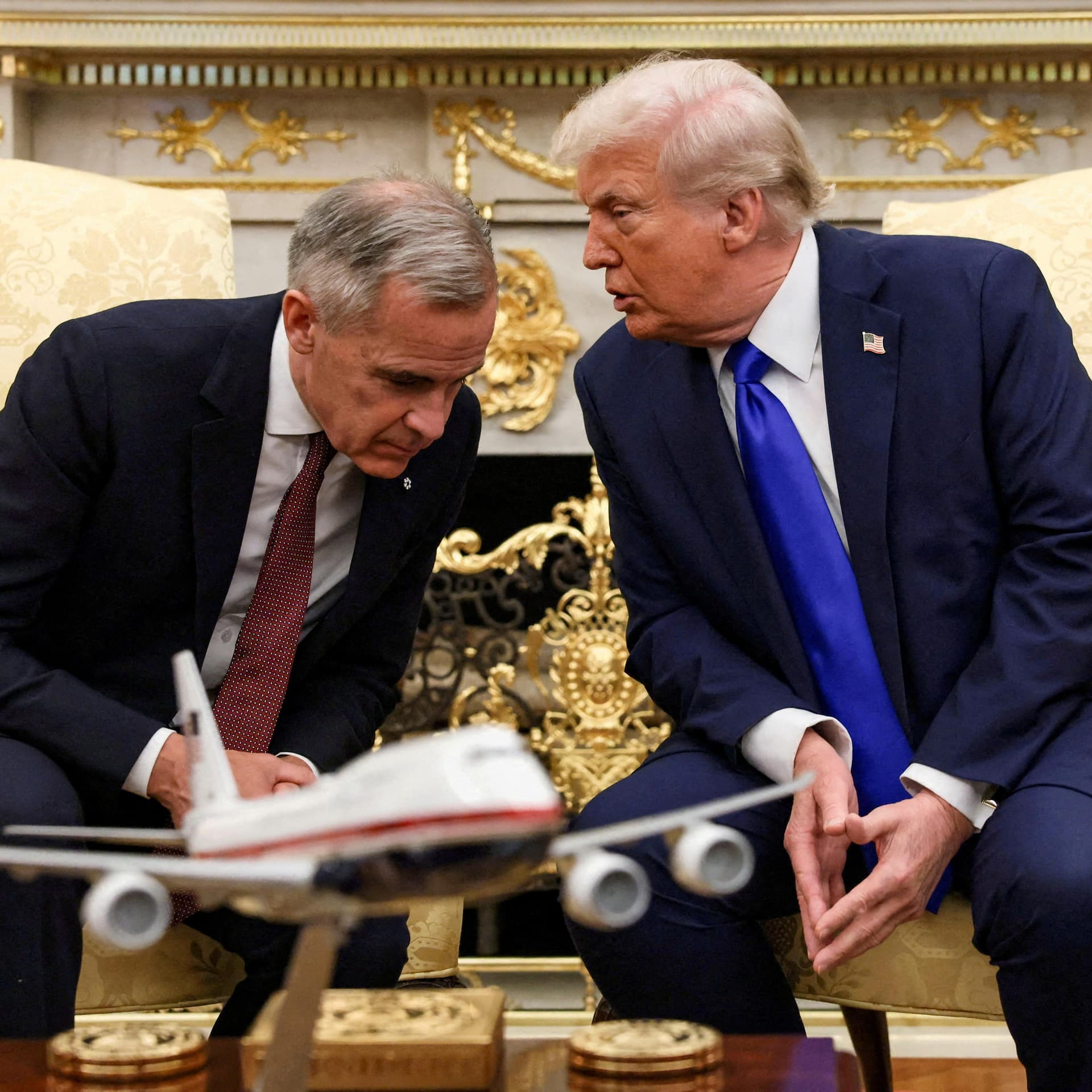
(Photo: US President Donald Trump (R) meets Canada's Prime Minister Mark Carney (L) in the Oval Office at the White House, Washington DC,7 October, 2025. Credit: Evelyn Hockstein/Reuters)