In short
The episode examines why Donald Trump and some U.S. conservatives are alleging “existential” persecution of Christians in Nigeria and threatening military action.
Guests
Lebou Di Seco, BBC Global Religions correspondent (background: reports on religion and politics globally; provides conflict and data context). Key claims discussed: Trump’s Truth Social post (Nov 1) says the U.S. will stop aid and may act “guns a-blazing,” instructing the Department of War; Ted Cruz’s Nigeria Religious Freedom Accountability Act of 2025 would push Nigeria onto the U.S. “country of particular concern” list, enabling sanctions.
Notable examples
Boko Haram kidnappings including the 2014 Chibok girls; churches/schools burned. Di Seco argues the persecution narrative is contested: Boko Haram targets Muslims too; a widely cited “50,000 Christians killed since 2009” figure is hard to verify. She cites ACLED data: more attacks on Christians, but more Muslim fatalities, suggesting broad insecurity and state failure rather than solely anti-Christian targeting.
Written by AI. May contain mistakes. Listen to the episode to check what was said.
Chapters
Tap a time to open that second in VOThe Context of Nigeria's Religious Crisis
1:30 to 2:30
Discussion on the persecution of Christians in Nigeria and its political implications.
“Now, to be clear, the United States is not at war with Nigeria.”
Legislation and Religious Freedom
2:30 to 3:50
Exploration of the Nigeria Religious Freedom Accountability Act of 2025.
“And today on The Global Story, why are President Trump and some of his supporters alleging that there's widespread persecution of Christians in Nigeria?”
Bill Maher's Controversial Remarks
3:50 to 4:50
Analysis of Bill Maher's statements on the killing of Christians in Nigeria.
“Well, I wondered if it was a term that had been invented for this, but in fact, no, it is actually, it's a thing.”
Trump's Strong Statements on Nigeria
4:50 to 7:20
Discussion on President Trump's tweet and its implications on U.S.-Nigeria relations.
“It may be to do with the comedian Bill Maher.”
Nigerian President's Response
7:20 to 8:20
Overview of Nigeria's president's reaction to Trump's comments.
“He was asked whether or not that means U.S.”
Nicki Minaj Weighs In
8:20 to 9:50
Examination of Nicki Minaj's unexpected support for Trump's stance.
“Nicki Minaj comes into it because she then tweets her thanks to Donald Trump.”
Understanding the Persecution Claims
9:50 to 12:30
Investigation into whether Christians are actually persecuted in Nigeria.
“We're here to talk about the situation in Nigeria and the all-of-a-sudden wave of interest in what's happening in Nigeria for the United States.”
The Complexity of Nigeria's Religious Landscape
12:30 to 14:00
Discussion on the religious dynamics between Christians and Muslims in Nigeria.
“that at that time they were targeting Christians specifically.”
Understanding Violence in Nigeria
14:00 to 18:44
Exploration of differing statistics on violence against Christians and Muslims in Nigeria.
“And certainly it seems like intersociety didn't do that.”
Trump's Political Strategy and Nigeria
19:32 to 26:39
Analysis of Trump's motivations and implications of U.S. foreign policy on Nigeria.
“What is the political upside for Donald Trump?”
Show all 11 chapters
Transcription and Promotions
28:38 to 29:22
Information about the transcription service and where to find more content.
“Transcription by CastingWords series, Pos George, the criminal behind Farage.”
Transcript
Automatic transcript. May contain errors.0:00This BBC podcast is supported by ads outside the UK.
0:30Search for PostGeorge The Times wherever you get your podcasts.
1:00Listen now or search for Good Bad Billionaire wherever you get your BBC podcasts.
1:30and sweet. Now, to be clear, the United States is not at war with Nigeria. Nigeria has in fact been one of the United States' most important partners in Africa for decades. But a story has begun circulating on the American right that has inspired the president and his allies. Where are the liberals? Where's everybody? Nobody's talking about the persecution of Christians, the slaughter of Christians in Nigeria. Christians, they say, are being murdered in massive numbers across Nigeria by what they call terrorist organizations. Here's the social media post from President Trump. Christianity is facing an existential threat in Nigeria.
2:11You know, since 2009, there's been more than 52 ,000 Christians who have been martyred for their faith. The number one persecuted religion in the world. What can you tell us about what's going on in Nigeria and why we've been so slow to respond? From the BBC, I'm Tristan Redman in London. And I'm Asma Khalid in Washington, D.C. And today on The Global Story, why are President Trump and some of his supporters alleging that there's widespread persecution of Christians in Nigeria?
2:55So, Tristan, I know you have been working on this episode. So tell us, where does the story start? Well, I think probably on September the 9th of this year. So that's the day that the Republican Senator Ted Cruz from Texas introduced something called the Nigeria Religious Freedom Accountability Act of 2025. It's a bit of a mouthful.
3:19Lebo Diseko:There is no country on earth where Christians are more persecuted than Nigeria. Since 2009, more than 50 ,000 Christians have been murdered by Boko Haram and radical Islamic extremists. More than 20 ,000 churches and schools have been burned to the ground. The bill is designed to demand that the Secretary of State of the United States designate Nigeria something called a country of particular concern. We're going to keep the fight going to protect Christians and to protect religious liberty. A country of particular concern. Explain that, Tristan. What does that mean exactly? Well, I wondered if it was a term that had been invented for this, but in fact, no, it is actually, it's a thing.
4:01So it's a legal designation. A country can be deemed one of these by the Secretary of State. And it basically means it's basically a list of countries who the United States believe are responsible for severe violations of religious freedom. So if Nigeria is added to this list, it means that the country itself and then certain Nigerian officials could be could have sanctions slapped on them. OK, I will say here in Washington, a lot of random legislation is put forth. It is often ignored by other members of Congress and doesn't go anywhere. But I feel like I've been hearing a lot about Nigeria in the past week.
4:42Why are we talking about this now? Well, I'm not sure it's necessarily because of Ted Cruz's original bill that he proposed. It may be to do with the comedian Bill Maher.
4:54Lebo Diseko:Thank you. Right, please. There's so much news to get to. So Bill Maher, he's a kind of politically tinged comedian. He's got a talk show on HBO, right? And in September, sometime after Cruz initially proposes this bill, he speaks on his show about the, quote, systematic killing of Christians in Nigeria. They are systematically killing the Christians in Nigeria. They've killed over 100 ,000 since 2009. They've burned 18 ,000 churches. He talks about mass murder in Nigeria, and he mentions it as a counterpoint to people who describe the crisis in Gaza as a genocide. This is so much more of a genocide attempt than what is going on in Gaza.
5:40Lebo Diseko:They are literally attempting to wipe out the Christian population of an entire country. Where are the kids protesting this? He's essentially whatabouting Nigeria in the context of Gaza. It's Africa. That's what no one's talking about it. And they should be. You can't read about it on mainstream media. It's sad. So thank you for bringing. And just to put Bill Maher into context here. I mean, he has been known for making pretty controversial comments about Islam over the years. Okay, well, I mean, he's only sort of peripherally on my radar. So I feel like that's important context. I mean, nonetheless, his clip goes viral.
6:18And it really stokes up interest in the question of what's happening in Nigeria. People start talking again about Cruz's slightly obscure bill that maybe people had missed before. U.S. Congress people start tweeting about it. And then it really takes off when on November the 1st, Donald Trump tweets about it on Truth Social. I saw that. And he says, if the Nigerian government continues to allow the killing of Christians, the USA will immediately stop all aid and assistance to Nigeria.
6:52Lebo Diseko:And may very well go into that now disgraced country guns a-blazing. guns a-blazing to completely wipe out the Islamic terrorists who are committing these horrible, horrible atrocities. And then he says, I'm hereby instructing our Department of War to prepare for possible action. If we attack, it will be fast, vicious, and sweet. Promising any attack would be, quote, fast, vicious, and sweet, just like the terrorist thugs attack our cherished Christians. Hmm, the cherished was in all caps, I recall. The cherished is in all caps. He was asked whether or not that means U.S. boots on the ground. Well, he didn't shut the door on that idea.
7:29So inevitably, then we hear from the Nigerian president who posts on social media. He essentially rejects what Trump has said.
7:38Lebo Diseko:Nigeria's president shot back saying that the portrayal of his country does not reflect our national reality. And then, Asma, this is where things start to take an unexpected turn. Are you familiar, Asma, with the work of one Nicki Minaj? Tristan, I love how you ask me these questions about American pop culture. But yes, yes, I am familiar with the work of Nicki Minaj. Moment for Life. Do you remember that song? Do you remember? Oh, I was going to go with Moment for Life. Do you remember that one? That was a long time ago. I mean, Super Bass was quite a long time ago as well, I think, wasn't it?
8:17But Nicki Minaj. Yes, help me understand how Nicki Minaj gets into this story. Nicki Minaj comes into it because she then tweets her thanks to Donald Trump. What I did not have on my bingo card is Nicki Minaj weighing in on this. She thanks Donald Trump for speaking up about Christians in Nigeria. She responds to his post on social media. She says, reading this made me feel a deep sense of gratitude. We live in a country where we can freely worship God. No group should ever be persecuted for practicing their religion. Thank you to the president and his team for taking this seriously. God bless every persecuted Christian.
8:57Let's remember to lift them up in prayer. I mean, Tristan, hearing what Nicki Minaj had to say, I think a lot of people would agree that no religious group ought to be persecuted. That's like very intrinsic to American values around freedom of religion. But the question I've had in hearing all of this back and forth is, are Christians being persecuted in Nigeria? Well, Asma, that is the heart of the question that we are going to delve into today on the show because it's far from clear what exactly is happening in Nigeria. So to help us answer these questions, I've been speaking with the BBC's Global Religions correspondent and her name is Lebou Diseko.
9:45All right. Okay, let's do it. It's great to see you, Levu. Thanks for joining us. We're here to talk about the situation in Nigeria and the all-of-a-sudden wave of interest in what's happening in Nigeria for the United States. Can you explain to us, please, where this claim that Christians are being persecuted in Nigeria comes from? Because from everything that I've read and seen, This is actually quite a contested matter. Yeah, look, it is very complex. And first of all, I just want to give a little bit of background. Nigeria is about 50-50 split between Christians and Muslims. And it is a country where it is fairly common to have intermarriage in certain areas, not everywhere, but in certain areas you'll have a lot of intermarriage between different faiths.
10:34The president's wife is actually a Christian and not just a Christian, she's a pastor. in one of the biggest churches in Nigeria. And the president himself is Muslim. Yes. So I think it's really important to explain that. I also don't want to underplay the attacks on religious houses, both Christian and Muslim, that have happened, and the fact that there are communities that are very frightened. And actually this issue of attacks on religious communities have been taken up by both Christians and Muslims over the years. You know, we've kind of seen waves of allegations. So I think to kind of take it, you know, step by step, one of the things that has kind of been spoken about a lot is jihadists, quote unquote, in the north.
11:27And I think a lot of listeners will be familiar with Boko Haram and the kidnapping of the Chibok girls. In 2014, is that right? Yeah, 2014. So basically, back in 2014, Boko Haram, whose name actually means Western education is forbidden, there was a spate of kidnappings of children at schools. So prior to these girls being kidnapped, there was a boys' school where a number of boys were rounded up and taken away. So there were 276 mainly Christian, but not only Christian girls that were kidnapped by Boko Haram. It took a while for it to reach international attention. But once it did, we saw that hashtag, bring back our girls, bring back our girls, trying to get them rescued.
12:18But to bring it back to what we're talking about at the moment, I think that in the kind of telling of this story, Boko Haram and the targeting of Christians is a thread that has been talked about a lot, that at that time they were targeting Christians specifically. But I think it's really important to point out that Boko Haram and other jihadist groups in the north of Nigeria basically say that anyone that is not them is an infidel. So they do also target Muslims as well. There are Muslims that have been attacked because essentially if you're not prescribing to their particular form of Islam, then either you convert or you die.
13:01So I think to characterize what's happening in the North as targeting of Christians doesn't really take in the full picture of what's happened. Yes, there are Christians that have, you know, been impacted by this and have had terrible things happen to them. But it is also true that there are terrible things that have happened to Muslims as well. What do the numbers tell us? And I know that Ted Cruz has referred to one particular figure, which is that 50 ,000 Christians have been killed in Nigeria. Does that sound like a real figure to you that reflects what's going on on the ground in Nigeria?
13:39Certainly when BBC Africa's data team dug down, it traced that number back to a report by an organization called InterSociety. But it didn't share a list of itemized sources, making it hard to verify the total number of deaths. You know, any organization that does a report should be able to give you their methodology, their sourcing, their, you know, how have they come to this, these figures. And certainly it seems like intersociety didn't do that. And it was just very difficult to stand up those figures. In response to the criticism, the organization said it's almost impossible to reproduce all our reports and their references dating back to 2010.
14:24Yeah. And I know that there is a bit of a kind of war of statistics in this story where different agencies and different NGOs are saying different things. But for you, what are the most convincing numbers that can tell us what's actually happening in Nigeria? Now, for me, it was really important to look at the source of the information. So, you know, you have a lot of Christian advocacy groups and their numbers by definition are kind of focused on what they see as happening to Christians in Nigeria. I decided I wanted to try and get this information from someone who didn't really have a chip in the game.
15:07And I went to an organization called ACLED, who are funded in large part by the United Nations. And they are essentially they call themselves an independent, impartial conflict monitoring service. So when I looked at their figures, there was a very interesting thing that came up. Essentially, they looked at attacks that were classified as religious primarily in nature. And they found that essentially there were more attacks on Christians, but there were more fatalities of Muslims looking at the last five years. The total number of targeted events against Christians over the last five years, 389.
15:56The number of deaths, 318. If you look at Muslims, it was far less actual attacks, 197 over the last five years. The number of deaths, 418. A situation where you have more Christians being attacked, more Muslims dying. It says to me that both faiths have reason to believe that they are not being kept safe. Is it possible for Christians to be victimized in Nigeria and at the same time for Muslims to be victimized in Nigeria? Yeah, I think that this is, the way you phrased it is really interesting because I think the conversation has been or, or, or. So either Christians are being attacked or Muslims are being attacked.
16:44Either Christians are persecuted or Muslims are persecuted. What certainly is true is I think that there is a lot of violence targeted at both Christians and Muslims. And the state has arguably failed to do enough to keep its citizens safe. So it seems like what you're saying is that there's a huge problem of safety for everyone of all groups in Nigeria. and religion maybe isn't the central issue here. And the issue really is that the government is struggling to protect its citizens. Is that correct? Yeah, and it's excessive governance. It's not just this government. I mean, this has been going on for years and years and years.
17:31I mean, it's worth pointing out that Nigeria, unfortunately, is an extraordinarily violent country. And in terms of rates of violence, it's only surpassed in Africa by Sudan and Somalia. Look, the security situation is increasingly out of the government's control. And many Nigerians would say the government's not done enough to keep them safe. A number, when I looked on social media earlier this week, there were a number of people saying, well, if this is what it takes for our government to act to keep us safe, maybe this is something that can possibly be a good thing.
18:44Transcription by CastingWords our new podcast series, Pos George, the criminal behind Farage. Search for Pos George The Times wherever you get your podcasts. Hi, I'm Simon Jack. I'm Zing Zing. And together we host Good Bad Billionaire. The podcast exploring how some of the wealthiest people on the planet made their money. And we are back with a new season. From sporting superstars to music moguls and celebrity CEOs. We'll be taking a closer look at the lives and fortunes of some of the world's richest people. and asking you to decide if they're good, bad or just another billionaire. Good Bad Billionaire from the BBC World Service.
19:20Listen now or search for Good Bad Billionaire wherever you get your BBC podcasts.
19:31OK, well, I'd like to ask you about the domestic policy side of all this. What is the political upside for Donald Trump? Can you help us understand why Trump might be pursuing this political line on Nigeria? Well, again, I don't know. What I do know is that the issue of religious freedom and quote unquote persecution of Christians is something that really matters to particularly evangelical Christians who are a core part of Donald Trump. I mean, 2016 and this time around, more than 80 % of evangelical, white evangelical Christians voted for Trump. So if you were one of these voters and you see Donald Trump speaking about this, certainly it is something that would resonate.
20:31What is interesting for me is how this has kind of gathered speed and broken through. I'm just not sure. Why now? Okay, well, if evangelical Christians in the United States are concerned about violence against Christians in Nigeria, and the US sees itself as a predominantly Christian country, why shouldn't the United States, as part of its foreign policy, take it upon itself to protect Christians whom they see being targeted elsewhere in the world? Well, this is the thing that's very interesting because we've never really seen before religion explicitly set out as a foreign policy aim, driver, motivator.
21:18If you look at the Project 2025 document, now obviously that was written by the Heritage Foundation and they're not in government, but they certainly inform a lot of the things that we saw in that document we now see playing out. They explicitly talk about this issue of protecting Christians around the world. I mean, we both know how important kind of Christianity and religion is in America in terms of politics. We saw it a bit in the past Trump administration, but under this administration, the kind of fusion and the way that the evangelical Christian worldview is driving foreign policy explicitly.
21:59I think that's new. And I think we also can't underestimate the impact of the attempted assassination on Donald Trump. You're talking about the assassination attempt during the campaign? Yes, during the campaign. So he certainly said that he felt like he was saved by God. And for a lot of evangelicals, they feel like that was what they would say, the enemy, quote unquote, you know, the devil, trying to take out a soldier for Christ. And yet he has prevailed. So that's how he's kind of viewed and he's viewed as somebody who is a champion of the rights and the concerns of Christians. Okay, well, I mean, away from the spiritual realm, according to Donald Trump, the United States has actually taken a policy decision, which is to include Nigeria on a list of countries, countries of particular concern.
22:54What actually happens when a country is added to that list? Well, there are a number of penalties that can be given. I mean, from the State Department website, it says that's a designation for countries that are engaged in severe violations of religious freedom. freedom. Now, essentially, I think placing a country on that list is like a severe warning. But from the State Department's own description, if they don't feel that enough has been done, there may be, quote, an economic measure that must be imposed. So, I mean, that suggests to me that sanctions could be something that is considered or maybe tariffs.
23:40We've seen Donald Trump using tariffs quite a lot to kind of ensure his political goals. Okay, because I was trying to get my head around what this list could actually be, and because I'd never heard of, you know, countries of particular concern before. And it's leapt out at me that one of the countries that regularly features on the list, because I think it's published every year, or renewed every year, is Saudi Arabia, which is clearly a very close US ally and a country whose leaders are very close to Donald Trump. So I thought it was very interesting that Saudi Arabia should also appear as a country of particular concern.
24:20And it's interesting that we're not seeing Saudi Arabia threatened with any kind of economic consequences that I'm aware of. So I think this brings us back to the issue of why now? Why this country? Well, in response to this new designation, what has the Nigerian government said about it? The Nigerian government did come out very strongly and say that, you know, there is by no means anything meeting genocide. But equally, there was a spokesperson for the president who said they'd welcome the US's help as long as their sovereignty was respected. So it was interesting to me because I felt like the Nigerians' response was quite robust, but there was also a kind of speaking Trump's language in a way.
25:16You know, we'd love your help. Thanks. It's not as bad as you think. We robustly defend our nation, but if you wanted to help us, thanks. So it was an interesting response. Okay. You're the BBC's correspondent covering global religion. To what extent would you say that religion is creeping in elsewhere around the world as a kind of foreign policy driving force? I mean, I would maybe reframe it and say what is new or what is, I say new, I've been looking at this from the last six years or so, is the fusion of Christianity and populism. So, Christian populism. I think that if you are in the United Kingdom and you think about the Church of England, or if you're in America and you are a mainline Protestant, you know, you think of Christianity as being about being good to your neighbor, being, you know, you don't really think of this sort of muscular populist Christianity.
26:24I think that kind of fusion with populism and the fact that often these kind of groups talk to each other around the world. I think that's new.
26:38Thank you so much, Lebu. No problem.
Read the full transcript
26:48That was the BBC's global religions correspondent, Lebu Di Seco.
26:56Now, we wanted to bring you an update on another story we've covered on the show. So on Monday, the Syrian president, Ahmed al-Sharah, is in Washington, and he'll be visiting the White House. Now, if you remember, al-Sharah became president of Syria after Bashar al-Assad's regime was overthrown about a year ago. But what's notable about al-Sharah is that he was previously a member of al-Qaeda. He left the organization in 2016. but last week the UN Security Council voted in favor of a US resolution to lift sanctions against him. About a month ago on The Global Story, we did an episode about al-Sharah and about Syria's first elections since Assad's fall and since al-Sharah came to power.
27:41And we spoke to the BBC's chief international correspondent, Orla Guerin. Now, these elections were a landmark moment in Syria. On the one hand, they were the first serious elections that Syria's had in many decades. But they've also faced criticism for favoring well-connected people in the country rather than paving the way for actual democratic change. That's the accusation. You can listen back to our episode from the 2nd of October by searching in this feed. And if you like what we're doing, please go ahead and rate us. It will really help others to find us. You can also email us with any story suggestions or ideas at theglobalstoryatbbc.com.
28:23Today's producers were Zandra Ellen and Kat Farnsworth. The editor was Annie Brown. The episode was engineered by Travis Evans. And our senior news editor is China Collins. That's all for today. We'll be back tomorrow. Cheerio.
29:12Transcription by CastingWords series, Pos George, the criminal behind Farage. Search for Pos George The Times wherever you get your podcasts.
From the publisher
President Donald Trump has warned that he will target Nigeria if the government there "continues to allow the killing of Christians". For months, campaigners and politicians in Washington have been alleging that Islamist militants were systematically targeting Christians in Nigeria. But how true are the claims that there is a persecution – or even a genocide – of Christians in the West African country? And how does Nicki Minaj come to thank him for his intervention?
We speak to the BBC’s global religion correspondent, Lebo Diseko. Producers: Xandra Ellin and Cat Farnsworth
Executive producer: Annie Brown
Mix: Travis Evans
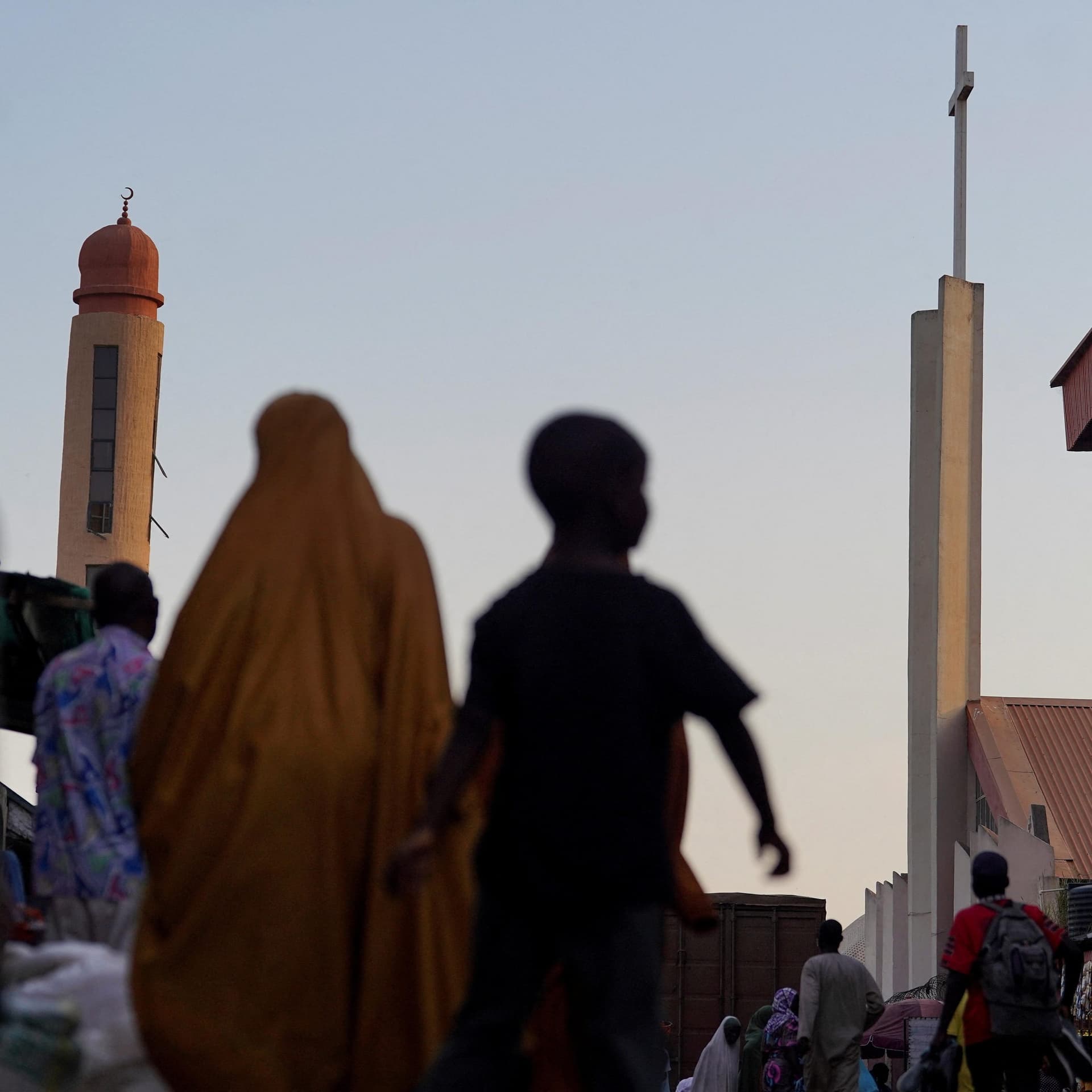
Senior news editor: China Collins (Photo: People walk along a street flanked by St. Joseph Catholic Church and Kano Road Central Mosque in Kaduna, Nigeria, 4 November, 2025. Credit: Marvellous Durowaiye/Reuters)