In short
Australia’s “delay” (effectively a ban) starting 10 December: teens under 16 can’t open or continue accounts on 10 major platforms (Instagram, Facebook, Snapchat, TikTok, X, YouTube, Reddit, Twitch, Kik, Threads), with fines up to A$50m for noncompliance; debate includes bullying/suicide harms, age verification, and constitutional challenges.
Guests
Katie Watson, BBC Australia/NZ/Pacific Islands correspondent based in Sydney; Emma Mason, mother of 15-year-old Tilly Mason who died by suicide in 2022 after sustained bullying that escalated online (including fake nude image circulating on TikTok/Snapchat/Instagram).
Key claims
Government aims to reduce algorithm-driven doomscrolling and mental-health harms; critics warn about workarounds, unequal impact on vulnerable teens, and free-speech/rights concerns (lawsuit by teens Noah Jones and Macy Nayland via Digital Freedom Project).
Notable examples
Tilly’s bullying timeline; fake nude image spread; YouTube Kids excluded but kids can still be exposed via watching without accounts.
Written by AI. May contain mistakes. Listen to the episode to check what was said.
Chapters
Tap a time to open that second in VOUnderstanding the Ban Details
0:00 to 0:45
Discussion on the specifics of the Australian government's social media ban.
“This BBC podcast is supported by ads outside the UK.”
Understanding the Ban Details
1:54 to 3:06
Discussion on the specifics of the Australian government's social media ban.
“A quick warning before we dive into today's show.”
Origins of the Ban
3:06 to 6:04
The backstory of how the social media ban originated in Australia.
“Government likes to call it a delay, not a ban.”
Personal Stories Behind the Law
6:04 to 10:52
Examining the personal stories that fueled the campaign for the ban.
“So the South Australian Premier, Peter Malinakis, the Premier is the head of government for a state.”
Teen Perspectives on the Ban
10:52 to 13:58
Teens express their views on the social media ban and its implications.
“Emma Mason was in New York in September when Anthony Albanese was younger.”
Concerns About the Social Media Ban
14:01 to 15:42
Discussion on the potential negative impacts of the social media ban on vulnerable youth.
“And they say effectively it disregards the rights of children.”
Efficacy and Enforcement of the Ban
15:42 to 17:27
Exploration of existing age limits on social media and the challenges of enforcing a ban.
“I mean, if you look at Instagram, for example, you have to be at least 13 years old to create an account.”
Responses from Tech Companies
18:51 to 22:21
Overview of tech companies' responses to the Australian government's new law.
“I want to ask you about these 10 platforms.”
Debate on Government Intervention
22:21 to 24:28
Discussion on the diverse perspectives regarding government intervention in tech.
“It might not be as effective as the government like.”
Global Implications of Australia’s Ban
24:28 to 27:06
Analysis of how Australia’s social media ban might influence global policies.
“I definitely see lots of rules here and people kind of follow them.”
Transcript
Automatic transcript. May contain errors.0:00This BBC podcast is supported by ads outside the UK.
0:31Because Schwab knows that when it comes to your finances, choice matters. No matter your goals, investing style, life stage or experience, Schwab has everything you need, all in one place, so you can invest your way. Visit schwab.com to learn more. Australia is on the verge of a potentially massive experiment, one that could change the social lives of young people. Beginning on Wednesday, teens under the age of 16 will be banned from a range of social media platforms. Let's turn to that fascinating development in Australia. That country will ban children under 16 from using social media. Well, it's less than a week to go before underage children are booted off social media.
1:17It's the world's strictest law relating to social media and the way young people use it. It's fair to say this legislation has divided public opinion. I think kids receive a smartphone way too early. I think it's too hard to regulate. I don't think it can work. They really should just be thinking about their sport or their school or catching up with a friend. It feels like I've only just gotten rights and now they're being taken away. From the BBC, I'm Asma Khaled in Washington, D.C. And today on The Global Story, how Australia became the first country in the world to ban social media for teenagers.
1:54And what might that mean for other countries taking notes?
2:05A quick warning before we dive into today's show. This episode contains discussions of bullying and suicide. Katie, thank you so much. I know you've joined us before here on The Global Story, but could I have you just tell us your name and title? I'm Katie Watson. I'm the Australia, New Zealand, and Pacific Island correspondent, and I'm based in Sydney. So Katie, I'm really excited to talk to you today. And I know you've done reporting and we've been really interested in this issue of the social media ban in Australia. But we also received this question from our listener, Georgia. She says, hi, Global Story team.
2:40I'm a big fan of the podcast and was wondering whether you'd be interested in doing an episode on the Australian government's social media ban coming into effect on the 10th of December. How are the parents, social media platforms and news media responding to the ban? What evidence is there that the bans actually improve online safety? And Katie, I just thought, aha, we've got to do this episode. Plus Katie Watson's already doing reporting on this. So thank you very much for joining us. And just want to start by asking if you can walk us through what specifically the government of Australia is doing.
3:13Government likes to call it a delay, not a ban. even though ban has become the word that everyone's using, the ban's kicking off with 10 platforms. So most of those platforms you would have heard of, the likes of Instagram, Facebook, Snapchat, TikTok, they have to make sure that nobody under the age of 16 has an account with their platform. I see. And the legislation basically says they have to take reasonable steps to make sure that they don't open account or continue in some way. And if they don't, then they face fines of up to 50 million Australian dollars. That's about 33 million US dollars.
3:56Wow. But there's some controversies with that. So, I mean, I was talking to the communications minister about that. The risk is that a platform might decide to just cop the fine. And she said that, you know, they may well just cop the fine, but then they're not complying with law. Any Australian company that seeks to conduct business on our shores must comply with Australian law. So we have found that the vast majority of the effective platforms have said, we consider ourselves to be a good company, we comply with the laws in the countries within which we operate. But one of the most controversial aspects of this is what is not included, because only 10 platforms initially are.
4:32And so there are plenty of other platforms that aren't being targeted, AI chatbots. But in particular, gaming is a big concern of parents. Why has that not been included? So just to recap here, a number of the major social media platforms you say will be banned or as the government saying, delayed, meaning nobody under the age of 16 ought to be on these platforms. And these are things like Instagram, TikTok, YouTube, just to name a few. Yeah. So Facebook, Instagram, TikTok, Snapchat, X, YouTube, Reddit, Twitch, Kik and Threads. Those are the platforms in question. And why is the Australian government doing this and why at this particular moment in time?
5:10So the short version is Anthony Albanese, the prime minister, wants to get kids off screens, back on the footy fields, back on the netball court. We want to give parents peace that it's important for kids' mental health to make sure that they're not stuck on social media. It's the algorithms, the doom scrolling, the online harm that can come to them through going onto social media. But yeah, I mean, very Australian, kind of, you know, off the screens, onto the footy fields. So there are plenty of kids sitting there thinking, well, I don't really like sport, but thanks for that. But I imagine too that a number of parents listening, I mean, look, myself even included.
5:48Sure, I would love my children to just not spend that much time on the iPad, go outdoors. There are questions that so many parents here in the US have also about the harms of social media. So I'm curious where the idea for this ban originated from in Australia. So it's really interesting, actually. So the South Australian Premier, Peter Malinakis, the Premier is the head of government for a state. He supposedly was told by his wife to do something. The truth is, it started with my wife. So she was reading this book over a week or two or whatever and sort of explaining to me what she was reading.
6:27She had been reading a book called The Anxious Generation by Jonathan Haidt. It's effectively talking about the smartphone generation and how children, I think from about 1995 onwards, have grown up with social media, have grown up with a smartphone, and it's changing the way they grow up. So less face-to-face time, more screen time, and as a result, that is rewiring their brains effectively. We were in bed and she finished the book and she put the book down on her lap and she turned to me and she said, you've really got to do something about this. I sort of stopped and thought about it. I thought, well, maybe we actually can.
7:12You know, we've got younger kids, our oldest is 10, and like I think most parents, we've been talking about it, including amongst our friends who have got older kids who are in their early teenage years who are just trying to navigate when should we let them have a phone, when shouldn't we? Those conversations have been parted to a thousand times just as a parent.
7:36So basically, Peter Malinowska's wife read the book, told her husband to read it, do something about it. Within a few months, had appointed a former High Court Chief Justice to look at how the state, so South Australia, could implement a ban. Okay. And then he took that to other premiers in Australia, including the prime minister, and talked about how it could be adopted nationally. So then that got taken up. I mean, it's worth saying that there was bipartisan support for the bill. I mean, it was clearly a bill that would pass very easily. Because it resonated with everybody. So it had support across the ideological spectrum there in Australia.
8:17It did. You know, Katie, we often hear about online safety concerns here in the U.S. when sometimes there are really horrific, unfortunate incidents involving children. And so as this became law in Australia, did those stories of Australians who were hit personally perhaps around issues of online safety kind of come to the forefront? And was that a part of this campaign to make this into law? Absolutely. In fact, I spoke to one woman, Emma Mason. Look, Tilly was a, well, she's my eldest daughter and really my eldest child. Who lost her little girl, Tilly, back in 2022. She died by suicide.
8:58Katy Watson:She was just 15. Before that, she was a creative, artistic girl. Loved to dance, loved to draw, loved to paint. And she basically was bullied in real life from the age of eight into high school. Then it moved online. So it translated from face-to-face bullying, and then whatever the issue was at night would then be played out in the evening via social media. And it began as things like messaging, text messages, but then moved on to things like TikTok and Snapchat and Instagram. She had various suicide attempts, and then effectively a fake nude image was circulating at school. Then that went forth to hundreds, hundreds, thousands.
9:44Katy Watson:And for Tilly, she was subject to something that she had no control over, a harm that was instant and a harm that she could not stop. She was looking up things about being sad, about being depressed, about being anxious, about wanting to end her life, about how to do that. And all of those things were all the things that she just saw. That was what then filled her feed. She couldn't deal with it. After that, the cyberbullying just got worse. And then she was found dead. I think our children have been the social experiment. We have just said, here's a phone, as I did when Tilly was 12. Not knowing that that would be part of her demise.
10:29Awful story, really terrible story. Emma Mason, her mother, has made this like her life's work now to make sure that something is done to protect kids. Have these parents now been out there, outspoken for why they believe this ought to be the law, or were they also a part of ensuring this became law in Australia? I mean, a bit of both, really. Emma Mason was in New York in September when Anthony Albanese was younger. She spoke, she stood by the prime minister to explain why this law was needed, a lived example of the horrors that can happen online. You've mentioned a couple of these parents who've been really outspoken in support of this new law.
11:13Are they indicative of parents broadly? What's been the reaction from parents to this? Most parents, if you were to stop them on the street to say, what do you reckon about this law? I'd say most of them go, oh, brilliant. Because when a child comes to them and says, please, can I have social media? they can go, no, because you're like, it's banned. It's against the law. It's against the law. But actually, there's a problem with that because it's not against the law, actually, in the sense that the onus is on the companies. So children aren't going to be penalized. Parents aren't going to be penalized.
11:47And that's one thing that a critic has said is that if the message that comes out of this is that it's against the law, kids will then worry that if they do break the law because they want to get onto social media, it's like, I don't know, having a cigarette underage, having a drink, lots of teenagers do it, then if they do it and they go online and there's online harm, they'd be scared to talk about it with their parents. I see. But yeah, the average parent, I would say, feels supported by the government because it's easier to say, well, look, you can't have it because the government says you can't.
12:17I also am curious about how teens and kids are responding to this, because you alluded to this a moment ago, Katie, that when something is often outlawed, teens will find a way to get to it. it goes perhaps deeper into the shadows. So what are you hearing from teens? There are some who think it's a good idea. Well, I think it'll have a pretty good impact. We'll have lots more free time. Get me off my screen a bit, which is actually really good. I'll probably establish more physical connections. Rather than just chatting to my friends on my phone, I'll probably make the effort to go outside and actually see them.
12:50I'd say probably most say no. I'm against it. I'm against it. I think it should be up to the families and the kids, not the government. I've heard everything from, it's patronising. You're old enough to get a job and open a bank account, then you're old enough to watch YouTube. Why should the government think that I can't look after myself? We've already grown up around it, we already know how to use it, and I just think we're more emotionally mature for that kind of thing.
13:26It's probably worth making the point that here, everybody's about to break up for a long summer holiday. So this ban couldn't come at a worse time for many kids. Because the seasons, you're saying, yeah, they're about to head into summer vacation. About to head into a long time where they don't see their friends and they would probably go on social media and they can't. And actually, there's a lawsuit that's been launched in the run up to the ban with two teenagers who basically say the law is unconstitutional. it robs them of their right to free communication. So they're two 15-year-olds, Noah Jones and Macy Nayland.
14:01And they say effectively it disregards the rights of children. In fact, Macy had said that we shouldn't be silenced. It's like Orwell's book 1984. And that scares me. They are backed by a rights group called the Digital Freedom Project. And it's led by a New South Wales libertarian parliamentarian. He's called John Ruddick. I mean, effectively, it talks about how the ban could hurt vulnerable kids. And I think this is a huge concern, you know, disabled people, LGBTIQ plus kids, rural, remote kids. What's their argument there? The argument is, is a lot of people find their tribe online. So it might be that you struggle to talk to friends and family, depending on where you are and what kind of atmosphere there is at school.
14:46So perhaps you start finding people, you know, in common online. And certainly when it comes to neurodiverse kids, I've talked to a woman who works with for an autistic charity, and she's autistic herself. And she said a lot of people find going on screens an easier way to socialize than in real life sometimes. So I see. Yeah. And especially more than 80 % of Australians live on the coast. So we're talking kind of Adelaide, Melbourne, Sydney, Brisbane, but it's a massive country where going into more rural, remote areas and a lot of kids could live on a farm and then they have to go to boarding school or to the nearest school hours and hours away.
15:26Again, it's that connection of being able to talk to your friends online because you can't talk to them as much and you can't just walk out the door and go down the road to go and see your friend. Let's talk a little bit about the efficacy of a ban like this, because my understanding is some of these tech companies already have age limits on the social media platforms. I mean, if you look at Instagram, for example, you have to be at least 13 years old to create an account. Recently, Instagram also announced this separate setting for parents that provides limited content so that it filters out certain things for teens' feeds.
16:00My understanding is it would restrict their ability to see or leave and receive comments on posts to some degree. Aren't there already some restrictions and limitations for children? Does the Australian government think that that is insufficient? Yes. Basically, their view is that companies have had 15, 20 years to make it better and they've just not done it. It's not enough. And that's what this year has been about. So the law was passed last year and now they've had a year to work out how they're going to make it work so they're talking about age verification so it could be like a facial scan it could be uploading id none of it is perfect there was um there was a kind of story going around here of how kids are putting on like old man masks and doing facial recognition so there are these discussions of right so you tell people to come off 10 platforms they can't get on them they're going to find another way around they'll find other platforms and in fact it's a game of whack-a-mole because in the time that all of these 10 platforms have been restricted other platforms, Lemonade, which...
17:03I'm not familiar with that. What's that? Yeah, so it's another social media platform that has seen a huge amount of people going towards that platform. And now the government's monitoring that because if they see that going to be a problem, then maybe they will bring more restrictions in. I mean, somebody said to me the other day, just because people will break the ban or find ways around it doesn't mean that that shouldn't be in place. So it's the same with, you know, with driving, with drinking. I was going to say, fake IDs have been around for a while here. Exactly. You put those laws in place, and actually Emma Mason, Tilly's mom, said, we have a law for murder.
17:38That doesn't mean that people don't murder, but you need these laws in place to protect people and to understand what the repercussions are. Because you do. It's part of society. It's part of having these guardrails in, and guardrails are really important.
18:14We'll see you next time. Come on! Get a load of this guy. Catch up on a dog. Yeah, we've got thoughts. Too loud? In Chicago, you're gonna hear it. Because nothing here gets built without conversation. Nothing moves without connection. So, if you think you know AT &T, it might be time to rethink that. Because their network has improved, like, a lot. So Chicago can keep speaking its mind with AT &T Wireless and AT &T Fiber. Chicago won't stop talking. Our improved network backs it up. AT &T, connecting changes everything. AT &T Fiber, limited availability in select areas.
18:59I want to ask you about these 10 platforms. A number of these social media companies are American tech companies. What have you heard from them thus far about their current positions, whether they will comply with this new law? They all say, I mean, certainly Meta, YouTube, Google, they've said they'll comply. Okay. They just don't agree with it. So, for example, Meta thinks that governments should be responsible for on an app store, and the age verification process could start from there as opposed to going on to each of the platforms. You know, like YouTube wasn't included at the beginning, and then it was brought in.
19:40And there's a lot of criticism over something like YouTube, because if you have an account as a kid... And they have a YouTube Kids account as well. Oh, so YouTube Kids is not part of it. YouTube Kids is not. Because YouTube Kids is actually, I mean, I have YouTube Kids for my kids, my young ones. It's my account. It's a stream of an adult account. What kids can't have is their own account because of these algorithms. However, you could argue that by not having an account, not signing in, the algorithms will probably still kick in in some way by the videos that you watch. They'll think, well, you'll also like this.
20:11Oh, I see. But they don't know how old you are. So they don't know that it will be more age inappropriate. There were murmurs of whether Google would be bringing in some kind of lawsuit. It's not really been referred to. We don't really know anything about it. But certainly when I spoke to the communications minister, she said that she's not going to be intimidated. These people who seek to stymie us have ulterior motives and we will fight it in the courts. And she's very firm saying she's on the side of the parents, not the platforms. Are you intimidated by the tech companies? No. So anyone who's got multiple small children knows how to negotiate against powers that seem beyond your control.
20:49I am not intimidated by big tech because I understand the moral imperative of what we're doing. But I did ask her, you know, Donald Trump has said he'll stand up to any country that attacks US tech companies. You know, I wonder how concerned Australia is about retaliation, because the fact is you're up against not just these tech companies, but you're also up against, you know, Donald Trump, who is not afraid in coming forward about his opinion. And Australia has always been quite like firm against tech companies. Billionaire Elon Musk is being congratulated for his win against the Australian government.
21:26Last year, there were a couple of stabbing incidents in Sydney. It was one in a shopping centre, and there was another one that took place in a church. In the wake of the stabbing of a Sydney bishop in April, the Online Safety Authority wanted to force X and other companies to take down graphic vision of the attack. And the safety commissioner, Julian McGrunt, asked for Meta and X to take down some of those images. There was a big kind of discussion about that between Elon Musk, who called Grant a censorship commissar. Australia's been in battle with tech companies in the past. And I suggest that this law is going to reignite that debate.
22:13Katie, you've been reporting on this for some months. Is it your assessment that this ban will work? I kind of feel that it is another tool. So I think it's not the silver bullet. It might not be as effective as the government like. But what it's done, whether you like the ban or not, it's opened up that discussion about safety. So my eldest is nine. He's not anywhere near social media. But what happens is it opens up that conversation to go, well, why is it being banned? What is wrong with social media or what is right about social media? You know, you've mentioned that the legislation in Australia seems to have had support across the ideological spectrum.
22:56And that is really intriguing to me because, well, we don't have any sort of law like this at a federal level here in the United States. We have seen some individual states, traditionally Republican states, I'm thinking of a place like Texas or Florida, who have taken some measures towards online safety. and traditionally Republican states have been really reluctant and suspicious of government intervention over private enterprise. And so I find this interesting. And so what was it in Australia that made people across the ideological spectrum say, okay, yes, we need to take this move? I mean, were there some who were just reticent about having the government intervene over private companies?
23:38So there is reticence, but I think the way politics works here is you don't have that extreme political kind of divide that you do get in the US, that you do get in the UK. Australia is a bit more cohesive for now. But that doesn't mean that there are not people here who think it's, you know, overreach. And that's what that high court challenge basically says, is it's overreach. It's so interesting to hear you talk about this all from the context of Australia, because these sorts of bans have not gained traction internationally. I mean, they certainly haven't gained traction at a federal level here in the United States.
24:13But I want to understand why Australia? Like, why did this idea take off in Australia? So Australian loves a rule, although some people would probably disagree with that. But having moved to Australia a couple of years ago, I definitely see lots of rules here and people kind of follow them. What do you mean by that? It just, there's a lot of, so for example, what shocked me when I moved to Australia was how many kind of restaurants closed by about 8.30. And I was like, this is weird. Like in a big city, why can't I go out and have dinner at a decent time? And I was talking to the commissioner of nighttime economy in Sydney, kind of, and I put this to him and I was like, there's so many rules around, like people don't have a crazy nightlife.
24:55It just feels very kind of demure. And he was like, well, this is a form of penal colony. We love a rule. Yeah. But also, for example, you know, things like smoking and vaping, they've got some of the tightest laws in the world, really strict restrictions on firearms. I see. There is a kind of respect as well here of people want to get along, have a good life. I mean, Australia is a massive privilege to live in. You know, it is very safe, incredibly safe. And I feel that people value that. So there is certainly that feeling of making sure that the environment that people live in is a good one.
Read the full transcript
25:35To what extent is the world watching what's happening there in Australia? I think 100 % they're watching whether or not they want to see it fail, probably in the terms of the tech companies or governments who feel the pressure and the fallout of the mental health issues. Suddenly the world is looking at Australia to see how's this going to pan out? And I guess that they're getting a lot of traction on this being the world first and trying something different. Certainly with something like this, it's giving them kind of some influence, right, and a talking point. But Emma Mason was very clear. You know, this is something that absolutely has to be there.
26:15I asked her about other countries getting involved and who had come to her when she was in New York, which countries.
26:22Katy Watson:We believe the EU is coming on board. You know, they are going to, all those children in Europe will ultimately start to become protected. I think the UK was interested. She also said that the US, she doesn't think, is anywhere near. doing something like this. I believe that whilst their children are being killed in schools with guns, they're not likely to want to try and manage a more ethereal harm. When there's discussion is still about the right to bear arms and children are still having to be protected in school, the least of the concerns will be to protect them online. It's just not going to happen.
26:57Katy Watson:And that's really sad for the 20 million Americans who are in that age group. But for the rest of us, we can band together and we can actually make a massive difference for our children. So I think most leaders are going to be, if not watching themselves, putting somebody on the watch to see how they themselves can either implement this or learn from the errors that Australia is potentially going to make in the next few months or years. Well, thank you so much. I'll be keeping an eye on it. I'm very curious how this all pans out. Thank you so much for talking to us. Thank you. That was the BBC's Australia correspondent, Katie Watson.
27:40By the way, we love to hear from listeners. Listeners like Georgia, who suggested the topic for today's show. So if you've got any thoughts, ideas, questions, drop us a note. Our email address is theglobalstory at bbc.com. And if you're enjoying the show, please also take a moment to rate us wherever you listen, it really helps other people find us. Today's episode was produced by Kat Farnsworth, Arun Keller, and Zandra Ellen. It was engineered by Travis Evans, and our senior news editor is Chyna Collins. That's it for today's show. Thanks as always for listening, and we'll talk to you again tomorrow.
From the publisher
**This episode contains discussion of bullying and suicide**
Australian teens are bracing for a new law coming into effect this week that will ban social media accounts for anyone under the age of 16. The Government says the legislation is designed to protect the mental wellbeing of Australian children and teens – but it’s already proving controversial, not least among American tech companies and some politicians who see the ban as a threat to free speech.
In today’s episode, we are joined by Katy Watson, the BBC’s Australia correspondent, to discuss how the country became a global test case for a bold new policy – and crucially, whether it will succeed.
Producers: Cat Farnsworth, Aron Keller and Xandra Ellin
Mix: Travis Evans
Senior News Editor: China Collins
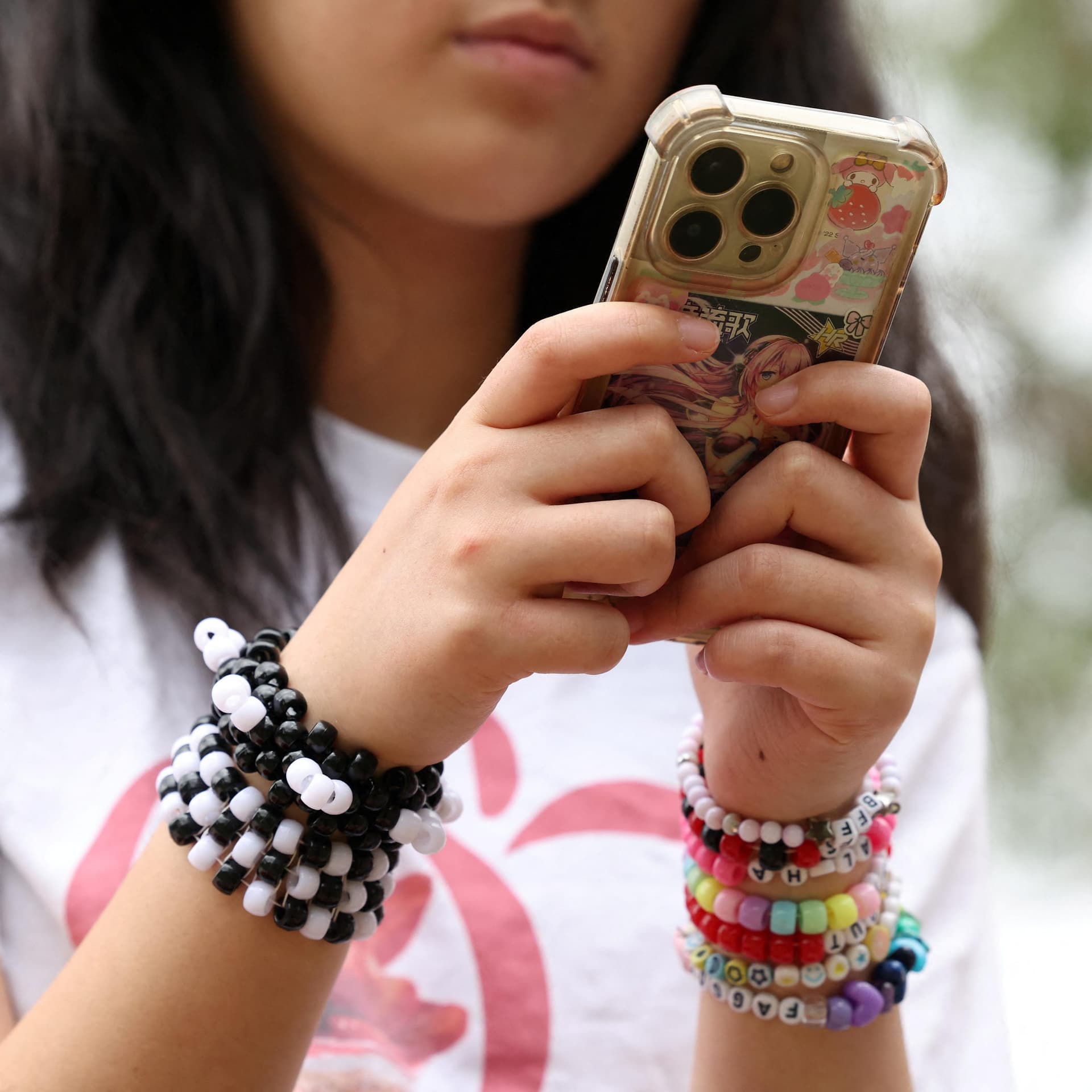
Photo: A teen using her phone ahead of social media band for users under 16. Hollie Adams/Reuters