In short
The BBC Global Story examines Donald Trump’s newly launched “Board of Peace,” whether it can stop wars, and who is involved versus excluded.
Guests/backgrounds
Frank Gardner, BBC security correspondent covering conflicts worldwide (China, Middle East, Venezuela).
Key claims
The board began as oversight for Trump’s Gaza plan but expanded globally; UN Security Council approved it in November. Gardner argues the Gaza charter barely mentions Gaza, risking Gazans’ needs being sidelined behind real-estate-style redevelopment. He also warns the chairman role concentrates power in Trump, with limited financial oversight and an opaque $1 billion “membership” stipend for permanent members.
Notable examples
Gaza ceasefire/hostage and prisoner releases after Trump’s phase one; Gaza needs cited as water, sanitation, food, shelter. Membership examples: Middle East states (Saudi Arabia, Qatar, Israel, Turkey, Egypt, UAE, etc.) invited; China and France declined; UK not ready; Putin and Lukashenko invited; Russia studying payment via frozen funds.
Written by AI. May contain mistakes. Listen to the episode to check what was said.
Chapters
Tap a time to open that second in VOLaunching Trump's Board of Peace
1:30 to 3:54
Discussing the announcement of Trump's Board of Peace and its ambitious goals.
“Please welcome the chairman of the Board of Peace, the president of the United States of America, Donald J.”
Understanding the Board's Mission
3:54 to 6:20
Exploring the goals and implications of the Board of Peace for Gaza and beyond.
“See, I'm a real estate person at heart, and it's all about location.”
Challenges Ahead for the Board of Peace
6:20 to 8:14
Analyzing the obstacles the Board of Peace faces in achieving its objectives.
“And to Trump's credit and the people who worked on it, the Qataris, the Egyptians, the Americans, as well as, of course, the Palestinians and the Israelis, the phase one of that peace plan has worked pretty well.”
Critics of the Board of Peace Structure
8:14 to 10:56
Concerns raised about the concentration of power and financial transparency in the Board.
“Whether that is with the best interests of Gazans in mind or whether this is just a real estate deal that somebody is going to make a lot of money out of, that's a bit of a moot question.”
Conclusion and Future Considerations
10:56 to 14:00
Reflecting on the potential future of the Board of Peace and its impact on Gaza.
“Because bored is a word that comes from the corporate world.”
Trump's Power in the Board of Peace
14:00 to 16:45
Explore Donald Trump's significant influence within the proposed Board of Peace and its implications.
“So Donald Trump has a huge amount of power in this proposed organization.”
Membership Dynamics in the Board of Peace
16:45 to 19:05
Discuss the nations involved in the Board of Peace and their vested interests.
“and they were absolutely on it in Afghanistan, looking at where the money was going and where there was corruption and so on.”
Exclusion and Reactions to the Board of Peace
19:05 to 21:30
Examine the nations declining to join and the potential consequences of these decisions.
“So Saudi Arabia, Qatar, Israel, Turkey, Egypt, Bahrain, UAE, they're in.”
The Nature of Peace in Diplomacy
21:30 to 24:26
Analyze the concept of peace in global discussions and its implications for negotiations.
“who feel that their ideas and views are not taken seriously at the highest levels of the UN.”
The Future of the United Nations vs. the Board of Peace
24:26 to 26:58
Investigate whether the Board of Peace could signify the decline of the UN's influence.
“a very smooth guy who's worked at Goldman Sachs.”
Show all 11 chapters
Overview of Current Talks
28:00 to 28:12
Learn about ongoing discussions involving Ukrainian, Russian, and US officials.
“And he said that talks would continue between Ukrainian, Russian and US officials on Friday in the United Arab Emirates.”
Transcript
Automatic transcript. May contain errors.0:00Frank Gardner:This BBC podcast is supported by ads outside the UK.
0:30Frank Gardner:Come on! Get a load of this guy. Ketchup. On a dog. Yeah, we've got thoughts. Too loud? In Chicago, you're gonna hear it. Because nothing here gets built without conversation. Nothing moves without connection. So, if you think you know AT &T, it might be time to rethink that. Because their network has improved, like, a lot. So Chicago can keep speaking its mind with AT &T Wireless and AT &T Fiber. Chicago won't stop talking. Our improved network backs it up. AT &T. Connecting changes everything. AT &T Fiber. Limited availability in select areas. Hi there, I'm Asma Khalid. And I'm Tristan Redmond.
1:08Frank Gardner:And together we're the hosts of the Global Story podcast from the BBC. For those of you who might be new to our show, we here at the Global Story dive deep every weekday on one big story at the intersection of where the world and America meet. And you can now watch the global story on the iHeart app. Catch every brand new episode every weekday. Just tap into iHeart to start watching. And we hope you enjoy the show.
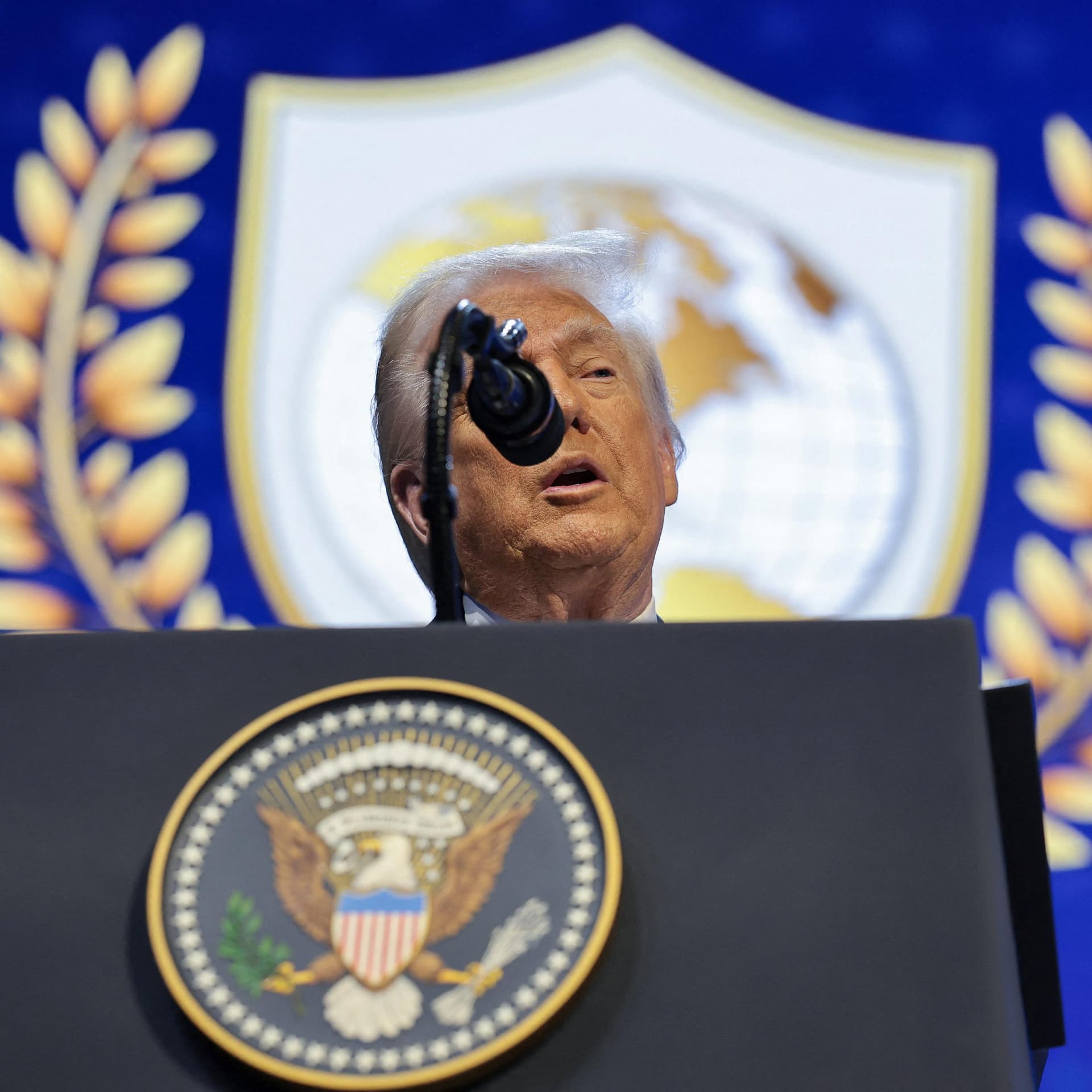
1:37Frank Gardner:Please welcome the chairman of the Board of Peace, the president of the United States of America, Donald J. Trump. At Davos on Thursday, on stage with prime ministers and presidents from allies, including Hungary, Argentina and Azerbaijan, Donald Trump officially launched his new Board of Peace. This board has the chance to be one of the most consequential bodies ever created. And it's my enormous honor to serve as its chairman. I was very honored when they asked me to do it. The board was originally set up as a body that would oversee Trump's Gaza peace plan. But it's morphed into something much bigger.
2:21Frank Gardner:Led by the US and its chairman, Donald Trump, it's a new institution that says it will address crises and conflicts all over the world, including Ukraine. It's presented as a break from, quote, institutions that have too often failed. From the BBC, I'm Tristan Redmond in London. And today on The Global Story, who's on it, who's not? And is the Board of Peace the new United Nations?
2:55Frank Gardner:Back in late September, Donald Trump announced that Hamas and Israel had finally agreed a ceasefire deal for Gaza. So this is a big, big day, a beautiful day, potentially one of the great days ever in civilization. And that the new government of Gaza would eventually be overseen by a body called the Board of Peace. We call it the Board of Peace, sort of a beautiful name, the board. a piece which will be headed, not at my request, believe me. I'm very busy. But we have to make sure this works. The leaders of the Arab world and Israel and everybody involved asked me to do this. So it would be headed by a gentleman known as President Donald J.
3:41Frank Gardner:Trump of the United States. Not everyone was behind the idea. But on the 17th of November, the United Nations Security Council gave it a seal of approval. By January, though, it had evolved into something else altogether, something bigger. See, I'm a real estate person at heart, and it's all about location. And I said, look at this location on the sea, look at this beautiful piece of property, what it could be for so many people. It'll be so, so great, people that are living so... The Board of Peace was eventually launched in Davos on Thursday, and the reconstruction of Gaza was part of the story.
4:18We think this could be done in two, three years. We've already started removing the rubble and doing some of the demolition. And then new Gaza. It could be a hope, it could be a destination, have a lot of industry and really be a place that the people there can thrive, have great employment.
4:30Frank Gardner:At a press conference, the president's son-in-law, Jared Kushner, unveiled images of a future Gaza city with shining skyscrapers, luxury apartments, coastal tourism, and plans to build over 100 ,000 housing units and 75 medical facilities. But by now, the Board of Peace says it has an even wider mission. It says it's designed to help, quote, all nations and communities seeking peace. But there's tremendous potential with the United Nations. I think the combination of the Board of Peace with the kind of people we have here, coupled with the United Nations can be something very, very unique for the world.
5:12Frank Gardner:It's for the world. This isn't United States. This is for the world. And so we're joined today by the BBC's security correspondent, Frank Gardner. We're delighted to have you back, friend of the podcast. Thank you, Frank. We'll get a little badge saying friend of the podcast. We can make that happen for you. I think that needs to happen. You could give me a kind of Nobel Peace Prize presentation. Give me yours. Frank covers global conflicts anywhere from China to the Middle East to Venezuela. And he's here to help us understand what this all means. So today we are going to try to understand the Board of Peace, Donald Trump's Board of Peace.
5:53Frank Gardner:Do you remember when you first heard about the Board of Peace? Quite recently. I mean, it was ratified by the UN as far back as November. And I don't think the UN had any idea when they approved it that this was potentially an existential threat to its own existence.
6:15the the UN approved this but what it approved was the idea that this was yet another mechanism for trying to resolve the Israel-Palestinian conflict specifically with a view to resolving Gaza to coming up with a long-term solution and it was within the framework of Trump's 20-point peace plan and I think probably people thought you know that looks great but is it really going to achieve anything. And to Trump's credit and the people who worked on it, the Qataris, the Egyptians, the Americans, as well as, of course, the Palestinians and the Israelis, the phase one of that peace plan has worked pretty well.
6:52The Gaza war stopped. It hasn't completely stopped some of the deaths, but it stopped the conflict. And it released all those Israeli hostages. It released hundreds of Palestinian prisoners. What it hasn't done is moved on to the next phase, the really tricky one. And that's going to be the test to this Board of Peace, because it needs to oversee the disarming of Hamas, the reconstruction of Gaza, and the deployment of an international stabilization force. None of those are going to be easy. And worryingly, the charter of this Board of Peace makes no mention of Gaza. There is mention further down in a kind of subcommittee called the Gaza Executive Board, which is going to be dealing with the day-to-day administration.
7:35But, you know, it's almost as if they've kicked the really difficult stuff down the road and brought in all these world leaders from Argentina, Vietnam, Azerbaijan, Belarus, and so on. How much do they know about the Middle East? What do you mean? Well, they don't know anything about the Middle East. So this is the remit of this border peace goes well beyond Gaza. It's a very ambitious project, but it's not really focused on Gaza. And I think the true test of this really is going to be whether it can actually deliver an improvement in the lives of Israelis and Palestinians, specifically Gazans.
8:12To be fair, Jared Kushner, Donald Trump's son-in-law, has been unveiling some pretty impressive looking plans for the redevelopment of Gaza. Whether that is with the best interests of Gazans in mind or whether this is just a real estate deal that somebody is going to make a lot of money out of, that's a bit of a moot question. The idea that Gaza could be this sort of wonderful bit of literal real estate is great. And if it's going to be peaceful and no longer a threat to Israel and Gazans can live there in peace and prosperity, my fear is that if that actually happened, Gazans would be priced out, you know, that they wouldn't actually necessarily benefit from it.
8:54I hope I'm wrong on that. I mean, the needs of Gazans right now are far more basic than great big glittery tower blocks and skyscrapers. It's things like water, sanitation, food, shelter. It's in a terrible state, Gaza.
9:08Frank Gardner:The fact that there is no mention of Gaza in the Charter, and we have seen, the BBC has seen a version of the Charter. At the moment that we're speaking, it hasn't been officially published, but we have seen a version of it. Is that bad news for Gazans? I think it is because they are already voicing fears that they are being ignored. All of this goes back to October the 7th, 2023, that horrific Hamas-led raid from Gaza into Israel that slaughtered 1 ,200 plus people and kidnapped all those hostages. What ensued from that, of course, was the horrific bombardment of Gaza that has killed tens of thousands of Palestinians, many of them women and children.
9:53So Gaza is not in a good state. And Hamas did that raid, and I'm not remotely justifying it. Hamas did that raid because they felt that the Palestinian cause, i.e. trying to get themselves a homeland, was being ignored, not just by the world powers, but by Middle Eastern powers as well. And so the aim of that raid was to bring Gaza and the Palestinian issue back into world focus, which it did at tremendous cost on both sides in human lives. So this board of peace is ostensibly about driving forward the Gaza peace process, the Trump peace plan, delivering on the second phase, which is the really tricky phase.
10:37But we're a long way off the practicalities of that.
10:40Frank Gardner:Okay, so it was originally proposed as a body that would oversee the peace deal in Gaza. It seems like Gaza has kind of slipped off its list of priorities somewhat. But do we have any understanding of where the actual name comes from? Because bored is a word that comes from the corporate world. It's not very often heard of in the diplomatic or international relations world. Gosh, I wonder who comes from the corporate world. I mean, exactly so. But how much do you think we can read into the use of that word in terms of how this thing is supposed to work? Well, quite a bit, I think, because this is essentially Trump's project.
11:17And, you know, he is, as he says himself, at heart, a real estate mogul. He's a real estate developer. And Steve Witkoff was a strip mall developer from Brooklyn who made friends with him back in the 80s, I think, in New York and plays golf with him and down at Mar-a-Lago. And this has got real estate all over it, rather than pure diplomacy or kind of Middle Eastern politics. Now, that's not necessarily a bad thing, because up until Trump turned up in his second iteration in the White House, the Middle East peace process was going nowhere. That's not to say that it's necessarily going to succeed this time, but he has made progress.
11:54And Trump, rightly or wrongly, gets stuff done. He's got this enormous kind of bulldozer approach. So in the light of what Trump has just been able to manage to do in Venezuela, that has really shocked and impressed a lot of people. So people, I think, are both scared and in awe of him. But you can't deny Trump's kind of personal and very controversial magnetism that has drawn in like moths to the flame, all of these world leaders, not all of, you know, they're not from everywhere. I mean, have got real doubts about this because they do not want to be on a board of peace alongside a man who is waging unrelenting barbaric war on the Ukrainians, i.e.
12:42Vladimir Putin, backed by Lukashenko. I mean, of Belarus, of Belarus. Yes. Odd choice. But, you know, for Trump, he kind of sees things in a different way to other people. I've done a piece for our live page today on the website, which was basically saying it's too early to judge whether this is going to work or not. I think that there is a risk that Gaza's interests or Garzan's interests could well get neglected as other more easily solvable projects and conflicts are tackled.
13:14Frank Gardner:Well, its stated aim is to resolve conflict and promote peace. But since this version of the Charter has begun circulating, this version of the BBC scene, there have been some particular areas that have been flagged as concerning for some. There are two of them that I want to raise in particular. One which has been raised is the role of the chairman, in this case, Donald J. Trump. And the second is more around financial transparency and accountability associated with the Board of Peace. So the role of the chairman, according to the Charter, the chairman can remove members, dissolve the board, veto almost any decision, invite anyone he chooses onto the board, create or dissolve bodies, and has the final decision on any disputes.
14:03Frank Gardner:So Donald Trump has a huge amount of power in this proposed organization. The second area of concern that has been flagged by some is this question of financial transparency and accountability. Now, there doesn't seem to be a provision for independent financial oversight. And there is this question of a$1 billion stipend for any nation that wants to join and become a permanent member. They would have to pay that. Only after three years. So it's open to all of those who've been invited. If they want to stay on beyond the temporary three-year term, it's like a temporary membership of a golf club.
14:41If you want sort of gold-plated status, then you've got to fork out the$1 billion.
14:47Frank Gardner:It's almost like a kind of membership due, isn't it? Now, if you look at all of this, it does feel somewhat like the power in this organization is being concentrated in the hands of one person, the chairman, who right now is Donald Trump. What do you make of that? I think he is securing his legacy for when he's told he can't have a third term as president. I mean, perhaps that's just me, but I mean, he wants a legacy. This is the crystallization of much of his vision for global domination. And part of it is in America's interests as he sees it, but also part of it is in the Trump family's interests.
15:25You know, Jared Kushner is very involved in the Middle East. He's got a lot of business interests. And Gulf Arab rulers, they like this firm. They like dealing with Trump. They did not enjoy dealing with Joe Biden at all, particularly the Saudis. Whereas Trump chose Riyadh as his first foreign visit when he during his first term of the presidency, and again went in May last year. They love him in Riyadh. And the Qataris, of course, gave him that$400 million aircraft for his personal use. I mean, he's liked and admired by the Gulf states, who also, by the way, love golf courses. So, you know, there was a natural synergy there, which I think was lacking with the previous, with both Presidents Obama and Biden.
16:12Frank Gardner:But these$1 billion that would be a membership due, do we have any idea what they would be used for? Is this an official donation to the funds of the organisation or something else? It is opaque. It's meant to be partly for the construction, the reconstruction of Gaza, and partly to fund the work of the board. And that, I think, is the bit that's going to need scrutiny. Well, actually, it's all going to need scrutiny because otherwise funds are going to be disappearing under the table. There needs to be something like SEGAR, the body that oversees the spending of defense money for the United States, and they were absolutely on it in Afghanistan, looking at where the money was going and where there was corruption and so on.
16:52It needs something like that. But as you rightly point out, this is a kind of... It really is like a corporate membership to some elite club rather than being part of the United Nations. And this is very interesting that China, only a few hours ago, has said, we are not joining this because we are founding members of the United Nations. We believe in the work of the UN. We don't think that this is a good idea because it's challenging the work of the UN. Now, it's perfectly possible that in a year's time, you and I could be sitting in this studio and, do you remember whatever happened to the Board of Peace?
17:31Oh, yeah. Do you remember? It was launched in such huge fanfare. We haven't heard much about it. You know, this could go one of two ways. It could actually become a mechanism for addressing, if not resolving, some of the big disputes and conflicts in the world. Or it could just quietly drift and die away and be in a brief flash in the pan, a great big bit of razzmatazz. Donald Trump got his big day and he moves on to other things. Goodness knows he's got enough to deal with at home, you know, with ice and immigration and economic issues. so it's possible he'll get distracted by other things.
18:23Frank Gardner:Hi there, I'm Asma Khalid. And I'm Tristan Redmond, and together we're the hosts of the Global Story podcast from the BBC. For those of you who might be new to our show, We here at The Global Story dive deep every weekday on one big story at the intersection of where the world and America meet. And you can now watch The Global Story on the iHeart app. Catch every brand new episode every weekday. Just tap into iHeart to start watching. And we hope you enjoy the show.
18:55Frank Gardner:Well, you mentioned China declining an invitation. Let's talk about membership. Who's in and who's out? Right. So most importantly, to my mind, the major nations of the Middle East are in. So Saudi Arabia, Qatar, Israel, Turkey, Egypt, Bahrain, UAE, they're in. These are all nations with a vested interest in there being a lasting and enduring and fair peace in the Middle East. and especially the big money people, because they are going to be the ones who are going to be expected to dip into their pockets to fund Gaza. So those Middle East leaders are in it, which is great. Controversially, Vladimir Putin of Russia and Alexander Lukashenko of Belarus have been invited to join.
19:39The Belarusians have said yes. The Russians are still studying it. And when it came to the billion dollar price tag, the Russians have suggested that they would be interested in paying this out of frozen funds, i.e. some of the funds that the West has nabbed and has sort of frozen for them. So it wouldn't actually cost them any new money, just money that they at the moment are not going to get back anyhow. There are all sorts of other people in there as well. Vietnam, Azerbaijan, Argentina, Armenia, I think is in there. The UK is not in there.
20:16Frank Gardner:What's the UK's response been? Yvette Cooper, the foreign secretary, Britain's foreign minister, has said, we're not rejecting it, but we are not ready to sign at the moment because it makes no sense for us to be on a board of peace with Putin, who has shown absolutely no interest in a real peace in Ukraine. That's Britain's attitude. Who's out? Who's declined? And what could the consequences be for them? So France and China have both taken the view that this is a dangerous rival to the work of the United Nations, and they don't want to undermine the UN. So they're not in. And, you know, let's not forget, by the way, all of this is coming on the very day after the kind of brinkmanship over Greenland, where it looked like there was a risk that NATO could be blown apart.
21:06Frank Gardner:It is unusual to some diplomats and observers that some of these countries are being included in the Board of Peace. Now, is it the case maybe that diplomacy has always been dependent on the idea of having conversations with all sides, even people that you don't agree with? And through that prism, is the Board of Peace, Donald Trump's new initiative, an admirable quest to bring together people of divergent opinions who feel that their ideas and views are not taken seriously at the highest levels of the UN. The UN has this Security Council, which is very exclusive, is run by nations that were the victors of the Second World War.
21:50Frank Gardner:More than 80 years ago is an outmoded way of running things, as plenty of UN critics have said. And it's constantly being stymied by vetoes, either for the United States or Russia and China, generally. So is the Board of Peace maybe an ambitious and inventive way of confronting new challenges in the year 2026? It could be, but it comes back to your question earlier that is this not dangerous having so much power resting in one man, Donald Trump, given how extraordinary, impulsive and vindictive he can be? I mean, that letter that was practically written in crayon to the prime minister of Norway saying, your country didn't give me the Nobel Peace Prize, therefore I'm going to stop being interested in peace, not completely, but mostly.
22:39I mean, that was just an extraordinary thing for any head of state to write, let alone the leader of the most powerful country in the world. So many of the things he has done are for the good. He achieved what Biden wasn't able to achieve and what all the diplomats of Europe and Qatar and Egypt and so on were not able to do. He got it through. He got it over the line. So, you know, I have said, let's wait and let's judge this on the results that it can achieve. And you may well be right. I mean, the UN is so unwieldy and it has its critics for being often very ineffective. It could be that this is a way of cutting through things, but it is dangerous that it is ultimately this border peace is going to do what the man at the top says.
23:28If the emperor doesn't like a proposal, it's not going to get very far with this. Something I've been thinking a bit about recently, Frank, is that we're hearing a lot of uses of the word peace in global diplomatic discussion these days.
23:43Frank Gardner:And I have been wondering whether or not its use is actually almost a sort of conversation ender. Because once you introduce the idea of peace being your primary concern, anybody who disagrees with you is, by logical extension, against peace. and nobody wants to admit that they are against the idea of peace. So you might be able to use the word peace to justify all sorts of different things. What do you make of that thought? I think that you're right. It is misused so often when it comes to, say, Ukraine. And likewise, the Russians, particularly through the figure of Kirill Dmitriev, who is the chief negotiator on the Russian side, a very smooth guy who's worked at Goldman Sachs.
Read the full transcript
24:29He speaks the language Americans speak, and he has managed to convince Team Trump that Russia really wants peace. No, what Russia wants is Ukraine's capitulation to Putin's terms. That isn't compromise. That's not peace. That's surrender. And Ukrainians are not yet so exhausted and broken that they are prepared to give in to that. But the way Trump sees that is the Ukrainians, and particularly the figure of Zelensky, are just being obstinate and are being nuisance. And that's why he says, you know, every now and then he says, I think Zelensky is the problem. Donald Trump seems to ignore the fact that there is a international criminal court warrant out for the arrest of Vladimir Putin for war crimes in Ukraine.
25:16And Donald Trump clearly has a very good personal relationship with Putin. Now, in some ways, that is a good thing because it lowers the chance of there being a horrific war, a terribly destructive war between the US and Russia, the two biggest nuclear powers, nuclear armed powers in the world, who still got their missiles facing each other. But on the other hand, it is extending the war in Ukraine because Donald Trump is absolutely refusing to see Putin as the aggressor and keep saying that Zelensky is the problem. When Zelensky is the president of a country that is coming under daily bombardment, we're talking about Shahid drones and ballistic and cruise missiles, and in some cases, even hypersonic missiles that are crashing into residential buildings in every Ukrainian city, hitting their electricity substations, plunging their people into cold and dark.
26:15Talking about the civilian population here, not the fighters on the front line, which is relatively static, but trying to cow the Ukrainian people into submission so that they accept Putin's terms, which are give him 20 % of the territory, give up any idea of NATO and belonging to the West, and reduce your army to a point at which you can no longer defend yourself. Those are his terms. That's his idea of a peace deal.
26:41Frank Gardner:Is the Board of Peace the end of the United Nations as we know it, and more particularly the UN Security Council? No, not yet. The UN is too big to roll over and die. But I think if a year from now, the Board of Peace is actually making progress and achieving things that the UN has failed to do, that I think is going to be a death knell for the UN in the long run. That will be the start of its decline. People will say, well, you know what? I actually want to get this done, so I'm going to do it through DJT's Board of Peace. rather than spending years trying to get it through the UN.
27:27Frank, thank you so much. Thanks. Let's see how this ends.
27:35Frank Gardner:That was Frank Gardner, the BBC's security correspondent. After we spoke to Frank, there was some more news from Davos. Speaking after a meeting with Donald Trump, Ukraine's president, Vladimir Zelensky, said that progress had been made on a deal for Ukraine. Security guarantees is done. So the document is done. We need to sign to understand that it will come only after the war will stop. And he said that talks would continue between Ukrainian, Russian and US officials on Friday in the United Arab Emirates. But that's it for today's episode of The Global Story. We might pick that up again next week.
28:11Frank Gardner:If you'd like to reach us, we're on theglobalstoryatbbc.com. And a quick note before we go, if you want to catch up on the latest news from around the world, then look for the Global News Podcast wherever you get your podcasts. And we'll have a bonus episode for you on Saturday, where Asma's been speaking to people who've been affected, for better or worse, by Donald Trump's first year in office. Today's episode was produced by Sam Chantaracic and Valerio Esposito. It was mixed by Travis Evans. Our senior news editor is Chyna Collins. And I'm Tristan Redman. Thanks for listening. Have a great weekend.
28:48Frank Gardner:Enjoy the bonus episode. Cheerio.
29:08Frank Gardner:Dive deep every weekday on one big story at the intersection of where the world and America meet. And you can now watch the global story on the iHeart app. Catch every brand new episode every weekday. Just tap into iHeart to start watching. And we hope you enjoy the show.
From the publisher
In Davos on Thursday, Donald Trump officially launched his new Board of Peace. Initially created to oversee the Gaza peace plan, the body has since expanded in scope. Led by Trump himself, the board says it will address global crises and conflicts. The initiative has raised concerns among traditional allies, while several controversial leaders have been invited to take part.
We speak to BBC security correspondent Frank Gardner about whether it could even replace the United Nations.
Producers: Sam Chantarasak and Valerio Esposito
Sound engineer: Travis Evans
Senior news editor: China Collins
Photo: U.S. President Donald Trump in Davos, Switzerland, January 22, 2026. REUTERS/Jonathan Ernst