In short
A BBC World Service “Global Story” Q&A on the 2026 World Cup in the US, Mexico, and Canada (48 teams; June 11–July 19). It covers FIFA corruption status, how broadcasting fees are set, Mexico’s security and protest risks, US visa/travel restrictions affecting Iran and other visitors, the impact of expanding the tournament, and myths about India’s 1950 World Cup withdrawal.
Guests/backgrounds
Dale Johnson, BBC Sports “football issues correspondent” (writes about issues beyond matches). Tristan Redmond and Asma Khalid are hosts. Will Grant is the BBC Mexico correspondent answering Mexico security questions.
Key claims
FIFA corruption allegations from the 2015 scandal led to bans for Sepp Blatter and Michel Platini (later reduced); current claims are said to be absent. Broadcasting rights are negotiated region-by-region, sometimes late. Mexico expects disruption mainly from teachers’ protests; US security involvement is limited to intelligence. Iran faces visa denials for 15 delegation members; FIFA says it has no role in US immigration decisions. Tournament expansion reduces group-stage jeopardy.
Notable examples
2015 bribery/fraud/money-laundering tied to marketing rights and hosting bids; Azteca Stadium protests; Jalisco New Generation cartel violence in 20 of 32 states; Iran ticket revocation claims; referee Omar Artan denied entry from Somalia; India’s “no boots” myth tied to 1950 qualifying by default due to other teams withdrawing.
Written by AI. May contain mistakes. Listen to the episode to check what was said.
Chapters
Tap a time to open that second in VOWorld Cup Overview
0:44 to 1:51
Introducing the World Cup 2026 and its significance.
“And together we host Good Bad Billionaire.”
Introducing the Guests
1:51 to 2:11
Meet the guests and their roles related to the World Cup.
“From the BBC, I'm Tristan Redmond in London.”
Football Issues and Corruption
2:11 to 3:17
Discussion on FIFA's corruption allegations and reforms.
“And today on The Global Story, the World Cup Q &A episode.”
Broadcasting Fees Explained
3:17 to 7:31
How FIFA determines its broadcasting rights and fees.
“And we're going to start with one from one of our audience members who wants to remain anonymous.”
Security Concerns in Mexico
7:31 to 9:22
Exploring security issues surrounding the World Cup in Mexico.
“But FIFA know they want to show the World Cup in every single country, so there has to be a compromise at some point.”
Political Implications of the World Cup
9:22 to 12:30
Analyzing the political dynamics and protests related to the event.
“Hi, this is Will Grant, the BBC's Mexico correspondent, And I'm in the Mexico City Bureau as the city gears up to host the opening game.”
Iran's Participation and Challenges
12:30 to 14:01
Discussing Iran's unique participation in the World Cup amidst tensions.
“In Mexico, I'm going to go on to our next question, which I'm pleased to say is actually from our very own Asma Khaled.”
FIFA's Influence on Security Concerns
14:01 to 15:34
Explore the tension between FIFA and security regulations for the World Cup.
“It's all about the concern about security and it's going to be quite tense.”
World Cup Expansion Discussion
16:08 to 17:56
Discuss the implications of expanding the World Cup from 32 to 48 teams.
“and ask a question to Dale, so it only feels fair that I should let you do the same.”
India's World Cup Withdrawal Myth
17:56 to 19:28
Debate the myth surrounding India's withdrawal from the World Cup in 1950.
“Is this historically accurate or is it just a myth?”
Show all 13 chapters
Travel Bans and the World Cup
19:28 to 21:44
Analyze the impact of travel bans on teams and referees for the World Cup.
“It never really gets through to the last stages of the qualifying process either.”
Contrasting World Cups: Russia vs. USA
21:44 to 23:59
Comparison of experiences between the 2018 and upcoming World Cup.
“and the contrast between what happened then and what's happening now is striking.”
Predictions for the World Cup Winner
23:59 to 26:27
Discuss potential winners of the World Cup and the biases influencing picks.
“Do you have a similar bias or are you able to take a more rational view?”
Transcript
Automatic transcript. May contain errors.0:00This BBC podcast is supported by ads outside the UK.
0:30No bouncing between tabs. And best of all, no spreadsheets. Stop managing software and start managing your business with one unified system. Try for free today at odoo.com. That's O-D-O-O dot com. Hi, I'm Simon Jack. I'm Zing Zing. And together we host Good Bad Billionaire. The podcast exploring how some of the wealthiest people on the planet made their money. And we are back with a new season. From sporting superstars to music moguls and celebrity CEOs. We'll be taking a closer look at the lives and fortunes of some of the world's richest people. And asking you to decide if they're good, bad or just another billionaire.
1:06Good, bad billionaire from the BBC World Service. Listen now or search for Good, Bad, Billionaire wherever you get your BBC podcasts.
1:19One and a half billion people watched the last World Cup final in 2022. Around 5 billion watched the tournament as a whole. As the saying goes, everything is bigger in America. But the World Cup is one of the few things that dwarfs even the United States. This week, the tournament comes to the US, Mexico and Canada. And perhaps appropriately, it's a supersized World Cup. 48 nations are competing more than usual. Today on The Global Story, we're taking questions from you, our listeners, on everything from allegations over FIFA to host country readiness to predictions for who could win it all. From the BBC, I'm Tristan Redmond in London.
2:08And I'm Asma Khalid in Washington, D.C. And today on The Global Story, the World Cup Q &A episode.
2:19My name is Dale Johnson and I'm the football issues correspondent for BBC Sports. What I do is basically the best way to describe it is I write about everything which isn't the ball being kicked. Can I just say that the fact that we have something at the BBC called a football issues correspondent is a sign of how seriously we take this sport over this side of the Atlantic? I think it's also a sign of the times. It's gone on the days when it's just about the results and the tactics and the matches. There's so much going on off the field. Yeah, absolutely. Well, we're so pleased to have you with us, Dale.
2:52Today is our first inaugural World Cup questions from listeners episode. I love that Tristan says our inaugural with grand plans that we're going to do more of these, but yes. Well, I mean, the World Cup goes on for how long, Dale? Is it five weeks or something like that? We might have space for another one during the course of the competition. Yeah, five weeks starts on the 11th of June on Thursday and goes to the 19th of July. All right. So let's kick off the audience questions. And we're going to start with one from one of our audience members who wants to remain anonymous. He asks about FIFA, the organizing body for World Cups.
3:26He says, is FIFA corrupt? And if so, to what extent? So, Dale, there were allegations of corruption against certain members of FIFA around a decade ago, weren't there? Where do we stand with that? Yeah, so the corruption around 2015 was one of the biggest scandals in world football, really. And it engulfed the whole FIFA, world football's governing body. And it was all about bribery, fraud, money laundering, mainly related to marketing rights for FIFA games, which were taking place in the Americas. But also in relation to the bidding for hosting of World Cups too. Many people were caught up on it.
4:06Well, Sepp Blatter, who has been the head of FIFA for 17 years, he ended up having to resign. Then it also embroiled Michel Platini, who was the head of UEFA at the time, European football's governing body. Now, he and Blatter have always denied any wrongdoing on this front, and it never got to the point where they received any type of punishment. Although we should say that both Sepp Blatter and Michel Platini were banned for eight years from all football-related activities by FIFA as a result of this investigation. These bans were subsequently reduced Blatter's to six years and Platini's to four.
4:44So there you go. So you've got a situation where basically the whole of FIFA's governance was replaced. And that is when Gianni Infantino came in. And Gianni Infantino was actually just thrust forward from being this administrator to somebody that was running the whole of world football and was in charge of trying to revamp and remove allegations of fraud and bribery. And there's no suggestion of corruption right now. Gianni Infantino, when he took over from Sepp Blatter as the head of FIFA, you're saying he's done a job of cleaning the organization up. Is that right? So what happened initially, FIFA sort of worked on a situation whereby just the members of the board would decide who hosted World Cups.
5:28And that led to the controversial situation where Russia got the 2018 World Cup and Qatar got the 2022 World Cup. One of the things Infantino did do was he moved it away from just that council and it gave all 211 members of FIFA the right to have a vote on who would, for instance, host the World Cup. So it was no longer within the control of this small body of men. It was always men. By moving away from just these people and to the 211 heads, it was felt that was less susceptible to corruption, so we say, because it was a decision made by the whole world rather than just a small group of people.
6:03We sort of touched on where corruption allegations are now. You were tiling us a little bit about Infantino. So why don't I skip on to our additional listener question here. Now we're going to hear from Swarit in India. Swarit is asking about how FIFA sets its broadcasting fees. Hello to the Global Story team. I'm Swarit from India. So I have a question about the broadcasting for the upcoming FIFA World Cup that's taking place in North America. So my question is that Indian viewers nearly missed out because FIFA initially set very high broadcasting fee for India. And only after the price was reduced, did ZNet secure the rights.
6:45I understand FIFA needs to generate revenue, but how does FIFA determine its broadcasting fees? Thanks. Dale, can you explain that? Well, FIFA has an amount it wants to get from broadcasting rights from all regions. For the last Women's World Cup three years ago, So it went very late in the day before the European countries took the rights on because FIFA wanted more money than the broadcasters were prepared to pay. So this is not just a men's World Cup issue. And FIFA and Gianni Infantino have got a certain amount that they think their rights are worth. And clearly the broadcasters with their local markets have an amount which they think they're worth.
7:23How do they determine the broadcasting fees, Dale? And are they the same per country? They're not the same per country. So it's just a case-by-case basis, really. And you always find with these tournaments that there will be some regions where it goes quite down to the wire before FIFA can get an agreement with one of the broadcasters. If we look at various aspects of this World Cup, the ticket prices, for instance, and various other things, including the broadcast rights, I think it's difficult to know exactly how FIFA comes up with the pricing structure for any element of this, really. But FIFA know they want to show the World Cup in every single country, so there has to be a compromise at some point.
8:00Okay. Okay. Thanks for that, Dale. We're going to trot on because we have an excellent question from our listener, Mary from Kentucky. Hi, Global Story. This is Mary from Kentucky. My World Cup question is about the state of security in Mexico. With the cartel violence a few months ago and the current teacher strikes that are threatening to boycott the World Cup and block main routes to the stadiums, what measures is the Mexican government taking to ensure the games go smoothly? And how might the U.S. government be involved, if at all? Thanks. Love the podcast. Well, Dale, I'm pleased to say we have an answer to this question from Mary, from our colleague and friend of the show, Will Grant, in Mexico.
8:43And we'll come to that in a second. But before we do that, what's your perspective on how seriously the issue of security in Mexico, in particular, has been taken by the organizers? Well, of course, the situation in Mexico has been quite stark since February, with a situation involving gangs and the protests have been building. And you only had to look at the Azteca Stadium earlier this week. People gathered to protest and close the road, and there was banners that said FIFA go home. So that gives you an idea of the feeling, and now the government are saying that there's going to be no issue when the tournament comes around.
9:14But it's clear that there's a lot of people in Mexico that aren't particularly happy with the situation of the World Cup being in their country when things are quite difficult right now. Okay, well, thanks for that. Let's cross over to Will in Mexico. Hi, this is Will Grant, the BBC's Mexico correspondent, And I'm in the Mexico City Bureau as the city gears up to host the opening game. It's a great question from Mary, so let's take it bit by bit. The first thing is the cartel violence when we saw in February masked gunmen from the Jalisco New Generation cartel spreading fear and violence in 20 of Mexico's 32 states.
9:54The expectation is that that won't actually affect the World Cup, that that was almost a one-off event in the wake of the killing of their leader, El Menchon. And that, in a sense, the gunmen needed to make a point that they could disrupt this event, that they could, in fact, reduce the streets to chaos at any given moment. It's a very clear message to the government of President Claudia Sheinbaum, but I think and certainly the government are confident that in no way would any cartel end up doing that to visiting football fans. The other point that's raised, of course, is this major teachers protest.
10:35Nationwide, teachers are on strike in Mexico over pay and conditions, pensions specifically. Those protests can become quite violent and they have threatened to block all the main arterial roads into the stadium on the day of the opening game. I think from speaking to officials around the game that they are expecting some disruption unless President Claudia Sheinbaum in the final hours can reach some kind of agreement with the union leadership. They are using the fact that the world's eyes are on Mexico City to make their political points, as are others. For example, the family members of Mexico's roughly 130 ,000 disappeared people, those who are complaining about the gentrification of neighborhoods and the effects of the World Cup on their parts of the city in terms of water supply and prices and things like this that have been affected by this event.
11:36So we will see political demonstrations around the World Cup. And I think the teachers' protests is the biggest one that people are watching out for. In terms of the final part and whether or not the US government would play a role, in theory, the US security forces limit themselves to an intelligence relationship with the Mexican government. There would be no actual hard military support, which is something that Claudia Sheinbaum has said is absolutely one of her red lines, that there is not to be US involvement in Mexican territory. This is a close security relationship. US Secretary of State Marco Rubio said it was better now, the security relationship, than at any other time in modern history.
12:17But I don't think we can expect to see US government involvement in the security around the World Cup at this stage. Mexico is very confident that it has this situation and the security of this event under control. All right. Well, thanks very much for that, Will. In Mexico, I'm going to go on to our next question, which I'm pleased to say is actually from our very own Asma Khaled. Asma, you have a question for Dale. I do. I do. And I hope you all don't mind me taking this opportunity. But I do think it's a question that's been on my mind, and I imagine it's got to be on a lot of listeners' minds here in the United States.
12:51And that is that Iran is participating in this World Cup. And it strikes me just how unusual this moment is because the US has been in an active war with Iran. And my understanding is that the Iran soccer team has to practice in Mexico, and they can only fly in and out of the United States for their matches. Why is that, Dale? It is completely unprecedented, the fact that the World Cup host is at war with a team that's participating in it. And of course, for quite a while, it wasn't sure whether Iran would be able to play in the World Cup. But there are some real issues here. The US has rejected visas for 15 members of the iran delegation what's going to happen next week on the 15th of june when iran play their first game when the team comes to enter the united states um we've got issues with fans and also other officials being able to get into the united states we've seen several cases of that so are we going to get to the situation next week whereby iran do try to enter the u.s to play the first of their matches and some of the players don't get in.
13:59And I think that's got to be a concern. This is all about the war. It's all about the concern about security and it's going to be quite tense. And does FIFA have no influence to lean on the United States to loosen up their rules or anything like that? I mean, you look at an organization like the IOC that organized the Olympics and sometimes they're almost as big and influential as a state. Does FIFA not have that same kind of weight? I think what we're seeing in this World Cup is really quite unique. In previous tournaments, you've seen FIFA be able to get a tournament work pretty much as they wanted to with a few small caveats.
14:38But even in those controversial ones, the government still made a lot of concessions to make sure the tournament worked as smoothly as possible. but we've got a situation now, for instance, the Iran Football Federation said that all their tickets have been revoked for their matches and each team gets around 3 ,000 to 4 ,000 tickets per game. This has not been commented on yet by FIFA, so we don't know if that's officially the case or not. But this presents a situation whereby one of the teams competing in the World Cup is not allowed to have its supporters there. One thing that Gianni Infantino said during the bidding process in 2017 is there cannot be a situation whereby the fans of one of the teams that are playing in this competition are not allowed to go to the matches.
15:33Save big money in your next painting project now at Menards. From your kitchen and bath to doors and trim and even your ceilings, Dutch Boy has the perfect finish for your painting projects. Dutch Boy's Dura-Fighter is a tough paint and primer that provides great scrub resistance and durability. Save big on Dutch Boy Paints. Plus, view our weekly flyer on Menards.com. And get your painting project started today. Save big money at Menards.
16:07Well, Tristan, I took a moment to have a bit of host privilege there and ask a question to Dale, so it only feels fair that I should let you do the same. I have one, Dale, which is, what do you make of the expanding size of the World Cup? So back in the day, the World Cup was 32 nations. Now it's 48. I mean, it's great to see small countries like Curaçao and Cape Verde and Haiti qualify. These are wonderful sporting stories. But I just wonder if it doesn't dilute some of the currency of what it actually means to be in the World Cup. What do you make of that? I think one of the biggest issues this expanded format brings is we lose a lot of the jeopardy around the group stage.
16:49There are not really any groups where you think that there could be big teams that might go out. And then when you factor in that because of the format, which requires 32 teams to get out of the group stage, that means for eight of the groups, the third place team is going to go through to the knockout phase as well. So you're talking that for eight of the groups, only one team's actually going to go home. And you've got to play 72 games to get to that process where you're down to 32 teams. So it's really quite bloated. It might be the case that people don't really feel that this World Cup under this format is really going to start until we get to the knockout rounds.
17:26You've nailed your colours to the mast there, Dale. Just wait until Kurosawa goes on a run to the semifinals. Well, let's see if they can beat Germany in their first game of the weekend. Well, let's see indeed. All righty. And now I'm pleased to say that we have another question here, Dale, from India. This one was sent in by Nikhil. Hi, I am Nikhil Jijon from India. There is a well-known story here that India qualified for the World Cup but withdraw because the players didn't have football boots. Is this historically accurate or is it just a myth? I love to know the truth. Thank you. All right.
18:06So is it true? Did India qualify for the World Cup but have to withdraw because they did not have football boots? Dale? Yeah. So you have to cast your mind back to what the world was like in 1950, really. In the Asian World Cup qualifying process, there was only four teams entered. when you consider now, I think it's 46 Asian nations go through qualifying. So you said Philippines, Indonesia, Burma, and India who put the skills forward. Now, Philippines, Indonesia, and Burma pulled out. So in effect, India only qualified by default. A lot of countries pulled out. France, Scotland, and Turkey all qualified and pulled out because they couldn't justify the cost of sending a team of players to take part.
18:49And so while India did have players that play barefoot it was really the olympics that india thought was the gold standard and no pun intended for his football team it didn't really want to put the resources in sending a team to the world cup so while barefoot is true it wasn't the reason why they didn't go to the world cup in 1950 and there are also stories that they only played 70 minute matches in india and so that the authorities were worried that they'd be showing up if they suddenly went to go and play in a tournament which was 90 minutes because they weren't used to doing it so there are lots of stories like that But while it is true about the barefoot angle, that might be one of those ones which has grown as a myth when it's not actually true.
19:26And has India ever got close to re-qualifying for a World Cup ever since then? No, no. India's never played at the World Cup. It never really gets through to the last stages of the qualifying process either. Well, it's hard not to wonder if huge countries like China and India are not sort of sleeping football giants that we might see more of in the future. Yeah, I mean, China had been in the World Cup a couple of times, but they have not been remotely close for many, many years. But it's quite remarkable that you do have these countries with such huge, vast populations that do not have a team that can get to the World Cup.
20:01You've indulged us by answering questions from both Tristan and myself. But if you don't mind taking one more from our team here at The Global Story, our producer Kat had a question about travel bans, which we did talk about a bit in a previous episode we did around the World Cup and geopolitics. As we get closer to this entire event kicking off, how are we seeing the travel bans that we've seen put in place under this Trump administration impacting fans and teams? Yeah, well, as I just mentioned, we just talked about the Iran situation, but there are other countries which are on the travel ban.
20:36One of the referees, Omar Artan, has been denied access into the United States because he's from Somalia, which is on the travel ban list. Did FIFA say anything in regards to the situation? All FIFA have done is confirmed that the referee has gone home and said that it has no role in the immigration plans of each country. But I mean, like we talked about in a previous question, this would not have happened in past World Cups because there would have been cooperation to make sure that the people that needed to get into the country within limits would be able to get into the country. The fact that a referee has not been able to get access to the country where the World Cup is happening, and we don't know the full details of why he was denied access yet, is remarkable, really.
21:21There are 52 referees, or 51 now, who will referee the 104 games at the tournament. They're all based in Miami, and because they're based in Miami, the referee has to be there. He can't just do games in Canada and Mexico, where he may be able to get access to. He has to get into Florida and be at the training base for all the other referees. Dale, I covered the World Cup in Russia in 2018, and the contrast between what happened then and what's happening now is striking. You know, there were a lot of concerns before the World Cup in 2018 that different people might not be able to make in, people who had, you know, voiced particular political views or were part of the LGBT community.
22:03As it turned out, none of those things transpired, and everyone seemed to be let in, and the whole tournament passed off without very many hitches. already in the United States were seeing people who are not being allowed in. Does that surprise you? It just shows exactly what this current situation is about, really. You mentioned Russia. Now, basically, Russia gave visa waivers to anybody that had a World Cup ticket. Russia basically rolled out the red carpet for anybody who was traveling to go to the World Cup. And the suggestion is if you were to go to Russia the year before or the year later, you would not have got the same welcome or the same openness.
22:40What you've got with the Trump administration is the opposite. Yeah. And I should say, you know, we've heard the State Department say that they will take the time necessary to ensure applicants don't pose a risk to the safety and security of the United States. And so they say that they're adjudicating each visa application on a case-by-case basis. I am just curious, though, that in this dynamic where this is an event that's being held across three countries, and you also have this governing body of FIFA. I'm just curious how you navigate that fairly for the players, for the refs, because this is not solely an event being put on by the United States.
23:19And also, you would think the fact that Gianni Argentino has a controversial relationship with Donald Trump, with the FIFA Peace Prize, and he's clearly gone out of his way to try to make Donald Trump feel as much a part of this whole World Cup as possible and even despite that there's been no concession to make this a smoother tournament well then let's move on we have a question from our listener joel uh and he says the following hey asma tristan and dale as a dutch fan of the show and the world cup i'm curious who you guys are picking as the winner of the world cup my personal bias is convinced it will be the Netherlands this time.
24:04Do you have a similar bias or are you able to take a more rational view? I'd like to know. Thank you guys for always bringing the deeper insights from the news, which I also listened to on your global news podcast. Thank you guys so much. Well, thank you, Joel, for writing that question. And I will just say no bias here, but somehow I am throwing a party for a group of first graders when the USA takes on Australia. So, no bias, but just saying. That's very brave of you, Asma. Dale, who's your pick? Well, I don't think I put too much money on the Netherlands to win it, unfortunately. I'm not sure they've got the goals that they need to win the tournament.
24:50Memphis Depay is their best player, but he's 32 now, and I'm not sure he'll be able to carry them all the way to the final. But pretty boring answers for me, really. I think there's three real contenders. Spain, we've got Yudemal who's one of the best young players in the world who plays for Barcelona Spain are a fantastic team they won the Euro 2024 beating England in the final France have also got an amazingly strong forward line with Kylian Mbappe and Nusman Dembele who's the Ballon d 'Or winner which is essentially the player of the year at the moment for the world and Desiree Douay he's also a fantastically exciting young player but the question then is are the conditions going to be suitable for European teams to go all the way and win the tournament with the heat that we're going to be in America.
25:35It could be that it's South American nations that will excel. And I think there's Argentina. I think they're going to be a decent bet to defend the World Cup that they won four years ago. They've obviously got Lionel Messi, but they've got many, many other good players like Nico Paz. He's one of the best top-and-conjun players in the world. I think it's going to be one of those three. my answer to you is that the nationality bias thing does apply in my case because i my team is france and i believe that france are going to do badly i'm pessimistic they were appalling in the european championship two years ago all the reports are that the team may be unhappy and their warm-up matches have been unimpressive so my nationality bias is a negative one and i'm not backing France, sadly.
Read the full transcript
26:24Thanks so much for the question, Joel. That was great. Yeah, thank you all for submitting questions for us. And Dale, thank you for helping us make sense of this moment. And I will just say, maybe no nationality bias, but sitting here in the United States, I will say for a country that historically hasn't really taken soccer all that seriously, maybe compared to American football, basketball, Well, it feels like a really exciting moment to be an American. Have a fantastic time, Asma. I'm very jealous that you're there and get to see it all in person. It's fantastic. Well, I don't have any actual tickets to the game, but, you know, be watching it from afar.
27:11Dale, thank you so much. Thank you. Thank you so much, Dale. That was fantastic.
27:19That was Dale Johnson, football issues correspondent for BBC Sport. And there'll be coverage of the whole tournament across the BBC, so you'll be able to get your football stroke soccer fix throughout. And please rate us wherever you're listening. It helps others find us. Now, we don't only want to hear from you all when we do a special Q &A episode like we did today. We love hearing from you all whenever you have story ideas, comments, suggestions, a bit of complaint. We love to hear it all. So you can send us a note at theglobalstory at bbc.com. Now, as you know, our show is one story every day about where the world and America meet.
27:57But if you want to catch up on the very latest headlines from around the world, then look for our sister show, The Global News Podcast. You'll find it wherever you get your shows. And that's it for The Global Story today. This episode was produced by Kat Farnsworth and Zandra Ellen. It was edited by Bridget Harney and mixed by Travis Evans. Our video producer is Matt Pintus. Our senior news editor is China Collins. And I'm Tristan Redman. And I'm Asma Khalid. We'll be back again tomorrow. See you then. Cheerio.
28:35Hi, I'm Simon Jack. I'm Zing Zing. And together we host Good Bad Billionaire. The podcast exploring how some of the wealthiest people on the planet made their money. And we are back with a new season. From sporting superstars to music moguls and celebrity CEOs. We'll be taking a closer look at the lives and fortunes of some of the world's richest people. And asking you to decide if they're good, bad or just another billionaire. Good Bad Billionaire from the BBC World Service. Listen now or search for Good Bad Billionaire wherever you get your BBC podcasts.
29:07Thank you.
From the publisher
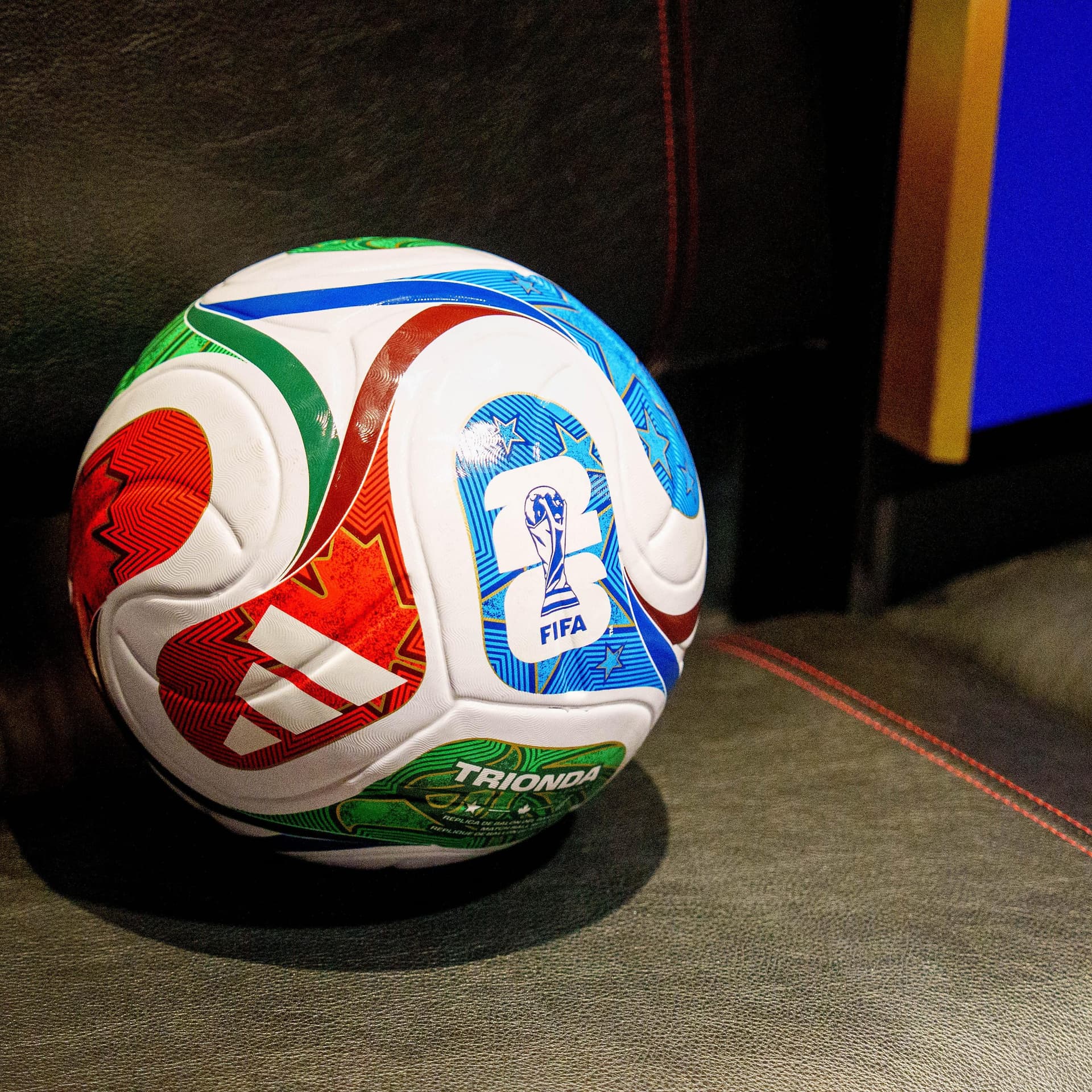
The Fifa World Cup kicks off this week. Beginning Thursday, football - or soccer - matches, depending on your preference, will be played in the US, Mexico, and Canada, with a record 48 nations competing for the trophy.
However, the tournament has been beset by controversies over ticket prices, travel bans that affect fans and officials, and security concerns.
We answer questions from the audience about what to expect from this year’s World Cup, with BBC Sports football issues correspondent, Dale Johnson.
Producer: Cat Farnsworth and Xandra Ellin Executive producer: Bridget Harney Sound engineer: Travis Evans Senior news editor: China Collins
(Photo: A Fifa soccer ball in a locker room at Kansas City Stadium ahead of the 2026 Fifa World Cup. Credit: Denny Medley/Reuters)