
 Ask ChatGPT


- Podcasts
- The James Altucher Show
- Robert Greene: Finding the Sublime After a Stroke
The James Altucher Show17 Nov 2026 · 1h 22m · 21 chapters
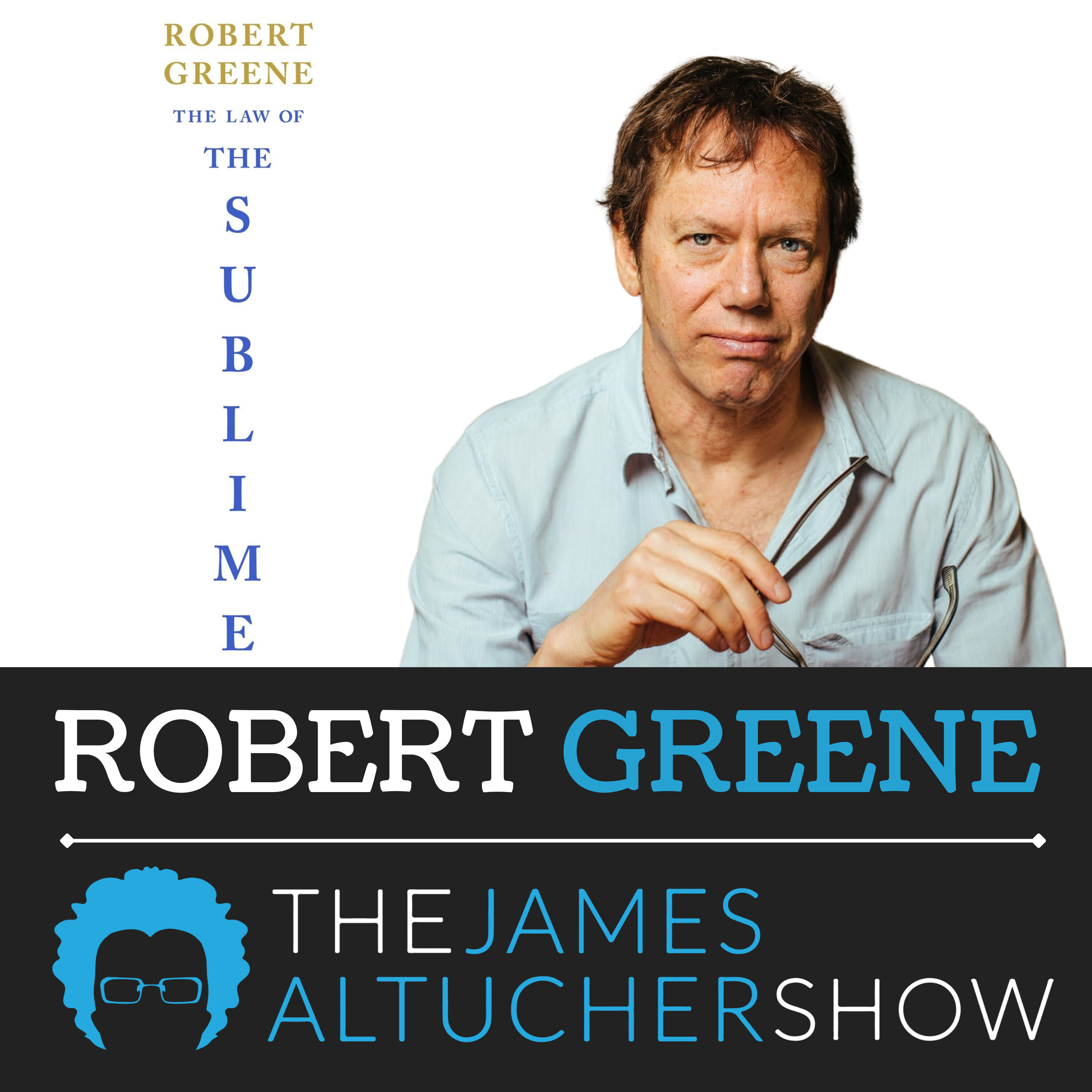
Robert Greene: Finding the Sublime After a Stroke
In short
Robert Greene discusses his book The Law of the Sublime, arguing the sublime is a bodily sensation and a way of perceiving beyond language and everyday “anti-sublime” mental loops. He links the sublime to near-death/stroke-like brain changes, expanded emotion, cosmic perspective, and practices meant to recreate pre-verbal perception.
Guest backgrounds
Robert Greene is the author of The 48 Laws of Power, Mastery, and The Laws of Human Nature. He wrote The Law of the Sublime after a stroke about eight years earlier; he spent seven years writing it, hand-copying due to loss of left-hand use.
Key claims
The brain constructs reality and self; when brain filtering dissolves, people can perceive more directly. Language and self-labels constrain experience; exploring a “second self” and childhood perception can restore intensity. The sublime is “ultimate therapy” for modern mental narrowing and algorithm-driven attention. Mortality contemplation can intensify life.
Notable examples
Post-stroke life finding sublime in small things (ivy, sky, conversations). “Miguel” in Argentina climbing Mount Aconcagua to escape empty therapy talk. Mozart’s starling story (Mozart composes for a bird’s communication; later a 1990s woman’s playback triggers the bird). Dersu Uzala’s tiger “language” and the idea of deeper consciousness. Ramana Maharshi imagining his own death leading to lifelong enlightenment.
Written by AI. May contain mistakes.
Chapters
1:28
The Impact of a Stroke on Perception
Robert discusses how his stroke changed his view on life and creativity.
“all written by one of the best writers out there and a good friend, Robert Green.”
2:52
Finding the Sublime in Everyday Life
Robert shares how he learned to find the sublime after his stroke.
“I almost don't want to talk about your stroke because I'm sure like everybody you've spoken to, you told the same goddamn story.”
5:50
The Role of Language in Understanding
Exploration of how language shapes our identity and perception of reality.
“And yet, you know, throughout the book, there's all these exercises.”
11:43
The Search for Deeper Meaning
Discussion on the human quest for meaning beyond material success.
“And on the one sense, I know there doesn't have to be a benefit to it, that there's a beauty to just exploring the sublime in your life.”
14:00
The Search for Connection and the Sublime
Exploration of how people are losing connection to larger truths and the concept of the sublime as a remedy.
“We're all focusing on what people think about me.”
29:17
The Complexity of Consciousness
Explore the intricate relationship between consciousness and reality.
“That particles are moving because of our way of observing them.”
31:07
Dersu Usala: A Story of Connection
Discover the profound connection between a scientist and an indigenous trapper.
“I know that sounds convoluted, and I'm not doing a great job describing it, but that's as close as I get to my view of consciousness.”
36:43
The Role of Mortality in Consciousness
Understand how contemplating mortality can deepen your experience of life.
“So that to me explains that there is another level of human consciousness that we have actually lost.”
41:08
Melancholy and the Sublime
Examine the interplay of pain and pleasure within the sublime experience.
“melancholy is like one of my favorite emotions like i love thinking about my daughters for instance when they were little and there's a sadness to it because you never can get those moments back.”
42:00
Exploring the Sublime and Melancholy
Discover the emotional depth of experiencing the sublime and how melancholy intertwines with pleasure.
“And it kind of just the emotional depth that it can bring to you.”
Show all 21 chapters
46:08
The Nature of Consciousness
Delve into the mysteries of consciousness and its connection to the universe and existence.
“become kind of frozen and constricted by the life I was living.”
51:13
Science, Curiosity, and the Unknown
Examine the relationship between science, knowledge, and the importance of curiosity in understanding reality.
“The more they know, the stranger and weirder and less comprehensible the universe appears.”
54:31
Hallucinogenic Experiences and Perception
Explore how hallucinogenic experiences can transform perception and enhance appreciation for reality.
“Anything that takes us out of the brain is kind of what is happening in your book, I feel, which is just, we're so addicted to believing that our thoughts are reality.”
56:00
Sublime Experiences Without Substances
Exploring how to achieve heightened awareness without drugs.
“that all these things you walk and never notice.”
57:10
Exercise for Experiencing the Past
A unique exercise that connects individuals to their past experiences and ancestors.
“And now you can use that experience to expand it in your daily life without the use of those drugs.”
1:01:57
Harriet Tubman and the Daemon
Examining Harriet Tubman's life and her connection to spiritual guidance.
“And I think that exercise, and a lot of the exercises in the book, they're all, they're all unique from each other.”
1:09:48
Surrendering to Life's Experiences
The relationship between surrender and the sublime in personal experiences.
“So you're either going to fight it or you're going to surrender to that and live your life.”
1:10:03
Exploring Sensitivity and Surrender
Learn how sensitivity affects our perception and the concept of surrender in relationships.
“of life more intense, I thought, as I wrote the book, that it's kind of a function of your degree of sensitivity.”
1:13:29
Finding Sublime Moments After a Stroke
Discover Robert Greene's experiences of profound sensitivity and awe following his stroke.
“When I came home in the weeks and months ahead, that frame just clicked back into place, and things kind of returned to their usual sort of dullness, and I got depressed.”
1:15:57
The Challenge of Writing and Future Ideas
Hear Robert discuss the challenges of writing his latest book and his thoughts on future projects.
“I mean, and yet it's still, this, this book has your fingerprints all over it.”
1:18:35
Impactful Conversations and Podcast Goals
James Altucher reflects on the meaningful impact of his conversations with Robert Greene.
“As I say, it sounds completely nonsense and sounds completely grandiose, but I have some thinkers and some writers and some ideas that are roiling through my brain.”

Ask about this episode
Get the gist, explore an idea or ask about something said.
 Claude
On The James Altucher Show, what are the key points of this episode?
Searching your listeningTranscript
Automatic transcript. May contain errors.
0:00James Altucher: Finished your essay a day early? That deserves a... Finally folded that laundry? That deserves a... Parallel parked on the first try? That deserves a... No matter what you accomplish today, celebrate with an ice-cold Coca-Cola. Because even the little wins deserve a big... Enjoy Coca-Cola.
0:30James Altucher: Today on The James Altucher Show. The sublime is not a concept of something abstract. It's a sensation in your body. It's a way of feeling the world emotionally and larger than just what words, the kind of bubble that words create. But mostly, I'm just trying to shake you up because you're in this kind of world that isn't real. You're asleep, essentially. You're mesmerized by language, by technology, of the human world we've created, and you're asleep. And I'm trying to wake you up that there's a different way of seeing, perceiving, and experiencing this world. This isn't your average business podcast, and he's not your average host.
1:14James Altucher: This is the James Altucher Show.
1:27James Altucher: Some of my favorite books are The 48 Laws of Power, Mastery, The Laws of Human Nature, all written by one of the best writers out there and a good friend, Robert Green. He's been on the podcast many times. And these books are like, if you want to learn storytelling, history, valuable lessons that you could use in your life, read those books or any of Robert Ream's books. But now he has a brand new book, The Law of the Sublime. He wrote this book after having a stroke, actually, about eight years ago. And after that stroke, he began to appreciate the world in a different way, begin to look for what he calls the sublime.
2:12James Altucher: And he gives many exercises how we too can see life in this brand new and exciting way. And he gives examples from history. You know, what's it like when you're trying to find purpose and meaning in your life? And because of that constant obsessing thoughts that go on in your head of everyday life, you miss the beauty of the universe. And in doing so, you make your life less valuable. So we talk about this. This book took him seven years to write because again, after his stroke, had some troubles. And I would say this podcast has changed my life. So I hope it changes yours. Here's Robert Greene, author of The Law of the Sublime.
3:04James Altucher: I almost don't want to talk about your stroke because I'm sure like everybody you've spoken to, you told the same goddamn story. Oh, I had a stroke and this happened and this happened and this happened. James. Yeah. It's getting a little bit tiresome. So, so let me ask you, which podcast should they listen to, to hear all about what happened to you? Cause I, it's very important to the story, but I don't want you to have to tell it for the eighth time. I have a video out there. It's kind of an introduction. It's like a preview of my book. It's about 10 minutes long. All right. We go into that. It's on my YouTube channel, and you'll know everything you ever wanted to know about my stroke, but we're afraid to ask.
3:42James Altucher: All right. Well, that sounds good. I mean, because I know you were even thinking of writing this book, The Law of the Sublime, before the stroke. Then obviously you had this cataclysmic thing happen to you. How do you think your approach to what the sublime is? And we'll get into that, into the meaning of that. How do you think your approach to that changed after the stroke? Well, before the stroke, I was going to travel everywhere and have all of these weird sublime experiences. I was going to go to these landscapes that would kind of wreak the sublime, like certain mountains, deserts, you know, ends of the earth.
4:17I was going to have encounters with animals. I was going to do all of these amazing things, you know, go to famous observatories in Chile and look at the night sky. And then I was going to write about that, you know. And then, of course, after the post-stroke, I could barely walk 10 steps out my front door, you know. So the whole scope of the book had to change dramatically. And so I decided that I would still write the book because having come so close to death, the feeling of this, it was no longer an abstract thought as it was 20 years ago. It was like a feeling inside my body of something very profound that had shaken me up.
4:57And so I wanted to go back to that experience. I wanted to go back to how my eyes and my perception of the world was dramatically transformed by the event. Communicate that to the reader and show them that they don't need a near-death experience to see the world differently, to see the world through these eyes. That's going to have a very, very powerful effect on them. It's going to make their experience of life much more intense. So I had to curtail all of those ambitious plans and just focus on myself and the narrowness of my office, which you can see in the background. And this was the world that I had to live in.
5:34And I had to find the sublime in just little things. I could look at the night at the sky outside or the ivy growing on the wall or in my backyard or in conversations with people. I had to find it in everything around me. So that was that was the main difference.
5:49James Altucher: You know, it seems like you say you don't need a near-death experience to experience the sublime. And yet, you know, throughout the book, there's all these exercises. And it seems like the exercises are intended to almost try to simulate in your brain what it would be like to have a near-death experience. To disconnect you from your body, so to speak. A lot of these exercises about either some kind of disconnection from your awareness or at least cut the connection between verbal language and what really might be happening in your brain. Well, yes. I mean, what happens when you go through a near-death experience, and there are many different varieties and there are many different ways you can nearly die.
6:36But what happens generally is that your brain starts to break down. And we don't realize it, but it's the brain that constructs our world for us. It constructs what we visually see, right? It receives this input, this data from the external world, which is just chaotic pixels of light. And it creates what you see, and it creates a comfortable, cushiony world that is familiar to you. It also constructs a sense of yourself as a separate individual, separate from your environment. so you can navigate spaces on and on and on. It constructs your reality. And when that brain starts to disappear, when its powers start to dissolve, the person who is undergoing it starts to see the world as it actually is without all those filters, without all that manufacturing of reality.
7:28And you're experiencing something directly that, as you say, is kind of pre-verbal. And it's very, very powerful. And so how do you get people who don't have near-death experiences closer to that experience? I use various strategies. So I tell stories of people who've had this experience, and I try and get you inside those stories so you can maybe feel what it's about. because the sublime is not a concept of something abstract. It's a sensation in your body. It's a way of feeling the world emotionally and larger than just what words, the kind of bubble that words create. So I have to have all of these strategies for getting the reader to kind of feel what it's like inside and to look at the world differently.
8:15And then by the final chapter, which is the death sublime, I'm literally trying to take you inside that experience and I have my final exercise in the book in which I literally have you on your deathbed feeling that experience of what it feels like to die, something I know very closely and I did a lot of research on. But mostly, I'm just trying to shake you up because you're in this kind of world that isn't real. You're asleep, essentially. You're mesmerized by language, by technology, by what the human world we've created, and you're asleep. And I'm trying to wake you up that there's a different way of seeing, perceiving, and experiencing this world.
8:59James Altucher: The reason we have language, if you think about it, is because at some point we were animals that were relatively weaker compared to the animals around us, whatever there was, gorillas, apes, whatever. And we needed a better way of communicating in order to get food. And it's interesting that language started off as this sort of very kind of almost small skill that ended up dominating everything we do in life. And people think that that's who they are, is who they can describe themselves with words as. And I feel like you're making the point in the book that we're so much more than that, that actually subtracting language and verbal understanding, even though we need it to live, subtracting it is kind of this pathway to the sublime.
9:49Well, it's kind of a paradox because I spend over 450 pages trying to get you to the experience, but I have to use words to describe it. So you're kind of teetering on this edge where you're trying to get people to see and feel this using words, but being able to subtract words as you say. But if you think about yourself, for instance, so some of these things, I can kind of ground them in very basic things that anybody can understand. If you think about yourself and who you are, normally you go through a process. If I were to ask you who you are, James, you would say, I'm shy, I'm extroverted, I'm ambitious, I'm humble, I'm spiritual, I'm materialistic, on and on and on and on.
10:35You'd have all these labels and these words for who you are. But a lot of this is just a reflection of what other people are telling you because we're a social animal. Who you think you are is a reflection of how other people see you and you internalize all of these judgments over the years. It's not who you are. You aren't this vision of yourself as shy or extroverted. You're much more complex. You're a living organism that has this particular wiring of your brain, this particular wiring of your physiology. and there's something much deeper going on. So if I can just introduce to you the simple idea that you don't know who you are, that you are a mystery to yourself, there could be something exciting about that idea and that you could begin to explore what I call your second self.
11:26It will open up these kind of avenues in your brain for experiencing yourself in a way that has, it doesn't have to do with words and categories, but has to do with sensations, has to do with how you personally experience the world different from anybody else.
11:41James Altucher: You know, not to ask almost the obvious question, but what's the benefit of that? And on the one sense, I know there doesn't have to be a benefit to it, that there's a beauty to just exploring the sublime in your life. But I'm asking the question, like, what do you see as the benefit to it? And by the way, I'll just say the reason I ask is because in other books, like let's take mastery, for instance, there's the benefits of really pursuing something and being focused on something and spending 10 ,000 hours on something. And, you know, it's slightly different than the sublime. You're looking for more, you know, expertise and mastery and conquering some area of man-made life.
12:26Because I'm trying to make the point that we humans have a hunger for something deeper than these other things. We have a hunger for a meaning and a purpose to our lives, for something that transcends our individual experience. We want to feel connected because we're aware of our mortality, which seems to subtract any kind of sense of purpose. Why go on working so hard if in 10, 20 years I die? It kind of takes all the sense of meaning out of our lives. We need to feel a connection to something deeper, to something greater, to something larger. And it goes back millennia, it goes back tens of thousands of years to the human animal when we first became conscious.
13:09And we looked at this world that is so weird, so marvelous, all these powers around it. We are aware of the universe. We are aware now with science and technology of all these incredible things about the world that we live in. And so you're asking me about kind of a practical effect. I'm not upset about that question. I think it's a very important question. The problem that people have nowadays is we're going through a mental health crisis in the United States and in the world. People's horizons are shrinking to the dimensions of their smartphones. Our minds and our experiences are being programmed for us.
13:46They're being programmed by algorithms. They're being programmed by people who are using us as kind of marketing tools to buy things. And so our sense of who we are is getting so constricted and so tight. And we don't really have these kind of connections to something greater and larger. We're all focusing on what people think about me. Am I getting enough attention? You know, photos of our breakfasts and vacation spots that people are suffering. They're missing something in their lives. They're missing a connection to something larger. And for centuries, religion, the very important part in our lives, a kind of anchor, because it made us focus on these larger questions.
14:26It made us focus on higher powers than just our individual survival. And without that anchor, without that kind of realness, I think people are going a little bit insane, and we're seeing signs of it in our country right now. The sublime is a kind of ultimate therapy that you can have. So in the first chapter, I talk about the cosmic sublime and connecting through science to the insane story of the origin of our universe. And I tell the story of this man, Miguel, in Argentina, who has everything you could want. He's got a beautiful wife, a family, a great job, a wonderful house. And he feels like it's empty.
15:08There's something missing. He doesn't know what. And so he goes to this therapist and they talk endlessly for days and weeks and months. And finally, the therapist realizes we're not getting anywhere because we're just talking, talking, talking. And the more we talk, the more he's centered on his problems and himself. And so he says one day, all right, we're going to stop all this therapy. We're going to train to go climb the highest mountain in the Southern Hemisphere, Mount Aconagua. It's like 15 ,000, 16 ,000 feet high. And don't ask me why. Let's just train. And in six weeks or so, we're going to climb that mountain.
15:45And the guy agrees. And they go climbing this mountain and there's storms and it's very arduous climb. And at some point they have to quit because it's getting too dangerous. But in the meantime, he's opening his eyes up to the universe, to the sky, to the changes in weather, to this insane mountain that they're climbing up. And it transforms him. And so opening yourself up to the wonders of the cosmos, that we live in a universe, that our little human brain has uncovered all the secrets, can literally transform your day-to-day experience. It has a very practical effect, the sublime, because it expands your mind, as opposed to shrinking it to the confines of your smartphone.
16:26Right, like you talk about how just staying in our everyday thoughts,
16:32James Altucher: every day that, you know, just where, where am I going to make money? How am I going to succeed in my job? What's good that, that, that you call that the anti-sublime and, and that it's deadening essentially. And, you know, connecting to this larger vastness, it almost reminds me of, you know, Carl Sagan's famous blue dot, you know, just this reminder. It's like, it's like you're constantly reminding us throughout the book that here are these, you know, you know, I think 12 chapters yet here are these 12 different ideas that express the vastness that we don't even realize the vastness of luck for instance that allows us to live here the vastness of the universe the vastness of inside our brain that we can't even comprehend the vastness of species on this planet yeah yeah and each type of vastness is a new way of appreciating the sublime and you're giving these these exercises and i'm wondering for you was it really different writing this book as opposed to like the 48 Laws of Power, where it's all about strategy.
17:35James Altucher: And by the way, obviously, brilliant book, sold millions of copies. It's all about strategy and the history of strategy and how other people throughout history use these laws of power to kind of accumulate for themselves and find success for themselves. What's the difference in writing this book? Well, there were several differences. First of all, all of my books have specific challenges. but with something like strategy and warfare and seduction and everything, it's like a mathematical equation that you can figure out. These kinds of moves on the chessboard, to use a metaphor that will be dear to you, these kind of moves on the chessboard will lead to this kind of success, will lead to altering the dynamic of the game, right?
18:22So it's fairly logical, although it's kind of like 3D chess because it can get kind of complicated. But the sublime doesn't have that logic because it's not like an equation it's not like you do a b and c and will lead to d it's something deeper it's something more i hate to use the word spiritual and so it was a much greater challenge to use words and verbal concoctions and and and verbal frameworks to describe what really goes beyond the experience of words and then second of all not having to dwell on my stroke, I had to handwrite this entire book because I lost the use of my left hand. It's like frozen.
19:08And you can't type with one hand and you can try dictation, but it's not a natural process for me to dictate my words because I think and I have to have some kind of relationship to my hand. So I had to handwrite this entire book over the course of seven years in different notebooks. And when you handwrite a book, it's a much different experience than typing quickly on a computer, which I used to do. I was a very fast typist. You have to write paragraphs on one notebook. Then on the second notebook, you look back and you copy exactly what's in the first notebook, but editing it, right? It required so much more effort.
19:49And the effort meant I had to go much more slowly because it's a much slower process. and the slowness made me think on a deeper, deeper level. So it was kind of like what it was like to write a book 100, 200 years ago, really. And so that, to me, definitely altered the experience of writing it. Besides which, as I said, it was a kind of a fool's quest to try and write a 500-page book or so on something that's impossible to put into words. But, you know, I'm foolish that way and I tried it.
20:21James Altucher: But you still have that very consistent and beautiful style of having these amazing historical stories to basically drive your topic. So everything from Mozart to Harriet Tubman to the story you just told about Miguel in Argentina. And, you know, you're very good at, like, I didn't know about the starling of Mozart. Yeah, that's a great story. Is that a true story? It's a totally true story. I believe you, but it's just like, I never heard it before. It's a great book out there. I really encourage you to read it, where I got a lot of this from. It's called Mozart's Starling. It was written, I believe, in the 90s or early 2000s.
21:02And it tells you the whole story, and it's an amazing story.
21:06James Altucher: And basically, it's, so Mozart loved the music of this bird. Yeah. Well, the gist of the story is, it comes in a chapter that I call the Interspecies Sublime. And I'm trying to open your eyes to the fact. That your brain constructs a world for you that you take for granted and you don't realize there are other realities. Animals, which we're discovering through the wonders of science, have brains that are wired much differently. Their senses are completely different. They experience the world differently. And by moving into their world, we experience a different way of consciousness. And that connection between human and animals can get very close.
21:44It can be extremely powerful. And so I tell the story of Mozart. One day he's walking through the streets of Vienna, and he hears somebody whistling a song that's really his piano concerto that he just composed recently, and it's only rehearsing. Nobody had ever heard it performed. And it's, who's whistling the song? And, you know, it's never been out there. And he turns the corner, and there's a place where they're selling birds in cages. And oddly enough, it's a bird that was whistling the song. It was a starling. And starlings have incredible mimicking powers. And it must have heard it from the rehearsal hall nearby.
22:25Anyway, Mozart loved animals and he adored birds for some reason. So he buys the starling. He calls it Star and he brings it home. And for three years, it's his closest companion. It's literally a love affair between a human and another species. and they're together all the time and they're teasing. You know, he brings women over, it's dates, and they're like teasing together. They have like this buddy relationship. And then the bird dies. He's horrified and he has a funeral for it with everyone wearing these suits and he buries the bird. At the time, he had been composing a piece in honor of the starling, right?
23:05And he later published it. It's called like a musical joke. and people thought it's the worst thing Mozart has ever composed. What's wrong with him? He's just such a perfect composer and this is odd. This is full of mistakes. It seems to go somewhere, but it doesn't resolve itself. He must have lost it at this point. And then fast forward hundreds of years later to the 1990s and this woman has a starling in her house and she knows the story of Mozart and his starling and she thinks this bird is going to love Mozart's compositions, right? Because starlings love music. And the bird is completely indifferent to Mozart's music.
23:48In fact, he likes bluegrass. That's his favorite genre. And then finally she plays this piece, The Musical Joke, which you can go listen to at any time. I totally encourage you to. And the bird is going crazy. It's jumping up and down. It's having hysterics. It's like, this is the most incredible thing this bird has ever heard. And she's wondering, what's going on here? She does some research and she finds other people have had the same experience with this one composition. So the point of this story was Mozart had gotten so close to this bird, he heard it singing all the time, that he understood how to communicate to a starling.
24:25He composed music that was specific for that bird that would make this bird get excited because he understood their language, their way of communicating. And so that boundary between us and another species was crossed by this composer. And he created something that to our ears is a little bit odd, although I think it's absolutely wonderful music. It is a bit odd, but to a bird, it's like, whoa, this is the best thing they've ever heard. I don't know about you, but I found that story very, very exciting for many reasons.
24:56James Altucher: It's amazing because, again, it's part of this theme of breaking down. like we think we're special because we have language and you and i can talk to each other and somehow that's connected to consciousness and what you're sort of showing there is that no we're again this our language is sort of a small part of who we really are and and going beyond that we can see other species are just as significant as us they have their own language they have their own way of sensing things and so instead of just being humans and the rest of the universe. There's really just billions of species here that we're all experiencing this life and could be excited in the same way.
25:41Well, there's a lot of science in this book, so I don't want people to think that this is just some new age spiritual gabbling or whatever you call it. There's a lot of science in the book. And to me, the brilliant part is we're uncovering what animal consciousness could be like. We're discovering dolphins in their sonar and bats in their echolocation and snakes, how they can see the world through heat. They can detect the heat of other animals around them. When you piece all of this together, you see that there's a different earth, a different planet that we inhabit. What we see is not what a bird sees when it's migrating thousands of miles north to south using the magnetic fields of the planet.
26:26They can see the magnetic fields of planet Earth. Snakes can see the heat just given off by other creatures. Whales can navigate through incredibly powerful sonar. Hawks have these eyes that can see 10 times more than we can see. So just imagine that our planet is not what we think it is. It's something else that's reflected through all of these different senses. And if you put the whole picture together, you get something much different, a much richer earth than what we experience.
26:58James Altucher: Take a quick break. If you like this episode, I'd really, really appreciate it. It means so much to me. Please share it with your friends and subscribe to the podcast. Email me at alcatra at gmail.com and tell me why you subscribed. Thanks.
27:20James Altucher: All right, so PrizePix packs are here. Now you can buy real basketball, football, and Pokemon cards on PrizePix. Sell them instantly on the app for real cash or ship them. Plus, PrizePix packs gives everyone the opportunity to pull high-value cards worth millions of dollars in packs as low as$1. You could get basketball and Pokemon cards worth millions of dollars in packs as low as$1, only on PrizePix. Cards are priced at 100 % fair market value based on recent sales data. For current PrizePix players, make sure to check your account for five bonus packs on us. It's just another way to run your game.
27:57James Altucher: Rip packs nationwide on PrizePix. I've been all over PrizePix packs lately, mostly the basketball packs, though I've been ripping some Pokemon ones too. There's something satisfying about opening a pack right on the app, seeing what you pulled, and then deciding on the spot whether you want to sell it back for cash or ship it home. I actually shipped one the other day. Didn't expect to keep anything, but it was clean. Here's the part that stands out. PrizePix is the only app where you can pull rare grail cards like the three basketball one-of-one rookie debut patch cards, Cooper Flag, Dylan Harper, and Concaniple, each worth millions of dollars.
28:31James Altucher: They even have Pokemon grails, like a 1998 Pikachu Illustrator card worth$2.8 million. You can pull all of these grails in packs as low as$1. So start ripping, selling, and collecting real cards today. And maybe you'll be the one to pull grail cards that you can only get on prize picks. New users, download the app today and use code Altature to get$25 instantly in packs after you rip your first$5 pack. That's code Altature to get$25 instantly in packs after you rip your first$5 pack. 18 plus in eligible areas. Terms apply. Collect responsibly. Prize picks. Run your game.
29:17what do you think consciousness is well it's an age-old question and it's probably the most impossible question to answer because we're using our own consciousness to try and solve that puzzle can you look at your own source of viewing the world and in physics they've come to the conclusion that our perception of the world and our consciousness is literally altering the experiments that they're conducting, right? That particles are moving because of our way of observing them. And it becomes very tricky to kind of pierce the reality of the quantum world because our observations are changing things.
29:56So I'm not saying I can answer that question, But I got very intrigued by this notion that even a lot of hardcore scientists and neuroscientists ascribe to, which has been called panpsychism, which is the idea that consciousness permeates the universe. It's not something just special to our brains or to a living organism. It's something that's already out there, that even particles of inorganic material have a form of consciousness. and that what is happening is because the question is, how could it arise out of nothing? How could something like that just emerge from nothing, right? There must have been some antecedent.
30:40And so the idea is our consciousness is simply awakening to the reality that is already out there. We're experiencing what is there already waiting for us. And to me, it makes a lot of sense because I'm not saying it's true because I don't know. I don't think we can ever really know. And I think we're very arrogant to think that we can pierce this puzzle of consciousness or that we can create machines that are conscious. But the reason I think it makes sense is when you add up all of the insane links in the chain, and I do this in chapter two, that lead to the human animal, that leads to us in our brains, it's so unlikely that it ever happened.
31:26And it gives you the feeling that it happened for a purpose, that our brains are awakening to the universe, that we're awakening to the big bang, so that we can bring this story out there and tell everyone and that we can actually experience the reality that was already there before we awakened with our consciousness. I know that sounds convoluted, and I'm not doing a great job describing it, but that's as close as I get to my view of consciousness. But I think that's the point, though, is that language is this man-made thing to help us get food.
32:03James Altucher: that it's not really was you it wasn't really in made by man to describe the sublime in some sense yeah it's interesting you know you say that because you remember the story that i forget their names now the couple they're deeply in love and they're walking in this area and they just felt bad all of a sudden they felt like really disconnected each other and it turned out that that area they were walking by you know this man had tortured animals killed his wife like did all these bad things and somehow they connected to that do you think consciousness is something that in some sense we can tap into in different ways like again most people normally think we only communicate via words does consciousness exist somehow in this way we can tap into It's a great question.
32:57I think the story that I think answers it in some ways is the story I have in, I believe it's chapter two, maybe three, that's chapter three, of this man named Dersu Usala. And he was a trapper, a hunter, from an indigenous tribe in Siberia, a tribe called the Gold. The filmmaker Akira Kurosawa did a beautiful film based on this book in the late 80s. It's a wonderful film. Anyway, this Russian scientist is sent by the government, this is before the Russian Revolution, is sent by the government to navigate these spaces of Siberia that have never been mapped before. So he's this trained scientist and he's going through this.
33:41And one day they're in their camp and they're having dinner. And this man appears by the campfire and he's this indigenous trapper. He traps furs named Dersu Salab. and he invites him to the camp and they start talking and he knows a little bit of the language and Dersu understands it in Russian. And you see, this man is really interesting, you know, because he has a completely different form of consciousness from the modern European mentality, okay? And so he asks Dersu, will you be our guide through this area because we've never been through it. It's kind of dangerous, they're tigers, etc. And he agrees.
34:21And over the course of two years, they developed this very powerful friendship. And he realizes that this indigenous trapper has a form of consciousness that is 20 times more powerful than anything he possesses. This man can read the slightest sign in the sky and tell you what the weather is going to be like in two or three days. He could smell a storm coming up. He could see how the leaves, the twigs on a tree were broken he could tell you which animal broke them why what kind of mood it was in which animal it was what they were doing in other words the whole forest had all of these secrets to it that he could decipher because he spent his whole life his whole life was this forest and he understood the language of it and then one day they're walking and they hear this very loud growl and the Russian scientist gets really scared.
35:14He picks up his rifle. It's a Siberian tiger and Siberian tigers are pretty damn menacing. They're enormous. And he picks up his rifle and Jersu is horrified. He says, put that down, put that down. And he walks right up to the bushes where the growling occurred, like just a few feet from it. And he says, Amba, which is their name for the tiger. Amba, we're so sorry we're here. We didn't mean to disturb you. We know it's your forest. We're just visitors here. This is your territory, right? We don't mean to disturb you at all. We come in peace. We love you. You're the spirit of the forest. And then the scientist is in amazement.
35:53The tiger literally walks away, right? And Dersu says, if you had shot that tiger, I would never speak to you again. You don't understand the horrible karma you would have created then. and he tells them that he knows these tigers, he's dealt with them his whole life and he knows how to speak their language. And then a couple of years later, Der Su gets murdered by people who like stealing the hides that he had accumulated and the scientist is so depressed because they had such a powerful bond and he thinks, what if we humans, our modern scientific mentality, had managed to keep that kind of closeness to the environment, that kind of super consciousness.
36:39Can you imagine how powerful and how beautiful we would be? So there is another level to our consciousness that connects us to the world that we have lost, that he possessed. And through him, I could experience it. And it was an amazing sensation. So that to me explains that there is another level of human consciousness that we have actually lost.
37:00James Altucher: And it reminds me even of, you don't talk a lot about religion in the book. And you just mentioned how there's actually a lot of science in the book. But when you talk about, for instance, in the final chapter about almost imagining or simulating what your own death would be like. And also earlier in the book, you're talking about the role of suffering in understanding the sublime. It does remind me of, for instance, Buddhism or, for instance, a figure like Ramana Maharshi from a certain branch of Hinduism. In particular, Ramana Maharshi lay down on the ground and completely imagined he was dead.
37:41James Altucher: And it's changed his life. Yes. I'm so happy you mentioned it. Because I had a story about Maharshi that I ended up cutting from the death chapter because it was getting way too long. He just suddenly, when he's 19 years old, I think he's 19, maybe 16, he suddenly feels like, I'm dying. I'm about to die. He doesn't know where it came from. He's in good health. There's no reason for it. He just feels like he's dying and he lies down and he kind of contemplates what is going on. And this awareness, this sense of him dying becomes like a powerful, powerful form of enlightenment. And he spends the rest of his life kind of reliving that experience and transferring it to other people and showing your closeness to death, your ability to contemplate it, to feel it inside can lead to the most intensification of your experience of life, right?
38:41and he goes through various phases of his life and he had these powers. He was an animal lover. He ended up having like a kind of an ashram of people from all over the world would come visit, including famous people like Somerset Maugham who adored him. And he had all these animals, you know, some of them quite dangerous. And like Der Su, he could talk to them and they had this understanding. It was uncanny, his connection to animals. But the point of his life was, your experience of your mortality is going to determine the quality of your consciousness. And in the Tibetan Book of the Dead, so there is a fair amount of some religion in the book, but it's a little bit more centered on Buddhism, I'm sorry to say, although I have nothing against any other religions.
39:28But in the Tibetan Book of the Dead, right, they called it the bardo, the kind of twilight phase between living and dying, those moments when you're dying but you're still alive. And it's the most intense level of consciousness you can attain because your consciousness, the brain is dying, as I said before, and it's turning into something else. And it becomes what's called the luminous self. Your consciousness just becomes luminous and you no longer have this experience of a self. and so in buddhism in certain strands of buddhism your relationship to death will determine where you are karmically in the universe and your degree of how you experience life and so that's sort of the point of the last chapter of the book that i try but there is i talk also about buddha himself and how his experience of enlightenment was sparked by a memory from his childhood and I have a chapter on childhood and I try and tell you, the reader, that you once experienced this different level of consciousness that we're talking about, this other level that I'm calling the sublime.
40:39And it was when you were two years old and three years old before language dominated your brain and you were seeing things for the first time and the world was wondrous and weird and strange and you didn't know everything for certain. And when Buddha returns to his childhood, suddenly his mind is it opens and he's enlightened and i'm saying your childhood is the key to this other level of consciousness and i kind of explained how you can use your childhood experience to return to some of those moments i wonder if it's related a little bit to melancholy like
41:13James Altucher: melancholy is like one of my favorite emotions like i love thinking about my daughters for instance when they were little and there's a sadness to it because you never can get those moments back. And there's regrets in there, but the regrets are part of the melancholy. Like, oh, I could have done more. I could have done this. But yet it's all wrapped up. It's like a beautiful emotion somehow. And I like it. I wonder if that's somehow related. I think I know where you're getting to. I mean, I'd ask you a little bit more about what your experience of melancholy is. But I think what you're getting at is the sublime is kind of a mix of pain and pleasure.
41:54So you kind of get a pleasure in your sadness. It's kind of, it feels sort of real to you. And it kind of just the emotional depth that it can bring to you. And in the sublime, when you're experiencing animals or experiencing the cosmos or a landscape, there's a moment of terror because you realize how small and insignificant you are. You're just a single individual among billions of other people, among billions of other animals, among billions and trillions of stars, that you're tiny and you're insignificant. But at the same time, that sense of insignificance is actually very exciting, that you're part of this immense thing out there and that your brain can contemplate these wonders.
42:40And so that mix of the kind of terror and excitement creates a very powerful emotional effect on you that we normally don't have because we either feel we either we feel these experiences separately but in melancholy i'm not sure because i haven't gone deep into it it's a beautiful word by the way melancholy you're kind of leaning into your sadness into your losses and you're finding a kind of perverse pleasure out of it is that correct
43:13James Altucher: Yeah, I wouldn't call it perverse, but yes. Okay. In the sense that I'm not necessarily seeking it out. Like I'm not saying, oh, I can't wait to feel melancholy today. It's just, it's one of those things that sometimes your thoughts go down there and you feel this sadness. But like you said, it's mixed with pleasure because it's always a sadness related to something that was pleasurable. Like, for instance, spending time with my daughters when they were younger, a time I will never be able to recreate. Right, right. And often when you're alone, you have feelings of melancholy. It's hard to feel melancholic when you're in a group of people.
43:52It's usually when you're alone. And loneliness, being alone, often has that feeling of solitude and quiet and comfort because you don't have to pretend. but you also feel isolated and being alone is a little bit like a presentiment of death and so that's i've never thought of it before but it's a very interesting connection that you bring up because something that i'm trying to point out in the book is we think of ourselves as these rational super analytical creatures but actually we can be defined by the animal that that experiences emotions on a much deeper level because we experience emotions and then we think about them and then we analyze them and we have incredible depths of different feelings that we can have.
44:47And the sublime is kind of the ultimate emotional experience you can have. And what I said in the beginning, a lot of our problem today is our emotions are flattening. they're flattening because of technology because we're programmed to react to how other people want to react and the range of what we can experience in the world is also flattening and so i'm trying in this book one thing that happened to me after my stroke that was very peculiar because i'm you asked me the difference between this book and other books is i'm a very kind of rational analytical person and suddenly i was much more emotional and i think it it's something that would happen to my brain i think my right side of my brain was damaged and the right side of the brain is traditionally what controls much more of your emotional experience of life although i'm i'm kind of simplifying it and so i became much more emotional and things that normally I could analyze.
45:51I was just experiencing like music was almost too much for me. It was almost too powerful. And I realized that this wasn't an aberration, that this wasn't something that came from a trauma. Actually, this is how we're meant to experience the world and that my emotions have become kind of frozen and constricted by the life I was living. And that there is another realm of experience we can have when we open ourselves up and i try to explain to you that the world we inhabit everything in it contains these emotions like the sun like wind like mountains that we can experience the world on this level and it's kind of like what those indigenous people experience when i talked about jersu and others so i'm going on this insane tangent based on melancholy i i'm
46:41James Altucher: sorry no it's good i mean you know this idea i never thought of it this way this idea that consciousness is not something that belongs to us but that we belong to it that we tap into it right and it's this idea like you brought up almost kind of the the quantum mechanics of consciousness that the act of looking at something changes you know these particles that's what these scientists have found with quantum mechanics is that your particles position literally is defined what only once somebody perceives it and then you start to ask and you talk about in the book how you know one possible beginning of the universe was that you know what they what scientists know is that there's these random quantum fluctuations happen where particles just appear and that enough could have appeared in this one moment that it was the Big Bang.
47:42James Altucher: And so then you have to ask the question, who was there to perceive, or what consciousness was there to perceive that first fluctuation of particles? And maybe that's something that's always existed, that's preexisted any concepts we have of time and the universe and anything, and we just happen to be wading into that right now. That's right. You've explained it better than I could have. So in essence, some are even speculating that particles are conscious, as I said, and that in some ways this permeates inorganic matter, which is a very kind of hard concept for us to wrap our brains around. I guess what I'm trying to open up in the book and in this discussion is that the world is more mysterious than we think it is.
48:30Part of a problem we have now is we think we know everything. We're so certain about the answers. We're so certain about what the world actually is. But when you contemplate things like, where does consciousness come from? When you contemplate the fact that at one point, the universe was born from a Big Bang explosion 13.8 billion years or so ago, you have to ask, well, what was there before? How could something emerge out of nothing? You know, it's like you can't even begin to comprehend something like that. It's similar to how could life have emerged from nothing? What was that moment where suddenly there was organic material out of the inorganic?
49:14So when you contemplate these things and you contemplate like I describe the meteor that hit planet Earth some 60 million years ago that destroyed, that killed almost every living creature on Earth. and you contemplate how random an event it was, it makes you think again about the world that you take for granted. And a sense of mystery is very, very important to our intellectual life, to how we experience the world, because the sense that you know everything and that you don't need to have any of these things to ponder, to me is a kind of deadness of spirit. And I think science is like our new religion, and it's opening up so many questions about what we take for granted as reality.
50:04And so, once again, I've got an attention here.
50:08James Altucher: No, not at all, because it's interesting because I feel like there's this conflict, particularly in the past 10 years in science, where neither side of this is right. But there's the one side of science that says, yes, we know everything because we can measure this, this, and this. And there's the other side of science that says, no, that's the whole point of science is to be curious and wonder and explore. Both are sort of correct, but they interweave with each other and, of course, can be manipulated appropriately or inappropriately. So it's an interesting view of science that it's knowing combined with curiosity.
50:43Yeah. And Einstein, probably our most celebrated scientist of all, he was completely aghast. The more he learned, the more mysterious the world appeared to him. And he was a very religious and spiritual person. And he tried to give the idea that there are limits to what we can know and that we're like children playing with ideas, but the world is beyond anything that we can comprehend. end. And a lot of physicists have that experience. The more they know, the stranger and weirder and less comprehensible the universe appears. And I find that kind of, it's kind of like a Socratic wisdom. So the wisdom that Socrates tried to create, tried to teach people, was the sense that you don't know anything.
51:31And when you have the feeling that you don't know anything, you become curious and you begin to wonder and you begin to look at the world through the eyes of like how you did when you were a child and everything is exciting and you're you're spurred to try and learn things and so the sense of your own ignorance is the seeds of your wisdom and a lot of scientists get that weird sensation that the more they understand the less they understand
52:12James Altucher: you talk about mc escher as well and yeah almost his desire to sort of paint this unknowingness of the world like you could paint a staircase and at first glance it's a staircase but no it's something that's impossible yeah and he did that very beautifully but when i think of him, I always think of the book Gödel Asherbach, so I think of the three of them simultaneously. And Gödel, the mathematician, kind of summarizes mathematically what you just said, right? Like his main proof is that there are more things that are true that can be proven, that can possibly be proven. That's always an interesting concept, that there are things that are true that there are no ways to prove.
52:52Yeah, I mean, I don't know his work very well, but that book I read a long time ago, and it's a fantastic book. But the idea with Escher was this kind of infinite recursion and he wanted to be able to paint or draw the infinite, right? Which is something impossible as Goodl would say. It's like attempting something that cannot be done. We can't get there. And he had a way of logically recreating the infinite in a small framework, which is to give you the impression of these patterns of things that repeat infinitely, like when you go to a barbershop and you see two mirrors and it reflects infinitely.
53:37He tries to create the impression of that by making things smaller and smaller and smaller until they disappear. And when you look at some things like Escher, it's like a visual paradox, like the staircase that seems to be going up and down at the same time. and in some ways that kind of paradox is kind of like the essence of the sublime moment because you think you're perceiving something but it's an illusion and the sense that you're perceiving an illusion is very powerful because you're aware of how your own brain is trying to solve problems and make sure that nothing is an illusion but that everything is kind of an illusion if you look at it that way.
54:21And so I'm really, you're the first person who's interviewed me that's mentioned Escher. So I'm very excited about that.
54:28James Altucher: Well, you know, it's, it's a great thing. Anything that takes us out of the brain is kind of what is happening in your book, I feel, which is just, we're so addicted to believing that our thoughts are reality. And I feel like all the exercises in your book and all the stories in your book are pushing us towards how do you get out of this addiction we have to what we view as reality you know and so so you know and what what would be your stance on like let's say some hallucinatory drugs like let's say ketamine or lsd or whatever where obviously those also take us out of our normal verbal conception of reality but maybe not in the same way.
55:12Well, you know, it's a very legitimate question, and I'm somebody that in my college years, I experimented quite a bit with LSD and mushrooms, and particularly peyote, which was my hallucinogenic drug of choice. And those experiences, maybe in some way they influenced the writing of this new book, because buried deep, deep, deep in my unconscious are these experiences I had when I was on these drugs and the world just suddenly looked differently, like the everyday world, just looking at a plant. It's kind of almost like a joke, but looking at things like that, suddenly I'm like, what? This is insane.
55:56This planet that we live in is absolutely incredible. The fact that there is sunlight, that there are clouds, that all these things you walk and never notice. when you're on these drugs, suddenly they appear to you in their vividness and their reality and their realness. And then, you know, decades go by and you're not taking these drugs anymore. At least I stopped. And yet the experiences are embedded deep inside of you. And they come back to you when you have, like when I had my near death experience and I woke up in the hospital and I'm looking at the sky out of my window. And this is like the first hours after I woke up and the sky is like dripping fire.
56:35It's incandescent. It's so intensely blue. I can't even believe it. It's like, well, that's how you thought, how you experienced it when you were on drugs. And so in this book, you don't have to take hallucinogenic drugs to have those experiences. I have nothing against it. It is a powerful tool. As long as it remains a tool, as long as it's not something that you have to keep returning to more and more and more and have the experience. It's something to build on and it's something to open, you know, to use Huxley's expression, to open the doors of perception so you see more of the world around you.
57:11And now you can use that experience to expand it in your daily life without the use of those drugs. But neuroscientists who studied the effect of even something like cannabis on the brain showed that the part of the brain that tries to make everything familiar and ordinary to you is what is actually bypassed. And I'm doing a terrible, unscientific job of describing it. But everything in your brain that tries to make everything familiar and fit into this framework kind of dissolves away. And so things that we normally never notice when you're high on marijuana or hash or something, you're suddenly becoming aware of them.
57:52So the effects that these drugs have is similar to what I'm describing in the sublime. But I think you can get there without having to rely upon these substances.
58:02James Altucher: Yeah, and look, you give very good exercises in the book. So I have to ask the question, like, if someone wanted to just try one exercise, you know, right after listening to this, they should continue listening to this. But if they wanted to try one exercise right after listening to this, what would be one you recommend? Well, a lot of the exercises are about going out, taking a walk and putting your phone away and just experiencing the world as it is. But one exercise that's kind of dear to me because it's kind of like that Escher drawing. It's sort of like getting your brain into something that's impossible and paradoxical.
58:41And I have it in chapter 8, which I describe the historical sublime and our relationship to linear time and how time is not linear. We can experience the past and the future in the present and that there is no such thing as abstract linear time. And so I have an exercise in the book in which I'm telling you, before you were born, you were actually dead. You can think of the time before you were born as your first death, right? You didn't exist. Your parents hadn't even any conception of you, obviously. And so what I'm telling you in this exercise is to think back on that apartment or building or rooms that you inhabited when you were first born, if you can remember as far back as you can.
59:30And in that room, there are going to be objects, lamps, tables, desks, all sorts of things. And they come from a period that's kind of from generation before you were born. They're older than you, right? They were there before you were born, when you were literally dead, right? And those objects have a kind of an aura to them that speaks of the past. And by connecting to them, by remembering, like I can remember these weird lamps that my parents had. They had like kind of green ceramic shades. And they're just something that only existed in like the 50s or 40s. And so when you connect to these objects, you're experiencing something of the world before you were born.
1:00:18And yet they're alive to you because you can remember them. And so now, you know, people are born like in the year 2000. So the experiment's different. They're remembering things from the 90s. And it could be you remembering parties that your parents were and the music that was played and the different kind of social atmosphere that existed. but in immersing your brain in that period 10 years before you were born you're experiencing the past as if it were alive and then if you go back in this exercise to your parents childhood and you try and imagine your parents childhood and the objects there and what it was like going into a realm that is maybe a lot of fantasy but you know your parents and you know the stories and you can almost experience what it was like for them when they were in their 20s.
1:01:08I'm getting you to time travel, to go into the past in a way where the past becomes alive and starts to become not just something with museum and dust and dead people, something that lives inside of you through these objects, through these memories. I think that experiment, the people that I know who've done it found very powerful and weird. I have other experiments that other people have thought had a powerful effect, one, on altering your relationship to time as you experienced it as a child, and to the final exercise in the book in which I lead you through what it's like, the feelings you're going to experience when you're on your deathbed.
1:01:49But that exercise, to me, kind of epitomizes sort of the paradox that the sublime can present, your death before you were alive.
1:02:00James Altucher: And I think that exercise, and a lot of the exercises in the book, they're all, they're all unique from each other. Like, and I think for instance, that particular exercise is very different from there's an exercise or two where it's more about observation, like observing, observing your emotions, observing your thoughts, almost as if you were outside of yourself. And those have a very Zen like feel like that's a very Zen style of meditation. And it again sort of minimizes the role that thinking has on who we are. And I think that's very interesting. There's definitely like Buddhist or Zen types of themes in the book.
1:02:44Yeah, definitely. I mean, I'm also because of who I am, I'm obsessed with like ancient cultures and pagan religions and the world thousands of years ago because people were human like us. They would face death, but they also had a kind of a different consciousness. Their cultural moment was so different. And by getting into them, we can experience a different way of experiencing our own modern world. And so I became obsessed, for instance, with Aztecs. I have a 800-page book here called Aztec Philosophy, which try to describe how they viewed the world. and it's very, very different from how we viewed the world.
1:03:27But trying to view the world through their lens can be a very, very interesting experiment. And one of the things that they have in there is that in the Aztec cosmology, everything is sacred. And that includes excrement, that includes waste, that includes dirt, and everything that we consider foul and foul smells, they are all sacred because they are there, because they are real, which is a kind of Zen philosophy, which says, you know, piss is transcendent, shit is transcendent. Over and over again, Zen koans talk about that. But in the exercise, I have you look at everything in the world as if it has that kind of sacred quality, even what is ugly, even what is distasteful, and to kind of reverse your, to walk through your environment and reverse your values.
1:04:21So for instance, we venerate youth and beauty and everything that's new. Now walk around and go the opposite. Everything that is old is beautiful. Everything that is aging and decrepit and falling apart is beautiful. And everything that's new is kind of ugly and sweet and I don't even want to be around it. And this is something that a lot of pagan cultures had, the sense that everything is sacred. Everything that exists is there for a purpose. And so just trying to kind of switch your brain off and look at the world through a different lens can be very powerful.
1:05:03James Altucher: Well, and I also like how, and this is connected to that, in the story about Harriet Tubman, and by the way, I always thought I knew the story of Harriet Tubman. It turns out when I read your book, I knew nothing about the story of Harriet Tubman. But in particular, you link her story to where her ancestors come from in Ghana and what their religion was and this concept of a sum sum. And I thought that was very fascinating what their religion was. And it's connected to what you just described. Yeah, well, so Harriet Tubman, who's a marvelous and fascinating figure, there's kind of a cliched version of her.
1:05:43And when you pierce the reality, it's actually much more interesting. And she had this moment where somebody threw this iron weight at another slave who had escaped. And she interceded and stepped before it. And it hit her on the head. And after that, something happened to her mind. And she started hearing voices. And she started hearing what she considered to be the voice of God. And this voice of God in her brain was now directing her and telling her what to do and telling her, you need to escape to the north. You need to go back to the south and free some of your relatives. You need to carry this cause to actually to the civil war on and on and on.
1:06:27And it presents a contradiction to our modern minds that this woman who was very practical and strategic, who freed hundreds of slaves. and in the Civil War itself, she led a campaign that literally freed like 700 slaves. So she was very strategic and she did immensely incredible things. And yet she describes as if she's guided by this voice. And how do we possibly make sense of that to our modern minds? Well, usually we just discount that as that's the superstitious part. That had really nothing to do that. It really was the fact that she was a very strategic person. But no, her experience was she's hearing the voice of God.
1:07:12And to me, this voice was something that I describe in this chapter as I call the daemon, which is your soul, which is what makes you a unique individual. It's the energy of your particular way your body is formed. When you asked me earlier about who the self is, and this is like your second self and when i went into examining her african roots because at that time she was a very devout christian and there was a very powerful christianity among the slaves but if you go back to africa her ancestors came from ghana because she was a slave in maryland they came from ghana in in west africa and there was a tribe there known as the akkan And they had very, very powerful, very exciting spiritual concepts that ended up becoming the Christianity that the slaves adopted was an amalgam of Christianity and African beliefs, which made it a very, very intense combination.
1:08:22and they had this idea called the sun soon that there is something inside of you that marks who you are as an individual you can call it your soul and that is like a voice and when you hear this voice it tells you what to do where to go and how you should guide your life and it kind of connected to how she experienced the world. And so, you know, we think of, our minds are so goddamn black and white, it drives me crazy. We think Christianity, pagan cultures, ancient Rome, it's all blended together. Christianity is an amalgam, it's a blend of all these other spiritual beliefs. Nothing human is completely separated from everything else.
1:09:08And so her experience of the world was very much tied to these kind of pagan beliefs that emerged in this very beautiful culture in Africa. And so, you know, open your lens of how you view history and people in the past to something a little wider and a little more real.
1:09:26James Altucher: I mean, it makes me think of the notion of surrender. Like a lot of what you're saying is, in some cases, you have to surrender to your circumstances. In some cases, you have to surrender to the voice in your head that's telling you to do something. What do you think of this concept of surrender being related to the sublime? I mean, you had to surrender in the sense that after your stroke, there are some things you couldn't do. So you're either going to fight it or you're going to surrender to that and live your life. Well, if I'm saying that the sublime is a doorway to make your experience of life more intense, I thought, as I wrote the book, that it's kind of a function of your degree of sensitivity.
1:10:12And you can think of sensitivity as kind of your openness and a feeling almost of surrendering. So when your senses are coarse, which will be the opposite of sensitive, you don't really smell things. You only see, you don't see things. You just see like kind of large pictures. You just see kind of cartoon cliches of the world. You're not picking up all of the details. You're not looking at a tree and seeing all the intricacies in it. You're not picking up all the different elements in any kind of scent or color or sound. It's all this kind of coarse grain, right? When you're sensitive, your senses open up to all the various details of the world and all the different sounds and the qualities of the sounds.
1:11:00I have an exercise in the book where I have you take a walk and all you're focusing on are the sounds that you're hearing so that you enter a world of pure sound and that'll be birds that'll be traffic that'll be people's voices whatever but it's like it's like you can now start to pick up all of these deep differences in the sounds that are around you and that is is a kind of a form of of surrender a kind of sensitivity that you're having to the world. And the ultimate form of surrender is a chapter I have in the book on love, on love sublime, where I'm kind of describing to you how two consciousnesses, a man and a woman, or any kind of pairing that you want to think of, but I'm talking about love between two people, you surrender to the other person's spirit, to their consciousness, to their being, to everything about them.
1:11:57And as you surrender and you fall, you have this incredibly powerful experience of that other person is no longer an object, someone outside you that you need to kind of move and manipulate, but they become a subject. They live inside of you. They're a part of you and you can almost feel what their world is like. And so the sense of succumbing to another individual if you completely surrender and completely let go and go as far as you can you reach what i call this level of love sublime where two consciousnesses become one so you're very right this concept of surrendering which i would link to sensitivity is an it's an integral
1:12:42James Altucher: part of a sublime experience you know it's a it's a very beautiful concept i mean let me just ask you're like in the past five six seven years seven years being sincere or more than eight eight or nine years since your stroke where have you now experienced the most sublime or awe in your life well it's weird james because in the hospital one week everything was very powerful very intense and that level of sensitivity was at its extreme and then i came home the way i describe it is we normally see the world through this kind of frame, like a picture frame, that makes everything kind of familiar and limited.
1:13:25And in that moment in the hospital, the frame kind of slipped off, and I'm seeing things differently as if as they actually are. When I came home in the weeks and months ahead, that frame just clicked back into place, and things kind of returned to their usual sort of dullness, and I got depressed. But as I started writing the book, and I started reading about the Big Bang and I start writing about it, when I'm researching the extinction of the dinosaurs in the world they live in and start to write about it, when I research about the most powerful ritual in the ancient world, the Eleusinian Mysteries, and I'm kind of making it come to life in my brain, I was re-experiencing the sublime that I had felt in the hospital.
1:14:11And so each chapter was kind of opening up a little channel in my brain to something different way of experiencing it. Because I can't write about things unless I feel them in some way. When I wrote the 48 Laws of Power, I was at a very kind of angry moment in my life about Hollywood and the fake hypocrisy and the fake piety of that world and how it was really about power. And so I felt what I was writing about and on my other books. I need to feel the sublime. And in writing the book, I had a lot of these sensations come back to me. And then I'm trapped in my little room that you can see behind me.
1:14:55This is where I spent most of my seven years, I'm afraid to say. I got this special kind of bicycle, essentially a tricycle, a recumbent bike and i got this extremely lightweight one the lightest weight one i could get and i could ride up into the hills i ride so slowly that it's almost the pace of hiking and i could go out and i could take all the exercises that i was writing about and now i could feel them out in nature and i would live so i was writing about the aztecs relationship to the sun how the sun to them was something alive and something real and that it was born and then it died. And there were five or six different lives of the sun.
1:15:40And now they were living through the final life of the sun. But the sun is the center of all this emotionality. I'd be on my bike and now I could feel that. So in those moments, I could feel what I was writing about. And those were probably the most intense sublime moments I had while writing the book.
1:15:59James Altucher: I mean, and yet it's still, this, this book has your fingerprints all over it. It's very different from 40 laws of power, but just the fact that you're researching Harriet Tubman and it takes you to the religion of, you know, her tribe, her, her ancestors tribe in Ghana, it's a very Robert green type of, you know, storytelling. And it's, and it's always impressive how you, how you weave it all together. It's amazing because there's so many different levels. One can read one of your books and I'm always appreciative and they're always worthy and deserving of of rereading many many times but like my question now is and this is almost maybe a sad question but how do you top this book how do you even think of what the next book is like i'm sure when you wrote master you're already thinking what the next book is but how do you think of what the next book is here well i do know this james i can't really write another book like this because i'm getting older i'm slowing down.
1:17:00I don't have the patience. I don't have the time left for me. I mean, I don't have seven years now to spend on a book because I don't know if I'll, I mean, I will be alive in seven years, but you start thinking a little bit differently. So I can't write the kind of complex book that I wrote, but I can write smaller books about thoughts that are consuming me right now. and right now I'm consumed with the thought that I can't even verbalize so it's going to just come out like gobbledygook but that so much of of what we think of in our world or so much that influences our our world is invisible to our senses that we wrap we're so obsessed with what we can see and hear and feel that we don't realize that we're surrounded by things that are basically imperceptible but that are guiding our lives.
1:17:57And a simple example would be the zeitgeist and the spirit of the times and the trends that are roiling through our culture and all of these little invisible little signs and details like the tracks of a wild animal that we're not perceiving but that in three or four years are going to be our reality. How can the human animal begin to perceive what is imperceptible in the present. And there are examples of people who have accomplished that, who are in fact considered our great geniuses and who can start to make visible what is essentially invisible. As I say, it sounds completely nonsense and sounds completely grandiose, but I have some thinkers and some writers and some ideas that are roiling through my brain.
1:18:48because if you could be someone who could start to sense what no one can sense, imagine the power that you would have over being able to see what's coming up in the future, to see what's happening in your own life, to sense what is actually not visible, which is completely mysterious, and to kind of shed some light on it. I don't know what will happen with that. It may never happen, but that's where my brain is right now.
1:19:16James Altucher: Oh my gosh, I can't now. I wish you could write it yesterday so we could do the podcast tomorrow about that. Well, Robert, it's always such an amazing pleasure to talk to you. I always get so much out of it. And honestly, when I talk to you, I really think about it for years and years to come. Like it's always impactful. The reason I do this podcast is not to just, I don't, I don't make any money from it. it's often a drag doing a podcast. Like I have to, you know, do it on a regular schedule and, and, you know, you never know what you're going to get, but I, I'm always deeply impacted by your books and, and, and in particular, our conversations, I really appreciate them.
1:19:58James Altucher: And I hope, you know, I, I, I enjoy it and I enjoy you and, and, you know, the law of the sublime, unbelievable book, but, but thank you once again for, for coming on my show and, and, and having this discussion with me. Well, thank you, James. It's actually likewise. I always feel extremely stimulated by our discussions because you don't ask the same tired questions over and over and over again. You come at it from your own experience, from your own individuality, and it kind of gives a little bit of sparkle to the conversation that is often missing in some of these. So I deeply, deeply appreciate anything that anytime I interact with you.
1:20:37Thanks, Robert. Thanks. That's high praise. oh well it's true and i mean it
1:20:56James Altucher: i don't know what i'm doing need a break forget it i quit escape to pluto tv this is objectively fantastic relax into the movies and shows you already know and love all for free swing even Even our news is uplifting. You stay classy, San Diego. Watch Tommy Boy, Crazy Ex-Girlfriend, Anchorman, The Legend of Ron Burgundy, The X-Files, Wayne's World, and so much more. We're not worthy! The best things on TV really are free. You just have to know where to look. Escape to Pluto TV. Stream now, pay never. Welcome to The Unbelievable, a new History Channel podcast presented by Rewind Studios. Adapted from the hit TV show, every episode we open our cabinet of curiosities to uncover the strangest but true stories in human history.
1:21:44James Altucher: Then dig into the historical record to show you exactly how and why they happened. What follows is a barrage of strange people, odd places, and peculiar events that prove one thing beyond doubt. When it comes to history, the truth is always more unbelievable than you think. Like, did you know a woman once survived a fall for more than two miles up because she crash-landed onto a nest of furious fire ants? That a 13th century pope once condemned black cats as the servants of Satan? Or that a lumberjack survived near decapitation by his own chainsaw? These aren't tall tales They aren't urban legends They're real events The Unbelievable is a History Channel Original podcast Brought to you by Rewind Studios New episodes every Friday Follow wherever you listen
From the publisher
After the stroke, Greene could barely make it ten steps from his front door, so he went looking for vastness in the ivy on his wall and the night sky.
A Note from James:
Some of my favorite books are The 48 Laws of Power, Mastery, and The Laws of Human Nature, all written by one of the best writers out there and a good friend, Robert Greene.
He’s been on the podcast many times.
And if you want to learn storytelling, history, and valuable lessons you can actually use in your life, read those books—or really any of Robert’s books.
But now he has a brand-new book, The Law of the Sublime.
Robert started thinking about this book before he had a stroke about eight years ago. But after the stroke, he began experiencing the world differently.
He began looking for what he calls the sublime.
And the idea is that we can do this too.
We spend so much of our lives inside our own heads. We obsess about everyday problems, money, work, status, technology, whatever is happening next.
And while we’re doing that, we can miss the beauty and strangeness of the universe we’re actually living in.
Robert gives exercises for breaking out of that.
He tells stories from history. He talks about animals, childhood, death, consciousness, science, love, nature—all of these different ways of seeing beyond the little bubble we normally live inside.
The book took him seven years to write.
After the stroke, writing itself became much harder.
But I think that struggle became part of the book.
I would say this podcast changed my life.
I hope it changes yours.
Here’s Robert Greene, author of The Law of the Sublime.
What You’ll Learn:
- How Robert’s stroke completely changed the book he originally planned to write.
- Why the sublime is something you feel, not simply an intellectual concept.
- How language, technology, and routine can narrow the way we experience reality.
- Why mortality can make life feel more vivid rather than simply more frightening.
- What animals and other forms of perception can teach us about the limits of human consciousness.
- How childhood curiosity offers a path back to awe, mystery, and deeper attention.
- Why surrender and sensitivity are essential to experiencing both love and the sublime.
- Practical exercises Robert uses to help readers slow down, notice more, and experience the familiar world differently.
Timestamped Chapters:
[02:46] A Note from James
James introduces Robert’s previous books, his stroke, and The Law of the Sublime.
[04:26] How the Stroke Changed the Book
James skips the familiar medical story and asks the more interesting question: how did surviving the stroke change Robert’s understanding of the sublime?
[05:29] The Book Robert Planned to Write
Before the stroke, Robert imagined traveling to mountains, deserts, observatories, and remote landscapes in search of extraordinary experiences.
[05:57] Finding the Sublime Without Leaving Home
Unable to travel, Robert learns to find intensity in the sky, plants, conversations, and the limited world immediately around him.
[07:17] Can You Experience Near-Death Without Nearly Dying?
James notices that many of the book’s exercises attempt to disrupt ordinary perception in a way that echoes a near-death experience.
[09:05] The Sublime Is a Sensation, Not a Concept
Robert explains why readers must feel the idea rather than merely understand it intellectually.
[10:04] Waking Up From the Human-Made World
Robert argues that language and technology can mesmerize us into treating our constructed reality as reality itself.
[11:19] Who Are You Without the Labels?
Robert challenges the familiar descriptions—shy, ambitious, spiritual, extroverted—that we use to define ourselves.
[12:23] Discovering Your “Second Self”
Beneath social labels, Robert believes there is a more mysterious self defined by physiology, sensation, and a unique way of experiencing the world.
[13:12] What Is the Practical Benefit of the Sublime?
James asks how this philosophy improves a life compared with the clearer goals of books like Mastery.
[13:56] The Human Hunger for Something Larger
Robert argues that mortality creates a need for meaning, connection, and an experience that transcends the individual self.
[15:00] When Your World Shrinks to the Size of a Smartphone
Algorithms, attention, status, and constant self-focus become what Robert sees as forces working against the sublime.
[16:26] The Cosmic Sublime
Robert tells the story of a man whose therapy changes when his therapist stops talking and takes him climbing instead.
[17:49] Expanding the Mind Instead of Shrinking It
The vastness of the universe offers an antidote to the repetitive concerns of everyday life.
[18:49] Why This Book Was Harder Than The 48 Laws of Power
Strategy can be reduced to patterns and moves. The sublime resists that kind of logical formula.
[20:26] Writing the Entire Book by Hand
After losing the use of his left hand, Robert spends seven years handwriting and repeatedly rewriting the manuscript.
[21:18] Why Slower Writing Changed His Thinking
The physical difficulty forces Robert to slow down, revise more deliberately, and think at a different depth.
[22:37] Mozart and the Starling
Robert tells the remarkable story of Mozart’s relationship with a bird that could imitate his music.
[25:20] Music Written for Another Species
A strange Mozart composition takes on new meaning when later starlings appear to respond to it differently from ordinary human listeners.
[26:29] Animals Live on a Different Earth Than We Do
James and Robert discuss how other species perceive magnetic fields, heat, sonar, scent, and visual information humans cannot access.
[27:14] The Interspecies Sublime
Science becomes a route toward wonder as Robert considers what consciousness might look like from inside another animal.
[30:20] What Is Consciousness?
James asks one of the questions Robert says may be impossible to answer from inside consciousness itself.
[31:01] Panpsychism and the Mystery of Awareness
Robert discusses the philosophical idea that consciousness may be a fundamental feature of reality while emphasizing that he does not know whether it is true.
[33:00] Language Can’t Describe Everything
James returns to the problem at the heart of the book: words evolved for practical communication, not necessarily for describing the deepest aspects of experience.
[34:04] Dersu Uzala and the Consciousness We Lost
Robert tells the story of an Indigenous Siberian hunter able to read weather, animals, forests, and landscapes with extraordinary sensitivity.
[36:17] Speaking to a Siberian Tiger
Dersu’s encounter with a tiger becomes an example of a relationship with nature radically different from the modern scientific mindset.
[38:12] Mortality, Buddhism, and Ramana Maharshi
James connects Robert’s death exercises with religious traditions that deliberately contemplate mortality.
[39:26] Death as an Intensifier of Life
Robert explains why awareness of mortality can produce a more intense form of consciousness.
[41:29] Childhood as a Doorway Back to the Sublime
Before language and certainty dominate the mind, children encounter the world as strange, new, and mysterious.
[42:23] Is Melancholy Sublime?
James describes the strange pleasure inside sadness, especially when remembering moments with his daughters that can never return.
[42:54] The Sublime Mixes Pain and Pleasure
Robert connects melancholy with the simultaneous terror and exhilaration of feeling insignificant inside something enormous.
[45:26] Technology Is Flattening Emotion
Robert argues that modern life reduces both the range of experiences available to us and the emotional depth with which we respond.
[46:25] How the Stroke Changed Robert Emotionally
A previously analytical person, Robert found music and emotion almost overwhelmingly intense after the stroke.
[48:00] Do We Have Consciousness—or Belong to It?
James explores whether consciousness might be something humans participate in rather than something generated entirely by the individual self.
[49:37] The Importance of Mystery
Robert argues that believing we already understand reality creates a kind of intellectual and emotional deadness.
[52:00] The More You Know, the Stranger the World Gets
Einstein and Socrates become examples of a form of wisdom grounded in recognizing the limits of knowledge.
[53:22] M.C. Escher and the Impossible
Impossible staircases and infinite visual patterns reveal the tension between what the brain thinks it sees and what can actually exist.
[55:34] Escaping the Addiction to Our Own Reality
James sees the book’s exercises as attempts to interrupt our automatic belief that our thoughts accurately describe the world.
[56:01] Psychedelics and the Doors of Perception
Robert reflects on his earlier experiences with LSD, mushrooms, and peyote and how they altered his perception of ordinary things.
[57:52] Psychedelics as a Tool, Not a Destination
Robert says altered states can open perception but believes the goal is eventually to access greater sensitivity without relying on substances.
[59:11] One Exercise You Can Try Today
James asks Robert for a practical exercise listeners can use immediately.
[59:49] Remember the World Before You Were Born
Robert describes an exercise that uses childhood objects, family memories, and imagination to experience the past as something still alive.
[01:03:00] Your First Death
The paradox of imagining the time before your birth becomes a way to challenge the mind’s ordinary conception of linear time.
[01:03:54] Seeing Through Ancient Eyes
Robert explains his fascination with ancient cultures and how radically different worldviews can loosen our assumptions about the present.
[01:05:02] What If Everything Were Sacred?
An exercise inspired by ancient and Zen traditions asks the reader to reverse ordinary judgments about beauty, ugliness, age, waste, and decay.
[01:06:12] The Hidden Story of Harriet Tubman
James asks about Robert’s exploration of Tubman’s spirituality and the African traditions woven into her worldview.
[01:07:19] Harriet Tubman’s Inner Voice
Robert examines the powerful guidance Tubman described experiencing after a serious head injury.
[01:08:15] The Daemon and the Second Self
Robert connects Tubman’s inner guidance with his broader idea of a deeper self beneath our socially constructed identity.
[01:10:36] Surrender and the Sublime
James asks whether accepting circumstances—including Robert’s physical limitations after the stroke—is essential to seeing differently.
[01:11:22] Sensitivity Is a Form of Surrender
Robert explains how opening the senses to small differences in sound, color, scent, and texture changes our experience of the world.
[01:12:11] Take a Walk Through Pure Sound
One exercise asks the reader to stop interpreting and simply listen to every sound in the environment.
[01:12:33] The Love Sublime
Robert describes deep love as a surrender in which another person stops feeling like an object outside you and becomes part of your inner world.
[01:13:54] Where Robert Finds the Sublime Now
James asks where Robert has felt the greatest sense of awe during the years since his stroke.
[01:14:36] When Ordinary Life Became Ordinary Again
The heightened perception Robert felt in the hospital faded—and its disappearance initially left him depressed.
[01:15:00] Writing Became a Way Back
Researching the Big Bang, extinction, ancient rituals, animals, and history repeatedly reopened the experience he was trying to describe.
[01:16:00] Experiencing the Book From a Bicycle
Robert takes the exercises into the hills around his home, using a recumbent bike to reconnect the research with physical experience.
[01:17:36] How Do You Follow a Book Like This?
After seven years on one project, James asks what Robert could possibly write next.
[01:18:04] Robert’s Next Obsession
Robert says he is increasingly fascinated by the invisible forces—cultural signals, trends, and barely perceptible changes—that shape the future before most people notice them.
[01:20:28] Why These Conversations Matter to James
James tells Robert how deeply their conversations continue to affect him years after they end.
Additional Resources:
- The Law of the Sublime — Robert Greene, Viking
- Robert Greene — Official Website
- Robert Greene — Official YouTube Channel
- Mozart’s Starling — Lyanda Lynn Haupt
- Gödel, Escher, Bach: An Eternal Golden Braid — Douglas Hofstadter
- The Tibetan Book of the Dead — Penguin Classics
See Privacy Policy at https://art19.com/privacy and California Privacy Notice at https://art19.com/privacy#do-not-sell-my-info.
More from The James Altucher Show
All episodes


We use cookies.They keep VO running smoothly and help us improve it. Privacy policy