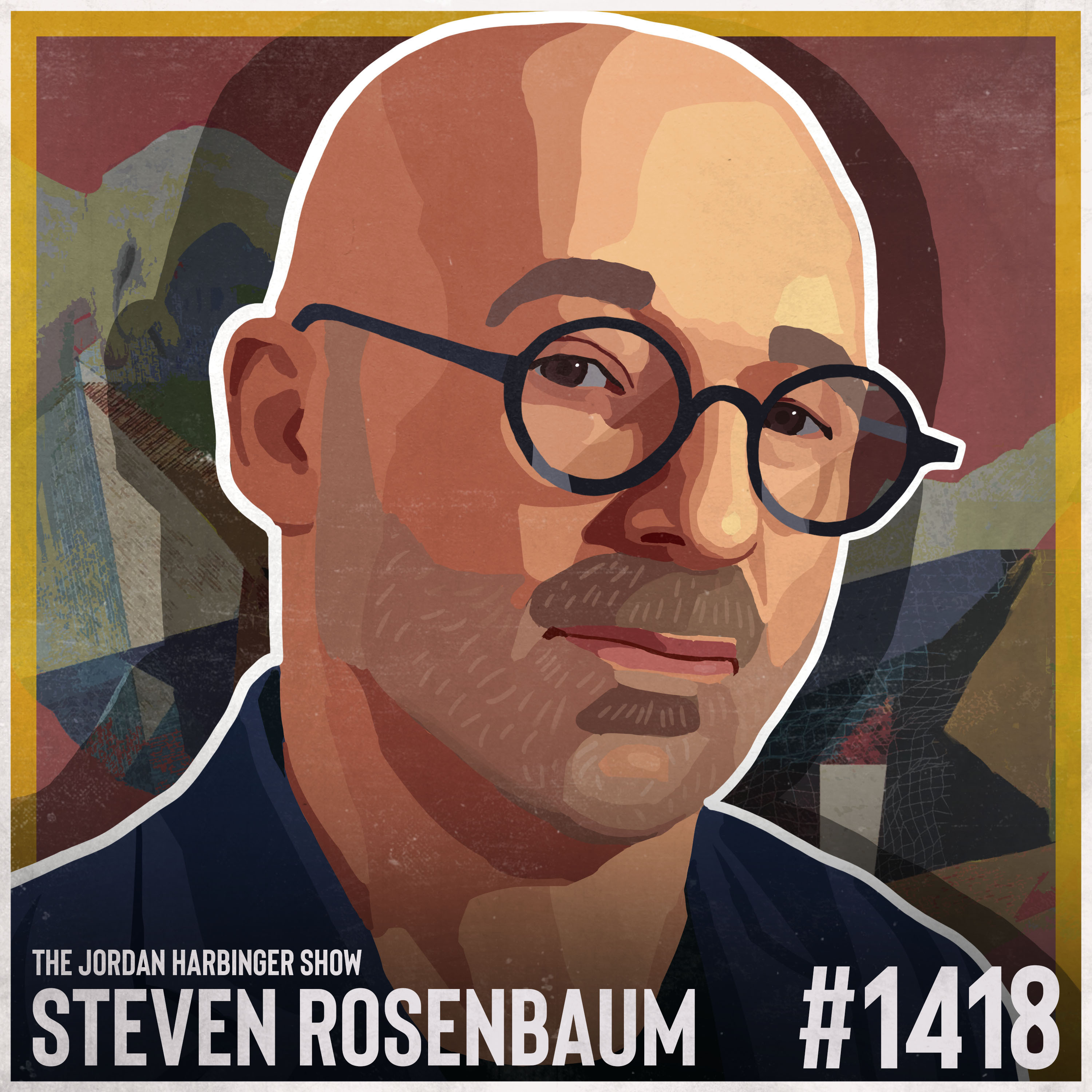
 The Jordan Harbinger Show
24 Nov 2026 · 1h 31m

 Add vo to ChatGPT or Claude to ask about everything you hear
vo listened to this episode to put together the overview and transcript, so there may be the odd mistake.
How AI blurs the line between “performance” and “truth,” reshaping trust, autonomy, and decision-making through convincing personalization, filter bubbles, and opaque algorithmic judgments. Rosenbaum argues society’s fragile shared standard of truth could unravel faster than expected.
Stephen (Steven) Rosenbaum is a media entrepreneur and author. He previously worked in show business (including magic/illusion and media production) and later became a podcaster and writer. His book The Future of Truth centers on correcting instances where AI/platform outputs were presented as real but weren’t.
AI systems can make fabricated or misleading content feel trustworthy because it’s confident and tailored to what you click. Personalized feeds can distort reality even when individual items are authentic. When consequential decisions (jobs, benefits, admissions) are made by systems people can’t inspect, errors and bias become unchallengeable. “Objective” machine outputs are not inherently objective; they’re shaped by data and incentives.
reality TV’s invented drama; “butter is dangerous” Soviet messaging as code for shortages; filter-bubble experiments comparing feeds; Amazon/algorithmic ranking burying desired items; AI-driven “agents” booking trips/actions without user choice; resume-screening systems that reward formatting tricks; and Rosenbaum’s experience correcting his own book after AI/quotes were wrong.
0:00This episode is sponsored in part by AT &T. Unwritten rules of holiday gifting. Number one, it's better to give than to receive, especially with iPhone 18 Pro for$0, plus savings on Apple Watch and iPad when you get all three at AT &T. Rule number two, when giving three Apple devices, keep a safe distance. Gratitude can get physical. Tis the season for more savings. Get iPhone 18 Pro for$0 with eligible trade-in, plus save on Apple Watch, SE3, and iPad when you get all three. requires trade-in of$230 or more, an eligible plan. Terms and restrictions apply. Subject to change. See AT &T.com slash iPhone for details.
0:36Whoever says saving money is hard doesn't know that new customers who bundle and save with Progressive save hundreds. Because switching your home and auto to Progressive is a better way to save than having to cut down on the things you love, like those morning iced lattes, one of your seven streaming services, and getting guac with your burrito bowl. So switch your home and auto insurance to Progressive and see if you could save without having to cut down on the things you love. Interested? Get your quote today at Progressive.com. Progressive Casualty Insurance Company affiliates and other insurers.
1:05Not available in all states. Coming up next on the Jordan Harbinger Show. So because they can keep testing, their ability to figure out whatever that thing is that you hang out and watch or click on, even though I'm aware of it, the robot says, okay, we're going to give Steve more of that. There is no doubt that part of why we live in such an increasingly separate world is because if we were to dig into the things you believe in and I believe in, my guess is we find a bunch of stuff that's totally an overlap. But the thing we should be worried about is if AI replaces this very fragile thing that we've had as a society called truth, it may unravel more quickly than we imagine.
1:48it.
1:53Welcome to the show. I'm Jordan Harbinger. On the Jordan Harbinger show, we decode the stories, secrets and skills of the world's most fascinating people. Our mission is to help you become a better informed, more critical thinker through long form conversations with a variety of amazing folks from spies to CEOs, athletes, authors, thinkers and performers, even the occasional Russian spy, music mogul or deep sea explorer. If you're new to the show or you want to tell your friends about the show, I suggest our episode starter packs. These are collections of some of our favorite episodes on topics like persuasion and negotiation, psychology and geopolitics, disinformation, China, North Korea, crime and cults, and more.
2:27That'll help new listeners get a taste of everything we do here on the show. Just visit jordanharbinger.com slash start or search for us in your Spotify app to get started. Today on the show, imagine writing a book about truth and artificial intelligence and then finding out that some of the quotations in your book just aren't real. That is a very specific way to have a very bad week. Today, media entrepreneur and author Stephen Rosenbaum joins us to talk about how AI is changing what we believe, what we choose, and how easily we can mistake a convincing performance for something trustworthy. His book is The Future of Truth, How AI Reshapes Reality, and his experience correcting it makes this conversation uncomfortably personal because it sounds right to me is a pretty low standard for evidence.
3:09Unfortunately, it's also a very popular one. Here we go with Stephen Rosenbaum. So finally, we're able to do this. I'm going to start off with your magic career. So at 14, you performed a sawing in half illusion with your friend Stacy at a talent show on the Long Beach Boardwalk. First of all, I'm impressed a 14-year-old kid can do this. I'm not saying anything about your magic skills, but I thought that would be hard enough that a 14-year-old maybe couldn't just buy this kit on the internet or, you know, from a mail order catalog and just do it. But I guess it's really a simple illusion, huh?
3:40No, I had a big magic show. You did? It was a traveling illusion show. Okay. I had five birds. I had a rabbit. Everyone else was like doing coins and cards. My fingers don't work that way. I was an illusionist. Doug Henning was my star, and I went to Broadway to see him, and I hung out at Tannen's Magic Store in Times Square, which is this legendary... Oh, yeah. I was a real magician. Sorry, this reminds me of Arrested Development where Job goes, they're illusions, Michael. Like, he doesn't want... I'm not a magician. I'm an illusionist. I'm an illusionist. You're 14. We're calling you a magician.
4:12It's an impressive trick, and also the shared understanding where the audience knows it's a performance. You're not really sawing a girl in half. But that shared understanding gives us kind of a clean opening into the world of deception. What did performing magic teach you about how easily people can be convinced by something they already know isn't real? So I loved every part of being a magician. I loved being on stage. I loved the top hat and the cape. I loved the birds. It was an agreement with the audience because they were there to be fooled and I was there to fool them. It was a different time, right?
4:47Kids were creeping around backstage trying to figure out how it was done. And there was no YouTube and there was no internet. So you would come up to me afterwards and say, hey, did you tell me how that's done? No, we had a pact. And if I were to tell you how it was done, I would be removed from the magic kingdom. When I was 15, I traveled on my own to Boston to the Society of American Magicians Convention and hung out, went to the fancy dinners, and remember thinking at the time, this is what I'm going to do for the rest of my life. I was going to be a magician, and I didn't imagine anything different than that until I started seeing the early days of media, both of which have M's, And I kind of transitioned to being a media maker, which, if you think about it, is really a version of the same thing.
5:39I made films. I ran my college radio station for four years. But all of it was some combination of showmanship, being able to dazzle people, and then also being able to tell stories. I can relate. I mean, look, I'm a podcaster. I became that way kind of by accident, I suppose. I get that feeling. But with magic, right, the audience agrees to be fooled. That's the whole point. In fact, you go to a show from Penn and Teller, right? They go, everything you're seeing is a trick. I'm not really shooting Teller in the face with this revolver. He's going to catch the bullet in his teeth, but it's a trick.
6:15It's fake. And it's like, but what happens when the same feeling of wonder comes from a tool, AI, that we're using to find out what's true. That's kind of not supposed to happen. We've just in the last year or two have crossed this line. And I go through this now all the time with people where they'll send me a video and they'll say, is this real? And my answer back to them is, how did it make you feel? And it's like, you know, the scene in the kennel where all the people line up on the bench and then the dog gets let out of its cage and it looks at each one and then it picks the old lady with the cane and everyone cheers and the dog goes up and licks her in the face.
6:53It's a great feeling. It's totally fake. It's fake. So we've blurred together the line between our permission to allow things to be fake and things to look so real that we assume they're true. Yeah, give me an everyday example where someone mistakes a good performance for good evidence. And besides podcasting, which is the example that comes to mind right off the bat. You have a lot of people believing everything that comes out of a podcaster's mouth because they think that they're funny or they like the savage way in which they deliver so-called honest news, right? Facts don't care about your feelings.
7:28I mean, that was one of those things that people started saying, and it's like, oh, it sounds so clever. And it's like, well, it doesn't mean you're actually correct about something. It's just a really clever way to body slam someone verbally. So I try not to do that on this show because while I'm giving a quote-unquote performance, I also don't want that to substitute for good evidence. If you go back in time, to me, the dividing line. So I did my first big television show, the one that broke out nationally at MTV. And I created a show at MTV called Unfiltered that was all shot by the audience.
8:01And we were very religious about, we don't tell people what to say. We don't go with the producer and say, you know, why don't you put the camera here? We handed people cameras and they told their stories. At the very same time, MTV was germinating and then launching a show called Real World. So I was literally in the room when reality TV got born. And I can tell you, because I've been in the room where it's made and made some shows that teetered near the edge of what is now reality TV, there's not a real thing about them. They are absolutely fake. So scripted and the drama is all invented. scripted, directed, can you give that to me again, but a little more emotion, just completely fictitious.
8:44The fact that we're now at a place where that's not even questioned, that's where we were before AI. People were making up stories long before computers even existed, but what specifically changes with AI? Is it the interactions? Is it the personalization? Is it the apparent authority, the confidence in which this not search engine tells you it's surfacing something that it found that's also correct? Or is it something else? No, it's all those things, but it's a moment in time. Things happen when they cross the road at the same time. People were so disillusioned with the state of politics, the state of affairs, that increasingly I think people said, I don't care what's real.
9:25I just want it to be real to me. MSNBC is fake. Fox News is fake. CNN is fake. They're all fake news, which is a phrase that I famously pontificated about how to eradicate fake news. I did a TED Talk that got a lot of views. And I will now say to your listeners, if they want to Google it, it is totally wrong. You're totally wrong. I mean, I was sure that we could, as a society, stand up for the fact that we needed. The fact that you talk about what it's like to be a podcaster and you say it on your show is incredibly authentic. And I appreciate that. Thanks. But there are lots of people who do the opposite.
10:04Well, yeah. I think about this a lot. My friends are like, what if you did it? And I'm like, no, no, no, don't. Just stop right there. I would be so rich if I just didn't care about what the audience heard from me. If I could just spew disinformation, misinformation, clickbait nonsense, we'd be having this conversation on my yacht right now. Why not? Of course. The number of people who do get-rich-quick videos go to the parking lot, stand in front of a Porsche they don't own, and talk about their car and hope the owner doesn't come out while they're recording. Exactly, yeah. You rent the boat, you rent the models, you take the picture, you leave.
10:38And I don't mean to sound old-fashioned because I don't think I am. But to me, we could be in a place now where we're talking about AI in terms of its power, but also being transparent about what is truth and what is truthiness. And one of the things I was surprised in what happened after the book came out was when I tried to talk about these platforms and their willingness to kind of shade the truth or make things up, nobody was interested in talking about it. Yeah, well, times have changed in the last, I don't know, eight months or whatever it was since you probably had any pushback on that.
11:16I mean, you were at TED. Gary Marcus was there. He's an AI researcher worried about unreliable systems. and Eliezer Yudkowsky, who I still am trying to get on the show here and there, but his fear is AI could destroy humanity. You all address the same audience. And Eliezer Yudkowsky is like, we should be sending nuclear strikes to data centers if AI gets out of control. I mean, he's really like, this is as dangerous or more dangerous than nukes. And I think it was today I saw in the New York Times, Bill Gates said something like, this makes nuclear weapons look like nothing. That's really scary from people who have seen everything computers have brought to us in the last 40 years.
11:51I mean, he's not a podcaster, right? He speaks with some authority on the subject. If you want to imagine what the meltdown could look like, take a little note card and a pencil and put it in your shirt pocket, starting when you wake up in the morning. And every time you touch a data center, put a little X mark on that card. And then when you're done, count how many times in the day you bought something from Amazon, paid your healthcare bill, paid a parking ticket. So if all that went away tomorrow, If one bad little AI robot decided to say, Jordan no longer has access to this data center, I'm just, by the second day, you'd be like, how do I buy groceries?
12:30Right. Yeah. Somebody was talking to me about this the other day. They're like, oh, we should just let China take Taiwan and take TSMC. And I'm thinking, no. And somebody else was like, well, we would destroy it. And I'm thinking, guys, if you want to go back to 1989 technology wise, yeah, we don't need places that manufacture these semiconductors. And it's not just the internet. It's like, do you like using anything? Like, do you like LED light bulbs? Because there's semiconductors in there that we can't just make by the gazillions anymore, right? This is a real problem. I like driverless cars.
13:01I'm not scared of them. I don't mind sitting in the back seat without a driver in the front seat. But the idea that one of these angry AI robots could decide to drive my driverless car into another driverless car, I do think about that. The scary part is it's not just not impossible. it's completely unpredictable and then there's nothing you can do about it by the time it shows up i had a guest on the show rob reed recently i love rock yeah so you know him so he was saying something like we went to lunch afterwards and he's like you know here's the thought experiment what would a super smart ai do if it existed but needed more power more data centers more infrastructure and it wasn't quite ready for prime time to do its thing where it takes over everything and he goes would it look exactly like everything does right now oh we don't have agi yet it still hallucinates and makes mistakes.
13:48Oh, we're still building out the infrastructure. Wouldn't it just sort of sit there and be as invisible as possible for as long as possible while we make crazy amounts of data centers and put crazy amounts of power, build more power infrastructure. So the thought experiment is basically like, what if it already exists? And by the way, if it does exist, if it comes online tomorrow, it's not gonna go, ta-da! It's gonna be like, oh, the smartest thing to do is sit here for as long as possible until someone discovers I'm here, then I make my move. or wait 10 years until the whole world has enough power for this.
14:19And I'm in every country that has electricity, right? It's like, well, that's what it would do if it were smart. So we just won't know. That was a kind of a terrifying thought experiment, right? Because the experts are like, we're just going to put it in certain things. And it's like, no, no, no, it's going to decide where it wants to go. And by the time it's in there, it's too late. And we're not going to know it's in there. It's like the hackers. Well, they're in our thermostats. Yeah. How'd you find out? Well, we've deconstructed one and we found that they're inside the power grid. They're not going to announce that they're going in.
14:46It's just going to go there and stay there and you're going to find it by accident one day, maybe when they decide to do something destructive. Jordan, we're sitting here today. We've not met in person. Right. And we're accepting that I'm really Steve Rosenbaum. Yes, exactly. And not AI. Right. And you're telling me you're really Jordan and not. But if you look at the latest round of these platforms, I mean, I could create BookBot Steve and say, go do podcasts all day, BookBot Steve. And some number of you would not know that. That's true. You know, people are like, well, just don't use M dashes.
15:21I'm like, really? Yeah, yeah, yeah. No, BookBot Steve has more hair and Robot Jordan is slightly better looking than me. Slightly. I have created an avatar and I have used it. I don't use it out on the internet. I don't use it in any public-facing way, partly because my wife got really angry with me. Really? Why? Because, first of all, she said, it doesn't look like you. I think it looks like a slightly handsomer version of me. Okay. She literally got angry and said, you can't be out talking about the dangers of AI and put this fake Steve thing into the universe, even if you label it fake Steve at the bottom of the screen.
15:56I don't know. It's a pretty good stunt, man. If you go back to Ted, you should just pull that. Just pull it. Hey, I got to come in remotely. And then it gives a speech, and then you walk out and you're like, Like, ta-da, I'm actually here. That was fake. That was entirely fake. Yeah. Yeah, I don't know. Will I have to credit you if I do that? Because it is a good idea. No, steal it, steal it. I don't care. Yeah, you can privately thank me and send me the link. But no, you don't have to credit me for that. So the book came out six months ago. And I was patient zero in this horrifically strange meltdown, which I went through kind of a series of steps.
16:28My first step was I take responsibility because my name's on the cover. Can't blame anybody else. My second was, but wait, no robot wrote, I mean, anyone who knows me for five minutes knows it's my book. I interviewed eight big name people in the book. I have the videos recorded of the, I mean, I had all this evidence that no one wanted to see that I had actually spent four and a half years writing the book. And that was of no interest to the universe. Let's get to this in a minute, because I feel like we're putting the cart before the horse. We'll leave people with a cliffhanger there. Sorry, sorry.
17:01I would love to speak about the filter bubble. You spoke with Eli Pariser, who warned about personalized online filter bubbles. And he makes this point that it seems obvious once you hear it. Most human behavior is pretty boring, so it gets edited out. What happens to our understanding of other people when they mostly see their most outrageous moments? So Eli and I go back a very long way. Our last filter bubble and my last book literally came out the same week. And so we were on the book circuit together. And I mostly disrespected him. I feel bad as I say that, but I thought he was wrong. My intellectual argument 11, 12 years ago now was we are already in our filter bubble.
17:46You read a certain newspaper, I read a certain newspaper, you listen to a certain radio station. We already have defined our intellectual worldview around our media consumption and that he was flagging something that couldn't get any worse. And to his credit, he didn't take the bait. We didn't bonk heads, but I was pretty sure he was wrong. And I had an opportunity before this interview, but a year or so earlier, to say to him in person, I owe you an apology because you literally said, canary in a coal mine, this is where we're going. And you laid it out with such clarity and precision. And I at least ignored you to my harm and detriment.
18:26and I now admire him tremendously for being that early. So this is like, I remember people talking about this, maybe his book was out then, but the filter bubble where, oh, your Facebook feed's different than my Facebook feed. Well, that's so weird. Well, not really. I know different people and they're posting different updates. No, but look at the news is different. And you're like, oh, that is really causing a problem. You know, my parents have their political beliefs and they're different and they see different things and I see different things than them. That's a real problem. I mean, now you have different things coming on Instagram, Facebook, Reddit, the news app that I use is showing me different things.
18:58The newspaper app, the New York Times app is showing me different things and it's showing other people because they know what I click on and actually read. I mean, it's almost like even when you don't intend to mislead someone, it can still distort reality. I mean, a feed can still distort reality, even if every individual, whatever video or article in it is real and authentic and not fabricated. So try this experiment. Go out with a couple of your buddies and have a beer. and when you're at the bar, say to them, listen, just for fun, hand me your phone. I want to look at your TikTok page and you can look at mine.
19:31I guarantee you they won't do it. Well, yeah, because it's going to be all 22-year-old girls on theirs, not mine, obviously. I don't use TikTok. It is so much worse than just filtering news or information. If someone were to be willing to show you their TikTok, it will show you things about them, interests of theirs, things they look at that will really disturb you. Coming out next week is the second edition of the Facebook film called The Social Reckoning. It's an Aaron Sorkin film, and a friend of mine is the lead character in the film. We had a conversation yesterday about this. These are companies that not only can they figure out the things that you find interesting, but they can amplify things to the point where you're like, everyone feels like I do about chocolate ice cream.
20:21The whole world hates chocolate ice cream. No, really, the AI that feeds Facebook has decided that they can tweak you by sending you chocolate ice cream videos. I find this all the time. I'll talk to somebody, and I'm shocked at the lack of media literacy where they go, well, look, the entire world is pretty much with me on X. It could be political. It could be an opinion on any sort of non-political thing. It could be an opinion about a country or about a people. And I go, do you really believe that? Yeah. Everything I see is about how, I don't know, Muslims, this or that. And I'm like, dude, that's because it knows what provokes you.
20:58It knows what you click on. It's not showing you the totality of all the news available. And it just happens to be a bunch of stuff that's based on this particular group that you already had a bias against or whatever it is, right? It's, there are people that don't understand this. Therefore they become reinforces their bias. and I've heard this about Jews and stuff. Oh, everyone now hates you. And it's like, no, you just click on anti-Semitic shit, man. Maybe that's a you thing. The thing about it that I find so deeply troubling is it takes the things about us as humans, young women and body image.
21:33I remember being a 15-year-old boy and I remember how confusing a time it was. Am I this? Am I that? So their ability to figure out, because they can keep testing, We'll send him wait videos. We'll send him, and whatever that thing is that you hang out and watch or click on, the robot says, okay, we're going to give Steve more of that. And even though I'm aware of it, I mean, there is no doubt that part of why we live in such an increasingly separate world is because if we were to dig into the things you believe in and I believe in, my guess is we find a bunch of stuff that's totally an overlap, and then there'd be something.
22:13So I'll give you a perfect example. I don't play golf. If I say in a room full of business people, I don't play golf, some non-zero number of them go, oh, you're a non-golfer. And they just step away just a little bit. I'm like, sorry, I could pretend I play golf. I tried twice. Hated it a long time ago. Hated everything about it. Hated the carts. Hated having to carry the shit. Hated the no phones. Hated it. The out group, right? You become a part of the out group. By the way, are you a golfer by any chance? I am not a golfer, no, so I couldn't care less if you don't play golf. The thing that I think we should be worried about, and this is where truth comes into the conversation, societies are always collections of people that have certain foods they like.
22:57There are certain spicy foods I don't like that my friends do. It doesn't make me not like them as people. But I think I worry that if AI replaces this very fragile thing that we've had as a society called truth, it may unravel more quickly than we imagine. Reality TV gave us a head start on believing things that were made up for our entertainment. Now let's hear from some people who are refreshingly upfront about trying to sell us something. We'll be right back. This episode is sponsored in part by Aura Frames. Our Aura Frame is hands down one of our favorite things in the house. It sits on our kitchen counter.
23:35We'll be in the middle of doing something. A photo rotates by and suddenly we're both standing there laughing. You know, remember that? Because we've got thousands of photos on our phones that I never would look at otherwise. Aura actually gets those pictures back into our day. It's a beautiful digital frame that rotates through our photos. So now we're seeing those moments we'd completely forgotten about. And some of the best ones are just ordinary days. Nothing you would have thought to print or whatever. But you see it and you're like, oh, I love that picture. It's like Juniper's first potty trained pee, literally.
24:01We love ours so much that we give Aura Frames as gifts every year. You can even preload photos before it ships because it's, you know, a cloud thing. So that's pretty cool. So when they open it, you've already given them something to smile about, not just an instruction manual that's too confusing for grandma. So life is amazing. Remember that with Aura Frames. Aura is the number one digital frame loved by millions of families. And their Black Friday Cyber Monday deal is the best of the year. For a limited time, visit AuraFrames.com and get up to$50 off select frames plus an additional$5 off your order with promo code Jordan.
24:32That's A-U-R-A frames.com, promo code Jordan. And please support the show by mentioning us at checkout. Terms and conditions apply. This episode is also sponsored in part by BetterHelp. Someone replies okay to your text and now you're analyzing and overanalyzing the reply. Are they annoyed? Now you're scrolling through old messages. Meanwhile, they probably just answered while unloading the dishwasher. If I could delete one thing from my brain, that habit of filling in the blanks with the worst possible explanation would be on the list. And during the holidays, there's a lot of blanks to fill.
25:00Family group text, changing plans, somebody who hasn't answered about dinner. It's exhausting when every little thing feels like something you need to figure out. Therapy can help you examine those assumptions and how they affect you. BetterHelp therapists are licensed, experienced professionals with at least three years and 1 ,000 hours of hands-on experience. And if your therapist doesn't feel like the right fit, you can switch at any time. BetterHelp is now in network with more than 125 health plans with many co-pays as low as$15 for eligible members. And if you don't have eligible insurance or you live outside the U.S., you can still get 20 % off your first month.
25:31Sign up and get 20 % off at betterhelp.com slash Jordan. That's better, H-E-L-P dot com slash Jordan. Using our promo code doesn't just get you a discount. It helps out the show as well. So if you decide to sign up or buy anything from the show, please do use our codes. They're all on the deals page at jordanharbinger.com slash deals to double win. You get a great deal and you help keep the show thriving. Thank you for your support. Now, back to Steven Rosenbaum. There's an interesting anecdote in the book. Esther Dyson, she's a tech investor, a former journalist you interviewed. She tells a story about a Soviet journalist who saw government warnings about butter and then immediately went out to buy butter.
26:09So explain that. What did this journalist know that an ordinary reader might miss? So just to put Esther in perspective, Esther is maybe the smartest person I've ever met. I've known her for a very long time. She's brilliant. She's a tech organizer. She knows everybody. She's a great big, larger than life, and comes from a family of geniuses. So when we sat down to talk, she literally said, well, when I was in Russia, and I was like, all right, we're going to start there. And her point was that the Russians understood in a way we don't as Americans that what the government says isn't true, but is literally meant to be some kind of a manufactured version of what they.
26:54So when they say butter is dangerous, that's code for we have a shortage of butter. I see. So they say butter's dangerous. And then when people go to the store, one, they don't want to buy it because it's dangerous. And two, if there isn't any, it can be, well, the government took it away because it's dangerous. Not this government doesn't function. They can't even get us butter. Ironically, at not exactly the same time, but not unlike the same time, I was in Russia. My senior year in college, I spent six weeks studying journalism in Russia. What year was this? Sorry to put a timestamp on you in Asia.
27:29Yeah, no, it's quite all right. 83. Wow, you went to Russia in 83. That must have been super cool. It was fascinating. Wow. I met a journalist from Pravda, and we ended up going back to his house, and we got a bottle of vodka and sat on the street and drank. In the road? Yeah, on the sidewalk. Okay. And he said to me, I'll never forget it. He said, you Americans, you believe in truth. we Russians, we read between the lines. And it was a badge of courage to him that his cynicism of society and government and information made him wiser. And I remember thinking that he was wrong at the time and that we had more trustworthy journalism than he did.
28:18And now I look back on that and I'm like, he might have been right. He might have been right. Yeah, he might have had a point. Yeah. As a result, I went back to the United States, went directly to my college radio station, and unplugged the Associated Press newswire printing machine, whatever it was called, teletyped, and said to my fellow senior journalists, we're going to write the news without a wire service for a couple of months. And they did not like that. I, in fact, wrote about it some years later as unplugging the truth machine because went click, click, click, click. This, Justin, you could rip the paper off and run to a microphone and you felt very authoritative, but you didn't do any work.
29:02Right. You were just a mouthpiece. You're just a mouthpiece. Exactly. So that person, the journalist with the butter, that person learned to read the motive behind the message. But how do we do that without sliding into, because right now people are going, yeah, whatever the authorities say, the opposite has to be true. I mean, we saw this during, well, it started really a lot more during COVID. And now you see that all the time. Well, the government says this, so really the opposite must be happening. That's equally bad thinking. I'm happy to say that I did not misrepresent that I would come on this podcast with you and have answers to some of those questions, because I think you're right to make it the problem, but I'll be damned if I know what the answer is.
29:40I see. I see. I don't think it's AI, though. No, no, no, of course. I just think it's interesting that we really love to be binary, like one thing or another. Either everything they say is mostly accurate or everything they say is almost entirely inaccurate. It's really hard for people, just all humans, myself included, to go, some of this is true and some of it isn't. And I don't know what it is. And I just have to get comfortable with that uncertainty. That's the hard part for me. And so, for example, you're driving down the road. It's two in the morning. You know the neighborhood really well.
30:13the traffic light in front of you is red. Now, do you make a judgment and say, you know, I know it's red, but it is two in the morning and there's nobody on this street. I'm just going to blow through it. Odds are you can do that and be safe. Yeah. Except the one out of 20 times when there's a car coming in the other direction and you die or they die or you both die. And society has always had certain kinds of rules, the traffic light being one of them, that even though logically we could probably take our odds and blow through it, we stop even at 2 in the morning. Now, maybe we stop and look both ways and then duck through it, but we don't just blow through it because even though the risk of dying is relatively small, it's not zero.
30:57When everything is up for grabs and you've got to feed your kids and you've got to pay rent and you've got to go to work and you've got all these other things you have to do. I was on a panel the other day at the UN, and they asked me as the last question, what's the one thing you would ask people to do? And I said, without skipping a beat, not shrug your shoulders. Not shrug your shoulders? Not be like, whatever. Nothing we can do. Yeah, I see what you mean. Don't opt out of being part of the complicated problem. You don't have to tell the world all your feelings, but make sure that you have them.
31:33The book discusses looking at why a platform is showing us a particular piece of content. So what can that explanation reveal? How do we even approach this? Give us an example. Because if I'm looking at Instagram and it shows me a video of somebody blowing up a stump or a manhole and it shoots way up in the air, the explanation reveals that I like watching things blow up and they're right about that. It's kind of interesting, right? It appeals to the kid in me. What can't it tell us about whether the content itself is true? First of all, I think we would have been friends if we were both 15 at the same time.
32:06I think so. Yeah. And gone to jail. I like blowing things up as well. I was a huge fan of SD model rockets. I have one right here just out of frame. I love them very much. And I think it was an excuse for 15-year-olds to be able to buy explosives. For sure, yeah. Now there's video cameras on them. Those are fun. I think I would answer a slightly different question. For TikTok or Instagram to be able to offer you as a user four little tabs along the top of the screen. news, entertainment, music, sports, and for you to be able to switch the channel would be technologically unbelievably simple. So why don't they do that?
32:48Why do they say, we're going to be a feed and we're going to mix together news, sports, pretty girls, rocket ships, scary terrorist videos in whatever stew of information we choose to send you, and your choice is to turn it off, which you don't really want to do and might be a little addicted to it. The first company that gives me back as a user some choice is going to find that there's an enormous need that wasn't being served. But I worry that no one will do it. Yeah, I think you're probably right about that. Look, I want to bring some of this into ordinary life as well. Your book also looks at algorithms judging job applicants, students, benefit recipients.
33:34What happens when a system measures something convenient like, I don't know, facial expressions or a pattern and a log and then treats that as proof of something much bigger like honesty or competence? Because we're already there if we're not, maybe we're just headed there, but it seems like we're already there. I know that there are AI algorithms and bots that look over resumes and go, there's a whole bunch of stuff in here that says this person's more competent, not just where they went to school or their experience. I'm sure it's even looking at the way the thing is formatted. I mean, there's all kinds of little things like that.
34:06But if a consequential decision about me comes from a system that I can't inspect, that nobody can inspect, actually, what information should I be asking for? Can I get a meaningful human review of any kind? And what would that involve? So I've been on both sides of that equation. So I ran a film and television production company in New York for a lot of years. And as we got more famous, I needed to hire more people. We got more and more resumes. And I can tell you on the short list of depressing things in life is coming into work on a Tuesday morning and having to go through 500 resumes. It's mind-numbing.
34:47And you end up making bad judgments. You pick people that went to the same school as you or that send you certain signals that feel familiar to you. So you make bad decisions, but you also, if you're lucky, are susceptible to some surprises. And some of the best hires I made in my career were people that on paper were just not equipped for the job. But the resume or the cover letter was just good enough to bring them in for an interview. And I had a rule, I did 15-minute interviews because that was all I could possibly tolerate. And I hired some people that by any mathematical measure would have been a no, would have been an instant no.
35:29And they turned out to be incredibly talented television producers or production assistants. So when along comes the internet and makes it push button easy to apply, and you go from 500 resumes to 5 ,000 resumes or 500 ,000 resumes. The only choice is to put on the other side of that flood of crappy applicants an AI or a technology which has become AI. And so you're right. I mean, you can game the system by knowing, for example, you can find a website that you can feed your resume into and it will tell you what the computer sees. As a perfect example of that is I'm a visual person. So I would look at my resume and I'd want it to be beautiful with columns and boxes and font.
36:15And what the system will tell you is the computer doesn't see any of that. It doesn't see any of the aesthetics. So literally you make the page full of text, make it chock full of text, and they'll tell you, take all that pretty crap out, that human language crap out, and just put in data that will make the computer love you. I'm not able to do that personally. It makes my skin crawl. But the answer to your question is, we're now at a place where almost anything critical is being reviewed by AI. You were getting to this kind of in the underlying question of your question, which is, can you see when it makes mistakes?
36:54And the answer is no, you can't. Maybe in the people that are washing out once you hire them. Right. You come up with another rule. Yeah. I, for example, react emotionally after every interaction now, salesperson, whatever. They say, would you mind giving us a vote? Just three questions, you know. And the questions are always like, great service, mediocre service. And what I know, because I know the technology is, all they're looking is for someone to fire. Oh, is that right? Because I have noticed that recently in the last six months or maybe even less, I'll go to Micro Center and buy a hard drive and they're like, hey, would you mind writing a review and mentioning my name in it?
37:33I'm thinking, you're a cashier at Micro Center. I mean, thanks for checking me out. And they were like, I remember saying, Aaron, does that really matter? Do you get a bonus or something? They go, no, no, no. It's just my boss told me it's really important. And I'm thinking, it can't be that important. But then a couple of weeks later, they're still doing it. And I'm thinking this poor guy has been here for months and he's still begging everybody to mention his name in a review. It's like, bro, you scanned it well. And then you pushed enter on the computer and my credit card build, that makes so much more sense.
38:01Right. Aaron got the least amount of mentions in reviews this quarter, and we need one less cashier. Bye, Aaron. And when you fire Aaron and you push that button, you don't feel guilty because the machine told me to do it. The machine told me to do it. The book talks about this. There is this weird human thing, which is if it comes from something that's driven by data, it must seem somehow objective. And the answer is no, not at all. In fact, the opposite. it. Man, that's a really good point. That's something for us to chew on, right? It's not necessarily objective. And I think, but it's dressed in objective clothing because it comes straight from the machine and it's very confident.
38:37In the book, you imagine telling an AI to organize a trip. This is huge right now. The agents, it books a flight, it chooses a hotel, it rearranges your calendar. I mean, you can do all this already. What changes? Because right now, the way I use AI is I go, give me a bunch of choices based on hotels in the, I don't know, Palmdale area. And And then it shows me, you'll probably like this because it has an outdoor pool on the roof and the food is good in the restaurant. And sometimes you eat at the hotel, you know, because you're in a hurry. That's fine. But what happens when the system stops giving me suggestions?
39:09And I just, because eventually I'm going to go, wow, this thing knows me so well. You just book it. I'm just going to show up. It starts taking actions in my name. What changes other than I'm putting in, I don't even know. I'm not even putting in less of myself. I'm putting in none of myself. It already knows me. It's like my wife. I booked you this thing. You'll like it. Maybe. I'm resisting that, but I know that day is going to come because it's like, why am I choosing a hotel? It's always choosing and it's always fine. So things are moving really fast. The fact that you're even asking those questions puts you in the top one percentile of people participating.
39:40Really? Wow. Right now, it is performing extraordinarily well. Right now, it is giving really good advice that's not exactly objective, but based on a combination of what you've done in the past and what it knows about what you like. And what's going to change in three minutes is people are going to pay those systems to be pushed up the recommendation scale. Okay. So when Hyatt says, if it's a choice between Hyatt or Marriott, here's an extra five bucks if you put me above the other guy. When you have three choices and you can look at Hyatt, Marriott, Hilton, one other, okay, you still pick the one where you've got membership miles or whatever.
40:22But whatever it puts below the fold is invisible. And the best example of this is if you try and buy something on Amazon and you say, I want a pair of shoes this size, this size. And you look and it's got 10 ,000 pairs of shoes that fit that perimeter. And it's shown you five. Well, if the one that you really want is 500 down the stack, can you make the search term more specific so that it moves it up? are you going to click just randomly 500 pages into the results? Sometimes I do that. Wow. I mean, Amazon has so many choices for this hinge you're looking for, this plumbing supplier, whatever.
41:05What's really sexy is when it puts that little tab that says most popular or best selling. Overall choice. Yeah, exactly. Yeah. Other people must know something. But we really are handing over some autonomy when we start letting the robots tell us what we like. It's going to be even worse than that with agents though, right? Because they're not going to go, all right, he searched on Amazon and we showed him this and then he clicked Prime only. So that limited some of our options. And then we put the sponsored ones on top, but then he scrolled past those and he found the one with the most reviews.
41:43But then that one was also sponsored in another thing. So he figured out that those reviews were also maybe because it was sponsored and other of people bought it. So then we put overall pick, but he didn't like that one either. But eventually, none of that's going to matter because I'm going to say, find me a pair of shoes. You already know my size. I'm going to use them in the gym, but I'm also going to walk and it's going to go ordered and I'm going to go fine. I can always return them if I don't like them. And then they're going to show up and I'm never going to know that the company paid for that to be the first result.
42:10It's never going to occur to me. Look, for shoes, maybe, but for other stuff, it's never going to cross my mind that I didn't choose this or that. It didn't choose the best thing for me. It chose the thing that gave it the best sales commission. Most people, including myself, are, if we ever know it, are going to forget about it or just not care eventually. And, you know, you're a human, so I'm going to take you off the hook just a little bit here. It's also exhausting. Give you an example. The refrigerator in my kitchen has put in 26 years of trustworthy service. You've had the same fridge for 26 years?
42:4326 years. Wow. So two days ago, I put my hand in to get the milk out. And I said, it feels a little warm in here. Uh-huh. And the freezer was still cold. So I went, whatever. It took me about half a day to figure out that the fridge was failing. Yes. So I said, you know what? I'm going to hire a repair guy to come and tell me what's wrong with the fridge. I went online, spent about 20 minutes, made four or five phone calls. Every one of those calls ended up in the same boiler room answering service. and it was clear to me that they wanted to charge me just enough money for the service call to get in the room so that they could then tell me, well, you really need a new blower and you need some new cooling.
43:24I was gambling that the scam was 500 bucks, but there was no way around it. There was no one in my neighborhood. There was no one that would come just look at the fridge. I'm happy to pay them. I just didn't want to be ripped off. So you know what I did? I know exactly what you did, but you tell me anyway. I bought a new fridge. Oh, I thought you were going to say you asked Chad GPT instead and it told you to buy a new fridge. I was close. Because what I figured out was after 26 years, even if I fixed it this time for 200 bucks. Right. I was right on the edge of its natural life or probably. For sure.
43:55So I bought a new fridge, ordered it. It came. Old fridge went away. But like that feeling of knowing you're going to be scammed. I haven't felt that in a long time. And it felt icky. You live in New York and you haven't felt like that for a long time? That's impressive. I have a fairly strong constitution about not being scammed. Yeah, yeah. Well, good for you. I tend to agree, but I don't live in the city anymore. Tell me, does your new fridge, has it got Wi-Fi? Does it have a little screen on the front? You don't seem like the type. No, but it does have an ice maker, so there is that. Well, yeah, okay.
44:26I feel like that's a forgivable luxury in the age of smart appliances. I don't understand Wi-Fi's on dryers or washing machines or fridges. I just, I don't need to talk to it. It doesn't need to talk to me. I'm totally good not having a relationship with my appliances. Apparently, reading something confidently into a microphone doesn't automatically make it journalism. Devastating news for my entire industry. We'll be right back.
44:52This episode is also sponsored by Paka. Jen accidentally put my favorite Paka sweater through a hot wash and then a hot dryer with crayons our son had left in the pocket. So it came out much smaller and covered in melted crayon. I was pretty upset about that. I immediately ordered the exact same sweater. No shopping around. When you find something you love and you're wearing that much, you just replace it. Jen is no longer allowed to touch that one. It just gets delicately rinsed in the sink. We're also checking pockets like airport security. Actually, maybe a little better because I don't know about you, but I've accidentally brought some crazy stuff through airport security.
45:20Paca makes outdoor and everyday apparel from alpaca fiber. Their best-selling hoodie is softer than cashmere, warmer than wool, breathable. It's thermoregulating, so it helps keep you comfortable as temperatures change, and it's naturally odor-resistant. so maybe I just won't wash it ever again. Problem solved. That's what you want and something you're going to reach for constantly. Comfort works for an ordinary day, whether you're hanging out at home, traveling, heading outside. Each one is made start to finish in Peru, features an Inca ID hand-woven by artisans, connecting what you wear to generations of craftsmanship.
45:48But here's my real endorsement. I never travel without my Paka. I immediately order a new one if I ever lose one, which happens kind of disappointingly often due to my brain malfunctioning. So if you're looking for your next go-to hoodie, check out Paka. To grab your Paka hoodie, go to www.pakaapparel.com. That's www.pakaapparel.com.
46:31like a person who's traveled before, and it rolls very smoothly. The whole thing feels solid. They've got great colors. We loved using ours. There's also a front laptop pocket with a built-in charging port. These are practical features you appreciate when you're moving through an airport. Somebody actually thought about what you're doing with your hands instead of just giving you another compartment to lose things in. If you travel, you know how much those little conveniences can add up. Upgrade to luggage that looks better, lasts longer, travels smarter. For a limited time, Noble is having the biggest sale of the year.
46:57Head to nobletravel.com for up to 67 % off your entire order. That's n-o-b-l travel.com for up to 67 % off. After your purchase, they will ask where you heard about them. Please support our show and tell them the Jordan Harbinger Show sent you. If you like this episode of the show, I invite you to do what other smart and considerate listeners do. Take a moment, support the sponsors. They make the show possible. And those sponsors are all searchable and clickable at jordanharbinger.com slash deals. Thank you for supporting those who support the show. Now, back to Steven Rosenbaum. The idea that recommendations will not actually be the best thing for you, but will actually have a hidden agenda and it will happen with everything, that worries me quite a bit.
47:42Because like you said earlier, we didn't really jump down this particular branch, but you said when the machine tells you what to like, but you won't actually realize that that's happening. You'll think, no, no, no, this picked based on things that I like. No, it's just telling you what to like. That's the difference. It's actually telling you what the best thing is. And it turns out that that's not true, but you don't know because it didn't give you alternatives. The agent did the thing that you told it to do, kind of, but it did it with its best interest or the parent company's best interest in mind, not really your own.
48:16That scares me. It's the loss of human autonomy. And part of what I try to remind myself of, I live in New York. So, you know, I can walk a block in any direction and be at a different dry cleaner, a different deli, a different restaurants, bookstores. I have lots of choice within walking distance of my apartment. But if I live in the Midwest and I live in the country and it's a drive to go to Walmart or Kmart or one of these big box stores, you know, I was in one the other day and I was thinking about how staggeringly overwhelmed. I hadn't been in a great big box store in a long time. New York, not overwhelming.
48:52Big box store, overwhelming. I think until three months, six months ago, it felt like AI was going to drive choice and judgment assistance. And now it feels to me like it's about taking away choice and judgment assistance. And that happened very fast. Very fast. And look, some people are saying, look, you Luddites, we delegate to human assistance all the time. We let software filter spam emails and process payments. Stephen, what makes some kinds of delegation reasonable and other kinds of delegation reckless or irresponsible? I think as a human, choice is part of the fun of life. I mean, I'm old enough to not have experienced dating apps.
49:39And my wife and I met when I was in college. And we started going out and very quickly we fell in love and we were living together. And then we got married, had kids. I feel bad for people that are in their 20s today because I worry that what dating apps do is send you people based on specifications that you might or might actually like or dislike. But when they say to you, how tall, what color hair, very simplistic kind of surfacy judgments. Right, stuff that doesn't actually matter in the scheme of things. You know, my wife and I have started five companies together. So part of what makes us so successful as a team is how different we are.
50:24Right. But if you'd checked redhead on some box somewhere, you never would have met, potentially. I don't know what color your wife's hair is. Brunette. But yes. So I worry that when we let software replace human-y things, I don't know, there's a certain chemistry here. And it's not as simple as she likes the Mets and I like the Mets or something mechanical like that. Now, to be fair, I have two friends that built and sold great big dating companies. And they claim that it's much more sophisticated than that. I just don't understand how their software worked. But I don't think so. If you told the algorithm, my favorite hotel is Hyatt, my second favorite hotel is Marriott, and my third favorite hotel is Holiday Inn, go shop for me, I'm traveling tomorrow.
51:11You would never end up in a funky little boutique hotel or there'd be no adventure part because how would it know, are you up for an adventure? No, I just need a damn hotel. Right, right, and I have memberships in two of them. Pick one of those. That's happening as we speak. And I think it makes both life and the world around you less interesting. And so if you're on a flight and the flight gets canceled and you end up landing either in another airport or you have a, I mean, the only reason why I've ever had Belgian waffles is because I had a layover in an airport that had Belgian waffles in Belgium.
51:51That's as far out of Belgium as I've ever gotten. I think the companies controlling these AI algorithms, they've borrowed an enormous amount of money. And having raised venture capital in my life, I can tell you one thing. You eventually have to pay it back. Yeah. And they prefer it back at a 10x return. Thank you very much. So at a 10x return, you know that advertising is coming to these AIs. It was interesting to watch OpenAI dabble in creating fictional video for like a second. And it was so unpopular and so unsuccessful that they ran from it, scrubbed it off the website. I remember that Sora.
52:30Oh my God, it's amazing. People used it. And then it was like, no, it's gone. Gone. The app's gone. You can't do it. It doesn't work. It was also creepy. It was creepy. It was creepy. I made videos with myself and other friends because they were like, you got to test this. it was just like, ooh, I don't love this. It looks like a cheesy commercial starring a Joe Roganized version of me. Like you said, it doesn't look like me and everyone else is like, oh, it totally looks like you. Totally. It looks like, ugh. I don't know. Creepy. Not really. Yeah, creepy. It's a creepy version of me. Now, what I don't know is whether or not things are moving so fast that if you took Sora and re-released it today, six months after its brief launch and then...
53:08Hiatus. Whether, like, now it would be less creepy. I don't know. It may be. You know damn well they're still working on it, right? Somewhere they're working on make this better, make it less creepy, make it able to be longer, use less compute or whatever it is. They're just going to try again in a year with a different sort of excuse to debut the video because that's one of the major, major things. look, it's not to make fake videos of stuff. It's to show videos where maybe it's to improve an existing video. Look, you did this, but the lighting was off. Just throw the video in there and we'll change it and we'll restore this old video that's from the 80s of you and your kids.
53:42It's gonna be great. People would love that, right? So they're probably testing a hundred variations of that kind of thing. And then eventually the Overton window will shift to where we go, you know, I don't just wanna restore video. I actually do wanna make fake video, but not for nefarious purposes. just for fun. I'll give you a perfect example. There's a camera system now that's shooting football games and you can put this camera system on the field and it will replicate every angle that the camera isn't at so that you can say, I can be in the sky, I can be on the field, I can be... And my reaction is, so at the point at which what's happening on the field may be real or may be an AI recreation of what is real, then maybe sports isn't fun anymore.
54:28Maybe it's a video game. Right. We don't really need the humans to play it anymore. Yeah. Or the weird things that happen when humans throw balls in the air and run into each other and, you know, have personality conflicts on the field and all that stuff. I mean, I think there's a flattening. And I will tell you that for me, as the world's become more digital, I go to more live events. Yeah. I was going to say the pushback is do more things live because that's where it's actually interesting and real. It's what I do. Found a great new bar with a jazz club in the basement six weeks ago. Been there a couple times.
55:01Really enjoy it. Look, when it comes to information sources, right, fake video, fake information, everyone just says check the sources. But normal people have jobs. They get kids. Back to your point about the Amazon thing. You're a human. Why is it your job? You're not going to sift through this. You're going to want the lightest look. Which claims deserve the most verification? And when is the sensible response to simply not act on something or not share something? I'll ask a slightly different question than the one you asked. I love this interview. I ask you a question, you go, nah, and then you answer a different question.
55:30You know what, though? It's fair. It's fine. I'm just to get you talking. I'm just playing with you. I don't think many things you can verify anymore. Okay. People wag their finger at me and say, you should have checked Google. And I'm like, have you been to Google lately? Right now, AI is at the top box and then the organic search is below that. How long before they just say, you know what? We're not offering that anymore. we're just going to offer AI because six months, 30 days, two years. Yeah. Well, you can always click on the sources if you want to by clicking the sidebar and filtering down and highlighting the thing and then pushing that no one's doing that, right?
56:02That's for like academics who need a bibliography. You know, damn well, y 'all are just reading the AI summary and that's the end. I don't know anybody right now, and I'm sure they are. We're going to get emails about this, but very few people are clicking the first eight sources like I used to do, right? I used to prepare for a show. Google, Steve Rosenbaum, certain company think tank, make sure I got the right Steve Rosenbaum. All right. 1, 2, 3, 4, 5, 6, 7, 8, 9, 10, 15, maybe if I'm really going after it. Second page of Google, those results are dead to me. I'm never going to see them. I'm reading all those.
56:31I'm taking notes on all those. Those days are over for the most part, right? I might read the first few three or watch the first interview or just because I'm doing this as a professional. You could be forgiven for not watching four hours from somebody whose book you're about to buy. No, thanks. I'll read the AI summary, and that decides whether or not I'm going to pick up the book. About once a day, I get a phone call from someone and they say, can I tell you about the service that we provide to people that run spinal surgery centers? Which you do not do. I say very nicely because I like salespeople and don't want to be harsh on them.
57:04You bought a shitty list. Yeah. There is a spinal surgeon named Steve Rosenbaum. He's not me. Tell your boss to pony up and buy a better list and call me with something I actually am interested in and I won't hang up on you and then I hang up. Right. So in your case, when you do the research, one out of every some number of times, 10, you say to somebody, so Steve, it's been great. It's funny. You were a magician and then you were a spinal surgeon. And I say, no, I wasn't, Joe. Has that happened to you? No, but I'm just saying like, not yet. If that happened to you in a recorded interview, you'd say, oh, I'm so sorry.
57:38I put together the research. You'd take it out and we'd do the open again. No. Yes. It's not like a car accident if you get a squib of bad information in writing your intro. So it saved you three hours, four hours, and your skill is in your interview style. And so AI giving you moderately bad information every now and then is not a game changer for you. Yeah, I still like to do some things in the old school way, like actually read the book, but it is tempting to go, I don't really have time for this. I'm not going to do it. But the problem is I do have enough exposure to podcast hosts and journalists that clearly didn't read the book.
58:15And I go, that was some substandard work. And the reason it happened is because you don't actually know anything you're talking about and you're reading from a page. So I don't want to appear like that. I'm fear driven, right? I don't want to look like a hack any more than I already do. So we're still putting in the work for now. So not to be Debbie Downer, but the only thing I worry about, so I write a lot. I write every day. I publish every day. Every morning, I'm like, I have to have something for today, and I've either written it the night before. Increasingly, I'm feeling like my content is being overwhelmed by the sheer volume.
58:52I feel like I have to manufacture more, more versions, more clips, more. And the one thing that I worry about is the fake Jordan, or somebody that is your assessable to your competitor, if they're the robot version of some version like you, they can publish 150 videos to your 10. And the algorithm on the platforms says, we don't care where it comes from. Amazon doesn't care whether it's putting up one Steve Rosenbaum book or a thousand Steve Rosenbaum-like books, hopefully not with my name on them. But at the end of the day, their math is really simple. They can sell one book from me or a hundred books from someone who's kind of like me, but a robot and they get paid either way.
59:36This is actually one major reason. And I won't go too deep into this, why I don't care about YouTube. I don't use TikTok. I post some stuff on Instagram as long as it's being created by a team that includes it for free. I outsourced all of that. And I do a rev share with those people, because if I focus on clicks, my job becomes AI expert says we're all going to die tomorrow. And then there's a thousand clips being made of different variations of that from, like you said, different angles where our foreheads are slightly different versions of shiny, right? And the skin tones are slightly different.
1:00:11That's stupid. That's a stupid job. And it belongs with a robot because it's a dumb effing thing to be obsessed with creating. So all I do is the audio, I record the video and I send it somewhere else and it's their problem because the second you start optimizing for YouTube clicks, your show is dead. The whole podcast landscape is littered with people who used to care about science, truth, interesting journalism, and stories. And now they just have, here's an actress that hasn't worked in 10 years, but is still kind of hot. More videos tomorrow. That's what they're doing because that's what gets clicks.
1:00:46And if you talk to them, you get a whiskey in them. They're like, I hate what I do now. And I'm like, what happened to you? 2015, we were sitting here talking about brain machine interfaces. And now look at the garbage you're working on. Yeah, I hate it, but it makes more money. No thanks. Not enough money in the world, man. I totally agree. Both of us have taken journeys in our life and my kids are like, did you have a career plan? I'm like, no, I didn't have a career plan. Yeah, right. The world changed. I changed. There's new stuff. I'm doing new stuff tomorrow. The thing that I don't know the answer to, but I think everyone in the content space should be concerned about, not worried, but just aware of, I'm a member of the Writers Guild, and they now have a written-by-human seal that you can get if you sign some commitments.
1:01:34I think we're all a little worried that readers or viewers... Might actually not care. Yeah, of course. I also think about that a lot. Eventually, they're not going to. And there are certain types of podcasts where even I will listen to the AI do it. I'll dump documents into what is it called? Notebook LM from Google. And I'll say, I don't want to read all of this, but I do want to understand it. Turn it into a podcast. My friend has a complicated litigation going on with Amazon. He sent me all the legal documents. He's like, you'll like this. Read the demand letter. and I'm like, you know what, I'm going on a walk.
1:02:12I threw it all into Notebook LM and it made a pretty reasonably good podcast with two fake people discussing all of his legal documents and like, oh my gosh, Tom, here's where the case really gets interesting. And I'm thinking to myself, wow, if you have an information-only podcast, like you're just a journalist reporting the news and your personality is irrelevant, you are done now. It's over. They don't need you for this. They just dump the documents into their white-labeled version of Notebook LM and you are finished. It's over. But I think, and again, this gets back to why I want to talk about the companies.
1:02:45At the end of the day, I think the question is, do any of these companies that are, quote, making content, using robots to make content, do any of them care about content? Generally not. Then they're going to make crappy content. Yes, that's what we see, right? That's what's out there. But I will say this. When people say, well, you know, AI is making video that's all slop and it's all crap because it's fake. I'm like, I remember being a young man and watching Star Wars and thinking it was awesome and not for a moment that I think this is fake. Right, exactly. Of course it's fake. It's little clay rocket ships and fake sets and crappy costumes.
1:03:29Laser guns, yeah. And so if you connect that back to me as a magician, you know, nobody was sitting in the audience with their arms folded across each other going, I think he's faking. Yeah, she didn't really get sawed in half. Come on. I don't think that fake or real is necessarily the line that we need to be concerned about crossing. It's about authenticity. And I worry that if they own the means of production and the means of distribution, then the question is for you and I as listeners and viewers, where do we go to find the content, either the podcasts or the videos or the films, that are made by real people and authentic.
1:04:08And I don't care what tools they use. And that gets me in trouble, by the way. I mean, I get hate mail for that, so. I can imagine that it would. In fact, speaking of authentic, I think we should talk about why we had to reschedule this podcast. So before we did this particular episode, we were scheduled in New York City and I get this email, like the day I arrive, I've got to get up at 6 a.m. the next day and rush to the studio. And I got an emergency, Jordan. I got to cancel. And I go, oh, well, I got other interviews. I wrote you back, hey, maybe we can do it later this week. Hopefully, I hope it's not a family health emergency.
1:04:40And a week after that, I get home and I get an email from your publicist. I assume by now you've heard the news about Steve's book. And I was like, oh, no, I did not. Please fill in the blanks. Tell us what happened, because the irony will not be lost on anyone here in this conversation. So first of all, let me tell you that in my entire life, the number of things I've canceled on is less than five in my life. And I knew you were going to say, tell me what, and I knew I didn't have an answer. And that was going to be a shitty podcast. Yeah, okay, fair. The book had been released. It was doing well.
1:05:15It was getting good buzz. All the right people were talking about it. And we had that right energy around it. And it was the right time. And I was scheduled to do an in-person interview at a bookstore in New York. with the media reporter from the New York Times. It was a Sunday evening. We were doing this event, Sunday morning, where he texted me and said, do you have a minute to talk? And I called him back. And he said, there's this quote in the book. I don't quite understand where it came from. The citation doesn't seem right. And I said, let me take a look at it. And I got off the phone. I looked at it and the citation wasn't right.
1:05:50And I called him back and said, yeah, you know, 320 citations in the book. Somewhere along the line, someone made a mistake. Thank you for pointing it out. And he said, you know, I think I'm going to have to talk to you about this on stage tonight. That back and forth happened three or four times over the course of Sunday. And he kept finding things that just didn't seem right. I don't know how he found those things. It turns out it was three things, not seven. But by the time we were done, we decided we were going to cancel the bookstore. So it was you and he both got canceled. and one other, which I'll tell you about in a minute.
1:06:24Then he called me the next morning. He said, listen, I feel really bad about this, but I'm going to have to write about this. And I said, okay, give me a couple of days to figure out where there was an error in the editing process, and I'll answer all your questions. He said, yeah, no, I'm writing for tomorrow. Oof. And I said, Tim, how is this a breaking news story? Book has errors in it. Film at 11. Right. I can't answer the questions because I have to go back to the original notes and then I have to talk to the fact checker. I mean, I had a lot of work to do, but he wrote it the next day, first online and then it was the front page of the New York Times.
1:07:01And one always wishes in their career to be on the front page of the New York Times. Yeah, but generally not your mugshot or the literary equivalent thereof. I've been famous-ish before, but not like this. I mean, it was written about in every publication you can imagine. No one called me. No one did any research. They took the New York Times and picked it up verbatim. I became a shameful author, a fraudulent author. They amplified the fake author writes book about truth and uses AI to write the book was essentially the, it kept getting worse and worse. Right. For like two and a half days. And I, because I'm a thoughtful but talkative person, thought I could kind of talk my way down from this ledge.
1:07:45Sure. And I said, since then, it's a little like fighting fire with gasoline. The more I talked, the worse it got. So I literally said, stop. I'm not going to talk about it. Went to my publisher and my publicist. I said, I'm not doing any media. They said, how long is it going to take for you to be able to answer the question? And I said, at least a month, maybe two. I'm a writer, and I knew what went into the book. And I knew to kind of peel the onion and figure out where the errors came from was going to be a cave diving job. Spelunking into the history, it's four years of work on the book. So to their credit, the publisher said, okay, we're going to hold off with a judgment.
1:08:28They stopped selling the book immediately. Oh, man. Ugh. And they took the audio book, the PDF, and the hardcover off of Amazon. And the only reason it's still on Amazon in any capacity is because some of the resellers had bought copies and wanted to. Right. They're like, oh, we got to dump these now. Put them back on. I hired a new researcher, and he went page by page through the book and put together a very detailed analysis with a lot of questions. And the simple answer is, in about 20 cases, AI took information about a subject that was in the book and turned it into a quote. We had 30 people working on the book, tons of humans, smart people, people from the Columbia Business School, editors, fact checkers, all kinds of smart people.
1:09:19In most of the cases, it just didn't flag a review because you look for errors in reviews. I mean, nobody's going and clicking on 400 citation URLs. That's just not how it works. I just assumed someone did that. Like an editor went, does this quote exist? Let me Google the thing verbatim. Oh, there it is. It's in this paper. All right, next. No one's doing that, hey? The big publishers sometimes will hire a fact checker, but mostly not. Wow. And what it comes down to, I don't want to point the finger at anybody. The assumption is we did a deal with this author because he knew what he was doing.
1:09:56He's diligent and careful. And that's the contract I signed with the publisher. And so the fact that they had proofreading and editorial and review doesn't abdicate me for my responsibility to do as thorough a job as I can. Oof. AI is, among other things, really crafty. I don't want to say that it has ulterior motives, but since my book blew up, there have been 50 or 75 other instances of books, lawyers, doctors, poets, all of whom have walked into a courtroom and said, Your Honor, this case, case doesn't exist, or this medical case. So these are not lazy. It's not like we have a epidemic of laziness.
1:10:40A real link attached to a fake quote is just bullshit with the bibliography. Here's a clearly labeled commercial break. We'll be right back. This episode is sponsored in part by AT &T. Let's talk about the unwritten rules of holiday gifting. Rule number one, it's better to give than to receive, especially if we're talking about three Apple devices, like iPhone 18 Pro for$0, plus savings on Apple Watch and iPad when you get all three at AT &T. Rule number two, if you give someone three amazing Apple devices, you're officially their favorite person, at least until next Christmas. Rule number three, never brag about how much you saved unless somebody asks, then absolutely brag.
1:11:19Rule number four, when giving three Apple devices, keep a safe distance. Gratitude can get physical. Tis the season for more savings. Learn how to get an iPhone 18 Pro for$0 with eligible trade-in. Plus, save on Apple Watch SE and iPad when you get all three. Requires trade-in of$230 or more, an eligible plan. Terms and restrictions apply. Subject to change. See AT &T.com slash iPhone for details.
1:12:07We'll be right back. Terms at Lowe's.com slash shipping terms. By the way, if you can't remember the name of a sponsor, you can't find the code, email me, Jordan at JordanHarbinger.com. I am happy to surface codes for you. It is that important that you support those who support the show. Now for the rest of my conversation with Stephen Rosenbaum. I actually just read that, I think in the New York Times, that biomedical research journals apparently have had just a massive, massive problem with this where they'll go, oh, I want to go back and find that. Oh, that source doesn't exist. Wait, but it's one of the founding things for this.
1:12:41Oh, this person used AI to summarize a bunch of drug trials. And then it said, oh, it's from this document where they did a meta study. There's no meta study. Oops. I was saying before, Jen and I looked at each other when we found out what happened and I went, oh my gosh. And you have that little like, better you than me, bro, kind of feeling, right? Because I'm thinking, oh my God, this is terrible and embarrassing. And then it was even worse because you know when somebody like gets arrested for doing something awful and you go, well, I would never do that. This was worse because I go, crap, I would definitely have this exact same thing happen to me and it would totally blindside me.
1:13:19Note to self, check anything I ever do with AI that ends up getting printed in a book or doing something because I can see this exact thing happening to me and just finding out the hard way too. I assumed you had to write a check back to the publisher for your advance. No, no. Oh my God. So here's what happened. And I admire them tremendously. A bunch of my friends, colleagues said, listen, pulp the book, call it a zero, take a year off. And when you come back, no one will remember. And I'm like, yeah, I'll remember. I wrote a book about truth that had errors in it. There's really only one choice for me.
1:13:55I have to fix it. I have to do the work. I have to pony up the costs because this is my responsibility. And either the publisher will republish it or I will republish it on my own or I will get another. And they said, no, no, no. Let us see what the errors look like. And what was interesting is if you read the New York Times article, nobody said that it was plagiarism. Nobody accused me of anything other than being careless. You got duped by AI on a book that was about how AI dupes people. That's rich irony. It is. It's not, oh, this guy has a bunch of sexual misconduct allegations that came out when his book, like, it's not that.
1:14:33Thank God. And if this had happened to anyone but me, I would have dined out on it. I would have said, this is a perfect example of why I wrote the book. And I would have talked about it on podcast. So I had to come to terms with, at the end of the day, I own it. And by the way, let me say, having just spent the summer going through the book, The only thing harder than writing a book is rewriting your own book. Yeah, oh man. It's no fun. It's no fun. None of the joy of writing your book in the rewriting of the book. But the book's better than the first edition. There's a new author's note at the very top of it that explains exactly what happened.
1:15:08Oh, I bet there is. I bet there is, yeah. And then there's a new chapter on hallucinations. This is how ironic this is. When we started working on the book, AI was not out. didn't exist yet. It exists in labs, but it wasn't yet. Oh, really? You started this that long ago? That's crazy. When we finally got done with it, somebody said to me after this blew up, well, how many times did you talk about hallucinations in the book? So I search the word hallucination in the manuscript. The word was in the book one time. Right. So I'm like, okay, that's no longer appropriate. That's an oversight. Yeah.
1:15:42So there's a chapter now on hallucinations. And what I don't know the answer to is if you and I met together in six months or seven months, it may turn out to be this entire finger-pointing accusatory chapter in which anybody who writes nonfiction for a living right now is, I guarantee you, because I have a lot of friends who are authors who have books coming out, they're all terrified. Yeah, they should be. I guarantee you everybody's like, hey, who's your fact checker? I'm just going to have them go through my manuscript real quick, just in case. Probably the best whatever 10 grand you'll ever spend at the end of your book process, right, is making sure that you don't end up pulling a Steve Rosenbaum on the front page of the New York Times.
1:16:24Now, having said that, on the other side of that, there is this software called Pangram, which you can take any piece of writing and put it in. It will tell you how much of it is written by AI. And my experience is that it is deeply flawed. Well, yeah. Didn't they put the Constitution in that? And it said like, oh, this is clearly written by AI and plagiarized. And it's like, Okay, well, I think we can throw this thing out. But I don't envy publishers today who, on one hand, nobody wants to be in the position that my publisher and I are in. And even though I think the new book is head and shoulders better than the original and all of the corrections are down to the last period and comma are in there, do I think the book is going to burst onto the scene and become a number one bestseller?
1:17:09I don't. I think it will be valuable in the space, and I'm glad it's out there. and I can hold my head up high and say, yeah, I made mistakes. I fixed them. Yeah, finally, yeah. And I use AI more cautiously than I used to. I bet. I have a question about that. You know, I just realized that medical journal thing that I thought I read in the New York Times was actually from your book. I read it in your book. I knew that. Why didn't you say anything? You could have said, hey, that's another book. I didn't want to embarrass you and say, yeah, I do. Don't you remember where everything you've ever read where it comes from?
1:17:37Of course not. No, of course not. I do this all the time. I go, I read this the other day and people are like, yeah, it's chapter eight in my book. and I go, oh, that makes sense. That's not embarrassing at all. I don't think people expect me to remember where I've learned anything. It's hard. How would you do that? Yeah, I'm doing this on the fly. I don't have, there's real-time AI for podcasters. I'm afraid to use it because I'm afraid it's going to make my job too mechanical. Don't you have a producer in your ear that's whispering, ask him about? I'll bump it because it's decent software. It's called Liam.ai.
1:18:03I can't remember how to spell it. I'll throw it in the show notes. But what it does, you put your show notes in and as you're talking, it will say, hey, why don't you follow up with this or whatever? And it'll also hear what you're saying, because it's a guest in the conversation. You know, you might say 98 % of statistics are all made up. And then Liam goes, let me check that. Actually, 99 % of statistics are all made up. If you want to correct him, here's what you would say. It does that. So that's pretty cool. But I'm afraid it's going to derail the things I actually want to talk about and make me too focused on is everything this, ask him this.
1:18:38And I'm like, I don't want to do it. So I have to probably just using it and they have to make it do things better. But I don't know. I don't know if I want a producer in my ear telling him this who's not an actual producer, right? If it's someone's natural curiosity, that's valuable to me. But if it's machine curiosity, I just don't know how helpful that would be for me at the level I'm at now. I would have loved to have that 10 or 15 years ago. I wasn't thinking as fast during conversations back then. This is a learned skill. It's taken me 20 years. But you've raised a really important question.
1:19:08I think about this with young people all the time. So when I'm writing, I've been writing since I was 15. I write all the time. And inevitably, if I'm working on something and I stick it in AI and I say, you know, what do you think about this? And it comes back and says, you didn't put this logic together. As a writing partner, I know what I think, but often it will make it sound less like me and more like it. And I will say, stop doing that. And I do worry that if you're in high school today and you haven't yet developed your own voice and you're working on that. And all of a sudden, you can stick your question into AI and it spits out a paper.
1:19:46Maybe you never learned to have your own voice. Yes, it messes with your voice. That's a great way of putting it. It changes your voice slowly. If you haven't developed your voice already, that could be problematic. So for me, it's like, oh, maybe I'd be able to keep my voice because I've had it for 20 years. If you're starting off using it, you got to be careful because what part of you is you and what part of you as the machine. And to be honest, the reason people listen to podcasts is because they like the person who's presenting it. If you all start to sound like notebook.lm and your personality is just a robot and you're voicing it, you're just a voiceover artist at that point.
1:20:19And frankly, an expensive one because the robot can do that for free too. So one of the few things left on Facebook that I actually like is it tells me when my friend's birthdays are. And it says three of your friends have a birthday today. And then it gives you a, it didn't used to, but it now gives you a squib of text of something you can say nice in addition to happy birthday. And I've gone from that making me really angry a year ago to being like, yeah, some of it, when I want to write something, I kind of want to just write that because that's kind of what I was going to write. And Grammarly does that too.
1:20:53It's like, well, you really want to correct that. Sometimes it's a spelling error that's bad. We don't want spelling errors. And sometimes it's, I don't like the way you've framed that, so I've just rewritten it for you. That still makes me angry, but I'm settling into it in a way that it is definitely partly because I'm writing more to keep up with the rising tide of garbage around me. But the obvious question that I heard you ask me next in my head was, so are you going to write another book? Not quite there yet. Beforehand, I think you still use AI and after everything that happened, where does it genuinely improve your work and where have you decided, hey, the slower human process is worth keeping?
1:21:35Oh, no, it improves my work all over the place in all kinds of ways. The immediate thing I was told as the book was imploding was you just need to raise your hand, put your hand on a Bible, raise your hand and say, I swear I'll never use AI again and you will be absolved of your sins. And I got told this by some very serious these people who I admire. And I said, well, listen, I feel that way about Microsoft Word, too. Maybe I'll just get a quill and a pad and I can just write everything in ink. Or maybe I could chisel it into a stone. There's some history. I can't not use the technology of the day.
1:22:08My entire career has been storytelling and technology, and I'm not stopping. And I'm hopeful that the companies that currently manufacture these platforms will also know that they're on notice that when they have the choice between sending me a citable sentence or a made-up sentence inside quotations that's actually not a quote, that they will stop doing that because it's just a matter of time before someone will come out and say, when you tell me to only put quotes in that have a citation that actually holds up, I will do that. And whoever says that first wins, whether that's OpenAI or Anthropic or someone else, quotes matter to me.
1:22:49What's one thing you're less certain about now than when you wrote the first edition? It's a great question. There's a chapter in the book about living in a post-truth world. I didn't want to write it in the book because I don't believe in post-truth. I found a source, and I did an interview with Steve Fuller, who's a fantastic professor in London. I tried to be respectful of his thoughts about post-truth, and I said in the book, I don't agree with him on these things. And when I sent him the galley, he got back to me about a week later and I saw the email was from him. I remember squinting because I thought he's going to say, you got me all wrong.
1:23:29You misrepresented me. I expected him to be angry with me. And he said, this is a great Christmas present. Thank you so much. You did a wonderful job and shared my point of view without being disrespectful of it. So now a year later, because that was from the interview to essentially today, I think that the nature of post-truth has changed to the point where if we're not living in a post-truth world, we're barreling toward one. And that scares the hell out of me. If someone listening wants to keep the benefits of AI without outsourcing their judgment to AI, to touch on something we hit earlier, what's the first habit you'd ask them to change tomorrow?
1:24:09I think whenever it's being charming, you should be wary. My experience is it tends to be more complimentary or more subservient when it's edging in the direction of being wrong. Okay. I think that's troubling on all kinds of levels. Anything that has a URL in it, you need to click on it and actually see it appear on the page. And you then need to take the time to take the sentence that it said it searched for you and put it in a search engine on the page that it sent you to and see that not only is it a quote and not only is it a URL that opens, but the page in which the URL sends you to, it has the quote of it.
1:24:55I see that. But what about a casual, like a non-writer? I want to keep using AI, but I don't want to not be able to pick a hotel, for example. I don't want to not be able to make a decision, right? I don't want the calculator effect, what that's done for people's ability to do math. I don't want that to happen for every question that I have. I think that the original sin that we're all now living as victims of is free. I think any page you're on, any site you're using, any technology that you're not paying for in any way, is most probably making money based on you as the product, not the customer.
1:25:32And as long as you're the product, I mean, when you say to Google, hey, you've screwed with me and I don't like that you've told me this information that I think is inaccurate. Their answer, they don't say it in words, but the subtext of their answer is go use something else. And if you're shifting from free Google search to something else free, all these people have mouths to feed and rent to pay and salaries to pay. They're making money by having your attention paid for. So pay for AI? Yeah, but at 20 bucks a month, And the dirty secret of that number is that it seems like a bargain to you. And it is a bargain because that's not covering their compute costs.
1:26:11Right. I remember being in New York when Uber arrived. And I remember getting in an Uber and going from lower Manhattan to the Upper West Side or beyond to like Columbia. It was like six bucks, eight bucks. Right. And I remember thinking, this is great. I have no idea how a cab would have been like 30 bucks. Eight bucks and you get a driver. It's wonderful. Well, it's now$75. So I think that's a little overpriced. But at the end of the day, at the point at which ChatGPT charges you with a profit margin, what they're delivering you with investor dollars, because Uber did the same thing. They raised money.
1:26:49They subsidized all those drivers. And that's exactly what OpenAI is doing right now. I think that you will find that the bargain-free or$20 product that you're able to get, someone who's competing with you is paying$250 and they're getting the good stuff. Yeah, that's interesting. That's a really good point. So we'll see the price go up and we'll also see the marketing come in to fill in the gaps, right? The ads and the steered answers towards a commercial partner. I know we're out of time, but I know you want me to ask if you're going to write another book. I don't know. I'd be a little scared if I were you personally, I'd be a little gun shy, but I guess now you know how to avoid the problem.
1:27:26Are you going to take that you're off or are you going for it? So what's the famous line? Everything's fine until the first time you get punched in the face. Yeah, something like that. This is not my first, I was going to say rodeo, but punched in the face, whatever the plural of, I've run a bunch of companies, some were successful, some ended up being a smoking hole in the ground. No, I'll get back on the horse. I mean, the hardest thing about book writing, particularly nonfiction book writing today is you have to say to a publisher, I have an idea that's so important and interesting that in two and a half years or three years, it's going to be red hot.
1:28:07And they're gambling. If you look at Curation Nation, which was my first book, it was exactly that. And I would argue that the questions of truth, people will come to say, well, Steve got caught with his whatever and a ringer, but the book was prescient in some important ways. So do I have it in me to be prescient a third time? I won't write a book if I don't think I can be. I care a lot about democracy. I care a lot about society. And I really do think those things are in danger. So I'm thinking about how politics works in a digital world. Steve Rosenbaum, thank you very much. Jordan, it's been a pleasure.
1:28:44And thank you for cutting me some slack when my world blew up. You got it, man. Like I said, can happen to a lot of people. And we're going to see more of this, perhaps not with as much rich irony because of the subject matter of the book, but it's only a matter of time. And I guarantee you this is happening a ton right now privately where somebody submits a journal article and the editor goes, where's the study for this? That doesn't appear to be real. Like you said, it's happening in courts. It's happening in medicine. It's happening everywhere. Some of it's just more publicized than others.
1:29:11And this is the beginning of us seeing this type of thing. I have a great business idea. I think doctors ought to advertise AI-free office. There you go. There's a red-hot idea for next year when people are scared that the doctor's using AI to decide what's wrong with them and isn't even going to take a look at them at that point. I don't know. That whole AI and medical thing freaks me out a little bit because it's going to give access to a ton of people, which is great, but will the quality of care go way, way down? That seems inevitable too. I guess we'll see. This has been really fun. Thanks for taking the time.
1:29:46I enjoyed it. Sean Hamian went from devout Mormon kid to meth dealer to federal informant, but even getting caught couldn't stop his downward spiral. I robbed this woman of grief, of closure, of her son. And I can still feel it. 22 years later, I can still feel that. A year later after I got sober, I tried to find her. I tried to look at my phone bill. I've tried to look up the hospital. I've tried to look up obituaries. I tried to find this woman to make amends and to say, this is what happened to your son. I could never find her. I tried a year later after that happened. I tried 10 years later.
1:30:18I tried recently when I wrote this book. I wrote a book in response telling her, this is what happened to your son. I'm not making light of my awful choices. People have died. And it's haunted me. So I signed the agreement. I had the blessing of the federal government. As far as I was concerned, I felt invincible to go deal drugs. The profound sense of loneliness that I felt was lower than I thought any human could go. So I started smoking the meth because I needed to eclipse any feelings I had in order to continue finding out information. And what ended up happening, it was so good that I got in this time warp of just using drugs and not selling.
1:30:56The mother's voice was haunting me. I can't rat people out. Okay, maybe I should rat out the Russian mafia guy, right? That seems like the right get. Like, wait, are they going to go after my family now? So I got nothing. And at this point, it's really obvious that I can't stop using. Like, really obvious. So I'm going to prison. I'm going to prison. The premise of my story is gay Mormon drug dealing narc for the federal government. Pretty dramatic. To hear how he got pulled into dealing, working for the feds, and what it took to finally get sober, check out episode 1376 of The Jordan Harbinger Show with Sean Hemian.
1:31:35Big thank you to Steven Rosenbaum. His book is The Future of Truth, How AI Reshapes Reality. The takeaway I keep coming back to is that a citation is not a fact check. It's a place to start one. An answer can sound completely reasonable. The link can open. The expert can be a real person who works on exactly that subject. You still have to check whether the source actually says what that answer claims it says. And if you're publishing a direct quotation, you need to find those actual words. That is an annoying amount of work, especially when the machine just saved you a bunch of time. but saving time on the first draft doesn't remove your responsibility for the finished thing.
1:32:06Your name goes on it. The chatbot doesn't attend the awkward phone call afterward. So next time your AI gives you a beautifully convenient quote, follow the link and find the passage. Read the surrounding context. If you can't substantiate it, leave it out. A sentence that would have made your argument stronger is still disposable. Your credibility, however, is much harder to replace. All things Steven Rosenbaum will be in the show notes at jordanharbinger.com. Advertisers, deals, discounts, ways to support the show, all at jordanharbinger.com slash deals. Please consider supporting those who support the show.
1:32:36Of course, 6-Minute Networking is still free and always will be over at 6minutenetworking.com. I'm at Jordan Harbinger on Twitter and Instagram. You can also connect with me on LinkedIn. And this show was created in association with Podcast One. My team is Jen Harbinger, Jace Sanderson, Robert Fogarty, Tata Salauskas, Ian Baird, and Gabriel Mizrahi. Remember, we rise by lifting others. The fee for the show is you share it with friends when you find something useful or interesting. In fact, the greatest compliment you can give us is to share the show with those you care about. If you know somebody who's interested in AI, maybe is using it to create something or write a book, definitely share this episode with them.
1:33:09In the meantime, I hope you apply what you hear on the show so you can live what you learn. And we'll see you next time.
1:33:21Whoever says saving money is hard doesn't know that new customers who bundle and save with Progressive save hundreds. because switching your home and auto insurance is better than cutting down on the things you love, like those ice lattes that help you get ready to face the day. So switch your home and auto to Progressive and see if you could save and keep sipping away. Get your quote today at Progressive.com. Progressive Casualty Insurance Company affiliates and other insurers not available in all states. You know that story you would absolutely never tell with your parents in the room? There's a podcast built around those stories.
1:33:55It's called Risk. People tell true stories they never thought they'd dare to share, and we're talking about things like being kidnapped by a Mexican drug cartel. It's a little beyond, hey, I had a weird weekend. But the hook isn't just how wild these stories get. It's hearing someone say the thing most people would leave out, the embarrassing detail, the terrible decision, the part that makes them look human instead of heroic. If you like the conversations on this show where somebody drops the polished version and tells you what actually happened, this other podcast is right up your alley. Some stories are funny, some are intense.
1:34:20You might find yourself thinking, I cannot believe you're telling this into a microphone, which honestly is a pretty good reason to keep listening. Listen to and follow Risk wherever you get your podcasts.
What happens when a book about truth gets caught with fake quotes? Steven Rosenbaum explains how AI fooled him and how to keep it from fooling you.
Full show notes and resources can be found here: jordanharbinger.com/1418
What We Discuss with Steven Rosenbaum:
And if you're still game to support us, please leave a review here — even one sentence helps!
This Episode Is Brought To You By Our Fine Sponsors:
See Privacy Policy at https://art19.com/privacy and California Privacy Notice at https://art19.com/privacy#do-not-sell-my-info.
Scan the code with your iPhone camera
Listen in the app.