
In short
The Logan Bartlett Show - Episode 149 Summary
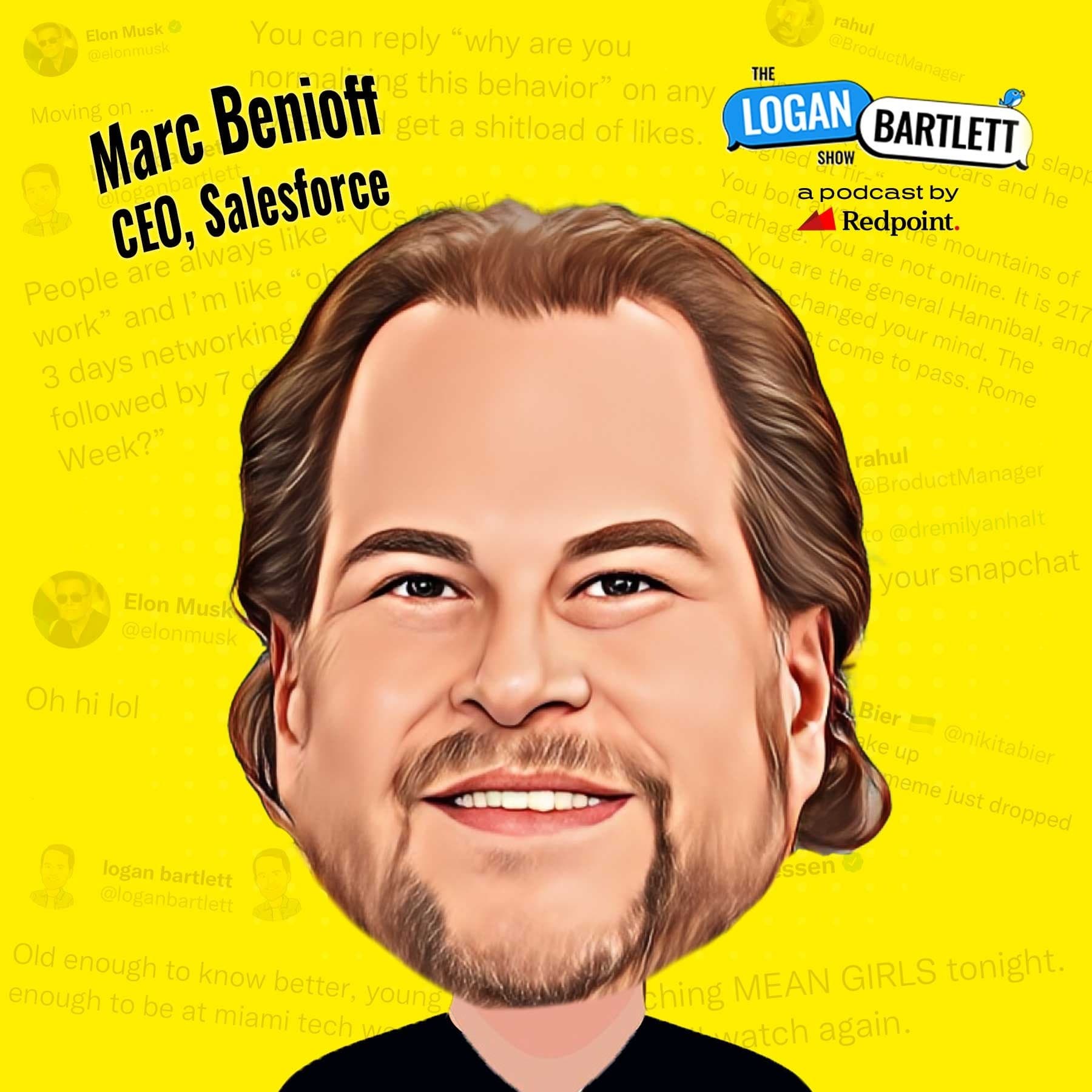
Podcast Overview Title: The Logan Bartlett Show Host: Logan Bartlett Featured Guest: Marc Benioff, CEO of Salesforce Description: The show focuses on insights from startup leaders to help others learn from their experiences and avoid common pitfalls in entrepreneurship.
---
Episode Highlights
Introduction and Overview (00:00 - 01:14)
- Marc Benioff reflects on the rapid changes in technology over the past eight months, particularly in the realm of AI.
- Discussion about Salesforce's advancements in AI technology and its implications for customer interactions.
Salesforce's AI Innovations (01:14 - 05:00)
- Salesforce has become a testing ground for AI, with a focus on "agentic" technology for customer support and sales.
- Over the past eight months, Salesforce has engaged in approximately 1.5 million customer conversations through its AI agents, maintaining customer satisfaction scores comparable to human agents.
- AI's role in lead generation has dramatically increased, with over 10,000 leads being processed weekly.
Market Sentiment and AI Adoption (05:00 - 06:15)
- Benioff discusses public market sentiment regarding AI and the confusion among investors about the transition to an "agentic" era.
- Clarifies that while applications will evolve, they are not going away entirely.
Salesforce’s Operational Efficiency (06:15 - 08:13)
- The shift to AI has allowed Salesforce to reduce its customer support headcount from 9,000 to about 5,000 while maintaining service quality.
- Emphasizes the synergistic relationship between AI agents and human workers.
Exploring Market Opportunities (08:13 - 12:57)
- Benioff discusses the potential for growth in the CRM and ITSM markets.
- Salesforce is entering the ITSM market with an agentic approach, leveraging its existing connection through Slack.
AI Role Across Different Market Segments (12:57 - 23:26)
- The episode dives into how AI is revolutionizing various market segments.
- Benioff shares insights into Salesforce’s investments via Salesforce Ventures, hinting at a focus on AI-driven startups.
Advice for Young Professionals (36:05 - 41:04)
- Benioff encourages young professionals to create value using their unique insights and capabilities in the shifting landscape of technology.
- Stresses the importance of trust, execution, and a clear vision for success in the AI era.
---
Key Concepts
Agentic Technology
- Refers to AI systems that can autonomously interact with customers, taking on roles traditionally held by human agents.
- Salesforce's implementation of agentic technology is seen as a transformative step in enterprise operations.
Human-AI Collaboration
- The future involves humans and AI working together, with each playing complementary roles in customer interactions and decision-making processes.
Market Trends
- There is an ongoing transition in the market towards AI-driven solutions.
- Startups have the opportunity to innovate rapidly, leveraging new technologies to meet customer demands.
Investment Landscape
- Benioff notes a unique opportunity for startups in the AI space, driven by the capabilities of new technologies and the demand for innovative solutions.
---
Conclusion The episode emphasizes the role of AI in transforming business operations, particularly within Salesforce. Marc Benioff illustrates the potential for AI to enhance efficiency, improve customer engagement, and create new business opportunities while maintaining the vital collaboration between humans and technology. As the landscape evolves, both established companies and startups must adapt to leverage these advancements successfully.
Written by AI. May contain mistakes. Listen to the episode to check what was said.
Transcript
Automatic transcript. May contain errors.0:00There were more than 100 million leads that we have not called back at Salesforce in the last 26 years because we have not had enough people. So we just couldn't call them back. But we have now an agentic sales just for our own company, more than 10 ,000 leads a week right now, having conversations, turning them into pipeline. Our pipelines have never been more full. And a lot of it has to do with that we're feeding them with this agentic capability. And so our salespeople are also now part and parcel in partnership with these agents as well.
0:32Mark, thank you for doing this. Oh, yeah. It's great to be with you, Logan. So I think it's been eight months or so since we had the last conversation. I think we're seeing a lot of, at least I'm seeing a lot of end of software. This is the end of application software as we know it going on, I guess. What's your perspective over the last eight months and some of the rhetoric about this, that we're no longer going to see the commercial opportunity for software that we've seen in the past? Well, I think there's two things. You know, you look at the last eight months. I mean, it's been eight of the most exciting months, I think, of my career.
1:08When you look at what's happened with applications and with software, it's pretty awesome. If you remember, our conversation was all about AgentForce, and we were getting ready to deploy AgentForce on our support layer. And now we have. And I just tell you, like, we're customer zero for our new Agentec service and support product at Salesforce. So we have now done about a million and a half conversations with customers. And at the same time, that's the agentic layer speaking to the customers. A million and a half conversations also happened through our support agents during that same period. And the CSAT scores were about the same, which was stunning.
1:49And also, I was able to rebalance my headcount on my support. I've reduced it from 9 ,000 heads to about 5 ,000 because I need less heads. But there's also an omni-channel supervisor now that's kind of helping those agents and those humans work together. And this is the most exciting thing that's happened, you know, in the last nine months for Salesforce. And we also are deploying thousands of customers with the same vision. I want to dive into some of those things that you brought up in a bit. But I guess I'm curious, the agent force, and you mentioned the cost reduction or the ability to kind of manage costs within customer support.
2:27And I think engineering as well, you guys have been able to manage what the headcount and scalability of that looks like. Do you think the biggest benefit of AI is going to be cost optimization for organizations? Or do you think that ultimately we're going to have revenue uplift as well? No, definitely not. I think that, you know, we are all on our path and I feel like I have to pioneer this as my, as I said, my own customer zero. And I just gave you the support example, but I have to tell you a good story, which is that, and something we did not talk about nine months ago, which is that there were more than a hundred million leads that we have not called back at Salesforce in the last 26 years because we have not had enough people.
3:08So we just couldn't call them back. But we have now an agentic sales that is calling back every person that contacts us in our company. And we're doing about, just for our own company, more than 10 ,000 leads a week right now, having conversations, turning them into pipeline. pipeline, our pipelines have never been more full. And a lot of it has to do with that we're feeding them with this agentic capability. And so our salespeople are also now part and parcel in partnership with these agents as well. So just in the way that the support people, nine months ago, I said, we were about to do that.
3:45We now have also done that in sales. And I have other examples I can give you because I am on a mission to make Salesforce an agentic enterprise. And I think that this is what can really transform every company. As you can see, I've rebalanced my support headcount, as I said, so I can now put those heads into sales. So I've increased my distribution capacity. And now I'm also making sure that I have much more efficiency and productivity in my lead generation and in the ability to actually work with customers that are contacting me. Even in my website, I have deployed an agent on the front of it.
4:22So if you go to our website, you'll see we've taken all of our data from our website, put it into our data cloud, put an agent on the front of our website. Now you can talk to our website right through our agent as well. And so that just makes the marketing so much more efficient. This is really the beginning of every part of the company having this kind of agentic augmentation. It's a force multiplier. It's a synergistic effect between me and the agents. And we're proving it out first at Salesforce. But we also have thousands of companies that are also deploying this. You talk to a lot of investors and you've seen a bunch of technological trends, I guess.
5:05Do you think public market investors or investors at large are sort of waiting to see this come to fruition, either in the growth rate acceleration or profitability before they really lean in on the themes? Or what's been the sentiment as you sort of talk to people in the public markets on the investment side? Well, I think you definitely see a lot of confusion with customers or with investors on what does it mean that we're moving into an agentic era? Does it mean that software and applications go away completely? I mean, that isn't true for me. I don't know if it is true for you, but I'm using applications on my phone.
5:42I will say, I mean, this is a thought exercise I was having the other day, and I'm curious your thoughts on it is like, you know, I've been long, my career's been sort of predicated on investing in software, broadly speaking, right? But I'm definitely going to websites less, like in using OpenAI or Cloud as the portal of accessibility in some ways. And so I was thinking, like, will I ultimately use some similar interface? And not to say that that's going to capture value that you wouldn't otherwise capture, but I do wonder about the interface element and the usability changing. Well, I think at Salesforce, what we have really seen is that in the type of applications that we're deploying and the automation that we provide to enterprise professionals.
6:24So I kind of gave you the example of, you know, our support center where we have an omni-channel supervisor that's managing humans and agents together. There's no better interface that I've seen, or I would use it, on top of our data foundation. Our data foundation is our data cloud, MuleSoft, Tableau, and Informatica. That's the core of our company. And we have a huge amount of data ourself in there, but we also manage 230 petabytes of that information for our customers all over the world. The second layer is the application foundation. And some of these areas, like support or sales, are highly specialized applications and require, you know, incredible, you know, powerful user interfaces.
7:06And by the way, it's not that I don't have like a Slack user interface for service and support or a Slack user interface for sales. But then, you know, I still have to branch out because all of a sudden I've got a lot more data I need to consume. And humans are not going away. We are working in partnership with these agents. And that's how I look at it. And then when it comes to Slack, like, for example, since I talked to you nine months ago, I now have, you know, a couple dozen agents running inside Slack on my behalf, doing renewals, you know, doing support, but also like doing my wellness benefits, doing, you know, all kinds of interactions with my employees.
7:46They operate inside the Slack application. You can see in the Slack marketplace all kinds of new agentic apps and ISVs that are running inside there. That's amazing. So that is probably the most exciting, most thriving ecosystem in tech for the enterprise right now is inside Slack. So I think we're really have a good, solid, you know, look at that every single day. Do you think this is maybe tied into my job in some ways, but do you think I don't know what percentage you guys have of the CRM market? I used Claude before this and it said 26 % was the number I got and ServiceNow was 44 % of ITSM or something.
8:29One question we've been wrestling with is like, do you think we're going to see just much more federation and like this generation of companies that are being founded right now might pick off a percentage point or two here or there? And the market overall will grow. And so it's, you know, a rising tide for everyone. But it's going to be really hard for net new businesses to have that level of penetration that you guys and ServiceNow and Workday and whoever else have been able to achieve. Well, I hope you'll come to Dreamforce and you'll see, actually, we've never been in the ITSM market before.
9:02So we're entering and we're building on Slack. You know, so it's a Slack-first app. It's a Gentic also. So it's a Gentic. It's Slack-first. And I mean, ServiceNow is a great company. They, you know, I think they automate like 9000 companies. I don't know what the number is that they have, but Slack is on a million companies. And those million companies, they're, you know, small and medium and large and extra large because all, you know, Salesforce sells to the five major segments of business at the all of the IT world. And Slack is one of those products that we do that with. And that idea that we're entering the market for ITSM, but it's, you know, a whole different kind of architecture, but it's the architecture that we're talking about, which is we have to have humans and agents working together.
9:47And that when we're, you know, managing, you know, our assets in our company or, you know, really kind of providing that kind of, you know, database to really understand the change configuration, you know, agentic capability is very powerful. And then if you can provide it right on your phone in Slack, that's really a next generation UI. And we're doing that with all of our products. So all of our products, like our sales cloud, which we've talked about for decades, it's becoming agentic sales. Our service cloud is agentic service. Even our marketing cloud, we do 11 trillion emails every single year.
10:25Those are all one-way conversations today. You're going to see a dream force. Those are all going to become two-way conversations. And it's because you're going to have an agentic on the end of that, having a conversation with those customers. And I'll tell you, like, even, you know, in my home, I have an Airstream trailer outside and it's hooked onto the power grid, you know, with this device from a company called Eaton. And they've been a customer of ours for years. They've done, you know, their sales and service on us. But we have this field service product that we also now have made agentic.
10:57And so when the field service agent from Eaton shows up, not only are they like on their phone, you can see the app, by the way, it's on the app store. Not only are they looking at all my information, oh, it's Mark Benioff, here's his home, you know, here's his Airstream, we got this working, or I don't understand why this is not working. He's not by himself, he's with the agent, he can interact with the agent and the user interface exactly as you're kind of describing that kind of, you know, large language model interface and trying to figure out what's going to work, what's not going to work.
11:25And then all of that is going to get stored into the system of record so that when the next agent comes out to fix my power system again, it's all right there in front of them because that's going to be the nature of field service. Even like when we work with PG &E on their wildfire prevention, they're out there with our field service app where they're looking at every power pole and every branch and every piece, but they're not alone, the agentic layer is with them. It's humans and agents working together. But the system of record, the agentic layer, the LOM, all have to be integrated together.
12:00You know, it's that, we talked about this actually nine months ago, I remember, the data layer, the data foundation, the application layer, and the agentic layer are the three core layers of how applications are working going forward. And that's, well, at least that's how I use them every single day. And maybe you have a different way. Even when I'm using, for example, like last night, I was shopping for ties. So I was, you know, on an LLM and I'm looking for the right tie of this kind of thing. It wasn't one of the two that you mentioned. It was a different one. And then it brings me in there.
12:32It's kind of a super search. You know, it's like helping me search to find the website. And then I'm now I'm on the website, but I still had to go to the website to complete the transaction, to identify, you know, who I was, complete the commerce. Will that maybe get more refined? It probably will. But when it comes to the fundamental trust, security and information sharing in an enterprise, that is a different ballgame right there. What is managing agents and managing workers entail? You guys have gone through this transition on the support side a little bit and increasingly maybe on the R &D and development side and now on the sales side as well.
13:10I guess, how do you think about if you're a leader and trying to figure out how to deal with both the change management process associated with going through that, but then also, like, how do you actually organize and design the business such that KPIs and accountability is actually roiling through the organization? Well, we talked about that too, nine months ago, which was, I really felt I was going to be the last CEO who was only managing meetings. Remember that? Yes, I do. And I still haven't come up with a better term of like managing agent workers or something. For some reason that feels a little dystopian to me, but it's clearly headed down that path in some way, shape, or form.
13:49Now, I don't think it's dystopian at all. I think that this is reality, at least for me, but I'm managing agents and humans. And that means my agents, when they show up to a customer, like I told you, I have that salesperson now that's calling back all my leads. And that sales agent, there has to be a certain kind of set of guardrails, a certain personality, a certain kind of tone, the ability to know when it needs to escalate immediately to a human being, because these large language models can do a lot of things, but they cannot do everything. And you know that. And that we're kind of hitting in some ways, you know, a high evolution of the large language model, as we can kind of see as we got into GPT-5, looks a lot like GPT-4.
14:32It's more evolutionary than revolutionary. So we're seeing a maturation of that type of technology right now, that deeply integrated into the application layer, that's where I'm getting the most value. And that idea that those agents then when they're directly talking to the customer or directly talking to the employee, they need to be managed through those guardrails. They need to be managed through that structure. And that's incredibly important for us as the tech vendor to be able to provide that to the customer. When you say 30 to 50 percent of work is being done by agents today, I guess, how do you think about the unit of work being done?
15:12How do you assess that at an organizational level to try to figure out where the balance is of who's doing what? Well, I think we kind of lay it out like in that support example, which is really, I think, the best example, right? that if we were having this conversation a year ago and you were calling Salesforce, there would be 9 ,000 people that you would be interacting with globally on our service cloud. And they would be managing, creating, reading, updating, deleting data. We called CRUD database with an app, a very powerful interface with Lightning. In some cases, if there's a case, maybe it gets swarmed onto Slack, but this is what they're doing.
15:51Maybe they're checking the analytics in Tableau. Maybe they're over here. you know, doing some other kind of sentiment analysis. Now it's a different system. Now, all of a sudden, here we are a year later, and the million and a half conversations that are happening going forward over the next year, and a million and a half human conversations that are going forward over the next year have now bifurcated. 50 % are with Asians, 50 % are with humans. And there needs to be also technology and people who are managing, how are these working together? And because all of a sudden, like the agent will scale out and say, whoa, I can't handle this.
16:30I need to, you got to go handle, have the human work on that. It's not any different than have you been like in your Tesla and all of a sudden it's self-driving and goes, oh, I don't know, I actually know what's happening. You take over. And that's kind of the same thing, but on a very complex, you know, you're working with a very complex customer, you know, in a support environment. That is really the magic going forward. You know, how do we get these two? And so that idea of the 50-50, I think that's definitely where we're going in sales, in service, in marketing, in field service, in the fundamental collaboration of our employees.
17:08All of these pieces are going to have that kind of balance. I don't know if you've reported since May on numbers related to this. What I had down was 8 ,000 deals and generating over 100 million in ARR for Agent Force. I don't know if there's newer numbers out there, if that's the latest. Well, you'll hear those when we do earnings next. Okay, great. Okay. So earnings, we'll wait in bated breath for that. I assume they're higher than they were in the past. What was counterintuitive or as this has ramped up, what's been unexpected in the response of actually seeing this out in the wild and in production?
17:44Well, you can see that our AI and data product line is the fastest growing product line we've ever had. It's, you know, it's over a billion dollars now. And that has been a huge shock that we've been able to scale it as fast. I mean, we've seen these great startup companies like Databricks and Snowflake. You know, we've been investors in both of those companies. We help bring Snowflake public or investors in Databricks as well. And, you know, and then, you know, we look at other companies that are doing data foundations or data foundries and others. is like, wow, this is a big category. And these companies are all like$3 to$4 billion in revenue.
18:19And now all of a sudden, whoa, we're a billion dollars and we're fast tracking to$2 billion in revenue on that product. So that's very exciting. I think that that idea that the data foundation product line, the data cloud, you could even say agent force at some level, though I wouldn't put it at that stratification. MuleSoft, which also provides the integration capabilities, as well as Informatica, which, you know, as we've announced we're going to acquire as part of our data foundation. And getting all of that working to really get our customers to harmonize all their data, because if you don't have that data together, you can't have the accuracy with the AI.
18:59This is really a huge category for customers. And I think that this category will radically expand or it has been expanding. It will continue to expand for us. Have you guys not closed Informatica yet? These big regulators, man, it's crazy how long these deals take to close. I guess you've never acquired a company before. Not at the scale, not at whatever your guys' valuation is. We've done quite a few acquisitions, I think maybe more than 60. So I'll just tell you that, you know, we just let everyone work at their own pace. Yes, yes. That's very diplomatic of you. I have a lot of respect for everyone.
19:32There are a lot of hard workers out there. Yes, yes, exactly. That's very diplomatic. They talk about a place we could use some agents, I guess. I guess one of the things we touched on last time that I'm very curious about is like the per seat pricing, which you guys were a pioneer in, and then the shift, the more agentic pricing. I guess any updated observations, thoughts, perspectives on like what's going to be maybe cannibalistic as you don't need as many seats to do it, but might increase overall dollars that a customer spends? How do you think about that now with a little bit more data? Yeah, I've been on the road for two months with customers.
20:08And so I'm just back now in my office. So, you know, my view of that really continues to evolve, which is, of course, with per seat pricing. We've always had consumption pricing also, which is like we saw in our commerce cloud or even on email or our data cloud is consumption pricing. Per seat pricing is like the sales cloud, the service cloud, Slack. You can see per seat pricing like on ChatGPT that you mentioned or, you know, these kinds of products. So per-seed pricing, consumption pricing, and then conversational pricing, or this kind of idea that maybe you have a certain amount of conversations or a certain kind of flex credits.
20:45And one more category, which is customers want kind of the ability to buy all of it as one big package. Way more aggressively than I realized, they want kind of a complete agentic enterprise license agreement. Every company is really on a path to become an agentic enterprise. I've articulated us as customer zero. Like I gave you the story now of service and sales or what I'm doing in Slack where I have a dozen agents and I'm renewing customers. You know, nine months ago, I had no agents deployed in my company when we talked before. You know, now I have lots of agents. And I think every company is going to, when they see what we've done and when you get to Dreamforce and see my keynote, I'm going to have 12 Fortune 100 companies there, you know, all showing you how to build an agentic enterprise.
21:32different shapes and sizes, different ways to do it, ranging from Pfizer to FedEx to OpenAI Anthropic. They're all going to be a dream force, really showing customers how to do that. That's October 14th through 16th in San Francisco. And I think that will be a very critical thing that I don't just articulate, hey, here's our great new product. Here's, like I said, the new ITSM product or this new product or that new product. But here is customers being successful, becoming agentic enterprises. Last year, we were just talking about agent force. We've talked about that. Here's agent force. You can deploy this.
22:09Go. Now we're saying, no, actually, this is a huge enterprise transformation for you. And in every category, we're going to transform that function. And we've had to rebuild every single one of our products to not only be the application layer, where you're creating, reading, updating, deleting the data, but also working hand in hand with the agents as well. And that is, I think, really exciting. I think for a lot of customers, they haven't been able to see it yet. And they want to see what other customers are doing and how to make it work and how to deploy it. And that, I think, will be probably my greatest pleasure at Dreamforce is to see customers show other customers how they're doing.
22:49You mentioned OpenAI and Anthropic there, and we touched on a little bit of the scaling elements of the model today. I'm sure you get to see a lot of stuff in preview or get to have conversations that a lot of people aren't privy to. Do you think we're increasingly moving to like an absorption and digestion phase where we just try to take advantage of all the value that we've already presented or those model companies have already presented for enterprises to take advantage of? Or do you think we're still on a fairly steep slope and it's a little bit of ways from the harvesting stage? It depends what category of the market we're talking about.
23:29You know, the market is really in five segments. You have the small and medium business, you know, call it a couple hundred employees. You have the medium businesses, call it a couple hundred to a few thousand employees. You know, you have the large businesses, call them like four or 5 ,000 employees. then you, of course, have the very large Fortune-wide editor businesses and you have the government. And these five segments of the market each need a slightly different version of the product. They need something with a slightly UI. They consume it a little differently. And the speed of their deployment is different because their architectures of deployment are different.
24:04And also, AI is going to dramatically change small businesses. There's going to be a radical explosion of the number of small businesses because AI is going to make entrepreneurs so much more capable and probably a media business too. And of course, in large business like mine, it's happening, but not everyone is probably as committed to deploying the technology rapidly and at the bleeding edge as I am. So those five segments will all adopt the technology slightly differently. And that's my observation of technology over 40 years. and so where do you think we are on that do you think we're at the absorption stage for for the mainstream enterprises or we're at the beginning of the beginning a lot of for big enterprises let's call them the big extra large enterprises you know they've a lot of them have tried things out some of them like in the dreamforce keynote pfizer will be there they've deployed agent force to 20 000 you know their sales professionals they use our life sciences cloud which is now also with Gentic.
25:06That idea that we're able to kind of, you know, work with a company like that to kind of give them much more capability for their professionals, that it's a force multiplier, you know, for their employees. That is very powerful. And for their customers as well. And other customers need to see that. In the pharmaceutical industry, it's a great example. You know, it's a variation of companies who are willing to try technology to companies like Pfizer, who are always the leaders in deploying that technology. So, you know, I'm called Albert Borel, CEO of Pfizer. Please come be part of my keynote. That's very important for me because they are pioneers.
Read the full transcript
25:44They're really doing an incredible job, you know, really delivering this next generation of AI. One of the things we're seeing in the private markets for startups, I guess, is this maybe an overused terminology, but adopting some of the nomenclature from the Palantir world of like forward deployed engineering, which I think is being purpose fit a little bit differently than what Palantir intends it to be. And maybe it's a little bit more of, I saw someone call it sparkling sales engineering or something versus in the past. But I guess, are you seeing more consultative relationships with customers that are helping or that are looking to you to help them more map the journey than you have in the past?
26:32And therefore, does that require like different staffing or different utilization of resources internally? I'm very inspired by Palantir. You know, they sell in parts of the market that I have not traditionally sold in. And they also sell at prices that I've never seen enterprise software being sold at. So I'm very inspired by - And they trade at multiples that, you know, rarely are seen as well, right? Yeah. And I mean, yes, the federal, U.S. federal government, Salesforce's largest customer. and, you know, we run all the major, you know, civilian agencies like the Veterans Administration, all is fully automated on Salesforce.
27:08And I would say that now, you know, when we look, you know, certain parts of the government we haven't sold into, but in some areas, you know, we are, you know, selling. And the U.S. Army, we just beat, you know, Palance here. It was publicly announced, you know, on a new deployment. And I would say that we're going to do that because our prices are so much better at lower cost and our technology is probably so much easier to use and deploy. But when it comes to forward deployed engineers, this idea that we had salespeople and system engineers on the front lines, that was always true. We had professional services.
27:43That was always true. But early deployment engineers or forward deployed engineers where you're starting to build the application before the deal is signed, that isn't something that we've really ever done before. And I find that very inspiring. And I'm definitely trying that out. and seeing if that will help me, you know, accelerate, you know, customer acquisition. I think it's a really cool idea. And I'm very inspired, not just by, you know, the hundred times revenue multiple. That's inspiring too, though. That's inspiring. Yeah. But I'm also, I'm inspired. Look, you know, I've been a$4 million company, a$40 million company, a$400 million company.
28:19I've also been a$4 billion company like Palantir. And now I'm a$41 billion company. So I've been all of those stages and each stage is a little bit different, but I can be inspired by everyone and anyone. Are there are there unique pockets that you think are advantaged to be a startup these days versus an incumbent in the in the market? And you would say, hey, here's the opportunity for investment that might exist outside of the core advantages that incumbency has. Well, I mean, Salesforce has been a very active investor. You know, we run our Salesforce Ventures. You know, we own 1 % of Anthropic.
28:57We just were part of selling Wiz to Google, you know, which was a huge, you know, outcome for us. I think more than a billion dollars. And, you know, we took Snow Plague public. That was more than a billion, a billion and a half. Both of those, I think, were a billion and a half. I would say that I don't know what the IR exactly is in Salesforce Ventures. I think it's like 33%, something like that. But when we're looking at these companies today, and I just met with two entrepreneurs myself yesterday, they're both 18 years old. They're both in Y Combinator. They're both building on Anthropic Cloud.
29:32They're both addicted to it because Anthropic gave them$30 ,000 of free credits. They're using their new Harmony API. They're doing all of these things. And I'm like, whoa, innovation is alive and well in Silicon Valley. And every time you hear that, you know, San Francisco is dead or something, I'm like, don't worry, another gold rush is coming. And then people never go, oh, Mark, you don't know what you're talking about. And then, oh, yeah, here we are. It's a gold rush. And look at people are coming in from all over the world with their pans and their shovels and their picks and they're got their blue jeans and they're panning.
30:03And I would say that it's a very exciting moment where you can see all these new technologies, new ideas, incredible innovation, and things are moving fast. And as evidence that, I'm going to go back and watch what we said nine months ago and see how much of it has iterated, evolved and changed and how much we've actually been able to get done. Because usually it's not these enterprise deployments are not done, Logan, in nine months. You know, it's like, whoa, I've got this. Oh, yeah. Hey, Logan, I got this is my actual result. Here's the KPIs. Here we go. And that's why I'm super motivated and excited.
30:42I'm super energized. And, you know, when you get to Dreamforce, this needs to be like a big message that I have, which is, hey, you need to become an agentic enterprise. Here's the products. Every app is now agentic. Here's the data foundation. Here's all these pieces. But I don't think customers care that much about what I have to say about the new products. I think what they want to know is, hey, what did that person do? What did FedEx did this? And here's, you know, the CEO of FedEx explaining exactly what they did here. You know, OpenAI did this and this is exactly how they did it. And that, I think, is cool.
31:22And that, I think, is another level of kind of capability that we have to be able to show. And I'm going to pivot, you know, how I present my keynote based on that feeling I have, which is that, you know, these customers like I'm built these big customers in Europe. and they're like, whoa, I want to become an agentic enterprise. These are customers that I've had for like one or two decades. Now I'm like, hey, we're going to move your whole infrastructure forward, rebalance your headcount the way I'm rebalancing mine, change your business KPIs, and you're going to come out the other side as an agentic enterprise.
31:56We kind of touched on it there. And also when you were talking about the startups or the young kids going through YC these days, but it does seem as a private investor, there is a different rhythm or cadence that it seems the AI first companies are operating under. And I think to some extent when your world around you is changing so quickly, it forces an internal culture of change to be much more material in a meaningful way than like more traditional businesses. I guess outside of adopting agent force in mass and, you know, all the good stuff that you guys bring to bear up and down the stack.
32:31Are there things you've learned about how to change the speed of moving a bigger organization that's gone through changes in the past, but now has to operate at the speed of the competitors that were founded in the last couple of years? Yeah. I mean, before talking to you, I actually spoke to a company that I helped start in the AI world. Richard Socher used to run Salesforce Research, has this incredible company called view.com. And it's an AI first search company. It's amazing. It's scaling incredibly well. It's does incredibly accurate search based capability. You probably have it on your phone.
33:10If you don't, it's pretty awesome. They also provide an API approach, which is widely consumed by some credible companies, gives them a search infrastructure, you know, powerful. And another example is I have another company called Artera, which is an AI first company. And that company is doing prostate cancer diagnostics. Just got an FDA clearance. It's about to do breast cancers, do other ones. And these are in my private venture portfolio, you know, which is Time Ventures. So when I look at what Salesforce is doing, what I'm looking, what I'm doing, I would just say it's very similar. You know, you have a great entrepreneur, you know.
33:51So you have Andre Esteva, who's running Artera. You have Richard Socher, who's running U.com. They're visionaries. They're experts, by the way, both of them used to work. Both of them are in Salesforce. Both of them used to work together in the AI world. They have a clear vision of what they're trying to accomplish. One is doing, you know, next generation search through an API. The other one is, you know, trying to provide democratizing high quality healthcare globally through AI. It's leadership. It's vision. You know, what do you really want? What is your outcome? Where are you totally passionate and totally focused about what you're doing?
34:27Nothing is going to replace that. And then the core values that they're building their companies on, you know, is it about trust? Is it about customer success? Is it about a vision and innovation? I would say that when you're running something like how Andre's running, which is you're in like the most sensitive aspects of somebody's life, you know, which is their cancer diagnosis. I would say that that's something where all of a sudden, you know, you better have be completely buttoned up as a company and have the highest level of trust and capability. And so your values matter. So your vision matters.
35:05Your values matter. And then your execution matters. The quality of your team matters. How you're actually making things happen day-to-day matters. And also, are you rapidly resolving obstacles? And what are your KPIs? Are you scaling your revenue? Both of those companies are scaling their revenue really aggressively. Like, you need to scale your revenue and go because others will come for you. Well, this has always been true. And, you know, I've been in Silicon Valley my whole life. I was born in San Francisco. I grew up in the peninsula in Hillsborough. So my whole life has been in Silicon Valley and all the great entrepreneurs and all the great venture capitalists that preceded us, you know, from the era of Arthur Rock and Sandy Robertson, who was one of my mentors, you know, to the great investors and entrepreneurs of today.
35:54You know, they have more things in common than different. And one of them is, you know, you better go and you better go faster and you better go now. I guess as we wrap, one thing that I get asked a lot, and I'm curious your perspective on this, is like if you're a young person, if you're 22 years old, graduating college or whatever, interested in entering a field in some way, shape or form, and AI is changing so much. Eight years ago, I would have said, just go get five years ago. I would have said, go get a CS degree and that'll benefit you no matter what you go do. And now I'm not sure my counsel would be the same.
36:34Anything you would give to someone that's maybe in the early part of their career and trying to figure out? Absolutely. Well, I told you, I just met with this cool startup that's in YC with these two 18-year-old founders that is amazing. And then I have two interns from Stanford working in my office for the summer. And hey, create value. Create value and deliver deliver something different and create something amazing. And these kids, I don't know, you know, these kids, they're AI natives. They're authentic natives. They're not digital natives, you know. Like they are, they know intuitively what's possible and where this can go.
37:20And then they're looking at my business process, my product lines, my capabilities, and saying, actually, here's your gap and this is what can get filled in. So that's very powerful. And we need these people. And I'm reading these studies, well, we're not sure if we're going to hire these kids from college. I mean, what a mistake for companies not hiring people from college or bringing in new talent or bringing people in at that age. I mean, that is where the real value and the insights and the energy is going to come from. I guess one last one before we hop. So you've been the CEO now of Salesforce for 25, 26 years.
37:54You've seen every cycle that, at least in my lifetime, from dot-com to mobile to cloud to AI. Do you have a contrarium bet that maybe people believe about AI today that we're going to look back on in five years and it's just going to be patently false? Well, I think that there's, you know, unfortunately, we have this kind of Klarna, you know i would say reality distortion field that got created around the time we talked about a year ago where all of a sudden the sea of clarinet seems like a very nice guy i've never met i've had him on the pod seem wonderful but his message has changed like 10 times in 10 months and the stuff that he said was true he's kind of walked back is not true i see on the other side there's people in my industry even some of my peers who talk about the end of apps or the end of crud, you know, that enterprise apps are just crud databases.
38:52It's like, whoa, I, I just think that there's a lot of kind of crazy things. I mean, I think even some of the talk about AGI may be too augmented that, you know, these large language models are really amazing, but they're not AGI. And I was like this, this weekend, I was like figuring out how might communicate this to people because we forget these large language models. These are relatively finite algorithm sets with regular, relatively finite data sets. And those two things provide you some functionality, but not all functionality. And as evidence of that, there's this really cool medical study now that our brains start to create immune cells when we're near sick people.
39:38and i was joking on twitter well i kind of missed that feature you know gpt5 i don't think it does that quite yet so we still have an advantage but i think at some level because you're talking about these finite algorithms and finite data sets which is kind of what all the ai is built on these the same data set these llms which is why they're all kind of seems like they're hitting this upper limit where you can see like gtp3 or 4 might have been more revolutionary maybe gtp5 is more evolutionary, you know, that there's still some cool things happening, but it's not these big transformational leaps.
40:14I think that we could kind of then make a statement of, you know, we're going to need another set of models and another set of capabilities before we get that next set. And that when you're dealing in the finite, like the finite data and the finite algorithms, we're infinite. You know, we're infinite beings. We have the ability to have the level of creativity and inspiration and insights that's beyond that. That's why that example of like, hey, we're creating immune, we have an immune system, you know, we're creating immune cells. We don't even realize we're creating immune cells. We're tapped into a level of energy and capability that's beyond the finite data set.
40:56So I think we have to keep that, you know, front of mind that we, I think we still are an important part of this world that we're in. That's an optimistic note to end on, Mark. Thank you for doing this. It's great to see you again, Logan. I hope you're coming to Dreamforce. Now that I'm invited, I was waiting. You are invited. I'm happy to have you. And it's going to be awesome. You're going to love it. And do you like Metallica or do you like Benson Boone? It seems like it's an A-B test. That's interesting. I guess if those are the two extremes, I would put myself in Metallica. I thought so. Yeah.
41:28Well, there's a whole group of folks who are Benson Boone people. We're going to have both. And maybe Stevie Wonder might make an appearance. Are you going to do the Benson Boone outfit? I hear big CEOs dress up like Benson Boone. And I will not be doing the backflip either. But I do like the music. But of course, Lars, I flip very close with, as you know. Yeah. Metallica does a lot with Salesforce. So we love working with them. Oh, OK. I will see you at Dreamforce. Great to see you, Mark. It's great to see you again.
42:04Thank you.
From the publisher
Logan is joined by Marc Benioff, the legendary co-founder and CEO of Salesforce, for a wide-ranging conversation on the rise of AI in enterprises. Marc explains how Salesforce has become the testing ground for its own “agentic” technology, using AI agents to handle customer support, boost sales, and transform marketing. He also shares his perspective on what’s hype vs. reality in the AI race, the opportunities for startups, and why the future is about humans and agents working together.
(00:00) Introduction and Salesforce's Lead Management
(00:35) Reflecting on the Last Eight Months
(01:14) The Impact of AI on Salesforce Operations
(02:15) AI's Role in Customer Support and Sales
(03:45) Salesforce's Vision for an Agentic Enterprise
(05:00) Public Market Sentiment and AI Adoption
(06:15) Salesforce's Data and Application Foundations
(08:13) The Future of CRM and ITSM Markets
(12:57) Managing Agents and Human Workers
(17:45) Salesforce's Growth and AI Product Line
(19:38) Pricing Models and Customer Success Stories
(23:26) The Role of AI in Different Market Segments
(28:51) Salesforce Ventures and Startup Investments
(36:05) Advice for Young Professionals and Future Trends
(41:04) Dreamforce
Executive Producer: Rashad Assir
Producer: Leah Clapper
Mixing and editing: Justin Hrabovsky
Check out Unsupervised Learning, Redpoint's AI Podcast: https://www.youtube.com/@UCUl-s_Vp-Kkk_XVyDylNwLA
🎙 Listen to the show
Apple Podcasts: https://podcasts.apple.com/us/podcast/the-logan-bartlett-show/id1606770839
Spotify: https://open.spotify.com/show/5WqBqDb4br3LlyVrdqOYYb?si=3076e6c1b5c94d63&nd=1
🎥 Subscribe on YouTube: https://www.youtube.com/channel/UCugS0jD5IAdoqzjaNYzns7w?sub_confirmation=1
Follow on Socials
📸 Instagram - https://www.instagram.com/theloganbartlettshow
🐦 Twitter - https://twitter.com/loganbartshow
🎬 Clips on TikTok - https://www.tiktok.com/@theloganbartlettshow
About the Show
Logan Bartlett is a Software Investor at Redpoint Ventures - a Silicon Valley-based VC with $6B AUM and investments in Snowflake, DraftKings, Twilio, and Netflix. In each episode, Logan goes behind the scenes with world-class entrepreneurs and investors. If you're interested in the real inside baseball of tech, entrepreneurship, and start-up investing, tune in every Friday for new episodes.


