
In short
The Master Investor Podcast with Wilfred Frost
Episode Summary
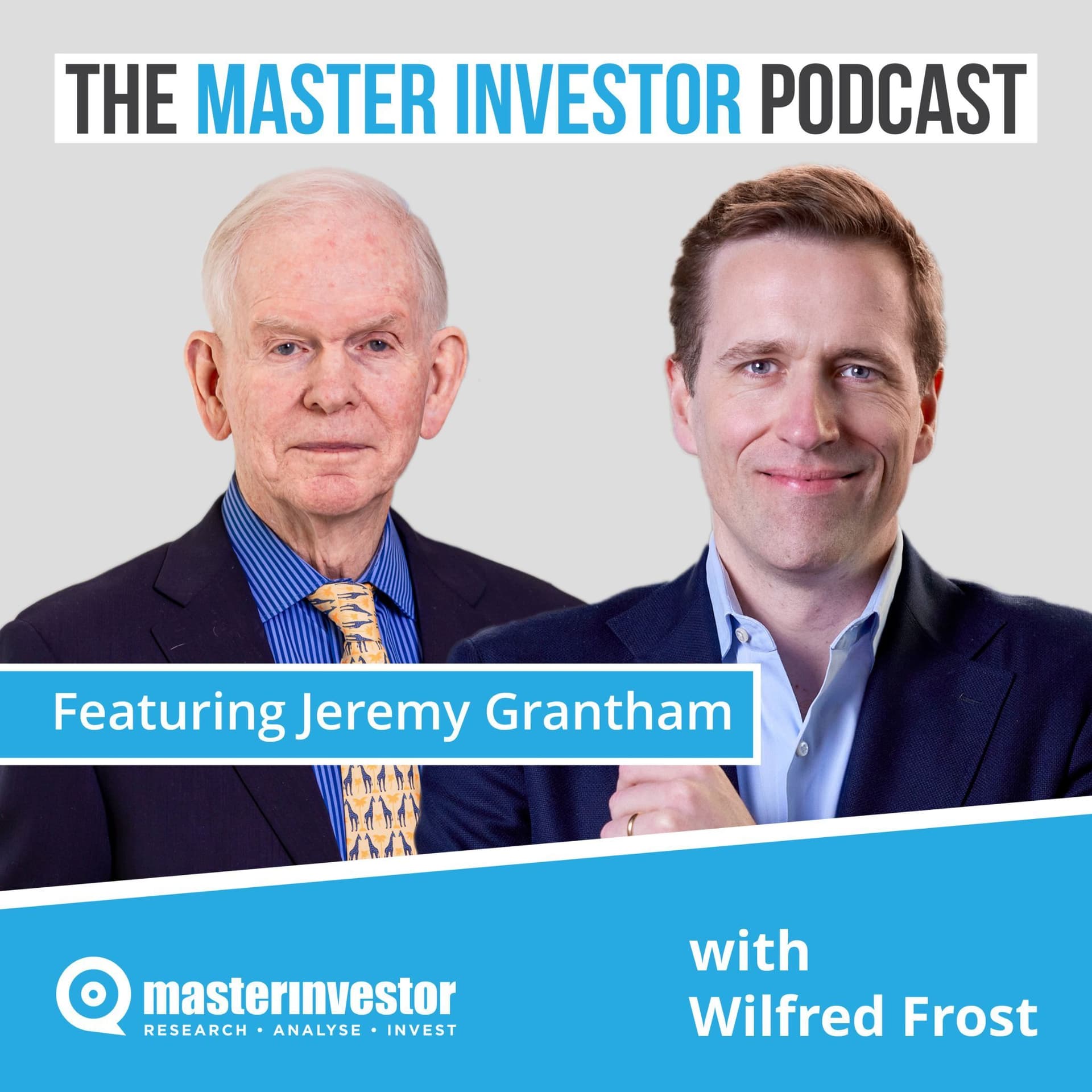
BONUS: Jeremy Grantham pt 2 - On Long Term Risks to the Market, and Humanity
Episode Overview In this bonus episode, Wilfred Frost continues his conversation with Jeremy Grantham, founder and chairman of GMO, focusing on the significant long-term risks facing both the market and humanity. Grantham discusses critical issues such as toxicity, declining fertility rates, and climate change, emphasizing their profound implications.
Key Concepts Discussed
- Toxicity
- Definition: Grantham describes toxicity as a pervasive issue stemming from the extensive use of chemicals since World War II, affecting all life forms, including humans.
- Impact on Humans:
- Chemicals, particularly pesticides, are designed to kill insects and plants and are likely to harm humans, especially pregnant women.
- These substances lead to endocrine disruptions, affecting hormones that regulate sexual and reproductive functions.
- Notable decline in sexual activity and sperm count over the decades, with current sperm counts significantly lower than historical averages.
- Grantham predicts that within 20 years, average couples will need assistance to conceive due to declining fertility rates.
- Declining Global Populations
- Current Trends: The global baby population is decreasing, particularly in developed nations, which is anticipated to impact economic growth negatively.
- Forecast: Grantham discusses a projection by the Lancet suggesting a potential drop in global population to 6 billion by the end of the century as opposed to previous estimates of 10 billion.
- Economic Implications:
- A shrinking workforce leads to reduced GDP growth and declining consumer confidence.
- Historical context provided with Japan’s declining birth rates, exemplifying the trend.
- Climate Change
- Current Perspective: Grantham expresses a somewhat less dire outlook on climate change than previously, acknowledging the potential for innovation and adaptation.
- Challenges:
- The need for political will and overcoming vested interests in the current economic system to shift towards sustainable practices.
- Acknowledges that while technological advancements may help address climate issues, significant challenges remain.
Additional Insights
- Human Nature: Grantham suggests that there is a societal tendency to overlook catastrophic trends in favor of more optimistic narratives, especially evident in the current bullish market.
- Future Outlook: As population pressures decline, there may be less strain on the environment, but the socio-economic consequences of reduced population and fertility present new challenges.
Closing Thoughts
- Grantham's reflections serve as a sobering reminder of the multifaceted risks humanity faces, highlighting the critical need for awareness and proactive measures in response to these long-term threats.
Next Episode Preview
- The following episode will feature Stephanie Link, Chief Investment Strategist and Portfolio Manager at Hightower.
---
Disclaimer The content of The Master Investor Podcast is intended for informational purposes only and should not be interpreted as financial advice. Always seek independent financial counsel before making investment decisions.
Links
- [Watch the full video on The Master Investor YouTube channel](https://www.youtube.com/masterinvestorchannel)
- Follow Wilfred Frost on [X](https://x.com/wilfredfrost?lang=en)
Written by AI. May contain mistakes. Listen to the episode to check what was said.
Transcript
Automatic transcript. May contain errors.0:00This is not gradual. This is catastrophic. What people do, however, is ignore it. We have such a desperate predisposition for good news. And at a time like this, to find yourself facing the most optimistic bull market in American history is really a very interesting testimonial to human nature, isn't it? Welcome to the Master Investor Podcast with me, Wilfred Frost. I'm delighted to bring you now some bonus content from our conversation earlier this week with the founder, chairman and long-term investment strategist at GMO, Jeremy Grantham. Earlier this week, we brought you his latest views on the current market.
0:48Now time to dive in to what he sees as the biggest long-term threats, not just to the market, but to humanity more broadly. Jeremy, great to have you back. And before I dive into some of those risks, I think it's worth pointing out to people that you've pledged not just some, not just a majority, but over 90 % of your wealth to charitable causes. That's right. Yes. We've handed over 90 and pledged 95. Wow. So you've already handed over that 90. It's not just a kind of pledge to come. Right. and I'm happy to say we have written checks out of the foundation for 750 million it's well thank you I guess on behalf of all these amazing causes that you've supported of the the many risks you identify there's sort of three in particular and I want to start with the one that maybe is less talked about by others and that's toxicity what do you mean by toxicity Actually, all of us, insects and humans and everyone in between, we live in a kind of toxic stew.
2:03We've been producing since World War II incredible quantities of chemicals for pesticides and everything else. and very many of them are either directly bad for you or leach chemicals over time into the environment that are bad for you. But my favorite category of watch your tail is pesticides because they are designed to kill our cousins, the insects, and our distant cousins, fungus and plants, weeds. It shouldn't be that unlikely that these things designed to kill great swaths of life would be damaging for humans, particularly pregnant women. It messes with endocrine disruptors, hormones that govern so much of what we do, what we think, what we feel.
3:12And in the lab, it reduces the sex drive of everything it's tested on, endocrine disruptors. They absolutely expect it would do that to humans. Every survey of sexual activity in every country, every age group is dropping like a stone. They're finally beginning to write about it, but it's been going on for 20 years. But now it is really obvious and it's become quite a lively topic of conversation. And so this chemical effect, hugely underrated in this indirect way, stretches back at least 15 years. And the direct effect is that it reduces, among other things, sperm count. One of the few things in this area that you can actually measure very accurately, they started to measure the academics in 1970 or 72.
4:15And there was 100 million units per milliliter. And today it's 35. And the latest report that surveys everything says the sperm count is reducing in the 21st century at 2.5 % a year, give or take, per year, compared to 1.5 % in the second half of the last century. It's accelerating. And every unit lost from 35 is going to be more painful, more consequential than the previous 1%. And this is the effect. Until it reached 45 units, we were so over-engineered like a good Victorian bridge that it didn't matter. You just tried a little harder, an extra week or two, and you had pregnancy. After it reaches 45, we start to see a rapid and dramatic really turn up in young couples needing help.
5:21And the leading expert came to the same estimate that we did, which I admit is a guess, but we did it separately. And that is that in 20 years, the average couple will need help. 20 miserable, quick passing years, and the average young couple will need help getting pregnant. So do you expect global populations to decline significantly? Global populations will decline significantly. The Lancet series came up recently and suggested it might be 6 billion at the end of this century, not 10 billion or close, which is what the UN, who have ridiculous assumptions, really. Atlantic Monthly, this issue, has an article calling them on that and suggesting that 6 billion is a lot more likely.
6:14And GMO, my colleague Jamie Lee and I wrote a paper five years ago that made exactly the case that is in this week's Atlantic Monthly and suggested that 6 billion was a much better number for 2100. What this means is that already the population of babies has been dropping in the developed world everywhere and most other places as well, that the workforce has been dropping in Europe for nearly either dropping or flat year to year for 15 years. This takes a big bite out of GDP growth. A lot of the American superiority towards the Europeans, they sneer at the Europeans as having lost the plot economically, bad policies, et cetera, et cetera, which they tend to do very easily, Americans.
7:06And they certainly have here. And without realizing that the main difference is that they, in the US have had significantly more immigration on average and moderately more fertility, moderately more indigenous growth. And that is at least half of the difference. And the other thing, of course, is fracking, which went from the US as a second rate declining petrochemical power to the largest producer of oil and gas in the world. which was nearly all of the growth globally coming from the US, with the effect that we had cheap natural gas, cheap power availability throughout industry, and even cheap raw materials in terms of petrochemicals, which led to enormous amount of increased GDP.
8:06So another big risk, just to move on and we can sum it up in a moment, you've been way ahead of the curve on is climate damage. Interestingly, I've read some of the things you've done recently on this. You're perhaps less concerned in your tone than you had been in the last decade at different points because you believe innovation can save us in that regard?
8:33The trouble with these topics is they are so complicated that to try and get them done in a few minutes It's a heartbreaker. No, climate change is a terrible burden on us, really, because if we rise to the occasion, which we just may, and we eventually hit a carbon zero economy, everything has been greened, everything electric, and so on. And with enormous use of our brains and research efforts, we could do this. It's not going to be intellectually that difficult. We have that kind of skill. It's a political will and the vested interest, the huge power of the vested interest of the current system behind pollution, which makes it doubtful.
9:29Jeremy then returned to his greatest current area of concern, declining populations, the only small positive of which is declining pressure on the environment. There is no chance we are not fairly well into a population crash. Yes, it's offset by old useless fogies over 65, which dampens the data. But if you look at the size of the workforce, it is declining year by year already and has been for quite a while. And that is guaranteed not only to directly affect GDP growth, but everything we do suggests it also reduces animal spirits. If you live in a world where nurseries are closing, grammar schools are closing like they are in Japan and have been for 15 years, your opportunities are getting less.
10:25you're not getting promoted at the same speed, your earnings are not rising at the rate that your parents did, you become disgruntled very easily. You can see that in Europe. You can see it in America where we have done relatively well, but we're so unequal here that the average worker and below have not had a very good deal now for a long time. It's shocking how quickly they become disgruntled. And when you're upset and disappointed, you don't reach for debt. You don't reach to extend your factory to take that risk on new production. And in that world, as animal spirits shrink, as Keynes made the point, your best laid plans can go awry if the buyers, the consumers, become conservative, nervous, fed up, and they feel a need for more savings.
11:23Your future can get dismal pretty fast. And that's, I'm afraid, pretty well guaranteed from population, current population. This is not me extrapolating 50 years in the future. This is me saying, do you know that Japan had 2.5 million babies at its peak in 1948? 50 years ago, 2 million. 10 years ago, 1 million. Today, under 700 ,000. That's just over a quarter of 1948. This is not theoretical, guys. This is happening starting in Japan and South Korea. China is down to a fertility rate of 1.1, which means every 30 years, the baby production nearly halves. This is not gradual. This is catastrophic.
12:17What people do, however, is ignore it. They ignore the toxicity data. They ignore the sperm count data, which is some of the best data out there. They ignore the population implications. We have such a desperate predisposition for good news. And at a time like this, when the risks forget nuclear war, forget Russia and China and Taiwan and the Ukraine, at a time like this, to find yourself facing the most optimistic bull market in American history is really a very interesting testimonial to human nature, isn't it? Well, on that note, Jeremy, we are out of time. That far from optimistic note, but nonetheless, important lesson.
13:08And Jeremy, once again, thank you so much for joining us. And to our listeners, thank you for tuning into this bonus bit of content with the GMO founder, Jeremy Grantham. It's been a delight, Jeremy. Thank you. Same here. Thank you. Next week, we are joined by Hightower Chief Investment Strategist and Portfolio Manager, Stephanie Link. And remember, nothing in the Master Investor Podcast should be considered direct financial advice. More information on our show notes if you want to look at that. The Master Investor Podcast is produced by Paradine Productions and Master Investor Limited in association with Bird Lime Media.
13:47If you've enjoyed the podcast, please subscribe and leave us a five-star review and see you next week
From the publisher
Some bonus content from Wilf's conversation earlier this week with the Founder, Chairman, and Long Term Investment Strategist at GMO, Jeremy Grantham. This time Jeremy focuses on the biggest long term risks he sees for the market, and humanity, including toxicity, declining fertility and climate change.
The content of The Master Investor Podcast is for informational purposes only and does not constitute financial, investment, or other professional advice. Always seek independent financial advice before making investment decisions
You can watch the full video on The Master Investor YouTube channel.
And follow @WilfredFrost on X.
This podcast is produced by Paradine Productions, The Master Investor Podcast Ltd in association with Bird Lime Media.