In short
The Master Investor Podcast - Episode Summary
Episode Title
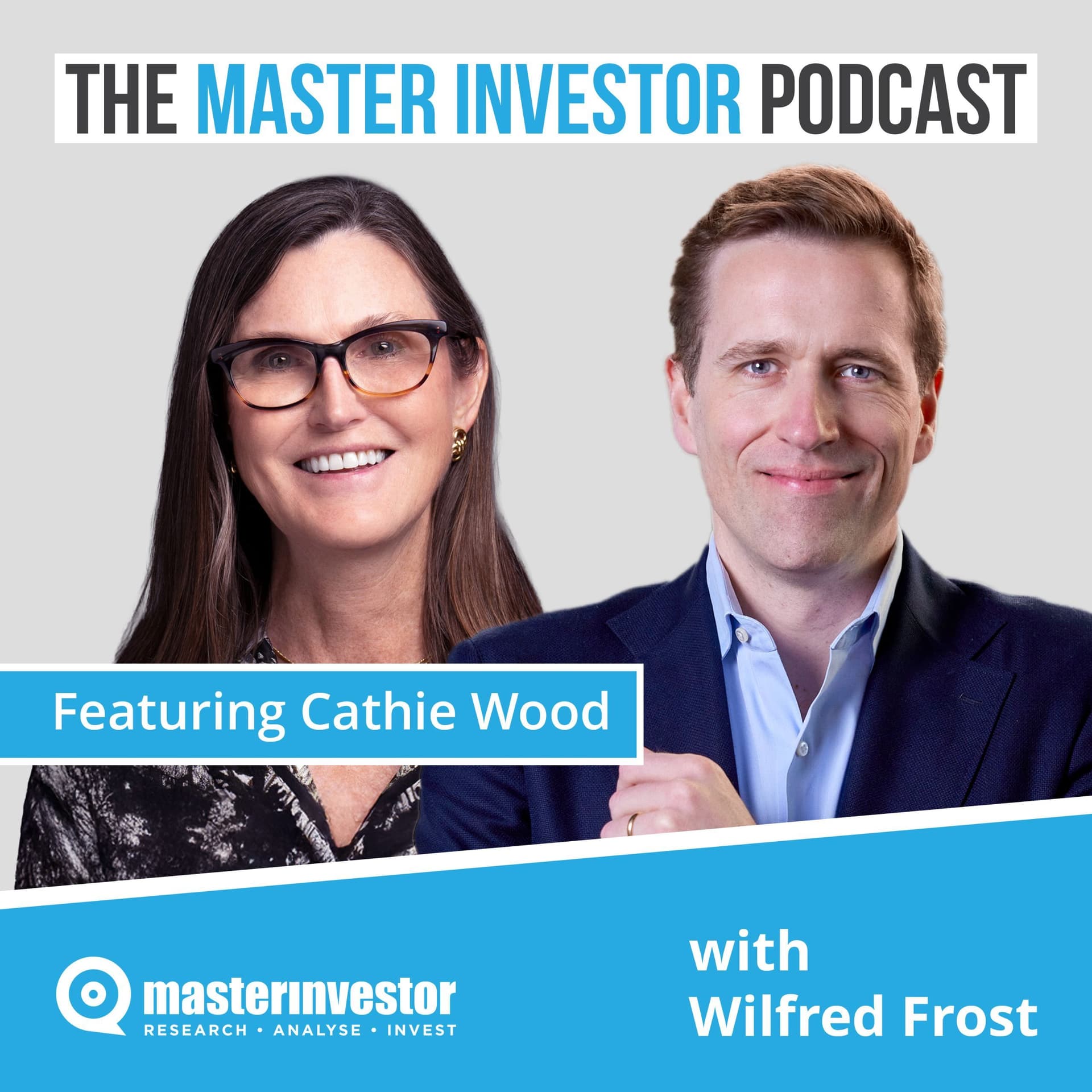
Cathie Wood: Turning Failure Into Innovation Host: Wilfred Frost Guest: Cathie Wood, Founder and CEO of Ark Invest Episode Release Date: [Insert Date]
Episode Overview In this episode, Cathie Wood shares her insights on disruptive innovation, her investment strategies, and her views on key companies in the tech space, particularly Tesla, Apple, and Alphabet. Wood discusses the importance of failure in driving innovation and reflects on her career experiences, including the significant drawdown experienced by her funds in 2021/22.
---
Key Concepts and Discussions
Importance of Founder-Led Companies
- Visionary Leadership: Cathie emphasizes that founder-led companies are critical in the current fast-paced innovation environment. These leaders set the culture and standards necessary for success.
- Case Study - Elon Musk: Cathie argues that Elon Musk is one of the greatest innovators of our time, highlighting his ability to make bold decisions that consensus-driven management cannot.
Investment Philosophy
- Technological Innovation: Cathie focuses on companies that are pioneers in technology and innovation, believing that these firms will drive future economic growth despite macroeconomic challenges.
- Long-Term Perspective: Cathie suggests that many investors overly focus on short-term results. ARK Invest operates with a five-year investment horizon, believing that businesses focused on innovation may sacrifice short-term profitability for long-term gains.
Market Insights
- Current Market Trends: Cathie discusses the broadening of the stock market beyond the top six tech companies (MAG-6) and highlights the positive developments in deregulation and tax cuts in the United States.
- Valuation Concerns: While acknowledging concerns about current market valuations, Cathie believes that the focus on short-term metrics limits appreciation of long-term value in innovative companies.
Views on Specific Companies
- Tesla: Cathie is bullish on Tesla, viewing it as a leader in the upcoming robotaxi market, which she believes will be a significant opportunity.
- Apple: Cathie expresses skepticism about Apple, particularly regarding its AI capabilities and failure to capitalize on the robotaxi opportunity.
- Alphabet (Google): She shares optimism about Alphabet's advancements in AI and its potential to compete effectively.
Future of AI and Robotics
- Winner-Takes-Most Market: Cathie believes that the AI landscape will see significant consolidation, with a few companies emerging as dominant players.
- Investment in AI Firms: Cathie mentions ARK Invest's venture fund investments in AI-focused firms like OpenAI and Anthropic, positioning them as key players in the evolving market.
Reflections on Failure and Innovation
- Learning from Failure: Cathie argues that failure is a vital learning process that fuels innovation. She reflects on her experience during ARK's significant drawdown and how it strengthened her conviction in their investment strategy.
---
Key Takeaways
- Founder-led companies are crucial for innovation.
- Long-term investment strategies focusing on innovation can yield significant returns.
- Deregulation and tax reforms can positively impact market growth.
- AI and robotics are poised for explosive growth, with a few companies likely to dominate the market.
- Embracing failure is essential for innovation and growth in business.
---
Next Episode Preview
- A bonus episode focused on cryptocurrency featuring Cathie Wood's insights on Bitcoin, Ethereum, and market trends is scheduled to be released soon.
Links and Resources
- ARK Invest's ETF Information:
- [US ETFs](https://www.ark-funds.com/our-etfs)
- [UK/EU ETFs](https://europe.ark-funds.com/funds/)
- Watch full episodes on [The Master Investor YouTube channel](https://www.youtube.com/@TheMasterInvestorPodcast).
- Follow Wilfred Frost on [X](https://x.com/wilfredfrost?lang=en) and [LinkedIn](https://www.linkedin.com/in/wilfred-frost-279667374/).
Disclaimer The content of The Master Investor Podcast is for informational purposes only and does not constitute financial, investment, or other professional advice. Always seek independent financial advice before making investment decisions.
---
This summary encapsulates the key discussions and insights shared by Cathie Wood in her conversation with Wilfred Frost, providing listeners with a comprehensive understanding of the episode's themes and highlights.
Written by AI. May contain mistakes. Listen to the episode to check what was said.
Transcript
Automatic transcript. May contain errors.0:00I think what we're learning about innovation is founder-led companies are very important. I know this from my own setting up my own company. You set the culture, you set the standards. And as long as the leader is a visionary leader with high standards and drive, that's the kind of company you want for, especially now, all of the innovation that's taken place in such a short period of time. More broadly on Elon Musk, is he the greatest innovator alive today? Yes. No doubt. You know, it's interesting. I was on a show for the first time after the company started in 2015. And I made the comment back then that I thought he was the greatest inventor of our age.
0:53And of course, we had just started the company. And I walked out of that program thinking, oh, no, I hope I'm right on this, you know, because I just said that and that will be replayed. But it is true. It is true. He's proven it out. He's a genius. If you don't understand something, if you don't develop conviction around something, then don't invest in it because you'll be a weak holder. All we do is technologically enabled innovation. We know what these technologies are going to do. Welcome to the Master Investor Podcast with me, Wilfred Frost, where we celebrate and learn from the success of the greatest investors, business leaders and politicians in the world, giving you, our listeners, the edge.
1:39My guest today is the Queen of Innovation. She is the founder of ARK Invest and oversees$35 billion in assets under management across a series of ETFs, the lead ETF being the ARK Innovation ETF, ticker ARKK, which sits at nearly$10 billion of assets under management. Cathy, it is such a pleasure to welcome you to the podcast. Oh, I'm delighted to be here. And I hope you like your British-based royal title that I gave you, the Queen of Innovation. But it's a title that is very fitting. You have really led this investment space over the last decade. What's interesting, when we started the firm, one of the reasons I started the firm is because we were seeing traditional asset management go benchmark or passive.
2:33And I said, wait a minute, there is so much innovation about to explode. The seeds were planted during the early part of my career in the 1980s through the tech and telecom bubble. They were planted then. now they're flourishing and uh so i said at the beginning we want to own innovation so thank you for saying that well it's my pleasure it's good good to have you here in london and a title that i think is is very fitting and i just want to dwell on that so you launched arc in 2014 yes and you were working at alliance bernstein beforehand i had taken garden leave but i my last position was at Alliance Bernstein.
3:20Well, because the thing I was in prepping for this, which I hadn't been aware of, is that you took this idea to do an innovation ETF to them and they said no. Yes. What was interesting about that story is Alliance Bernstein got the first exemptive relief to start a fully active equity ETF, the first one in the. And so I said, I'll do that. I'll do that. And then, you know, when others in the organization got involved, it became quite controversial. So, you know, it was good for me. I didn't realize how good it would be over the long term that we agreed to disagree. And I was able to go on my merry way.
4:06And how quickly did success come? Was it a really hard grind initially? Or, you know, as I mentioned, 35 billion assets under management now, what was the sort of crossover point where you felt we're really, we're really onto something here? I always felt we would be onto something, but a couple of things. 2017 was critical, I think. So we started in 14, 2017 was when we broke even and then hit our hockey stick. That year, crypto took off, Bitcoin. And we were the first public asset manager to give our clients exposure to Bitcoin through GBTC, which was a grantor trust at the time. And Bitcoin in 2017 went from less than$1 ,000 to$20 ,000 by the end of the year.
5:02And so many people had in 2015, when we first put it in the portfolio, dismissed it as a marketing gimmick. Many in the ETF space, because we had just started, oh, right, marketing gimmick, but it wasn't. In fact, the more I heard that, I said, oh my goodness, nobody really understands how big this is going to become. And obviously it fell back and then has rallied very hard since. And I just flagged to our listeners, we're going to have a special spinoff crypto episode that will drop this weekend. So stay tuned for that and get Cathy's latest views on that. Obviously, you soared into late 2021.
5:432020, I think your ETF rose 150%, amazing performance. It fell sharply after a high in 2021, but the performance over the last one, two and three years has been very strong. And we might get to that kind of challenging period in a moment. But let's snapshot now, first of all, if we can. And there's so many macro risks out there, whether we're talking about tariffs, debt levels, aging population, Fed interference. Whenever I hear you speak, ultimately, none of those really bother you because you believe so much in the innovation that you invest in, that you think GDP growth is going to power through all of those challenges.
6:23Yes. And we're listening to the markets as well. This market, the stock market, is climbing the proverbial wall of worry. And it is broadening out. In fact, that concentration towards the MAG-6 is starting to broaden out. That's a very strong bull market. Now, why is this happening? Yes, the headlines blare. Negative news, as you say. It seems to get a lot more attention. If you look under the covers, at least in the United States, there are some provocative changes taking place in terms of deregulation. I don't think people understand how much deregulation is taking place in the U.S. in every industry.
7:15And then the one big beautiful bill, OB-3, we've nicknamed it, OB-3, underneath those covers are tax cuts that I don't think many people, even in the United States, understand because they're mostly focused on the corporate sector. And they're allowing full expensing of structures, structures, equipment, domestic R &D, and software. In year one, first year of service, that is taking the effective tax rate in the United States from 21 % where it is today. This is effective. It'll still be there. This is corporate tax rate. This is corporate tax rates, 21 % down to 10. So it's in the 10 to 12 % range, some of the lowest in the world.
8:14And so you hear a lot of people saying, okay, American exceptionalism is dead. The dollar's demise is upon us. And first half of the year, biggest decline in the dollar since 1973. That was all true. But we believe that the return on invested capital in the United States because of the deregulation and tax changes, return on invested capital in the United States is going to increase relative to that in the rest of the world. That's dollar positive. That is dollar positive. So I think that's why the markets are powering forward in the U.S. And that's before we even kind of got to the innovation positives as well.
8:58which we'll definitely come to in a second. But just let's pause on valuations. How do you think about those? Because we've done regular conversations when I was at CNBC from 2016, 17. And so often I would probably say the same questions now, which is, do you look at it and think things are a bit stretched? Do you think just too many people care too much about valuations or not? Well, we do care about valuations and many people think we don't, but it is a part of our discipline, and I'll get to that in a moment. I think many investors in the United States are very focused on the short term. And the short term means they want their profits now, their dividends now, their share repurchases now.
9:50Companies very focused on innovation are actually sacrificing short-term profitability in order to capitalize on these massive opportunities. That's what we do. So if you're asking me that question, yes, I think there's too much focus on the very short term. Our investment time horizon is five years. And when it comes to valuation, we make the assumption that whatever premium to the market our portfolios are valued at now, that that premium to the market is going to compress towards a market multiple within five years. So we are looking at valuation as a headwind for us in the next five years.
10:37And our analysts have to believe that the revenue growth and margin expansion in the portfolios and associated with each stock are going to be strong enough to overwhelm the valuation compression and deliver our investors a minimum hurdle rate of return of 15 % at a compound annual rate. And one of the other kind of, when people get worried about current market valuations, Another thing that comes up a lot is the concentration that currently exists in the market. A lot of people, I think, would also think ARK ETF, Cathie Wood, she's all about innovation. That means all the big AI hyperscalers.
11:20They're all linked in broad kind of themes. But you actually think the market concentration is, it is a risk for the overall market, but it's not a risk for you. Can you expand on that a little bit? Sure. We are not. In the top 10 of our portfolios, you will not find the Mag-6 for the most part. They might earn their way if they do very well in this new age. And the reason is we're focused on the purer plays. There are a lot of high expectations for this new world in the Mag-6. And we're hearing already, Apple, a lot of controversy around its AI expertise. We have been worried about that for six to seven years because we've watched Apple, which should have moved into the ultimate mobile device.
12:18What is that? Robo-taxis. And they tried. And they had one management turnover after another. Robo-taxis, we believe, are the largest AI project in the world. And Apple, by all rights, should have been there, given its focus on hardware, on mobility. But they couldn't get it right because it's an AI project. And I don't think they were able to hire the right kind of expertise. Or from another point of view, even now, they have put their AI strategy under the former head of VisionPro, which wasn't really a big success. This should be coming from Tim Cook, the highest levels. And so they haven't done that yet.
13:04Are you as concerned about, obviously you said Mag6 because Tesla you do own. Yes. Are you concerned about the other five of those six as you are as Apple? Apple, we have been concerned about their AI expertise. All of the others, you know, they have been extremely successful, right? So they're at the top of these indices, all of the broad-based indices. And that means historically they've had a lot of success. Our focus is on truly disruptive, technologically enabled innovation. And so if we're right on that, there's always the possibility that past successes, which created duopolies, almost monopolies, are going to create problems for them.
14:00Now, we were actually very surprised at how quickly Google is reinventing itself. It always had the best AI researchers in the world. It bought the UK's own deep mind, right? And now it is starting to get with the program. We're quite impressed. They're in the full stack of AI from chips, TPUs, to the cloud, GCP, to large language models, Gemini. And we're very interested in what they're doing, I have to say. uh amazon agentic ai is going to challenge it to some extent because this idea that we start our shopping experience at amazon may not hold true as much in the future but they'll probably be like the walmart of retail in the future meta platforms we thought oh my gosh they're doing such interesting things, this open source strategy in AI and large language models was working and working, and then it didn't work.
15:12It wasn't keeping up with even Grok XAIs. So we're wondering what's going on there. So let's talk about AI and where you are invested, because some of these names obviously aren't listed, but you've invested in them privately, which your ETF holders get exposure to. I think you're invested in XAI, OpenAI, Anthropic. Yes. That's in our venture fund. In your venture fund. Is it going to be a winner-takes-all market like for search it was for Google in these models or not? We think it's going to be winner-take-most. And we're already seeing victims. So this acqui-hire strategy that especially meta-platforms has now, Mark Zuckerberg is plucking talent, usually the CEOs, out of companies, LLM companies, that are probably not going to make it.
16:14So we're already seeing that a number of companies are giving way to the big four, which would include Gemini as well. So yes, we do think, and if you look at what's happening as they're leapfrogging one another, OpenAI has stayed really ahead, but to watch Grok or XAI in terms of the large language, to see it shoot up ahead of OpenAI in February, OpenAI then LeapFrog. But to see that happen so quickly, even before Anthropic and Meta, Lama, was very interesting. So this is the big race and it is winner take most. And so I guess you having multiple positions there is a hedge as opposed to obviously conviction that all three can win to the same extent.
17:14And they can develop expertise in different kinds of LLMs. So Anthropic was coding. Now OpenAI wants more of that market. I think XAI is going to be a very interesting one to watch because, this is key, what is going to be the defining factor in who wins almost anything in AI? It's proprietary data. And when you think about XAI, you think about all of Elon's companies and all of the disparate data that nobody has. So the Tesla data, Neuralink AI is patterned after the brain, Neuralink getting a lot of information there. A SpaceX getting data that nobody else has about space. And even boring company, you know, tunneling.
18:13So these are disparate forms of data. Everybody thinks it has to be just text and the internet. No, no, no, no, no. There's pattern recognition. This is all about pattern recognition. So we think that's the sleeper. I want to get into Elon in depth in a second, but just quickly on the, is it when it takes most of one of those US players or how threatened should they be and the world be about Chinese innovation in this space? I love what China is doing in this space. They're distilling our models and going open source. And we in the United States actually forced that open source movement because our software companies stopped selling software because of IP theft.
19:00So now open source is the movement in China and is helping them move even faster than otherwise would have been the case. There's nothing like competition to get U.S. companies going. And so they looked at DeepSeek, open source. They said, hey, that was pretty clever. They have taken some of those ideas and applied them to their own algorithms. So this is a race. And, you know, it's very interesting. I think even today, someone in China, it was one of the Chinese autonomous companies, they basically said, you know, we move quickly, yes. But in this case, we needed full self-driving, Tesla's ideas to reverse engineer that to get us going.
19:51So, and Tesla is well aware of that and the U.S. is, but the U.S. is not preventing, unlike in the chip space, the U.S. is not preventing this software exchange. We've heard nothing about that. And obviously some fast, fast moving competition there. One quick final question on the big, the Mag-6 as you frame them. Do you think it's possible we've overbuilt data center capacity? And does that, again, have implications for the incumbent giant that you're referring to? Yes, it's interesting. My background is economics. And so when I see capital flooding into a space, my first thought is, okay, there's going to be overbuilding and we're going to have inventory problems.
20:33And that was the story of the late 90s, right? Tech and telecom bubble, too much capital chasing too few opportunities too soon. The technology wasn't ready. The costs were way too high. That's what's changed here. The technologies are ready. We had deep learning in 2012, transformer architecture 2017. Costs have collapsed. AI training costs are dropping 75 % per year. AI inference costs, so you put in a query to chat GPT or any of the others, the costs of processing that are dropping 85 % to 98 % per year. And so the cost of innovation is collapsing. The cost of developing LLMs, as we just did, that's the one area that is getting more expensive, but it's a huge land grab.
21:28You know, who's going to win? And as I said, it may specialize in some way, shape or form. Maybe one wins the generalized space. You know. We'll see. We'll see. Yeah.
21:45let's move on to talk about robo taxis and and elon more broadly on elon musk is he the greatest innovator alive today yes no doubt you know it's interesting uh i was on a show for the first time after the company started in 2015 and i made the comment back then that i thought he was the greatest inventor of our age. And of course, we had just started the company. And I walked out of that program thinking, oh, no, I hope I'm right on this, you know, because I just said that and that will be replayed. But it is true. It is true. He's proven it out. He's a genius. And him shaking hands again with the president yesterday.
22:31Is that an important step or actually the innovation outweighs even the politics. As we said, when the split happened, we didn't know if it was engineered partly and got out of hand, engineered partly because what does President Xi Jinping have to hold over President Trump's head? Tesla, you know, a huge part of Tesla's production and consumption comes from China. So was that somewhat manufactured and then went way off the rails. Have you asked Elon about that? I have not. I stay away from politics. We just keep our focus on the technology. But my hypothesis was that that might have been true.
23:18And even if that was true, and even if it was a bad breakup, which it seemed to be, but that President Trump needed Elon Musk's genius to be number one in space. And he's a realist, President Trump, number one in space. I mean, Tesla has right now, I think 95 % of all the satellites up in space. It's going to be very hard for anyone to break through that. Let's talk about robo-taxis. We said that with AI, it's going to be winner takes most. Is robo-taxis winner takes all? winner take most again i think uh in the u.s for example which we think will be the largest market we don't think china will be the largest market because the cost to ride in a taxi there is 35 cents per mile uh-huh right and in the u.s the cost per mile for an uber minimum two dollars and at surge time,$4 to$8.
24:25It's ridiculous. So it's going to be much more valuable in the United States. And in the United States, we have two players. Everyone else has failed. I know that Zoox with Amazon is trying to break in, but they've been working at it for a while. The two so far are Tesla and Waymo. Waymo commercialized way before Tesla in 2018 or 19. Tesla commercialized just this June in Austin, Texas. But now we're watching the race, and Tesla is moving very quickly. Waymo is trying to keep up. We think Tesla wins the race mostly because it is vertically integrated from a manufacturing point of view, whereas Waymo is dependent on other auto manufacturers and it's dependent on a hardware stack that is much more expensive.
25:22It has 23 sensors so we've got we've got LiDAR, radar and then just plain computer vision. Tesla is relying only on nine sensors, computer vision alone. And the philosophy there is, hey, how do we drive cars, human beings, with two sensors, our eyes, right? Okay, so Tesla has nine and believes that a Tesla car will be 10 times safer. It's almost as safe as a human being right now, 10 times safer in the next few years. And it's going to be so much more efficient for travelers in terms of traffic. Now, well, traffic, actually, we believe if you cut the cost of something, we believe to in the U.S., these are U.S.
26:17numbers, the cost to drive a personally owned car is roughly 75 cents per mile. At scale, we think that cost for a robo-taxi will be 25 cents. So if you cut the cost of something by one-third, you will get more of it. Will there be fewer cars on the road? Yes. There will be fewer auto sales because the capacity utilization of a robo-taxi will be 60 percent. Some people think 70 percent, whereas the capacity utilization of a personally owned vehicle is only 4 or 5 percent. It's going to be really interesting to see who wins it. It is. Almost wonder with what you say about Gemini and what you say about Waymo, whether I'm almost surprised you don't have a position in Alphabet as a hedge.
27:04We do in our more specialized strategies. And as we gain conviction in what they're doing, you never know what will happen in the other strategies. Well, keep an eye on your disclosures as they go ahead. A lot of people do that for us. Every time you make a trade, the whole world knows about it. In terms of Elon more broadly, I mean, you mentioned the access to data he's got from X to Neuralink to SpaceX. Oh, and X is the other one I didn't mention, of course. Yeah, tons of info there as well. Is it a problem? I mean, I guess it's not for you because you have positions in most of them, including the private ones.
27:40But is it a problem that all of that isn't under one roof in a kind of corporate governance access to investors type? I guess we all know about it, but would it be more preferential if all of Elon Musk's businesses were available in the Musk company? Because one might benefit more than the other, and it might be the private companies, not the public ones. Well, we think Tesla's got a huge appreciation ahead. So I think what we're learning about innovation is founder-led companies are very important. I know this from my own setting up my own company. You set the culture, you set the standards, and as long as the leader is a visionary leader with high standards and drive, that's the kind of company you want for especially now all of the innovation that's taking place in such a short period of time.
28:42You know managing by consensus is fine when the world isn't changing at a rapid rate. Consensus is what many people are really saying when they say governance right. I think I'm going to agree with Elon and Mark Zuckerberg on this one, given where we are. This we have never seen, we've never been in a technology revolution like this one. So I'm going to throw off because we're running out of time on the main part of the conversation. I just wanted to touch on some stocks that you hold that people might not know about, that we don't talk about as much. And if you just give us the sort of quick one-minute bull case on why you hold them, it would be really interesting to know.
29:26What is Figma and why do you hold that? So Figma, if people know Adobe in the design space, they probably know Figma as well. Figma introduced collaborative design and leapfrogged Adobe. So that's why we own it. The world is moving into a more collaborative mode. We know from our own businesses, what would we do without whether it's Slack or Teams or what have you. So that's the same thing in the design space. Why do you own AMD but not NVIDIA? Well, we do own NVIDIA. It's a much smaller position. The valuation is much different. uh amd has had a lot of practice uh competing with both nvidia and intel it competed with nvidia in the gaming space successfully gained share in that space and in intel in the cpu space and we see what's happened to intel and that's giving amd even more uh running room to increase its share of the cpo space i think nvidia is you know the innovator in um in the gpu space and even recently with rubin we're seeing oh yes another innovation that amd will have to to copy there is a lot more competition though besides amd tesla believes it will have a competitor chip to NVIDIA's best this time next year or early 27.
31:13And I think Elon's confidence in that has gone up. So NVIDIA has been in the generalized AI space, extremely effective, number one. I think there are going to be more specialized players that come in and usurp some of the role. And NVIDIA is trying to address that as well. And in terms of the final short question on this I was going to have is the theme of robotics you love. Is China potentially going to win on robotics over the United States? And who in the United States are the best companies that you can play that with? Because it's not as publicly listed and available a theme as some of the others that we've been talking about.
31:54Well, Tesla is going to be the largest robotics manufacturer. Now, Why are we saying that? Tesla already with robo taxis is in the robotic space. So autonomous vehicles are robots. They will be electric and they will be powered by AI. That's a robo taxi. That is also a humanoid robot. So it's already expert at the convergence among these technologies in a way that no one else is, very few. Elon says he believes that Tesla will be number one globally in humanoid robots. That's going to be a$26 trillion market. We agree with him. But he also says the next nine players are in China. We don't know if that's completely true.
32:46We've got figure AI in our venture fund, but we are amazed at how quickly China is moving. And it has such a big demographic problem that it is imperative that it moves in this way. So we think Tesla will be number one. Another player is Teradyne. It bought a European company, a Danish company called Universal Robots that's starting to work with Amazon now. So you're right. There aren't that many pure play robotics manufacturers. And we saw this in 3D printing as well. industrial automation, the industrial sector tends to gobble those companies up or compete against them. And so maybe that's why this is happening this way.
33:35I wanted to touch, given that we're having this conversation in London, on the theme, the secret source that makes America the home for all of this innovation. And I guess coming back to the point of whether they're publicly listed or not, in the VC world, in the early stage of these companies, It's kind of more than just allowing for failure. It's not quite celebrating failure, but certainly saying to innovators, have at it and see what you can do. And that capital is so readily available. Is that the key factor, do you think? I think it is. You know, I lived for five years in England here when I was little.
Read the full transcript
34:14I started school here. I didn't know that. I did, yeah, around Cambridge. Okay. And having been raised here and having somewhat of an understanding of the culture, failure was not acceptable, at least when I was growing up. And to some extent, that's true in grade school in the U.S. as well. You know, the parents want their children to get straight A's and all of that. But once you get into the university system, move fast and break things is a philosophy. Celebrate failure. Starship. We've had, you know, how many failures? We had three or something. But each one was celebrated for the progress it made to get to the next stage.
34:58And move fast is, and that's why capital. Capital has learned to move quickly. You know, if you have to deliberate and, again, by consensus, get an investment going in something, you're probably never going to invest in it. Right. So, yes. Yeah. I mean, it's the innovation in the U.S. over the last decade or two has been has been completely off the scale. In terms of the U.K. and Europe specific, you're doing a lot more marketing here now and you have direct ETFs available here. We do. Two years ago, almost exactly, we bought a company called RISE, R-I-Z-E. And they have just done an amazing job throughout the UK and Europe.
35:43And in fact, I think we just hit a billion dollars today. Of your ETFs in London? Yes, the listed ones in London. So ARKK, ARKI, and ARKG. So Flagship Artificial Intelligence and Robotics, which is a new fund. We don't have this one in the U.S. And I think genomics is what they call it. We call it multiomics in the U.S. Well, we'll make sure in the show notes we have the details of the tickers for the London options as well as the U.S. options. I wanted to come back and as we round off this first part of the conversation and a reminder, a bonus crypto episode coming this weekend. Touch on the performance because on one year, two years, three years, your numbers are very, very good.
36:31And anyone that's held it for that period has done really well again. But obviously, you're still down from the February 2021 was the high. And the peak to trough drawdown at that moment was nearly 80%. I think I'm right Was that a painful period to go through? Of course, of course. It depends. If people had, investors had rebalanced during the boom, the 150 % increase the year before, if every time we had reached, let's say, 5 % of their portfolio or 7 % of their portfolio, they had rebalanced to that original 5%. then they would have done really well, even with that drawdown. And we are certainly going to be out there educating a little more aggressively this time than we were the last time, if that happens to us again.
37:29The way I like to characterize what did happen, boom, bust. The bust was worse than the NASDAQ sell-off after the tech and telecom bubble. That should not have been because the technologies are ready and the costs are low enough. DNA sequencing costs in early 2000s, 2.7 billion to sequence one person's genome. Today,$200. We're going to get a lot more of it. So it makes no sense that that happened, but that just increased our conviction that we had become a deep value portfolio. And so the way I like to characterize, boom, bust. If you look at from economic inception, this is U.S. portfolio now, U.S., because that's the only one that's been in place for that long.
38:16From our inception to today, our compound annual rate of return has been 15%, even with that bust in the middle of it. So that gives you a sense. And I think that we have just begun because, as I mentioned before, we're hitting prime time in so many of these technologies. that, you know, I think the world is our oyster. I don't want to be too comfortable in saying that. And we do, as I said, the valuation is back at a premium. We assume compression. We assume it in our assumptions and our rate of return expectations are, you know, well north of 15%. And the long-term performance, I totally agree, has been great as it has the last couple of years as well on the bounce back.
39:06Just finally on that, I know you're very constructive on the outlook for the economy because in large part of the innovation that you're very close to. If you're wrong on that, and there's a recession, perhaps it's a short term US recession for all sorts of possible reasons. Do you think in that regard, your portfolio, the main ETF, for example, will be high beta. And even if long term, most of the companies you hold are going to be great success stories, short term, they'll fall more than the S &P 500? Typically, they do. Now, we have in 2018, when interest rates were going up the last time, we outperformed the market significantly.
39:48In fact, we were up when the market was down. I like to think that COVID was an anomaly. governments will never respond to a pandemic the way they did that time because we're going to be paying for that for years and everyone knows it and we've reached the limit. I don't think that's going to happen again. So the boom was a function of excessive monetary and fiscal stimulus. The bust was pulling the rug out from under it. I don't think we're going there again. My final question of this main part of the conversation, Kathy, is what is your overriding piece of advice, investment advice for our listeners?
40:30Many. I think Warren Buffett and many people probably think I have nothing to do with the way Warren Buffett thinks. That is not true. Warren Buffett was very upfront. He said he did not understand technology and therefore did not invest in it. If you don't understand something, if you don't develop conviction around something, then don't invest in it because you'll be a weak holder. All we do is technologically enabled innovation. So we're a great complement to a Warren Buffett strategy because we know what these technologies are going to do. And so I would say diversification is a very good thing.
41:16Sure. Value. Growth. we'd be on the growth, we'd be a great complement to those sorts of strategies. Cathy, it's been such a treat to catch up and have this extended conversation here in person. Can you stick around for our crypto discussion as well? Sure. Thank you so much. We will wrap up this first part of the conversation with Cathy Wood, the founder of ARK Invest. Do stay tuned. As I mentioned, we'll have a bonus crypto conversation with Cathy dropping this weekend. So make sure you're subscribed to the Master Investor Podcast to receive that. And remember that nothing you've heard on the Master Investor Podcast should be considered direct financial advice.
41:54More on that in our show notes if you'd like to see it. The Master Investor Podcast is produced by Paradine Productions and Master Investor Podcast Limited in association with Birdline Media. If you've enjoyed the podcast, please do subscribe on YouTube or click follow on your podcast platform and then you'll be automatically notified each time a new episode drops. Join us again in a couple of days for more with Cathie Wood on crypto.
From the publisher
Cathie Wood, Founder and CEO of Ark Invest, which manages $35bn in disruptive, technology-enabled innovation, joins Wilf to share her market views - why she’s hugely bullish on Tesla, bearish on Apple, warming up to Alphabet, and convinced that both Robotaxis and AI will be “winner-takes-most” markets. She also explains why she’s so optimistic on Robotics as a theme.
Cathie reflects on the highs and lows of her own career, including the 80% drawdown her funds suffered in 2021/22, and why she believes failure is essential to great innovation. She argues that Elon Musk is the greatest innovator alive, and that founder-led companies are more important than ever in times of rapid disruption - enabling bold decisions and risk-taking that consensus-driven management can’t match.
Don’t miss our crypto-focused bonus episode, where Cathie Wood explains why she believes Bitcoin will be the biggest cryptocurrency, her take on Ethereum and Stablecoins, and what recent Gold trends mean for markets. Subscribe so you don’t miss it when it drops!
To find the relevant ticker for Ark Invest's Funds in the region you are in:
If you are in the US visit: https://www.ark-funds.com/our-etfs
If you are in the UK or EU visit: https://europe.ark-funds.com/funds/
The content of The Master Investor Podcast is for informational purposes only and does not constitute financial, investment, or other professional advice. Always seek independent financial advice before making investment decisions
You can watch the full video on The Master Investor YouTube channel
And follow @WilfredFrost on X and Linked In
This podcast is produced by Paradine Productions, The Master Investor Podcast Ltd in association with Bird Lime Media.