Ask ChatGPT

 The Mishal Husain Show
13 Nov 2026 · 43m · 20 chapters
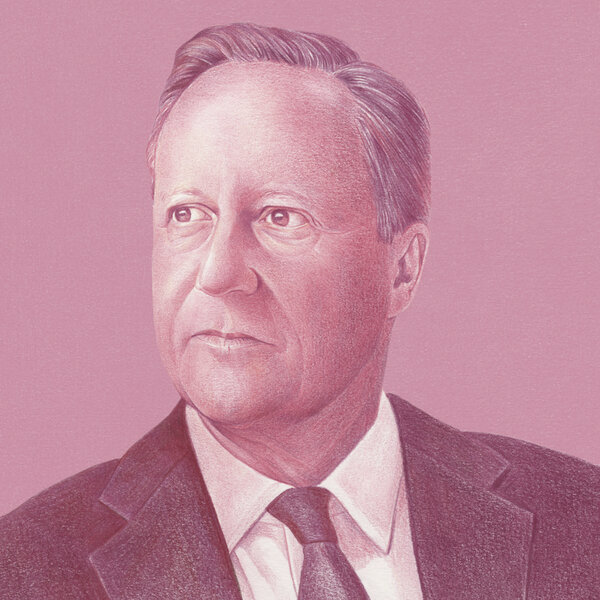
David Cameron discusses his Bloomberg podcast “Ending Alzheimer’s,” including his mother Mary’s dementia progression and his belief Alzheimer’s will be cured, plus policy themes spanning social care funding, Brexit, and UK foreign policy.
David Cameron is a former UK Prime Minister (2010–2016) and later Foreign Secretary under Rishi Sunak (2023–2024). He is interviewed by Michelle Hussain, host of The Michelle Hussain Show (Bloomberg Weekend).
Dementia is driven by brain diseases, not just aging; the UK’s earlier “urgency gap” delayed action. He argues Alzheimer’s can be cured within decades due to improved diagnosis, drugs reducing amyloid (donanemab, lakanemab, and trontinemab in trials), better brain research (including stem-cell-derived brain cells), genomics, and AI-enabled research. He regrets delaying the Dilnot care-cost cap and says insurance should help manage catastrophic long-term care costs.
Mary’s decline included UTI-triggered steep drops, loss of walking and speech, and a final year of near-total shutdown. He cites the 99% drug-trial failure statistic and Professor John Hardy’s 1990 amyloid link. He also discusses Brexit as a “partnership” model with the EU rather than rejoining, and says Russian bots/influencers didn’t change the referendum result.
Written by AI. May contain mistakes.
Michelle introduces David Cameron and the context of their discussion.
“I mean, if my party or anyone else asked me to do something, I would take that very seriously.”
Discussion of Cameron's past political successes and challenges.
“From Bloomberg Weekend, this is The Michelle Hussain Show.”
Cameron shares personal experiences with his mother's dementia.
“Let's dive in with the moment that David Cameron settled into his seat in the studio.”
Cameron discusses the emotional and physical toll of dementia.
“rather than how she was right at the end.”
Cameron talks about advancements in Alzheimer's research and future hopes.
“And before your father died in 2010, he already said that he thought there was something wrong with her memory.”
Cameron shares his vision for future treatments and care for Alzheimer's.
“decades we're talking about the life chances of children born today.”
David Cameron discusses potential future treatments for Alzheimer's disease.
“But with AI, you can have huge numbers of extra researchers, as it were.”
Cameron reflects on the decision to pause the plan to cap care costs for Alzheimer's sufferers.
“But I wondered if knowing what you know now, You look back on a decision you made as prime minister to pause the plan that you had to cap care costs and whether you see it differently now.”
Cameron shares his regrets about policies regarding long-term care during his office tenure.
“Well, look, we certainly didn't solve it.”
Cameron discusses the importance of integrity in business relationships.
“You know, I'm still proud of lots of the things we did.”
Cameron reflects on the implications of Brexit and its impact on the UK-EU relationship.
“And there's a whole chapter in your book devoted to that.”
David Cameron discusses the importance of maintaining partnerships post-Brexit.
“So that would be my position, is let's make the partnership model work best.”
Cameron addresses the impact of Russian interference on the Brexit referendum outcome.
“We're all suffering from problems of terrorism.”
Discussion on whether Brexit has made Britain poorer and its economic implications.
“And do you think Britain has ended up poorer?”
Cameron reflects on the political instability in the UK following the Brexit decision.
“None of those has got anything to do with Europe.”
Cameron discusses the political ramifications of the in-out referendum strategy.
“After that, but look, if you're asking me, do I regret the fact that there was, you know, it was a very tricky period after the 2016 referendum?”
Cameron evaluates his actions regarding the Israeli-Palestinian conflict during his tenure.
“But it was primarily the Conservative Party.”
Cameron expresses his dedication to public service and willingness to return to government.
“Which is the choice of Rishi Sunak to call the election that point.”
David Cameron discusses the challenges and reflections on his political career and decisions.
“And your mother being public spirited, I guess, would approve of that?”
Acknowledgment of the team and summary of the episode.
“and some of the wider context on David Cameron and his record, including, yes, some Brexit stats, courtesy of Bloomberg Economics.”

Get the gist, explore an idea or ask about something said.
 Claude
On The Mishal Husain Show, what are the key points of this episode?
Searching your listeningAutomatic transcript. May contain errors.
0:00Capital is evolving. I've seen brilliant people fail because they forget that they need to motivate people, that they need to gain their trust. Find out more later in this podcast with Thinking Capital from HSBC and Bloomberg Media Studios. For big business, AI opened up a world of promise, but that world of promise turned into a world of pain. Cost spiraling, data trapped, security and governance risks multiplying, and ROI out of reach. That's why enterprises turn to Boomi to connect data, apps, and AI, helping them operate securely, efficiently, and at scale. Boomi turns a world of AI pain into a world of AI gain.
0:40As Boomi says, we got you. Head to boomi.com. That's B-O-O-M-I dot com. The world of business is constantly evolving, and Comcast Business keeps you totally in step with secure AI-backed networking in more than 100 countries. They're powering over 90 % of the Fortune 500 and millions of small businesses. That's a lot of muscle. And behind it all, thousands of experts answering your call at 2 a.m. like it's 2 p.m. One partner powering how business gets done for companies around the globe. When you add it all up, no one does business like Comcast Business. Bloomberg Audio Studios. Podcasts. Radio.
1:23News.
1:28I love public service. I mean, if my party or anyone else asked me to do something, I would take that very seriously. I loved coming back as Foreign Secretary. So if Kemi Badenokh is elected Prime Minister, you are available? I'm absolutely available. David Cameron, 10 years after a Brexit departure from Downing Street, on the causes that move him today. I'd had that slightly idle thought that, well, isn't dementia just something that happens when you get older? And it was partly that sort of embarrassment and shame of realising how wrong I was that made me think, hold on a second, we should be doing much more about this.
2:08From Bloomberg Weekend, this is The Michelle Hussain Show. I'm Michelle Hussain.
2:17There's an interview that I had with David Cameron back in 2015 that's always stuck in my mind because I think it reveals how quickly things can change in politics. It happened at his party's conference soon after he'd won them a parliamentary majority at the 2015 election. And I could see on his face that day, he was on top of the world, set to be prime minister for another five years, for sure, and quite possibly longer. And then a few months later, the Brexit vote. Cameron was on the losing side. He resigned. And since then, while he's published a memoir, he has done very few long form interviews, even in the period between 2023 and 2024, when he came back to government as Rishi Sunak's foreign secretary.
3:11So when we sat down together for the conversation you're about to hear, it was the first time we were meeting in more than a decade, I realized. And it was sparked by the podcast he's made for Bloomberg, which is called Ending Alzheimer's. Over four episodes, he reveals his own mother's struggle with dementia and his hope, his belief, that the disease will become a problem of the past. But of course, there was more to talk about. Brexit, for starters. I don't think he loves being asked about it, but he knows it will always be part of his legacy. And he clearly thinks a lot about how the world is right now.
3:57Donald Trump, migration, the Middle East, how the UK should navigate all of that. So there's a lot happening in this episode. Let's dive in with the moment that David Cameron settled into his seat in the studio. I did enjoy the series. I think there's science and history in it. I put a lot of work into it, actually. It properly put my time in. And also, I'm not a scientist. I mean, I was always asking the dumbest questions. But sometimes that's a good thing, you're sort of helping people get that. Well, at the heart of the series is the personal experience where you and your siblings are talking about what you saw your mother Mary go through.
4:36Set that out for us, how you saw the disease develop in her. Yeah, it's, I mean, to start with, you just notice the forgetfulness, you notice, you know, pauses in memory and repeating things, and that gets sort of worse and worse. But it's not a sort of straight line progression. Often it's connected with your physical health. So I remember when mum went into hospital once with a UTI, that then there was a really steep decline, and then it leveled off again. And so it's not a straight line. But but to start with its forgetfulness, then it gets worse. There's quite a lot of depression because, of course, as you know, this is happening.
5:17You worry about it and you get very depressed about it. So that's another thing. So she did know. Did she talk about it herself? She knew that she was getting forgetful. She knew she couldn't remember things. She kept saying that all the time and she got depressed about that. But that's all, you know, sort of manageable. You work at trying to, you know, be a good son and a good brother and sister and what have you and trying to make it all work. But really, the most depressing part is towards the end. And we argue amongst us, the children, about how long she had it, but seven years, five years.
5:51But the last year and a half, the last two years is really so depressing because everything shuts down. And really, in the last year, she stopped sort of walking. She became more bedridden. She found talking more difficult. By the end, you're not really talking at all. You can't get words out. You know, a lot of your movement goes. And it's, you know, the last few months were really, really difficult. And, I mean, fortunately, we were all there at the end, so we were able to say goodbye. And afterwards, you remember, you know, what your mum used to be like rather than how she was right at the end.
6:28But it is, it's a dreadful disease and it's a terrible way to go. And it is now the leading cause of death in the country. And you say in the series that the disease robbed you of the woman she was. And she does sound like an extraordinary woman, public spirited, served as a magistrate. I was also thinking about everything she must have dealt with in her life. Your father, battle, serious difficulties health-wise all his life. She was a very strong woman. And actually all my friends, when I talk to them about her, they all make this point about, oh, we were all terrified of Mary, they always say, because she was quite a sort of formidable woman.
7:04I mean, to me, she was a very loving mother. She was huge fun and all the rest of it. But she was sort of a strong character. Expected a lot of you. Expected a lot of everybody. And almost, I mean, a lot of people with dementia and the diseases that cause it, of course, there are lots of things you should do to try and protect yourselves. But actually, she was, you know, healthy, outdoors, lots of social connections, pretty fit and all the rest of it. So you did feel you'd been robbed. And I mean, the nice thing was that after dad died, she did have a few really good years of getting out around the world and seeing things and making new friends and going to new places.
7:46And she was a great grandmother to the grandchildren. children. And so we have very, very happy memories. But the last of the seven years of the dementia, you know, the last couple of years were really depressing. But looking back now, do you think she might have had it for 15 years? Because she died in 2025. And before your father died in 2010, he already said that he thought there was something wrong with her memory. Yes, that's right. I think this is difficult because, of course, look, all of us, the thing about your brain is you don't develop new brain cells after a certain age. And so we all have a certain amount of brain atrophy and trying to differentiate between what's just sort of normal forgetfulness and the brain atrophy that we all have a bit of, that trying to work out the difference between that and full-blown dementia caused by one of these diseases is difficult.
8:36I mean, I definitely struggle to recall names and places. We all have that experience of, you know, go to the fridge and open it and you can't quite remember what you're looking for. But I don't know when it really kicked in. That's why I say five years, seven years could be longer. But my father did talk about it. He said, I'm worried about your mother's memory. Well, I was particularly interested in the timeframe because it was in 2012 that you as Prime Minister launched the Dementia Challenge and started talking about it. And I wondered if there was a personal experience that was there in that period.
9:03No, actually at that point in my life, I didn't think either of my parents had dementia. In fact, I didn't really know anyone personally with dementia. I'd come across a lot of people by being a member of parliament and going around care homes and seeing i remember particularly sort of seeing men in their sort of 40s and 50s you know visiting elderly relatives and not being recognized i remember sort of watching that and thinking what a terrible situation it was and then as i say in in the podcast a lot of my interest came from the fact that you know i was then sort of brief properly well of course this is caused by diseases of the brain and i'd had that slightly idle thought that well isn't dementia just something that happens when you get older.
9:44And it was partly that sort of embarrassment and shame of realizing how wrong I was that made me think, well, we ought to do more about this. And as a politician, I also saw that there was a sort of communication problem, which is for years, we've had a really positive attitude that cancer is something we can crack. There's a bunch of different cancers and different diseases, and we need more research, we need better diagnosis, and we need better treatment. But with the area of dementia, which is now, as I say, a bigger killer, there wasn't that same sense of urgency. There was this sort of slight, lots of people had that view that it's just something that happens when you get old.
10:21Well, that's not true. It's caused by diseases of the brain. So that's where the impetus came from in 2012, was the sort of shame and embarrassment about not knowing enough about this and thinking, hold on a second, we should be doing much more about it. There's certainly a lot of sense of time lost. I remember probably not long after the period of your dementia challenge talking to one of the key researchers who said, for years I was talking about this as a disease of the brain, and including the scientific community, kept saying it was just people getting old. So we have lost time. And also, one of the things I think comes out in the podcast is, you know, this great man, Professor John Hardy, discovers in 1990 the sort of connection between the amyloid buildup in the brain and diminution of your mental capacity and some of the genetic background to it and all the rest of it.
11:09That's 1990. And then you fast forward and it's 30 years before we really get some drugs that are doing some good. And then also, again, in the podcast, in 2014, there's this paper called the 99 % paper, which proves that 99 % of the drug trials that have taken place have ended in failure. So it's a long history of failure, partly because not enough effort went in, but also it's the brain. It's difficult to research it. And yet this series is called Ending Alzheimer's, and there is a moment where you say very clearly in it, Alzheimer's will be cured. Just explain why you believe that and how you think it'll happen.
11:51But I think what's happening is that we're making huge progress both on diagnosis. I mean, at the moment, you have a sort of cognitive test, and it's quite difficult and imperfect. We're going to have blood tests soon, probably as soon as 2030, they'll be available. Blood tests, which will really give you a better diagnosis. And we've now got, you know, a couple of drugs and a new one coming along that are stopping the buildup of these proteins in the brain and clearing them away to some extent. I think that is huge progress. But also, I think that we've learned how to do brain research so much better.
12:26One of the moments in the podcast that really blew my mind was in this laboratory in Oxford. I said, what am I looking at now? And they said, well, we're growing brain cells in a Petri dish. These are cells taken from a patient, turned into stem cells, then turned into brain cells. And then you're able to see how they react to different compounds and different experiments. And those sorts of breakthroughs give you enormous confidence that we're going to crack this. And, you know, look, I'm not a scientist. I'm not a medic. But my favourite bit from the podcast is when a scientist says to me, you know, no child born today will have to say such a long goodbye to their parents.
13:03And I think that's incredibly moving. And the idea that there's someone alive today who'll be cured, I think that is an accurate statement. So I think we will get there. It's still a long time frame, isn't it? It's a long time frame. decades we're talking about the life chances of children born today. Well, that's right. But I think the point is that we've now got not only these two drugs, dononomab and lakanomab, that are showing some real breakthroughs. We got another one in trial called trontonomab, which has found a way to sort of shuttle into the brain and work faster at a lower dose. But we've also got, you know, hundreds of trials with hundreds of drugs underway, which is a much better position than we've had for years.
13:41And there is this renewed impetus. And then I think you combine that with, we've got greater understanding of genomics and the genetic nature of these diseases. We've got AI. I know everyone mentions AI, but I mean, the point is AI effectively means that every scientist, of course, they're going to have their PhD researchers alongside them. But with AI, you can have huge numbers of extra researchers, as it were. So I think if you put all those things together, I think we will get to a situation where there will be treatments. My vision is quite simple. In your 50s, you're going to go to the doctor, and as well as all the blood tests you have, you'll have a blood test for the buildup of these proteins in the brain for the science of Alzheimer's, and then there'll be a pill.
14:28Rather like today, you take a statin if you've got high cholesterol. We'll have a statin for the brain, something that will prevent the onset of this disease. So I think that's where we'll get to. And the task, I think, now is to try and get there as quickly as we can, rather than it taking years or decades. The other part of this, and again, you talk about it in the podcast, is the care element and particularly that emotional intensity and the costs that are involved in caring for someone with Alzheimer's. In your mother's case, you paid for that care. You could afford that. But I wondered if knowing what you know now, You look back on a decision you made as prime minister to pause the plan that you had to cap care costs and whether you see it differently now.
15:14Yeah, I think, look, the idea of capping care costs is a good one. And we not only commissioned it through the Dilnot report, but then we legislated for it. But we did delay it once or twice. It was meant to come in, but then I left office. Why it's the right decision is that basically a number of people are paying catastrophic costs for long-term care in care homes. And it is slightly the fickle finger of fate. One person living at number 22 Acacia Avenue doesn't get dementia, keeps their home, passes it on to their children. Next door, they get Alzheimer's. They have to sell their house to pay for care.
15:51But what we found, look, at difficult times in government was, of course, that cap is quite a big subsidy to relatively better off people because they are homeowners with assets and savings. And so the reason it was put off was thinking, well, at a difficult economic time when we were having to get the budget deficit down, get the country's finances in order, is this really the top priority? The disappointment I have is that the aim of a cap really is to say, if we cap the costs, then the insurance industry should be able to come in and do the rest, actually, of sort of saying, right, well, if there's a cap, then you can insure against having to pay up to that cap.
16:32And they weren't willing. They weren't willing. And one of the things I've sort of discovered since leaving office is, you know, frustrated I didn't know more about it at the time, was actually there have been occasions in insurance situations where governments have stepped in. So, for instance, with the potential costs of insurance against terrorist incidents, actually the government stepped in and set up a system. And I do feel that insurance is part of the answer for this problem because, of course, it's not something that affects everybody. So some sort of risk sharing. You do see it differently now then.
17:06I always knew it was a terrible cost. But if you'd had this experience then, you might have thought harder about it because I know you said that it's one of your biggest regrets. Well, it is a regret, but it's a regret we didn't do it and didn't see it through, but we sort of set it up for it to be done. But I think that the reason we didn't do it wasn't that we were idle or feckless or weren't thinking. We thought through very carefully, but thought this is, you know, a two, three billion pound cost, and it's mostly going to go to better off people. So we needed to find a way of making it work.
17:39And I think looking back, this insurance idea, I think, is the right one. I mean, Andy Burnham, all credit, is looking at how we pay for social care. This is a broader set of reforms. Got to look at, you know, how we, the quality of the care that provide and all those other things. But I hope when he looks at this particular issue, which is the catastrophic costs of paying for long-term care, often in a care home, I think there's a real role for insurance. And I think that's where we should be looking. He said that politicians of his generation, he would include himself, obviously, but also you were cowardly in ducking this.
18:15Well, look, we certainly didn't solve it. I mean, you know, as far back as 1997, Tony Blair said, I don't want my children to grow up in a country where people have to sell their home to pay for care. So we've all not managed to solve this problem. I think the Dilmott cap or something like it comes close. But I think it's got to be combined, in my view, with an insurance based solution, because I think that's the way to not put an unnecessary burden on less well off people to pay for better off people to pay for their care. How much time do you spend today looking at your period in office, which ended so suddenly?
18:54I mean, you were only 50 when you left office. Yes, it was now 10 years ago. I mean, of course, you think about it all the time. And I mean, I've always tried. I mean, I'm intervening in politics here by talking about... And you came back as Foreign Secretary. I was an intervention. But I try to sort of limit my interventions. You don't hear me on a daily basis commenting on the government. I don't have a newspaper column or a TV show. Although it's the opposition in government now, so there's nothing to stop you. No, no, absolutely. I just think, as an ex-Prime Minister, I'm very conscious how hard the job is.
19:24And I don't want to make it, you know, obviously I'll make interventions, but I try to keep them limited. Of course, I think about it a lot, about the challenges we faced, about the things that have happened since. You know, I'm still proud of lots of the things we did. We got the economy growing again. We created 1 ,000 jobs a day. We got the deficit down. We've got some big improvements in our schools. But, you know, there are obviously things you wish you, you know, things you didn't do that you wish you'd done and all the rest of it.
19:56As we're in a world that's becoming more and more transactional, I think that integrity with which people hold themselves when they conduct business is paramount. It's not always the best price that wins. It's that trusted partner with integrity where you have a deep relationship. This is Thinking Capital from HSBC and Bloomberg Media Studios, a series decoding the modern pursuit of capital in all its forms, from social to financial capital and cultural to intellectual depth. We'll hear from global experts attuned to every dimension of capital. Sometimes you will not know when that trust has been lost, if you're not looking out for the signs.
20:37The meetings are still happening. You have the person's number on WhatsApp. They're still picking up the phone. And yet something has changed. To hear more from our lineup of global leaders, search for HSBC Thinking Capital.
20:56Most meeting note takers get the easy words right and the important ones wrong. The client's name, the acronym, Whisperflow Notetaker is built to get the hard words right. It takes notes on any meeting platform, Zoom, Google Meet, Teams, even WhatsApp calls, keeps every meeting searchable, and connects to Claude or Chat GPT so you can ask, what did we agree to last Tuesday? Free to try on Mac and Windows at whisperflow.ai. That's W-I-S-P-R flow dot AI. Running a small business takes everything you've got. But with Chase for Business, you're not alone. They bring together local support and a broad range of resources to more than 7 million customers.
21:36With a deep understanding of your day-to-day needs, they provide products and guidance built to help you thrive. Right now, earn$500 when you open a new Chase Business Complete Checking account for new business checking customers with qualifying activities. Offer expires January 21st, 2027. Chase Business Complete Checking has the flexible tools you need to accept payments, make deposits, and manage your finances with confidence. Learn more at chase.com slash podcast biz offer. Chase, make more of what's yours. Fees may apply to Chase Business Complete Checking Accounts. The$500 offer is available for new business checking accounts with qualifying activities through 1-21-2027.
22:15Eligibility and qualification requirements must be met. Additional restrictions may apply. Please speak with a business banker for more information. JPMorgan Chase Bank, NA. Member FDIC. For big business, AI opened up a world of promise, but that world of promise turned into a world of pain. Cost spiraling, data scattered across disconnected systems, security and governance increasingly complex, AI initiatives struggling to scale, and ROI that remains frustratingly out of reach. The challenge isn't AI itself, it's having the infrastructure AI needs to succeed, which is right where Boomi says we got you.
22:52Tens of thousands of enterprises trust Boomi to connect data, applications, processes, and AI. With Boomi, businesses can eliminate silos, automate workflows, strengthen governance, and create the foundation AI needs to perform at scale. The result? Faster innovation, more efficiency, better business outcomes. Boomi turns a world of AI pain into a world of AI gain. As Boomi says, we got you. Head to boomi.com to learn more. That's B-O-O-M-I dot com.
23:35Brexit. Can we talk a bit about Brexit? Because it's 10 years old. And I tell you particularly what I was thinking about as you came here today, because we're recording at Bloomberg, that it was at Bloomberg in 2013 that you made the speech that set out the plan for the in-out referendum. And there's a whole chapter in your book devoted to that. Many chapters in the book devoted to Europe. Well, there's one chapter called Bloomberg. Yes, that's right. Today, do you think that Britain would have a stronger future in the EU? I think I fought the campaign to stay in on an amended basis. And I obviously wanted to win that campaign.
24:07I was desperately disappointed that we lost that campaign. But I'm a Democrat, a believer in democracy. We voted to leave, and I think the right thing now is to try and become, you know, not just neighbours, partners and friends of the EU, but the best friends, the best neighbours, the best partners. And I think we can make that work. But obviously I fought the campaign at the time. I don't take back anything I said then. Yeah, and stronger in. That's why I echo that language. You believed then that Britain's future was stronger in the EU. So today, 10 years on? 10 years on, we're now in a different situation.
24:42We voted to leave. And so I'm not trying to anticipate your next question, but when I look at what the prime minister is trying to do, my advice would be, look, we're in a partnership position with this organisation. And I think Ukraine proved what a brilliant partner we are, probably one of the most capable partner they have. And so I think we should focus on how do we be the best partner? Now, if you start endlessly producing this idea that we're actually on a path to rejoining, I think you're in danger of getting a less good partnership deal. Because, of course, the EU countries will just think, well, these guys are going to rejoin anyway.
25:20So what's the point in giving them a good partnership deal on how we get the most out of the city of London for Europe, how we get the most out of young people being able to work in each other's countries? Andy Burnham set out a few different options, and one of them could end up in the Labour manifesto at the next election. So this could be part of the platform on which the next election is fought, in which case the Conservatives will have to have an answer to it. So if it does end up being fought on membership of the European Union rejoining and Labour win, is that a sufficient mandate in your view, or would you advocate having another referendum?
25:53I think, first of all, we live in a parliamentary democracy where we ask parliamentarians to make decisions on our behalf and be accountable. But I think when you're looking at major changes to the setup, I think there is a role for referendums. And that's why we held referendums not just on Europe, but we had one on the Welsh Assembly, the Scottish Assembly. We had one on the voting system. And yes, we had the Brexit referendum. But I still think that view is broadly right, that, you know, in a parliamentary democracy, most decisions made by parliament, but those sort of more fundamental rules of the game arguments.
26:29So you would have another referendum. I don't want to. I don't. Who knows where we will be? But as I say, my advice would be focus on the partnership. You know, we're living in a difficult, dangerous world. Britain is a big enough country to be a friend, neighbour and a partner and succeed in that way rather than being a member. Let's work on making that on that work. And as Foreign Secretary, I was responsible for our relationship with the EU. And these negotiations will be very tough because that's what the EU does. It's a negotiating organisation. And so if you go with a great idea for greater financial collaboration, they'll be just saying, well, we'd like the fish or we'd like this or we'd like that.
27:09And so if you're not going to commit to trying to make the partnership stronger because you're flirting with rejoining, I think there's some danger. So I'm not sure where you stand today. Because if I look at what George Osborne has said and written recently, he's very clear. Brexit has been a mess. He thinks there should be a rejoining of the customs union. I'm not sure whether you're saying, I've changed my mind on the EU. I don't believe that Britain should rejoin. Are you today a Brexiteer? What I'm saying is today, instead of launching an argument about rejoining, which I think would be a very long and painful argument and who knows where it would end up, instead of that, focus on how do we be the best friend, best neighbor, best partner.
27:49On that, I don't think actually necessarily joining a customs union is the right answer. I think actually we have signed good trade agreements with other countries in the world. when I was Foreign Secretary. My maiden speech to the House of Lords was the bill for the Trans-Pacific Partnership, where Britain has effectively joined a trade agreement with some of the fastest-growing countries in one of the fastest-growing parts in the world. So that would be my position, is let's make the partnership model work best. And if the next Labour manifesto does include rejoining, presumably your party, as it stands at the moment, would then oppose that.
28:29You know, I'm a big supporter of Kenny Baden-Ock. I do some work with her, which I very much enjoy. Every week for Prime Minister's Questions? Not every week, but I started working for John Major in 1990, helping him with Prime Minister's Questions. So in some ways, I'm doing the same job 36 years later. My career hasn't really progressed. But I won't be writing the manifesto. But I think, you know, the right answer, as I said, is we decided to leave. Let's try and make the model work of being friend, neighbour and partner. And it works both ways because, of course, you know, Europe's financial center is still the city of London and Britain.
29:04So let's find a better partnership there. We face these huge security challenges. Let's make a better partnership there. We're all suffering from problems of terrorism. You know, there are lots of areas where let's make the partnership model work. And who knows what's going to happen with these new arrangements with Canada, with what's happening with Ukraine, where it wants to get much closer to Europe and maybe eventually join, but it might be joining in a different way. Who knows what will be there in the future? I think that should be the focus. I think opening up all the arguments about free movement and all of that, I don't think that is a very good use of our time.
29:41Do you think that Russia did affect the outcome of the referendum in 2016? I don't think it affected the outcome, no. I think it's true to say that there were, and I think this, I'm just quoting evidence that, you know, there were Russian bots and influencers trying to influence the debate in the UK. That's always the case. I mean, the fact is our adversaries, you know, Russia, China, North Korea, Iran, they spend a lot of time trying to sow division, distrust and disharmony in our country. That's the nature of that. So I think, you know, it's one of the things that we need to spend much more time thinking about and combating because these other countries are trying to divide us.
30:23When you returned to government in Rishi Sunak's time as Foreign Secretary, did you ask that question? Yes, I know. I asked it at the time. I followed all the debates about it. As Foreign Secretary, you're obviously quite involved in this whole... You asked at the time of the referendum? After the referendum, there was, I think, there was a select committee report that looked into this. My view is the question, were there attempts by others to influence the Brexit debate? Yes. Did they actually have an impact that altered the result? I don't think they did. And do you think Britain has ended up poorer?
30:55No. I mean, I think that... Poorer than it would otherwise have been? Well, that's a very difficult question. If you look at the... I think we have to try and deal with the facts. I mean, since Brexit, we've grown faster than Germany, about the same as France, pretty similar to Italy. We've had a sort of, you know, would we have grown even faster if we'd stayed in. So what Osborne thinks? It's a hard, I mean, we were doing very well in 2015, 2016. We were fastest growth in the G7. The economy was going very strongly. Employment was growing strongly. But since then, we've had COVID. We've had the Ukraine war, which caused inflation to rise to 11 % in this country.
31:32Stripping out those things in the counterfactual is hard. But I don't run away at all from the things I said during the referendum. I thought the best answer for us was the best of both worlds, which was being in, but with these special sets of arrangements we had out of the euro, out of Schengen. I got us out of Ever Closer Union and with better restrictions on paying benefits to people coming to the UK and all the rest of it. But look, I lost that argument. There was a referendum fair and square. I was very careful that the rules of that referendum, we didn't put our hand on the scale in any way.
32:07I argued with everything I had for us to stay in. I lost. I said that. And I decided to resign because I thought the country needed a new prime minister because I'd been on so much on one side of the argument, I wouldn't have the credibility. But as I say, my position is that we've got to make the partnership model work. And I think we can. And I think that's, I think I'd also make one other point, which I think is quite important. I mean, if you look at the economic problems we have today. I don't really think they got anything to do with Brexit at all. I mean, our economic problems are we are overspending, overborrowing, overtaxing, overregulated, and far too much being spent on working age welfare.
32:48Those are a set of problems that have nothing to do with Brexit. We need a government that actually gets spending under control, gets taxes down, helps entrepreneurs, deals with our borrowing problem, reforms the welfare, and massively deregulates so we can build houses, build infrastructure. None of those has got anything to do with Europe. So that's sort of, in a way, that's my point. Do we really want to go into another decade-long debate about whether we should be in or out, when actually we should deal with our own problems while making the partnership model work? I think, now you're getting me fired up, but I think I would advise my party to focus on that rather than reopen the argument.
33:25But here's where I wonder whether you accept some responsibility for something wider, which is the level of political churn. You've just been standing at the cenotaph in a long line of prime ministers, you know, a huge number of living prime ministers. And your party cycle through leaders and prime ministers immediately after that. So the country's capacity to deal with the complicated world that you're describing, as well as its domestic problems, are linked to that decision you took to fight the 2015 election on a plan of an in-out referendum. Well, I think it's certainly true that delivering Brexit turned out to be extremely difficult.
34:04And that was something, I mean, at the time, I remember saying to so many colleagues and saying publicly, you know, don't think that by leaving the EU, you'll suddenly stop talking about Europe. It will become even more engrossing because of the difficulties of these arrangements. And it was a very painful period. I think we go into all the prime ministerial changes. I mean, some of them you might say were partly to do with COVID or more to do with Ukraine and inflation or individual circumstances. Was your party not really being able to decide what kind of leader it wanted or needed in that period after Brexit?
34:38I certainly think the case with my successor, yes, that was very directly connected to the fact she couldn't get her Brexit deal through. After that, but look, if you're asking me, do I regret the fact that there was, you know, it was a very tricky period after the 2016 referendum? Yes, I do. I mean, it was painful to watch. And, you know, I long for us to have a sense of stability. I don't, obviously, I'm not a Labour supporter, but I wish the Prime Minister well because we need to have, you know, stable, sensible, thoughtful administration in our country. But going back to the question about the referendum, and you make the point that the Bloomberg speech was in 2013, I came to the conclusion we were going to need this approach in more like 2011, 2012.
35:27So some people argue it was a sort of flash in the pan, sort of late addition to the 2015 manifesto. It absolutely wasn't. This was part of what I felt was a necessary strategy. But it was an issue in the party, not the country. No, it was an issue in the country. No. Well, okay, here's a quiz question for you. Can you name the party that fought an election between 2000 and 2015 that didn't promise a referendum? Labour promised one over the European constitution, get back in, didn't deliver it. Primarily, it was an issue in the Conservative Party and it ended up becoming a national debate. I don't accept that.
36:00Through the referendum. I don't accept that at all. We had treaty after treaty, you know, the Maastricht Treaty, the Nice Treaty, the Amsterdam Treaty, each time you had political parties promising referendums and not delivering them. I thought it was unsustainable to have the situation where you keep having powers passed from Britain to Brussels and treaties passed and referendums promised and never delivered. I think it was poisoning our politics and not just in the Conservative Party. As I say, if it was just the Conservative Party, why did Labour promise a referendum? But it was primarily the Conservative Party.
36:30It was a big issue in your party. Come on. Yes, it was. But it was a big issue for the country. A bigger issue in your party than other parties. As I say, every party promised a referendum at some stage during that process. I want to ask you about the period that you had as Foreign Secretary when you came back to serve in Rishi Sunak's time. It was right after the Hamas attacks of October 7th. Today, looking at Gaza, where there's a terrible situation with floods and displaced people being flooded out of tents, and we know that the death toll is about 70 ,000 people, of whom it's thought that 20 ,000 were combatants.
37:02Do you look at that period when you were Foreign Secretary and wish that you had acted to restrain the Netanyahu government? I look at that period and think we did a huge amount to try and get the Israeli government to focus on the need to get aid into Gaza to treat prisoners properly and to try to bring about the changes that were necessary. This was dialogue. I don't think you took action. Well, we took action in that I went to Israel repeatedly. I used all the leverage that we had to try and get aid in, and I think it did work to an extent. But it was incredibly frustrating. But I think we were right in our overall position in that this was a horrific attack on Israel, and we wanted to demonstrate our support in the light of that.
37:57But we also, I had some very, very tough conversations and I did take action. For instance, I did sanctions and travel bans against violent settlers and put in place the sanctions that were done. Well, actually, one of the things, one of my few interventions after the election was to ask the question, well, why haven't Smotrich and Ben Gavir been sanctioned in the way that I was just about to do before the election intervened? So, no, I think we had the right. Which is the choice of Rishi Sunak to call the election that point. But I'm thinking about a moment a few months before, April 2024. Because in all of this period, arms exports licences continued.
38:34You didn't stop that. And that was even the case after three British citizens, James Kirby, James Henderson, John Chapman, had been killed in the World Central Kitchen attack on an aid convoy. Even at that point, you didn't stop the arms export licences. Well, you had to ask yourself the question, you know, what will the effect of this be? Will it actually have an impact on what is happening? And my conclusion was it wouldn't. And you also got to ask, what are the other consequences? Because there are programs like, I think, the F-35, where there's quite an integrated supply chain. Of course, the F-35 is very important to our security.
39:11So my conclusion was that to do more than what we did would have been pretty much performative. and I think actually if we look at what's happened since, I would argue that it was largely performative. And also you could say the same about the recognition of Palestine. Now I moved the dial on that by saying, when I was Foreign Secretary, by saying that it shouldn't come at the end of the process, that recognition of the Palestinian state should be part of the process. It doesn't have to wait for the end. And it's something, you know, I always thought the American position, it was going to be the last thing that happened.
39:44I thought that was wrong and I made that very clear. But again, I would say the decision the government made actually in the end was quite a performative one because it just threw this bone out, as it were, to the backbenchers rather than saying, let's make the recognition of Palestine part of the political process that we want to see. Okay. So 70 ,000 dead in Gaza and you don't think you should have taken more action while you could have. did a lot of things to try and help the people in Gaza by going to Egypt, going to visit the aid convies, putting the money in. Also, by the way, the government I led increased the aid budget to its highest level ever.
40:24So we were able to intervene in these sorts of humanitarian crises. But it was an extremely difficult situation. But I don't think the things that people were asking me to do on, for instance, the arms ban, I think they would have been performative rather than real. And I think they might have damaged our own security in a dangerous world because of things like the F-35. Could you see yourself coming back to government again? I love public service. I mean, if my party or anyone else asked me to do something in public service, I would take that very seriously. I loved coming back as Foreign Secretary.
40:55I mean, I joked at the time that I thought I'd do it okay because I'd served an apprenticeship as Prime Minister for six years. But that wasn't entirely unserious because, of course, foreign secretaries, you need to know the people, know the issues, know the leaders. And obviously, the more as foreign secretary, you could go to Israel and not just meet the foreign minister, but actually, you know, hammer your fist on the table with Netanyahu, which I did several times and meet the president because you knew him already. You've been dealing with him for 20 years. So if I was offered a job like that in future, you know, circumstances depending, but I'd love to do something else.
41:29So if Kemi Badenok is elected prime minister, you are available. I'm absolutely available. I haven't said that to her, but I'm very happy to make sure I do. Because, look, I love public service. It's the thing that motivates me more than anything. I hope I approved working with Rishi, who I found a very good boss. You know, I don't have to be the boss. I'm very happy being part of the team. He was great to work for. He was always on top of the detail. He chaired meetings brilliantly. He really knew what he wanted to achieve. He was very easy to work for, and it was an absolute pleasure. I was only sad it wasn't longer.
42:02And your mother being public spirited, I guess, would approve of that? Well, I hope so. I think it was obviously difficult being the parents of a prime minister, because, of course, often when you do something, you know, people think you're terribly busy, so they don't bother you, but they ring your parents. So I remember when I did equal marriage, gay marriage, which I was very proud of, and it was a great social reform. You can imagine my parents had lots of friends who thought, you know, this was a terrible idea. Although my parents were always very supportive, but they were inundated with phone calls.
42:37What does David think he's doing? And, you know, I did feel sorry for them. I thought it's not fair. They're getting the grief for decisions I've taken because people think I'm too busy to talk to them. It does make me wonder how close ideologically you are to someone like Kemi Badenok. because you were proud of having the greenest government ever. She wants to repeal the Climate Change Act. You were proud of overseas aid and protecting it from cuts, even at a difficult time. She wants to reduce it by something like 90 % from where it is now. So, look, we do have some different outlooks, but I'm a team player.
43:09She is the leader of my team, and that's why I don't do many public interventions because I try and give my advice privately if it's required, and I want her to do well. I actually think on the climate issue, I'm very proud that we were a very green government, big investments in renewable energy. We've got the world's biggest offshore wind industry going. But some of the targets that were subsequently set by Theresa May and Boris, I thought, you know, they were done without, I think, perhaps enough attention to how exactly they were going to impact the cost of living. So coming away from some of those, which actually even this government is now doing on, for instance, the electric car mandate and all the rest of it.
43:51So being pragmatic. I mean, conservatives, we do care about the environment. We care about what we pass on to our children, but we're pragmatic. And I think the pragmatism is important. So I think Kemi has some reasonable points on that. The thing that might surprise you is on ECHR and all those sorts of things. I think she's absolutely right. Look, one of the reasons we've got such a problem with populism in our world is politicians of the center right and center left have not done enough to tackle illegal migration. You'd be comfortable with leaving the European Convention on Human Rights, being with Russia and Belarus that are outside it.
44:26I think that's a sort of classic kind of, you know, easy way of putting it. I put it a different way. We have to do whatever it takes to stop the small boats and to stop the illegal migration that is not only making it impossible to have a sensible conversation about migration more broadly. arguably it's stopping us having a sensible conversation about lots of things in politics because ordinary people just look at this situation clear day in the channel a thousand people getting into boats and breaking into our country and they think this is outrageous are you sure it would stop the boats well not on its own of course it won't but there we have to do everything it takes i mean i have many many disagreements with donald trump let me tell you but actually when he sort of shut the border right at the beginning of his term he probably should have left it at that rather than all the ice raids and everything else.
45:12But that moment, he showed people, I understand your concern about illegal migration, and we put up with it for too long. And I think that's the situation we're in. So I would say to Kemi, whatever it takes, we've got to fix this problem. Because not least, if we don't fix it, we're not going to be able to have a sensible conversation about other things. You've still got so much to say, which just makes me wonder, finally, how much of a frustration it's been for your political career, at least at as prime minister to have ended when you were only 50? Well, I was party leader for 11 years. And so you've got my book open in front of you.
45:50There's quite a lot on being leader of the opposition. Some people say, why do you want to write about all of that? But actually, to me, it's an important period because I led the Conservative Party for 11 years, which is a very long time. I was prime minister for six years. Of course, I wanted to go on longer. But, you know, that was a long period of time leading a political party. I was delighted to come back as Foreign Secretary. But, you know, you have to find another way of living your life. You know, I don't spend every day intervening in politics. I'm proud to sit in the House of Lords.
46:21I make a contribution. But I get on and do other things, like Alzheimer's research, like the work I'm doing on rare diseases with Oxford University, which are another form of public service. You can make a big difference on some of these issues by focusing on those rather than what's happening right now in Parliament. David Cameron, thank you. Thank you.
46:49Quick question for you. How much of your day is spent typing? Email, Slack, notes, prompts to chat GPT? Whisperflow is a voice-to-text app. Instead of typing, you talk and it types for you in any app on your Mac, Windows, iPhone, or Android. It takes out the ums, fixes the typos, and the result sounds like you wrote it, four times faster than typing. So the email that used to take two minutes now takes 30 seconds. Whisperflow is free. Download it at whisperflow.ai. That's W-I-S-P-R flow dot A-I. Running a small business takes everything you've got. But with Chase for Business, you're not alone.
47:24They bring together local support and a broad range of resources to more than 7 million customers. With a deep understanding of your day-to-day needs, they provide products and guidance built to help you thrive. Right now, earn$500 when you open a new Chase Business Complete Checking account for new business checking customers with qualifying activities. Offer expires January 21st, 2027. Chase Business Complete Checking has the flexible tools you need to accept payments, make deposits, and manage your finances with confidence. Learn more at chase.com slash podcast biz offer. Chase, make more of what's yours.
47:59Fees may apply to Chase Business Complete Checking Accounts. The$500 offer is available for new business checking accounts with qualifying activities through 1-21-2027. Eligibility and qualification requirements must be met. Additional restrictions may apply. Please speak with a business banker for more information. JPMorgan Chase Bank, N.A., member FDIC. For big business, AI opened up a world of promise, but that world of promise turned into a world of pain. Cost spiraling, data scattered across disconnected systems, security and governance increasingly complex, AI initiatives struggling to scale, and ROI that remains frustratingly out of reach.
48:37The challenge isn't AI itself, it's having the infrastructure AI needs to succeed, which is right where Boomi says we got you. Tens of thousands of enterprises trust Boomi to connect data, applications, processes, and AI. With Boomi, businesses can eliminate silos, automate workflows, strengthen governance, and create the foundation AI needs to perform at scale. The result? Faster innovation, more efficiency, better business outcomes. Boomi turns a world of AI pain into a world of AI gain. As Boomi says, we got you. Head to boomi.com to learn more. That's B-O-O-M-I dot com. If you listen to financial news, you know a lot of time is spent thinking about what's next.
49:22The next opportunity. The next investment. The next move. But sometimes what matters most is being ready for what you never saw coming. A storm damages a second home. A pipe bursts above a collection you spent decades building. An unexpected loss puts a growing business on pause. Those are the days no one sees coming. But for more than 75 years, Cincinnati Insurance has been ready when they do. With deep expertise, coverage for businesses, homes, valuables, and more, Cincinnati Insurance works with independent agents who take the time to understand what matters to you. Together, they help protect more than what you own.
49:59They help protect what you're building toward. And when a bad day does come, Cincinnati Insurance has real people there to help make things right. Because planning for the future isn't only about knowing what's next, it's about making sure you're ready for what you can't predict. Let Cincinnati insurance make your bad day better. Find an independent agent at CINFIN.com.
50:44and some of the wider context on David Cameron and his record, including, yes, some Brexit stats, courtesy of Bloomberg Economics. Those notes are published for every episode, and they're at bloomberg.com forward slash Michelle. And so to the team, Jessica Beck and Chris Martlu are the show's producers. The video is produced and edited by Andy Haywood. Guest booking is by Elan Bird. Social media by John Horsville. production assistance from Indira Ray. Our music is by Bart Warshaw and the executive producer is Louisa Lewis. For this episode, John Canfield was running the studio. Special thanks to Alex Wickham, Brendan Scott and Penny Crook.
51:29And at Bloomberg Weekend, to Brendan Francis Newnham and our executive editor, Catherine Bell.
51:43If you listen to financial news, you know a lot of time is spent thinking about what's next. The next opportunity. The next investment. The next move. But sometimes what matters most is being ready for what you never saw coming. For more than 75 years, Cincinnati Insurance has worked with independent agents to help protect businesses, homes, valuables, and more. Because planning for the future isn't only about knowing what's next. It's about making sure you're ready for what you can't predict. Let Cincinnati Insurance make your bad day better. Find an independent agent at CINFIN.com. Most meeting note takers get the easy words right and the important ones wrong.
52:25The client's name, the acronym. Whisper Flow Note Taker is built to get the hard words right. It takes notes on any meeting platform. Zoom, Google Me, Teams, even WhatsApp calls. keeps every meeting searchable, and connects to Claude or Chat GPTs. So you can ask, what did we agree to last Tuesday? Free to try on Mac and Windows at whisperflow.ai. That's W-I-S-P-R flow dot A-I. For big business, A-I opened up a world of promise, but that world of promise turned into a world of pain. Cost spiraling, data trapped, security and governance risks multiplying, and ROI out of reach. That's why enterprises turn to Boomi to connect data, apps, and AI, helping them operate securely, efficiently, and at scale.
53:11Boomi turns a world of AI pain into a world of AI gain. As Boomi says, we got you. Head to boomi.com. That's B-O-O-M-I dot com. The world of business is constantly evolving, and Comcast Business keeps you totally in step with secure AI-backed networking in more than 100 countries. They're powering over 90 % of the Fortune 500 and millions of small businesses. That's a lot of muscle. And behind it all, thousands of experts answering your call at 2 a.m. like it's 2 p.m. One partner powering how business gets done for companies around the globe. When you add it all up, no one does business like Comcast Business.
How close are we to drugs that could cure Alzheimer's? David Cameron, who served as UK prime minister from 2010 to 2016, believes the pace of progress will soon make it a problem of the past.
In a new Bloomberg podcast, Cameron speaks to scientists at the cutting edge of research, including those pursuing a statin-style preventive pill. For the former prime minister, this mission is personal, as he explains in a conversation with Mishal Husain. His mother, Mary, died last year of a disease he says robbed the family of a “formidable” woman.
Cameron also talks about his own record on healthcare, the legacy of Brexit, his brief return to government in 2023 as foreign secretary and the future of the UK’s Conservative Party.
Subscribe to ‘Ending Alzheimer’s’, a new podcast from Bloomberg, presented by David Cameron: https://swap.fm/l/FbwsUBoi6WQfTX0W7Wx
Contact The Mishal Husain Show [email protected]
Visit https://www.bloomberg.com/mishal to read Mishal’s notes and reflections on this conversation.
Subscribe today on Apple Podcasts and Spotify.
See omnystudio.com/listener for privacy information.