In short
The Naked Scientists Podcast: Eradicating Polio
Episode Overview In this episode, the Naked Scientists delve into the journey toward eradicating polio, a highly infectious disease primarily affecting children, which can lead to paralysis. The episode discusses the virus's history, vaccination efforts, and the current challenges in its eradication.
Key Topics
Understanding Polio
- Definition: Polio, or poliomyelitis, is caused by a virus that infects humans and can lead to paralysis.
- Infection Statistics: Most infections are asymptomatic; only about 1 in 200 lead to paralysis.
- Historical Impact: Polio was a major health crisis in the 20th century, crippling thousands, including notable figures like Franklin Roosevelt.
Transmission and Mechanism
- Transmission Method: Polio is transmitted via the fecal-oral route, often through contaminated hands or food.
- Pathogenesis:
- The virus enters the body, replicates in the intestines, and can then enter the bloodstream.
- It can invade the central nervous system, leading to paralysis, particularly affecting respiratory muscles.
Vaccination Efforts
- Vaccination Types:
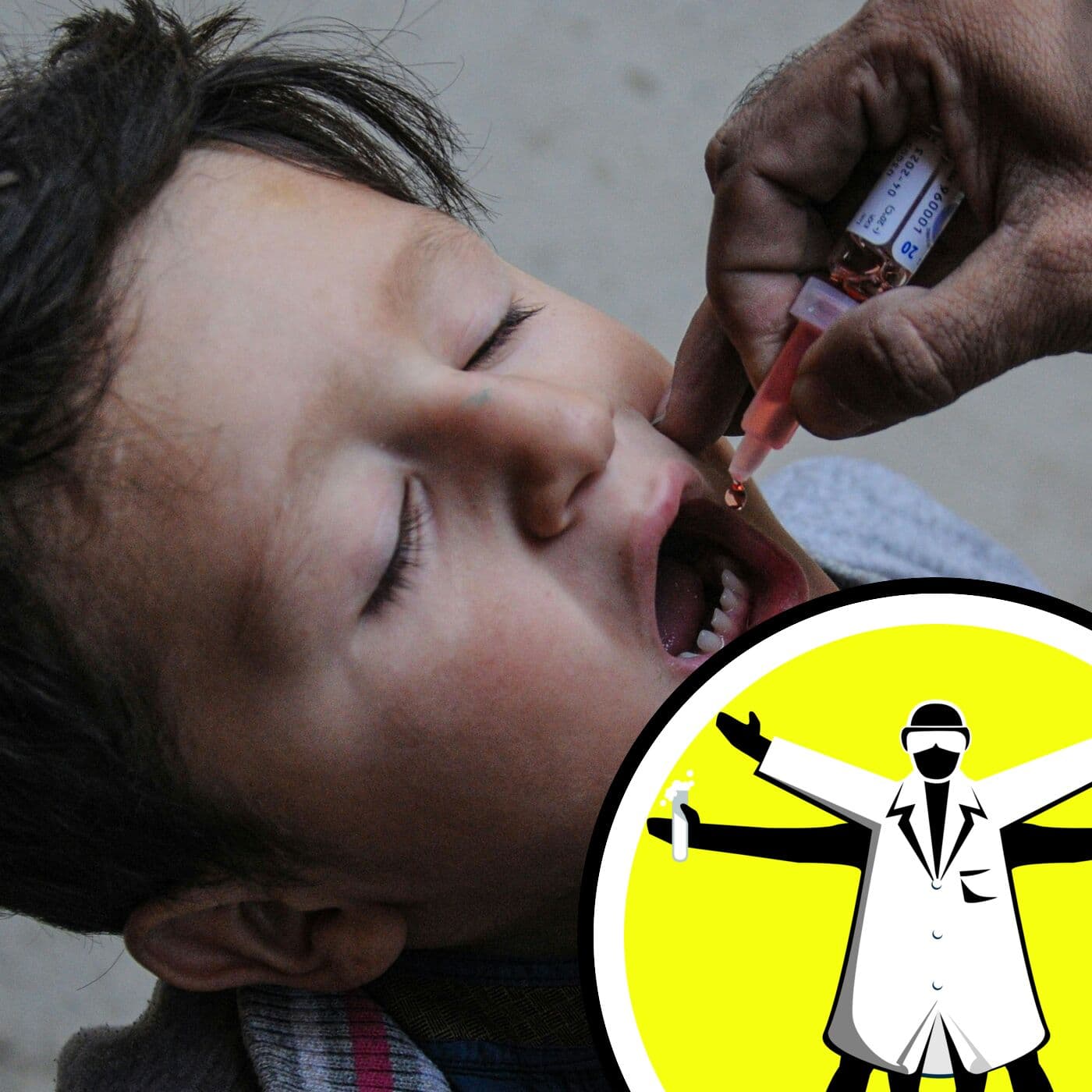
- Oral Polio Vaccine (OPV): Contains weakened virus; effective but poses a risk of reverting to a virulent form.
- Inactivated Polio Vaccine (IPV): Contains killed virus; safer but less effective at inducing community immunity.
- Virus-Like Particle (VLP) Vaccine: A newer approach that mimic the virus structure but contains no genetic material, minimizing risk while still eliciting a strong immune response.
Challenges in Eradication
- Current Statistics: Polio continues to circulate in regions like Afghanistan and Pakistan, with recent counts showing ongoing transmission.
- Barriers:
- Security Issues: Ongoing conflicts hinder vaccination efforts in certain areas.
- Community Engagement: Success in eradicating polio requires strong community involvement and education on vaccination importance.
The Path Forward
- Eradication Success:
- Two of three wild polio virus types have been eradicated globally.
- Ongoing surveillance and vaccination are crucial for maintaining polio-free status in regions previously affected.
- Global Cooperation: A unified effort in funding, policy, and scientific research is needed to push for the final eradication of polio.
Key Takeaways
- Vaccines have dramatically reduced polio incidence, but challenges remain in certain high-risk regions.
- New vaccine technologies, like the VLP, offer hope for a more effective and safer approach to immunization.
- Continued vigilance, community involvement, and global cooperation are essential to achieving complete eradication.
Conclusion The episode ends on a hopeful note that, despite the challenges, the global community is closer than ever to eradicating polio. With the right efforts, tools, and community engagement, polio could soon be a disease of the past.
For more updates and to support the Naked Scientists, listeners are encouraged to check their website and social media platforms.
Written by AI. May contain mistakes. Listen to the episode to check what was said.
Chapters
Tap a time to open that second in VOUnderstanding Polio: A Historical Perspective
1:26 to 2:38
Overview of polio's history, its impact, and the role of vaccination.
“in the worlds of science, technology and medicine.”
Kath O'Reilly Explains Polio
2:38 to 3:51
Kath O'Reilly describes polio, its effects, and its transmission.
“Here's Kath O 'Reilly from the London School of Hygiene and Tropical Medicine.”
The Mechanics of Polio Infection
3:51 to 5:05
Details on how polio infects the body and its effects on the nervous system.
“individuals, the brain is no longer able to control the moving of the diaphragm.”
Treatment and Historical Responses
5:05 to 9:03
Discussion on treatments for polio paralysis and historical efforts to combat the disease.
“However at a global level that the estimates are prior to the introduction of vaccination about 300 ,000 individuals potentially up to a million you know we really don't know.”
Vaccination Strategies Against Polio
9:03 to 10:12
Exploration of how vaccines have changed the landscape of polio prevention.
“but it really was a pretty permanent paralysis.”
The Science of Live vs. Killed Vaccines
10:12 to 14:05
Discussion on the differences between live and killed polio vaccines and their efficacy.
“It's basically just the outer shell of a poliovirus.”
The Science Behind Live Vaccines
14:05 to 16:41
Discover the benefits and risks of live vaccines in providing polio immunity.
“Absolutely and unfortunately therefore if that vaccine has mutated, you spread in the same way.”
Innovative Virus-Like Particles
16:41 to 19:28
Learn about the development of virus-like particles for safer vaccination.
“And also we make this just from protein, which we make in different expression systems.”
Current Polio Transmission Hotspots
19:28 to 21:49
Understand the regions where polio is still active and the challenges faced.
“My perfect day as sand, salt, water, and friends.”
Strategies for Global Eradication
21:49 to 24:56
Explore the strategies needed to eradicate polio globally and the ongoing efforts.
“The count as of now stands at 44, including 31 cases in Pakistan and 13 from Afghanistan.”
Show all 15 chapters
The Feasibility of Eradicating Polio
24:56 to 28:01
Examine the challenges and possibilities of reaching polio eradication.
“as one of the very few diseases ever eradicated worldwide.”
Challenges in Polio Eradication
28:01 to 29:13
Learn about the ongoing challenges and efforts needed to eradicate polio globally.
“We also need a unified global and sustained effort to essentially keep pushing to reach that finish line.”
Surveillance Strategies for Polio
29:14 to 31:08
Discover the key surveillance methods used to monitor polio virus circulation.
“And when we do achieve it, how will we keep an eye on things and for how long so that we know we really have achieved it?”
Polio-Free India: A Case Study
31:09 to 32:27
Explore how India successfully maintained polio-free status for 15 years.
“And then for the past 15 years, it has been maintaining sensitive surveillance systems through these primary modalities that I just mentioned, syndromic paralytic surveillance and the wastewater or sewage surveillance.”
The Fight Against Political Instability
32:28 to 32:38
Understand how political instability poses a threat to polio eradication efforts.
Transcript
Automatic transcript. May contain errors.0:28My perfect day as sand, salt, water, and friends. allergic to SkyRizzy. Serious allergic reactions, increased infections, or lower ability to fight them may occur. Before treatment, get checked for infections and tuberculosis. Tell your doctor about any flu-like symptoms or vaccines. Thanks to SkyRizzy, there's nothing on my skin, and that means everything.
0:49Ask your doctor about SkyRizzy, the number one dermatologist prescribed biologic in psoriasis. Visit SkyRizzy.com or call 1-866-SKYRizzy to learn more.
1:04all engine running absolute genius get this welcome welcome this is the show where we bring science what that essentially means is discovery advances research technology unbelievable without further ado this is the naked scientists hello welcome to the naked scientists podcast the program that brings you the biggest breakthroughs and also talks to the major movers and shakers in the worlds of science, technology and medicine. I'm Chris Smith and this week we're going to be unpacking the efforts to eradicate polio.
1:43For much of the 20th century, polio was one of the most feared diseases in the world. It's a highly infectious viral illness. In fact, there are a family of three separate polio viruses, all capable of invading the nervous system and, in severe cases, causing permanent paralysis and death, often through problems with breathing caused by respiratory muscle weakness. This was in fact how the iron lung came into being. At its peak, polio outbreaks paralysed hundreds of thousands of people every year, including Franklin Roosevelt, who would go on to become the longest-serving US president. Vaccination, however, has since transformed the picture, pushing the virus to the brink and eliminating it from all but a handful of regions.
2:25Because it is exclusively a human infection, it's also one that we can potentially eradicate for good, and we'll unpack how health leaders internationally are making great strides towards that goal a bit later on. But first, let's find out what exactly is polio. Here's Kath O 'Reilly from the London School of Hygiene and Tropical Medicine. Polio is just like the shortened word for the full name, poliomyelitis, which is the description of the disease that this particular virus causes. This pathogen, this virus, it infects just humans. And actually, a majority of the infections are essentially nothing to be concerned about.
3:08You might not even know that you're infected. but for example for every 200 infections about one individual might have this poliomyelitis and so what this is it's paralysis and so typically it's paralysis in the arms or the legs and a disease of children in a majority of settings. It also affected people's respiratory system didn't it because that's where the iron lung came from the whole idea of putting people in tubes that breathed for them because they just couldn't. Yeah, it goes into the brain stem and it's able to basically paralyze other parts of your system. But for these unfortunate individuals, the brain is no longer able to control the moving of the diaphragm.
3:57And so there were some really dramatic steps that were taken to put individuals in these sort of big chambers that would essentially control the air in their system so that it can force the lungs to sort of breathe air in and out but this was essentially the only way that someone could stay alive. Paul Alexander was the famous man in the iron lung he died a couple of years ago he spent his entire life died at the age of 78 he was a lawyer he was used to practice law from within his iron lung how many people obviously nowadays it's different but when he was growing up how many people would expect to catch polio in a country like the uk per year and and either be in the category who end up with a serious problem with their nervous system versus just what we think of a non-serious infections with it what are the numbers look like historically yeah we're not too sure actually.
4:55One of the challenges is that this manifestation can be caused by a number of different pathogens and so whilst we might be able to count paralysed individuals we couldn't really say how many were caused by poliovirus. However at a global level that the estimates are prior to the introduction of vaccination about 300 ,000 individuals potentially up to a million you know we really don't know. It's thankfully rare these days but I mean I'm not that old but I remember as a child growing up there was a lady who lived down the road from me who walked with a quite serious limp and she had had polio as a child so I mean it was a very visible manifestation in those days.
5:40What can you tell us about the actual agent itself? You've said that humans are the only natural host for polio virus but what actually is it? Where does it come from? How do we catch it etc. It's a tiny, tiny little virus. Virologists refer to it as faecal oral transmission. But essentially what this means is that it's found in poo. I've got a small daughter currently, and I was trying to change her nappy this morning. She was not helping at all. And, you know, it just made me think about how easy it is for basically stuff in poo to be transmitted into your hands. If you're not washing your hands before you've prepared food, then, you know, you might accidentally consume some of that contamination.
6:22And so it's this kind of natural process really that results in spread of virus from one person to another. Okay, so it gets where you'd rather it didn't, you eat it effectively. Once it's in the mouth, where do the virus particles go next? So it goes in the same place where your breakfast might be go in, so down into your gut. And so the virus is able to infect you. Basically, it attaches to your cells in your stomach. And once the virus is able to infect you, it can then start to multiply inside you. And viruses do this very clever thing where they take advantage of your cell machinery to reproduce more viruses.
7:09You know, you might only need a small number of viruses to be consumed for you to basically become a virus factory. So it goes down your throat, replicates in the lining of the intestine so it can get out of the body and do what your daughter did this morning and spread. But in the process, it then presumably in some people, it's into the bloodstream and that's going to take it to other organs which can include the central nervous system and that's that's the origin of the paralysis is it gets into the nervous system. Exactly and and virologists and pathologists think that this almost might be a horrible accident if we think about it from the virus's perspective there's no benefit to cause paralysis in individuals if anything you're less likely to be infectious once you're paralyzed.
8:00were there any treatments that could be thrown at this or we can throw at cases because this is still going on around the world isn't it in some in some places unfortunately this is happening on a daily basis are there any treatments we can throw at this or once you get that paralysis is that it well once you get the paralysis it is pretty much permanent going back to the 1950s and there was this setup of a charity in the United States called the March of Dimes. So Franklin D. Roosevelt was someone who acquired polio relatively late on in life. And he was determined to develop treatments for individuals that have developed this paralysis.
8:43So a lot of this is a lot of therapy. So physiotherapy and also improving how individuals can make use of these limbs, even though they might have less ability to sort of use their muscles. It might become less severe over time with this therapy and with age, but it really was a pretty permanent paralysis. Kath O 'Reilly at the London School of Hygiene and Tropical Medicine there. Now, as Kath mentioned, vaccines have been game changers at the forefront of the global fight against polio, turning what was once a devastating disease into one that is now largely preventable. The vaccines work by building a lifelong immunity to the virus, so even if we do run into it, any infection is trivial.
9:29Through their use, we're now closer than ever before to eradicating polio. But developing and delivering vaccines isn't straightforward. Vaccines based on weakened, live forms of polio are very effective, but they're also seeding potentially viable viruses back into the environment, making eradication paradoxically more tricky in the long run. Vaccines based on killed poliovirus, on the other hand, are safer, but they're harder to administer and they may have an overall lower coverage. There is, however, potentially a third way. A new generation of vaccine that is extremely good at driving a powerful immune response but comes without the risk of it being a live virus.
10:12It's called a VLP, virus-like particle. It's basically just the outer shell of a poliovirus. Nicola Stonehouse, a virologist at the University of Leeds, has been developing it. I asked her first, though, to explain the background to the existing polio vaccines. So there are two sorts of vaccines. There are what we call the oral polio vaccine and the inactivated. The oral one, many of us who are sort of, let's say, over 40 will have had. And this is like a little drop on your tongue. And this is a virus which has really had the stuffing knocked out of it. The immune system still recognises it as polio, but it doesn't cause disease or it shouldn't cause disease.
11:00When you say it's had the stuffing knocked out of it, it's live. It still infects, but it doesn't cause disease. That's right. So, yeah, so it can still infect, which is why you can take it in the same way as you actually still would be infected by polio. That's, you know, through the mouth. So it can get inside the body. It can replicate more copies of the virus can be made, which actually makes it a very effective vaccine. But it can't cause disease. There are three polio viruses out there naturally. Are all of them in the vaccine in weakened form like that? There are different formulations over time that have been used.
11:41But in order to do all that early eradication, then yes, it was a mixture of the three different types of polio. Unfortunately, there's not cross protection. So in a worst case scenario, you can have polio three times if you don't have those three different types in your vaccine. We no longer see types two and types three in the wild. we only see type 1 but we do see some vaccine derived polio cases. And what are they and is that the reason why we have killed vaccine now because there was a big change wasn't there it's about 15-20 years ago now but we stopped using live vaccine like you've been describing in countries like the UK in favour of a killed vaccine is that the reason?
12:30Some countries still use live vaccine. Some countries in fact have never used a live vaccine. So it is a complicated transition. But there is a risk of a live vaccine of whatever sort converting back to causing disease. And this can be from an event where there's what we call recombination, where there are very similar viruses that are circulating around, which are not causing disease. But there can be a kind of joining, if you like, of those viruses with the vaccine, and that can result in the vaccine regaining some virulence along with mutation. It's very, very rare, but it happens. And when we use these live vaccines, how do they actually protect us?
13:17What do they do that means that when we do encounter polio for real, if we do, we don't succumb to it? So we believe that the main protection for polio are antibodies. So the immune response that's generated to the vaccines means that the body produces antibodies and that memory is retained so that if you then get infected again, that memory response means that you produce antibodies quickly and you can combat the disease. So actually, I think some vaccines don't give you long term immunity, whereas vaccines like polio that we have as children actually then protect us for the rest of our lives.
14:04And is that the rationale for using live vaccines still then rather than killed ones because we get longer term protection? So it's a more agile intervention? no not necessarily so the the vaccines that are live can replicate so they are they are still producing more more virus particles more vaccine if you like in the body and they do that in the gut so you get a sort of a gut response which is much more native it's much more normal and that gives you better protection so it gives you what we call mucosal immunity it also means you can spread that person to person which can be also very helpful.
14:47That's intriguing so you're saying if I get the live polio vaccine I can actually infect you with my vaccine and protect you as well so there's a degree of a wider envelope of coverage than just the people you immediately give the vaccine to. Absolutely and unfortunately therefore if that vaccine has mutated, you spread in the same way. Yes. Ouch. So we now have this combination of live vaccines, which are still used, but we've reduced their use in some geographies to avoid this risk of them reverting back to a virulent form, but we're still using them in some places. We have a killed version, which can't do that.
15:28And therefore, ideally, we'd like to just use that, but we can't use it everywhere quite yet so that we need to transition between the two. What's your other option that you're now able to put on the table? What we've been trying to do over the last 15 years or so is to produce what we call virus-like particles, something that the immune system will see as a virus but it contains no genetic material so it hasn't been made from virus it's never been in contact with viruses and therefore is completely safe both to make and also to use in essence then it's a bit like an empty husk it's the it looks like a virus the immune system thinks it's a virus but it has no ability to make more virus therefore it cannot cause disease yep yep it's it's an empty shell how do you make it then?
16:25So it sounds very straightforward, doesn't it? So you think, my goodness, has this taken 15 years? Because normally, you would have the container or the husk, as you mentioned it, full of genetic material, and that partly stabilises it, it stops it getting deformed. So if we have no genetic material, we have to put in some stabilising mutations into the virus surface into the capsid structure in order to stabilise that and mean the shape doesn't change and therefore the immune system really does see this as a virus. And also we make this just from protein, which we make in different expression systems.
17:08We can use plants, we can use yeast, we can use insect cells, because these are cheap manufacturing systems. If you're going to make a vaccine that's going to be used worldwide and it's also going to be compatible with current childhood vaccines it's got to be cheap. In essence then you program yeast or insect cells to make the outer coat of the polio virus but there's no innards but because there's no innards it would be unstable and deformed so you have found ways to engineer some changes to effectively adds some struts to prop things open so it stays strong and it stays looking like a virus right the way to where the immune system can see it.
17:55Ingenious. This makes the structure more stable to temperature because quite often vaccines are not very temperature stable and if you think about the challenges of trying to vaccinate in some parts of the world where the external temperatures can be very high, then everything's got to be kept cold. These particles that we've generated are really quite thermally stable. So you can heat them up and they don't change. They are nice. They stay as we want them to be. The proof, of course, is in the pudding or the proof is in the eating in some respects. It's not an oral vaccine, this one, though, is it?
18:34But is it any good? How have you tested this? Polio is exclusively a human infection. So how have you tested this works? And at what stage are you at with now deploying this into the end game to eradicate polio? Animal experiments have been done at the Medical Health Regulation Agency, so MHRA, and they show neutralising antibody titer. So the amount of, if you like, good antibodies that are generated per amount of vaccine. And the aim that we had would be to generate antibodies that were as good or better than the current vaccines that are in use, those inactivated vaccines. And that's what we've achieved.
19:18Nicola Stonehouse at the University of Leeds. And Nicola thinks that pretty soon she should have a workable solution that could well be ready to play a part in pushing polio to extinction worldwide. We wish her luck.
19:34My perfect day as sand, salt, water, and friends. But my moderate to severe plaque psoriasis can take me out of the moment. Now I'm all in with clearer skin thanks to SkyRizzy. Rizzen Kizumab RZA, a prescription-only 150mg injection for adults who are candidates for systemic or phototherapy. With SkyRizzy, most people saw 90 % clearer skin and many were even 100 % plaque-free at 4 months. SkyRizzy is just 4 doses a year after 2 starter doses. Don't use if allergic to SkyRizzy. Serious allergic reactions, increased infections, or lower ability to fight them may occur. Before treatment, get checked for infections and tuberculosis.
20:11Tell your doctor about any flu-like symptoms or vaccines. Thanks to SkyRizzy, there's nothing on my skin. And that means everything. Nothing is everything. Ask your doctor about SkyRizzy, the number one dermatologist prescribed biologic in psoriasis. Visit SkyRizzy.com or call 1-866-SKYRizzy to learn more.
20:35The Naked Scientist podcast is produced in association with Spitfire. Cost-effective voice, internet and IP engineering services for UK businesses. Find out how Spitfire can empower your company at spitfire.co.uk.
20:53Music in the programme is sponsored by Epidemic Sound. Perfect music for audio and video productions. This is the Naked Scientist podcast with me, Chris Smith, and today we are exploring the global effort to eradicate polio. Now, while polio has been eliminated from most parts of the world, the virus is still circulating in a handful of places. Today, regions of Afghanistan and Pakistan continue to see ongoing transmission of wild polio virus. However, there's hope because some countries with very similar challenges to the aforementioned have already successfully eliminated the virus. But why exactly does polio persist in these neighbouring Asian nations?
21:36Here's Zabair Wadood, who's at the World Health Organisation. In 2024, we had 99 cases of polio virus type 1 in both these countries. Last year in 2025, The count as of now stands at 44, including 31 cases in Pakistan and 13 from Afghanistan. Now, if I zoom in further, there are three places, two in Pakistan and one in Afghanistan. Cosmopolitan city of Karachi that a number of people would have heard of, very famous city of this region. Certain areas and population groups are harboring polio virus. And in 2025, the program did not detect any paralytic case of polio in Karachi. It was all through environmental surveillance.
22:26But the detailed analysis in the labs and the genomic sequencing of those viruses indicate that there is local transmission that are going on. The second place is another geography in Pakistan called South Heber-Pakhtumkwa, which is at the border of Afghanistan, where insecurity that is leading to lack of full functional access to all the children to be vaccinated on a consistent basis that's lacking. And hence, we are not able to build the population immunity up to the levels required for stopping the transmission of virus. And the third place is the southern region of Afghanistan, where, again, the challenges mostly linked to security-related dynamics and full functional access in the local context to all the children on a consistent basis.
23:23And hence, the population immunity through vaccination drives will not be built up to the levels required to eradicate the polio virus. Are those difficulties surmountable in your view? Because if we've got polio anywhere, people often say, well, then it's everywhere. Because with the global population being as mobile as it is these days, we cannot afford for it to be anywhere. So we've got to get to it everywhere. Is this doable? Polio has been eradicated from places like Yemen, places like South Sudan, places like northern Nigeria. And the places that I was referring to have very similar challenges when it comes to the unstable security situation and law and order challenges and insecurity and access challenges.
24:13Polio program in those places demonstrated working closely with the local communities and going beyond community engagement to the level of community ownership where people would know how important polio vaccine is. Encouraging news, isn't it? Zubair Wadud there from the World Health Organisation. Now, as we just heard, eradication means stopping the virus everywhere and keeping it from coming back. That requires sustained vaccination campaigns, but also constant vigilance and surveillance in communities and via sewage systems and also rapid responses to any new outbreaks. The final phase can often be the hardest, but if successful, polio would join smallpox as one of the very few diseases ever eradicated worldwide.
25:00So how might this be achieved? Well, I've been speaking with Ananda Bandhya Padye, who's a medical epidemiologist at the Gates Foundation. Wild poliovirus 2 and wild poliovirus 3 have been certified eradicated, which basically means you can't find a trace of these wild viruses, these two specific serotypes anywhere in the world. So that basically means we have only one wild type left, the wild type 1. And the fact that we've been able to eradicate two of the three and it stayed eradicated, those two, that must give you confidence that it is possible to get this over the line and go for the last one.
25:46Absolutely. So the proof of concept is decisively there. It's not just these two wild polio types being gone, but they have not come back. We have established the vaccination efforts in a way that these viruses, once they have been stopped, there's no way they can actually come back and reinfect communities. So absolutely, yes, the proof of concept, both of eradicating different types of polio viruses and sustaining that eradication status is very much there. What do you think our chances are? Are we going to get this over the line? Because ever since I was at university, and that was a little while ago now, people have been saying we're getting so close to eradicating polio.
26:39and every time we don't quite make it. Are we going to do it this time? And by when do you think we'll be waving the flags and saying we've done it? You know, I keep referring back to sports when I talk about eradication. If you're a sports fan, Chris, disease eradication is the Olympics of it. You know, if global health is a sport, then eradicating a disease is clearly the World Cup or the Olympics. You know, it's the ultimate goal of any public health initiative. And not all the pathogens can be eradicated. Polio is clearly one such pathogen that can be eradicated from a virologic perspective.
27:24And then from a tool perspective, we have everything that we need to get to the finish line. But the difficulties remain. It's not an easy task to get rid of a pathogen once and for all. And as you know, there has been only one human disease that we have been able to eradicate. So it remains a very difficult and complex task. There are many challenges, including the challenges of the difficult geographies, the challenges with the virus itself. It's a notoriously smart virus. It finds our most fragile settings and most vulnerable settings all the time. We also need a unified global and sustained effort to essentially keep pushing to reach that finish line.
28:15But I think, again, given the fact that eradication itself has been one of the most challenging tasks for global health, it's not surprising, actually, that we are very close. But there's still a few metres left that we need to cross across the thousands of miles that we have already crossed, with 1 ,000 cases of paralysis being reported in the 1980s before the eradication campaign started. That was per day, right? That was the 1 ,000 a day on average? Correct. 1 ,000 cases of paralysis from polio per day from the world to where we are right now, where out of the three wild-type viruses, two are gone.
Read the full transcript
29:03More than 99 % of the geographies are free. So the trajectory is very clear, but that shouldn't underestimate the challenges that remain ahead of us. And the only way to overcome those challenges is to get united and remain united as a global community from a funding perspective, from a scientific perspective, from a policy perspective, to really reach that finish line and to ensure we have the science and the policy backing us to sustain that achievement. And when we do achieve it, how will we keep an eye on things and for how long so that we know we really have achieved it? When will we feel finally happy to say polio is eradicated?
29:51Yeah, that's a great question. And there are multiple examples as to how we know that the virus circulation has really been decisively stopped. There are proven surveillance strategies that include tracking of all cases of acute onset flaccid paralysis, which basically means the muscles are weak and loose from the virus infection. So we do that acute flaccid paralysis with support from the national governments and WHO accredited laboratories across the world. We also do sewage surveillance or wastewater surveillance for poliovirus circulation monitoring. So essentially strategic areas of different countries, they collect the sewage samples, they send it to the WHO accredited laboratories, and then poliovirus presence is confirmed or ruled out.
30:53These two forms the cornerstone of the surveillance system, and that will continue after we see the last virus being detected from the existing sources of the virus outbreaks. And you see an example like India, which had its last case of paralytic polio detected in 2011. And then for the past 15 years, it has been maintaining sensitive surveillance systems through these primary modalities that I just mentioned, syndromic paralytic surveillance and the wastewater or sewage surveillance. And based out of the data that are coming in from those sources, we can say with confidence that India, as an example, has been polio free for 15 years.
31:47Ananda Bandhya Padier from the Gates Foundation there. So it looks at face value very encouraging, doesn't it? Two of the three naturally occurring polio viruses have already been globally eradicated. so our approach can clearly work and now just one form of the virus remains in pockets of a couple of countries. The figures speak for themselves don't they? Fewer than 50 documented cases last year. The problem that confronts us though is that political instability and conflict are the biggest enemies of public health and a glance at any newspaper confirms that with what is going on at the moment we're very likely to be creating more opportunities in the weeks ahead for the polio genie to escape from the bottle again globally and before we finish ramming in the cork.
32:32Let's hope that doesn't happen and that we can end this decade with polio consigned to the past. That is it for this week. We're back with you on Friday with a look at the latest science news stories for the week. In the meantime, we'll have updates as usual on LinkedIn and also on Instagram. Do please leave us a review on Apple, on Spotify and wherever you get your podcasts. and a very big thank you to those of you who are stepping up to support this programme with your donations. If you like what we do and you can help us, do please head over to nakedscientist.com forward slash donate. I'm Chris Smith, thanks for listening and from all of us here at the Naked Scientist team, until next time, goodbye.
33:52Transcription by CastingWords is just four doses a year after two starter doses. Don't use if allergic to SkyRizzy. Serious allergic reactions, increased infections, or lower ability to fight them may occur. Before treatment, get checked for infections and tuberculosis. Tell your doctor about any flu-like symptoms or vaccines. Thanks to SkyRizzy, there's nothing on my skin. And that means everything. Nothing is everything. Ask your doctor about SkyRizzy, the number one dermatologist prescribed biologic in psoriasis. Visit SkyRizzy.com or call 1-866-SKY-Rizzy to learn more.