In short
The episode covers four science stories: (1) how weight loss affects fat cells, (2) whether gut bacteria can reduce PFAS (“forever chemicals”), (3) why space ice may contain tiny crystals, and (4) why Earth’s rotation speeds up slightly on specific days, plus a listener Q&A on Lyme disease.
Guests/backgrounds
Will Scott (MRC Laboratory of Medical Sciences, Imperial College London) studies obesity using patient fat biopsies and single-cell/molecular profiling; Kieran Patil (University of Cambridge MRC Toxicology Unit) studies PFAS interactions with gut microbes; David Gozard (University of Western Australia) models Earth-Moon tidal effects on day length; Michael Davis (computational physicist) models amorphous ice structure; Ruth Ogden (Liverpool John Moores University) researches psychology of time; Jack Lambert (infectious diseases, Mater Misericordiae University Hospital/UCD) explains Lyme acquisition/diagnosis.
Key claims/examples
Senescent fat cells rise with obesity and largely disappear after bariatric surgery; PFAS aren’t broken down but are “soaked up” by mostly Bacteroides, increasing mouse fecal excretion up to 3-fold; low-density space amorphous ice contains ~20% crystalline order, challenging panspermia cargo packing; Earth’s day shortens by ~1.5 ms on July 9, July 22, and Aug 5 due to Moon orbit and seasonal mass shifts; Lyme disease is acquired via tick bites (up to ~5% of UK ticks positive), and antibody tests can be ~50% sensitive/also stay positive long after infection; bullseye rash warrants immediate treatment.
Written by AI. May contain mistakes. Listen to the episode to check what was said.
Chapters
Tap a time to open that second in VOThe Science of Fat Loss
0:50 to 2:27
Discussion on how fat cells behave during weight loss and their health implications.
“Hello, welcome to the Naked Scientist podcast.”
Interview with Will Scott
2:27 to 8:01
Will Scott explains research on fat cells and obesity-related health issues.
“But we've not really understood in great depth why that happens and even less so for weight loss.”
Gut Microbes and Forever Chemicals
8:01 to 14:03
Research on how gut bacteria may help eliminate harmful PFAS chemicals.
“These substances, which were originally thought to be harmless and inert, are everywhere, including even in some food containers, but they're increasingly looking likely to be causing hidden health harms.”
Exploring Probiotic Applications
14:03 to 15:03
Learn about potential probiotics that could help excrete harmful chemicals.
“Obviously, it's academically really interesting that this can happen and you might be able to exploit these bugs in some ways.”
The Nature of Amorphous Ice
15:34 to 15:51
Understand the implications of amorphous ice on life and technology.
“Cost-effective voice, internet and IP engineering services for UK businesses.”
The Nature of Amorphous Ice
15:55 to 23:00
Understand the implications of amorphous ice on life and technology.
“This is the Naked Scientist podcast with me, Chris Smith.”
Earth's Changing Spin
23:00 to 28:00
Explore how the Moon's orbit affects the Earth's rotation speed.
“And surprisingly, in July and August, time is going to zoom by ever so slightly faster.”
Understanding Global Time Synchronization
28:00 to 30:45
Explore how various atomic clocks work together to maintain global timekeeping.
“Is there a master clock somewhere on Earth, David, to which all of the other clocks, like the satellite clocks and all the other examples you've been talking about, are all synced to?”
The Psychology of Time Perception
30:45 to 33:34
Delve into the subjective experience of time and its impact on well-being.
“This seems though like a very good opportunity to think about how we humans respond to and register time and the fact that most of us these days complain of being chronically short of it.”
The Impact of Time Pressure on Health
33:34 to 36:28
Learn about how a time-pressured lifestyle affects physical and mental health.
“Is there any evidence, Ruth, that the life we are now living in that time-pressured mindset is translating into ill health?”
Show all 12 chapters
Understanding Lyme Disease
36:28 to 40:05
Discover how Lyme disease is transmitted and the challenges in diagnosing it.
“Ruth Ogden at Liverpool John Moores University there.”
The Human Genome Project: A Retrospective
42:00 to 42:22
Learn about the legacy and advancements stemming from the Human Genome Project over the last 25 years.
“The Naked Scientist comes to you from the University of Cambridge.”
Transcript
Automatic transcript. May contain errors.0:20On now at Lowe's. In-store and online. Valid through 916. While supplies last. Selection varies by location. See lowes.com for more details.
0:35All engine running. Absolute genius. Get this. Welcome. Welcome. This is the show where we bring you science. What that essentially means is... Discovery. Advances. Investitions. Research. Technology. Unbelievable. Without further ado, this is The Naked Scientist. Hello, welcome to the Naked Scientist podcast. This is the programme that brings you the biggest breakthroughs and talks to the major movers and shakers in the worlds of science, technology and medicine. With me, Chris Smith. And this week, the cells that vanish when we slim down. Are these the link between obesity and health problems like diabetes?
1:10Also, the bacteria that may be able to shield us from the forever chemicals that we're all eating. Why will three days over than they should be. And, as the Human Genome Project celebrates its 25th birthday, we speak to some of the key players behind this giant leap for the life sciences.
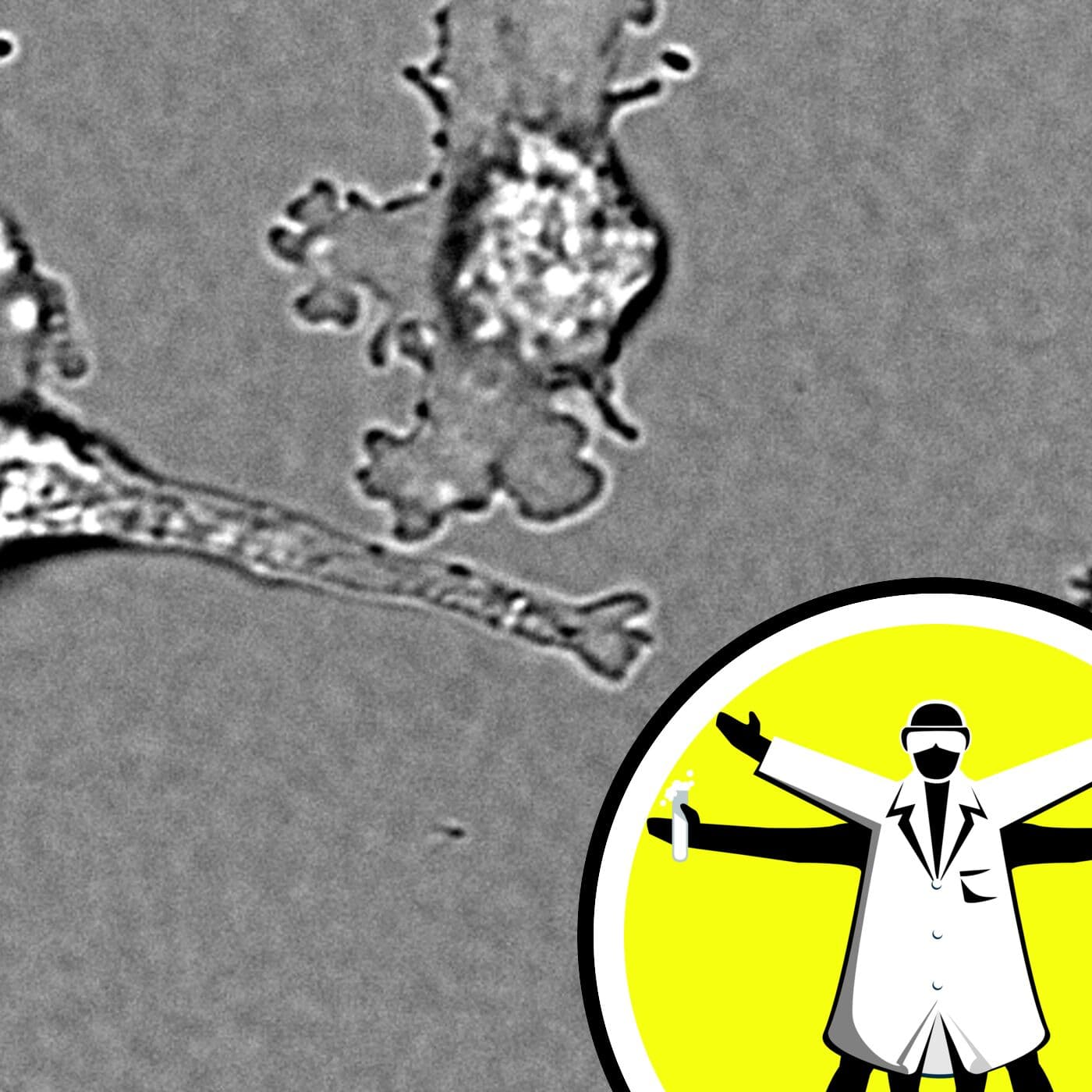
1:37First this week, what happens to our fat when we lose weight? Well, scientists in London have just made a surprising discovery. It's not just that fat shrinks but our bodies also clear out damaged or so-called senescent fat cells at the same time. It's the presence of these cells they think that contribute to some of the damaging effects of weight gain like diabetes through producing inflammatory and other abnormal signals. The removal of these senescent cells by the body might well therefore contribute to the improved health status that accompanies weight loss although what stimulates the disappearance of the cells in the first place when we diet, or indeed their persistence when we overeat, isn't yet known.
2:21But they might hold the key to better management of obesity and diabetes in future. Here's Will Scott from the MRC Laboratory of Medical Sciences in Imperial College London. So we've known for a while that as fat tissue expands and gets bigger, it causes some of the normal roles of fat tissue to not function properly, and that's very intrinsically linked to the complications that people with obesity get. But we've not really understood in great depth why that happens and even less so for weight loss. We think a lot of these processes may improve when we lose weight but we don't really know why.
2:59And so one of our main mission statements is to understand this. And how have you gone about looking at it? Very lucky to work in the clinic with patients. and so we've asked some of our patients who are obese or overweight to donate some of their fat tissue to us before they lose weight and then after they lose weight but also we've taken healthy lean people and asked them to do the same this has allowed us to compare how fat tissues change when we put on weight but also how they get better when we lose weight and the people that were losing weight. Was that what, just going on a diet, exercise or were they having other interventions to help them slim down?
3:40So they've had a very specific type of weight loss which is an operation for weight loss which we call bariatric surgery. It's one of the most potent or strongest forms of weight loss and that's our main reason for studying it. We wanted to see big differences so we could really unpick what was happening or the biology underneath these things. so you get these biopsies from the fat tissue when a person is in their initially starting overweight state and then as they lose weight you get a sample again what do you do with those samples though how do you interrogate them to work out what's happening so we're really lucky to have these amazing tools in our laboratory where we can take every single cell in a piece of tissue and all in one test we can look at all of the cells that are there and we can very deeply look into all of the molecules in those cells.
4:34And when we do that across thousands or even hundreds of thousands of cells, we can build an enormously rich picture of what happens in our tissues when we gain weight and when we lose weight, how cells change, how they communicate with each other, and the problems that they run into that cause these disease processes. And what did you see when you did that on the people before and after they lose weight? How do the two compare? One of the most important things that we see is that when people become obese, some of their cells become stressed and permanently damaged, a process we call senescence.
5:15And this senescence process increases as people get more obese. But what was really striking to us is that these damaged senescent cells seem to disappear almost completely with weight loss. So it looks like the tissue is sort of repairing itself, if you like. Do you think those senescent cells, since their number correlates with the risk of having problems from obesity, is it your view then that they are the cause of at least some of the metabolic problems, diabetes and so on, that people who are obese are at higher risk of developing? They're one of a number of conspiring factors. Our fat tissues become inflamed when we put on weight.
5:55and this is partly because some of the fat cells swell, they get too large if you like and they release stress signals and these stress signals cause inflammation and that process causes some of the fat cells to senesce but also senescent cells then release different types of factors that are toxic to the tissue. So you have this sort of vicious circle of processes that all conspire together that harms these tissues. and you note that when they lose the weight these cells disappear so where do you think they're going why are they disappearing so they're either being eliminated cells have programs where they can die but they do that in a managed way so they don't stress the tissue out so that's one possibility the other is that some of the immune cells that are also there in the tissue find these senescent cells and they get rid of them.
6:52And we don't know exactly which is driving this, but what we can see is the key processes within these senescent cells that cause them to be senescent and to cause other cells to be senescent. So if we could find a way to just go in and zap the senescent cells without the person having to lose the weight first, would that also work? if you're right that should be the case that's the principle everything has a caveat in science as you know senescence is also important in some contexts probably the reason that our cells senesce is for things like wound healing we damage ourselves the cells next to the wound senesce and they release these inflammation and kind of scarring factors and that helps us heal but when this is switched on all of the time it causes us damage so we have to always get the right balance with these types of things there's a lot of interest in trying to treat senescence but we've always got to be careful we do it properly and we don't do harm at the same time really interesting study that thanks very much to will scott from the mrc laboratory of medical sciences and imperial college london that work just came out in nature we're sticking with what we put into our mouths Cambridge scientists have discovered that a certain species of microbe found in the human gut might be able to help defend us against the toxic and long-lasting forever chemicals that are known as PFAS molecules.
8:20These substances, which were originally thought to be harmless and inert, are everywhere, including even in some food containers, but they're increasingly looking likely to be causing hidden health harms. Kieran Patil at the University of Cambridge MRC toxicology unit has found though that a common bowel bug actually appears to be able to soak them up. We wanted to find out if gut bacteria in our bodies can help us get rid of forever chemicals. Their technical name is PFAS or polyfluorinated alkyl substances. These are widely used chemicals in consumer and industrial products because they are stain resistant and they are very tough.
8:57You find them on frying pads and they're non-stick coatings. You go to McDonald's and you get your burger wrapped up in a nice sheet of paper that's grease proof that's the same family of chemicals isn't it exactly that's the same family of chemicals you'll also find them in waterproof clothing and shoes and so on and unfortunately nowadays in our bodies and in our blood but the ubiquity of these chemicals has arisen because of the belief that they are harmless these chemicals are are very inert for chemical reactions that way they persist in the environment for hundreds of years and initial thinking was that since they are so chemically inert they are going to be harmless but unfortunately that's not the case.
9:35There have been many links shown to different diseases including cancer, reduced fertility, reduced immunity and so on. Do we know how they produce those effects, these chemicals? If they are so inert why should they be having those harmful outcomes? Although they're chemically inert they are not biophysically inert right so they tend to we accumulated inside the body, inside vital organs like liver and so on. And if you can cause inflammation, it can cause oxidative damage and so on and so forth. So what led you down the path of wondering what microbes might be able to do then? So the gut microbes have amazing capability to deal with lots of different challenges.
10:11They're already helping us in many different ways, you know, in terms of digesting our nutrients and so on. They have to, in the natural environment, deal with lots of chemical stresses. So we wonder whether they will also have some ways to deal with these forever chemicals. And what did you do? So we started our experiment in a taste tube, so to say. Take a panel of gut bacteria that would represent average healthy human gut and throw these chemicals on them and see what they do to these chemicals. To distill that then, you take a population of gut bugs that you would find in the average person's intestine and just grow that in a culture and then ask, well, I'm going to add these forever chemicals and see what it does to the bacteria.
10:52Did you add them at the sort of level that if I were eating a normal diet going about my life in general, that's the sort of level of exposure I would get? Exactly. So we added in many different levels, like what would be exposure levels, even 10 times lower that and, you know, hundreds of times higher that as well. So we look into what happens to this chemical outside the culture, outside the cells of bacteria. Do they disappear? And if they disappear, are they broken down or they are taken inside the cells? And what do you see? Do they get into the bacteria? They're not, unfortunately, broken down by bacteria, but we see that the bacteria soak up like sponges, these chemicals, and store them inside in dense aggregates.
11:32Really? Do all the bacteria do that? Because you said a mixed population representative of what's in the gut, is it certain types or species of bacteria that do it? Indeed, so mostly bacteroides, but not all bacteria. So, for example, gram-positive bacteria will tend not to do that. Now, obviously, a test tube or a culture dish does not have an immune system. It's not a lining of an intestine like they would be for real. So would the same happen in a physiological environment, in a gut for real, for example? Did you test that? Great question. And for that, once we knew that it happens in an in vitro situation, we wanted to know whether it will happen in an animal gut environment.
12:12So we did that experiment in mice. So we colonize mice with human gut bacteria so that their microbiome looks more like a human. And then we give them these chemicals and see what happens. And do the bacteria do the same thing as they did in the dish? Do they soak up these forever chemicals? Yes, exactly. That's what they did. And the way we measure it is that we look into what comes out in the faeces because most bacteria, you know, they grow inside the gut, but in the morning routine or wherever the mouse do their routine, they will come out. and we see that there is up to threefold increased excretion of these chemicals in mice faces.
12:45Is your argument then that if the bacteria can do this, they are in a way protecting us from forever chemical exposure? So I eat some forever chemicals, I've got some of these microbes, at least some of the PFAS molecules will be soaked up by the bacteria, not me. Exactly, that's what our research suggests, that our microbes, gut microbes, might already be helping us to get rid of these chemicals. Do you know how the bugs are doing it? So we have some molecular insights into this. We now know that there's an active molecular pumps that are taking them in, and in some bacteria actually even pumping them out.
13:21And just closing the loop on the fact that you're feeding mice these chemicals and arguing that the bacteria appear to be interrupting the flow into the mouse, did you measure the mouse to see if when you do this, and they have these particular bacteria, the mouse is getting a lower dose of these chemicals? Yeah, so we know that the mouse is getting lower dose because more is pooped out from the mouse faeces. In this particular experiment, we did not measure the mice blood content simply because the way this experiment was set up and our license was that we could do this experiment for a short period.
13:56But definitely in the future, we have to do a longitudinal experiment to see the effect on the body level. And what about applications of this? Obviously, it's academically really interesting that this can happen and you might be able to exploit these bugs in some ways. Do you think this is a possible avenue that we could use to protect us, ourselves, from exposure to these chemicals? Definitely. So I personally see this finding as kind of understanding how clogs and springs work. And once we understand that, we can go and venture into building a clog. And in order to do that, we co-founded a company called Cambiotics, whose goal is exactly this, to develop probiotics that can be taken orally.
14:36And hopefully they will help us accelerate the secretion of PFAS from our bodies. Kieran Patil at the University of Cambridge there. And the findings that he was talking about have just come out in Nature Microbiology. So there you go. You'll have a probiotic to take for blood pressure control. and another one to help you soak up the surface that you scraped off from your non-stick pan cooking your fried egg in the morning.
15:02Cha-ching! That's the sound of Lowe's Labor Day Savings. Get up to 45 % off select major appliances and save up to an additional$100 on select laundry pairs. Plus, get three bags of Miracle-Gro 0.75 cubic foot garden soil for just$10. Labor Day deals are on now at Lowe's. in-store and online. Valid through 9-9 while supplies last. Selection varies by location. See Lowe's.com for more details. Soil offer excludes Alaskan Hawaii.
15:33The Naked Scientist podcast is produced in association with Spitfire. Cost-effective voice, internet and IP engineering services for UK businesses. Find out how Spitfire can empower your company at spitfire.co.uk. Music in the programme is sponsored by Epidemic Sound. Perfect music for audio and video productions. This is the Naked Scientist podcast with me, Chris Smith. Still to come, why is the Earth spinning faster on some days this year? We will find out. But first, water is one of the most abundant molecules in the universe. Here on Earth, we see it in the liquid state, as steam, and also as a solid.
16:16Ice, of course. in space though it is so cold that it exists mainly just as ice but it's not the ice that we know instead of nice regular crystals like a snowflake space ice has got no structure the particles exist in a random jumble and this is called amorphous ice but physicists have always struggled to explain why some amorphous ice is of an apparently lower density until now because with a combination of x-ray techniques and computer modelling, Michael Davis has found that amorphous ice actually contains lots of little crystals. It's a bit like those chocolate bars that have bits of honeycomb scattered through them.
16:55One of the reasons that this matters is because it makes the claim that life-giving molecules like simple proteins came to Earth from outer space a bit less likely. And that's because the structure of space ice that Michael envisages wouldn't have much room left between the molecules to pack in a cargo of chemical hitchhikers. If we think about the atomic structure of something, it's how atoms arrange themselves in three-dimensional space. And if you think of steam from your kettle and water in your glass, it's completely disordered is what it would look like at the atomic level. The atoms just move around with no pattern that you could recognise.
17:31Whereas an ice cube is a solid and it has a hexagonal structure. If you think of a snowflake, it has a hexagonal symmetry. Whereas amorphous ice, it's kind of like we have a solid, a bit like everyday ice you put into your drink. The atomic structure is completely disordered like the liquid, so like a frozen snapshot of the liquid. And why should the condition be different on Earth compared to across the universe? How do you know that most of the water out there is in that amorphous form? The conditions in space are much harsher. So the background temperature on average would be around minus 270 degrees Celsius.
18:07so extremely extremely cold so we're talking about things that have extremely low energy and so the ice in space water in space in nebula clouds you've seen photos from the huppel telescope for instance these sort of gas clouds they'll be at very low temperatures and it won't have the energy effectively required to make these nice hexagonal symmetries the atoms are moving extremely slowly when you're at that low temperature and so they can't rearrange themselves into a nice structure they're sort of trapped. It's funny isn't it to think that ice needs some heat in order to be icy in what we call ice.
18:42So why does that matter then knowing whether it's in that amorphous state or in ice cube earth state? If you think of these amorphous solids they're basically like a snapshot of the liquid and so to physicists it's a very very interesting model for the liquid water and now to get a little bit technical there's multiple different types of this amorphous ice that we know of. One of them is a low density amorphous ice. Another one is a high density amorphous ice. And so this idea basically risen to the theory that perhaps liquid water itself is a mixture of these two, a low density liquid and a high density liquid.
19:17And so this is one of the very interesting ways that amorphous ice feeds into the physics of how we understand something as important as liquid water. And how have you been trying to probe this then? How have you been trying to get underneath whether that is the case? In this theory, we want to understand really detailedly the structure of low density more precise that was our aim this most common form of ice in the universe and it's surprisingly difficult to get a full atomic scale resolution so you could literally see each atom how it's arranged themselves in three-dimensional space is really really difficult experiment still in this day and age and so what we do an experiment was we have things called x-ray diffraction a bit like i go for an x-ray in the hospital to take images of materials and we get back like a signal just a line on a graph effectively we don't have a full image of the eyes.
20:01To complement this, where I come in is the computational physics side. So this is effectively where I would use computers to simulate water. So I basically put the laws of physics into the simulation, and I can model water directly. It's a bit like how you put gravity into a video game, so your character sort of jumps up and down in a sensible way. I've generated a range of structures, things that are highly crystalline and things that are highly disordered, amorphous. And effectively, we were done trying to find what's the best match to what we see in experiment from the x-ray it was kind of a goldilocks situation you know it was not too crystalline and not too amorphous so what we found is actually we have a sort of happy medium around about 20 percent crystalline order but basically the material instead of being completely disordered this low density or the size it's disordered but it has very very tiny crystals embedded throughout it so it's kind of like it's full of tiny diamonds throughout the liquid water the stuff that's out there in the bulk of the universe does still have some crystalline structure but it's as you say it's like a giant mess of small crystals rather than one giant crystal why does this matter why is this exciting to a physicist to know that that amorphous water out there contains an element of crystalline structure so i think there's three aspects i think one is how it impacts our understanding for liquid water and so of course understanding the nature of liquid water is incredibly important for a huge range of ways that we understand you know life a second would be this is the most common form of water in space and so there's a huge number of ways that this could impact cosmological phenomena quite an interesting one is this theory called pansperbia which is effectively the building blocks of life landed on earth via a comet bulk material of a comet is ice and it is actually this amorphous ice and so if this building box of life were to arrive via a comet what we have there is organic material preserved inside the ice the reason that doesn't work in reality is because crystals in solids actually damage ourselves a completely disordered solid would actually be a very good transporter for organic materials compared to normal ice as we know it our finding negatively impacts a little bit because these crystals we'd have in the material mean effectively there would be a slightly worse carrier for organic material and perhaps a third one would be it's quite interesting i think we've been studying this material for around about 90 years and to find something like this will we actually change our understanding of the atomic structure this is really really important because amorphous structures are actually everywhere in our everyday life you know if you think of fiber optic how you get your broadband a vital part of fiber optics is that it has no crystalline structure it's completely disordered and that's how we transport information across now if there's a material like water where after 90 years of quite intensive studying we can still change our atomic understanding of it this raises the question this could be happening in an abundant different ways for technology as well.
22:51And so if we could remove the crystals, we could even improve technological materials for making fiber optic even better. Michael Davis there. Well, to time now. And surprisingly, in July and August, time is going to zoom by ever so slightly faster. Earth usually takes 86 ,400 seconds to do a full spin, otherwise known as a day. But on the 9th of July, the 22nd of July, and the 5th of August, our planet is expected to pick up the pace ever so slightly and trim a millisecond or so off the length of a day. Will we even notice? We'll hear from Ruth Ogden on that score in a minute. But first, what is actually up with the planet?
23:31David Gozard is a physicist at the University of Western Australia. This is happening because of the orbit of the Moon. Generally, the orbit of the Moon slows the rotation of the Earth down over time, and this is a gravitational dance between the earth and the moon and the earth's tides the moon pulls on the earth's water and creates the tides and that creates friction as the earth rotates under those tides and then there's this gravitational dance where rotational energy of the earth is transferred into the orbit of the moon so it means we're losing rotational energy and slowing down basically if you wind the clock back 65 million years the dinosaurs had a much shorter day than we do now but the moon's orbit is not a perfect circle and it's not perfectly aligned with the earth's equator so it means the moon gets closer to the earth and further from the earth at different points in its orbit and so that means the effect of the moon slowing us down is reduced and with various other effects so seasonal changes like where water moves or ice moves and builds up on the Earth's surface due to changes of seasons in the northern southern hemisphere, we get a few days where we rotate very slightly faster than we normally do.
24:48How on earth did this get picked up in the first place? So we model these things, we can model them quite precisely. So the Earth-Moon interaction is relatively easy to model. Tides are very predictable, we can see those coming. The less predictable parts of what the earth itself is doing so things like as the amazon river fills during its wet season or glaciers get more snow on them and get heavier that shifts where water and ice and basically earth's gravity is distributed across the earth so those things we can model to a certain extent but there are some bits that are trickier to model such as what the earth's core is doing so what magma flows are doing beneath our feet but overall we do generally have a good model of what these things are doing and so we can predict in advance that we're going to get this speed up so 1.5 millisecond short a day on a particular day and when we actually come to measure it using stars as a reference we may find it's close to 1.5 milliseconds like 1.45 or 1.55 do you expect then that this is a blip effectively on those days for all the factors and all the reasons you've said and that in the aftermath we'll get that millisecond back we're not we're not going to all be short changed a millisecond hereinafter yeah it's just these three days that are shorter than average as i said earlier the moon is slowing us down steadily so over time the earth's rotation is continuing to slow and so we all just get longer and longer longer days does this make a practical difference for us humans i mean it's neither here nor there is it I mean, some days it gets dark earlier because it's cloudier.
26:30But there are devices on Earth that are working to fractions of a second. I'm thinking to take money out from an ATM machine, you're using GPS data because the timing has got to be right. To trade money on the London or the New York Stock Exchange, we're using GPS signals and relativity to get the timing right. So when those sorts of times shift like that, does that have the potential to make differences? Yes. So not this one event on its own, a single day or a few days being faster or slower by a millisecond isn't going to be noticed by anything other than the people making careful measurements of these things.
27:10What happens is because we're slowing down and we accumulate more and more drift of this time, once we accumulate about 900 milliseconds, so 0.9 of a second, then we add or subtract a leap second. So it's a similar concept to a leap year. A year is actually 364 and a quarter days long. so to make sure we don't our calendar doesn't drift out of synchronization with the sun over the course of a century or so we have to add an extra day every four years to account for that quarter of a day the leap second is a similar concept every time we gain about 0.9 of a second we add on a leap second to our clocks just to keep them in sync with what the heavens are doing Is there a master clock somewhere on Earth, David, to which all of the other clocks, like the satellite clocks and all the other examples you've been talking about, are all synced to?
28:11And if so, where is that? There's a network of clocks. So various metrology institutes around the world, so NIST in America, the National Physical Laboratory in the UK, and various others around the world, all of them have state-of-the-art, very high-precision atomic clocks. and these get networked together to eventually calculate time reference so there's no one master clock it is all these clocks working together to create a master which is utc and hence that's what would notice when we're a millisecond or so out and it's it's against that that we would make the correction yes so in your work sending huge amounts of of telescope data over long distances this is something you would worry about but for the average joe like me i'm not going to notice yes as someone who works in sort of time and frequency measurement and astronomy leap seconds are a very silly idea because at a human level we don't care these leap seconds are designed to keep our clocks aligned with the heavens so we're keeping our very high precision superior clocks aligned with this old archaic way of doing things that's far less precise.
29:26Why the heck are we doing that? As I said, we have daylight saving time. We have different time zones. We play with the time arbitrarily over a matter of hours as humans. These sorts of precision timing things only matter for our computer networks. So why do we bother adding leap seconds? It would take thousands of years before the leap seconds accumulate a noticeable human amount. so we should just do away with these leap seconds and let the sun and stars drift out of sync with our clocks for a few thousand years because we're not going to notice the only people are going to notice are astronomers and i think it's better that we update the pointing of the telescope to know okay the star is actually one second away from where we thought it would be rather than getting our high precision clocks to update and our GPS systems to update and potentially causing various glitches and problems and so the international timing community have agreed that we're going to stop using leap seconds in 2035 so I think that's a really good idea I'm looking forward to that.
30:36So make the most of your leap seconds they're a dying breed they'll be disappearing in under a decade thank you very much there to UWA's David Gozard for explaining why they happen in the first place. This seems though like a very good opportunity to think about how we humans respond to and register time and the fact that most of us these days complain of being chronically short of it. Ruth Ogden is the Professor of the Psychology of Time and she's at Liverpool John Moores University. Time is really really subjective. It's not like a clock would tell you. How you feel about a minute or a second is really heavily dependent on what you're doing and how you're feeling.
31:12So we construct time from our activities and our emotions. One of the issues that we face in modern life is that we just don't have enough time. We fill all of our time with a variety of activities. And this can mean that we don't really think about time in the way that we should. We see time as being a resource which should be spent, which should be used up, which can never be wasted. But really, for good well-being and good quality of life, we need to change how we think about time. So I completely a degree with David. I mean, the odd millisecond here and there is going to make very little difference, if any difference at all, to the population.
Read the full transcript
31:50But what it does is raises our understanding and our awareness of time. It makes us appreciate that time is something that's important and something that we should take care of. Where did we catch this kind of gotta be busy mindset from? Because I don't remember feeling like I do now when I was little, when I was growing that way but they sure as hell do now even in retirement yeah i mean we live in a society where busyness and productivity is valued above almost everything else so you have societal norms which are telling you to be busy to always be active to be constantly doing things you have smart watches which bleep you to tell you to stand up or to work more or that you're stressed and you need to relax So we've got this constant stream of pressure to not waste time.
32:41And as a result, we seem to have lost the art of doing nothing. We've unlearned how to relax and how to genuinely have unfilled time. as a result of that what we often find ourselves doing is trying to relax whilst doing other things so productive relaxation so this might be looking on your smartphone and watching reels of cats or some other thing that you find some basic level of enjoyment in but the problem we then have is that society tells us that this is a bad use of our time that we should be promoting our intellectual growth or meeting with other people so I think that the way in which we think about Alzheimer's left us stuck between a rock and a hard place.
33:20We're supposed to be constantly busy, but when we need to relax, the things that we do aren't valued. And as a society and as individuals, we really need to think carefully about how we want to spend the time we have and how we can spend it in ways that make us feel good rather than fulfilling society's needs. Is there any evidence, Ruth, that the life we are now living in that time-pressured mindset is translating into ill health? There's plenty of evidence that time pressure is bad for all aspects of your health. Time pressure increases stress, it's associated with greater risk of heart attack, it's associated with risky decision making, poor mental well-being, it's even associated with greater levels of divorce and there's some emergent evidence, coming back to what you were just saying about parenting, that time pressure and the impact of time pressure is intergenerational.
34:14So the children of time pressured parents are themselves likely to feel negative effects as a result of the pressure that their parents are under. For me, this is the public health campaign that needs to be addressed. It's at the root cause of many mental and physical illnesses that are affecting society and individuals today. Hard to imagine how we might start to chip away at it though isn't it because if you think about it were i going to work 30 years ago the rate at which i would work would correspond roughly to the rate at which my inbox would fill up which would correspond to the rate at which the postman would bring the work for the day or someone would arrive at my desk and drop some work off now it's an all-you-can-eat email buffet of work coming in distractions coming in phones pinging phones ringing so we've kind of connected ourselves to an artery of incoming pressure that we didn't have before.
35:08But the workplace seems to exist and thrive on that. So it's very hard to see how we fix it. This is a really good point. And we can look across to other European countries who are trying to address this through national legislation, such as the right to disconnect, which provides individuals with a legal right to not have to work or attend to their arteries of information beyond their working hours. But these are possibly ineffective because they don't challenge the social norm of busyness equals success. What we really need is for employers to have job descriptions and job roles which are the equivalent to one person's day's work.
35:49At the moment we are in a situation where the role and the tasks within a job are vastly greater than the time that people have to fulfil them. And part of the issue here is that if we think back to industrial periods, jobs were based on time. So you would go to a factory between the hours of nine to five. And when you left the factory, your job was done. So it was a time based model. Now we're much more fixed on a task based model. And the number of tasks continually increases. And it's only when we reduce the number of tasks to be reasonable for one individual to do that we're going to be able to see this breakage in the model that we have now and an increase in free time.
36:29Absolutely fascinating. Ruth Ogden at Liverpool John Moores University there. Well now it's time for question of the week and James Titko has been investigating a certain kind of bacterial infection thanks to this question sent in from Leonard. I'd like to know about this Lyme disease and how it is acquired and the diagnosis. Thanks Leonard. Lyme disease is caused by infection with a bacteria known as Borrelia. This parasite can travel through the bloodstream to many parts of our bodies, triggering immune responses and thus a range of symptoms, including skin rashes, fevers, potentially even neurological damage and more.
37:07So how does it get into humans in the first place? Here's Jack Lambert, professor and consultant in infectious diseases at the Marta Misericordi University Hospital at University College Dublin. To the best of our understanding, you only acquire it from a tick bite. Certain ticks are carrying the Lyme bacteria, and when they bite you, they inoculate into your blood, and you develop a bacterial infection called Borrelia bordophori, commonly known as Lyme disease. Some of the people get a rash around the site of the bite, and that's the classic bullseye rash. Once the bacteria enters through the skin, it gets into the bloodstream and it goes everywhere.
37:50So it can present weeks to months after the inoculum as joint pain, cardiac problems, tachycardias, brain problems, nerve problems. It kind of affects almost every tissue of the body. Even studies have shown up to a year after the original bite. As many as 5 % of ticks in the UK test positive for Borrelia. This remarkable, albeit pernicious bacterium, which has the ability to proliferate in ticks, mice, deer, our pets, and of course us. It makes humans sick by triggering an immune response and subsequently inflammation in many parts of the body. And it's the varied nature of these symptoms which complicate the next part of your question, Leonard, on diagnosis.
38:38But Jack believes there are other factors at play too. The issue is that I think in the UK and Ireland, people are led to believe it's a rare disease, you know. In Ireland, they don't keep track of it, so they can make any numbers up. So they say there's 100 cases a year. I think there's 2 ,500. The practitioners, it's not on their radar screen. That's number one. But the next challenge is the testing is imperfect. So I would say the standard tests that are used by the NHS in Ireland are about 50-50 accurate. So I have people say, oh, we did a Lyme test. You can't have Lyme. The test is negative.
39:12But the antibody test, in my opinion, is only about 50 % sensitive. So you can have a tick bite, be sick as anything and have a negative Lyme test. It's Lyme disease. You can have a positive Lyme antibody test from a bite you had 10 years ago. It can stay positive. It's your immunological memory. Be perfectly healthy and you don't have Lyme disease. Additionally, if you get the classic rash following a tick bite, that means the infection's already in your body going into your bloodstream you don't need to wait for an antibody test you just treat right away. So Leonard Lyme disease is acquired by tick bites which transfer the Borrelia bacteria into our bloodstream.
39:53Challenges in diagnosing this disease include the many different symptoms the imperfect testing and perhaps a spot of bias in the medical community as to how common Lyme disease really is if you have a bullseye rash you should go to your doctor who should start treating for Lyme disease straight away thanks to Jack Lambert professor and consultant in infectious diseases at the Marta Misericordi University Hospital and to you Leonard for that question next time we'll be answering this one from listener Laurie if we can put small nuclear reactors on submarines and Mars rovers. Why can't those small nuclear reactors be used along with sustainables to power our towns and cities?
40:40Thank you. Now if you know the answer, why don't you drop into our forum? That's at nakedscientist.com forward slash forum and you can have your say there. You can also email me, it's chris at the nakedscientist.com and do of course send in any questions, thoughts or comments that you would like us to delve into on your behalf. Again, chris at thenakedscientist.com. On the fact that I don't yet know what's going to happen to me, I have no further updates for you quite yet, but I do expect to know something very, very soon. So watch this space. I promise to update everybody as soon as I know. You will know.
41:14And what I will say is thank you very much indeed to everybody who got in touch. A lot of you copied me into correspondence and so on, and I can reassure you and assure you I read absolutely every single one of them. I was touched and extremely humbled by what you said and extremely grateful as well. I did try to write back to as many people as possible but it got to the point where I just couldn't keep up. So I am sorry if I haven't got back to everybody but please rest assured I guarantee I read 100 % of what you wrote in and I'm very, very grateful. that is where we have to leave it for this week but do join us on Tuesday when very special anniversary 25 years since the first draft of the human genome project I was actually in the audience when Sidney Brenner came to Cambridge and announced that tomorrow we're going to be seeing the announcement of the unveiling of the human genome project and that was a quarter of a century ago what has happened since I've been down to the Sanger Institute where a lot of the action happened to find out how it got going and what we've discovered in the meantime.
42:21The Naked Scientist comes to you from the University of Cambridge. We're also supported by Rolls-Royce. I'm Chris Smith. Thank you for listening. And until next time, goodbye.
43:14We'll be right back. Selection varies by location. Holland Papers offer excludes Alaska and Hawaii.