In short
Chronic wounds cost the UK NHS about £8.3B/year, more than cancer/obesity, and are worsening due to rising diabetes driven by obesity. The episode explains why diabetic wounds become non-healing (biofilms, entrenched infection, dysfunctional immune responses, poor blood supply, and inflammatory damage including cellular senescence) and discusses new research directions and diagnostics.
Guests
- Matt Hardman, director of the Wound Innovation Institute (University of Hull). Background: leads a new institute funded for wound infrastructure; works with NHS and industry partners.
Key claims/examples
Chronic wounds are “hidden,” socially isolating, and can lead to amputation; NHS lacks “blockbuster” wound treatments. Institute targets prevention, infection control, and active healing tech (e.g., 3D bioprinting, remote diagnostics/telemedicine).
- Caten Dattaria, professor of medicine (University of East Anglia), chair of the Association of British Clinical Diabetologists. Background: diabetic foot disease expert.
Key claims/examples
“Perfect storm” of neuropathy (no sensation), vascular narrowing (reduced blood supply), and impaired infection-fighting cells. Proven interventions: pressure relief, improving blood supply (vascular surgery), infection treatment, sharp debridement/podiatry. Examples: buffy coat therapy can increase healing ~50% but is limited by UK cost-effectiveness and clinic workflow.
- Holly Wilkinson, University of Hull. Background: studies wound biology.
Key claims/examples
Diabetic foot ulcers contain bacteria protected by biofilm slime that shields from host cells and antibiotics; wound healing normally follows immune/proliferation/remodeling stages, but diabetes disrupts this via inflammation and senescent “zombie-like” cells.
Written by AI. May contain mistakes. Listen to the episode to check what was said.
Chapters
Tap a time to open that second in VOChronic Wounds vs. Cancer Costs
0:51 to 2:14
Discussion on the high costs of chronic wounds compared to cancer treatment.
“Hello, welcome to The Naked Scientist, the show that brings you the biggest breakthroughs and also talks to the major movers and shakers in the worlds of science, technology and medicine.”
Understanding Wound Care Challenges
2:14 to 4:40
Exploration of the complexities surrounding chronic wounds and their treatment.
“We're in partnership this week with UK Research and Innovation who are supporting this new initiative and Matt Hardman is the Wound Innovation Institute's director.”
The Role of the Wound Innovation Institute
4:40 to 6:52
Insight into the new Wound Innovation Institute and its objectives.
“You are unleashing a sort of step change up there in Hull.”
Diabetes and Chronic Wound Risk
6:52 to 9:00
Examining how diabetes increases the risk of chronic wounds and complications.
“So the 16 million from the UK government was all for infrastructure and equipment.”
Current Treatments and Future Directions
9:00 to 14:00
Overview of existing treatments for diabetic wounds and future research directions.
“Matt Hardman at the Wound Innovation Institute will hear a bit more from Matt later on in the program.”
Challenges in Wound Treatment
14:00 to 14:33
Explore the complexities of treating specific types of foot ulcers.
Introduction to Chronic Wounds
15:08 to 15:36
Understand the economic impact and complexity of chronic wounds.
“cost-effective voice, internet, and IP engineering services for UK businesses.”
Mechanics of Chronic Wound Healing
15:36 to 16:22
Investigate the factors complicating the healing process in chronic wounds.
“But first, we need to look a bit more deeply into the mechanics of what's actually going wrong in a chronic wound to frustrate the healing process.”
Deep Dive into Diabetic Foot Ulcers
16:22 to 18:24
Examine the characteristics and challenges of diabetic foot ulcers.
“So we'll look inside a diabetic foot ulcer.”
Body's Response to Wound Breaches
18:24 to 22:32
Learn how the body detects and responds to wounds.
“must sense that somehow so how does the body know that that breach is there?”
Show all 15 chapters
Factors Leading to Chronic Wounds
22:32 to 24:54
Discuss why some individuals develop chronic wounds, especially diabetics.
“So there are multiple things that go wrong in somebody that has diabetes.”
Innovations in Wound Management
24:54 to 26:11
Explore new diagnostics and treatments for chronic wounds.
“Holly Wilkinson at the University of Hull.”
Challenges in Wound Healing Technologies
26:11 to 28:00
Investigate the technological advancements and their limitations in wound care.
“So there's dressings that intrinsically have electrical current within them.”
Understanding Chronic Wounds and Healing
28:00 to 33:16
Explore the complexities of chronic wounds, their causes, and healing processes.
“I'm thinking of things like your genital tract, your gastrointestinal tract, etc.”
Understanding Chronic Wounds and Healing
33:21 to 34:25
Explore the complexities of chronic wounds, their causes, and healing processes.
“Now we're back with the latest science news stories from the week on Friday including everything you need to know about a new mRNA-based flu vaccine which has just been approved for use in the United States.”
Transcript
Automatic transcript. May contain errors.0:00Holly Wilkinson:Hi, this is Becca Moore from For The Girls and this podcast is sponsored by Aerie, where you can find the right bra in 59 sizes, soft fabrics and good fits. If your bra strap is digging into your shoulder right now, it's the wrong bra. We get so used to being in pain as girls that we forget it doesn't have to be this way. Your clothes should not hurt. I got to the point where I stopped wearing bras altogether and now my life has changed, you guys. The only bras I have in my dresser right now are Aerie and I'm not kidding. Aerie's on a mission to make you feel good and that starts with your bra.
0:27Holly Wilkinson:Your bra should hold you in, not back. Visit Aerie.com to find out what you're doing. find the right bra for you.
0:36Ketan Dhatariya:Ball engine running. Absolute genius.
0:38Holly Wilkinson:Get this. Welcome. Welcome.
0:40Mat Hardman:This is the show where we bring you science. What that essentially means is... Discovery is... Advances. Questions. Research. Technology. Unbelievable. Without further ado, this is The Naked Scientist. Hello, welcome to The Naked Scientist, the show that brings you the biggest breakthroughs and also talks to the major movers and shakers in the worlds of science, technology and medicine. I'm Chris Smith and today the medical problem much more costly than cancer that is destined to get dramatically worse in the years ahead.
1:19Mat Hardman:If I told you that a big healthcare system like Britain's National Health Service or NHS spends much more money treating chronic wounds than it does on combating cancer, more likely than not you'd wonder if I needed to check my figures. But it is absolutely and shockingly true. Billions are ploughed into the problem, but the situation isn't improving. Most of these wounds lie downstream of disorders like diabetes, and the biggest risk factor for that is obesity. Alarmingly, official figures out last week show that, like many Western countries, Nearly a third of the UK population is now in that weight category, and therefore the diabetic, and subsequently the wound problem, is destined to become much, much worse.
2:07Mat Hardman:The UK government recognises this risk, and that this is a poorly understood and poorly managed part of healthcare. We're just throwing money at the problem without really fixing it. So what are they doing about it? Well, they've invested in a new Wound Innovation Institute, based at the University of Hull in the northeast of England to bring together academics, clinicians and industrial partners to try to get under the skin of the wound care problem and harness science to develop new diagnostics and treatments. We're in partnership this week with UK Research and Innovation who are supporting this new initiative and Matt Hardman is the Wound Innovation Institute's director.
2:45Mat Hardman:We got talking about the scale of the problem he's up against and how he plans to tackle it.
2:49Ketan Dhatariya:It's a huge drain on worldwide healthcare. In the UK, the NHS spends about£8.3 billion per year, roughly, on wound care, which is almost the same as it's spent on managing cancer or obesity. Really? Why haven't I heard about this? It's mainly, I think, because wounds are kind of a hidden problem. Most people don't publicise the fact they've got a persistent chronic wound and they're also a major human burden so people who have wounds have chronic pain and because of that they tend to socially isolate the wounds can kind of produce a lot of exudate they don't smell very good lead to anxiety depression ultimately people who suffer from wounds have reduced
3:35Mat Hardman:independence so it's a multidisciplinary problem it's not just a cut on your foot the implications and the domino effects are quite profound yeah and i think people tend to think that
3:46Ketan Dhatariya:But, you know, because when they're younger, they have a wound and it just heals. You kind of assume your body is going to be able to heal. But as you get older or you develop diabetes or you have vascular insufficiency, then that can lead to a position where you develop a wound and it actually can persist for many months or even years. And the worst part is if you have a wound that persists for that amount of time and goes on to develop infection, you can actually end up with having to have an amputation. And if you have your leg amputated, there's only a 30 % chance you'll still be alive after five years.
4:21Mat Hardman:Now, are we spending a lot of money on this because it's just a big problem, but we're pretty good at dealing with it? Or are we actually really not very good at dealing with it? And we're actually spending all that money on those repercussions and downstream effects that you've just outlined.
4:36Ketan Dhatariya:It's absolutely the latter. So the understanding of the fundamental biology of wounds is not as complete as other areas like cancer. weirdly there's a lot of commonality between wounds and cancer a lot of the biological processes that occur during wound healing are actually hijacked during cancer but that's a whole nother discussion um so i think that because there's not been a huge amount of investment in wound research we don't have that fundamental understanding and then the treatments that are available some work reasonably well but there are no kind of blockbuster treatments for wounds
5:11Mat Hardman:And is that what you're trying to change? You are unleashing a sort of step change up there in Hull.
5:17Ketan Dhatariya:Yeah, well, I spent my entire career working on WINS and I've seen incremental changes. But yeah, at Hull, we are really pushing the boundaries of what's possible. And we've been able to do that through significant investment from the UK government, from the university, which we're very grateful for, and a consultor of partners that we work with, both the NHS of the UK and industry partners.
5:41Mat Hardman:So what's got the government interested to the extent, because my understanding is they've invested about 16 million pounds in your initiative, which you're then able to leverage more from industry through sort of partnerships and things. But what's made them do this? I mean, obviously, you've made them do this, but what is it that's made them receptive?
6:01Ketan Dhatariya:Particularly in the region where we are in Hull, we have a very socially deprived population who have real problems in terms of wound healing. We have many people per week having their leg amputated due to persistent chronic wounds. And I think that it's the right time. A number of technologies are now coming in like genomics and like omics technologies that will allow us to have really important new insight into the causes of wound problems. And we have the infrastructure now that will really enable us to kind of start to address the different aspects of WIMS that we couldn't address previously.
6:39Mat Hardman:How are you going to spend the funding then? Are you spending this just on research projects or are you effectively building the facility that will enable you to then explore all these different avenues going forward?
6:52Ketan Dhatariya:That's a great question. So the 16 million from the UK government was all for infrastructure and equipment. So we've just finished spending that. We bought£12 million of equipment and refurbished laboratories. The added value now is obviously that gives us fantastic infrastructure to then be able to push forward with research projects. And it's the partnerships that are really important for driving those research projects. The university have funded us with significant investment for people. And so we're having a big recruitment drive at the moment to bring in some world leading experts to supplement the capabilities we have, recruiting at all different levels.
7:31Ketan Dhatariya:to then allow us to be able to undertake more volume of research.
7:35Mat Hardman:And what will be the big targets? Usually when you have an initiative like this, you draw up a list of your big hits, the things you're going to go for first. So what's at the top of your wish list?
7:47Ketan Dhatariya:So wounds is simple. You can kind of break it down into three areas. Prevention is better than treatment. And actually, the reason that a lot of people develop chronic wounds is that they don't do what they could potentially do to prevent those wounds. And that applies to the patients and also the healthcare professionals. You know, if you can see the patients more quickly, if you can look at things like telemedicine and remote diagnostics, if the patient awareness is increased in terms of how to look after their feet, look after areas of their body that could be susceptible to developing chronic wounds, that could be a game changer.
8:23Ketan Dhatariya:Then there's infection. There's a lot we don't understand about the causes of wound infection, how the bacteria that inhabit your skin can lead to infection in certain situations. And then there's the treatment side. And in terms of treatment, there's a lot we're doing now in terms of new technologies, things like 3D bioprinting and looking at ways to actively promote wound healing, which is something that paradoxically doesn't really happen in terms of current wound management. it tends to be kind of passive treatments you know putting a dressing on to protect the wound rather than active treatments to promote healing.
9:01Mat Hardman:Matt Hardman at the Wound Innovation Institute will hear a bit more from Matt later on in the program. First though why are people with diabetes at such high risk of developing chronic incapacitating and potentially lethal wounds which frequently include foot and leg ulcers as well as sometimes even infections spreading into underlying bones that can lead to amputation. And what can we do to change this? Caten Dattaria is a professor of medicine at the University of East Anglia and he's the chair of the Association of British Clinical Diabetologists.
9:33Holly Wilkinson:There are three real things that really impact people with diabetes and the first one is if your diabetes has not been very well controlled as it could have been over the many years you get certain conditions that predispose people to developing ulcers the first one is nerve disease so the nerves that carry sensation in the feet become numb so you can't feel your feet you can end up getting a small wound you cut your toenails too short or you get a stone in your shoe something you don't feel it and also people who have diabetes the the blood vessels in their feet become very narrow so you can't expand the blood supply if you wound yourself if you cut yourself anywhere on your body you normally you know how much how did that much blood come out of that little hole but in people with diabetes they can't mount that So you've got the problem of a wound which you can't feel, blood supply that doesn't get there, and also in people whose blood sugars are quite high, then the infection-fighting cells don't work very well.
10:25Holly Wilkinson:So you've got a whole – it's a perfect storm with diabetic foot problems.
10:28Mat Hardman:Is there any evidence that the rate of wound repair, the rate at which cells grow to restore integrity of a skin layer, for example, is that compromised in people with diabetes?
10:40Holly Wilkinson:Absolutely. So there are problems with diabetic foot wounds in that you've got acute wounds, those that occur quite quickly and they can heal very quickly than a few days or weeks. And you've got long-term wounds or chronic wounds and the biology of chronic wounds is very different. And if you've got those ongoing problems of neuropathies and nerve damage, poor blood supply, and actually also pressure, which stops the blood from getting down to that wound, then the wounds become chronic and that makes a wound much more difficult to heal.
11:07Mat Hardman:what have we done historically to try to address that obviously better management of diabetes has got to be upstream of all of this but for some people they're already in this position so we want to heal their wounds up so how have we tried to do that or how do we currently try and do that
11:24Holly Wilkinson:so there are only three ways really of trying to improve things the first one is pressure relief keeping the pressure off a wound to allow the blood to get down there and stop the sheer stresses from continuing to break the wound down. It's improving the blood supply so if you've got tight blood vessels then maybe seeing a vascular surgeon may be necessary and thirdly it's just treating any infections in the wounds. There are other things like good podiatry care so good what's called sharp debridement with a scalpel just taking off all the dead skin but effectively those are the only things that have really been proven to show improvement in wound healing in people with diabetes-related foot disease.
12:01Mat Hardman:And in terms of future directions what sort of avenues are people exploring now actively to try to optimize not just the prevention side of it but also if people are in this position making sure their wounds do recover more promptly and stay away so we're in
12:18Holly Wilkinson:the process of updating the guideline on wound management for the whole world and there are only two interventions which have definitely been shown to help but they've only got one trial each so it's not great evidence one is a special kind of dressing which is available in most parts of the world which has got a special substance in the dressing that helps people who've got poor blood supply and nerve damage those are the only people have been shown to help the wound healing and the other one is actually very interesting where they take people's blood they put it into a centrifuge they spin it down very quickly and the cells the infection fighting cells and the things that help wounds heal rise to the top that's called a buffy coat you take the buffy coat you put that onto a wound and again that's been shown to help speed up wound healing the problem is in the uk that it was not deemed to be cost effective by the people that tell us what to do so nice that it was not cost effective so we don't use it regularly how does it work then that technique what's thought to be the mechanism of action because it's got every all the proteins all the platelets all of the good stuff that helps wounds heal are in that top coat and and you can take it off you can spin it down so you're just left with the liquidy part of the blood which you discard but the top bit you can take off and apply it to a wound and you have to apply it every couple of weeks until the wound heals but it's got all the growth factors got all the things that cells wound healing cells love to help the wound from healing but as i said it takes 25 30 minutes to spin it down and in a very busy foot clinic most of us can't afford that time so it's therefore not cost effective to do it but the efficacy is high then it is it increases the chance of healing by about 50 yeah can we not
13:50Mat Hardman:short circuit this or find a better way because with that level of response that sounds like an
13:55Holly Wilkinson:amazing intervention it would be and it we'd love to do it and i think the teams who invented the process of trying to work on it so it makes it faster but the trouble is within the hard pressed NHS environment we have to think of the numbers of people coming from the door who we can treat because it's not for everybody you can't give it to everybody just for a certain kind of foot ulcer as well so that's the difficulty.
14:14Mat Hardman:Even so wouldn't it be good if we could do that more generally and it is interventions like that that Matt Hardman and his colleagues at Hull's Wound Innovation Institute are actively pursuing and trying to harness better. That was Kate and Dottaria chair of the association of british clinical diabetologists
14:33Holly Wilkinson:hi this is becca moore from for the girls and this podcast is sponsored by airy where you can find the right bra in 59 sizes soft fabrics and good fits if your bra strap is digging into your shoulder right now it's the wrong bra we get so used to being in pain as girls that we forget it doesn't have to be this way your clothes should not hurt i got to the point where i stopped wearing bras altogether and now my life has changed you guys the only bras i have in my dresser right now are Aerie and I'm not kidding. Aerie's on a mission to make you feel good and that starts with your bra. Your bra should hold you in, not back.
15:02Holly Wilkinson:Visit aerie.com to find the right bra for you.
15:07Ketan Dhatariya:The Naked Scientist podcast is produced in association with Spitfire,
15:12Holly Wilkinson:cost-effective voice, internet, and IP engineering services for UK businesses. Find out how Spitfire can empower your company at spitfire.co.uk.
15:27Mat Hardman:You're listening to the Naked Scientist podcast with me, Chris Smith. Today, the health and economic impacts of chronic wounds are going under our microscope. Shortly, we'll hear more about the new avenues that scientists are exploring to try to forge new inroads into an underappreciated problem that is more costlier than cancer. But first, we need to look a bit more deeply into the mechanics of what's actually going wrong in a chronic wound to frustrate the healing process. and it turns out that it's a perfect storm of entrenched infection with microbes lurking beneath protective chemical shields we dub biofilms alongside overzealous but dysfunctional immune responses a compromised blood supply that limits the delivery of immune cells and raw materials needed for repair and an inflammatory media caused by damaged senescent cells that's the problem now some or all of these factors are usually playing a part and the person who's been unpicking all of this to work out how best we can intervene is the University of Hull's Holly Wilkinson.
Read the full transcript
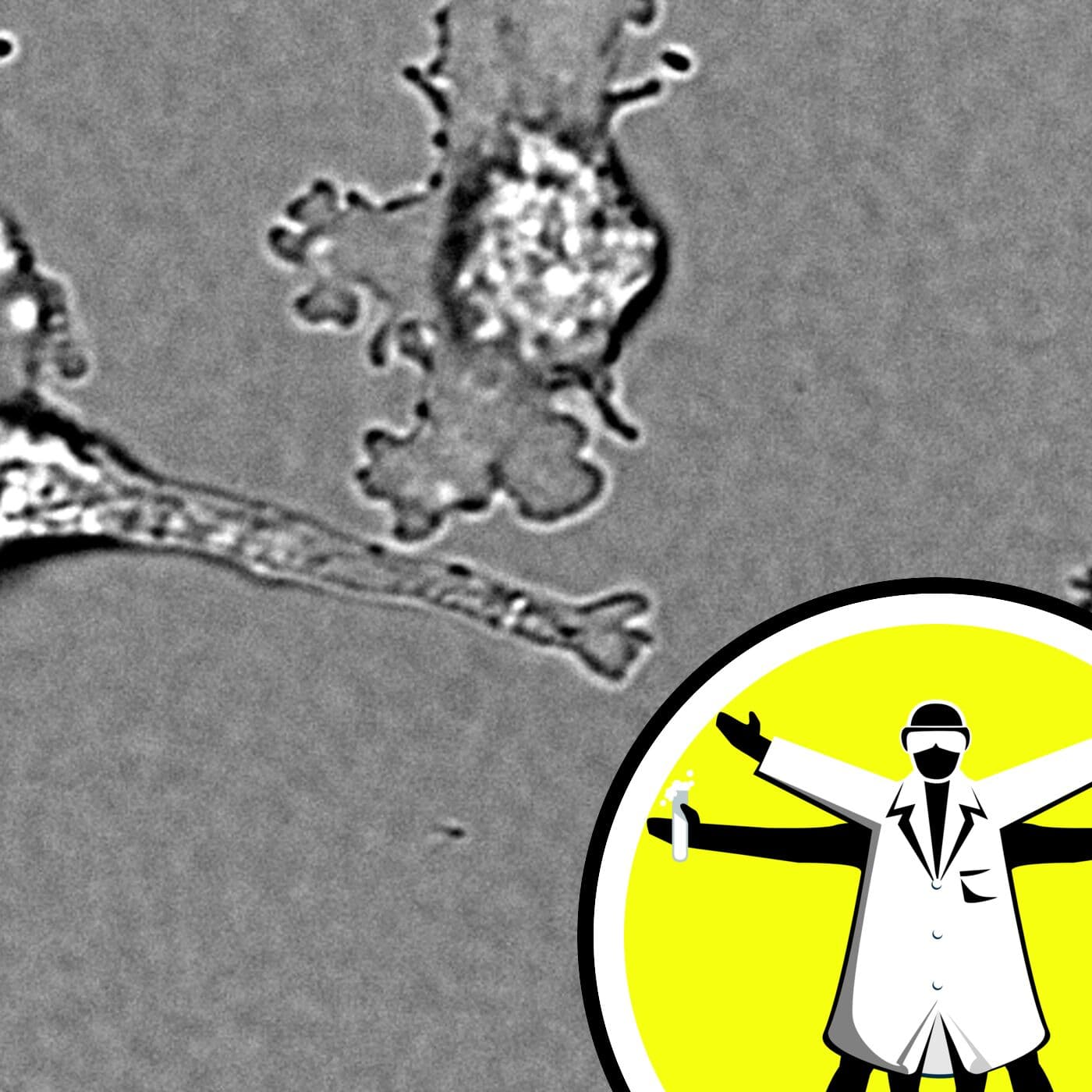
16:27Holly Wilkinson:So we'll look inside a diabetic foot ulcer. These are obviously a type of non-healing wound. They're characterised by a lot of infection and also lots of different types of microbes reside in those types of wounds. We will also see that a lot of those microbes are encapsulated in a type of slime, which we tend to call biofilm. And this actually protects those bacteria from our host cells, which might want to fight those bacteria. And it also protects those bacterial cells from antibiotics as well. So one of the reasons that we end up with really problematic infections in these wounds is because of this slime that encapsulates these bacteria.
17:11Holly Wilkinson:in those wounds as well we also see lots of different types of skin cells and in this environment it is very inflammatory so we'll have lots of types of immune cells that are in there both trying to attack the bacteria that's in those wounds but also just behaving in the wrong way
17:29Mat Hardman:when we look inside this sort of wound the skin has got multiple layers to it so how many layers has this wound gone through and what effectively happens at the bottom of the wound like the bottom of the well what is there what's it hitting and what is the body doing about it yeah so so these
17:50Holly Wilkinson:wounds do go quite deep so we go through the layer that we count as the the barrier of our skin which is our epidermis and we go into the the tissue that is underneath that which is our dermis the part of our skin that is full of collagen and it gives our skin that that kind of youthful structure and when you have a wound that fails to heal you get breakdown of all of that collagen so we eat away at that nice structure and it can go quite deep down to kind of the underlying fascia the underlying muscle the underlying bone when when these wounds become very very serious.
18:23Mat Hardman:The body must sense that somehow so how does the body know that that breach is there?
18:29Holly Wilkinson:So what tends to happen as kind of a first line response is the cells that we have in that barrier layer they release signals if they become injured so they release damage associated signals and also we have bacteria on the top of our skin and our skin cells sense those bacteria and usually they they exist together in harmony they communicate with each other but if you get a breach to the barrier that can throw all of the signals off as well so we then also get bacteria associated signals that shouldn't be there and that also signals to the body that there's a problem here that we need to solve.
19:06Mat Hardman:And what's the body's response? These signals come flooding out of the wound. There's presumably a gradient, they're hottest where the wound is and the signal dissipates away from the wound. So how does the body use that and what's its reaction?
19:20Holly Wilkinson:Yes, so there's a few different things that happen all together. It's kind of an orchestrated, if you like a concert of kind of different instruments that all come together to produce this wound healing response so we have activation of the immune system so we have kind of sentinel cells that guard the epidermis that are immune cells and they get those signals and then they they leave the epidermis and they migrate out of the skin to go and tell the body that we need to amount an immune response to this so then all of the new immune cells flood in from the blood we also have the the cells that are in that top layer of the barrier they also become activated and usually they're kind of like a brick and mortar structure and they kind of just sit there solid in their little shape but when they get activated by these signals they kind of shimmy away from each other and become less of a brick and mortar shape and more like loose cells that can move around and then obviously when they become like that they can then start migrating and moving to close the gap that has been created so there's lots of these different activation states that happen to our cells that changes them from how they function in a skin environment versus how they function when we have an active wound how would it heal normally so say
20:37Mat Hardman:this is not someone who's destined to get a chronic wound it's it's just a cut you slip with a knife and you breach your skin presumably all the mechanisms you've just outlined they're invoked but you don't end up with a chronic problem so how would it work to heal up normally because if we understand what normal looks like it's easier to see what abnormal looks like
20:58Holly Wilkinson:yes a normal wound healing happens in three to four stages the first thing that happens is that immune response so our immune system comes in clears out any potential bacteria that could be a problem and then this stage is then replaced by a proliferative stage where our cells that form the barrier will start to migrate to close the gap. And then if there is any issues lower down in the tissue as well in the dermis where we have all the collagen, the collagen producing cells can start to produce more collagen and fill in all those gaps as well. And then we end with a remodeling stage because we have to remodel all of the collagen that is put down initially that is, you know, quick and dirty, just put it all down to fill the gap.
21:41Holly Wilkinson:But then we need to make it into a proper skin structure you know you can tell what the remodelling stage is if you look to a cut on your finger because you'll have scar tissue and that's part of the remodelling of the skin is
21:53Mat Hardman:the generation of that scar tissue so the first thing is that the the immune system defends you meanwhile the skin that's surviving at the margins knows we've got a breach here the cells grow like bilio to flood in from the edges to fill the gap as well as other cells making collagen to basically fill up and occupy the space this all stitches itself together but it looks ugly and then a period of remodeling kicks in once we close things up to tidy stuff up and make it neat again so why doesn't that happen then normally in a person who's destined to get a chronic wound a diabetic why does that go wrong?
22:33Holly Wilkinson:So there are multiple things that go wrong in somebody that has diabetes. So they tend to develop vascular problems so their blood vessels don't work as well as they should do and that affects blood supply to the skin which then affects how well the skin cells function because blood carries the nutrients that our cells need and then also the underlying pathology of diabetes causes our immune cells to not function properly we have a lot of underlying inflammation in the body so when there is a wound there becomes a situation where there is too many of these immune cells appear and obviously we want a small amount of inflammation at the beginning of wound healing because that's really important for clearing out any debris allowing ourselves to migrate and also to clear out any potential bacteria but if we have too many immune cells there and they're too activated then they're basically fighting with our other cells in that environment so they're producing factors that will degrade collagen as our collagen producing cells are trying to put down collagen so they're just constantly fighting with each other and then it means that we can't properly fill in the gap.
23:45Mat Hardman:Does the fact that they may have very high glucose levels does that also affect the environment of the wound so that any microbes that are there are basically being fed an all-you-can-eat buffet?
23:56Holly Wilkinson:Yes, so high glucose does actually drive inflammation. So we know in terms of the pathways that are activated that glucose is a driver of those inflammation-related pathways. And one area that I'm actually very interested in and work on is a process called cellular senescence, which is an ageing mechanism in the body. And this is actually driven by glucose as well. So if we have high glucose in the environment, it triggers our cells to become very very stressed and when they become stressed they can go into what we like to call as a zombie-like state when they become senescent and when this happens rather than dying due to the stress which is usually what happens with normal cells they go into this zombie-like state where they don't die but they're not alive and they're not functioning well but they then produce lots of factors that drive inflammation so we are also carrying out a lot of work in our lab to look at these zombie cells in diabetic wounds and kind of how they're preventing wounds from healing as well.
24:55Mat Hardman:Holly Wilkinson at the University of Hull. So the aim here is to bring together all this learning to try to develop new approaches to wound management and healing and that begins with better diagnostics so you know what you're up against. Matt Hardman again.
25:12Ketan Dhatariya:So I think the first thing is it's really important to understand what the cause of the pathology is in specific wounds because the treatments won't be the same for every wound and I think it's understanding how to manage the different causes of that pathological healing is fundamental. So being able to develop diagnostics that can be used to kind of identify what treatment would benefit what specific wound is essential. So a good example is infection. So you can have wounds that are infected with antimicrobial resistant organisms and have biofilms that absolutely need to be eradicated and managed.
25:51Ketan Dhatariya:But then you can also have wounds that have a very high level of microbial burden, but those could actually be beneficial microbes. And you don't want to be going in and killing those microbes because they could actually be having a beneficial effect on healing. So it's understanding the causes of the pathology to then be able to target specific treatments. And so with wounds, you tend to have devices. Almost everything is device-led. and that could be an antimicrobial dressing it could be a negative pressure application to to remove exudate and stimulate cells but there are all kinds of other emerging technologies that
26:29Mat Hardman:are proving to be quite interesting i remember about 20 years ago interviewing a gentleman who was sticking electrodes in wounds and he had one in the bottom and one at the edge and he was able able to show there was a voltage being created between the bottom of a wound and the sides and he said that is the guide to cells that are proliferating at the edges and migrating in to
26:53Ketan Dhatariya:fill the hole is that true yeah absolutely there's a good amount of literature on electrical currents and electrical stimulation within wounds there's been a number of kind of devices developed to address that. So there's dressings that intrinsically have electrical current within them. There are devices to apply electrical stimulation to wounds. One of the challenges is understanding that biology doesn't necessarily then translate into clinical efficacy. These devices have kind of relatively limited benefit in terms of the clinic. That is a problem because wounds are very very difficult to heal and so a lot of the technologies that are developed you don't really know if they're going to work until you get them into people the models that we have to be able to evaluate clinical efficacy are relatively challenging does it matter where on the body
27:48Mat Hardman:the wounds are because skin although we use the word skin it's going to differ across your body surface so presumably there are going to be some places that might be tougher to fix than others
28:00Ketan Dhatariya:absolutely and again this isn't something that's really not that well understood the microbiome the bacteria that inhabit your skin is wildly different depending on what body region you look at your elbow and my elbow are more similar than my elbow and my head which is crazy in terms of the composition of the bacteria that are there we know that cells are fundamentally different depending on which region of the body you look at and we know that the skin structure is very different particularly a lot of diabetic foot ulcers form on the bottom of the foot and your palma plantar skin on your feet and hands is very different to the rest of the skin on your body for example you know it lacks hair follicles and we know that hair follicles have stem cells and those stem cells
28:46Mat Hardman:contribute to wound healing presumably also the immune response is going to differ across the body surface because we know there are some places where the immune system is really tooled up and is on higher all the time. I'm thinking of things like your genital tract, your gastrointestinal tract, etc. There are going to be other places where it's perhaps a bit more sluggish.
29:09Ketan Dhatariya:Yes, but I think probably the changes in the immune response are more due to changes with diabetes or age. We know that immune synestines is a big problem in terms of susceptibility to injury and age is one of the main risk factors for developing poor wound healing. Generally, younger people heal very well. And then as you get to a certain age, you kind of get to a tipping point. And then as you get older, your skin changes significantly and becomes much more fragile, thinner. And again, that contributes to the susceptibility to injury.
29:46Mat Hardman:So you have less agile stem cells in the skin because it's older, which is going to contribute. You've got a less agile immune system because it's older. and that's going to contribute you've also got perhaps a less agile nervous system so you can't feel when you're bashing yourself about it seems like a perfect storm you can't just solve one
30:06Ketan Dhatariya:problem yeah absolutely but then the question is the really interesting question is why doesn't everyone develop chronic wounds you know it's probably around globally around one in four people with diabetes will have a chronic wound at some time in their lifetime and about one in 20 older people. So not everyone develops chronic wounds. Again, it's understanding what the different factors are that make people more susceptible to poor healing.
30:32Mat Hardman:So what do you think then is the best way forward? As part of the new initiative, you're obviously starting and testing various things. How do you bring it all together to try to bring that cost that you outlined at the top of this program down as that enormous spend?
30:48Ketan Dhatariya:Yeah, it sounds simple, doesn't it? But the first thing is, you absolutely need to do research that's informed by understanding the clinical problem, talking to patients, talking to clinicians, really understanding whether what you're doing in a research laboratory, whether you're a biomedical scientist or an engineer, has clinical legs and application. The second thing is it's really kind of embracing the technologies that are available. We have now the ability to sequence whole microbiomes in a very cost effective way, whole genome sequence microorganisms in a very cost effective way now, which opens up whole new opportunities to be able to have a really detailed understanding of what's there in a wound in terms of the bacteria and the microbes to then be able to really target antimicrobials, anti-infection, anti-biofilm technologies where you need them when you need them and then on the host side in terms of the host cells there's a lot of opportunities to develop new treatments around the body of evidence that's already there.
31:53Ketan Dhatariya:We are looking at hormone modulation, we know that hormones change significantly over the lifetime and we know that changes like going through the menopause reduction in estrogen has a significant impact on your ability to heal. we are developing new biomaterials that are able to then stimulate cell biology to promote wound healing we've got new approaches in terms of taking new technologies to target things like proteases in the wound which are essentially important for wound healing but if you have too many can digest wound tissue and we're using things like cold plasma to be able to stimulate wounds as well as manage the infection so there's a huge amount of opportunity there the other thing that we're doing within the institute which i think can't be underestimated is working on predictive modeling and predictive models because you can have a really good idea in the laboratory you can you can do the the study from 20 years ago to measure that change in electrical current across the wind but then you need to have the right kind of models to be able to test whatever you're developing before you put them into people matt hardman at the wound innovation institute
33:00Mat Hardman:issues. Well let's hope that their endeavours quickly begin to bear fruit and we see meaningful and tractable tangible progress in the treatment of what is effectively a huge clinical iceberg towards which we and many populations like ours are steaming at breakneck speed. Today's show was brought to you in partnership with UK Research and Innovation. Now we're back with the latest science news stories from the week on Friday including everything you need to know about a new mRNA-based flu vaccine which has just been approved for use in the United States. Hear how it works on Friday. And for more Naked Science in the interim there is of course our science Q &A show that comes out every week that's called Ask the Naked Scientist and it's available on all good podcasting platforms and there's also our space science strand Naked Astronomy for those who are very fond of heavenly bodies.
33:50Mat Hardman:Of course if you appreciate what we do here and you'd like to get behind us and support the show do please consider making a donation you can do that at nakedscientist.com forward slash donate i'm chris smith thanks for listening and until next time goodbye
34:25Holly Wilkinson:Hi, this is Becca Moore from For The Girls, and this podcast is sponsored by Aerie, where you can find the right bra in 59 sizes, soft fabrics, and good fits. If your bra strap is digging into your shoulder right now, it's the wrong bra. We get so used to being in pain as girls that we forget it doesn't have to be this way. Your clothes should not hurt. I got to the point where I stopped wearing bras altogether, and now my life has changed, you guys. The only bras I have in my dresser right now are Aerie, and I'm not kidding. Aerie's on a mission to make you feel good, and that starts with your bra.
34:52Holly Wilkinson:Your bra should hold you in, not back. Visit Aerie.com to find the right bra for you.