In short
The episode covers three science stories: (1) UK meningitis outbreak genetics: UKHSA and Oxford compared genomes of Neisseria meningitidis from Kent (March 2026) with ~50,000 global genomes. They found ~90 genetic changes linked to increased virulence, including a larger capsule for immune evasion, changes aiding survival in blood/brain tissues, iron-acquisition genes, and altered pilin proteins for better attachment. Public health antibiotics and contact measures likely eliminated the specific strain, though related strains still circulate. Examples: 21 cases in one week; 2 deaths; 30,000 given prophylactic antibiotics; linked to a Kent nightclub (5–7 March). (2) Bat evolution: St Andrews study (Nature) argues bats arose ~65 million years ago, with early flight and early echolocation; suggests European origin and later global dispersal. Example: a New Zealand burrowing bat. (3) Heat-loving amoeba: Syracuse study (Cell) describes “incendiameba cascadensis,” replicating at 63°C in Lassen Volcanic NP, surviving via cyst dormancy; likely eats thermophilic bacteria.
Guests
Charlene Rodriguez (UKHSA), Sonia Vernes (University of St Andrews), Beryl Rappaport (Syracuse University), Kate Spence (University of Cambridge).
Written by AI. May contain mistakes. Listen to the episode to check what was said.
Chapters
Tap a time to open that second in VOMeningitis Outbreak in Kent
1:29 to 9:27
Discussion on the recent meningitis outbreak in Kent and its implications.
“Now the good news is that the study also shows that the interventions to block the spread at the time also may have wiped out the causative strain.”
Key Takeaway from Meningitis Study
9:27 to 9:40
Insights on the genetic changes that heightened the bacteria's virulence.
“Better to be safe than to be sorry, especially if you're a young person who's going off to university.”
Bats: Origins and Evolution
9:40 to 14:00
Exploration of bat evolution and their geographical origins based on genetic studies.
“Now Europe and about 65 million years ago are the answers but what were the questions?”
Bats and Their Evolutionary Journey
14:00 to 16:52
Explore the origins and adaptations of bats as revealed by recent research.
“can you not just do how the family tree is related but how it's related geographically and therefore where the ancestors of bats probably sprang from.”
The Discovery of a New Amoeba Species
18:15 to 25:27
Learn about a newly discovered heat-loving amoeba and its unique survival strategies.
“Meanwhile, still to come, will technology help us to track down the last resting place of Egypt's most famous queen, Nefertiti?”
The Mystery of Nefertiti's Burial Site
25:33 to 28:00
Investigate the ongoing search for Nefertiti's hidden burial place and its significance.
“Kate Spence is an Egyptologist and an archaeologist at the University of Cambridge.”
The Quest for Nefertiti's Tomb
28:00 to 31:38
Exploring the theories and challenges involved in locating Nefertiti's burial site.
“it becomes quite difficult because we don't know whether Nefertiti was buried as a queen or whether she was buried as a king and we have evidence for other female kings being buried as kings in the Valley of the Kings.”
Transcript
Automatic transcript. May contain errors.0:28So you're not worried about hosting the whole family for the holidays?
0:44Hello,
0:50welcome to the Naked Scientist podcast, the programme that brings you the biggest breakthroughs and talks to the major movers and shakers in the worlds of science, technology and medicine. I'm Chris Smith and coming up scientists identify the gene changes linked to more virulent meningitis bacteria the record-breaking amoeba thriving at temperatures that would fry most other life forms and our Egyptologists on the cusp of finding Queen Nefertiti's three and a half thousand year old long lost tomb
1:28Scientists in the UK say they've discovered why the bacteria responsible for the country's worst ever outbreak of meningitis B proved so dangerous. Two young people died, nine ended up in intensive care, and 30 ,000 people received prophylactic antibiotics to block the spread of the outbreak that stemmed from a nightclub in the English county of Kent earlier this year. The study by the UK Health Security Agency and the University of Oxford, and released provisionally as a pre-print this week, has compared the genomes of the meningococcus bacteria behind the outbreak with existing strains of the same bacterium that circulate naturally.
2:07The analysis has highlighted a number of genetic changes that appear to have enhanced the virulence of the bugs, turning something that can normally loiter harmlessly in the throats of about 10 % of the population into a much more aggressive infection. Now the good news is that the study also shows that the interventions to block the spread at the time also may have wiped out the causative strain. Its relatives, though, are still circulating, which is why a vaccination programme for young people heading off to start their new university year is in full swing right now. The UK HSA's Charlene Rodriguez led the study.
2:45Back in March 2026, there were 21 cases of meningitis that occurred over a week in Kent, and very tragically, two young people died. At the time, UKHSA public health teams kicked into action a number of measures to try and prevent people getting sick from that same bug. Presumably what stood out was that we get, what, three, four hundred cases of meningitis per year normally in the UK. So to have 20 plus all at once, that told us something had changed. Yeah, this is what public health do. They monitor and they track certain diseases. So meningococcal disease, which is this disease, is a notifiable disease.
3:26So when a case happens, doctors are supposed to tell the public health agency for this reason, because they're diseases of importance, that if we know too many are happening at a certain time, we need to get on top of that and understand why that might be happening and try and stop further spread. So yes, one week and 21 cases was a warning sign that there were too many and this looked like it might be an outbreak. and then that leads into a whole chain of public health actions and investigations and people contacting patients and their families and giving antibiotics and talking to those people and trying to understand about what exposures people might have had what where have they been what have they been doing trying to understand the movement of people because with infectious diseases there's always other factors involved so people spread things from one person to another or you get it from the environment depending on what infection it is so there's a lot of investigative work that goes on at the same time to try and understand how these people have acquired this infection and what other actions might be needed and at the time you'll remember maybe that they were linked to attendance at a certain club a nightclub on the dates 5th to the 7th of March.
4:34The thing is though that there are lots of young people and there are lots of nightclubs and there's lots of that kind of socialising going on every weekend but we don't see these big outbreaks of meningococcal disease so what do you think or what was going through your mind thinking well there must be some other factor or there must be something else which is driving this at the time so we had exactly that same conversation that weekend after these cases were coming out you know why was this not happening in other places if it was a more general like say problem so that pointed us towards the bacteria because we know there's lots of different types of this bacteria this meningococcus that circulate and differ between geographies and between continents.
5:15And so then it made us worry that there was something about this particular strain of bacteria that was maybe contributing to the fact that this was such a large, and at the time it was described as explosive and unprecedented outbreak. And how did you pursue that? So what we have done is we've taken the bacteria that caused the outbreak, we have six of those strains and we looked at the DNA and we compared them to each other. But we also compared the DNA to a bigger biobank of about 50 ,000 genomes from across the world, including 5 ,000 from the UK, to be able to look at genetic differences between the outbreak compared to all of these other strains to try and understand what it was that was different about this outbreak strain compared to others.
5:59We could see that there were about 90 genetic changes between these outbreak strains and their closest relatives, which were also from disease in the UK. So you look at the genetic spelling changes, for want of a better phrase, that have happened in the strain linked to the outbreak compared to, let's call it the parent strains, the forms that we normally pick up in Britain. And the rationale is, well, if there are changes in the outbreak strain, at least some of them might be linked to the fact this has happened. Exactly, yes. So we looked at those 90 and basically went down the list one by one to try and understand, do we think this was important in either the way the bacteria grows or could cause disease in a human?
6:42What stood out? We saw that a number of strains had actually got a bigger capsule, a coat the bacteria wears, to try and invade being killed by our immune system. This bacteria is part of our throat microbiome and it can live there, most of us, not causing any problems. But very rarely can invade through those tissues into the blood, causing sepsis. And sometimes it can get from the blood to the cross the brain barrier and cause meningitis. The changes in the bacteria we're seeing can help them to either stick on to our throat better or get through into the blood better, survive in the blood better or survive in the tissues around the brain better.
7:23Other changes that we found when they'd acquired DNA from other bacteria that live in the throat may have affected their ability to grab iron. And it needs to grab iron because when it's in the blood, that's what helps it to survive a bit better. The other changes we saw were in these proteins on the outside of the bacteria called pillins, but they help bacteria to attach to human tissues. So our throat tissue, for example. Now you've got this fingerprint, so you know what you're looking for. you've got the sort of risk strain labelled. Do we know what its prevalence is? If we look at the population of meningitis causing bacteria across the UK that crop up and are carried naturally, is this particularly well represented or was it just a one-off?
8:07It's fizzled out because of your public health intervention, now we don't have to worry. So this particular Kent strain is interesting because actually we haven't seen it again in the UK in either disease or in a study that we did swabbing noses and throats of young people in Kent soon after the outbreak. It may be that the same genetic changes that made the strain so dangerous may also have explained why it hasn't continued to spread because actually it was just too invasive to then be sustained in the population carrying from one person to the other to the other. There is also the fact we gave a lot of antibiotics out at the time in Kent and so if it was in people's noses then it was killed and that the whole point of that is to stop it going to the next person to the next person so we haven't seen it other strains like it sort of its ancestors that were in this same family are circulating in the UK and I guess the concern is particularly that this may happen again in some of those strains who have already acquired there's said a couple of those changes and we can't predict when or where that might happen and of course it goes without saying if you or someone you know should develop a flu-like illness with a headache, neck stiffness, an aversion to bright lights and sometimes a bright red skin rash, do please seek medical advice.
9:27Better to be safe than to be sorry, especially if you're a young person who's going off to university. That was Charlene Rodriguez at the UKHSI on what made the meningitis strain behind the outbreak in Kent earlier this year so nasty. Now Europe and about 65 million years ago are the answers but what were the questions? Well it was where did bats come from and when and researchers at the University of St Andrews think they can now answer both with a lot more certainty. Their findings are the product of a clever study that takes into account published bat genomes essentially the bat genetic family tree together with evidence from fossil specimens that can help to point us towards what was happening, where and when.
10:13Sonia Vernez led the study. Bats are incredibly diverse. There's more than 1 ,500 species of bats alive today and they show some of the most remarkable features we can see in biology like echolocation and being the only flying mammals. and we really thought if we could understand their genomes we could understand something about their evolution and these remarkable qualities that is in their biology. One of the things that genomes can tell us is roughly how long species have existed for because we can look at how sort of far apart the different members of a family tree are. So when do we think based on the sort of analysis you've been doing that bats first started fluttering around?
10:55Well based on our new work and some prior work that's been long studying bats, we know now that bats have been around for about 65 million years. And flight emerged really early on in their existence. So bats as flying animals seem to have emerged pretty early. But what we know now from our paper that we've just published is that they were also echolocating really early on in their history. So they were not only flying, but they were using this amazing biosona. How do you know that? It's because the work we've been doing involves not just genomes, but also fossil evidence. And so being able to build those two aspects, the very, very old of the fossils and the very, very new of the cutting edge genomics technology, we can intersect the pieces of evidence and look at how the family tree evolved and where these fossils really sit in the family tree.
11:51and what we've shown is that some of the early echolocating fossils that have been identified actually sit really early on in bat history at a point before bats became this diverse set of species. So 65 million years ago the ancestor or the precursor to bats comes along and it very quickly gets these traits that we define as bat specialities and then the family tree diversifies after that. Yes, that's right. So what did they come from then? That's a hugely debated question in biology and one that we still haven't been able to answer fully yet, but we're getting closer with more fossil evidence and more genomes.
12:35So they're in a family that has some very strange sister species in evolutionary terms. Some of the close relatives outside of bats are things like seals and horses and cows. So it's still a really open question of what the closest living relative to the bat family tree is, but one that we hope to answer with genomes and fossils in the future. That number, 65 million years, it stands out, doesn't it? Because that is the time, roughly, when the dinosaurs go extinct. We know there must have been some very dramatic changes happening to the earth, to the environment. Is that significant here? Is that why bats suddenly proliferate and become big on the world stage around that time?
13:20It might be. I don't think we've been able to answer that question specifically. But the fact that they were both flying and echolocating means that they were able to inhabit niches that other animals might not have been able to. So for example, they're the only flying mammal. The other flying vertebrates that you think of would be the birds. But often they're awake during the daytime and bats have the benefit of being able to see in the dark so they can inhabit new niches and their ability to fly has meant that they quickly spread throughout the globe and weren't as restrained geographically as some other mammals.
13:56Do we know, though, Sonia, where they spread from? So in other words, if you bring all this evidence together, can you not just do how the family tree is related but how it's related geographically and therefore where the ancestors of bats probably sprang from. Yes, and that's one of the really exciting findings in this paper actually, is being able to not only build a more accurate family tree, but look at where that family tree originated and how it dispersed. And so our work actually suggests that bats originated in Europe and then dispersed around the globe from there. That's fascinating. So why do you think or what do you think was special about the environment they would have been in Europe at that time that meant it gave rise to bats it selected for the thing that made bats a reality I think what we've been able to show is the strength of the evidence that suggests they really do or does look like they emerged from this part of the world and then moved into Africa setting up a European African hub and then what you see is they keep evolving and keep changing into the families in the bat family tree and they take on different properties as they move around the world adapting to those different environments.
15:08Have you seen any interesting adaptations in terms of they evolve to do something and then they appear to lose it again and then regain it again because sometimes when you have very long evolutionary timelines with some species you see them gaining and then losing traits and then having to re-evolve them. Have bats got any interesting stories to tell in that respect? Oh I think they have so many interesting stories in that respect. For example, sometimes people say, well, there are birds that don't fly, are there bats that don't fly? And we haven't found any bats that don't fly, but one of the bats we sequenced in our paper is a New Zealand bat.
15:45And it's also got the nickname as a burrowing bat because it's evolved to run along the ground and dig into the foliage to find its food. And one of the theories about why it's been spending more time on the ground than you would expect for a bat is because there were very few predators that would attack a bat when it came to New Zealand. It was the only mammal that's native to the island that's a land mammal. All other mammals in New Zealand were brought through people coming to the islands. And so it probably had a lot of time where it was safe to walk around on the ground and not be picked off by a lot of other mammalian predators.
16:26Is it a big bat? I never knew that existed. Oh it's not a very big bat, it's quite small. They're really amazing creatures and actually a few years ago they're so beloved in New Zealand that they won the competition of bird of the year despite very much not being a bird. The sort of honorary bird. Honorary bird of the year. Brilliant. Sonia Vernes at the University of St. Andrews. That study on the origin of bats has just been published in Nature.
17:21Halloween decor now at Wayfair.com. Wayfair, every style, every home. The Naked Scientist podcast is produced in association with Spitfire. Cost-effective voice, internet and IP engineering services for UK businesses. Find out how Spitfire can empower your company at Spitfire.co.uk.
17:48This is the Naked Scientist podcast with me, Chris Smith. And we're now halfway through today's programme. If you're enjoying it, do then please consider supporting us over at nakedscientist.com forward slash donate. It's really easy, safe and secure. And by helping us, you're helping to make sure we keep this show on the road, literally as well as metaphorically, every week. and thank you very much to those of you who are helping to support us already. Meanwhile, still to come, will technology help us to track down the last resting place of Egypt's most famous queen, Nefertiti? First though, a tiny single-celled organism that can survive at temperatures that will be deadly for all other known complex life has been described.
18:33In a study published in Cell, scientists found a new species of amoeba, which has been appropriately christened incendiameba cascadensis that can eat and reproduce in hot spring water as warm as 63 degrees celsius in california's lassen volcanic national park the amoeba can also protect itself at even higher temperatures by temporarily turning itself into a dormant spore-like cyst structure a dose of the cold though and by that i mean the temperature that is still a pretty hot 42 degrees C will prove lethal. Beryl Rappaport is based at Syracuse University in New York. We have found a new species of amoeba, a single-celled organism that can survive at hotter temperatures than any other known complex life.
19:23When you say hotter temperatures, how hot's hot? They can replicate, that means going through their whole life cycle at 63 degrees Celsius, So it's much hotter than a human body or anything that we can sustain. Indeed, because if I put my hand in water that was 63 and a half degrees, I would feel burned. I would definitely go, ouch. Yes, you'd be getting some burns pretty quickly. Begging the question, well, if I can't put my hand in that water, but these things can not just survive in it, they can reproduce and thrive in it. How are they doing that? We have some hypotheses, some evidence, but a lot of this we're working to still understand.
20:01And one, we know that they have some interesting behaviors in how they move. They can kind of change shapes quickly, which might help them move away from environments that get too hot. Also, when it gets very hot, they can enter this dormant protective state called a cyst that allows them to survive at temperatures that are even hotter before the temperatures get colder and then they can reemerge. and we also think that they have some strategies in their gene structure that allow their proteins that make up their cell structures to stay stable at these high temperatures both in how they maintain those proteins if they start to unravel to recover them and also just in the structure of those proteins that keeps them more stable.
20:50Is that why high temperature is a bad thing is that why I am naturally aversive towards high temperatures because it will damage the proteins in my cells? That is one of the negative effects that high temperature can have on cells. It will damage protein structure and it can also change membrane structure, make membranes more fluid, which makes it a bit harder to keep cell structure intact. And it can also have effects like speeding up reactions so just a little bit less control over what's going on in the cell. Therefore what have these organisms evolved or how have they evolved to defeat that problem?
21:31Still some hypotheses but we're seeing that as they are living at higher temperatures for example when we look at the expression or activity of their genes at the high end of their temperature versus lower end, we see more activity of genes related to refolding or degrading proteins that have been damaged, as well as expression of membrane trafficking. So maintaining how they're regulating the membrane compartments in their cell. How did you discover these things and where? Where did you find them? We found these amoeba in a small, hot geothermal stream in Lassen Volcanic National Park in northern California in the US.
22:19And this is a stream that is often overlooked in this park where it's on the hike to this really large, hot lake called Boiling Springs Lake, this turquoise lake. You can't miss it. So these amoeba come from a small pH neutral stream, which is a bit unique in this environment where other features are really acidic. Don't amoeba eat other microorganisms and things? They engulf them and eat them. Isn't that their diet, bacteria? For the most part, but there's a pretty incredible diversity among amoeba where some can even eat other eukaryotes like fungi or other amoeba. Some can even eat animals, but these amoeba do eat bacteria.
23:05Well, the reason I ask the question, Beryl, is that, well, if they're busy living at temperatures that nothing else can survive in, don't they go hungry? Or do they retreat into these very high temperatures if they have to, but they live most of their lives not where it's that hot, where there is still something around to eat? Well, interestingly, these are the only amoeba or rather eukaryotes in the environment they live in. But there's a lot of diversity of bacteria in this environment. And a lot of bacteria and other type of single cell organisms, archaea, can survive at much hotter temperatures than these amoeba.
23:42So the amoeba are eating thermophilic or heat loving bacteria, which have already been established in these environments. Probably the whole environment has evolved together then, so you've got a community of microbes. These are the slightly more advanced, specialised eukaryotic ones, but their food source and them have all evolved together, which is why they're all living in these extremely hot conditions. They likely have been interacting together for many thousands of years, and the interactions between the meba and the bacteria have also likely changed the trajectory of these species. What can we do with this?
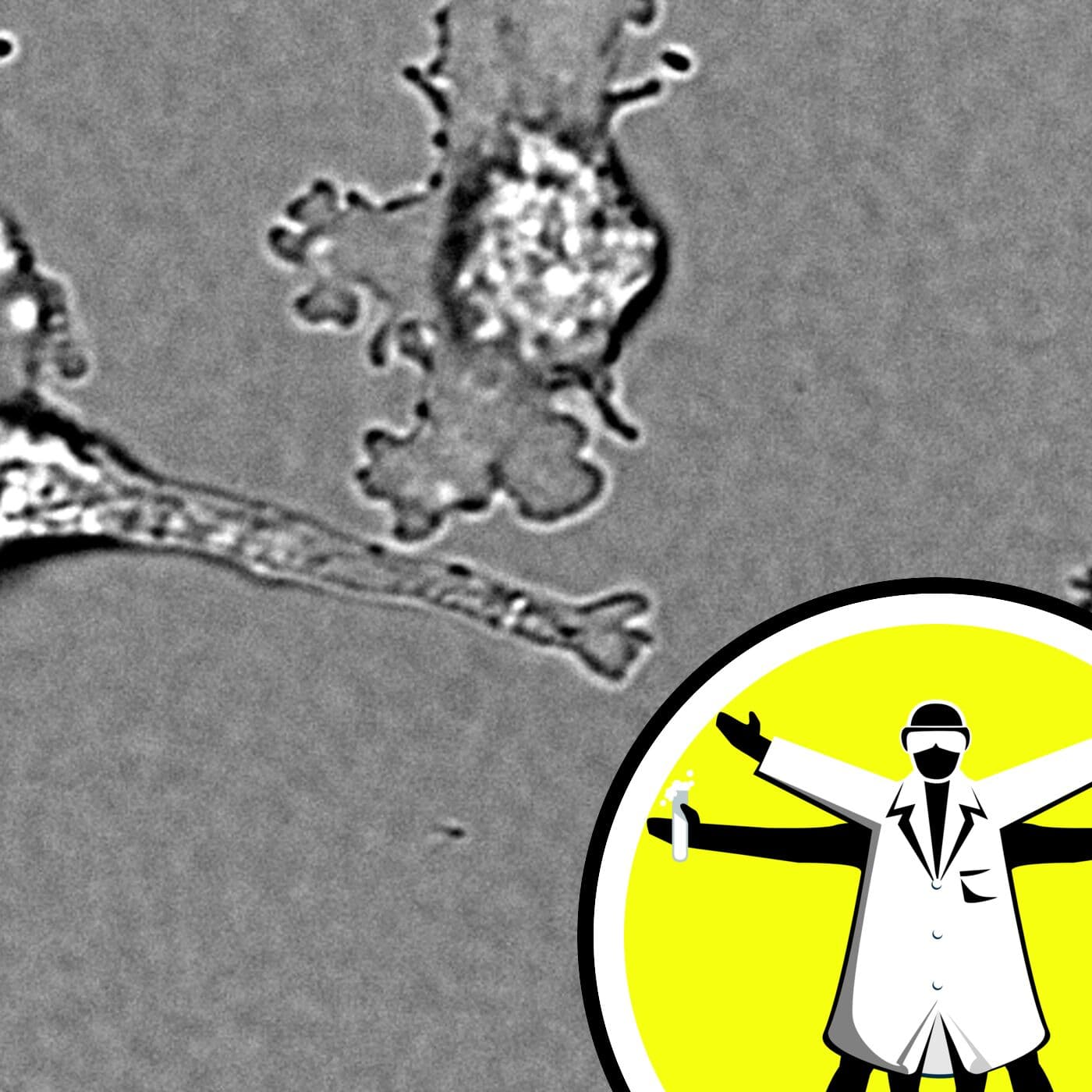
24:20Apart from being academically extremely interesting and very exciting, and it's turned into an amazing paper in one of the world's best science journals for you, what can we do with the learning? Are there any applications now that we can take away from these amoeba and apply elsewhere? There are some applications for our day-to-day life. For example, we could look into using some of the proteins like enzymes from these amoeba for heat-stable purposes where we need proteins like this. For example, bacteria that live at high temperature, a lot of proteins from them have already been in use in, for example, shelf-stable foods or medical diagnostics or genetic testing so looking towards more complex cell which might have really different structures of proteins from some of these bacteria these might have interesting uses for other biotechnology that we use in day-to-day life really interesting beryl rapaport at saracruz university there and beryl has sent us some remarkable images of her new amoeba she's discovered which you can see on our website just head over to nakedscientist.com forward slash podcast and it's in the transcripts for the program on there more than a century after the discovery of tutankhamun's tomb new surveys point to a large structure beneath egypt's valley of the kings and the story which has been published as an exclusive in nature has excited some archaeologists because they believe we may be closer than ever to solving another ancient mystery, the resting place of Nefertiti, Egypt's long-lost heretic queen who reigned about three and a half thousand years ago and was actually King Tut's stepmother.
26:05Others, meanwhile, are more sceptical. Kate Spence is an Egyptologist and an archaeologist at the University of Cambridge. Nefertiti was the wife of a very famous king of Egypt called Akhenaten. And Akhenaten is particularly famous because he liked to do things a bit differently. And he decided he wasn't keen on the traditional gods of Egypt. And he was going to bring in the worship of the sun god, which he called the Aten. So he built a whole new sort of capital. He changed Egyptian religion. He changed the way they wrote. He changed art. And so he was a really, really fascinating character. And Nefertiti was his wife.
26:47They had six daughters, but Akhenaten also had children by other royal women, including Tutankhamen, who we think were not 100 % sure, but we're pretty sure that Tutankhamen was Akhenaten's son. Now, obviously, we know where he's buried. Do we know where Nefertiti is buried? We don't know where Nefertiti is buried. And this has caused all sorts of interest in different places over time. One of the problems we face is we don't know where she was buried. She could have been buried initially in Middle Egypt at a place called Arkhanaten, which was where Arkhanaten had built its capital. But she might also, her body might have been buried in the Valley of the Kings or somewhere else in the region of Luxor.
27:34but one of the problems is is there is a theory that Nefertiti later became a female king of Egypt and it all gets very very complicated because for that time period we don't have enough texts and we don't really know what's going on we've got a series of rulers who we don't have a lot of information about sometimes we don't know their gender we don't know their identities so it becomes quite difficult because we don't know whether Nefertiti was buried as a queen or whether she was buried as a king and we have evidence for other female kings being buried as kings in the Valley of the Kings. Either way she was pretty important so she could well have been afforded a decent burial in this very prestigious place.
28:21She was really important. Yeah so could she be connected to these new structures or these new potential sites that have been identified? Well, this is the theory that's been put forward. So an Egyptologist called Nick Reeve suggested just over 10 years ago that possibly the burial of Nefertiti was hidden within Tutankhamen's tomb. So it's entirely possible she was buried in the Valley of the Kings, but we don't know where. We also can't rule out, obviously, that she may have been buried elsewhere too. How are these surveys actually being conducted? What sorts of quality of insights do we get when we do them?
29:00So the issue we have here is that there's been this proposal that there's additional burial within this tomb. But of course, the Valley of the Kings is a UNESCO World Heritage Site. It's an incredibly important site and you can't just go digging holes all over the place and cutting holes in the walls of Tutankhamen's tomb to try and find this missing burial. so what people have been doing is trying to use various forms of survey which can look into the ground so they use different forms of ground penetrating radar they've also been using various forms of resistivity to try and look into the rock and see whether there might be something behind there and there's been a whole series of these surveys going on over the last sort of 10 years or so to try and see whether there's something there.
29:49And some of them have said that they don't think there's anything there. This most recent survey suggests that they do think there may be chambers somewhere in the rock near the tomb of Tutankhamen. That's based on reprocessing some of the earlier data, but also on new measurements. How do we grapple with this situation and this quandary that we get these tantalising insights, but also we're very eager now to make sure we do no harm or minimal harm. What do you think the way forward is? This is really difficult because I think a lot of the people who are involved in investigating this would like to drill holes into what they perceive to be potential chambers to see whether there's anything there.
Read the full transcript
30:35It will be up to the Ministry of Tourism and Antiquities in Egypt whether they allow this to happen. In the past, particularly in relation to the pyramids, they've drilled holes and put cameras into sort of hidden chambers to see whether there is anything there. Do you think they are going to find Nefertiti? Do you think she is down there? It's a really intriguing idea, but it doesn't quite add up to me in that most Egyptian kings don't want to be buried with someone else important in the close vicinity of their tomb. There's also the problem that actually a lot of equipment, which some would think might have come from Nefertiti's tomb, or Smenkare, this possible name if she was a king, has actually already been identified in Tutankhamen's tomb.
31:22So even if there was a burial there, it had probably been very substantially emptied to reuse the material for Tutankhamen's tomb. I never realised that the ancient Egyptians were in the habit of recycling their grave goods. News to me. That was Egyptologist and archaeologist Kate Spence on the quest to track down the tomb of Nefertiti. That's it for today. Do tune in on Tuesday, though, when we're going to be putting heart disease literally under the microscope. We've partnered with the British Heart Foundation to explore why this is the biggest killer in the world and how their leading experts are trying to tackle it.
31:57Do please leave us a review on whatever podcasting platform you use to listen to us. Those rankings do help our visibility and that really matters. so thank you in advance for that and if you like what we do each week as I mentioned before do please consider making a donation to support the show that's over at nakedscientist.com forward slash donate it does mean a lot and it helps to keep us ticking along I'm Chris Smith and from all of us here at The Naked Scientist thanks for listening this week and until next time goodbye
33:03We'll see you next time. Shop Halloween decor now at Wayfair.com. That's W-A-Y-F-A-I-R dot com. Wayfair, every style, every home.