In short
The episode covers four science stories: (1) Cryptosporidium treatment: Francis Crick Institute researchers use CRISPR gene editing in cultured human gut cells to identify host genes the parasite depends on, then repurpose an old cholesterol-biosynthesis pathway drug that significantly impedes parasite growth in culture and in mice (over half reduction in an immunosuppressed mouse model) and reduces intestinal damage. Key context includes Devon’s 2025 outbreak linked to animal-to-human (zoonotic) water contamination; current approved nitazoxanide is less effective in young children and immunocompromised patients. (2) Bionic prosthetic knee: MIT’s Tony Hsu describes an above-the-knee system integrated with residual bone for direct force feedback plus an agonist–antagonist myeloneural interface to recreate “phantom knee” control; users report intuitive, fast learning and major emotional impact. (3) Near-Earth objects: Natural History Museum planetary scientist Sarah Russell explains asteroid monitoring, the plane-sized 2025 OW flyby, and Bennu sample findings (including salts, organics, and evidence Bennu formed beyond Jupiter). (4) Li-Fi: Pure Li-Fi co-founder/CTO Dr Mustafa Afghani and Dr Mohamed Islam discuss infrared, RF-spectrum-free wireless for privacy/security and cable replacement; examples include government/defense use and Bridge XC trials for gigabit connectivity.
Guests
Bishara Mazouk (Francis Crick Institute); Tony Hsu (MIT); Sarah Russell (Natural History Museum); Dr Mustafa Afghani (Pure Li-Fi); Dr Mohamed Islam (Pure Li-Fi).
Written by AI. May contain mistakes. Listen to the episode to check what was said.
Chapters
Tap a time to open that second in VONew Treatment for Cryptosporidium
0:45 to 7:25
Exploration of a new treatment for the gut parasite cryptosporidium using an old drug.
“Cryptosporidium is a common intestinal parasite.”
Innovative Bionic Prosthesis Development
7:25 to 13:55
Discussion on a breakthrough bionic knee that enhances mobility for amputees.
“Researchers at MIT have unveiled a breakthrough in bionic prostheses for above-the-knee amputees.”
Innovative Bionic Prosthesis Development
14:02 to 14:15
Discussion on a breakthrough bionic knee that enhances mobility for amputees.
“cost-effective voice, internet and IP engineering services for UK businesses.”
Asteroids and Near-Earth Objects
14:25 to 20:19
Discussing the significance of near-Earth asteroids and their monitoring.
“and deal with that annoying problem of poor Wi-Fi signal.”
The Future of Connectivity with Li-Fi
20:19 to 27:10
Exploring the innovative technology of Li-Fi and its advantages over Wi-Fi.
“They wake us up in the morning, they play us music and we use them to send those late-night emails we probably shouldn't be sending.”
Question of the Week: Human Cell Types
27:10 to 28:02
Explaining the different cell types in the human body and gene expression.
“Marushka Subban, and next time I'm stuck underground, I won't be searching for signal.”
Exploring Gene Expression and Cell Types
28:02 to 30:26
Learn about how gene expression differentiates various cell types and the impact of the Human Cell Atlas.
“So how is it that a liver cell learns to do something completely different from a nerve cell?”
Listener Question and Engagement
30:28 to 31:19
Discover how to engage with the show by submitting questions and get insights on cloud formations.
“Recently, on a cold, clear winter's night, I took a picture of a cloud in a perfect tube shape.”
Transcript
Automatic transcript. May contain errors.0:16Hello, welcome to the Naked Scientist podcast, the programme that brings you the biggest breakthroughs and talks to the major movers and shakers in the worlds of science, technology and medicine. I'm Chris Smith and this week an old drug heralds a new treatment for the gut parasite cryptosporidium, the bionic need that anticipates where amputees want to go and makes movements much more natural and why we're spotting more near-earth objects and is one of them going to hit us? From Cambridge University's Institute of Continuing Education, this is The Naked Scientists.
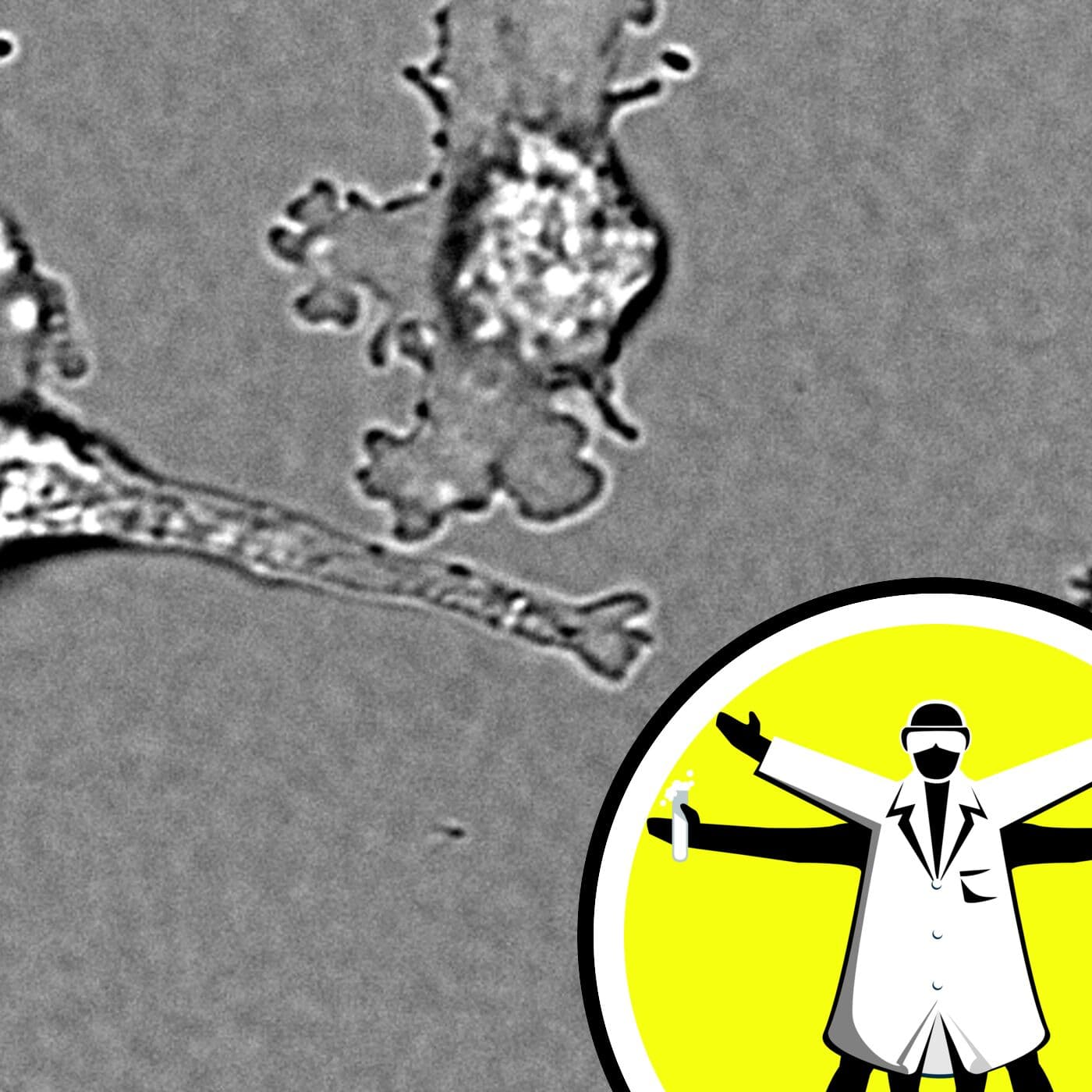
1:00Cryptosporidium is a common intestinal parasite. Usually picked up from drinking water, it infects the cells lining the gut, causing pain and diarrhoea symptoms which can go on for weeks. In some groups, though, it is particularly risky. Very young children and people with weakened immune systems can develop severe and sometimes life-threatening infections. And the problem is made worse by the fact that we have no proven remedies to date. But now, scientists at the Francis Crick Institute have taken an extraordinary step. By using CRISPR gene editing to switch off one by one almost every gene in cultured human intestinal cells, they've been able to find out what genes need to be operating in a cell either to boost or limit the growth of cryptosporidium.
1:49This has enabled them to comb through our existing repertoire of drugs looking for agents that target the same genetic pathways in our cells. And guess what? They've found one. An old, long-since-abandoned cholesterol-lowering drug that can significantly impede the growth of the parasite, both in culture and, excitingly, in animal tests. Here's Bishara Mazouk. So we are looking for a cure or a treatment for cryptosporidiosis, which is an intestinal parasite that infects children under five and immunocompromised people around the world. There was a problem with that in the southwest in the last year or so, wasn't there?
2:32Yes, definitely. So people in Devon, sort of May last year, were all told to boil their water supply because it was believed to have been contaminated with cryptosporidium. Where does it come from then? If it was getting into drinking water, what's the natural source of cryptosporidium? So there are different species that infect different organisms, but the outbreak that happened in Devon, we believe, would have been cryptosporidium parvum, which is a species that infects ruminants. So cows, lamb, sheep. So we get a lot of outbreaks as a zoonotic transmission. So that's going from animals to humans.
3:08So what it spills over from the animal, if you get contamination of the water supply with, say, faecal material, that's how it would get in. Exactly. Exactly. Yes. And when a person has it, what sorts of symptoms does it cause? If you are a healthy adult, you would probably have stomach cramps and diarrhea for about maybe two or three weeks. But if you are a young child, say under two years old, or if you have problems with your immune systems, this can be sort of uncontrolled diarrhea for prolonged times. And do we have any treatments at the moment for it? At the moment, there is only one drug that's approved for treatment.
3:49It's called nitazoxonide. But unfortunately, it actually doesn't work as well in the people that need it most. So in young children or in immune suppressed people as well. And hence, you were going looking for something that might work better. Exactly. Yes. And how have you approached it? So the problem with cryptosporidium is there's very little known about it already. Research on this parasite is lagging behind other more well-known parasites like malaria or toxoplasma. so we actually just set out to understand what about ourselves the parasite really needs. So cryptosporidium is a parasite that lives in the cells of our gut so we just asked what do our cells provide that the parasite needs.
4:32So we disabled almost every gene that our cells express one by one and then asked the question how does this affect the parasite. And your rationale is I suppose, if you disable the genes one by one and you find out whatever it is that the parasite's relying on in our cells, you can then say, well, are there any drugs that will do that for us that would therefore probably work against the parasite? Exactly. So what we really wanted to find would be something that our cells make that there's already a drug designed to target for maybe a different reason. And did you find some genes that you could disable that would disable the parasite?
5:11Interestingly, we found some genes when we knocked them out, the parasite didn't grow as well. But some other genes when we knocked them out, the parasite actually grew better. So we actually then homed in on one particular gene that made one metabolite that growth of the parasite seemed to hinge on. And luckily, because this gene is in the cholesterol biosynthesis pathway, A drug company had already been interested in it maybe kind of 20 years ago as probably an alternative to the statins that everyone uses. And so a drug had already been developed to target this gene. Does that drug then mimic this effect of knocking out the gene and does that disable cryptosporidium?
5:54It does. So in a dish, we tried this drug and it seemed to work and then we moved it to mice. so we infected mice with cryptosporidium and then treated them with this drug and it reduced parasite growth in the mice as well. How good is it? Does it reduce the parasite growth by a meaningful amount as in were you a person struggling with this because you're HIV positive and immunosuppressed or you are a very young child? Would it be the difference between chronic diarrhea and being better? It's hard to translate mouse studies to human studies so we are hoping to take this to human studies next. But in the mice, in our particular immunocompromised, so immunosuppressed mouse model, it was able to reduce the parasite by more than half.
6:39And it also reduced the intestinal damage that we see that is a hallmark of this parasite infection as well. And is the next step now to do a human clinical trial to see if you can break the back of a person who's got chronic cryptosporidium infection with this? Yes, exactly. So we're working with some collaborators right now who are used to running clinical trials in endemic regions so yes we're very much looking forward to to trying this out and the nice thing about this drug is it already has gone all the way up to phase three clinical trials so there's already a lot of safety data as well behind it so we're hoping to fast track the tests in humans and in children.
7:20Bishara Mazouk at the Francis Crick Institute with some great news about a potential new remedy, but using an old drug, for cryptosporidium. Researchers at MIT have unveiled a breakthrough in bionic prostheses for above-the-knee amputees. The new knee, which is directly integrated with muscles and bones, allows users to walk faster, climb stairs and navigate obstacles with greater ease. To explain how it works, here's Tony Hsu from MIT. The prostheses that most people have, the ones that you can buy in the market. They help you walk, they help you go downstairs maybe, but they don't have any motors and so they can't move like human legs do.
8:02So in our work, what we did was we attempted to more directly integrate the prosthesis with the human so that not only can you exchange energy with the device, but you can actually exchange neural information to inform the device how to move directly. Is that purely motor as in movements Tony or are you saying you can get some feedback some sensation from the prosthesis and feed that back into the person so they've also got some awareness of where in space their prosthetic is and how much force they're putting through it? So the really cool part is that the way we approach the problem where we integrate the prosthesis directly with the residual bone after the amputation, the person who has this prosthesis actually gets direct force feedback from that bone.
8:51Just like our skeleton is supposed to be directly loaded, we take that same approach and we take advantage of all the rich sensors that we have in our bones and our tissues to actually provide that person's sensation of the prosthesis. So even a very moderate tap all the way at the prosthetic foot can be felt at the bone just because of the way that we've designed the mechanical interface. And what about that movement ability as well? Because that's the thing, as you say, when a person loses a body part, they lose the ability to move everything downstream of wherever they've had the amputation.
9:30So what have you done to try and address that? The technique that we use in this paradigm is called the agonist-antagonist myeloneural interface, which essentially takes muscles which used to be connected together and reconnects them after the amputation. so in this study we provided people muscles that work together again just in this case for the knee but we take these muscles that already exist that used to control the knee and then we reattach them in a way that makes sense to the brain that provides the person a sense of their phantom knee moving around in free space so the person thinks they're going to flex their knee this would normally extend or stretch the muscle over their thigh and shorten the muscle around the back you can sense the activity in the muscles that would want to do that work out therefore what the joint would do and make the joint behave in an appropriate way so when it does move it moves in a way the brain's almost expecting it to i think that's actually a perfect explanation and then we call this the feed forward direction as in the signal comes from the brain and then the joint reproduces the movement that the signal contains and then in the feedback direction just like you mentioned earlier we get sensation from the prosthesis all these forces and impacts and movements that are conveyed through the bone back to the brain and so in this way we have the feedback direction and we close what we call the control loop.
11:06And how does that work functionally? What do the patients or the wearers say about this compared to devices that are much more dumb, for want of a better phrase? They're just a passive prosthetic that they're strapped on. Right. It's like, it's night and day. Working with these patients in the lab, when they come in and first start using our experimental device, it's really an emotional moment, especially because it's been so long for some of them since they've had movement of this joint. So just even the ability to flex and extend a knee, just those two movements, right? Not doing anything fancy, not juggling balls or trying to avoid obstacles, just extending and flexing the knee, that can produce a really profound emotional impact on our patients.
11:57So people get to grips with it quite quickly. It's not a steep learning curve for them. They can actually master this and get to grips with it fairly fast. As scientists, I would say if we do our job correctly, then it's completely intuitive. The interface is invisible or seamless. And the person just uses the motor skills, which they developed since they're one or two years old, right, to move their residual muscles, to move their phantom joints. And then if we do our job correctly, we can immediately reflect these at the knee. Given that it sounds, from what you're saying, like people took to this like a duck to water and really, really genuinely appreciated it, is this likely to become the gold standard then for above knee amputations?
12:39This is what we would strive to offer patients from now on. Are you going in that direction? This is definitely the school of thought that we are a part of, we as other researchers on the paper. there are a couple of perspectives one is that if you make the device smart enough on its own like let's say use ai or really advanced math if you make the device smart enough on its own then it can do everything that the human would want it to do but the other perspective is that there are just some movements that you can't get the device to do especially very fast and dynamic movements think again about playing football perhaps or dodging obstacles as you're running through a forest, there are some really dynamic movements that perhaps require human intelligence.
13:24And so we've taken this latter approach where we put the human in control. We put the pilot in the seat, right? And we really think that if you just provide a means for the person with amputation to express themselves physically, physiologically, then not only will they get a better movement out of the device, but they actually feel more incorporated with the device. And that's also extremely important for psychological well-being. Tony Hsu from MIT, that study has been published in the journal Science. The Naked Scientist podcast is produced in association with Spitfire, cost-effective voice, internet and IP engineering services for UK businesses.
14:07Find out how Spitfire can empower your company at spitfire.co.uk.
14:15Music in the programme is sponsored by Epidemic Sound, perfect music for audio and video productions. This is the Naked Scientist podcast with me, Chris Smith. Still to come, the scientists using infrared light to help us beam information about and deal with that annoying problem of poor Wi-Fi signal. First though, you probably won't have noticed, but dozens of asteroids have flown past Earth since the start of the year. It's a silent reminder of the constant cosmic traffic in our solar neighbourhood. NASA have been paying particularly close attention to a plane-sized asteroid though which has been speeding by at almost 14 ,000 miles an hour Now while it poses no immediate danger it made its closest approach at just over 4 million miles from the Earth and in astronomical terms that is pretty close Sarah Russell is a planetary scientist at the Natural History Museum in London and she's a leading expert on asteroids and meteorites She's been speaking to my colleague James Titko There are several asteroids at any one time that are approaching the Earth or near the Earth.
15:19This one, 2025 OW, was of particular interest because it came quite close to the Earth. So it was just outside the distance between the Earth and the Moon. But these sort of things are quite common. And the reason they're in the news a bit more now is because the space agencies are really getting on top of it. So obviously a massive asteroid hitting the Earth is potentially a mortal threat to us here. But it's quite fairly straightforward to have campaigns that are observing asteroids just to make sure that we know where all of the potentially hazardous asteroids are in the solar system and to monitor their orbit closely so that we can assess the risk.
16:05So the ones as big as we're talking about, the size of a plane, if they were to hurtle into our planet, depending on where they hit, I suppose, that has the potential to cause quite widespread devastation. Yes, something the size of, say, 50 metres across would cause a huge amount of devastation. So that's about the size of one that fell in Siberia 100 years ago called Tunguska. And it actually flattened trees over hundreds of miles area. and the glow from the impact could be seen even from Western Europe. So luckily that area was uninhabited, but you can imagine if that fell on a inhabited area, that would be absolutely catastrophic.
16:48So that's exactly the sort of events that we want to mitigate by keeping a close eye on the skies. All the while, though, I think I'm right in saying there are lots of near-Earth objects, a lot smaller than that, that are more commonly falling to Earth than people might realise. Yes, that's right. So there's extraterrestrial material falling to Earth all the time. And in fact, the Earth is growing by tens of thousands of tonnes every year because we're continuously experiencing this stream of material. Most of it's in the form of dust and it just hits the top of the atmosphere and doesn't harm anyone or anything.
17:26And, you know, if you see a shooting star up in the sky, that is a tiny little grain size extraterrestrial material that's coming into Earth very regularly. And then we also get slightly bigger objects that actually make it to the ground as meteorites. And that's actually kind of my favourite sort of thing because I study meteorites as my job at the Natural History Museum. So it's actually a fantastic resource. I was going to say, for most people, the thought of these near-Earth objects falling onto Earth's surface is the stuff of nightmares. whereas for you it's like Christmas. It totally is.
18:02What I love about meteorites is that most of them are fragments of asteroids and they formed at the same time that the sun and the planets formed four and a half billion years ago. So they are kind of fossilised relics from that time and they can tell us how the planet formation processes happened. It's these fragments of asteroids, A few rare meteorites that come to Earth are fragments of the Moon and from Mars. And so they can also tell us about our neighbouring planets and our Moon as well. We know, having spoken to you here on the programme before, that you're particularly involved with the asteroid Bennu and the samples the OSIRIS-REx mission managed to retrieve for you to study.
18:47I wonder if you could tell us a bit more about what those samples are revealing. I mean, we spoke to you last time and we talked about salts and amino acids. So is there anything more to update us on? We're still looking at Bennu. So the science team is working for another year on the samples and we're still discovering loads of stuff. Yeah. So for us, the salts were fantastic to find because that's the kind of thing that we don't really see in meteorites that come to Earth naturally. We really had to have a space mission collecting the piece of asteroid and bringing it back to Earth, keeping it pristine because these salts are very easily dissolved away just in the humid atmosphere.
19:32And likewise, it was great to be able to look at the organic material in this completely uncontaminated sample because most meteorites become very quickly contaminated when they come to Earth. So, yeah, we're still working on it at the moment. The work that I'm doing is looking at grains that predate the asteroid's accretion. But there were little dust grains that were floating around four and a half billion years ago in our solar system. And they can give us some clues as to the exact part of the solar system that Bennu formed. So we're finding that Bennu probably formed quite far out of our solar system, maybe beyond Jupiter.
20:08and so it's moved a lot in its history to end up in the near-earth region that it is today. Sarah Russell at the Natural History Museum in London. These days mobile phones are ever-present. They wake us up in the morning, they play us music and we use them to send those late-night emails we probably shouldn't be sending. They're interwoven into nearly every part of daily life. But even in our hyper-connected world these days there are still places where microwaves, the invisible carriers of mobile signals and data simply can't reach. And we all know the frustration that accompanies a bad mobile or Wi-Fi signal.
20:45But this technological blind spot has motivated one group of scientists to wonder whether rather than rely on microwaves, whether we could beam information using something else entirely. Infrared light, for instance. Marushka Subban reports.
21:07Oh, there's no network down here. No Wi-Fi, no signal, just me and this flickering overhead light. But what if the answer isn't in signal bars? It's in the invisible light all around us. Today, we're exploring a technology that's not using radio waves, but infrared light to send data silently and securely through the air. It's called Li-Fi, and it might just be the future of connectivity. To understand how we got here, I came to Edinburgh to the Pure Li-Fi headquarters and spoke to Dr. Mustafa Afghani, co-founder and CTO of Pure Li-Fi, where we find out what Li-Fi actually is and how it's different from the Wi-Fi we know and lose all too often.
21:53The RF spectrum is quite limited. And what's happening with our ever-increasing demand for data consumption is that we're running out of that limited spectrum. So this is where Li-Fi can help because it can offer nearly 3 ,000 times greater spectrum than RF. And actually, because of how it works, it doesn't have the same challenges with interference either, meaning the ability to scale is significantly greater. But at the same time, there are also increasing awareness of security vulnerabilities, particularly cybersecurity. light doesn't go through solid objects it actually offers a much higher level of privacy and security compared to traditional RF so there is also a lot of interest from just the general public governments and so on it's primarily in the government and defense use cases today where privacy and security is paramount so it's really enabling wireless communication in industries where RF-based wireless was previously forbidden or prohibited.
23:06That's one area where this is being used as a standard mobile wireless communication technology, but there are also a completely different use case in the form of cable replacement. For example, our Bridge Xe product, it's allowing telecoms providers, the cellular providers, to enable gigabit internet connectivity in places where they could not do so before. Traditionally, light-based communication has worked by flickering or dimming LED lights in a form of binary communication. The photons from those LEDs formed a sequence that could pass information to a receiver. But LED communication is limited by needing to keep it dim enough to not annoy us people.
23:51By switching to infrared, a wavelength we can't see, that problem is alleviated. To expand on this and more, I met with the Advanced Technology Manager, Dr. Mohamed Islam, the man helping make Li-Fi work at the speed of light. You can think of digital media as being encoded in zeros and ones in binary digits, and these can be translated in Li-Fi terms as lights being turned off and on. So we use infrared invisible light, and these lights can be turned on and off at incredible speeds, exceeding tens and hundreds of millions of times per second. And you can encode binary digits like this. This is one way of translating binary digits into light communication.
24:38And another way can look into changing and affecting the light intensity of the emitters by encoding the data in the subtle changes of light intensity. and these can also work at very high speeds exceeding the tens and hundreds of millions of times per second and then on the other side we would use a very tiny and small foot receiver which will translate these light intensity changes into electrical signals which can then be translated into binary digits these tiny receivers can be integrated into consumer electronics devices such as mobile phones, tablets, laptops, even TVs and wearables. Even think about it like fiber optic but releasing the light from the fiber into wireless domain and it is all around us.
25:34And what's Pure Li-Fi building to make this real? Our systems are currently in use in government and defense, and it is currently being evaluated by global consumer brands. On the other side, we have solutions for other use cases, such as cable replacement. We have a Bridge XC system, which is currently in trials in support of telecommunications operations in trialing and deploying gigabit operations at a faster rate and at a lower cost. It all sounds very exciting. But before we wrap up, I went back to Mustafa with one big question. What does the future of connectivity look like with Li-Fi in it?
26:18Just two words, really. That's simply better. Why? Because we imagine connectivity that never buffers, never fails, and never unintentionally leaks into your neighbor's house, for instance. So with Li-Fi, we can continue to enjoy all our modern conveniences in a seamless fashion with privacy and security that gives everyone a peace of mind. It will just simply fit in to everybody's life alongside cellular, Wi-Fi, and all the other communication technologies that we're already used to. So I think with Li-Fi, the future is bright and better. We've all been in places with no bars, no Wi-Fi, and no signal.
27:03But the future of connectivity might not be above our heads in the light we see, but in the light we don't. I'm Dr. Marushka Subban, and next time I'm stuck underground, I won't be searching for signal. I'll be wondering if the infrared light around me is already doing the job. Marushka Subban reporting on pioneering work being supported by UKRI. That's the UK Research and Innovation Funding Council. Well, it's time now for our question of the week. and this time James Titko is sorting through the cells in the human body to answer this question. Hi, this is John Bondy from Vermont in the US. Recently someone said that there are 400 cell types in the human body.
27:44How are these cell types different at the genetic level? Thank you. Thanks John. All cells in the human body in fact contain essentially the same genome. That is, every cell starts with the same set of genetic instructions written in the DNA sequence. So how is it that a liver cell learns to do something completely different from a nerve cell? Well, it comes down to which specific pattern of genes in each cell are turned on. This is called gene expression and is controlled by special proteins called transcription factors. Imagine the genome as a giant cookbook. Each gene is a recipe and transcription factors are the chefs choosing which recipes are required for that particular cell type.
28:29So how many individual cell types are there? Well, an ongoing international project set up here in Cambridge, the Human Cell Atlas, is attempting to identify and map every cell in the human body. Here's Sarah Teichman, founder of the project, speaking to the eLife podcast. So it's really thanks to high-resolution and high-throughput technologies that we can now see cells in terms of their entire genomes, transcriptomes, at the level of tens and hundreds of thousands of cells at a time. And so what I'm talking about in a nutshell is the resolution revolution in genomics. So you're basically describing the entire molecular fingerprint of that cell, rather than the morphology of the cell, the way we've been doing with conventional microscopy methods.
29:18While the old rule of thumb suggested there were a few hundred cell types, the human cell atlas has played a big role in updating this picture. Biologists are detecting subtle differences between cells by looking at their gene activity, capturing cell states that were previously overlooked during observations under a microscope. We don't really know how many cell types there are. We're seeing thousands essentially now with these high resolution technologies. There are 37 trillion cells probably in the human body, and we're not going to sequence all of them, but by sampling in a strategic way from different tissues in the body, we hope to learn about the vast majority of the cell space that's out there.
Read the full transcript
29:59So John, cells share essentially the same genome. What gives each cell its unique role is the specific pattern of genes switched on inside it, directed by those molecular chefs, the transcription factors. The Human Cell Atlas Project has discovered tens of thousands of distinct cell states by capturing the molecular fingerprint of cells rather than the mere morphology that conventional microscopes could reveal. Thanks for sending that question in. Next time, we're responding to this. Hi, Naked Scientists. This is Michelle from South Africa. Recently, on a cold, clear winter's night, I took a picture of a cloud in a perfect tube shape.
30:41It stretched quite a way back behind my house and into the distance in the front. What kind of cloud is this and what causes it? Thank you so much. And if you think you know the answer, why don't you jump onto our forum? That's at nakedscientist.com forward slash forum. There's a question of the week board there where this and all of the previous questions we've ever discussed on the programme are still being discussed. It makes for some great reading. Or you can, of course, email us. It's chris at thenakedscientist.com with your thoughts or comments, as well as any questions that you may have you think you'd like us to delve into for you.
31:16In the meantime, that is it for this week. But do join us on Tuesday when Will Tingle is on the hunt for dinosaurs. We'll be hearing how drones and cutting edge imaging are changing the way we view the distant past. The Naked Scientist comes to you from the University of Cambridge. It is supported by Rolls-Royce. I'm Chris Smith. Thanks for listening. And until next time, goodbye. Thank you.