In short
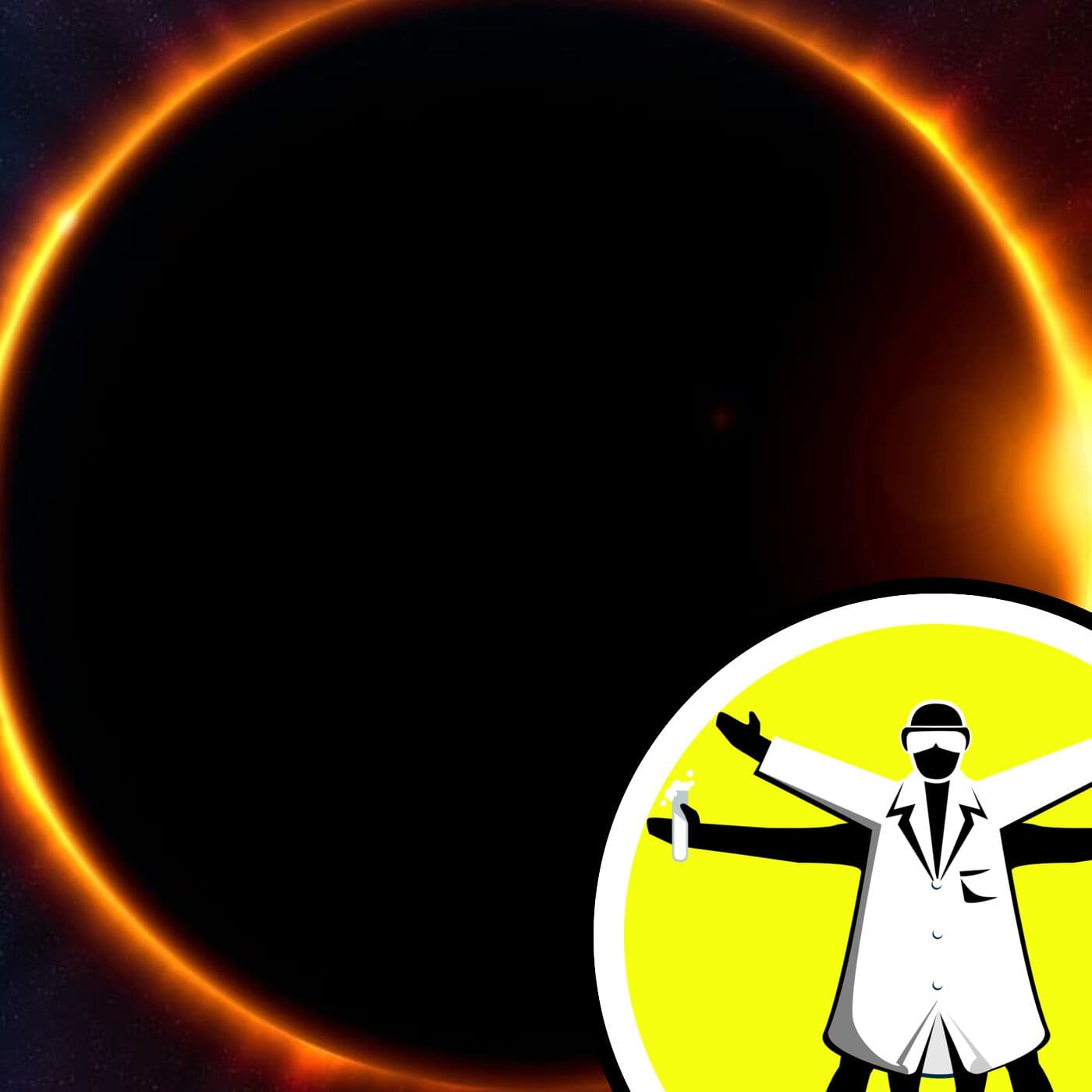
The “Solar eclipse special” episode explains the science behind solar eclipses, why total eclipses are rare, how to safely observe them, how eclipses affect animals, and how scientists use eclipses to study the Sun’s corona and space weather. It also notes the upcoming 12 Aug 2026 eclipse across Europe, with the UK seeing a partial eclipse (~90% coverage) and northern Spain potentially seeing totality.
Guests and backgrounds
Becky Smethurst, astrophysicist at the University of Oxford; Stephen Price, chair of the Bristol Astronomical Society; Megan Argo, astrophysicist at the University of Lancashire; Nikki Rail, deputy director of NASA’s Heliophysics Division.
Key claims
Moon’s orbit is tilted (~5°), so alignment isn’t monthly; total eclipses depend on moon distance (elliptical orbit), producing annular eclipses; early Earth likely lacked total eclipses as the Moon was closer; eclipses can’t be safely viewed with naked eyes/binoculars/telescopes without certified filters; corona is millions of degrees hotter than the Sun’s surface.
Notable examples
1919 Eddington expedition testing Einstein’s general relativity; bees returning to hives during the 1932 eclipse; Bristol’s free Clifton Downs event (5pm+, eclipse after 7pm); NASA’s use of WB-57 aircraft, balloons, and Parker Solar Probe; possible Perseids sightings during totality in Spain but uncertain.
Written by AI. May contain mistakes. Listen to the episode to check what was said.
Chapters
Tap a time to open that second in VOUnderstanding Solar Eclipses
0:32 to 0:59
Discover how eclipses occur and why they don't happen every month.
Understanding Solar Eclipses
1:16 to 2:28
Discover how eclipses occur and why they don't happen every month.
“This is a rare celestial event where the moon passes directly between the Earth and the Sun, briefly plunging people into darkness.”
Rarity of Total Solar Eclipses
2:28 to 4:18
Learn about the factors that make total solar eclipses rare events.
“with the moon getting in between us and the sun?”
Eclipses and Earth's History
4:18 to 6:06
Understand the unique cosmic conditions that allow total solar eclipses.
“And were we looking at eclipses when Earth was much, much younger?”
Visibility of Eclipses and Meteors
6:06 to 8:00
Explore the potential for observing meteors during a solar eclipse.
“What we have in the UK is a partial solar eclipse this time.”
Predicting Solar Eclipses
8:00 to 9:10
Learn about the mathematical models used to predict solar eclipses accurately.
“Oxford University's Becky Smethurst there and you can find more from Becky on her YouTube channel too, so go and take a look.”
Observing Eclipses Safely
9:10 to 10:46
Discover the best practices for safely viewing solar eclipses.
“the 20th century occurred around this time in 1999, and it attracted millions of viewers across Europe and Asia.”
Events for Eclipse Viewing
10:46 to 13:00
Learn about local events for safe solar eclipse viewing, including equipment used.
“But for people that want to look at it safely you can buy certified safe eclipse viewing glasses and you'll be able to see the chunk coming out of the sun as the as the eclipse proceeds.”
Excitement of Solar Eclipses
14:00 to 16:24
Discover the growing excitement around solar eclipses and their significance.
Excitement of Solar Eclipses
16:55 to 17:16
Discover the growing excitement around solar eclipses and their significance.
“The Naked Scientist podcast is produced in association with Spitfire.”
Show all 15 chapters
Historical Perspectives on Eclipses
17:16 to 24:19
Explore how ancient cultures interpreted solar eclipses and their significance.
“And this is the Naked Scientist podcast with me, Chris Smith.”
Scientific Importance of Eclipses
24:19 to 28:03
Understand how solar eclipses contribute to scientific research and discovery.
“valuable for scientists who are seeking to learn more about the sun itself and our place in the universe.”
Understanding Solar Eclipses and Their Impact
28:03 to 29:17
Learn about the significance of solar eclipses and their effects on technology and society.
“We can also visualize eclipses from space at times.”
Research Insights from Solar Eclipses
29:17 to 30:24
Discover how scientists utilize solar eclipses to study the sun's corona and its behavior.
“That's today and very much at the forefront of knowledge.”
Protecting Instruments During Solar Observations
30:24 to 31:55
Understand the precautions taken to protect instruments from the sun's intense light during observations.
“And just a final sort of geeky question, which is that we're always told do not look at the sun because the lenses in your eyes are extremely good at focusing light.”
Transcript
Automatic transcript. May contain errors.0:00Hi, this is Becca Moore from For The Girls and this podcast is sponsored by Aerie, where you can find the right bra in 59 sizes, soft fabrics and good fits. If your bra strap is digging into your shoulder right now, it's the wrong bra. We get so used to being in pain as girls that we forget it doesn't have to be this way. Your clothes should not hurt. I got to the point where I stopped wearing bras altogether and now my life has changed, you guys. The only bras I have in my dresser right now are Aerie and I'm not kidding. Aerie's on a mission to make you feel good and that starts with your bra.
0:27Your bra should hold you in, not back. Visit Aerie.com to find the right bra for you.
0:58technology and medicine. I'm Chris Smith and today we are training our telescopes on the science of solar eclipses.
1:15On the 12th of August 2026 people across Europe will have the chance to see their first full solar eclipse in almost three decades. This is a rare celestial event where the moon passes directly between the Earth and the Sun, briefly plunging people into darkness. So we thought we'd take a look at the science of the eclipse itself, as well as delving into the history of our observing the phenomenon over the past few thousand years, and also how researchers are making use of eclipses in the more modern era to get a much better look at the surface of the Sun itself. Becky Smethurst is an astrophysicist at the University of Oxford.
1:52Megan Argo:So a solar eclipse is when the moon passes between the sun and the earth and the alignment is just right that it will block the sun. So we see that as a shadow passing across the sun. You know, we can turn the sun into a beautiful crescent shape during the day because of this. And if you're very, very lucky to have the perfect alignment, the moon will completely block the sun in what's known as a total solar eclipse. Why doesn't this happen every month? Because the moon goes around the Earth, takes about one month to go all the way around. So why doesn't this happen every month with the moon getting in between us and the sun?
2:31Megan Argo:Yeah, well, we have to remember these things. I feel like we've got this picture of what the solar system looks like and the moon goes around the Earth. There's all this like big flat disk, but actually the moon's orbit is at about a five degree angle to the orbit of the Earth around the sun. So as the moon goes around the Earth and we get, you know, full moon on one side and it takes another two weeks to come back round to go in between the sun and earth again and become a new moon so that it's not lit up at all and we don't see it. Sometimes it passes above the sun, you know, like five degrees above it.
3:00Megan Argo:And sometimes it passes below the sun, five degrees below it. So you have to have the alignment just right. And on average, this happens around about every 18 months or so that you get the moon crossing the sun earth orbit, and then we get an eclipse. And in terms of a total eclipse, that is presumably a lot rarer than just that 18 month period that you just mentioned. It is a lot rarer just because, not just because of that alignment, but there's so many different factors at play. For example, the moon's orbit is not a perfect circle. It's slightly oval shaped. So sometimes it's further away from us and sometimes it's closer to us as well.
3:39Megan Argo:So if it's further away, when you get that perfect alignment, you sometimes don't get a total solar eclipse. You get what we call an annular solar eclipse. So not annual as in every year, annular as in round. You get sort of like a ring of the sun still just visible around the moon during an annular solar eclipse. So these things are fairly rare, but not so rare that they don't happen enough that people can chase them around the world and things like this. Is it just pure chance that at this point in Earth's history, with the moon being the size that it is, that one completely covers the other, as in the moon completely covers the sun like this?
4:20And were we looking at eclipses when Earth was much, much younger? Had we been here, we wouldn't have seen the phenomenon.
4:27Megan Argo:then exactly yeah so it is a complete cosmic coincidence that we even get like total solar eclipses in the first place the sun is 400 times further away but also 400 times bigger so this is why you get it so that the moon can perfectly block the sun because they happen to just appear like the same size in the sky that is not true though for the you know entire history of the Earth, because we think the moon formed when another planet hit the very early Earth, let's say four billion years ago. And as that happened, it threw out a load of debris that eventually became the moon. That formed a lot closer to us than it is now.
5:06Megan Argo:And slowly but surely over the years, over the millennia, over the many millions of years, been moving away from us. So, you know, early sort of like life on Earth would not have seen a total solar eclipse. They would have just seen the moon passing in front of the sun possibly completely blocking it when it was very close to us you know and fully blocking out but not getting this spectacular sort of corona that we currently see where you can still see this sort of outer atmosphere of the sun almost during a solar eclipse and so in the future in a couple of billion years time because the moon's moving away about two centimeters a year isn't it so give it enough time we'll end up with eclipses that just won't happen anymore because the moon will have migrated farther and farther away and it will cross the sun but be swallowed by the light from the sun so we won't get this phenomenon we're so lucky to be alive right now we are in the future annular eclipses will get more common as the moon gets further and further away and thankfully we're just living at the perfect right time to be able to witness this phenomena we're going to explore this to an extent later in the program because eclipses do give us a chance to do experiments and learn more about things like gravitational lensing and so on we will talk about that but this is persid's time of the year that's the meteor shower so does that mean that we're going to get this possibility of both meteors and an eclipse at the same time in the night sky possibly yes i don't want to say no because anything is possible i will preface it with those of us in the uk it will not get dark enough to see a shooting star.
6:40Megan Argo:What we have in the UK is a partial solar eclipse this time. The alignment's not quite right for us. So we'll see about 90 % of the sun covered. So, you know, in terms of brightness, it's going to look like a bit of a cloudy day. So just like on cloudy days, we can't see shooting stars, you know, during the day, we have to wait till night time to see them. We actually can't see a shooting star during a partial solar eclipse. Those in totality, though, say in northern Spain, it technically theoretically will get dark enough for you to see some of the brighter of the shooting stars during the solar eclipse it'll be like when we try and watch the Perseids when it's a full moon in terms of brightness so it is definitely possible but then you've also got the extra added issue complication of the fact that you know the Perseids are completely random as well you know we usually say on the peak of the Perseids you get a shooting star maybe to a minute or so on the peak.
7:36Megan Argo:Some of those will be really faint though, some of those might be really bright. So if you're lucky, in the like four minute window of totality in Spain, you might see a Perseids, but also it might be in the complete wrong part of the sky as well. You might not be looking, you know, in the direction of whichever way the shooting star goes, you'll be looking at the eclipse and enjoying it. So it's technically theoretically possible, but who knows if anyone will actually catch one. Now I know you physicists are a really bright bunch and you obsess about getting your sums right presumably predicting these eclipses is all based on maths and knowing the paths of the earth the sun the moon but are they actually accurate enough so we know we're not going to let people down we're not going to make a big splash with this program and then people are going to turn up and then say well i didn't see anything yeah they're accurate enough at least for like um the near future so to do this we have to have really good 3d models of what is what is the earth doing what is the moon doing where is the sun and that takes knowing the earth's orbit to great precision the moon's orbit to great precision but also the fact that you know the earth is processing as it rotates around as well and the moon's doing weird wobbly things as it moves and everything so we have to have that kind of precision so in the near future we can definitely predict them to the you know the accuracy that we need to say go outside at this time and you will see this.
8:55Oxford University's Becky Smethurst there and you can find more from Becky on her YouTube channel too, so go and take a look. You have to go back almost 30 years to remember an eclipse like the one that's happening this week across Europe. The last total solar eclipse of the 20th century occurred around this time in 1999, and it attracted millions of viewers across Europe and Asia. Stephen Price, the current chair of the Bristol Astronomical Society, is hosting a special event in that city so people can observe this one. I began by asking him how professionals tend to observe eclipses. They would generally use a specialist solar telescope that's been designed to not only safely observe the sun but also observe in a special frequency of light.
9:40So quite often we use a hydrogen alpha telescope which is a telescope that observed not across the whole white light spectrum but focuses in on a very narrow part we call hydrogen alpha and that gives us tremendously detailed and amazing views of the sun. You can see prominences on the sun, you can see the structure of the surface, great detail in the sunspots. And to look through that kind of telescope with the eclipse proceeding is not only a wonderful experience, but it's also great for taking astrophotographs and actually seeing how the progression of the eclipse goes. I suppose that's a bit like looking at a rainbow and saying I'm only going to look at the red light or the purple light.
10:21But why is that better to see the sun in just one wavelength like that? It's because you can see the structure of the sun in a lot more detail. So rather than just a very bright ball, a white ball or an orange ball, you're beginning to see this structure on the surface. You get the feel that it's a living star, if you like, and things are happening to it. And the reason that's important is you're actually looking at the frequency of hydrogen. and of course the sun is made up mainly of hydrogen so you're looking at it through one of its fundamental processes if you like and if a person who is not a astrophysicist wants to see an eclipse what's the best way to go about that because we mustn't look at the sun because it's a bit like and under a magnifying glass or burning bits of wood with the power of the sun the magnifying glass you end up setting fire to your own retina don't you if you just stare at it yes you must never ever look at the sun with the naked eye and especially through binoculars or a telescope because the damage is almost instant and permanent so absolutely avoid that.
11:24But for people that want to look at it safely you can buy certified safe eclipse viewing glasses and you'll be able to see the chunk coming out of the sun as the as the eclipse proceeds. But what we say is if you want to use some of these specialist telescopes and look at those then all throughout the country including Bristol. We've got these solar eclipse parties, if you like, where people can come along, they can have their glasses, but also use our telescopes as much as they want. I've got some welding equipment, because I did a bit of welding, and I find that's absolutely brilliant for looking at the sun, even when there's not an eclipse, because you can turn, you can dial it down really, really dark, and a welding arc is actually brighter than the sun, so you get brilliant views.
12:09Yeah, well, can I just rain on your parade, I'm afraid? please please don't do that the reason i say that the reason i say that is even though the welding glass stops a lot of the light what it doesn't stop is the radiation you can't see that comes out of the sun the the uv intense radiation for example which you can't see but it will hurt your eye so that's why to look at it safely you need to have these certified filters to actually reject that radiation and just allow a small amount of safe radiation through i will push back on that though because my fancy welding mask says it stops uv up to a very high classification and i know it works because i had a hole in my trousers uh quite a big one where i'd knelt over and broken the knee through and i've got a sunburnt knee and i've got no sunburnt face so it must be working to a reasonable extent to to keep me safe yeah it does work to an extent but you've got to remember a couple of things first thing to remember is it's designed to protect you from welding it's not designed to protect you from looking at the sun so just remember that and secondly you know your eye and your retina everything in your eye is much much more sensitive than your skin so you're looking at one of your most sensitive organs through something that's not designed to look at the sun so i think the formal recommendation is um it might work but don't do it rely on something that's certified and designed to protect you from the from the radiation i should come along to one of your events and get your proper guidance, shouldn't I, rather than come with my welding kit.
13:40So what do you actually do when you hold these events? And what are you going to do? What have you got in mind? So what we do is we turn up with all our specialist telescopes. We also turn up with about 200 or 300 free eclipse spectacles for the public, and we hand those out. Some people bring their own as well. And then we help people by looking at the sun through the spectacles. we explain what they're seeing we talk about the sun what an eclipse is and how it works and then for some of them that want to see it in more detail we then let them look through our specialist telescopes where you can see this detail on the sun and also see in a much more magnified image the the chunk of the moon's shadow moving across the sun the anticipation builds over the sort of hour or so of the eclipse event and you can see people get really really excited and really want to look at the sun through the scopes are you expecting anything special in particular from this one or will this be just a run-of-the-mill but very nice thing to see no it certainly won't be a run-of-the-mill i mean in terms of the uh coverage of the sun you know for us in the uk and in bristol in particular you know it's massive uh if i'm sure you know that if you want to have the next totality in the uk is 2090 i think this is maybe not unique but pretty unique in our lifetime in this part of the world so it's a very special event i think it's also special because as you've you've said you can galvanize a lot of interest particularly among young people so this is really powerful in an ambassadorial way for for science space science and astronomy definitely and so many young people we find that our stargazing events have an interest in astronomy you come with their parents because they've learned about it at school have this thirst for knowledge about the things they see in the sky and of course normally we we never look at the sun because it's not safe to do so so this kind of event looking at something unusual and particularly with with an eclipse which is so rare in this case is very very good for young children and if people want to come to to your event i presume this is just free where do they go and when?
15:46Absolutely it is free and so it's Wednesday the 12th of August we're meeting at the Clifton Downs in Bristol near the sea walls and we're starting from 5pm onwards and after 6pm the eclipse starts with the maximum just after seven o 'clock so during any of that time please turn up and have a wonderful experience. Indeed and there have been some reports actually that many shops are now running low on eclipse glasses, so I hope you've managed to grab yourself a pair. That was Stephen Price at the British Astronomical Society. Hi, this is Becca Moore from For the Girls, and this podcast is sponsored by Aerie, where you can find the right bra in 59 sizes, soft fabrics, and good fits.
16:30If your bra strap is digging into your shoulder right now, it's the wrong bra. We get so used to being in pain as girls that we forget it doesn't have to be this way. Your clothes should not hurt. I got to the point where I stopped wearing bras altogether, And now my life has changed, you guys. The only bras I have in my dresser right now are Aerie, and I'm not kidding. Aerie's on a mission to make you feel good, and that starts with your bra. Your bra should hold you in, not back. Visit Aerie.com to find the right bra for you.
16:57The Naked Scientist podcast is produced in association with Spitfire.
17:02Megan Argo:Cost-effective voice, internet, and IP engineering services for UK businesses. Find out how Spitfire can empower your company at spitfire.co.uk
17:16And this is the Naked Scientist podcast with me, Chris Smith. And today we are gazing skyward to explore the science of solar eclipses. Indeed, in a minute we'll hear how scientists are actually using the phenomenon to get a better look at the sun itself. But first, let's step back in time. Before modern science, people around the world often viewed solar eclipses as terrifying attacks on the sun, a sign that angry gods were speaking to them, or omens that predicted forthcoming dramatic events like wars. Megan Argo is an astrophysicist at the University of Lancashire. She has been researching the history of our interactions with eclipses for us.
17:53Megan Argo:So eclipses have been going on for longer than humans have been on this planet, And the way different cultures in history have interpreted them depends on the nature of that culture to a large extent. So there are some cultures that have seen these solar eclipses, you know, this brief period of darkness as demons devouring the sun. And in those cases, the traditional way to try and end an eclipse, because the sun is vital to life on Earth and the growing of the food and the whole functioning of the ecosystem. system the way to try and end an eclipse would involve people running around making lots and lots of noise shouting banging pots and pans and in some cultures doing things like firing flaming arrows towards the sun to try and reignite it to try and bring that back that warmth so there are those aspects of cultural understanding of eclipses but then there's also other cultures i think the romans saw it this way where it was actually the gods were angry they were displeased with some aspect of human nature or human culture or something that had happened on Earth.
18:54Megan Argo:So there was one story that I read where the culture would actually, they would come together if they were having a fight, you know, over land or something during an eclipse happened, they would come together and make peace in an effort to try and appease the gods. So they would bring back the sun and restore normality. So there are lots and lots of different traditions all around the world because these eclipses can happen anywhere. so anywhere that has seen one will have had some sort of myth story legend associated with it the ancient civilizations like the romans and the greeks that you mention they were obsessed with monitoring documenting and trying to understand the movements of heavenly bodies and it wasn't until copernicus came along much more recently that people accepted that perhaps the earth wasn't the center of the universe but did they manage to sort of have any insights into the fact that the moon must be going around the earth and therefore it was coming in the way of the sun did did the ancients have that kind of view as to what was going on or did they just think it was some random thing happening that was causing this it's an interesting one because if you actually if you watch a solar eclipse you can't actually see the moon in advance of the eclipse happening so the fact that we know that it is the moon covering the sun we think of that as a more modern aspect of understanding but there is evidence certainly from some of the Aboriginal cultures in Australia, so an Australian academic, Dwayne Hamark, has done lots of research trying to understand the astronomical sophistication of a lot of the mythology in those cultures.
20:26Megan Argo:And there is evidence that certainly in some parts of Australia, they did understand that it was the moon covering the sun. And this goes back thousands of years. So even without what we think of as a modern sophisticated model of the solar system as the earth going around the sun and the moon going around the earth, it's still possible that ancient cultures did have some understanding of the mechanics of the solar system, even if they didn't have the model that we have today. And if you look back at the written records from places like Mesopotamia, where we think that's the earliest written records of predictions of solar eclipses, those records date back to 2000 BC, well before our modern understanding of the solar system.
21:03Megan Argo:But they were able to predict, at least to some extent, when eclipses would happen, not Not necessarily where they would be visible on the Earth's surface, because that requires a more mathematical understanding of the mechanics of the situation. But they certainly were able to predict the cycles. Obviously, we put humans very high up the pecking order because we regard ourselves as supremely important. But other animals experience eclipses just like we do. What do we know about their reactions? Because it's not just us that's going to be a bit discombobulated by seeing the sun disappear. animals presumably are going to experience this and think that nights come early or something yeah that's right so it is it is a brief period if you happen to be in the line of totality you see a brief period of darkness and that affects animals in in different ways and there's been studies of this effect going back a hundred odd years so there was a chap called william wheeler who advertised in the new england newspaper for observations by the public of what the animals did in the 1932 solar eclipse that crossed America.
22:07Megan Argo:And he received hundreds of anecdotal reports from people in the line of totality about what happened to animals. So there's one particular chap called Joseph Burgess in Massachusetts who sat during totality and watched what his bees did. And the bees, when totality happened, all the bees started coming back to the hives. And his description of it is fascinating because so many bees came back at once because darkness fell so quickly. normally darkness takes time to descend but during an eclipse it goes dark quite quickly there were so many bees trying to get back into the hives that they actually blocked the entrances but then about 20 minutes later the bees started displaying their normal morning behavior so they started coming out of the hives and doing the sort of routine that they normally do in the early morning the same sort of studies have been done more recently as well so in the u.s there was an eclipse that crossed the continent in 2017 and another one just recently in 2024 and biologists been studying animal behavior in zoos so there's a chap called adam heartstone rose who's a biologist and he went and studied animals in two different zoos in each of those eclipses and watched how the different animals in their enclosures behaved during totality and there was a wide variety of behaviors from not being bothered at all to suddenly starting displaying mating behavior to going to sleep or waking up depending on the nature of what those animals normally do in darkness to completely bizarre behaviors like my favorite one is his description of the normally completely sedentary statue-like komodo dragon suddenly started racing around its enclosure and again they also asked for the public to contribute their own observations as well so there was a whole citizen science project called life responds which was about trying to get a more complete description of what was going on with wildlife during the period of totality brilliant stuff Megan Argo at the University of Lancashire and last year we actually heard here on the program from Dustin Reichardt in Ohio who studied how birds reacted to the 2024 US eclipse he found there were two dawn choruses that day if you want to listen to him again you can look up the episode it's on the 10th of October 2025 he's in there discussing his study now finally today while eclipses are clearly beautiful and fascinating they're also incredibly valuable for scientists who are seeking to learn more about the sun itself and our place in the universe.
24:30Indeed, probably the most famous example of this is Arthur Eddington's 1919 expedition to the west coast of Africa to test Einstein's theory of general relativity. Einstein had posited that the sun's gravity would warp nearby space, bending the path of passing light rays coming from more distant stars. By blocking out the sun's direct light, the eclipse rendered these stars temporarily visible, but because their light was being bent, they appeared in the wrong place, just as Einstein had predicted. These days, interest in eclipses hasn't waned and scientists are still using them to enable them to see what would otherwise be extremely hard to visualise.
25:10Leading the charge is Nikki Rail, who's the deputy director of NASA's Heliophysics Division. Total solar eclipses and even partial eclipses are like nature's ultimate science hack. When we blot out the sun's kind of blinding face with the moon, we get this front row seat to its outer atmosphere or the corona. This is not normally visible for us from the ground. And it's really impossible to replicate even in space when we use techniques like coronagraphs, where we have something that is like a physical blocker on a lens so that we can't see the bright light. We really can't get that fantastic view of the corona without this incredible natural phenomena of the eclipse.
25:47That's the layer around the sun. So one's got the surface of the sun. And then if you were to go above the surface of the sun, that's where that corona is, isn't it? That's right. That's the kind of the atmosphere of the sun, as we like to think of it. And it's almost like freely filament layers. When you're looking at an eclipse, you'll see the corona putting on this incredible show in that atmosphere of the sun itself. It's the bizarre observation that that's actually hotter than the sun itself, isn't it? Because I could go and make materials that would withstand standing on the surface of the sun at 5 ,000 degrees or so, but go a little bit above the surface and suddenly you're into millions of degrees.
26:20So that's one of my favourite facts that we've learned from past eclipses and also just from our study of the sun. It is wild and we do not understand why the outer atmosphere or this corona is millions of degrees hotter than its physical surface. And so by kind of tracking and understanding this fine steel structure of the plasma or the energy and the filaments that come out during totality in the corona, we're starting to be able to gather clues on what is happening and what is happening with the magnetic fields of the sun and also the energy of the sun as it translates into solar wind. But it's pretty wild that as you move away from the surface, it's actually hotter.
26:54And the fact that we don't understand that is equally interesting and wild. What can you actually see when there's an eclipse of the corona and how do you image it? That's a great question. So when we're looking at the actual corona, what we're going to see is kind of almost like filamentous structures. We're going to see things like energy release from the corona. We're going to see things like loopbacks and what's going on with the plasma as it translates into solar wind and as it becomes solar wind and gets closer to our Earth's surface. And what we really are interested in seeing too is as we're transiting in and out of totality, what is happening with the energy that's flowing out from the surface of the sun and also what that means for the energy as it translates into the Earth's atmosphere.
27:39Is that observation from the Earth or from space or both? Appropriate solar viewers as you're transiting in and out of the totality, use cameras and imaging and telescopes from the Earth. We also use things like planes, like WB-57s, where we outfit them with cameras and instruments. And those are about 15.2 kilometers above the surface of the Earth, above the clouds. So they're not subject to any weather on Earth. We can also visualize eclipses from space at times. More commonly, though, we're doing it from the ground with telescopes and also using kind of our higher altitude view of balloons and or the WB-57s I mentioned.
28:18So planes, balloons, telescopes are our most common ways to visualize that corona and what we'll be doing for this upcoming eclipse. If we can ultimately work out how it's working, what does that help us to do? So a few things. So the sun is such a critical and important part of our daily life, right? We kind of take it for granted at time, but when there is solar energy or activity going on, it directly impacts things like satellites for navigation, power grids on Earth. And also when we send humans, you know, far into space, there's risk depending on what's going on with their space travel. So it's critical for us to understand these like mood swings or these solar cycles that we have as we transition in and out of kind of solar maximum or a really busy period or solar minimum or a quieter period from the sun's energy to protect our modern technology and also help us just enable understanding of our star.
29:05This is our neighbourhood star that directly impacts us every day. And without understanding what's going on with it, we as a technological society, you know, need to figure out how to mitigate from events that happen from our star. That's today and very much at the forefront of knowledge. But how have you used and relied upon eclipses in the past or how have other scientists now forebears done this and exploited eclipses to try to learn more? As we've done multiple campaigns over the years, we've been able to gain some understanding. One of the things you mentioned before was, you know, why is gaining an understanding of why is the corona or the outer atmosphere of the sun millions of degrees hotter than its physical surface?
29:45You know, we also have localized kind of rapid cooling events as the moon's shadow crosses the Earth at supersonic sonic speeds. And so we can use balloons to understand what's going on with some gravity waves or ripples of energy in the acoustic gravity waves across the Earth's ionosphere. So we understand how energy is transferring in and out based on the sun. We are also really trying to understand the solar atmosphere closest to the sun's surface. So using things like the WV-57 aircraft or our Parker Solar Probe, we're out there mapping this lower corona to better understand how heat and energy are transferred into solar wind or that energy that starts to leave the sun.
30:23In addition to all the incredible space weather events that are going on with coronal mass ejections or kind of eruptions of energy coming out of the sun and how we detect the structures and those things that are happening. And just a final sort of geeky question, which is that we're always told do not look at the sun because the lenses in your eyes are extremely good at focusing light. That's how they work. And they will do to the back of your eye what a magnifying glass can do to a piece of wood in sunshine and burn it. So when people are trying to observe the sun with fancy instruments, how do you avoid destroying your fancy instrument?
30:57That's a great question. So it is critically important to never look directly at the sun ever. And if you are looking at the sun, you need to be using an appropriate solar filter that is including even when you're up to like 90 % totality, it's still incredibly bright, especially when you're seeing the transition in that of totality. But we do things just like we do with instruments that we do use to protect our eyes, kind of a series of filters on our very, our lenses and the instrumentation. So on a spacecraft like Parker Solar Probe, we're not only instrumenting, protecting instruments from temperature, but also the very bright light.
Read the full transcript
31:31So the shielding that's on there, you're going from thousands of degrees, you know, at the surface to room temperature a few inches behind it, which I think is an engineering marvel. The same applies with the exception of temperature. We don't have to worry about temperature so much on the ground of our telescopes. That's for our spacecraft. But we use these incredible filters, very similar to what solar filters look like for your eyes to protect the lenses and the optics. And the solar eclipse will be on Wednesday, the 12th of August, 2026. And hopefully we've given you an idea of what you can expect.
32:02If you do miss it, you can nevertheless enjoy this programme all the same. Many thanks to NASA's Nicky Rail there and also to the rest of this week's contributors. We'll be back with the latest science news stories from the week on Friday. And do you suffer from sensitive teeth? We've got a fascinating story about a new type of toothpaste that uses frozen smoke to get to the root of the problem and turn off that pain. You can hear about it coming up later in the week. You can also drop me a line, meanwhile, with any thoughts or feedback to chris at thenakedscientist.com if the wish takes you and last point if you appreciate what we're doing for you here and you'd like to support our show do please consider making us a donation you can do that safely and securely over at nakedscientist.com forward slash donate we really appreciate it i'm chris smith thank you for listening and until next time goodbye
33:12Hi, this is Becca Moore from For The Girls, and this podcast is sponsored by Aerie, where you can find the right bra in 59 sizes, soft fabrics, and good fits. If your bra strap is digging into your shoulder right now, it's the wrong bra. We get so used to being in pain as girls that we forget it doesn't have to be this way. Your clothes should not hurt. I got to the point where I stopped wearing bras altogether. And now my life has changed, you guys. The only bras I have in my dresser right now are Aerie, and I'm not kidding. Aerie's on a mission to make you feel good, and that starts with your bra.
33:39Your bra should hold you in, not back. Visit Aerie.com to find the right bra for you.