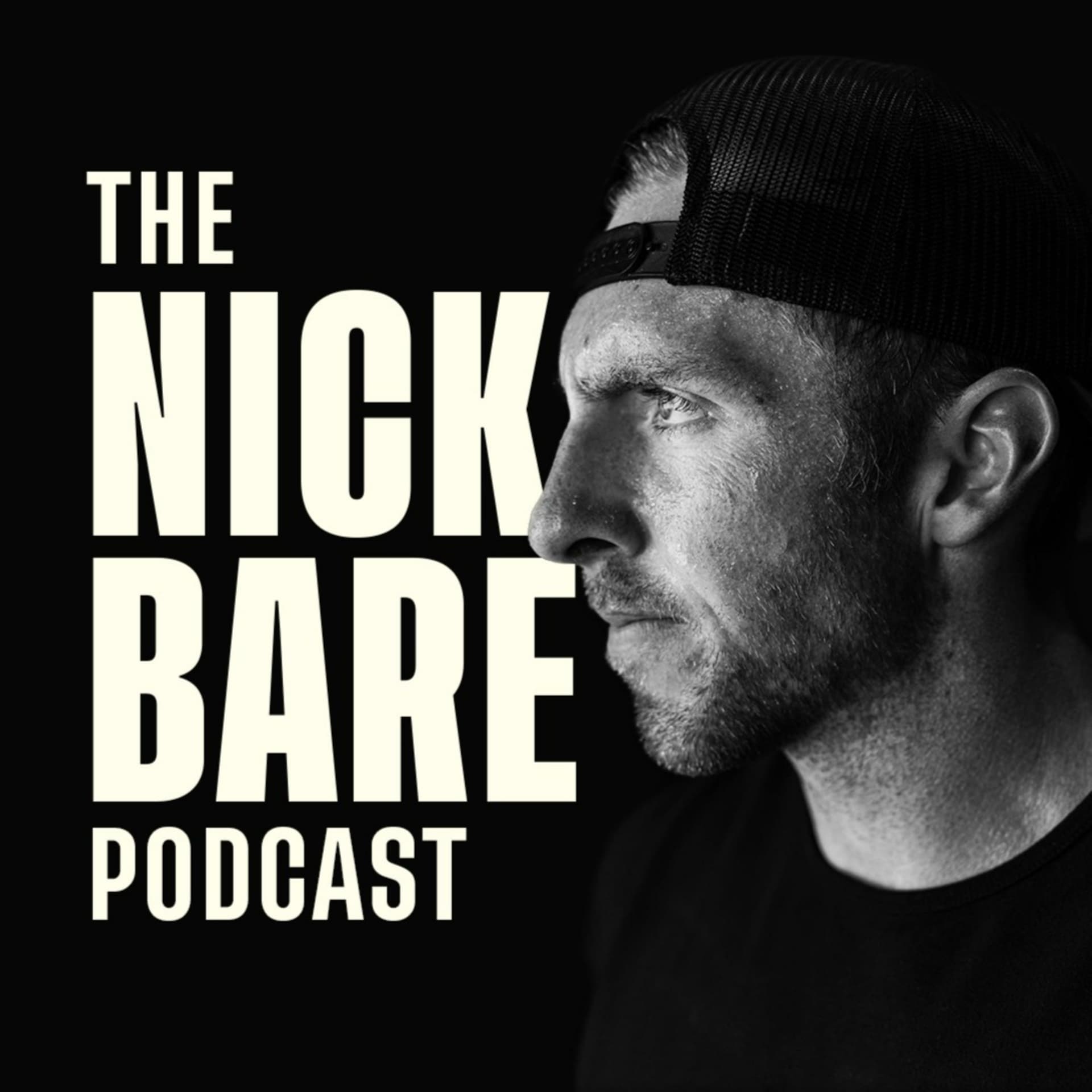
In short
The host explains “locking in” as hyper-focused urgency (not “hurrying”), eliminating distractions and decision fatigue, and using a “winter arc” mindset (Sept–New Year) to avoid coasting. He then details how he got leaner over 90 days.
Guests
No guests are mentioned; it’s a solo episode by Nick Bear.
Guest backgrounds
N/A.
Key claims
Locking in requires narrowing focus, reducing noise, and managing time; crash dieting and deep, fast deficits cause plateaus, performance/sleep issues, cravings, and rebound. Leaning out can be done without starving or avoiding social life.
Notable examples
Marathon-prep analogy; waking at 2:30 a.m. to work and return to routine; using a food scale instead of calorie tracking; reducing dietary fat gradually (e.g., fewer eggs, leaner meats, less butter/olive oil); two weekly high-intensity “High Rocks” sessions (750–1,100 calories each); “make food boring” and separate what you want vs what you need (granola vs dried figs/Greek yogurt/berries). He lost ~10 pounds, mostly body fat, aiming for single-digit body fat (DEXA recommended). App relaunch: Go One More method at nickbearfitness.app.
Written by AI. May contain mistakes. Listen to the episode to check what was said.
Chapters
Tap a time to open that second in VOThe Concept of Locking In
0:45 to 4:00
Discussion on the importance of commitment and focus to achieve fitness goals.
“a few reasons I want to talk about why, how, and the power of locking in.”
Marathon Prep and Its Lessons
4:00 to 6:30
Explains how marathon training parallels the process of locking in for fitness.
“That's a little, a blimp on a progressive scale that then just falls apart overnight.”
Embracing the Winter Arc
6:35 to 12:00
Insights on utilizing fall and winter months for discipline in fitness.
“There's a video that will talk about what's included in the app, how much it costs, all of the things that will answer all of your questions.”
Overcoming Fear of Commitment
12:00 to 14:00
Exploration of why some people hesitate to fully commit to their goals.
“You don't need the winter arc to motivate you.”
The Importance of Locking In
14:00 to 17:46
Learn about the concept of 'locking in' and how it relates to personal performance and expectations.
“I laid there for about 20 minutes and I realized I got way too much energy.”
Minimizing Decision Fatigue
17:46 to 21:42
Discover strategies to minimize decision fatigue and enhance focus for better productivity.
“Locking in is about focus, reducing the noise and managing our time efficiently.”
Urgency vs. Hurry
21:42 to 24:16
Understand the difference between operating with urgency and hurrying through tasks.
“I kept coming back to the thought of these sprints that we sometimes have to endure.”
Getting Leaner: My 90-Day Journey
24:16 to 28:00
Learn about my personal experience with getting leaner over 90 days and the insights gained from it.
“These last 90 days, I have been locked in on getting leaner.”
Understanding Body Fat Measurements
28:00 to 28:38
Learn about the accuracy of body fat measurements and the value of DEXA scans.
“objective report of body fat and all these data points.”
Losing Weight Sustainably
28:38 to 30:28
Discover the importance of a gradual weight loss approach for long-term success.
“You know, people come to you all the time.”
Show all 19 chapters
The Risks of Rapid Weight Loss
30:28 to 32:28
Understand the negative impacts of crash dieting and the importance of preserving muscle.
“is a great baseline of where to get started.”
Strategies for Effective Weight Loss
32:28 to 34:19
Learn how to create a caloric deficit and the pitfalls of changing too many variables at once.
“And the last thing I want to share is that we know in order to lose weight, you need to be in a caloric deficit, which can be achieved by both dieting and exercise, caloric expenditure.”
Maintaining Balance During Weight Loss
34:19 to 36:17
Explore the benefits of a balanced approach to dieting without sacrificing social life.
“and when you do that, one, you can't measure what's actually working and it makes it hard to continue losing weight because you have nothing to pull from as you get deeper into a deficit.”
The Mindset for Getting Leaner
36:17 to 38:26
Discover how mindset and intentionality play a role in successful fat loss.
“Like I've said, I didn't avoid social situations or events.”
Practical Dietary Adjustments
38:26 to 41:57
Learn practical tips for reducing dietary fat while keeping protein and carbs high.
“because a lot of people believe that to lock in you gotta be miserable and that's not true locked in, sharpens performance.”
Tracking Portions for Consistency
42:01 to 43:37
Learn how to effectively manage portion sizes without tracking calories.
“why I've tracked everything I've eaten, everything I prepared, everything I put in my mouth, tracked in MyFitnessPal.”
Integrating High-Intensity Workouts
43:38 to 45:31
Discover the benefits of incorporating high-intensity interval training into your routine.
“Number three, I added two high rock style, high intensity interval training sessions per week alongside my regular training split.”
Simplifying Your Diet Choices
45:32 to 46:57
Understand the advantages of a simplified diet and reducing meal variety.
“by eating more of the same meals and reducing unnecessary decisions.”
Distinguishing Wants from Needs
46:58 to 49:03
Learn the importance of separating cravings from nutritional needs for better health.
“A bowl of purely Elizabeth granola, a bunch of honey and peanut butter, maybe some chocolate chips.”
Transcript
Automatic transcript. May contain errors.0:05All right, ladies and gentlemen, welcome back to another episode of the podcast. Today's episode is how to lock in and get leaner in the next 90 days. Now there's two separate topics of discussion for today, but they have parallels. One will lead into the other. Those two topics of discussion are, number one, how to lock in. And the second is how I got leaner in the last 90 days by locking in. a few reasons I want to talk about why, how, and the power of locking in. And it's very in real time for me right now. Last night, I slept about four hours, partly because I'm working on a lot of things right now.
1:08And then also partly because I just couldn't sleep because I'm so excited about the things that I'm working on. So there's a lot to do, which has me working late and working early in the morning and then I wake up in the middle of the night excited to work on the things.
1:34It's similar to going into a marathon prep. That's the way that I can best describe it. As a runner, I am a runner. I run year round. It is part of my morning routine. I wake up at or before 5 a.m. and I'm out the door running within 30 minutes. I do that right now, six days a week. And I run year round. If you are a runner, that's what you do. It is part of your identity. But when you go into a marathon prep, there is a goal, a very specific goal. There is a timeline. The focus shifts, volume increases, intensity changes. That focus is refined and distractions are eliminated. In order for us to go hyper-focused, we have to go narrow.
2:44And to go narrow, we have to eliminate distractions and sometimes other opportunities. And when you go all in, you lock into that marathon prep, you then can achieve your goal. Like right now, I could not go run a sub 240 marathon at this moment in time. But if I locked in, I set the goal, I identified a timeline, I refined my focus, my training,
3:21Nick Bare:my volume, my intensity, I eliminated other distractions in my life so I could focus on that goal. I could go then PR my next marathon. I know that I could. I know that I could, but it would require a season. It would require a sprint. It would require anywhere from 12 to 20 weeks to prime my body to go toe the line at a marathon and PR that next race. that's what it looks like. That's what it feels like to lock in. What locking in is not is that you are a bum on the couch 10 months out of the year and then for two months, you decide to turn it on and you go to the gym and you hit your steps and you're prepping your meals and you're tracking your macros and you're feeling better and you're prioritizing sleep and you're not drinking alcohol and all of the bad things, all of the vices in your life you eliminate for 60 days out of the year, that is not locking in.
4:41That's a little, a blimp on a progressive scale that then just falls apart overnight. That is not locking in. right now I am locked in on a specific project that I'm working on. And that project has been in the works these last couple weeks and a few months now.
5:11Nick Bare:I've talked about it in the last couple episodes and I've shared it on social media. By the time this episode goes live, we will have had relaunched my fitness training app, the Go One More method. I've had the Go One More method, my fitness training app for about six years now. And I decided a few months ago that I wanted to relaunch the app, put all of my time, all of my energy, everything that I've learned and accumulated and have experienced, I wanted to take what's in my brain, in my mind and put it into a platform, an app to be a resource for you guys to be more consistent, to guide your training, to guide and educate you on nutrition and meal prep and recipes and mindset.
6:15And I've put a lot of time and energy and effort into relaunching this app. And I'm so proud of what it has become. And if you want to join the app or learn more, go to nickbearfitness.app, A-P-P.
6:35Nick Bare:And we have a website, a landing page. There's a video that will talk about what's included in the app, how much it costs, all of the things that will answer all of your questions. But that has been a project for me. for a few months now. And when I pursue a new project, I go all in. I don't just dip my toe. I don't just tinker. No, I lock in because within my work, it's a blessing and a curse. I'm a perfectionist. I want to make sure all my T's are crossed, I's are dotted. it is the best resource, product, service for you, for the consumer. My goal is to always over-deliver. Whether that's a product here at BPN, a product service with my app, my content, YouTube, the podcast, I take it really serious.
7:49And I've had to lock in these last couple of months, but the closer we get to launch, because at the time I'm recording this episode, we launch in four days. The app relaunches. Everything's coming down to the wire of making sure it is just perfect to roll out. to hand over for you guys to use, to incorporate into your life because it's a powerful tool. It's a powerful resource. And when I lock in, I eliminate the noise. I eliminate the distractions. I'm hyper-focused.
8:40And it's interesting timing right now
8:44Nick Bare:because as we record this, it is the beginning of September. And there's this thing that happens around this time of the year. As summer is coming to a close, fall is upon us. And before you know it, Christmas and New Year's is going to be here. There's this thing that has started on social media the last couple of years that is called the winter arc. the winter arc is all about locking in. It's the idea of using the fall and winter months, roughly September to New Year's as a no excuse period of discipline. And instead of the more common pattern of coasting through the fall and holidays and waiting for New Year's resolutions to initiate a fresh start, you use those cold, dark, fall, wintry months to lock in.
9:57Just like runners and marathon season. If you're like me, you're always dialed. training is a priority. Health is a priority. Nutrition is a priority. Fitness is a priority. Being disciplined and committed, those are priorities. Those are things that we value. They're foundational to us. But I love this idea of the winter arc, where for a lot of people, they spent the spring and early summer to prepare for the summer months when they're going to be outside by the pool, at the beach, on vacation, in minimal clothing. They want to get in the best shape of their life or at least the best shape of the year.
10:52And then for a lot of people, they fall off. They coast. As summer comes to an end, pools close,
11:04Nick Bare:it's getting a little cooler out, not walk around in bathing suits anymore. You're starting to throw a hoodie on in the evening and wearing long pants and covering up. And some people use this as an opportunity to let off the gas a little bit, to coast, and coast until the new year. And they say, okay, we'll just wait till January 1st, New Year's resolutions hit and then we'll get back on track. Then we'll hop back on the saddle and we'll kickstart our health and fitness and performance goals again. And why I love this concept of the winter arc is because it says, screw that. We ain't doing that.
11:54We ain't coasting. And for a lot of you guys just like me, you're on it year round. You don't need the winter arc to motivate you. You don't need the winter arc to keep you disciplined. You don't need the winter arc to wake up early and knock out your run and stay up late and prep your meals
12:18Nick Bare:and all of the things that we do on a regular basis. If you listen to my content and you follow me, I'm sure you live a lifestyle similar to me or at least aspiring to. But the reason I love this concept is because it has the opportunity to build awareness of pushing back and resisting the temptation of coasting during these cold, dark, fall, wintry months. And if we can rise more people up and motivate them and inspire them to lock in when it's so easy not to, that means more people are fit, more people are healthy, more people are thriving with energy. Let's double down on it. The winter arc is a lock-in.
13:17Lock-in.
13:22I think a lot of people actually are afraid to lock in. Not because of the commitment that's required and the work that comes with that commitment. I was thinking about this in my run this morning.
13:46Last night, as I was describing, my mind was just racing. There's a lot to get done right now. A lot of work, a lot of really exciting work.
13:56Nick Bare:I stayed up late working on some projects. And I woke up at 2.30 a.m. and I could not fall back asleep. I laid there for about 20 minutes and I realized I got way too much energy. There's no way I'm falling back asleep. So I went into the office and I started working. And I worked until about 5 a.m., which is when I normally wake up. and I went into the kitchen. I mixed up my G1M Sport and G1M Sport Plus, my fuel. I let that sit for a little bit, got some more work done, laced up my shoes at 5.30 and I was out the door. Back on schedule, morning routine. I think a lot of people are afraid to lock in.
14:46I think people sometimes intentionally underperform. This is what was rattling my brain on this morning's run.
15:01I think people intentionally underperform. You might be asking yourself the question, why would someone intentionally underperform? I know people like this in my life. they have all the potential, they have all the ability
15:17Nick Bare:and they continue to just drop the ball. And it almost feels like they do it on purpose. It's like self-sabotage. And I sit there and I watch it happen. I'm like, it all looked like it was coming together. It all looked like it was working out. And then it just fell apart for no reason. And I think people intentionally underperform and fail and miss and choose not to lock in because once you achieve something, once you win or accomplish or succeed or reach the goal that you said you wanted to get to, you are now held to a higher standard, an expectation, not just from other people around you, but also by yourself.
16:08If someone watches you succeed,
16:11Nick Bare:and accomplish something, achieve the thing you said you wanted to and then worked for and got it. Now your standard of excellence, the expectations of you and the way you perform are higher than your previous self. And you have to continue to rise to those levels of expectations and standards. And I think a lot of people would rather keep their expectations and standards lower so that no one can measure what they've done previously to what they're doing right now or what they do in the future.
16:57And that's got to be a really hard realization. If there's a level of self-awareness in that individual that can have that realization.
17:13To lock in
17:19its focus, its intentionality,
17:23Nick Bare:its removing the noise, its eliminating decision fatigue. Locking in doesn't have to be extremely restrictive. rigid or strict, as we'll get to here in a little bit as I'll talk about how to get leaner, how I've gotten leaner these last 90 days. Locking in is about focus, reducing the noise and managing our time efficiently.
17:56Eliminating decision fatigue. What do I mean by this? On a daily basis, We are exposed and surrounded by the need to make so many decisions.
18:13I mean, think about television. Back in the day, you turn on your TV, there were a few channels that you could watch. A few channels. and if you turn on the TV and it was 6.40 p.m. The movie that's on might've started 40 minutes ago. You can't rewind it. You got to just pick up where you found it and if there's nothing on TV you don't want to watch, you just turn it off and go do something else and that had evolved and advanced over years to the point where you could record shows. You could watch two shows at once, picture in picture.
19:12Nick Bare:And then that evolved to VHS and DVDs and now streaming. And now when you sit down in front of your TV at night, You have millions of options. And oftentimes someone is trying to figure out what they want to watch on TV, scrolling for 30 minutes before they choose something and simultaneously scrolling on their cell phone, trying to make other decisions. What Instagram stories they want to watch? What recipe they want to pull for tomorrow night's dinner? We are constantly being exposed to the need to make decisions. So it is our job, it's our responsibility to minimize decision fatigue. Great example.
20:09I know every day, for the most part,
20:13Nick Bare:what I'm consuming for breakfast, what I'm consuming for lunch, what I'm consuming before my workout, after my workout, what we're making for dinner and what I'm having as my evening snack. I want to spend very little time and energy trying to decide what, when and where I'm going to consume food. When I'm getting ready in the morning, I wear the same pair of shorts. I have a few pair, but the same shorts. I buy the same running shoes over and over again. I buy the same socks on my way into work. After I shower, if I shower that day, I go in my closet. I buy the same shorts. I grab a pair of shorts.
21:06Nick Bare:They're comfortable. They fit. They work. I grab a dark t-shirt out of my closet, my VPN hat, socks and shoes and or canes, and I head into the office. I don't spend any mental energy thinking about what I want to eat, what I want to wear, what I want to do during my free time. I minimize decision-making fatigue as much as possible that allows me to lock in. As I was planning this conversation, I kept coming back to the thought of these sprints that we sometimes have to endure. These seasons and periods of life that become busy, that become chaotic, we're working towards accomplishing a goal that has a focus and a timeline.
22:07And then we oftentimes find ourself
22:13hurrying when we actually should be
22:19Nick Bare:operating out of a sense of urgency. And there's a difference between operating from a place of urgency and hurried. I want to break these two down because I think for many of us on a daily basis, we are practicing this life of hurry, hurry, hurry, hurry. Where in reality, we should be operating from a practice and approach of having urgency. You see, urgency and hurrying can look similar from the outside, but they come from different places. Urgency is a state of focus. It's clear-eyed, purposeful, and driven by the importance of the moment. When you operate with urgency, you're still present, still making sound decisions, just moving with intention because the situation calls for it.
23:23Nick Bare:Hurrying, on the other hand, is often driven by anxiety or a fear of not having enough time. It's reactive rather than intentional and it tends to sacrifice quality, awareness, or judgment in exchange for speed. You can move fast with urgency and still be in control. Hurrying is when that control starts to slip. The difference matters because urgency sharpens performance while hurrying usually undermines it. To lock in, you cannot hurry. locked. To be locked in, you are operating from a place of urgency, not hurry. The difference matters because urgency sharpens performance.
Read the full transcript
24:25These last 90 days, I have been locked in on getting leaner. I think for a lot of people, when you say, I'm approaching a cut, a caloric deficit, I want to lose body fat, I want to get leaner, their minds immediately go to restriction, Rigidity, meaning no flexibility, no fun. Removing and avoiding all social situations. Just a non-fun period of time. You look good, but feel miserable. To get leaner and to lock in does not have to come with a negative association.
25:24Nick Bare:and I want to share with you how I locked in over these last 90 days and got leaner. I lost about 10 pounds and I would say it's primarily body fat, not just weight, body fat. I didn't get a DEXA scan, which I should get a DEXA scan. I'd be curious what my body fat percentage is right now. It's definitely single digits for sure. If you've never done a DEXA scan, I highly recommend it. It measures body fat percentage. It also measures lean tissue, muscle, and it will show you where you're holding that lean tissue and body fat specifically. So you lay down on this table. It looks like an x-ray or MRI machine and this arm goes over top of you and scans you.
26:16Nick Bare:You got to sit or lay as still as possible. And this machine goes over top of you and it does a full body analysis. And once they print it out, the tech will go over it with you and it'll show you body weight, body fat percentage, where you're holding specific amounts of body fat, your lean tissue, muscle tissue. And you can do this a few times a year, once a year, every couple of months. And it's cool because you can look at how the data changes in trends. What you ideally want to see is that your weight stays the same or increases and body fat stays the same or decreases, but muscle mass increases.
27:11And this is one objective way to measure. Body fat, disbursement, lean muscle tissue.
27:22Nick Bare:Are you gaining muscle or are you just gaining weight? You feel bigger, you look bigger. Is that actual muscle? Or is it just body fat that just makes you look a little bulkier? A DEXA scan is one of the most accurate ways to measure body fat. I personally am not a big fan of, you know, they have scales. They have like these, I think they're called in-body tools where you stand on the scale and you hold these two arms and it'll give you a deep analysis, objective report of body fat and all these data points. And they're just not as accurate as a DEXA scan. So if you have it available, they're pretty inexpensive.
28:16I would recommend get a few scans a year,
28:19Nick Bare:one scan a year. It's just really great data to have. But how did I drop 10 pounds primarily fat and get leaner over the last 90 days? Some call outs prior to. Could I have done it in less than 90 days? Yes.
28:42Goes for running a marathon too. You know, people come to you all the time.
28:49Nick Bare:Hey, I want to run my first half marathon. I want to run my first marathon. And I want to do really well. I want to PR. All right, cool. When is it? 30 days.
29:04Man, how much running have you been doing leading up to this? Zero. This is going to be tough. And I would recommend that you choose a race
29:17Nick Bare:that's a few months away. So it gives us time to build into a prep. So you can actually put forth a great effort in performance and minimize reduce of injury. I meet people all the time who they do a crazy crash diet and they lose 15 pounds in a month. And then you see them in the following month and they've gained all of it back and then some. It's crash dieting. It's not sustainable. Could I have lost 10 pounds in less than 90 days? Absolutely. I could lose 10 pounds in a week if I wanted to, but it's definitely not going to be primarily fat and it's not going to be done in a sustainable way.
30:08Nick Bare:So 10 pounds, 90 days, that's roughly 3.3 pounds per month. that's a very conservative and sustainable, realistic approach. About one pound of weight loss per week is a great baseline of where to get started. You can do it faster, yes. But is it going to come with sustainable, long-term, manageable results? Probably not. This is one of those things, losing body fat and weight, you want to really take your time with it. Because when you allow yourself the right amount of time, yes, it's more sustainable. You can keep that weight off for longer, especially the body fat, but it allows for a more flexible lifestyle.
31:12Nick Bare:In my case, especially with a family and traveling and kids during the summer, It really didn't affect our lifestyle, our vacations, our travel, our social situations at all. I don't even think most people knew that I was in a dieting phase because it was so non-intrusive. There's less risk to performance impact. So if you go into too large of a caloric deficit too fast, it will definitely affect your performance, your training, your workouts, your sleep, your recovery, your mental capacity and concentration and mood. And when you do it slow, when you lose weight slow, you can target fat loss, like I said, instead of just weight loss.
32:07Nick Bare:And that includes muscle. If you lose fat and wait too quickly, you will burn muscle. You will probably most likely be in a catabolic environment where, yeah, you're losing weight, but all that hard earned muscle that you built over time, you don't want to lose that. You want to preserve that at all costs. And the last thing I want to share is that we know in order to lose weight, you need to be in a caloric deficit, which can be achieved by both dieting and exercise, caloric expenditure. So reducing caloric intake and increasing caloric expenditure. Caloric deficit means that we need to be burning or expending more calories than we are consuming.
33:00Nick Bare:So if it takes 2 ,500 calories a day to maintain our current weight, technically anything less than that is a caloric deficit and we are on our way to losing weight, burning fat, getting leaner.
33:20Nick Bare:And if you're trying to lose weight and get leaner, I would encourage you to just change one variable at a time, allow time to assess the results and then make changes. What do I mean by this. Well, the flip side to that advice would be you decide you want to lose weight. So you add on three extra cardio sessions per week. You increase your daily step count from 10 ,000 to 20 ,000. You reduce calories by 500 a day. You stop going to social gatherings, birthday parties, events, business dinners. You isolate yourself. Those are a lot of variables. That is throwing the kitchen sink at trying to lose weight.
34:23Nick Bare:and when you do that, one, you can't measure what's actually working and it makes it hard to continue losing weight because you have nothing to pull from as you get deeper into a deficit. I was just having this conversation with someone here at BPN a few weeks ago. They've been trying to lose weight for the last couple of months and they've been very successful. They've lost a lot of weight over the last couple of months. by going to a very deep, aggressive caloric deficit. And it worked. But what happens when you go into a deep caloric deficit too fast is you get to a point where you can't pull any more calories away and you plateau.
35:11Nick Bare:So if you're usually eating 2 ,500 calories and you drop calories to 1 ,800 overnight and you start doing additional cardio on top of that and you start losing weight and fat really quickly. And then eight weeks later, you plateau. You stop losing weight. Your body has acclimated to that new caloric intake and energy expenditure. And what are you going to do from there? You're going to drop calories to 1 ,500. You can do an hour of cardio every single day on minimal calories or you now have no energy. So you want to really stair-step this process of losing weight, losing fat very slowly so it's sustainable and only changing one variable at a time.
36:11What did I not do in these last 90 days to get leaner?
36:15Nick Bare:I didn't starve myself. Like I've said, I didn't avoid social situations or events. I didn't overdo cardio or increase my caloric expenditure to an excessive level. I didn't experience any decreases in performance output or sleep quality. I haven't had any insane food cravings or desire for cheat meals. that can sometimes be a problem. If you go into a caloric deficit that is too deep, you're too restrictive, you change all these variables overnight, you start having cravings and temptations and you want to binge and you become food focused and eventually you burn out and you give up on the diet, you're unmotivated, you go back to your old ways of living and eating and being sedentary and you gain it all back.
37:13That didn't happen in these last 90 days. So what did I do to get leaner? It's simple.
37:24Nick Bare:Simple does not mean easy. And I want to make sure that we don't confuse that because I'm not saying that getting leaner, losing body fat, getting fit and in shape is easy. Because for a lot of people, it is one of the hardest things they ever try to do in their life and they've tried many times over and over and over again and they continue to fail
37:54and I feel bad for those people who can't commit, who can't make the change sometimes it's their mind
38:02Nick Bare:that is just holding them back and then sometimes they just don't know you know sometimes people don't know that there's things you can do to get leaner and it doesn't have to be super restrictive and it doesn't have to affect your social life and your performance and your sleep and your mood and all these things because a lot of people believe that to lock in you gotta be miserable and that's not true locked in, sharpens performance. It removes the noise. It is intentionality. It is focused. It is managing our time efficiently. It's eliminating decision fatigue. So here's what I did. And here's what you can do too.
39:03Nick Bare:Number one, I kept protein and carbohydrates consistent, fairly high. Protein for me is always one gram per pound of body weight. And carbs, I keep high because I train a lot and carbs are energy. And my output, my performance is dependent on energy, carbohydrates. But what I did is I slightly reduced dietary fat over that 90-day period. So I decided I wanted to start getting a little bit leaner. I just started making some intentional decisions around my diet to start reducing dietary fat. Doesn't mean I took my dietary fat intake on a daily basis from 120 grams to 50 grams overnight. But I just slowly, every couple of weeks, I'd make more intentional decisions.
40:05Nick Bare:I stopped eating eggs for breakfast. I used to eat like five whole eggs for breakfast and that's 30 grams of fat. So what I started doing is my morning protein shake with a little bit of peanut butter. So I went from my breakfast having 30 to 40 grams of fat to my breakfast having 15 grams of fat. Some of the other changes I made, instead of consuming a fattier cut of meat, like a ribeye steak or a New York strip, we ended up eating more tenderloins and chicken thighs and chicken breasts and leaner fish for dinners. I stopped adding as much olive oil and butter onto vegetables or potatoes and rice as we were cooking them for dinner.
41:05These small little changes I made by reducing dietary fat a little
41:11Nick Bare:bit every couple of weeks reduced my daily caloric intake quite significantly over a 90-day period. We also know that fats are more calorically dense than proteins and carbs. So for each gram of protein and each gram of carbohydrate, there's four calories per gram. Fat has nine calories per gram. So there are more calorically dense macronutrients in foods than their counterparts. So I kept protein and carbs consistently high while slightly reducing dietary fat over time. Number two, I didn't track calories, but I used a food scale at every meal to stay consistent with my portions. There have been seasons before why I've tracked everything I've eaten, everything I prepared, everything I put in my mouth, tracked in MyFitnessPal.
42:13Nick Bare:I really don't like tracking calories. My diet doesn't change too much from day to day, but I use a food scale to ensure consistent portions. We have a food scale in our pantry. We have one in our kitchen. I travel with one. Steph and I use it all day, every day and we don't even think anything of it. For example, dinner. We'll prepare some sort of protein, chicken thighs. We'll make rice or potatoes and then we'll make a veggie. That's typically what we're having for dinner. Protein source, starch, carb, vegetable. I'll get a food scale out. I'll put it on the table, put my plate on top. I tear the food scale so it goes to zero.
43:07Nick Bare:I'll add eight ounces of protein, tear it back to zero, do 300 grams of rice or 10 ounces of potatoes, tear it, and I'll just fill the rest of the plate with veggies. I don't weigh the veggies. I just load it up with veggies to fill me up. But I'll weigh my carbs and I'll weigh my protein for portion control, but not to track it into a macro and calorie counting app. I didn't track calories, but I used a food scale at every meal to stay consistent with portions. Number three, I added two high rock style, high intensity interval training sessions per week alongside my regular training split. So right now my training split with these changes, because I'm preparing for some high rocks competitions this fall.
44:00Nick Bare:And I was just excited to add in some variation to my training again. These high rocks workouts are fun, especially when you do it with partner. So Monday, six-mile run in the morning, push strength in the afternoon. Tuesday, six-mile run in the morning. And then high rock session in the afternoon. Wednesday, six-mile run in the morning, lower body strength in the afternoon. Thursday, six-mile run in the morning, pool strength in the afternoon. Friday, six-mile run in the morning. High rocks session in the afternoon. Saturday, long run, Sunday off. That's my current split. And then during those two high rocks style hit sessions twice a week, I burn anywhere from 750 to 1 ,100 calories in one of those sessions.
44:57Nick Bare:And they're anywhere from 60 to 75 minutes, but it is high intensity. Heart rate is high. It's typically a circuit. I'm sweating profusely. I'm burning a lot of energy. They are high calorie demanding workouts. It is revving that engine. So those two sessions a week increase my caloric expenditure quite significantly. Number four, I simplified my diet by eating more of the same meals and reducing unnecessary decisions. You want to get lean? Make your food boring. Make it boring. Viewing food for what it is, it's fuel. So I'm not concerned with variation for flavor. I don't get burnt out over the same meals.
46:00I can eat the same meal every day. every time, over and over, and probably never get tired of it because food can be noise.
46:15Nick Bare:When we're constantly needing more variation, more flavor, more excitement, I'm hungry for this, I'm hungry for that, I'm not hungry for this, I'm not hungry for that. We waste time on thinking about what we want, what sounds good, what doesn't sound good. simplify your diet by eating more of the same meals and reducing unnecessary decisions. Make your food boring. If you eat a bunch of boring food, you start craving the boring food. You don't crave the ultra processed, super indulgent, high fat, high savory type foods. and number five I learned to separate what I wanted from what I actually needed food noise drives what we want and if you can separate what you want from what you need it's a game changer like when it comes to the evening sometimes I can hear this little birdie on my shoulder speaking into my ear saying, you know what sounds really good?
47:28Nick Bare:A bowl of purely Elizabeth granola, a bunch of honey and peanut butter, maybe some chocolate chips. That does sound good, but it's probably also like 1 ,500 to 2 ,000 calories. On certain days, when I burn a lot of calories, I probably could consume that. But in the past, I'll be honest, when I've had a bowl of purely Elizabeth granola at night in the evening, it has led to two bowls and then three bowls and then four bowls. And before you know it, the bag is gone. And there's like 11 servings in a bag, which is depressing. You ever weigh out a serving of dense granola? That serving size is sad.
48:15Nick Bare:So instead of being tempted towards what I want, I consume what I need. and that is usually dried figs, good healthy carbs and fiber, plain Greek yogurt, some cacao nibs and berries, blueberries, raspberries, strawberries, blackberries. Sometimes I throw some honey or maple syrup on top, hits the spot. It's a perfect sweet treat. That's what my body needs. Not necessarily always what it wants, some nights, yes, it's exactly what I want. But some nights I want that purely Elizabeth bag, the entire bag. So if you can learn to separate what you want from what you actually need, it can be a game changer for you.
49:05It's how you lock in. You want to lock in, start by identifying what you want versus what you need. So that's what I wanted to share with you guys today. how to lock in, why to lock in,
49:24Nick Bare:the power of locking in and how to get leaner in the next 90 days. Like I've just done with some pretty simple changes to my life, my diet, my training. Take it slow, make it sustainable. It's adaptable. But I'm telling you, lock in, find something, choose something identify something and lock in get it done go one more
From the publisher
Over the last 90 days, I lost about 10 pounds and got leaner without crash dieting, starving myself, avoiding social situations, or sacrificing my training and recovery. I did it by locking in - not through extreme restriction, but by narrowing my focus, reducing unnecessary decisions, and giving the process enough time to work.
In this episode, I explain what it really means to lock in, why some people may underperform to avoid raising the standard expected of them, and the difference between moving with urgency and living in a hurry. Then I break down the five changes I made.
CHAPTERS:
00:00 Intro
01:34 The Marathon Prep Analogy for Locking In
03:58 What Locking In Is NOT
04:56 Relaunching the App
08:40 The Winter Arc
13:22 Why People Are Afraid to Lock In
17:19 What Locking In Actually Means
18:14 Minimizing Decision Fatigue
21:42 Urgency vs. Hurrying
24:25 How I Got Leaner
30:07 Why Slow, Sustainable Weight Loss Wins Long-Term
33:21 Change One Variable at a Time
38:39 The 5 Things I Did to Get Leaner in 90 Days
49:06 Closing: Lock In, Get It Done.
JOIN THE APP AND GET READY FOR UPDATES
https://www.nickbarefitness.app/
ORDER MY BOOK HERE: https://www.amazon.com/Go-One-More-Intentional-Life-Changing/dp/1637746210
FOLLOW:
Become a BPN member FOR FREE - Unlock 25% off FOR LIFE
https://www.bareperformancenutrition.com/collections/performance-nutrition
IG: instagram.com/nickbarefitness/
YT: youtube.com/@nickbarefitness
This podcast is for informational purposes only and should not be considered legal [health or profession] advice. Bare Performance Nutrition (BPN) is not responsible for any losses, damages, or liabilities that may arise from the use of this podcast. This podcast is not intended to replace professional medical advice.
This podcast may not be republished without the written consent of Bare Performance Nutrition (BPN)
MB01NZKNILLPKWV