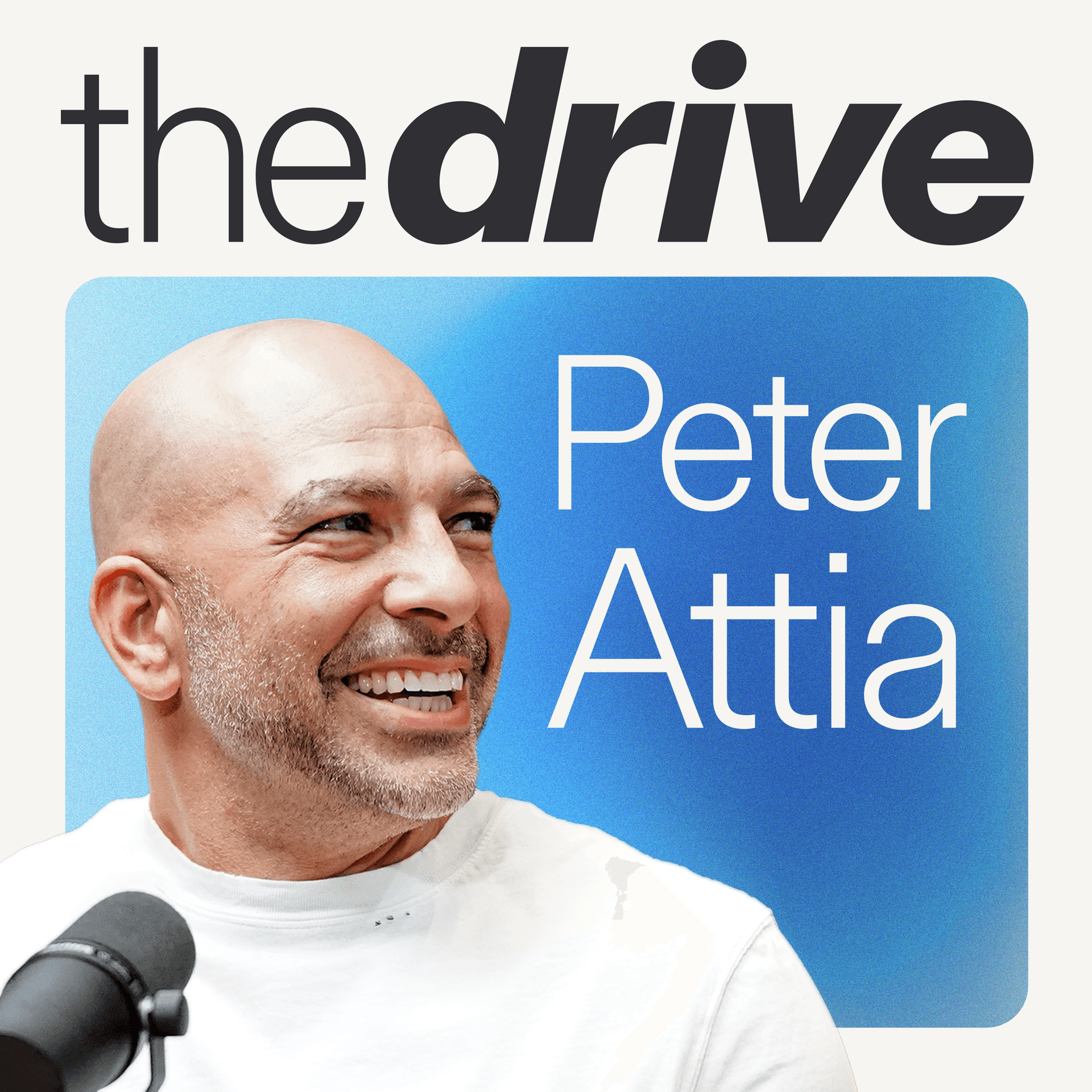
In short
Podcast Summary: The Peter Attia Drive - Episode #357
Episode Title
A new era of longevity science
models of aging, human trials of rapamycin, biological clocks, promising compounds, and lifestyle interventions with Brian Kennedy, Ph.D.
Episode Overview In this episode, Dr. Peter Attia interviews Brian Kennedy, a prominent biologist and leader in aging research. The discussion centers around current advancements in longevity science, including human trials of rapamycin, models of aging, and the search for effective lifestyle interventions and compounds that promote healthspan and longevity.
Key Takeaways
- Brian Kennedy's Background
- Former CEO of the Buck Institute for Research on Aging.
- Currently Director of the Center for Healthy Longevity at the National University of Singapore.
- Focuses on targeting aging through clinical studies and interventions.
- Aging Models
- Linear vs. Exponential Models:
- Traditional models view aging as a linear decline in biological function.
- Kennedy presents an exponential model, suggesting a non-linear increase in mortality risk with age.
- Rapamycin Human Trials
- Current human trials examining dosing strategies and timing in relation to exercise.
- Rapamycin may enhance immune resilience but concerns about immune suppression exist at high doses.
- Biomarkers and Biological Clocks
- Most current aging biomarkers lack clinical utility.
- Kennedy's team works on developing a more actionable biological clock to measure aging.
- Promising Compounds
- Alpha-Ketoglutarate (AKG): Shown to increase lifespan and reduce frailty in model organisms.
- Urolithin A: Potential to enhance mitochondrial health and reduce frailty.
- NAD Boosters: Skepticism about their efficacy; exploring sublingual delivery systems.
- Lifestyle Interventions
- Importance of VO2 max training, strength building, and pharmacological interventions (GLP-1s, SGLT2 inhibitors) in promoting longevity.
- Muscle strength and fitness as strong predictors of healthspan.
- Research and Innovation
- Discussion on the need for increased funding in aging research.
- Hope that AI can help accelerate discoveries in aging science.
- Clinical Applications and Ethics
- Emphasis on the need for clinics to be transparent and grounded in science.
- Discussion on the ethical implications of emerging therapies and the importance of patient safety.
Detailed Discussions
Aging Models
- Kennedy critiques the limitations of traditional aging models which do not account for the complex interactions of biological systems.
- Proposed models illustrate the interconnected nature of biological decline and mortality risk.
Rapamycin and Aging
- Ongoing trials aim to establish the geroprotective effects of rapamycin.
- Kennedy shares insights on dosing protocols and expected outcomes, emphasizing the need for careful consideration of immune function.
Biological Clocks
- Critique of existing epigenetic clocks and their predictive capabilities.
- Presentation of a new clinical chemistry clock that shows promise in predicting morbidity and mortality better than chronological age.
Compound Efficacy
- The conversation includes the exploration of compounds like spermidine and their role in longevity.
- Emphasis on the importance of understanding mechanisms of action to optimize combinations of therapies.
Ethical Considerations in Longevity Research
- Discussion on the proliferation of aging interventions and the potential for exploitation in the health market.
- Emphasis on patient education and informed decision-making regarding longevity treatments.
Conclusion Dr. Attia and Dr. Kennedy delve into the evolving landscape of longevity science, emphasizing the importance of rigorous research and ethical considerations in the pursuit of extending healthspan and lifespan. The episode presents a holistic and critical view of current advancements and the future direction of aging research.
For more insights and detailed notes, visit [The Peter Attia Drive Show Notes](https://peterattiamd.com/briankennedy/?utm_source=podcast-feed&utm_medium=referral&utm_campaign=250721-pod-briankennedy&utm_content=250721-pod-briankennedy-podfeed).
Written by AI. May contain mistakes. Listen to the episode to check what was said.
Transcript
Automatic transcript. May contain errors.0:10Hey everyone, welcome to the Drive Podcast. I'm your host Peter Atia. This podcast, my website, and my weekly newsletter all focus on the goal of translating the science of longevity into something accessible for everyone. Our goal is to provide the best content in health and wellness, and we've established a great team of analysts to make this happen. It is extremely important to me to provide all of this content without relying on paid ads. To do this, our work is made entirely possible by our members, and in return, we offer exclusive member -only content and benefits above and beyond what is available for free.
0:46If you want to take your knowledge of this space to the next level, it's our goal to ensure members get back much more than the price of the subscription. If you want to learn more about the benefits of our premium membership, head over to peteratia -md .com forward slash subscribe. I guess this week is Brian Kennedy. Brian is a renowned biologist and leader in the field of aging research. He's the former CEO of the Buck Institute for Research on aging and he is now the director of the Center for Healthy Longevity at the National University of Singapore. In this episode, we discuss why Brian moved his research from the US to Singapore and how that shift opened the door to running larger scale clinical aging studies.
1:30How the field of longevity research changed around 2017 when serious funding started pouring in and reshaping priorities and the pace of discovery. We explore two different concepts of aging, one being the linear accumulation of wear and with age, but the other being the exponential or non -linear increase in all -cause mortality with age. And again, I think Brian's explanation here is one of the more interesting ones I've heard. Talk about how Rapa Mison is being tested in humans today, what we know so far, and why dose timing, especially when exercise could be critical. Why current aging biomarkers often miss the mark and what Brian's team is doing to build a clock that clinicians might actually find useful?
2:12Compounds that show early promise such as Alpha Keta Glutarate, Eurolethan A, and Sublingual NAD, Boosters, Molecule Weave Long. Disgust and questioned and that Brian himself has been skeptical of, but nevertheless we've found an interesting place to discuss it here. How to combine lifestyle factors and pharmacology with a focus on VO2 max, strength training, and the use of GLP1, Agonis, and SGLT2 inhibitors. Lots more as well, so without further delay, please enjoy my conversation with Brian Kennedy.
2:47Brian, thank you so much for being here. You might actually hold the record for longest journey taken to come to this podcast. In fact, I don't know if anybody could travel a greater distance than from Singapore to come out here. Thank you very much. It's my pleasure to be here and I don't think you can get further from here to Singapore. Let's tell folks a little bit about how you wound up in Singapore. I'll speed things through it by way of background. Obviously you used to run an institute called the Buck Institute. Tell folks a little bit about what the buck is and what you did there. It was really the first institute solely devoted to understanding aging and longevity.
3:25And it started around 2000 with some money that was donated by a woman who died in Moraine County, North of San Francisco. And I was the second CEO there in 2010. There are about 20 faculty at the time all devoted to either aging or aspects of aging, very basic science. As you can imagine, in the 2000s and around 2010, that was a significant component of the aging research field. It was still a very small field. And so the goal was really to help that institute grow. And it was tough times in the 20 teens because the funding levels were low. It was right before the real interest in aging and longevity happened around 2017, 2018.
4:05So we were really struggling to keep the doors open and I think the bucks doing a lot better now and as well as the rest of the aging field at the time that you were there how much of the funding came from NIH and how much came from either donations or industry. Yeah, it was very heavily oriented to NIH and our goal was to get more industry funding. We started seven companies when I was there, some of which are still hanging around and also really tried to ramp up the philanthropy. But philanthropy for aging wasn't really happening until around 2017, 2018 when people started really getting the idea that you could slow aging and prevent all these diseases and stay healthy and functional.
4:47And so that revolution happened around that time. The faculty there are quite the stars that had cast Eric burdens there Judith Campese was there until she passed away. Yeah, that's unfortunate. You really had a collection of people doing great work. Eric came after I left, he took over as a next CEO, but yeah, Judy was there, Henry Jasper. He's gone on to Genentech, but Gordon Lithgow and a bunch of other people working on aging. So it was a good group of people for sure. What do you think led to this interest that you've alluded to in 2017 -2018 in this idea of you describe it as you see fit, but something happened in 2017 -2018 that's brought a lot more interest into the field.
5:29However, one describes it. I think you just reach an inflection point. It's really hard to know what triggers that Calico started a few years before that Google's alphabet that companies that was focused on longevity, they've not been very open about what they're doing, but it triggered a lot of publicity for the longevity field. It got Silicon Valley interested, and I think that Matt and I used this slide that you have aging, pointing to all these different diseases. We started using that slide around 2005, and we were making the point around health spend shortly afterwards, and really this idea of preventing disease and keeping people healthy, interacting earlier.
6:09I don't know, I'm so sick of that slide. I can't look at it anymore. And we weren't the only ones doing it, but I think there were a few of us doing it. And it finally, I think helped trigger a movement, hopefully. Do you think the field, these are sort of dumb questions, as I realize, as I'm asking it, but do you think the field would have accelerated sooner had it not been for some notable setbacks? For example, I don't remember exactly when GSK bought risk -bearer at all, but I believe it was like around 2006, 2007. Yeah. It was clear to me, I think, by about 2010 that was not going to work.
6:42And I think it was probably clear to GSK around that time as well. Yeah, maybe sooner. So do you think that that type of hype with nothing to show for it was kind of a negative force in that equation? And maybe this inflection point could have happened sooner. IE during your earlier tenure there could it have been easier to have raised funds if there had been less of those examples? I think it's hard to know. I mean, it's unfortunate and what happened. I mean, in one way, the investors made money off of that deal. Since it was a success, but what was developed was not going to go anywhere, and that's unfortunate.
7:14I think that it probably slowed things down a little bit. Because there's always this doubt about whether you can slow the aging process. And so when you have a major effort that's triggered around trying to do that, even though they ended up focusing on disease, and we can talk about the struggles of longevity biotic companies in that way. But when something like that fails, it probably does slow down other investor interests. So today, your in -sing report, tell me what you're doing there. I kind of have one foot in academics and one foot in the private sector these days. On the academic side, we're really focused on targeting aging.
7:55And that comes back to what I alluded to with the biotech companies a minute ago, a lot of them are targeting aging pathways, but to raise money and get their drugs tested, they have to turn to some disease indication, which is understandable. And companies I'm involved with do that too, but that's not what we really want to do. What we really want to do is slow the aging process and keep you from getting sick. And so in an academic setting, we can test that clinically. So we basically have a whole range of animal models, the pipeline from yeast, worms, flies, kill -e -fish mice and humans. Billion years of evolution there.
8:28Yeah, yeah. We bring interventions in at the right place, validate them, really believing the idea that if it works across different model organisms, it's more likely to work in humans. And then we design human clinical intervention studies to validate that they're targeting the aging process. I don't think anybody knows exactly how to do that yet, including us, but we're doing our best and learning as we go. So how is it funded the Institute you're at? Mostly through the University and the government in Singapore, but we also have some philanthropy and we do contract sponsored research to test interventions from companies as well sometimes.
9:04How many PIs are there? So I run a program that has about 35 PIs in it. But a lot of them are doing other things. They're not all focused on that one concept. I just told you they have their projects around Alzheimer's disease or we just have this guy. Michael Cheese working on sleep and aging, which is so understudied. It's kind of like an academic department. People have their own projects. They're focusing on. Is there any department at a US university that brings together as many people that are focused on specifics of aging this way? Yeah, I don't think so. Although I would say it depends on how you define aging.
9:43Yeah. If you branch it out to cancer, then definitely. but I'm not sure if it's this focused on actual aging process. So let's kind of start with a question that I think we'll end up coming back to because it's so fundamental. I enjoy going down the rabbit hole of fundamental questions in physics. Sounds good. And we're not going to do that, but I think the fundamental questions in biology, I think some of them center around aging. What do we think is actually causing aging? Okay, so I'm going to force you into physics since you asked that question. Well, because we just had the first ever international conference on gerophysics in Singapore.
10:17I was one of the organizers and the reason I got behind it is the very question you just asked. We've been debating what aging is for the longest time. And I think we would argue for two hours in some conference room, somewhere in the world. And at the end of it, we would come up with the definition, shit happens and the new time is really just frustrating. I don't even want to talk about it now. And Vadim Gladyshev has been on like a evangelical rant about how do we define aging? We don't know how to define it. He asked that question at every conference. I think it's a fair question. And we all throw our hands up in the air.
10:52And so the idea was we have a lot of data now, a lot of human data. And aging researchers are beginning to try to model that data. But they're not modelers. You know, I think most aging biologists are at least myself. If I have a skill, it's intuition. It's not writing equations in code. but the physics people, the theoretical physicists, especially, they know how to model things, and they model things based on physical principles that are proven. And so we've been trying to bring these groups together, because I believe maybe they only answered your question is that we have to write in an equations early days on that, but I'm excited about where that's going.
11:28And do you think that these will be explainable through equations, or do you think that this exceeds our level of intelligence to understand and it's really going to be up to a black box that contains a neural network to understand this. And maybe we take a step back actually. So for the listeners, they've heard us on this podcast talk about quote unquote hallmarks of aging. Maybe explain to people what the hallmarks of aging are, which I don't mean like list them all, but the concept of them. I wouldn't put you on the spot for that. But the idea that has been proposed is that there are hallmarks of aging.
12:06And why is stating those, not the same as answering the question that you, me, and everybody else is struggling with? Well, this is kind of an existential crisis with me because the hallmarks of aging came out in 2014 or 2013. And then I wrote another paper right after that called the Pillars of Aging, which is kind of the poor stepchild of the hallmarks of aging. And that was because there was an NIH conference and there were seven topics discussed and they asked me to write a review calling them the pillars of aging. So I did. But even in that review, I had the seven pillars of aging, but I connected them all with lines, because I don't really think that these hallmarks and pillars, which are the pathways in the cell that are thought to be driving the aging process, the inflammation, epigenetic changes, these kinds of things.
12:52They're all interesting to aging and you can modify them or they get modified if you slow the aging process, but what strikes me is how entrained everything is. So if you take an intervention like rapamycin that slows aging, it can impact all of the hallmarks. I think those are like outputs or ways you can look at aging, but nobody is really just targeted. The idea that you can target each hallmark and then you'll live forever is not going to work because it's really the network that connects the hallmarks together. And to me, healthy aging is about maintaining homeostasis. It's about maintaining a responsive network in your body that sort of keeps you in equilibrium response to the events that are happening during aging, the stochastic events, the damage that's happening, and it keeps you functional.
13:37And that network is highly malleable. You can influence that network by drugs or behavior. And if you do, you can drive benefit from it, and you can read it out as an improvement of all the hallmarks. It's not like one thing of exercise effects only this hallmark. So I think the hallmarks was good because it drove interest in the field as part of the reason a lot of investment came In the biotech sector, but it also is misleading because I think the idea that Aging is 12 different things and you just need to fix all 12 of them and is Completely wrong. It's really about your body knows how to function in a healthy way It's about trying to maintain that and maybe improve upon it So do you look at the hallmarks which I believe have been modified since the original paper and a few others have been added, do you see a rank order or a seniority of them in terms of causality?
14:27For example, one of the hallmarks is mitochondrial dysfunction. Now one could say that mitochondrial dysfunction occurs independent of another hallmark of aging, which you've listed epigenetic change. Alternatively, you could say actually it's the epigenetic change that occurs stochastically and that that is driving mitochondrial dysfunction. And if you reverse the epigenetic change to the previous epigenetic layout, you will correct the mitochondrial dysfunction. How do you think about the interconnectedness through the lens of causality? Yeah, I think the primacy issues a major one. I like the idea that mitochondrial might be one of the primary drivers.
15:07Also, every time we do an experiment, we keep coming back to inflammation. All of the interventions that extend lifespan and reduce chronic inflammation, almost all of them. And then every time we create a new biologic aging clock, which we're doing a lot of now in my lab, and we do principal components and figure out what the main driver is, it always related to inflammation. I think there's something, it may not be inflammation, maybe a response, but it's so central that a lot of the interventions, I think, are working by dampening inflammation. But to your point, inflammation could easily be a readout state.
15:41Yeah, yeah. I think when you modify it, you get an outcome. So it's not just an endpoint that you look at. How are you measuring inflammation and maybe walk me through how you're doing it in different model systems? So are you studying inflammation in yeast? Not so much in yeast, but you can study innate inflammation in worms and flies because those pathways, the rudimentary elements of those pathways are there. And then in mice, you have both innate and adaptive immunity that you can study. And so we look at inflammatory cytokine panels and a range of other things in various tissues to see how that's changing over time and how interventions impact that.
16:18And we do that in humans too in our clinical study. And so what do you believe is the hallmark of maladaptive inflammation? Do you think that the hallmark of that is based on immune function, i .e. deteriorated immune function and or over aggressive immune function? Or do you think, no, the hallmark of that could simply be found in a cytokine profile that is not typical? I mean, this is maybe more of a technical question, but it's going to become interesting as we move our way into humans. I think it's central to ImTor. One of the things we were one of the earliest people to publish was that what's happening during aging is that baseline levels of ImTor are creeping up.
16:58You can't turn the pathway off. I think most of the interventions, Sir Tuen's, ImTorr, or inflammation, it's not about doing anything super physiologic with the interventions. It's about restoring the dynamic range that you had when you're youthful. And ImTorr is a great example of that, and I'll bring it back to inflammation. You need ImTorr on when you wound your skin or you get an infection or you have a big meal in your liver, but you need it off the rest of the time. And when you're young, you're very good at maintaining that dynamic range. But what's happening with aging, at least in stem cells, is that the baseline levels of mTOR creeping up.
17:36People in this podcast are pretty familiar with mTOR. We've had David Sabatini on many times, Matt Kabralin as well. But I just want to make sure that for anybody who's here who's either new or forgot, let's take a step back. mTOR is so important to this discussion. Let's go back as far as we need to and explain mTOR. Talk about complex one. Talk about complex to talk about how one impacts the other. We're obviously going to talk about rap amicin in that context, but take as much time as you need to make sure listeners really understand why M. Tor is so central across all of life that we've ever known.
18:14Our entry into the M. Tor pathway was in Yeast. This is Matt, K. Berline, and I. And so we were screening the Yeast deletion set. It's a set of strains which each gene is deleted and looking for wines. How many genes, by the way, in yeast? There are about 5 ,000, and then some of those are essential. So you can't screen those if you knocked them out the Easter dead. About 70 % of them in the Easter are still viable, and so we were trying to find ones where when you knock out a gene, the yeast live longer. Surprisingly, there were like 300 genes that met that description, and that one thing I learned from that is that extending lifespan at least in a simple organism like yeast, and there's also data in worms, is much easier than anybody would have ever expected.
18:55did. That's still a pretty cool tour to force in the 90s. You guys were doing this in the early 90s. We did the Sir Two and Stuff in the 90s. We did the full genome screen in the 2000s when I was in Seattle with Matt. It was a lot of work and we did it brute force. We had people sitting at microscopes dissecting yeast all the time and I think there were 80 some authors on that paper, you know, for a yeast paper that might have been a record. But anyway, one of the main things we hit was the MTOR pathway and downstream of it is protein translation, we hit a lot of things in protein translation.
19:27And MTOR is a nutrient -responsive kinase, so it responds to the levels of carbohydrates and also amino acids that the cell encounters, and so that fit into the calorie restriction data, which I'm sure you've talked about, that reducing calories can extend lifespan. So it seemed like it was going to be very central from the beginning in modifying aging. And I think that's proven true, turning down MTOR signaling across a wide range of species these extends like span and I think the data in humans, it's not fully validated, but I think that if you alter mTOR signaling in the right way, you can probably slow aging in humans too.
20:02Now, why is it then that the first human brush with mTOR modulation shows up in the form of immune suppression? That's a bit unfortunate in a way. Rapa Mison is discovered on Easter Island and you've probably gone through the whole story of this. It almost died. I feel like I'm overdue for a retell of it, but yes, probably top five stories in science, right? It's pretty amazing, actually. I think I read you. Yeah, I read it yesterday. And you went to Easter Island too. I haven't even been there. I mean, press. We're going to go back in 2016. So yeah, yeah. But this drug had the ability to kill bacterial cells that was bacterial cytol, you know, they'd start with and then they discovered had impacts on human cells, but almost got but throw it away and then gets restored and it makes a new life as an immune suppressant.
20:50Certainly, if you use it at high enough doses and you really dampen the ability to activate tour, you can impair the immune system. And especially if you combine it with cyclosporin or some other anti -inflammatory or immune suppressant, then it's used for after organ transplant in those contexts. And do you think that it's that necessary combination with one to two other immune suppressants that allows it to shine. And I'm actually not aware of literature that looked at rapamine, or rapamycin in isolation as a potential treatment for organ transplant patients. I'm not either. And high enough doses that may have that impact, but I think the side effect profile would be too extreme by combining it with other drugs at lower doses.
21:35I think you get a bigger effect. But I think the main thing for aging is that it's not immune -suppressive, I think at the levels that people are taking it for longevity, which is once a week, let the trough levels come down. I don't think we're seeing immune suppression in that context, at least not above background. What do you think of the window we got into this idea of immune modulation and maybe immune enhancement with that type of a dosing regimen vis -a -vis the paper that John Manek and Lloyd Clixtean published about 12 years ago? Yeah, I like those papers. I think there's definitely a nugget of truth in there, and I think it can protect from respiratory infections, if used correctly.
22:13So I still think rapamycin is the gold standard for a small molecule impacting aging. At the end of the day, it may not be the best, but right now, I think the evidence is still the best. And I think coming back to the earlier thought, when you have mTOR creepy not when it shouldn't be, that's driving chronic inflammation and then chronic inflammation is continuing to drive mTOR. So it's this feed forward circle of disruption that connects this nutrient pathway to inflammatory signaling. I think that's one of the earliest events that's happening. So let's go back to something you said a second ago, which is absent the equations biologists have to rely on their intuition.
22:49And so if we believe in the primacy of that deterioration, that homeostatic deterioration that you just described, what is driving it? Is this entropy? What is it that is changing? Interpy has been used often on ever since I started in the aging field. You know, it's just a lazy term we use because we don't have something better to say. No, but I think there's a nugget of truth in that. And I think ultimately I work with Peter Fedich of it, Jerro. And I think he's probably the deepest thinker in the aging field in terms of understanding this process of aging at a mathematical level. My only role in working with him is I was a math major.
23:29Fortunately, I didn't try to pursue that, but I survived enough to get a math degree in college. So I'm kind of his, not whisper or translator, I take what he says and try to help him reframe it in a way that the rest of the world can understand. He really thinks about things deeply. I think his view on it is that really what we're talking about is resilience. From an image, you could imagine that when you're young, you're living in this deep valley, And you do all kinds of crazy things. You get too much fast food, you get sick, you diverge off the bottom of the valley that lowest activation energy and biologically you look older, but you're in a deep valley.
24:09You keep getting pulled back to health. And so almost no matter what you do, at least in the short term, you're coming back into health. There are hills you can go over into what you would call failure states, which could be chronic diseases or could be some major functional decline. And that doesn't happen when you're young because it's a very steep hill, but these hills are coming down as you get older. And so when you diverge off the healthy state, it's harder to get you back and occasionally go over the side and then you're in a frailty mode once you have a later stage disease. So the question is how to mathematically model that and it's more of a dynamic systems type of modeling.
24:47And when you look at the large data, and I'm getting to the point where you're going to understand why I need the physicist, but when you look at the large data, it almost looks like there's a linear accumulation of damage. So what we're doing now is we're trying to measure biologic age from large data sets like UK biobank. And then we're breaking it down into principal components. And when you do that, a lot of the principal components don't track with aging. They track with sex or smoking or something else. the ones that track with aging, usually there are a couple of them. One of them is the primary driver and it's kind of going up linearly.
25:23And that looks like damage. And that's probably the main driver of aging. It doesn't have to be damaged. It could be stochastic events. It could be subtle changes. But when you say damage, do you mean... What damage are you driving? That's why I'm saying a damage. ...trying to back off a bit. It may be a cluster of different types of damage. It may be stochasticity not really defined as damage. subtle changes here and there that each on their own have tiny little impacts. But when they start to add up, they put stress on this network and eventually it starts to break down. So that looks linear and the problem is that mortality looks exponential.
Read the full transcript
25:59And so if you model it into a mathematical equation that talks about these values going down, that's a linear change. But the chance the ball is going to go over the hill is an exponential change. And so what I like about it is you can fit human data into an equation that is compatible with Gompert's equations and exponential increase in mortality. I think it's on the right track. I mean there's probably a lot of changes. There's also another component usually in these biologic aging clocks that's age -related and it's oscillating. It sort of oscillates around that first component going up and I think that's why you see these methylation clocks are going up and down and changing and everything.
26:41And I think of that component is how well you're functioning at the damage state you're at. So you have all these events that are going bad. And that's defining your age. Maybe it says you're 50. But then you can be somewhere between 40 and 60 depending on what your behavioral patterns, what supplements or drugs you might be taking. And those things are going up and down. So that's why when you get sick, you look older and then you get better, you come back down, that first driver is not changing. It's the second one that's oscillating. And most of the interventions seem to affect the second one, which suggests that what we're doing right now is, all right, I'm going to say this, then I'm going to qualify it.
27:23It suggests that what we're doing right now is sort of working around the edges. We're doing things that may have five or ten years impact on health span, which by the way is a revolution if that's successful. I think that's a major breakthrough in medicine if we can give of everybody five or 10 years of extra health spent. But these things may not impact maximum life spending humans and they may not get us to 150 or 200 in the kinds of ways to get there, maybe a totally different kinds of intervention. So we're thinking about that a lot with Peter right now and I translated my research and translated a bit to my switch my research into translation about 10 years ago, because I was like, I don't wanna be retired in 80 on a porch somewhere and not have any impact on humans.
28:03But now I'm starting to think back a little bit to basic science because I'm starting to think that the interventions that we need to develop if we really want to have the big changes are not being done yet and we have to go back to some discovery science to do that. So Brian, there's a lot you said there that's really interesting and I'd like to unpack it both for myself and for the listener. The first thing you said, actually I'm not sure I understand is we have a linear process of we're going to use the word damage loosely. And over time, that is increasing monotonically and linearly. And not alterably.
28:41No, exactly. Superimposed on that. So we have damage occurring this way. Superimposed on that, we have cyclic episodic volatile change that it probably explains a lot of the difference between two 50 year olds that you might see. You might see a 50 year old. They look great. You see a 50 year old. They look like they're 75. Why? Or you might see it even within an individual. Boy, at 50, I looked horrible, but I got my act together and by 55, I actually looked like I did 10 years sooner. So that's this superimposed curve. And you're saying, look, everything we're doing from a translational perspective, all All the stuff Peter talks about, by the way, wrote a whole book on this topic is, how do you impact the oscillation?
29:30Well, if you sleep this way, if you exercise this way, if you eat this way, if you take this supplement, this drug, manage all of these factors, you are absolutely going to put yourself on the better wave here, but you are not impacting this guy. That's what I'm afraid is happening, you know? But then you said something a moment ago that I just want to make sure I understand, is Is your explanation for why aging follows a Gompurt's curve as opposed to a linear curve? Is that all due to the superimposed wave that goes on top of the linear curve? Or was there another reason that aging follows exponential Gompurt's law?
30:08No, I think I had conflated two ideas at once there. Okay. So let me dissociate that. You've described the wave better than I do. So we'll leave that to that. I think that you're right. It's almost like we're trying to get to the best state we can be at for the damaged state we're in. By the way, I have never thought of it that way, Brian. I love that description. And it's actually what I say to my patients, because I get people that come to me and they say, Peter, I really want to live to 150. I'm told you're the guy. And I say, actually, I'm not the guy. I don't believe it's possible. What I believe is possible is seven to ten more years of infinitely higher quality life.
30:48And if that's not what you want, if you want something that is far in excess of that, you're going to have to go to somebody who's got proof that they can do different. Yeah, and I don't think there is any proof. I obviously don't think there is either. I do leave the idea open that it could be possible. I think it may be feasible to do that, but I don't think anything is... I don't see any evidence that there's anything that's doing it. Yeah, yeah. Translationally, I agree with you. I think the linear too exponential is the idea of the hills. You've got a ball. If you do it at two dimension, you've got a curve that looks like this and you've got a ball here and The damage is causing the thing to come down and so the chance is the ball going over is actually Now I get an inch.
31:26Yep. Yep. Yep. Yep. So even if you have a linear reduction in the height of the hill Yeah, the activation energy will increase the probability exponentially over the curve and by the way I'm just trying to think through why that's the case is that the case because of Is it a V squared problem and getting over the hill if we were to model it out as actual balls? Yeah, I have a graph. I have a model a movie that really helps people that are not mathematicians I think both of us have some understanding the math But a lot of people don't and I think that yeah, it's something like that. I think also it explains very well Why treating disease doesn't work because you have 50 failure states you can go into it each person based on their genetics and their lifestyle that he'll dig over that failure state maybe a little bit different.
32:17Sometimes, person's not going to go over this one, but there's a chance you're going to go over a lot of different failures. And if you block one of them, say you treat diabetes or something, you're still going to go over the other ones. The only way to really slow aging is to keep the hill higher. Yeah. Again, that's both a beautiful model, a mental model for how to think about it. And yet still equally infuriating because I don't know why the walls are coming down. Yeah. Why are the hills coming down? What is the fundamental reason? What's the particle reason for the wall height coming down?
32:53I think the hills are resilience. Resilience is the most important part of it is resilience. Nobody understands it. Yeah, exactly. All right, I'll give you a half -baked answer because it's all I can give you. I think that what's happening is this damage is impacting this network that's keeping you healthy. this homeostatic network. And it's in little ways here and there and here and there. And the network compensates for that and does okay. But even enough damage happens. You just can't compensate anymore for events that are happening. So when you get sick, you get some viral infection or you fall down when you're 80 and break your hip.
33:28You just don't have that homeostasis pathways in place to allow you to recover and compensate for that. I mean, that's sort of the best answer I can give you right now. So if you had to guess, and I'm hopeful that the listeners are with us, because this idea of the linear and monotonic Increasing in damage is the thing that has to be addressed if we're going to make a step function change and human longevity. I like how you described it We're really tinkering around the edges. Everything we do is tinkering around the edges But if we fundamentally want to get to a point where maximal human lifespan is changed and health span is fundamentally altered we have to bend the slope of that line.
34:10So my first question for you is, what is the probability in your mind that Rapa Mison is doing that, based on what you've seen in animal models? First of all, if you look at something like a worm, I think the modeling's very different there. Worms are just already in a failure state. They're like designed to last for two weeks. They don't have that homeostasis that humans have. And so you can get huge impacts by interventions there. Yeah, in worms or other organisms that the pathway may translate to humans, but the effect sizing humans is going to be much smaller. I suspect that's where Rafa Mycin is that it's going to give you a healthier period if you take it the right way or I don't think any intervention is going to affect everybody.
34:51Okay, but a majority of people may benefit from that, but I think it's in the modest effect and size not in the change the. Not in change, love. Okay. I want to come back and talk more about Rafa and M. Tor because you're, again, one of the few people along with Matt, David, people who can really talk in depth about it. But let's now stay in the world of speculation. If you had to even imagine something that can change the slope of the line, i .e., I guess we define maximal lifespan as the 90th percentile of lifespan. So let's just make a number up and say maximal human lifespan today is, I don't know, 105, maybe 90.
35:27Something like that. Okay. 120 is the. It's the 9 .9999. Yeah, exactly. So we're gonna take 90th percentile human lifespan up by 25 years. If I told you Brian, you might not be alive to see it nor will I, but I have a crystal ball and in the year 2100 90 % of humans will live to be 130. And now I say, give me your best guess as to what did this. Is your guess going to be small molecules, genetic engineering, Epic genetic engineering, like just go down the pathway or multimodal, it's going to have to be 10 different things like this is just kind of like the fun sci -fi game. Well, I think the scary thing is that that linear accumulation, it does look like entropy, which reversing the second law of thermodynamics is we don't have to reverse it.
36:13We just have to slow it. Even slowing it is a challenge, right? And if you think about it from a physics standpoint, which I'm getting further and further and deeper and a pool, I shouldn't be in. I'm just telling you that right now. But if you I'm giving you a life jacket just just keep treading water my motto by the way with the consulting I do is that I know what I don't know It's not a good model for consulting and I've learned but anyway as you get into the physics of it It's really about temperature and I don't mean temperature in terms of the temperature in the room I mean the energy in the system that's driving the changes or damage and The question is how do you lower that and so Maybe what you need to do when you're looking for longevity interventions is not looking for how long a worm lives because the worm is dying for a different reason.
36:58It's already in the failure mode. It's about how to lower the noise in the system and lowering the noise in the system might be a way of changing that slope. So that could be transcriptional noise. It could be anything you can measure as noise that happens over time. You might want to try to lower that noise. That's an interesting concept. Now, that may also come with secondary effects that people don't want. Right. There might be a retardation of growth and development early in life, and it might be one of those things where you don't want to touch this slope for the first 30 years of life. Yeah.
37:32Yeah. Where's the point at which you want to intervene? And I think that temporal component is really important. It's taking us into a different concept and taking a stuccolyotropy. And it is true that if you look at all the yeast mutants that extend lifespan, most of them would not make happy yeast in the wild. They slow growth or they do something else, affects some property like mating that is not going to make for a yeast that survives through natural selection. But if you put them in a lab, they can divide more times. So a lot of long lived mutants have fitness cost. And so the question would be that if you target this noise in the system, which is a completely different way of thinking about interventions, what will the fitness cost be with that?
38:08And you're right, maybe you can get around it by temporal things like the mTOR pathway. You probably don't want to impact as a child, but as an adult, it's more important early in life than it is later in life. It's only important at certain times. So if you impact it the right way, you can get the benefits without the cost. And maybe that's possible at these interventions, but we're so early, I can't even with any confidence tell you what kinds of interventions would have that impact. I will say one other thing is that I think reprogramming is potentially a way to mitigate some of these inter -entropic change.
38:43Because if you can replace the cells with new cells, those new cells may have some of the damage because they come from the old cells, but they would probably get rid of a lot of the damage too. And so that may be a way of changing the slope. So like reprogramming, which I think is still very early stage, that may be feasible strategy. So as a thought experiment, if I could clone you right now, or you had a twin, let's just say you've got a twin. One of me is enough in the world. Yeah, but you're in Singapore. So we're going to have a North American version. We're going to have this Singaporean version.
39:12So we have two of you and in one of you we're just gonna act as the control. We're gonna give you some vehicle. In the second one, let's just assume I can use the fidelity of CRISPR to Revert your entire epigenome in every cell of your body to what it looked like when you were 20 and any time it gets out of whack I smack it right back to 20 year old Brian epigenome only not genome not proteome, I don't change anything, but epigenome. Well, those things are going to affect everything else. What is your guess as to the difference in lifespan and health span of those two versions of you? That's an interesting question.
39:56I think there would be a difference for sure. I'm not sure it would be a huge difference. You don't think it would be huge. That's interesting. Well, I'm not as sold on the primacy of the epigenetics. So what would go wrong? I don't know the answer, of course. I'm just kind of thinking through data that I've seen. So if you look at epigenetic code for two different hepatocytes, liver cells, one from a 20 -year -old, one from a 50 -year -old, and I tell you which one's 20, which one's 50, and then I show you a bunch of others. You can always tell which one's the older one, which one's the younger one.
40:28Probably tell that from mitochondria or a lot of other things, too. Yes. So the question is, is your belief system that just because you revert the epigenome back to what it looked like when it's 20, it's not going to change gene expression enough to move the needle. I think it'll definitely influence gene expression, but there's also DNA damage. This happened. There might be connoial changes. The question we're asking is if you revert that, how many of these other things can we fix and restore? And that's the unknown answer. I suspect you would have a significant impact on those things, but not fully restore them.
41:01I think the question of the primacy of the epigenome is an open question, there's nobody knows the answer to this. How testable is the hypothesis? How would you design the experiment to test that? I think that's difficult because if you want to do it in a very direct way, you really need to modify the factors that are controlling the epigenetic regulation, but there are a lot of factors doing that. It's not just DNA methylation, it's histone modification. There's nuclear packaging and nuclear lamens, which are linked to aging as well, and there's It's not just one pathway to change. So I think from a real life standpoint, it's hard to think about how you would do that.
41:35Effectively. I think people have really jumped on it. And maybe when I'm talking about aging clocks at some point, people have really jumped on this idea of epigenome being a D driver of aging because you can get a biologic age by measuring the DNA methylation changes across the genome. Well, I mean, they're asserting that that's the case. I don't see any evidence that that's the case. Yeah, we can come to that. We definitely want to do it again. You can get to that same point by measuring the proteomic changes by measuring the microbiome changes by looking at facial structural changes and Jackie Hans got great data on that in China.
42:10So anything in a human where you have a deep enough data set that's enriched enough and you have samples across a wide enough age range, you can make a clock that predicts their age. And the facial clock is about as accurate as the methylation clock. So I think that a lot of people have jumped on this methylation or epigenetic bandwagon, but they're taking association and causality and they're making a big leap there. Now we know that you can modify epigenetic factors and extend the lifespan of yeast and worms and flies, maybe even mice. So it does have a role, but you can do that with synthetic factors or nutritional regulators or calorie restriction or a lot of other things.
42:50It's not clear to me that that's a bigger effect then you're going to get from targeting these other interventions. To be fair, none of them are completely reversing things either. So they're not addressing your question. Yep. Do you believe, again, we're in the philosophical, I'll bring it back to reality at some point today, do you think that immortality is impossible? Unless we define it through AI copying your brain. I mean, physical immortality. Do you believe that that is impossible? Well, I like to tell people that I'm immortal because I think the mindset of it gives gives me is a very healthy mindset for me.
43:26You talk a lot about the emotional aspects of aging your book. I love that chapter. We can come to that later. But that's I don't really believe it's true. I think the odds that you could achieve that level of change in aging is non zero, but close. So I'm skeptical that that can be done. I think it's fair to say, but I wouldn't rule out the possibility. Of course, nobody's ultimately going to be immortal because you're going to get hit by a boss sooner or later. But what you're really talking about as being immortal in terms of dying from aging. I guess what I'm really saying is, can one ever get to the point where resilience is high enough that you cannot die from disease?
44:04I have seen nothing so far that suggests that's possible, but that doesn't mean it isn't possible. Yeah. And then that gets even to physical frailty and sarcopenia and things like that, where even when we see centenarians and super centenarians, their frailty is still pretty remarkable. Meaning, they still look pretty feeble and frail. Age adjusted their grade, but at the end of the day, when they're 110, they still look like someone who's in the final years of their life, just as someone would if they were 84, 85. I mean, I had two grandmothers that lived to almost 100.
44:46One died She was driving at 95. I think she quit driving. She bolder 238 game at 93. So that's like a 70 something girl. Yeah, exactly. My point is she just had a phase shift of 20 years, but it didn't undo the inevitability of that decline. No, I agree with that. Getting us to 100 is a good goal, I think. I agree completely. Do you think that we're spending too much time worrying about finding immortality, escape velocity, understanding the core of aging, when maybe we should be spending more time on how do we preserve health span in the last decade of life? Why is it that most people in the final decade of their life are physically too frail to enjoy life, are cognitively just even absent Alzheimer's disease.
45:30They're just not cognitively sharp enough. They're in pain. They're fracturing their hips. They're not doing what gave them joy through most of their life. We should fund aging somewhere closer to the level we're funding cancer and answer both of those questions at the same time I think one of them is a translational question about how do we slow aging as much as we can right now and improve the health of the population as much as possible And the other one is a basic science question. Can we stop aging? Can we reverse aging? If anybody tells you they have the answers to that they're lying to you or they're lying to themselves We don't know.
46:06It's maybe the most important question in biology and we should be throwing money at it. So we've seen all this money go into the private sector side by tech companies, supplement companies, longevity clinics, and on and on. And I think that's great, by the way. And I've spent a lot of my time working with those groups because I think it's important, but we're not seeing the academic funding that's going into the basic science of aging and longevity. And the big questions that you just raised are still not answered. I'm changing your question to a plea for more funding. And unfortunately, the kind of funding that supports that is usually government funding, foundation funding, and that's under major threat right now.
46:47I'm really worried that we're not going to answer those questions. Yeah, this was a discussion that came up on a longevity round table. I think most people, myself included, were really surprised to hear how disparate the funding differences are and how if you could put, I don't know. If you could reallocate 10 % of funding from the disease -specific pools to the age pools, it could have an enormous difference. And then an enormous as an understatement. So, when you think about the big chronic diseases, cardiovascular disease, cancer, dementing diseases, and metabolic diseases, those would be the big four.
47:25I've often maintained that the least inevitable of them is ironically the one that is the most deadly today, which is cardiovascular disease. Atherosclerotic diseases, so cerebral and cardiovascular, ironically the most preventable. Both because we have the best understanding of what causes them, and we couple that with the most tools to prevent them, whether it be tools to combat hypertension, dyslipidemia, et cetera. And the responsive to lifestyle modification, anyway. Which of those major diseases of the other three, preventing cancer, metabolic, do you believe is the most inevitable to our species?
47:59I wouldn't put metabolic category for sure because I see that more like cardiovascular. I agree. So of the other two, cancer and demanding or neurodegenerative diseases, which one is just seemingly inevitable? We don't know enough about dementia to answer, but I will say that cancer is a little bit different than these other diseases, I think. And it may be less modifiable by longevity interventions. Dementia, we just don't know. My guess is it's highly modifiable, too. but there's not enough data to be sure of that, like there is for metabolic and cardiovascular disease. But cancer is an accumulation of mutations, so it's a more defined event that's happening.
48:36It's also an impact on the immune system that's different a little bit than normal aging, so it may be less approachable from a longevity viewpoint. It's funny, that's exactly my view that cancer is the most inevitable of these diseases. do you think that the inevitability or the age -related component stems more from the accumulation of mutations or the weakening of the immune system? It's probably both. You don't get to cancer without the right mutations happening, but I think we're learning more and more that the immune system is playing a major role in it. We can see that very clearly from the interventions that improve immune function and they're having a big role in certain types of tumors.
49:19But I think that's going to be true for Alzheimer's and the dementia as well. We've completely underestimated the role of inflammation in the immune system and those diseases as well. And they may be the primary drivers. I'm very frustrated by some of these fields. One of them is Alzheimer's. I kind of feel like one of these Alzheimer's researchers, they're going to die at some point of 90 and on their tombstone, it's going to be like major accomplishment was to completely remove plaques from the brain died of Alzheimer's at 94. There's been so much focus on one or two mechanisms of disease that we've spent 30 years not studying the others which may be more important.
49:56Why do you think that? I mean, I write about it in the book. I'm really curious as to why you think that's happened. Unfortunately, that's not an isolated incident in science. So why do you think it's happening in a field where the results are otherwise so dismal? What's the saying that scientific progress happens one few times? out of time. I think that's part of it. You get people that have successful research programs and their postdocs get hired and all the jobs. And so when you take a field and it grows from a small field to a bigger field, everybody can draw their lineage back to four or five different PIs.
50:29And so whatever models, and those PIs get really focused on those models and they see that as their ticket to prizes and things like that. And so then you focus on a subset of the disease mechanisms that the exclusion of all others. And I don't want to single Alzheimer's on. I think a lot of diseases meet that category, but it's unfortunate because what we're realizing is that there's a lot of factors that contribute to any disease. And I think longevity may be an interesting way of looking at it. Like I think it's better take a mouse. We've tried to make Alzheimer's models in mice and they don't prove that informative.
51:05why you're creating the disease a mouse doesn't get genetically in a young mouse and comparing that to a natural disease in an old human. I think you learn more about Alzheimer's if you look at the brain neurodegenerative changes that happen in the mouse normally with aging, the downstream things are different, but the drivers may be the very similar to the ones that are driving Alzheimer's and that may be a better model of Alzheimer's than trying to artificially create something that a mouse doesn't get. So I think aging is helping change that perspective. The drivers of aging, I think, are very similar between a mouse and a human.
51:42The downstream events can be different, but the drivers are what we care about. Let's go back to rapamycin for a moment. Do you believe that the primary effect of rapamycin is tamping down maladaptive inflammation through obviously the intermittent blunting of emtore? I think that's one of the major things, certainly. There's good evidence for enhancement of autophagy, there's good evidence for changes in protein translation, and those things are not mutually exclusive to inflammatory changes anyway, but I think those are the three things that we have pretty good evidence for. I really think that all of these interventions that we're looking at are restoring dynamic range.
52:21It may take superphysiologic changes to change that linear line, but I don't think that's what we're looking at right now. We're restoring things that happen when you were young. So, given that we're not likely to have human clinical trials of rapamycin that study aging for the simple fact that we don't even know what an aging biomarker is, we're going to largely be extrapolating from animal data if we have to make decisions about humans using rapamycin for giro protection. I'll push back a little bit. I know where we're going with this, but we're doing a study like this in Singapore on humans six month intervention with Rapa Mison.
53:00And we're looking as many different parameters of eight. We're not doing disease. In fact, we're not taking people with disease. We're taking people that are 40 to 60. They may have a precondition for a disease, but they don't have anything that would be defined as a disease. So it could be high glucose. And then we're looking at changes in a wide range of different biomarkers, clocks. So tell me a little bit more about the study. So how many subjects. We're doing these, I don't remember the exact numbers, it's somewhere around 150 to 200, so it's not huge. And how you're dosing it. Intermittently.
53:33Once a week? Yeah. How much? I think it's 5 milligrams is what's in the protocol. It's being run by Andrea Meyer, which is one of my collaborators in Singapore. Got it. So 5 milligrams of rap and moon once a week for six months, and then let's go through all the different measurements. So a range of clocks in flammatory cytokine panels, functional measures, pulse wave velocity, DEXA strength measurements, cognitive measurements. I'm still missing a couple of them. Do you expect to see changes in strength or cognition or things like that? I mean, do you worry that those are kind of the wrong outcomes to look for in a six -month study of people that are young?
54:14This comes back to what are you measuring? This is where I knew we were going with this. I don't think we know. I mean, certainly you can change those parameters. I think if you exercise, you're going to change your strength. Absolutely. If this was a six month exercise trial, fill your boots. I think six month exercise trial might also change the cognitive parameters. It's possible. A six month sleep correction trial would undoubtedly change cognitive parameters. So I don't think it's unreasonable that a drug could do these things as well. I think rapamycin is complicated when it comes to muscle.
54:44And I know that partly because I'm going to be non -scientific for a minute. I've become my own best model organism. So I try all kinds of different things on myself now. I know it's equals one. I'm not sure, rapamycin and skeletal muscle, you know, without exercise, I'm not sure what it's going to do. One of the things I notice is when I take rapamycin, if I do like a hard run, I'm a runner. I've gone to more lifting than last three or four years. I've always been a runner. I don't have good runs within 24 hours of taking rapamycin. And it may be because you have to activate an imTOR in a context or something like that.
55:20Sorry, if you take RAPA 24 hours prior to a run. Within 24 hours of running. Got it. Now, what about if you take RAPA after a run? Is your recovery better? I don't have a sense of that. What I do know is three or four days after I take RAPA, I have really good training. I think what's happening is that maybe in that short window after you take it, you can't activate the pathway enough. But in the long term what you're doing is dampening the basal signaling and you're getting the better dynamic range So if the truffle levels are low, I think that's me. I'm going to experiment with that Brian because I always take Rapa The same day of the week.
55:57I do the same workouts on the same days of the week I'm gonna do it Adjustment on that and see I didn't try it with resistance either so I don't know what it's gonna do there What tools do we have to measure atophagy in humans? Well, you can pull out blood cells. We're talking about the limitations of what you can get from a human right to blood saliva. That's where we're going. I think you can pull out blood cells and you can look at white cells and see whether autophagy pathways are induced or not. You can take muscle biopsies. We don't really like doing that in our clinical studies because it makes it harder to get volunteers.
56:32I think if you do muscle biopsies the right way, they're probably not that painful to people, but people have that perception. and we need healthy volunteers for our studies. I'd love to look at muscle. I think that autophagy is another one of these dual edged swords, though, right? You don't want autophagy all the time. You want to know on the appropriate levels at the right time. If it's on all the time, you're going to get muscle atrophy, probably. So it's about dynamic range. What would you need to see in this study to feel that rapamycin is giroprotective? Because my concern, I suppose, would be, you're not going to see a difference in dexia.
57:07you're not going to see a difference in physical performance, you're not going to see a difference in cognitive function. You might see a reduction in certain cytokines, but not all cytokines. I forget what the other markers that you said were, but I guess my concern is, since we can't measure aging, we're not going to see enough of a signal. The other go, you mentioned epigenetic clocks in an ideal world that would be the perfect tool to measure them, except for the caberlin experiment. I bring Matt to all my conferences now because I use that slide. Where he did like eight of them at once. But there are multiple issues here.
57:41One issue is are the consumer testing companies? Do they have a standardized enough protocol that it's reliable? And I think I'm skeptical that that's the case. You're doing in -house measurement. We're doing everything in -house. We can control everything. So we get around a lot of those problems. Just for the listener, so they understand what we're talking about. Matt Cabralen bought four of the top commercial tests, did them in duplicate simultaneously. So it took eight tests at the same moment in time, and he has a funny graph that shows how pathetic they are. Not only do none of the tests agree with each other, the identical tests rarely agree with each other.
58:19So just if you're listening to this and you want to go out and get a commercial test that tells you how old you are biologically, reconsider it. I want to tell you we have the potential for a better clock. You want to talk about that? Yeah. So consumer wise, I think there's concerns. What are you using as a control when you talk about given how inflammation and epigenetic change might be the only two signals that you find here? And again, this is just me being pessimistic nanny. This is just my prediction. I do not think there will be a finding in any of those other measurements, but you might have a chance with inflammation and epigenome if you're measuring.
58:58Here's my problem with pulse wave, Brian. It is so user -dependent in terms of the technician who is doing, like we don't use it clinically at all because we think it's a useless test. I think the carotid intimal thickening is a useless test and that's an easier test to do because unless you have a tech who basically has a PhD in how to do vascular imaging and they're the only one that does it every minute of every day. If my patients come in with a CIMT, I open a bird cage, I take out the poopy bottom paper, I put their CIMT in there, I close the bird cage. That's how useless it is. So I just worry that all of those tests, they're just going to be noise, no signal, but these other two might have signal.
59:42What's your control for it? Accelerated aging or something else? It would be really interesting if you did a six month parallel fasting trial where if you took people and you rendered them hypochaloric, you put them on some draconian 60 % calorie diet for six months, where you really think you would tamp down inflammation and atophagy. If anything's going to reprogram the epigenome in six months, you think that would be it. That would be a very interesting control. Even if you had a fraction of the number of subjects. Yeah, I mean, we're doing multiple. The first study was with a time release version of AKG with PDL Health Top of Eudorate.
1:00:18Okay, I'd like to hear more about that as well. finished and we're just analyzing data. So I can't tell you much data, but we finished the trial. We did six month intervention and three month follow up. So we want to see if their changes do they maintain if you stop taking the compound. Okay. Because in mice, oddly, they do for aging, but I'm skeptical that's going to happen in humans. We're doing multiple studies. They're not all at the same time, but we will be doing the same study over and over and over again with different interventions. Yes. Yeah. Yeah. It's like I was just saying your ITP equivalent in Yeah, yeah.
1:00:49By the way, I don't know if six months is long enough. I don't know if we're doing the right test. I don't think anybody knows these answers. What is the cost of doing that experiment? You just described it. It's about a million and a half sinks. So that's a million and a half years dollars. Yeah, this is really interesting and not that I'm here to do this, but it's just I get asked so much by people. Where can I put money? Where can I put money? So I'd like to make sure that people who are listening to this, who are thinking about, hey, how do I fund insanely high -levered research? This, to me, strikes a great way to fund out.
1:01:20We would love to have that because it's really hard to raise money for this still. Yeah, but if you think about it, if you're sitting there and you're listening to this and you're saying, look, I'd like to put a million dollars to work on something that would dramatically change adding a decade to life. In my opinion, you really are better off putting money into this type of translational research than you are into basic science or into pharma research that tends to be a little bit more, you're not going to move the needle. Pharma's still not doing aging. They're thinking about it. They're starting to, but they've been saying that for a long time.
1:01:49No, this is great, because you can tell I have strong opinions on ideas for how to do some of these experiments. So let's talk a little bit about alpha -ketoglutarate. Walk us through the rationale for how that came to be something that you would put through this type of rigorous program. Yeah. So company full disclosure that I'm involved with, PDL Health, they have a product Rejuven now. They came to us many years ago at the buck and working with Gordon Lithgo and I and they were like, this screen natural products that would have an impact on aging because the mindset of what became the CEO of this company was I can't get drugs but proof for aging at any time in the near future.
1:02:25This work with natural products. Things that the FDA just calls grass Yeah, out of the gate. And let's look for combinations of things that work together because we can get IP around combinations. We can't get IP around single natural products. So we screened a lot of things in worms and AKG came out as one of the best things in worms and then we started testing interventions in mice and that's led now to we're testing. We do four or five different intervention studies in mice every six months now. Not just with natural products and not just for this company, but we built that into our own kind of ITP and mice too, although we do it differently.
1:03:01But anyway, AKG came out as one of the biggest effects, and then in the mouse studies, we found that for male mice, there was a combined effect with vitamin A. Vitamins are an interesting discussion too. There was also a combined effect with both sexes with vitamin D, and so that led to this product regiveant, which is AKG time release AKG. Very important because otherwise it goes away in five minutes if you don't have a time release version. Tell folks what alpha -ketoglutarate is. Is it part of the crebs cycle? Yeah, it is. It's a TCA cycle or crebs cycle. Central metabolite involved in hundreds of reactions.
1:03:35It's a lot like NAD. They're doing different things, but they're both central metabolites. They're both going down with aging in organisms. And the idea of supplementing them back up would be beneficial. And so when we did that with AKG and mice, we see about a 5 to 10 % increase in lifespan, but a dramatic increase in frailty. or decrease in the treatment. Yeah, I know what you mean. So that I would argue that they're squaring the longevity curve as we talk about it. Yep. So if that translated to humans, it would be a big impact. And so that's what led to the human product. By the way, I think that if you did not extend lifespan by a day, but you just improved health span, that's a home run.
1:04:16Yeah, I agree. For most people, that is all they actually want. Yeah, I agree. I think if they get that, they'll want the other two. Never the reverse. No. Nobody wants more lifespan. The reverse is what we're doing now. I know, I know. It's called a treating point. But yeah, I completely agree with that. So we're still excited about this product, about AKG, and especially the time release version. And there's been some studies that have been published, one of which we helped analyze the data for using rudimentary methylation clocks showing that it reverses aging by a few years. Again, it's that oscillation thing we were talking about earlier, I think.
1:04:51And that's why we wanted to do a controlled placebo double -blighted clinical trial at the university. In that case, we're just testing the time release AKG. We didn't include the vitamins because we're trying to get some mechanistic information. We don't want confounders in there. But I think the data is still pretty good on AKG that it's going to have an impact in people. That human trial has been completed. You're evaluating the data. You're going to have to see a signal. But in each of these trials, do you do the same measurements, the same outcomes? generally yes, but we sometimes modify the primary endpoint because we want to choose a primary endpoint that's most likely impacted by the intervention.
1:05:29In a way, it doesn't matter that much because we're measuring as many things as possible anyway. Of course, we learn over time as we do things, so we add things or take things out there, not working well, that sort of thing. Did you guys do a study on your relief in A as well? We haven't published it yet, but I'm happy to talk a little bit about it. We don't have human data, but the mouse data is really good on your with an A. This is why we haven't published yet because when we did it, it dramatically reduced frailty and male mice, but not females. So we're repeating that. There may be specific differences, but we're the first ones to see that.
1:06:02So we want to go back and see what's going on. I feel like I've written a newsletter on this where I came down on the side of this isn't doing anything. Am I mistaking this for a different molecule? Is this the one that in theory enhances mitochondrial function? Yeah, the idea is that it enhances my topology, so turnover of damage by the悶ria. I'm not sure I completely agree with that. We do see that in cell culture, but we also see mitochondrial biogenesis. And so these two things are connected. If you induce mitochondrial biogenesis, you'll also induce my topology. I'm not sure where's the chicken and where's the egg in this, but it does seem to induce mitochondrial turnover.
1:06:39But we also find other pathways. When we look at a molecule, if we don't know enough about it, like rapamycin, we know it binds to MTOR. You're a lithium, we don't know what it does. An AKG also. We know a lot of things it can do. We don't know which ones are relevant for aging. For you're a lithium, we went back and did this screening assay to proteomics, thermal shift assay, to look for binding partners for the compound. And we have some... Tell me about the history that led to using it. Well, for us, Johan O 'Wear published this data that it was slowing aging in mice, and that's led to a lot of research.
1:07:13So we weren't the first ones to study your lip and and a lot of what we do is testing interventions that come from other labs because If I'm going to do a human study, I want to at least see it repeat in my hands and an animal first Absolutely If it doesn't repeat in my hands that doesn't mean it doesn't work It may mean the conditions are different, but I think it if it does repeat it makes an argument for robustness and so That's why we started your lip and we've we also see positive effects of sphermedine and glycine and other things but we didn't make the initial discovery on your list. So we don't know the mechanism of action.
1:07:46Well, they would argue it's increased by the Conductornaver, but we don't have a target. We have targets, we haven't published yet. Oh, you do. Yeah. Did you guys discover the target? Yeah, we've got a couple new targets that we haven't published yet. So that could explain some of the effects. And have you studied this in humans yet? No, not yet. That's planned, but hasn't been done yet. Okay. This might be actually one of the ones where I would say, unlike in the rapid trial, you actually want to come up with primary outcomes that are quite different. This is where, for example, I'd want to see fat oxidation.
1:08:18Yeah. I'd want to see what we talk about is zone two efficiency. If this is indeed improving mitochondrial function, I'm not aware of a better test of mitochondrial function. Yeah, I know I agree with you. And that raises the point of whether we should couple these interventions to exercise. That one for sure. That adds complication, but it may be worth doing in this context. And not to get in your business, you must muscle biopsy these people. Yeah, I know. You're going to have to get off weight. You're going to have to get people that are willing to, we're going to have to do it. To get a little punch biopsy of the quads, because it's just too important to understand what's happening.
1:08:51I think a lot of these supplements, I'm going to go back to an in equals one story here. Yeah. I think a lot of these supplements are impacting exercise. And so it's kind of a win -win. You take something, you exercise better. You drive benefits from that exercise. So it's kind of you win twice with some of these. I'll tell you what happened recently. I've been very skeptical of NAD. Not that going down and restoring it won't be good, but I'm skeptical it's going through sertoins. I think it could be doing a lot of other things, but I'm also skeptical that NR and MN are really changing NAD levels that much.
1:09:23And our mice don't really respond in our studies with NR and MN. I've never noticed anything taking NR. Again, that's just one person, but that's me. When I last looked at this and I know I'm going to get a lot of hate mail because I always get hate mail when I talk about this, the only study I've seen in humans that shows a real benefit of NR was in patients with ALS that had the patients in the NR group had a longer time before requiring ventilation than the patients on the placebo. Is there another study I'm missing? Well, there have been health spent studies arguing improved health spent. But by what metric?
1:10:02I can tell you we've done them as well, and we do see very subtle changes that are aspects of the frailty measurements we do. In mice or in humans. In mice, but it's not enough to really convince us it's statistically significant. I wouldn't be shocked if there's a tiny effect as what I'm saying. And why do you think that is? Do you think it's that NR and NMN are not efficient vehicles to generate enough energy? I think that's one thing for sure. Well, let me tell you the rest of the story because I pretty much given up on the pathway in a company that came to me and wanted to test one of their products.
1:10:36This company is called IXBIOFORM. They have a new product that's sublingual NAD. They specialize in technology for sublingual delivery and they make other things too. Just explain to folks why that matters. You can't take NAD orally because it just gets destroyed. Typically people take NAD intravenously. But if you take something under the tongue, you get this magical property where it dissolves and it enters the circulation without passing through the digestion and obviously the liver where these things get chewed up. And you can do this every day. Lots of drugs are given in this man. Yeah, IV is just not practical on a repetitive basis.
1:11:16How many milligrams of NAD? 100 milligrams. The one I'm taking also has Appigenin in it, which is a CD38 inhibitor. So CD38 is a consumer of NAD. So if you block that enzyme, this is another natural product. If you block that enzyme, then you also effectively increase NAD. So I was taking that along with the regiuve, which is the AKG plus vitamin A, and also it would be complex, but mainly AKG effect. And when I take them together, I notice this acute effect on my exercise performance. So I'm running. My heart rate goes up. My respiratory rate doesn't go up as much. It goes up a little bit, but normally if my heart rates at 150 or 155, I'm breathing hard.
1:11:59I'm breathing closer to normally when I take these two things together. I've gone off, I've gone back on, I've taken one off. Is your rate of perceived exertion tracking more with your respiratory rate or your heart rate? It's tracking more with my respiratory rate. I don't perceive that I'm exerting. I run faster when I do it. You know what would be so cool to see Brian is measuring your lactate levels at a fixed heart rate under those two different respiratory rates, but under the same load. Do it on a treadmill just to make it unambiguous. I'd be super curious to see a lactate performance curve.
1:12:30I should do that. I don't think you can imagine this. I've got things telling me these two parameters. I'd like to just quit my job and do nothing other than these experiments. Yeah, and this may happen for no one else. I don't know, but for me, I can go off it sort of goes away. It's starting to not go away now because it's improving my exercise performance and now I'm getting more fit. So it's getting harder to see the effect, but it still comes and goes when I go on and off either the AKG or the other thing I'd be interested to see is let's pretend off drug heart rate 150 RPE 7 velocity X. Yeah on drug I want you to go back to the same RPE, let heart rate go higher and let velocity go higher.
1:13:18And I'm curious as to how long you can sustain that relative to what you were doing before. In other words, does some other system get in the way that ultimately reduces your capacity? I can't answer, but the reason I noticed is that I'd taken it three days. I didn't even think about it. It's like every morning I'd do it. I was on the treadmill and I'm running. I keep pushing the speed up and I'm not getting out of breath. And I was going to run 5K, I ran 12K, and I still didn't feel that tired at the end of it. And then I started thinking, how did this happen? Because I know how my body performs and normally is this molecule in trials yet with humans?
1:14:00It's not even, have to be in trials, it's a natural products. It's on the market. Yes, yes, yes. But for those of us who want to actually know if it works. Oh, come on. Yeah, yeah, those of us who believe in this pesky thing called evidence. Yeah, yeah, yeah, yeah. I'm getting past that now. I'm joking. There've been a lot of animal studies and they can show that when they... I'm not even sure this is published. I think I can say this. When they add sublingually in a rat model, you have to anesthetize the rats to get it, the sublingual delivery. You see it incorporated very highly in red blood cells, the NAD.
1:14:31This was just with the NAD, not epigenate. There is literature to support this and it's not my field, but I'll just say what it is is that they're channels that can take up NAD directly in certain cell types. There is literature out there. I had Josh Rebenowitz on the podcast and he talked at length about this. What I took away from that discussion was intravenous NAD will work. The question is what's it working for? And so would your belief be that the effect you experience here should be mirrored by what somebody experiences with intravenous NAD, not with sanding the limitations of the frequency that they could do it?
1:15:05But yes, I think so, but the dose is so much higher on IV and ADN. It could be too high, I don't know, but in theory, yes. But this is so simple, you just every morning, it's gone in 30 seconds. For me, again, it's enhanced by the AKG, too. So you're adding two metabolites that are both going down with aging that are both involved in hundreds of different, they're giving you cellular metabolic flexibility. I think that's what they're doing. I don't think it's one pathway they're activating. And is the alpha -ketagglutarate, it's vitamin E or A that it's combined? For a male, it's vitamin A and the new product has some B -complex in it as well.
1:15:39And these are commercially available products? Yeah. And you're about to publish on them in humans. The rejuvenation has already been published on the AKG by itself. Yeah, uncontrolled, not placebo controlled methylation study of users. Okay, so take what you want out of that. Not much. I'm just going to say, you can talk me off my... No, no, no, no, I don't want to try to do it. I will say that I think community data is valuable. And I think if you go back and look at the paper, we didn't do the any of the analysis. We just analyze the data. But if you go back and look at the paper, I think we were very clear in that paper, even in the abstract of the limitations of the finding.
1:16:13So I think that for community -based data, it's better to have it out there and published, but you want authors that are willing to be honest about what the data says and what the data doesn't say. But yeah, the study that's been completed it is just AKG time release on none of the vitamins and it's placebo controlled in as many parameters as we can measure. So hopefully it'll show something. Okay. And then you're doing the one with vitamin A and E. We're not doing that right now. We'd love to do that. But we've financed this study ourselves. The only thing the company did was supply the time release AKG.
1:16:48It would be good to go back and look at the actual product in combined with this NAD now. But I just sort of figured that out myself five months ago. I don't even have any animal data that that's true. It would be interesting to go back and add these things in animals, but you can anesthetize a rat and do some lingual delivery one time and measure the PKPD. Yeah, but you can't do performance. Sometimes it's gonna be a nightmare. You mentioned spirmidine a moment ago. Let's talk about that. It's getting quite a bit of buzz. Tell us everything about spirmidine. Well, so we studied that a while ago when I was at the buck and we wanted to look at, we were confused because at that time the data was spirmidine could extend lifespan, but it didn't impact metabolism.
1:17:25And I'm almost everything in a mouth extends lifespan as some impact on metabolism. So we did a high fat study with spermedine, and we showed that an old animal's spermedine could suppress the metabolic dysfunction that came from a high fat diet in mice. But we had some control mice too, and actually not many, but the study wasn't designed to do lifespan, but we left them alive and looked at survival and the spermedine extended the lifespan of the mice too. Has permitting been studied in the ITP? I don't think it has. Don't think it has. Don't quote me, but I don't think it has. We were able to repeat the life span effect in my, even though that wasn't the goal of our study, and show that it restores metabolism in a calorie -challenged context.
1:18:09And so that's what made me believe that it's a robust molecule that we can see that effect as well. So I would say I'm optimistic about spermadine as well. That we haven't done on a long time. Where does permadine occur in nature? I actually don't remember. It does naturally occur. It does naturally occur, yes. I think it's in certain foods or habits, but I'm worried I'm complaining that with the uralithin. Okay. Have you guys looked at alpha estridial 17? No, we haven't looked at that. I actually would be an interesting one. I agree. And I'm also a director of an Asian Center for Reproductive Longevity and Equality in US in Singapore where we're looking at ovarian aging.
1:18:46It's like PhD biologist, all of a sudden I'm getting asked a million questions about HRT. So I decided I better learn something. But there's two things that I've learned from this. One is that general protectors tend to extend fertility in mice and it's not just one thing. It's permitting. It's AKG. It's been shown for metformin and rapamycin and like... There's a rapatrial going on, I think, in my computer. So that's one really potentially useful avenue of translation for these general protectors. I'm really excited about that. The other thing I think you have more expertise than I do, please disagree, is that the question should not be, should a woman do HRT?
1:19:26The question should be, is there any reason a woman should not do HRT? Because I just see the value of hormone replacement to far outweigh the risk and the majority of women. I don't know if you feel that way, but 17 alpha is interesting, right? Because it worked in males. And not females. Yeah, it's also non -feminizing. I don't know what that really means not sure how much I believe that. And so it could be triggering some of these same pathways. And I know testosterone's another one that and I did the study on it and show it's a little bit of an increased risk and prostate cancer. And then everybody said, don't do testosterone replacement.
1:19:59That's been fully fully. I agree. Yeah. And then most men are not doing that are if they're doing it, they're doing it in an uncontrolled ways that taking levels maybe to too high that could be dangerous. I feel like men are in a better position today because one, more trials have been done to undo the bad ones. So the Traverse trial, which has probably been a year now, even though the Traverse had many problems with it, it undid a lot of the damage of some of the fear mongering from really bad studies that suggested testosterone and causing prostate cancer turns out it's the exact opposite. Women, unfortunately, are still struggling under the dark cloud of the Women's Health Initiative, which was apocryphal, no one's undone it.
1:20:41I travel to 25 countries a year and a lot of countries in Southeast Asia. And so now everywhere I go, if I see a doctor I'm like, how many women are doing HRT? And what are you finding? It's extremely low. And because they're deferential to US recommendations or... I think the changes in what doctors tell people is slower in these countries. But maybe there's less risk. It's also cost money. If you have somebody that doesn't have a lot of access to finances, they may be less able to do it in these countries. I don't know all the reasons, but I'm just looking into it now, but it's stunning how low the HIT is around the world still.
1:21:17And we're just missing an easy opportunity, I think, to help people. I agree. I mean, I think there's a part of me that is just so interested in the frontier. How do you push the boundaries of this stuff? I truly could be infinitely happy working nowhere but at the frontiers of thinking about the molecules. But at the same time, I feel just as excited about trying to figure out how to make sure people aren't scoring own goals all day. Right. Like, there's so many ways to just help a person without anything magical, find another five years of life and dramatically improve health span through judicious use of everything from HRT to correct exercise, reasonable nutrition.
1:22:03There's just so many great ways to do it. but obviously the idea of doing both of these is so appealing. I come back every three months to the US. You know, I lived here 50 years and then I left and I come back every three months. You leave someplace, you come back, you notice things, you didn't notice. And the same two things every time I come back, I get it in the airport. I don't even have to like leave the airport. One is so many people are not in shape. There's so much obesity. It's striking compared to almost anywhere else in the world. The second one is people just seem so stressed here.
1:22:35Singapore is a pretty stressed country and I still feel that people are more stressed here when I come back. What are the obesity rates in Singapore? Relatively low, but in Asia you've got this challenge with skinny diabetes. So you have a lot of people that can't build the out -apacity that they need. Right, but they're storing all the visceral fat. And then so they're storing the fat in the wrong places and this may be even worse. So the diet is moving more Western in Asia and it's creating problems that's just not as obesity associated. Yeah. And now that you're coming back, do you notice a difference at all based on GPL1 agonist?
1:23:08I think they're making a difference. I guess it's not passing the airport test yet. It's not passing the airport test yet. Yeah. I don't know how widespread they're being used either. You probably know that. I don't think I'm familiar with the latest stats on how widely they're being used. Let's go back to the epigenetic clock. Do you think that there could be value in this as a tool? And let me hold the bar as high as I think it would need to be to justify their use. Right now we have this thing called chronologic age. I can look at your birth certificate, I can know how old you are, and based on that, I can make an estimate of how much longer you will live.
1:23:41So if I look at a person who's 40 years old and I know nothing else about them, and then I see another person who is 65 years old and I know nothing else about them, I can say with a high degree of confidence that the 65 year old person will live on making this up because I'm not an actuary, but somewhere between 20 and 30 more years and the 40 -year -old person I can say with a pretty high degree of confidence will live somewhere between call it 30 to 50 more years or something like that. Now to me that's a pretty good test. I know a noable, measurable thing about them. It's measurable by knowing their birthday and it predicts future life.
1:24:22Do you think biologic clocks will ever serve a purpose like that where I could take 250 year olds and one of them has a biological age of 40 and one of them has a biological age of 60 according to the clock and That those numbers will actually be better at predicting future life than their chronological age of 50 Or do you put yourself in the camp that says no Peter? That's a ridiculous standard that no biologic clock could ever come to but it might tell me about their health It might be yet another biomarker that says, hey, the guy at 40 is just healthier than the guy at 60 and somehow by the way It's picking that signal out of a data field that I can't pick out anywhere else because they otherwise look identical So we measured this recently because collaborators of mine at in US Beyond grubber and function and I had this small role in this project They decided the functions of geriatrician.
1:25:21He sees people all the time frustrated, the geriatricians have limited things they can do. They're seeing people that already have multi morbidity and the clocks are not that useful. And so he's wanted to like, how do we create a reliable clock that a doctor can understand for what purpose? For biologic age. I'll tell you what I think the purpose is for it in a minute. So the first generation and second generation clocks, the first generation clocks try to predict your chronologic age and the second one's predict some outcome. So the question is, we want to predict mortality, we don't want to predict your chronologic age.
1:25:54So intrinsically, if it works, it's going to do better than the chronologic age for the second generation clock. So it took in Haynes data, collected around 1999, 2000 mortality data for 200 months. And these parameters are nice because you can actually do a consumer test of HBA -1C. There are many labs that do that. It's reproducible to a large extent, much better than DNA methylation. And doctors use all these parameters. So the things that are in inhaines LDL, all the things in your book and inflammatory markers, medical tests, some cognitive self -reported stuff. So we took everything as a feature and used AI linear model to try to predict mortality and one of the second generation of this clock now.
1:26:39And it predicts mortality better than any other parameter in inhaines. It's way better than ASCVD. the cardiovascular disease measurement. And so recently the methylation data came out on inHANES. So we could go back and compare the mortality prediction for methylation clocks. Some of the first generation clocks are worse than chronologic age. Your passport is better than they are at predicting mortality. Which to me means that they're not useful because even if they're not designed to predict mortality, if they don't capture some element of that, what are they measuring? The second generation clocks like Grim Age and Fino Age, they do better job than chronologic age for sure.
1:27:20At predicting mortality. Just to be clear, we've captured that out of the NHANES database. That's from NHANES. That's the only thing we've looked at right now. Okay, let me make sure I understand that. You had 200 months of forward looking data. You've got 18 years of data and you're saying, if we know the methylation of somebody at At that time in the cohort, 1999 to 2000, we could predict their date of death better than the actuarial data of their age. Yeah. Okay. I wasn't aware of that. It's been accepted for publication. Okay. Not even sure it's online yet. Okay. That's very interesting. Okay.
1:27:57Yeah. So that basically answers a question that I've never seen answered. Yeah. But our clinical chemistry clock does better than those. Okay. What is included in that clinical clock? What are about 50 parameters that we measure now? but complete blood count gives you about 30 of those parameters. So it's not as elaborate as you think it would. Yeah, yeah. No, I blew it. And then it's a lot of standard markers that you already measure. You probably measure all of them. Yeah. So that was going to be my question is about $300 and Singapore, if you did it all to Novo, but anybody going to a doctor's office has most of those parameters measured anyway.
1:28:29And if they're going to a wellness longevity center, all of them are probably. Of course. Yeah. The question I suppose is this, if you're met life, you are better at predicting mortality than anybody on the planet. I don't know if it's met life, by the way, but pick the best life insurance company. This is their business. They're so good at predicting mortality. It's frightening. I don't know how they're doing that, so I can't comment. Well, and nobody does, right? My point is they're looking at age. They're looking at a whole bunch of things in your medical history. They're looking at a whole bunch of blood tests, your blood pressure, your weight, your waste your circumference, all those things.
1:29:04And they're coming up with an exceptional prediction of remaining years on life. The real question is, do you believe that they will incorporate a second generation, epigenetic clock, or do you believe that they've already got that captured in their data set? They may, I don't know, it's an unanswerable question. We're focusing on the clinical chemistry anyway. We're not doing any methylation. And what we're finding is hospitals want to use this now. Clinical chemistry or methylation? clinical chemistry. I think it's because it resonates. When you show them the list of parameters, a doctor doesn't have to be an expert in epigenetics to figure out what's going on.
1:29:38And the other thing is they're all actionable. So we have principal components that we can break it down in and we can see smoking in one component and we can see metabolic disease in another one in obesity in another one. And we find cases, a few conclusions from this are really interesting. One is we find cases where nothing's out of the reference range. Okay? So a doctor that's looking at things, especially if they have a few minutes to look at, they're not going to prescribe anything for this person. But these four parameters in this principal component are increasing their biologic age by four years, which means it's 50 % increase in mortality risk.
1:30:13These are actionable things. You can treat LDL. You can treat high blood pressure. You can treat these markers, right? And so clinicians are actually willing to then be a little bit more aggressive and try to prescribe something or lifestyle modification or something to treat these markers. It's actionable. Yeah, exactly. That makes sense. The reason that you prefer this is it doesn't just give you an answer. It gives you a solution. Yeah. That's what we're working toward. And the other thing we did is we broke and hands down really interesting. And hands also has all the medications people are taking.
1:30:45team. But the weakness of it is a snapshot. It's a cross -sectional measurement of all these things, but they measure a lot of stuff. And so we could look at people's clinical parameters out of the reference range. Should they be being prescribed some drug and they're not being given it? And that goes up to about 20 % when you're 65 years old, and then year 2000 in the US, meaning 25 % of people should be treated for something, but they're not being treated. Those people have a higher -binal education, past and mortality, not surprising. There's It's also the group at 65, every clinical parameter looks good.
1:31:18They have a lower biologic age they live longer, but you can break that group down and you can say one group is not taking any medication and the other group is taking medication. It's just their clinical parameters are managed well. The people taking the medication have a lower biologic age and live longer. It doesn't really matter what the medication is. It's true for the major medications you would give for metabolic and cardiovascular disease in the year 2000. So I think that suggests that being more aggressive and getting people optimized earlier Is better than just being on pretty healthy and my blood pressure is a little bit high But I don't need to take you know and so it's suggesting we need to be more aggressive I think the other thing is that suggesting that these drugs that were around in 2000 For these treating pre -conditions are actually aging drugs.
1:32:06They're actually extending And what are the classes that we see the most common lipid and hypertension? High -pretention, metformin. It's a standard thing. So, do you think metformin will have neuroprotective properties in people who are metabolically healthy? Skeptical. I think what it is saying is that if you catch preconditions early enough, you protect against the other failure states a little bit, too. So you're more optimistic that rapamycin would be neuroprotective in humans than metformin? Yeah. That would be my prediction, yeah. Do you think there is a drug out there that you think is more likely to be geroprotective in humans than rapamycin at this time?
1:32:45The GLP drugs and SGLT2, I think, are interesting. I don't think we have the data right now. Again, I don't know in people that are, you know, if you're obese, I need... Let me restate the question. If we just took a population of middle -aged healthy individuals, we could design an experiment. You had the placebo arm, the metformin arm, the rapamycin arm, the SGLT2 inhibitor arm, and the GLP1 agonist arm. What is your prediction in length of life or additional years of life given in that six arm study or whatever it is? I think the last three would be comparable metformin. I'm skeptical of. So RAPA, SGLT2, GLP1.
1:33:27We don't have data in healthy people that much with SGLT2 and GLP1. And I mean, so mechanism of action is what if the GLP one group and the SGLT two group are metabolically healthy, they don't have glucose excursions that are high, they're moving on some, what do you believe is the mechanism of action? I guess I'm going by a different statement, which is most people were calling healthy or not totally metabolically healthy. Sure. In those cases, I think there would be a benefit. I don't know in the perfectly optimized person, whether there'd be a benefit. Every time I talk to a doctor, I ask him, are you losing more lean muscle mass with these drugs than you are just by fasting or my style.
1:34:04And I get, if I ask 10 doctors, I get 10 answers. So I don't know what the answer to that question is. I think the reason that least is a thought experiment, it's an interesting question is, because if the GLP1 agonist and SGLT2 inhibitors only work, if you have some degree of glucose irregularity, then it begs the question. Well, it says, look, glucose homeostasis is one of the most important features of living, great, but if you could correct that with diet, sleep, and exercise, which you can, it's hard could be done. Then those things aren't going after fundamental pillars of aging because people who eat well, who exercise well and sleep well still age.
1:34:50Matt and I debate this all the time about we published a study in mice recently where we analyzed all the data that's out there in mice. And we tried to determine where's reality on interventions that extend lifespan in mice. Because if the control mice are really short lived, which happens a lot, why is that you think it's just really hard to control. I mean, if you look at the ITP data, the control mice are all over the board, and they're very well controlled, that's scientists doing the experiment. We see a lot of variation too. There are some cases they're bad by variums and that causes a problem.
1:35:24But even in good vibranums. I don't know. It's true in every organism in yeast and worms. One cohort of worms will all live a little bit shorter. One cohort of worms will live a little bit longer. It's cohort dependent, but I don't know why. But anyway, if the mice are short -lived, if your extension is there, all you can say is it's longevity normalizing. You don't know that it's slow in aging. It's only when the controls are really long -lived and you're getting extension that you can really make the argument it's longevity extending. And And so that gets to your question. The real answer though is dependent on how many people you believe that are optimized right now, because it's a possible to do the study.
1:36:04Yeah, no, no, of course. It is a few. It is not realizing works in this population, trust me, at least for keeping people healthy. But whether it's really slowing aging is an open question, I think. I think the best case would be rapid mice in there. Yeah. And then of course it begs the question, which is could these effects be additive? So would there be a benefit to a person who is unbalanced quite healthy, but let's say their hemoglobin A1C, if it is indeed an accurate representation of their average glucose, is 5 .4%. So I don't know exactly what that translates to. It probably translates to an average blood glucose of 110 or so milligrams per desoleter.
1:36:42But the data, there are data that show based on hemoglobin A1C that lower is always better. So 5 .0 is better than 5 .4, even though 5 .4 is deemed completely healthy. That's all caused mortality data. So we're saying we take a person who's at 5 .4, they're not even pre -diabetic. They can barely see where pre -diabetic starts, let alone diabetic. But we give them an SGLT2 inhibitor. I'm at 5 .4. Yeah, I can volunteer for this. There you go. So you go from 5 .4 down to 5 .1, just on the basis of that drug, we throw a GLP1 agonist on top of that. now you're at 4 .9, then we give you rapa mison, which really doesn't impact your glucose, but we think it's going to do something a little bit different.
1:37:23You would say in that situation, you might believe that there's some actual geroprotection, but not adding that form in it. I don't want to lose muscle mass, though. And which of those drugs would you be most afraid of? The GLP1 agonist or rapa? GLP1 agonist. Okay. I think lean muscle mass is super important. It's probably better to have high lean muscle mass and be a little bit more fat than it is to be low on both as my best guess. Now what do you make of the data that I talk about all the time, which look at the hazard ratios for mortality based on high VO2 max and high muscle mass and high strength, and how those three things stand out so far above anything else, meaning when you look at hazard ratios associated with smoking, type 2 diabetes, even cancer, they are not as lethal as being incredibly weak, incredibly low in muscle mass, and incredibly low in fitness.
1:38:21How much causality do you think is there? Versus how much of that is just, those are just such good markers of health. I think there's causality there. I think it's super important, but it may only be important for squaring the curve. I don't think there's much evidence that maximum lifespan is extended by these things. We don't have the human data, of course. The animal data. We can't do the experiment. The animal data is pretty much with exercise as you square the curve. Again, I agree with you. It's a revolution. If we can do that, I'm not being negative about it, but I don't know about maximum lifespan, whether there be an effect or not.
1:38:53I believe it's so much that I put a lot of effort in increasing my lean mass. That's why I started resistance training because I wasn't getting as much from running. I get more mindfulness from running, but I did a lot more resistance training too. So I typically will tell patients that you should really think of exercise. I do actually think it's reducing your risk of chronic disease, but then you still get into the whack -a -mole game. If it lowers your risk of Alzheimer's disease, it might not have much of an impact on cancer risk. It's unclear. But if it lowered your life expectancy by six months, it would still be worth it based on the health span benefits that you get and the quality of life that you would enjoy, especially in that final decade of life.
1:39:32Probably. Let me come back to one point though, because I'm a bit of a rant about this. Combining interventions. First of all, I will say two things before I say what I'm going to say. One is that I believe we need to empower people to make decisions on their own health. And so I support hackers. If they want to educate themselves and try different things and they know what the benefits and risks might be and what we know and we don't know, more power to them. I feel like part of the reasons we get such low compliance in medications is that we don't empower people, we don't give them choices. They don't know why they're doing things.
1:40:06We just tell them what to do and people don't respond while they're that. Having said that, I can't pick three interventions that work well together in a mouse. And we do these studies all the time. They're more likely to cancel each other out than to have additive effects. If you're taking 20 pills, it's like mixing 20 colors of paint together, you're gonna get some ugly gray outcome. Or at best, you're gonna get an unknown outcome that we can't predict. So I'm really cautious and want to tell people that there are a lot of people out there promoting doing a million different things at the same time.
1:40:38I try one or two things at the same time. I try to see how my body responds. I measure things. Even simple measures are useful. I think that if you're doing ten things, you don't have any idea what's working and what's not working and whether things might be impairing each other. And I really think that's a scary path to go down. Now, what about, for example, how are you deciding to use the alpha -ketaglutarate and the NAD? You've seen at least some evidence that each of those individually works. Yeah, I've been using that regivement with the AKG for a long time. I was involved in the research.
1:41:13I'm actually in the board of the company. It's something I've done and I've just taken for years. And I add one thing to it and take it away. So I've tried Estesanth and I've tried Fukoyden. and I've tried Rapa Mice and I've tried a bunch of other things too. So I tried to measure before and after getting better at that, when I first started doing it, it wasn't measuring that much. But that's the approach I take. I never take six things at one time. It's kind of intuitive. If it's something's interesting to me, you see an effect on the mice that I want to try it. I want to do EuroLith and Anastasant and next.
1:41:46So if you had significantly more resources, so let's say you had a budget, What is your current budget this year for both animal and human research? It's complicated because we have multiple streams. I would say we probably spend about four million a year. Okay, so if that number were multiplied by 10 or 20 25 you had a hundred million dollar annual budget to do World -changing translational neuroscience. What would you be doing different? Scale would be one. When you do a combination in mice you've got four groups. If we had more money we could design multi -factor clinical studies and pre -clinical studies where we're testing many compounds at the same time.
1:42:27We're sort of doing nested groups and we could get a indication for things that actually could be additive together, not just things that are working on their own. Right now we struggle to get to that next step for finances and we could apply those to human studies and combine it with lifestyle interventions too. you. The other thing we really believe is that when you have a compound like your elithin, you're never going to really know what to combine it with unless you know what the compound's doing. So we do a lot of discovery stuff now trying to figure out not what pathway. If you take a drug like rapamycin, it affects every hallmark.
1:43:03That doesn't tell you primary thing the drug is doing. In this case, we know it binds tour. Your elithin, we don't know. So we need to know what that molecule is binding to in the cell. And if we understand the mechanism at that level, we can combine it better with other interventions and start to understand how to put the puzzle together of what we need to combine to get the biggest effect. Do you have enough human resources to deploy that kind of capital if it were available? It would take a center to do it, but yeah, we could build it. And Singapore is very motivated by the way. I have to give the government credit.
1:43:37They They understood the aging problem before almost anybody. It's taken them a long time to really figure out what to do about it. And they went through kind of early stages of putting roofs on sidewalk so people walk an extra hundred steps in the hot sun. You know, it sort of helps. But now I think they're really motivated to commit to targeting health span. If they do, it's the right place to be because it's a small island. It's a compliant population. They believe in their government. What's the population? 5 million and then 1 million workers and 5 million people that live there permanently.
1:44:09I think that it's a good place to really take studies not just in the clinic but move them into the community and actually get validation in large populations. And that's why I like being in Singapore. I think the opportunity is there to make it an example for how to do health spend. It's already very long lived by the way. It's among the top three in the world depending on what statistics you want. But the health spend, people still have morbidity there. They still have 10, 12 years of sickness and decline. There's a lot of frailty there. You can see that just walking around. So there's room for improvement, for sure.
1:44:43How will AI help in this field? Do you think it will allow for more intelligent experiments? Will it allow for better signal detection in messy data? How do we unleash AI? What's problem? We're using it now, ready for the clocks and signal detection. We're using it to pick drugs now. We just published a paper with Eric Fullen in Germany, where we're trying to improve how to ask large language models, medical questions related to longevity. I talked a lot of doctors and they said, you shouldn't be asking perplexity these questions. And I'm like, I'm a realist. People are asking. So this figure out how to get the questions asking the right way to get the right answer.
1:45:19But I'm thinking more in terms of the research. Now, yeah, I'm just giving you examples there. I think that what's going to happen next is AI is going to start telling us what questions to ask. Right now, it's telling us how to analyze our data. It's still not very good at telling us what the next question is. And I think that's the - How do we get it there? It's not one that I'm qualified to answer, but I think that the question is the trajectory that it's on now is amazing. Is there a barrier to go to that next step, or is it just a matter of getting computational power and slightly modifying neural network algorithms or something?
1:45:53I don't know the answer to that, but I do think there's a reasonable chance that I'm not going to be needed in 10 years. I think about this question a lot when it comes to experimental topics because I still don't have a good enough sense of how many training cases an AI needs to learn this. We know for language what it took. We understand how many tokens were needed to allow the neural networks to do what they do today, and it was enormous. So there are some problems that might require far less input. But you might be able to do it with 10 ,000 hours of data as opposed to billions of hours of data.
1:46:32To me, I think that's the question more than anything else. I was wondering if you had a point of view on the answer. Yeah, I don't really know. All I know is half my lab is doing it now. So I never would have guessed that five years ago. Meaning they are trying to use AI to help them ask experimental questions or interpret data. Okay. The latter I can understand. Yeah. We've become half dry lab, which I never would have guessed in my lab. Meaning that half the people just sit at computers and aren't doing experiments in animals. Yeah, so what are you most excited about trying to uncover Truth or high probability of truth in the next five years.
1:47:10I think experimentally at least preclinically We want to find interventions that really combine together to have synergistic impacts I don't think there's much out there There's a rapamycin in Metformin and a couple other things from the ITP, but there's small effects Can we break through a barrier and get 50, 60 % effects in mice by combining things together? I think that's what pre -clinically we're excited about. And the other thing I'm excited about is going back to this entropy question, are there new classes of interventions that change that primary linear accumulation of quote -unquote damage?
1:47:43I'm also really excited now that I'm working with longevity clinics in various countries. So we're applying the clock we built. We're also helping them try to decide which interventions to do and hopefully collect data so it can be analyzed because I think there's so much going on. I tell this joke all the time that getting scared to tell it more, but it used to be that yeast and worms and flies were the model organisms for aging research and now billionaires are the model organisms because they're doing all kinds of stuff. I can't even test. I'm really curious to see what's happening. Some of it I guess might work.
1:48:16Some of it I I guess might not work, but we can't find out in the other way. And I don't want to see these clinics working in isolation and nobody's ever at least learning what's coming out of the data, even if it's not perfect. I'm excited to work with these clinics and go see what they're doing right now. That's maybe not the answer to your question, but there's a lot of cutting edge stuff going on. I will pretty much work with people if they're doing something I consider safe. And if they're honest about the data on efficacy, those are the two things I ask. Transparency and safety. and then I'm happy to try to interact.
1:48:49What are you seeing that you're worried about? What trends do you see that people are doing from a biohacking longevity standpoint that have you concerned? Either I'll put this in two buckets, the higher bucket would be safety, second bucket would be predatory behavior around, basically people having their money wasted, even if the agents that are being sold are not necessarily harmful. I think the first one, I'm excited about gene therapy. Don't get me wrong. I think it's interesting, and it may really change the field going forward. I even kind of like Follestatin. Follestatin is a protein. Yeah.
1:49:20Yeah. But I think that those treatments are not very well proven yet and I would not do. You wouldn't spend $100 ,000 for Follestatin gene therapy? I probably don't have to spend the money and I still haven't done it. I've done MSCs though. IV to try that and I think stem cells, it's a different question there. I think if you're are repairing soft tissue damage or something like that and injecting them directly probably works. For aging, I have no idea, but I think it's probably safe if you have somebody that's a good practitioner that knows what they're doing. But I think there's a lot of... This is a problem with stem cells.
1:49:56You go places and you really don't know who you're working with and if they're really treating the cells correctly, if you're putting the right things in your system. So there's a safety concern there based on the practitioner, I think. So those are things that concern me. I haven't gotten totally on board with growth hormone yet. I think probably use correctly might be okay. The data is interesting. Are you aware of human data that, and I'm in your camp, by the way, which is, I actually had a bunch of friends over for dinner last night and this came up and I said, look, I can't point to a study that tells you this is a bad idea.
1:50:29And I've never spoken to a person who takes a modest judicious dose of growth hormone who doesn't tell me they feel bad. Yeah, I agree. So it's hard to believe it's not making people feel better. I also have never seen data to suggest it initiates cancer, but it seems very biologically plausible that if you have cancer, small amounts of cancer, your probability that this becomes clinically significant is higher in that circuit. Again, I say that with no data. And so my view has just been, despite my own interest in trying things, I've left the growth hormone one off the list. Is that an answerable question, do you think?
1:51:09I think we could do clinical studies. Some are being done. How would we address the safety concern? You really need to be able to try to track people for quite a long period of time who are cancer susceptible. In all of these things, we don't know what the long term is. And I guess it's a great area. This is a weird thing with these clinics because I think from what I read in your book, you're doing sort of validated stuff. You're not really out there in the stratosphere doing crazy stuff that we don't know about. I would like to think I'm not, but I'll tell you, there are people who are very critical of my use of rapamycin in patients for giroprotective reasons.
1:51:43There are people who might think I'm crazy for giving people SGLT2 inhibitors who don't have diabetes. So I think there's things that we do, not for all of our patients. Fewer than 10 % of our patients take rapamycin because my view is, unless you're willing to have a very lengthy discussion about the pros, the cons, the risks, the uncertainties. And I don't give people an answer that says, oh, this stuff's amazing. My answer is, I don't know. Here's how I think about it, probably, holistically, here are the trade -offs. You can tell I'm not a good salesman. If only 10 % of the patients are taking it.
1:52:17I think that's perfectly reasonable. They're cuttings doing some really out there stuff. How do we know the long -term safety on them? I think if you're going to go do that stuff, you need to go in with your eyes open. You're taking a risk. I've just seen so many horror stories of people that have come back from because you can't do this a lot of the stuff You can't even do in the United States. So they're coming back from South America or Mexico places in Asia having done Fallestat and therapy or other very questionable stem cell therapies and I mean people that have had horrible infections Literally just artifacts of the treatment and that's a practitioner problem with the yeah exactly There's some great stuff happening too.
1:52:51I work with Burmurene grad hospital in Thailand and they've got a longevity clinic now They're very grounded in good science. And so the problem is if you're a consumer for these products, it's really hard to know. Someone listening to us who's saying, guys, can you give me some rules of thumb, some heuristics for navigating the never -ending landscape of longevity hacks that keep showing up on my Instagram feed, my TikTok feed and at cocktail parties? That could be diet books. it and just going to clinics around the world. I think it's really difficult to sort that out. What I was going to say is it's clinical practice and research at the same time.
1:53:32It's a very unique situation, right? And there aren't many examples of that that I know of that are really maybe some functional medicine is a little bit like that too, but it's interesting and I feel like it's better for scientists to engage with where it's possible to engage with these clinics and try to help them than it is to just let people do things. If you can provide oversight that's helpful, you should be doing it. That's kind of how I feel about it. A lot of academics don't even want to work with these clinics at all. I get criticized for working with them sometimes. So it's an interesting world right now.
1:54:05Well, there are a lot of things we talked about today, Brian, that I can't wait to follow up on myself. So I'm really looking forward to the endhains second gen clock paper.
1:54:19That value over all the other data we have. My intuition is it won't, but the fact that we now at least have a clock that can outperform chronologic age is a step in the right direction. I'm going to be very interesting to see some of the data that you've talked about as far as alpha -ketocluterate. You've also peaked my curiosity with the sublingual NAD, and so that's really interesting. Have you been able to measure NAD levels in your RBCs? I haven't done it myself. There have been some studies He's done that. On that exact supplement? Yes. I don't think anything is published. It's done by the company, but yeah.
1:54:51And I do like this idea of taking ITP winners and combining them and seeing if we can get, I mean, if you could get a creative value, I mean, that would be remarkable. But even if you could just get additive benefit, it would be pretty amazing. I think so too, right now. I think that's still a hang up for the field. Yeah. Well, this was super interesting, Brian. I really appreciate making the time to come out here. I know that being on a plane for that long is not always fun But that's where I live anyway, so it's fine. Thank you. Thanks a lot Thank you for listening to this week's episode of the drive head over to peteratia MD dot com forward slash show notes If you want to dig deeper into this episode You can also find me on YouTube Instagram and Twitter all with the handle peteratia MD You can also leave us a review on Apple podcasts or whatever podcast player you use.
1:55:44This podcast is for general informational purposes only and does not constitute the practice of medicine, nursing, or other professional healthcare services including the giving of medical advice. No doctor -patient relationship is formed. The use of this information and the materials linked to this podcast is at the user's own risk. The content on this podcast is not intended to be a substitute for professional medical advice, diagnosis, or treatment. Users should not disregard or delay an obtaining medical advice from any medical condition they have, and they should seek the assistance of their healthcare professionals for any such conditions.
1:56:19Finally, I take all conflicts of interest very seriously. For all of my disclosures and the companies I invest in or advise, please visit peteratiamd .com forward slash about where I keep an up to date and active list of all disclosures.
From the publisher
View the Show Notes Page for This Episode
Become a Member to Receive Exclusive Content
Sign Up to Receive Peter’s Weekly Newsletter
Brian Kennedy is a renowned biologist, leader in aging research, and director of the Center for Healthy Longevity at the National University of Singapore. In this episode, Brian shares insights from ongoing human aging studies, including clinical trials of rapamycin and how dosing strategies, timing, and exercise may influence outcomes. He presents two key models of aging—one as a linear accumulation of biological decline and the other as an exponential rise in mortality risk—and explains why traditional models of aging fall short. He also explains why most current aging biomarkers lack clinical utility and describes how his team is working to develop a more actionable biological clock. Additional topics include the potential of compounds like alpha-ketoglutarate, urolithin A, and NAD boosters, along with how lifestyle interventions—such as VO2 max training, strength building, and the use of GLP-1 and SGLT2 drugs—may contribute to longer, healthier lives.
We discuss:
- Brian’s journey from the Buck Institute to Singapore, and the global evolution of aging research [2:45];
- Rethinking the biology of aging: why models like the hallmarks of aging fall short [9:45];
- How inflammation and mTOR signaling may play a central, causal role in aging [14:15];
- The biological role of mTOR in aging, and the potential of rapamycin to slow aging and enhance immune resilience [17:30];
- Aging as a linear decline in resilience overlaid with non-linear health fluctuations [22:30];
- Speculating on the future of longevity: slowing biological aging through noise reduction and reprogramming [33:30];
- Evaluating the role of the epigenome in aging, and the limits of methylation clocks [39:00];
- Balancing the quest for immortality with the urgent need to improve late-life healthspan [43:00];
- Comparing the big 4 chronic diseases: which are the most inevitable and modifiable? [47:15];
- Exploring potential benefits of rapamycin: how Brian is testing this and other interventions in humans [51:45];
- Testing alpha-ketoglutarate (AKG) for healthspan benefits in aging [1:01:45];
- Exploring urolithin A’s potential to enhance mitochondrial health, reduce frailty, and slow aging [1:05:30];
- The potential of sublingual NAD for longevity, and the combination of NAD and AKG for metabolic and exercise enhancement [1:09:00];
- Other interventions that may promote longevity: spermidine, 17𝛼-estradiol, HRT, and more [1:17:00];
- Biological aging clocks, clinical biomarkers, and a new path to proactive longevity care [1:23:15];
- Evaluating rapamycin, metformin, and GLP-1s for longevity in healthy individuals [1:32:15];
- Why muscle, strength, and fitness are the strongest predictors of healthspan [1:37:30];
- Why combining too many longevity interventions may backfire [1:39:30];
- How increased funding and AI integration could accelerate breakthroughs in aging research [1:41:45];
- The research Brian is most excited about, and the need to balance innovation with safety in longevity clinics [1:47:00];
- Peter’s reflections on emerging interventions and the promise of combining proven aging compounds [1:54:00]; and
- More.
Connect With Peter on Twitter, Instagram, Facebook and YouTube