
 Ask ChatGPT


- Podcasts
- The Playbook Podcast
- Can a low-key Democrat win in 2028?
The Playbook Podcast15 Nov 2026 · 44m · 18 chapters
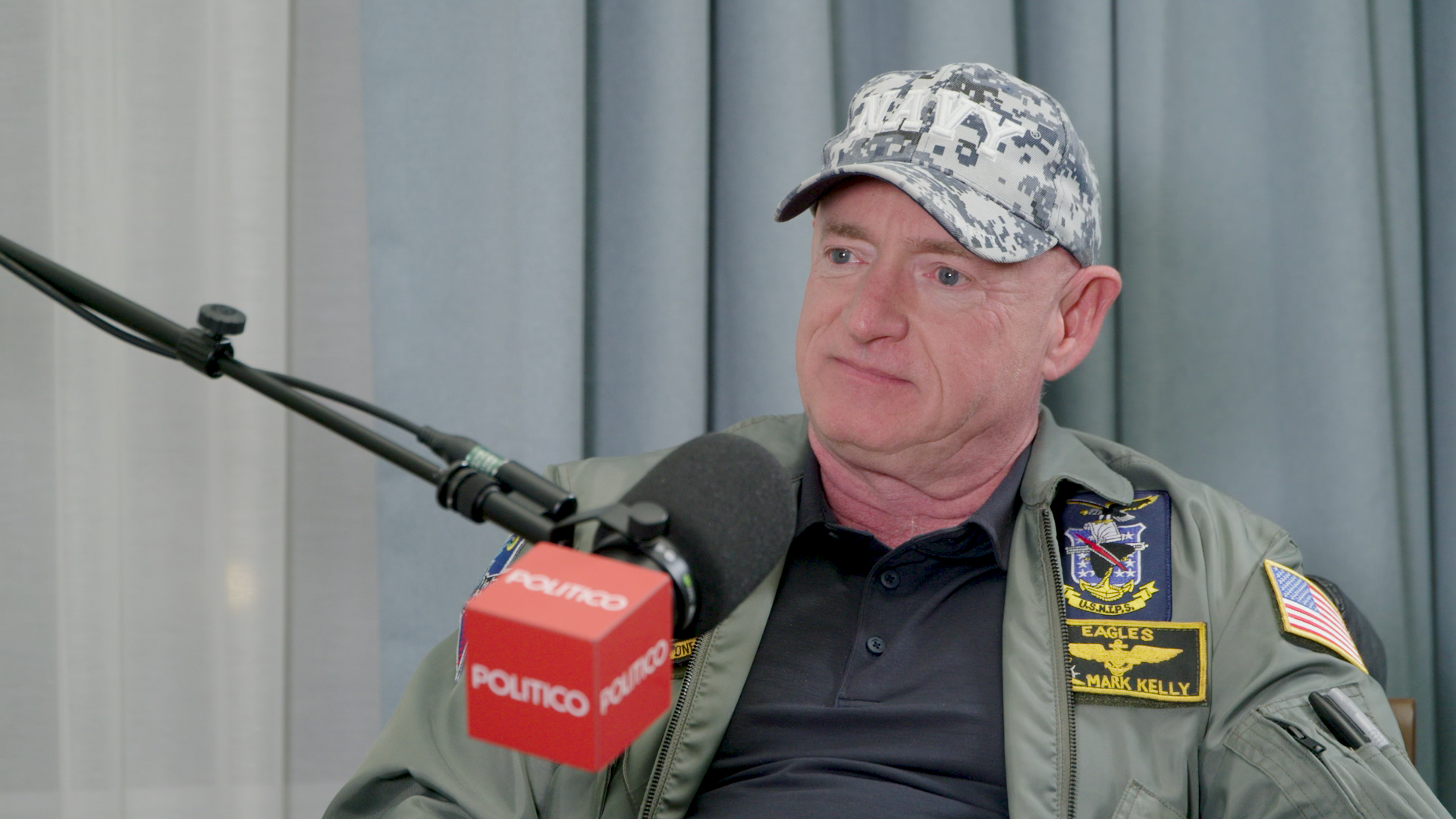
Can a low-key Democrat win in 2028? | The Conversation
In short
Senator Mark Kelly discusses whether a “low-key” Democrat can win in 2028, arguing Democrats won because voters were fed up with Trump/Republicans, not because they love Democrats. He also addresses the U.S. Iran crisis, saying the U.S. is stuck without a strategic goal/exit plan and that the best path is a negotiated settlement to restore something like the 2018 nuclear deal (freedom of navigation through the Strait of Hormuz; no nuclear weapon development). He comments on Pete Hegseth impeachment prospects, immigration policy (orderly asylum; separate border security from internal enforcement; reform ICE practices), Israel/Gaza (reckless disregard for collateral damage; not using “genocide”), and campaign finance reform.
Guests
Mark Kelly, Democratic U.S. Senator from Arizona; retired NASA astronaut and former Navy officer; flew 39 combat missions in the Persian Gulf War and 299 carrier landings off USS Midway.
Written by AI. May contain mistakes.
Chapters
1:30
Veterans Day and Military Experience
Discussion on Senator Kelly's military service and its relevance today.
“Folks, thank you so much for supporting our show.”
3:17
Analyzing Current Middle East Conflicts
Senator Kelly discusses the complexities of the current Middle East conflict.
“is entangled in another war in the Middle East.”
5:26
Strategies for U.S. Involvement
Exploration of U.S. strategies and diplomatic options in the Middle East.
“President, Secretary of Defense, incompetent.”
8:11
Political Implications of Recent Actions
Discussion on the political fallout from President Trump's comments and actions.
“Yeah, I think it's going to be something like the 2018 deal that President Obama negotiated and Donald Trump tore up.”
12:40
Reflections on the Recent Elections
Senator Kelly provides insight on election outcomes and future Democratic strategies.
“And then he tried to indict me and send me to jail.”
14:02
Legislation and Minimum Wage
Discussion on legislation regarding healthcare and minimum wage workers.
“help people who are minimum wage workers and raise the minimum wage, of course we would want to work with him.”
14:33
Election Analysis: Vote Dynamics
Analyzing the recent election outcomes and public sentiment towards Democrats and Republicans.
“There's a lot of analysis, a lot of punditry going on right now.”
16:41
Candidate Quality and Election Results
Discussing the quality of candidates and its impact on election results.
“in Kansas, Adam Hamilton, Josh Turek in Iowa, you know, who as a disability advocate, was a member of the legislature, was very accomplished and successful.”
18:07
Leadership Dynamics in Congress
Exploring the implications of leadership roles and voter expectations for Democrats.
“I am Kansas through and through, and that is how I campaign.”
20:25
Trump's Immigration Position
Evaluating President Trump's stance on immigration and potential bipartisan efforts.
“He really cares about the American people.”
Show all 18 chapters
22:10
Border Security and Internal Enforcement
Discussion on the need for an immigration system and criticism of current enforcement practices.
“A lot of dreamers, I know dreamers who did not find out that they weren't U.S.”
25:08
Foreign Aid and Israel's Actions
Debating the appropriateness of U.S. aid to Israel and the consequences of its military actions.
“Well, first of all, Stephen Miller is a hired thug, in my opinion.”
28:01
Military Strategy and Civilian Safety
Discussion on the military's approach to combat and civilian safety in conflict zones.
“Obviously, I used to plan my combat missions off of that aircraft carrier that's down the street.”
30:19
2028 Presidential Aspirations
Thoughts on the potential candidacy for the 2028 presidential election and personal motivations.
“You told my colleague, Adam Wren, that you would make a decision about running for president after the midterms.”
32:19
The Changing Political Landscape
Analysis of how political messaging and media impact voter engagement.
“And I want the future of this country to be great for kids.”
36:25
Biden's Legacy and Democratic Strategy
Discussion on President Biden's achievements and how Democrats should navigate his legacy.
“It's like, my partisanship has not been trendy over the last few years.”
38:15
Wealth Inequality and Campaign Finance Reform
Exploration of wealth inequality in America and the need for campaign finance reform.
“flying airplanes and flying a rocket ship.”
42:01
Addressing America's Challenges
A discussion on the importance of addressing America's structural debt and deficits.
“Why doesn't the nurse or the teacher or the cop or the fireman, why don't their voices matter as much as somebody like Elon Musk?”

Ask about this episode
Get the gist, explore an idea or ask about something said.
 Claude
On The Playbook Podcast, what are the key points of this episode?
Searching your listeningTranscript
Automatic transcript. May contain errors.
0:00Presented by AHIP. Health plans work every day to shield Americans from high and rising costs by negotiating lower prices from providers and drug makers and protecting consumers against unexpected medical bills. Learn more at AHIP.org. It's not that the American people love the Democrats and that's why we won this election. It's that they're really not happy with the Republicans.
0:31Hello, hello, and welcome to The Conversation. I'm Dasha Burns. And every week on this show, I talk to some of the most compelling and sometimes unexpected power players in Washington and beyond. And this week, I sat down with Senator Mark Kelly. Now, Kelly has worn a lot of hats in his lifetime. And while he's currently the Democratic senator from Arizona, he's also a retired NASA astronaut and a former naval officer. We spoke on Veterans Day in San Diego, where he was walking in a parade in front of the USS Midway, a ship where he's actually flown combat missions from during the Persian Gulf War.
1:05With his firsthand, deeply personal experience in the military, Kelly was the perfect guest to talk to about this moment in the Iran war and the attempted impeachment of Defense Secretary Pete Hegseth. Beyond military issues, there was so much to talk about with a new Democratic-led Congress coming in, 2028 looming, and of course, Mark Kelly has been talked about as a potential 28 contender. He has not yet officially announced anything, but I did ask him all about it. Folks, thank you so much for supporting our show. Please make sure that you are subscribed wherever you are listening or watching us and make sure that you download Politico's brand new app.
1:39You can find us there, too. And now here's my conversation with Mark Kelly. Senator Mark Kelly, thank you so much for joining the conversation. Good to be here, Dasha. And happy Veterans Day. Thank you. We are here in San Diego, which is also my hometown. And a great Navy town. A great Navy town where you just walked in a Veterans Day parade with the USS Midway. You flew 39 combat missions in the Gulf War, many of them off the Midway. All of them. All of them off the Midway. You said 199. No, I said 299 carrier landings. 299 carrier landings. I have 375 carrier landings on like six or seven different ships, but 299 of them are on the midway.
2:23You were just one short. I was one short of 300. And you know, I don't have it on this jacket. I have it on another jacket. There's like patches for each hundred. So I have the 200 carrier landing patch. But not the 300 one? I don't have the 300 one. Oh, that must keep you up at night. No, not anymore. It did for a while. But my operations officer, during the time of Operation Desert Storm and when I was in the squadron, he's the CEO of the USS Midway Museum. His name's Terry Craft. He's a retired admiral. And we were talking about that. He said, well, why didn't you tell me that you needed one more landing?
2:58I said, well, I told our skipper, you know, the squadron commander. And he was like, he wasn't that sympathetic. He said, well, you should have told me. Well, look, I think this is an important moment to have someone with your experience talk about the moment that we're in. 35 years later, the U.S. is entangled in another war in the Middle East. And voters in this election resoundingly rejected the war and its impact on their lives here at home. But, you know, as I talk to experts of all kinds on this, there doesn't seem to be a simple solution here. You can argue about how we got here, right?
3:37But we are here. And there are a lot of theories about how to get out, but no one seems to have that clear answer. What is the right next step for the United States in this conflict? Can I back up and talk about the difference between the war in the Gulf, the first Gulf War in 1991, and what we're in today? Okay, but not a very long history lesson because we have a lot to get into. We've got a lot to cover. We had a well-defined strategic goal, and we had a plan, and we executed the plan, and we got out. And we accomplished that thing in like six weeks. The whole thing was over. And the president of the United States at the time, George H.W.
4:15Bush, made it very clear to the country why this is important for us to do and got the country behind it. This case, you know, Donald Trump gave a speech, State of the Union speech, like weeks before this thing happened at the end of February and had like, I don't know, one or two sentences about it and just moved on, didn't prepare the country for it. And it's because he didn't have a well-defined strategic goal. And when you don't have the goal, it's hard to come up with a plan. He turned it over to the most unqualified Secretary of Defense we've ever had as a country, Pete Hegseth, to come up with a plan.
4:51And the plan stunk. And his plan was just to bomb as much stuff as possible. Well over 10 ,000 targets. I think he himself, Pete Hegseth, talked about, we set new records. We bombed 12 ,000 targets in this period of time, unlike anything we've ever done before, just killing people for no strategic reason. So now, when you get into a conflict like this without a strategic goal, without a plan, without a timeline, and without an exit strategy in the beginning, you find yourself stuck. And that's where they are, because in my opinion, they're all incompetent. President, Secretary of Defense, incompetent.
5:33So now, what do we do? We can't just walk away. If we walk away, the Iranians get control of the Strait of Hormuz, and that's going to cost the American people a lot of money. Families, it will cost them money. You can't escalate at this point because why are you escalating? You didn't have a goal to begin with. And you'll have a lot more dead Americans. So the other option is you have to come up with a negotiated settlement with the Iranians. The problem this president has is he tore up the deal that was working, tore it up in 2018, that had uranium enrichment below 4%. And now the uranium enrichment's much higher than that.
6:15Last year, summer of 2025, they did the Midnight Hammer operation, which supposedly got rid of, obliterated their enrichment capability, which it didn't. Did a lot of damage, didn't obliterate it. So when you put incompetent people in charge of a very complex operation, this is what you get. But here you are now. I know. Here's what I'll suggest. If it's not making a deal and it's not getting out, what is it? Well, you got to make a deal. You got to make a deal. Okay. And I would contend that the best person in our country to negotiate a deal with the Iranians is not the son-in-law of the president.
6:54There's like no chance he's the best person to do this. So you got to get rid of him. And you got to get rid of Steve Wyckoff. And you got to put professionals in charge. Is there anyone in the administration that you think could do it? I think you got to find people who have experience with the Iranians. They're out there. I don't know who they are by name. It's not Jared Kushner, and it's not Steve Wyckoff. If I was Donald Trump, that's where I would start. Well, it took Obama, President Obama, a long time to negotiate the nuclear deal. There's a very good chance that the next person that comes into the Oval Office is going to have the same problem on their hands.
7:28Yeah, I think Trump could kick the can down the road until he's out and turn this problem over to whoever the next president is. So say a Democrat gets into the Oval, what do they do with this? Well, you got to get the Iranians to agree with something, and it can't include them being the person who collects tolls for people going in and out of the Strait of Hormuz. They have to allow freedom of navigation, and they've got to commit to not developing a nuclear weapon like they had committed to before. I sit on the armed services and the intelligence committee. They were not rushing to get a nuclear weapon.
8:07So you think the end of this is going to ultimately be back to status quo? Yeah, I think it's going to be something like the 2018 deal that President Obama negotiated and Donald Trump tore up. That deal was working. It wasn't perfect. But they were not developing a nuclear weapon under that deal. we should try to get back to that. This president is going to be really uncomfortable negotiating something that he tore up because he's going to get criticized for it. But then when the stakes are this high and the American people are paying so much more out of their pockets and can't afford their lives, he's going to have to suck it up and come up with a negotiated settlement that he's probably not going to be happy about it, but he needs to do it.
8:51So you just called Pete Hegsett the most unqualified secretary of defense ever to serve. House Republicans just banded together to stop an effort to impeach him. If the next Congress brings this back up, do you think there would be enough Republican senators to convict Hexeth? Have you talked to any of your colleagues across the aisle? I know colleagues on the other side of the aisle are not happy with this Secretary of Defense. They think he's screwed things up. He's not a serious person. When you're running around on a stage like a 12-year-old playing army, talking about killing people and lethality and now testosterone, you're not taken seriously by the military or by folks in the United States Senate.
9:36You've heard that from Republican colleagues. I heard, yes. I know of Republican colleagues of mine that are not happy with the Secretary of Defense. And won't make your name names, but... Well, some of them are pretty vocal about it. Yeah. Tom Tillis. Yeah. Now, he will not be there after January 3rd. But there are people in place right now that you think you could convince or they could come to an agreement to potentially convict Hegseth? We'll have to see. You know, that's not my job. My job might be to sit there and listen to a trial and I would decide how I'm going to vote. And from what I know now, I think there is enough there to remove Pete Hegseth from his job.
10:15But do you think that there are Republicans that would seriously wrestle with this and consider it? We know there are. You know, we know they are there. Are there enough? I don't know. We will probably find out. You have a lot of accomplishments in your life that have given you a lot of headlines in the news. But in the world of politics, you were really thrust into the spotlight when you were part of this seditious six, when you and five other members of Congress cut a video reminding service members that they have no duty to obey illegal orders. the way that the president and defense secretary pete hegseth responded to that and the aggressive attacks on you do you think that trump essentially elevated you politically and kind of put a spotlight on you and started some of that swirl around hey maybe mark kelly 2028 what do we think he gave he gave the video a lot more attention than it would have received otherwise that's for sure.
11:17He got our message out there. And he gave you a new kind of platform. When the president of the United States says you should be hanged, and that has never happened before in our country's history for a president to say that another member of another branch of government, specifically in this case, Congress, should be hanged, it gets people's attention. So yeah, I mean, he brought a lot of attention to the issue of not following illegal orders, which is essentially following the law. When orders and the law are in conflict, you follow the law. It's on a plaque at West Point. People know this, but they need to be reminded of it, especially with what was going on.
12:02We strongly felt, but yeah, sure, it got me. We weren't looking for this. By the way, this was the second video we did. The first one got little notice. It's funny how things go viral, isn't it? This went viral because of Donald Trump. It went viral and gave you a pretty big money bomb to go and campaign around the country and shower money around the map? I raised and gave away over$14 million this election cycle. You thank the president for that? I'm not going to thank him for anything. Do you think he gets a little— He said I should be hanged. And then he tried to indict me and send me to jail.
12:42So I'm not thanking him for anything. Now, 16 normal people basically told him to take a hike. I mean, unanimously, they said, go away with your ridiculous charge against these members of Congress. So, yeah, I'm not thanking him for anything. He needs to figure out what he wants his legacy as president to be. He's got an abysmal approval rating. He just got his ass handed to him in this midterm election. And does he want to be known as the weird guy that was focused on reflecting ponds and ballrooms? Or does he want to be taken seriously as a president? And I think he still has some time to turn that around.
13:30And the way he would do that would be to work with members of Congress to pass meaningful legislation to improve the lives of the American people. People are struggling. We have half the country right now is having a hard time affording food. And we have the ability, if we could get him on board, to really deliver and make some positive change for these people. Would you extend that olive branch even though he suggested you should be hanged? If the American people, you know, get something out of it, of course. If we could pass legislation to fix the ACA tax supplements for their health care or get some people back on Medicaid who should have never been kicked off or to help people who are minimum wage workers and raise the minimum wage, of course we would want to work with him.
14:24We need the president to sign our legislation. We're going to send stuff to his desk. It's going to be his option. Are you going to stand with the American people? Are you going to continue to stand with the billionaires and all your buddies who might not want some of these things? You mentioned the election. There's a lot of analysis, a lot of punditry going on right now. But from where you sit, do you think that this was more a vote against Trump than a vote for Democrats? And what do you think Dems need to do before 2028, given, you know, the national Democratic brand is not exactly popular among them?
15:02No, it's not that they love us, right? It's not that the American people love the Democrats. And that's why we won this election. It's that they're really not happy with the Republicans. And I think it's three things why we had this, I mean, historic election night. And it's not that Democrats really won, the American people won. This is a big win for the American people because this could mean some positive change for them, their kids, their grandkids, you know, for their future. I think the first thing is it finally sunk in with the American people that this president and the people around him are so corrupt.
15:44I mean, corruption that was almost unimaginable. I think you could take all the corruption of any government official in our country's history, local, state, federal, presidents who were corrupt, add it all up. Multiply it by a thousand. And you don't even get close to this. When you talk about pure amount of money going into somebody's pocket. So they're fed up with that. And I think the second thing, what the president said he was going to do when he ran for election in 2024, he actually did the opposite. Instead of lowering people's costs, he got us into a war that raised their costs. Instead of dealing with inflation, he put on these tariffs on all these countries that increased inflation and increased costs for the American people.
16:38But then I think the third thing, the third thing is when you look at the candidates that we had on the ballot, the quality of these people, their backgrounds, pediatrician in South Carolina, Annie Andrews, pastor in Kansas, Adam Hamilton, Josh Turek in Iowa, you know, who as a disability advocate, was a member of the legislature, was very accomplished and successful. across the board. The people we had on the ballot were better than the candidates they were running against. And I think those three things together is why we got those results. But you know, it's not going to be easy for Democrats going forward.
17:19Governing is hard. It's never easy. And you've got a really diverse slate of people coming in. And I'm talking about diversity in all its shapes and forms, right? You have an ideological diversity, like I think Democrats haven't had in a while. Well, that's because we have a lot of people. While you're in control of Congress. A big majority, you're going to have a diverse— Absolutely. One of the biggest mandates from voters, one of the biggest messages they sent, I think, is they want change. They don't like Washington. They're sick of both parties. The candidates that did best in those areas— And nobody likes Washington.
17:53No, no, no, of course. And the candidates that did best, I think—I sat down with Adam Hamilton in Kansas, and he told me, you know what? Kamala Harris, stay in California. Chuck Schumer, he's a liability here in Kansas. I am Kansas through and through, and that is how I campaign. Well, I went to Kansas and campaigned with Adam Hamilton. Well, it's interesting who he wanted there and who he didn't, right, and who some of these folks shared the stage with. The leadership battle. You just had Senator Alyssa Slotkin, a moderate, Senator Bernie Sanders, a progressive, both come out and say, Senator Chuck Schumer, do not seek this Senate majority position.
18:33It's time for a change. Do you think that keeping Schumer in that leadership role could backfire for Democrats, given what voters just asked for? Well, it depends on what happens next, right? What does Senator Schumer do if he finds himself as a majority leader again. I think he will. I mean, it's... But I think the question, before we even get there, like, you've said you'll support Schumer as majority leader. Yes. Do you think there's risk to that? He worked really hard to get this majority. He raised an enormous amount of money. Obviously, money isn't everything. We demonstrated that in this election.
19:13But I think it matters less about whose name is on the door and more about what do we do with it. If we do the same, if we have the same plan that we've had before, I don't think that's going to work. But don't you think it could signal to voters that they're not being heard when they say we want to see a new generation? I'm not sure voters themselves pay a lot of attention to who gets elected into the leadership position in this House of Congress, the House and the Senate. I think they want results, and we have to deliver those results. And we've got 56 people among the Democrats that now it's on us to pass legislation and to send it to the president's desk.
20:03And then it's going to be up to him to make a decision on whether or not he signs it. If he doesn't sign it, that's stuff we can show, hey, here's where we are. We want to help you, and give us a chance in 2028 with the House and the Senate and the White House, and then we can deliver. I would prefer we deliver now. What about a Senator Chris Van Hollen for a leader? Chris is a great guy. He really cares about the American people. I've been working with him. I don't know if he's going to run for this position or not. You mentioned working with President Trump. He surprised a lot of people, went on 60 Minutes.
20:39He said he was open to an immigration deal with Democrats. He kind of walked it back a little bit. A little bit. I mean, this is President Trump, you know, we're used to the whiplash at this point. But he did say he was seriously considerate. He said it to me in a phone call on election night as well. So you're talking to him on election night. What was his mood? You know, surprisingly conciliatory. I called him live on our Politico broadcast. We had an election night live special and I decided to call him up and he answered. And, you know, he said he thinks it's because he wasn't on the ballot.
21:19And he said that he told everybody that he was on the ballot myself on the ballot. I brought that point up to him. But listen, he said he wants to work with Democrats. We'll see. But as a border state senator on immigration specifically, what do you make of that? And do you think there is a deal to get done with Trump on this? Could be. I think it would be really a very positive thing for the country if we could do something on Dreamers especially. That's something he's signaled interest in too. Hey, you know, dreamers are, I look at dreamers as, as American as my own two daughters who deserve this.
21:55And, you know, the, and the, you know, the anxiety that they, they go through here, who in many cases, they don't know any other country other than the United States of America. You know, they came here when they're, in some cases, when they're months old or just a few years old, and they never left, right? A lot of dreamers, I know dreamers who did not find out that they weren't U.S. citizens until they were like in their teens. You know, one case, I know somebody found out when they were like 16, 17 years old that they weren't a U.S. citizen. They didn't know they came to the country when they were just a few months old.
22:33These young people, in many cases, young people, you know, in every other way, they're Americans and they should be citizens. Are there some parts of Trump's immigration agenda that you would want to keep in place? I mean, illegal border crossings are at record lows. And you did criticize President Biden for not taking that issue seriously enough. What happened during the Biden presidency at the border was a disaster. It was chaos. We don't need to go back to that. But we do need a system. I think we need a system where people can come here and ask for asylum. It needs to be orderly. We need to be able to give people reasonable decisions in a reasonable amount of time.
23:14I don't want in Arizona to see the chaos that we've seen at the border before. I also think you've got to separate border security from internal immigration enforcement. And what this administration has done on that issue is outrageous and horrible and in many cases illegal. And it has to be reformed. You voted for the Lake and Riley Act, which requires detention of certain immigrants who have been arrested but haven't necessarily been convicted. Looking at how this administration has approached immigration enforcement, do you stand by that vote? I'm the son of two police officers. I'm a senator of a border state.
23:53I think we've got to prioritize people who have committed crimes, serious crimes. And if you want to focus on removing people from this country, it needs to be people in that category, not tearing communities apart like this administration has done. I mean, in some cases, you've got ICE shooting U.S. citizens, deporting U.S. citizens, deporting migrants to countries that they don't even know anything about, that they did not come from. This is a horrible thing to do, and it's wrong, and it's got to stop. Presented by AHIP. In the face of rising medical and drug costs, your health plan is working to make health care more affordable.
24:42negotiating lower prices from hospitals and drug makers, protecting patients from health care fraud, helping people get the preventive care they need with no out-of-pocket costs. Health plans are the only part of health care working to make care more affordable for you. Let's work together to address the root causes of higher health care costs. Would you work with Stephen Miller on an immigration bill? Well, first of all, Stephen Miller is a hired thug, in my opinion. I heard the big sigh when I said his name. Yeah, for this administration, right? He's the worst possible option to be the chief of staff.
25:23Yeah, I would say you'd be better off picking anybody else who works in the executive branch other than him. And yet, here we are. I don't know why Trump did this. I think it's Donald Trump giving a middle finger to the American people by putting Stephen Miller in that job. You know, legislation goes, you know, from us to the president. We're going to send him stuff that we want him to sign. And if he signs the kind of legislation, then I think we're going to, you know, work to pass. That'll be a win for the American people. Stephen Miller, I think, was a mistake. and you know I wish the president would rethink his choice there.
26:04President Trump says that Israel no longer needs billions of dollars in American military aid. He made that announcement just before the election. Do you agree with him? Well, I view Israel as the Israeli people and the country as often a partner to us, the only democracy in the Middle East. helping Israel is not only important to the security of Israel, it's often important to our own national security and our own interests in the region. I think it's always appropriate to evaluate the kind of security assistance that we provide to countries. It's something we should do on a regular basis, regardless of what the country is.
26:57Well, so in this moment, do you think cutting that aid is a good idea? I think in this moment we should re-evaluate the kind of aid, you know, we give to Israel and other countries. And, you know, I've even heard, you know, Bibi Netanyahu say, well, maybe we don't need this aid anymore. Yeah, Trump said that that's the case. We should consider it and consider what's in the best interest of the United States. In democratic primaries, the word genocide has become kind of a dividing line in the debate over Israel's conduct in Gaza. Israel vehemently rejects that characterization. Do you believe that Israel's actions in Gaza amount to genocide?
27:37I believe that the way that the government of Israel conducted these operations in Gaza was a reckless disregard for collateral damage and the loss of innocent human life. It was reckless. and there should be consequences for it. And I mean, so many people unnecessarily died. Obviously, I used to plan my combat missions off of that aircraft carrier that's down the street. We go to great lengths. The United States military does often go to great lengths to make sure those things do not happen. And what they should have done is they should have gone much slower. They should have used guided munitions and not a lot of unguided.
28:29when Israel started using naval gunfire against targets in Gaza. I went straight to the ambassador, Ambassador Herzog, the Israeli ambassador to the United States, and explained to him why this is unconscionable that they're doing this in that kind of environment, going after the type of targets that they're trying to hit in a city to use naval gunfire was wrong. They stopped. So I am not happy. I mean, what they did was reckless. But I hear you're not going so far as to use the term genocide. Do you think your Democratic colleagues that are are going too far using that term? Well, I mean, I think everybody, you know, has a right to their own opinion.
29:16I mean, this is going to be a major fault line for Democrats, both in Congress and in 2028? Well, ultimately, it comes down to semantics. At this point, what do we want our relationship to be with Israel? And what is in the best interest of the United States? The election in Israel, you know, went sort of the way I hoped it would. We'll see what happens. Gadi Eisenkot, kind of, he didn't win the 60 votes he needs, but he's given an opportunity to form a government. And if he successfully forms a government here in the coming weeks, we should see the end of Bibi Netanyahu. I hope that's the end of him.
29:59And we will have what I think will be a more reasonable government in Israel, a government that we can be more aligned with to our benefit, but also I think it would benefit the country of Israel and the Israeli people. Okay, Senator, I've been keeping my powder dry, but we got to go there. I have to ask 2028. You told my colleague, Adam Wren, that you would make a decision about running for president after the midterms. It is after the midterms. It is after the midterms. But you know, after the midterms goes on for a while. Sure, sure. A conveniently vague promise you made there. So When will you make that decision?
30:45After the midterms. Before the end of the year? Before the end of the year, I haven't decided on when I will make the decision after the midterms. Have you actually decided and just aren't ready to say it? I think there might be people out there that do that. I actually have not made a decision on this. I am thinking about it. I, you know, I'm not your typical person that runs for president, right? I spent 25 years on active duty in the Navy. I'm an engineer. I'm like a very mission-focused person who believes in science and data, not a lot of this bullshit that you see in Washington. You know, I'm not your typical senator.
31:32So I've got to make a decision. Hey, am I the right person at the right time? Does all of my family support this? not only my wife Gabby, who we talk about this, she was a member of Congress. This is a rough business, right? She knows that. We know that better than anybody. Before Gabby got shot, I thought I had the risky job in the family. I flew 39 combat missions. I flew four space flights on a rocket ship built by the lowest bidder. And she's the one that nearly lost her life serving her country. But I believe in public service. I believe in the future of this country. I want to contribute to the future of this nation in the best way I possibly can.
32:18I have two granddaughters now. One's five years old. One is about 10 weeks old, brand new. And I want the future of this country to be great for kids. I mean, I was fortunate enough to grow up in a time where hard work paid off. The system we have now, I mean, the system still works. It just doesn't work for most people. It doesn't work for, you know, people like me who grew up, I was a son of two union cops. It doesn't work anymore. You know, it's people with connections, it's people with money. You know, they benefit from this system. We gotta rebuild the system where everybody benefits. I'm listening to you And I'm seeing those words being delivered at a podium with a big sign in the background.
33:10I've sometimes delivered them with a little sign in the background now. Sometimes at a podium, usually not. Listen, what I'm curious about, I think you've heard versions of this before, and I'll say it like this. Listen, Donald Trump fundamentally changed what it takes to capture Americans' attention. Even in your own party. In this case, it was saying a bunch of crazy stuff. Sure. But virality is a thing in politics now. You have people in your own party like John Ossoff, like making speeches with clips that are everywhere on exit on Instagram. Your style is more low key. Do you think being able to command attention to break through the noise is now a prerequisite for running for president?
34:00Well, I'll tell you this. Donald Trump commanded attention by just, you know, everybody to all the cable news networks tuning in all the time to see the next crazy thing he was going to say. I actually put that kind of on the media. The media kind of the media that everyone loves to be mad at us. The media that he's— They love to hate the media. Well, I'm not mad at you guys, but the media that he seems to dislike so much made him, right? And I think there's— But there's so much more than just the mainstream media now, right? There's no comparison with him and, like, John Ossoff. No, no, no. But I guess I'm saying it's like the media landscape and the attention landscape has changed dramatically.
34:41And voters are— Yeah, totally has. —are, like, vibes really matter to voters, right? Yeah, the viral clips matter. Yeah. I mean, do you think you can command attention in the way that might be pretty important in this climate? I have no idea. I have no idea. And again, I haven't made the decision. Oh, no, I know, I know, I know, I know, I know. But just in terms of your thinking and how you, I mean, breaking through the noise in this moment. In this moment. Moment, right? I don't know. How do you do it? Maybe we'll find out. Maybe we won't. You know, Jim Clyburn told me that a governor would have an early advantage because they know how to manage is what he said.
35:26What do you make of that? Well, I really respect Jim's opinion on these things. He's a smart guy. He's been doing this a lot longer than I have. When I view what Washington is like right now, the polarization and people getting into their quarters, You know, I do see, you know, the asset, the benefits of the governor in that position. But I also see the value of having somebody who has relationships with Republicans in Congress. I mean, that is a positive, you know, positive thing because we've got to stop this, like getting into our corners and refusing to work together. You think the polarized, like, fighter characters is not— I think the fighter is good when you're fighting for the right thing.
36:19Yeah. But ultimately, you know, having the ability to work with the other side is often necessary because that's the way our government works. It's like, my partisanship has not been trendy over the last few years. It's not trendy, but sometimes it's necessary. You know, Clyburn also told me that it would be a mistake for Democrats to run away from Joe Biden's legacy. What do you think about that? Hey, I think we passed some really good legislation when Joe Biden was president. We got a lot of stuff done, and it was bipartisan, right? Infrastructure bill. Bipartisan, it has the word bipartisan in the name to improve this country's infrastructure.
36:58The Chips and Science Act, a piece of legislation that I really cared about, that I worked really, really hard to get past, that is bringing semiconductor manufacturing back to our country, the place that invented the semiconductor. We lost it, and now it's coming back. A lot of it's coming to my state, not why I did it. I did it because it's in the best interest of our national security and our economic security to have that here. That was Democrats and Republicans working together. Now, sometimes on some of the stuff, you got to go it alone. I get that. You know, when we do it through a process that, you know, I don't want to get into the way, you know, Washington works, but sometimes, you know, Democrats, if we have a Democrat in the White House, we're going to get some stuff done because we really need to change the deal that the American people get.
37:49They're getting a bummer of a deal right now. And it's not satisfactory, and it's not right. And we've got to improve people's lives. But, you know, President Biden is out with a book. He's going to be around. Do you think it would behoove Democrats to embrace him in the next couple of years or to turn the chapter? So you're asking the kind of question that I think you should ask a pollster and not a guy who spent 25 years in the Navy flying airplanes and flying a rocket ship. But that also means you know people and you understand what people are looking for and what they want to see. I feel I know people.
38:32I've had a rather successful career doing a couple different things. Yeah. You were one of the finalists to become Harris's running mate. Have you stayed in touch with her and does her decision to get into the field or not have an impact on yours? To answer the second part first, it will not impact my decision one way or the other. You know, what Vice President Harris decides to do. Are there others whose decisions might matter, like Ruben Gallego, who's also an Arizona? No, I would just have to make the decision that I feel like I'm the right person at the right time and I can win and my family's on board.
39:05And according to my timeline, which I am not sharing with you. Brutal. And then, but, and have I kept in touch with her? We've played phone tag a little bit. Recently? No. You know, you've mentioned this. You've done a lot of really hard things in your life. You've survived a violent childhood, exploding missiles, flying to space, an attempted assassination, an attempted murder of your wife, Gabby Giffords. Should you decide to do this, why would you want to add something like running for president to your list? Or does the challenge of the presidency not daunt you as much because of everything else?
39:42I think if it doesn't daunt, you know, somebody who's considering it, they're probably not the right person. It's in a lot of, it's the hardest job on the planet. And I've done hard things before. And that's why this is part of the decision process for me, would I be the right person or not? But I really believe in our country. I still think we are the most innovative, generous people on this planet when we get it right. We often make mistakes and we get off track and I hate to see when that happens. I think that's happened very recently and we are failing the American people right now. We now have what, like 1 % of our country owns as much wealth as the bottom 90 %?
40:31We have one individual, who by the way is a very successful immigrant, Shows the value of immigration sometimes, that this person could be that successful, that has so much wealth. I mean— Elon Musk? Elon. Yeah, I mean, Elon. So who's built some incredible companies? You know, SpaceX, incredibly successful. Who's really helped our country, our national security. But on the other hand, spending a half a billion dollars in an election, should one person be allowed to do that? And this guy's got so much money. If you started the day Jesus was born and you made a million dollars a day up until today, over 2 ,000 years ago, you still wouldn't have as much money as Elon Musk.
41:14Think about that. A million dollars a day from when Jesus was born. He has more money than that. It's hard to imagine the kind of money that is now in the hands— Do you think Democrats should accept money from him if he chooses to? We have to reform our campaign finance system. It is broken to have billionaires and big corporations and money is now like speech and companies are considered like people, as decided by the Supreme Court. It's a ridiculous decision. Citizens United decision needs to be overturned. And we need campaign finance reform. It is out of control. and what it means is that corporations and rich people get a much bigger say in who gets elected to these positions.
42:03That's not right. Why doesn't the nurse or the teacher or the cop or the fireman, why don't their voices matter as much as somebody like Elon Musk? So that needs to be fixed. This country we built has such a promising future if we just fix a few things. Yes. We got to come up with a plan for this$40 trillion in debt. We have a$2 trillion structural deficit. We have to fix this or the American people are going to be continue to pay for it. Well, sounds like you got your work cut out for you, Senator. Well, somebody does. All right, sir. Thank you so, so much for your time. Appreciate you joining.
42:43Appreciate being on. Thank you. This has been The Conversation with Dr. Burns. Thank you so much for tuning into this episode. to make sure that you never miss another one. Make sure you're subscribed. And don't forget to download our Politico app. We are there. Also, thank you so much for tuning in. We'll be back next week.
43:15Presented by AHIP. In the face of rising medical and drug costs, your health plan is working to make health care more affordable. Negotiating lower prices from hospitals and drug makers. Protecting patients from health care fraud. Helping people get the preventive care they need with no out-of-pocket costs. Health plans are the only part of health care working to make care more affordable for you. Let's work together to address the root causes of higher health care costs. Learn more at ahip.org.
From the publisher
Sen. Mark Kelly (D-Ariz.) joins Dasha in San Diego for a conversation about the Iran war, the future of the Democratic Party and the possibility of a 2028 presidential run. The Arizona Democrat says voters weren’t necessarily embracing Democrats in the midterms so much as rejecting Republicans, and he argues his party needs to show it can improve people’s lives.
Kelly also discusses why he’s still weighing a presidential bid and whether a quieter political style can break through in today’s attention economy. Plus: his critique of Defense Secretary Pete Hegseth and his response to President Trump’s threats against him.
Have thoughts for The Conversation? Text or leave us a voicemail at 202-643-1536.
More from The Playbook Podcast
All episodes
We use cookies.They keep VO running smoothly and help us improve it. Privacy policy