
In short
Shopify’s “AI-first” approach to software engineering and beyond—how they adopted Copilot early, expanded to Cursor and agentic tools, and built internal infrastructure (LLM proxy, MCP endpoints) for safe, measurable AI use. They also cover reliability “code red,” intern hiring, and AI-driven workflow changes.
Guests
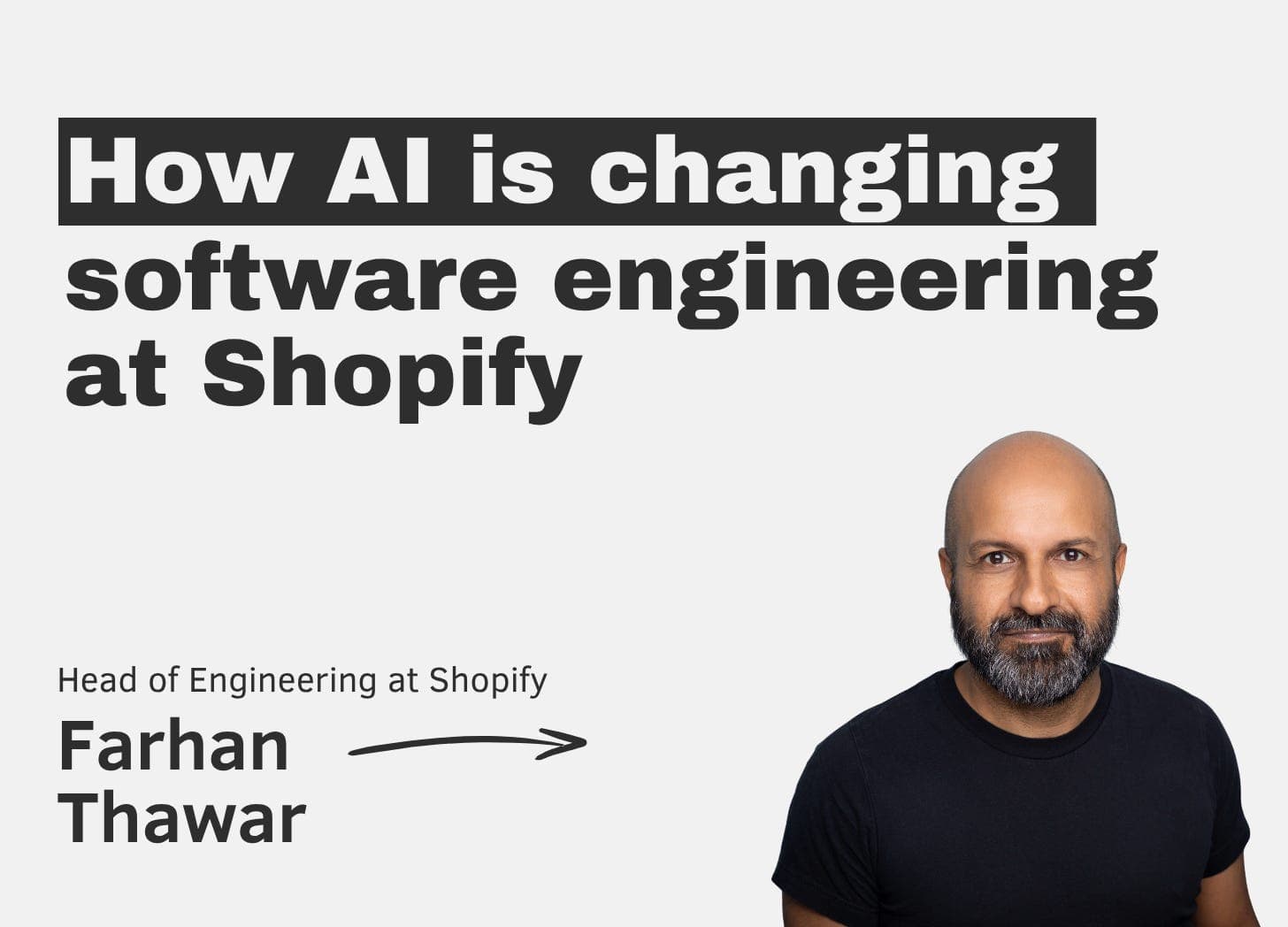
Farhan Thawar, Shopify Head of Engineering. Background: long-time hands-on leader who pairs on problems; involved in Shopify’s intern program redesign, AI tooling rollout, and even operational fixes (e.g., “chief Wi‑Fi officer”). He also describes pairing with Anthropic applied AI engineers.
Key claims
Shopify uses AI across engineering, R&D, finance, sales, support; non-technical teams build MCP servers and “vibe code” small tools. They expect AI tool access for everyone and track token usage via an internal LLM proxy and leaderboards. AI spend is treated as an investment, not a cost cap.
Notable examples
early GitHub Copilot deployment (2021) for all Shopify engineers; internal Cursor growth outside engineering; Anthropic Cloud Code pairing; “code red” to drive exceptions/segfaults to near-zero over ~7 months; LLM proxy + LibreChat; MCP access to “The Vault” wiki; interns: hiring ~1,000 in a year.
Written by AI. May contain mistakes. Listen to the episode to check what was said.
Chapters
Tap a time to open that second in VOFarhan Tawar's Role and Leadership Style
1:33 to 4:12
Understand the unique leadership approach of Farhan Tawar at Shopify and his hands-on involvement.
“If you enjoy the podcast, please do subscribe on your favorite podcast player and on YouTube.”
Shopify's AI-First Approach
6:10 to 9:59
Explore how Shopify has integrated AI into its operations and engineering practices.
“So this leads me really nice into the next thing I heard about you, which is at Shopify, you have gone kind of AI first, and we're going to talk a little bit about that.”
AI Tools and Their Impact
9:59 to 14:01
Discover the AI tools used at Shopify and their influence on engineering and beyond.
“Did you like talk to the team saying hey, bring up the things and also how did you decide when you will stop?”
The Evolution of Vibe Coding
14:01 to 18:06
Explore how non-technical individuals are starting to code and its impact on engineering dynamics.
“But the fact that the non-technical people are now kind of building, do you see any parallels from the past?”
Impact of AI on SaaS Vendors
18:06 to 20:13
Discuss the implications of individuals creating personal software solutions for SaaS vendors.
“I don't think we should be worried, by the way, because let's take another view.”
Shopify's Embrace of AI Tools
20:13 to 24:03
Learn about Shopify's internal shift to integrate AI tools across various teams.
“And it was meant to get everyone to move from passive to active.”
Building Internal AI Infrastructure
25:03 to 28:00
Insights on how to effectively build an internal AI platform and its benefits.
“And how many MCP servers do you have, Kevin?”
The Importance of AI Investment
28:00 to 28:32
Discussing the need for companies to invest in AI tools for productivity gains.
“because I'm unclear how you can use that much.”
Choosing the Right AI Models
28:32 to 29:18
Exploring the significance of selecting advanced AI models for better results.
“Do I understand that even though you cannot measure it right now or maybe not as accurately, you believe that there's productivity gains and you believe that people need to use it to get these?”
Leadership in AI Adoption
29:18 to 30:14
How leadership exemplifies the use of AI tools in innovative ways.
“And so we tell people, please move off the small models, move into something more bigger.”
Show all 23 chapters
Personal Projects and AI Tools
30:14 to 31:22
Sharing personal experiments and projects using AI tools.
“Yeah, so when I was building, when I was pairing with that engineer with Onanthropic, Like I was building something for myself.”
Comparing Tools for Web Tasks
31:22 to 32:21
A comparison between AI tools and specific platforms for web scraping tasks.
“I was like, let's figure out when the next SanDisk Extreme Pro 8-terabyte drive comes out.”
Hiring Interns Despite AI
32:21 to 32:58
Discussing the rationale behind hiring interns while companies cut back.
“And we have a lot of automation happening in Gumloop now because people have to do something.”
Learning from Interns
32:58 to 35:18
The benefits of learning from interns and fostering a culture of growth.
“But then you told me something interesting.”
Tools and Methods at Shopify
35:18 to 36:24
An overview of the tools and methods used by engineers at Shopify.
“I don't know why people think that you don't.”
AI in Project Management Updates
36:24 to 37:57
The integration of AI in generating project management updates.
“First, as an engineer, like what tools do people use?”
Balancing AI with Reflection
37:57 to 39:41
The importance of reflection in project updates while using AI.
“I want to push you a little bit on this because I think there's two schools of thoughts here.”
Coding Interviews for Leadership Roles
39:41 to 41:50
Implementing coding interviews for engineering leadership positions.
“As an engineering manager, what additional things might people use?”
Utilizing AI During Interviews
41:50 to 42:01
How AI is incorporated into the interview process for candidates at Shopify.
“Yeah, and I guess especially now we have these coding tools when you can generate something.”
AI in the Interview Process
42:01 to 43:30
Learn how AI tools are integrated into Shopify's interview process.
“So you're using AI during your interview process.”
Shifting Engineer Expectations with AI
43:30 to 44:34
Discover how AI is changing the expectations of software engineers at Shopify.
“And what has changed, let's say, three years ago when we didn't have any of these tools?”
Adopting AI Culture at Shopify
44:34 to 46:06
Understand strategies for fostering an AI-first culture in engineering teams.
“And as a closing question, a lot of people are thinking we'd love to be like Shopify.”
Practical Insights from Shopify's AI Use
46:06 to 46:36
Explore practical insights on how Shopify leverages AI for effectiveness.
“I love how you are not afraid to, you know, like take some turn to learn more.”
Transcript
Automatic transcript. May contain errors.0:00We've been using AI tools for a long time in engineering. I believe we were the first company outside of GitHub to use GitHub Copilot. And the reason I know that is because when Thomas Domke became the CEO of GitHub, the same day I emailed him saying I would like GitHub Copilot. This is 2021, a year before ChatGPT. He messaged me back saying it's not available for commercial use. And I said, that's not what I asked. I don't care what you have for commercial use. I would like this deployed for all Shopify engineers as soon as humanly possible. I think it took him about a month and we were not charged for two years because there was not a SKU to charge us.
0:29And we said in exchange, we'll give you lots and lots of feedback. And so we were using Copilot for a long time. And then we worked with them as we started looking at their roadmap. We then deployed Cursor internally as well. Actually, we were all very new to Cursor, about a year into Cursor. So we were kind of trying all these things. And as we try them, we want to see what's working, what's not working. And then we let more engineers use it. The most interesting thing about Cursor is that the growth in Cursor at Shopify is happening a lot outside of engineering. And outside of R &D, finance, sales, support.
0:56Those are the teams using Cursor. What happens when a company goes all in on AI? Shopify did exactly this a few years ago, and Shopify's head of engineering, Farhan Tavar, told me exactly how it's going so far. In this episode, we discuss how Shopify works closely with AI Labs, and why Farhan paired for an hour with an engineer at Antrofic working on the Cloud Code team. Why Shopify is planning to hire 1 ,000 interns in a year, and how they incorporated AI into their entry review process. Why Shopify has no cost limit on how much an engineer or team can spend on AI tokens, and many more. If you're interested to know what an AI-first tech company operates like, this episode is for you.
1:32This podcast was recorded as a live podcast at LDX3 in London. If you enjoy the podcast, please do subscribe on your favorite podcast player and on YouTube. So welcome everyone to this very special live podcast with Farhan Tawar. And we're going to talk about AI at Shopify. But before we start about AI, I just wanted to talk a little bit about you, Farhan. So I did a little bit of research. I talked with a couple of engineers at Shopify and they told me, you know, your role is the head of engineering and engineers told me that they see you in everything. You have reworked Shopify's intern hiring program.
2:09You've defined what Shopify does. In fact, you even were in the weeds to deploying an internal hack fest to more than getting the Wi-Fi right for a hack fest. So I'd like to know what is a head of engineering do at Shopify and specifically what do you do or maybe what do you not do? Yeah, so I think what's interesting about Shopify is that we use this line, we're not a swim lane company, which means that we don't try to put people into these roles where you are like, you're in product, so only think about product. Or you're in engineering, only think about how the code is written or architecture.
2:41We're very much just curious problem solvers. And so if something's broken, we expect curious people to go and look at the problem, even doesn't matter what their role is, and try to solve it. And so last year at our Shopify summit, which is our employee event where 7 ,000 people come to one space, the Wi-Fi did not work super well. And so I spent all my time in that summit for three days trying to fix the Wi-Fi. I became known as the chief Wi-Fi officer. And so this year, which was two weeks ago, I deployed 300 Ubiquity APs, 800 switches. Access points. Yeah, to have a much, much smoother Wi-Fi experience, which is how that all got started in terms of...
3:20The team built lots and lots of memes because they thought the Wi-Fi was not going to work, but it did work. And so I did publish all those memes. I need to ask you because a lot of leaders would say, look, your time is super valuable. You're kind of ahead of an organization. How many people are... 3 ,000. 3 ,000 people. You're kind of up there and your time is now, if you measure it in dollars, it'll be expensive. It's a lot better to just get a specialist to do these things. Why do you still do these things and do you disagree with that advice of like focus on on the high leverage things? Yeah, so we don't love the there's that notion of like hire smart people and get out of their way Instead what we say is like hire smart people and pair with them on problems So the difference for us is we really like to bring in obviously lots of smart people Hands-on people and instead of just saying hey you take this area and then go away and just solve it for me and come back We like to pair with them and say you're smart.
4:10I'm smart. Can we work on this problem together? This episode is brought to you by WorkOS. If you're building a SaaS app, at some point your customers will start asking for enterprise features like SAML authentication, SKIM provisioning, and fine-grained authorization. That's where WorkOS comes in, making it fast and painless to add enterprise features to your app. Their APIs are easy to understand, and you can ship quickly and get back to building other features. WorkOS also provides a free user management solution called AuthKit for up to 1 million monthly active users. It's a drop-in replacement for Alt-Zero and comes standard with useful features like domain verification, role-based access control, bot protection, and MFA.
4:47It's powered by Radix components, which means zero compromises in design. You get limited customizations as well as modular templates designed for quick integrations. Today, hundreds of fast-growing startups are powered by WorkOS, including ones you probably know, like Cursor, Vercel, and Perplexity. Check it out at WorkOS.com to learn more. That is WorkOS.com. If you want to build a great product, you have to ship quickly. But how do you know what works? More importantly, how do you avoid shipping things that don't work? The answer, Statsig. Statsig is a unified platform for flags, analytics, experiments, and more, combining five plus products into a single platform with a unified set of data.
5:29Here's how it works. First, Statsig helps you ship a feature via feature flag or config. Then it measures how it's working, from alerts and errors, to replays of people using that feature, to measurement of top-line impact. Then you get your analytics, user account metrics, and dashboards to track your progress over time, all linked to the stuff you ship. Even better, Statsik is incredibly affordable, with a super generous free tier, a starter program with$50 ,000 of free credits, and custom plans to help you consolidate your existing spend on flags, analytics, or A-B testing tools. To get started, go to statsig.com slash pragmatic.
6:05That is S-T-A-T-S-I-G dot com slash pragmatic. Happy building. So this leads me really nice into the next thing I heard about you, which is at Shopify, you have gone kind of AI first, and we're going to talk a little bit about that. But one thing that you do is you have access to some of the top AI labs and what you told me just before that you pair with them. You just told me that the other day you were pairing with Antropic engineers. Can you tell me about this whole pairing and how you work with these AI labs? Yeah, because, again, we're like super curious problem solvers. And so when there's something interesting happening in the industry, we want to be close to it.
6:41So obviously, ChatGPT comes out, and then Anthropics builds their model. Gemini has their model. Cohere has their model. We want to be as close to the leading edge as possible. And so we try to be close to those people and what they're working on. And one of the things we do is when something comes out, so in this example, it was Cloud Code. We deployed it inside of Shopify. We saw people using it. This was in May, right? Three or four weeks ago. Exactly. Well, so Cloud Code came out before that, like, let's say six months ago. And then we started spending time with Anthropic. I wanted to see how Anthropic was using Cloud Code internally.
7:10Similar to, like, OpenAI is now releasing Codex. I want to figure out how they're using it internally. And so what I did was I reached out to Anthropic and said, hey, I'd like to pair with one of your applied AI engineers. We spent an hour building a bunch of things. And I learned how he sees Cloud Code being used internally in Anthropic. And I can take that back and say, well, here's how we're using it at Shopify. and we can together figure out where we think this thing can go. Is this just a matter of like you just ask them? Yeah, I mean, because we are Shopify, we're very lucky. People want to see how we work.
7:39We tend to work in an unorthodox way and they also are interested in how we use it, but they also use it. And so it was more of a, again, a pairing. It was a true pairing. It wasn't like me as a customer trying to push them and say, I really want, it was, we have a shared Slack channel. I pinged in there saying, hey, who'd want to pair with me for an hour on something I'm building inside Shopify? Somebody put their hand up on Applied AI Engineer and said, we'll show you how we work and we show you how we work, and we can together figure out where we think this product could go. So I do that with a lot of the providers.
8:07And as you're pairing, is it just you pairing and then you later tell people? Yeah, so I might record the session and then share it internally to say, hey, I just did a pairing session with Anthropic. They might use it for a case study that they're building. But the idea is, again, because I'm just curious, when somebody says something, I'm like, oh, how does that work? How can we use this? And so I think it's a way for us to just learn. And one recent thing that I just wanted to go into before we get into some more of the AI things, it's a really fun fact that most people don't know. You just came out of a code red for seven months.
8:39I think this is the first time we're looking. What was this code red? What was it about? And what did people outside and inside of Shopify see of it? Yeah, so we were internally seeing a lot of things that weren't bubbling to the surface, but that can actually affect the operation of a system. So you would typically call it tech debt, but we had a lot of signals showing that the tech debt was growing. Not just the general ones like taking longer to update a piece of software or build a version 2 of a product or people having a hard time maintaining some of the software stack. We saw things even not externally but internally that were shooting out signals.
9:13Lots of exceptions growing. Even in some cases because we build things at the very low level of the stack. So for example, we patch, we're core contributors to Ruby. We patch MySQL. I believe we have the second largest MySQL fleet in the world outside of Meta. And we were seeing things like seg faults and things like that, that I was not willing to feel like we should move on and just build features as normal. And so we actually got together, spent... We didn't think it was going to be seven months. We thought it was going to maybe be three months. And we took something between like 30 to 50 % of engineering.
9:43We didn't have an actual number. We just said, these things have to not grow anymore, like exceptions. Unique exception counts have to shrink. There should be zero seg faults. we should understand everything that's happening in the system and so we spent almost seven months doing that over the last, you know, from November till now. How did you make sure that you fix the right thing? Did you like talk to the team saying hey, bring up the things and also how did you decide when you will stop? Because like whenever I hear these code reds it's always you know, a lot of companies do code yellows, code reds but sometimes they can drag on forever Yeah, so we had multiple metrics that we used.
10:15One was literally what I said, exception counts, unique exception counts and segfaults which we literally would say like segfaults are at zero now and exceptions should be going down. But we also looked at other metrics that we have. We want to have four nines of reliability across our different surfaces, storefronts, merchant admin, point of sale. We looked at all these things, and we also used the 28-day rolling average of those things. And once those were all green, and we saw that, again, segfaults were zero and unique exceptions stopped and was shrinking, we then felt like we were in a place where we can start building features again.
10:46And now going on to AI. So you're a huge early adopter of AI coding tools. Can you tell me on what tools you started to use and what you're using right now and what you're liking, what engineers are liking specifically, like to focus more on software engineering but maybe even outside of software? Yeah, so we've been using AI tools for a long time in engineering. So I believe we were the first company outside of GitHub to use GitHub Copilot. Really? Yeah, the reason I know that is because when Thomas Domke became the CEO of GitHub the same day I emailed him saying I would like GitHub Copilot. This is 2021, a year before ChatGPT.
11:23He messaged me back saying it's not available for commercial use, and I said, that's not what I asked. I don't care what you have for commercial use. I would like this deployed for all Shopify engineers as soon as humanly possible. I think it took him about a month, and we were not charged, I think, for two years because there was not a SKU to charge us, and we said in exchange we'll give you lots and lots of feedback. And so we were using Copilot for a long time, And then we worked with them as we started looking at their roadmap. We then deployed Cursor internally as well. Actually, we were very new to Cursor, about a year.
11:52Really? Yeah. They were a tiny startup back then. Yeah. So, yeah. I think that's super late. You're saying it's super early. I feel like it's very late to Cursor. We knew about Cursor for a long time. We like to have one tool at Shopify for the things that we're doing. And so we don't like to have multiple tools. So, like, we have, like, Figma. We don't try to have lots of other visualization tools. We have MySQL. We don't have other databases. So we try to focus on one tool. And so our bet was VS Code. But because of AI's proliferation and we don't know what's going to happen, we then started making a change in our stance around trying more tools than just one.
12:24Maybe we consolidate, maybe we don't. But right now we have Cursor and VS Code as our two AI tools. And then Cloud Code came as the agentic workflow, and we started using Cloud Code. We tried Devon last year. So we were kind of trying all these things. And as we try them, we want to see what's working, what's not working, and then we let more engineers use it. The most interesting thing about Cursor is that the growth in Cursor at Shopify is happening a lot outside of engineering. And outside of R &D, finance, sales, support, those are the teams using Cursor. What do they use it for? So what's happening is they're, because Cursor is actually so ubiquitous on building things, they're using it to build MCP servers outside of regular engineering domains.
13:05So for example, Salesforce, Google Calendar, Gmail, Slack. They're building MCP servers to access those services and then building homepages for themselves. Like if you're a salesperson, connect to Salesforce, connect to Google Calendar, connect to my email, and tell me what opportunity I should be working on. So just going back, with an MCP server, when you have a service, you can put an MCP server and then you can access it, for example, with Cursor or with an agent. Exactly. Do engineers help build that MCP server? Sometimes, yes, but a lot of times, no. Now that these services are coming out with their own MCP agents so that you can literally just download GitHub's MCP server, right?
13:43You don't have to actually build it yourself. But a lot of times, they're actually just building it themselves, and they're watching videos, and they're actually just deploying it on their own without any engineer intervention at all. Now, it's end of one, right? They're building software for each individual person, not infrastructure for all these people. Does this remind you of anything? You've been around in the tech industry for a long time, But the fact that the non-technical people are now kind of building, do you see any parallels from the past? Did this happen before, or is this new? This coding part is new, although you remember like WYSIWYG editors and people starting to self-serve.
14:16I think it reeks of that, but they are, I mean, they're not reading the code, right? They're really much vibe coding, and if it doesn't work, they just delete and start over. But even if you read Anthropics documentation on Cloud Code, they say one third of the time you can kind of get something working with one shot. And so we're starting to see that. And people are getting used to the fact that if it doesn't work, they just delete and start over and try to get it working. I find this really interesting on how this is happening. Is it changing the dynamics with engineering? Because one thing I noticed when working at places like Uber, everyone was a bit jealous of engineering.
14:48They wanted engineering resources. They couldn't get it. They really wanted these things. Do you see any of this change? I'm going to say yes and no. So there's a weird thing happening whereby, So let's say you're a PM. And let's say you're a technical PM. You now probably have enough knowledge to vibe code some new feature you've been waiting for engineering to build for you yourself. The question is, can you submit a PR and should the PR be accepted by engineering? I'm going to ask you first and I'll tell you what I think. Well, I think you can always submit a PR. Yep. and engineering will tell you why it can either be accepted, if it's good, or what is missing.
15:28May that be conceptual, may there be coding standards, and all those things. But at least, you know, and this feedback for them, they're seeing what this person wants to do. I think it should be a great thing. Yes, I'll say yes with one caveat. And the caveat is the problem with Vibe Coding today is you might generate 10 ,000 lines of code for a very simple application feature that now the burden on engineering to read the 10 ,000 lines is there. So what we say is, yes, you can submit a PR, but you have to understand the code you are writing. Writing yourself. Exactly, before you submit it. Before passing the burden.
16:05Because I can do the same thing, and I can say, hey, I'm going to write a blog post, generate 20 pages, and then send it to you and be like, hey, edit this and post it on your blog. And now you have the burden of having to. Now, if I said I read it all and it is my voice and I agree with it, then you might be more likely to read it. The interesting thing that we're probably going to see this from with open source projects because it's so easy to use AI tools and they're going to get a lot of these things. I think policies like this are interesting. Exactly. Now, I wanted to get your take on one thing, which is going around in social media.
16:32There's a lot of people predicting it's the end of SaaS because people can create their own SaaS. Now, what you told me is some of your non-technical people are creating small solutions. For themselves. For themselves. how do you see this potentially changing SAS vendors or are you you know and you're also someone who actually you know buys a lot of SAS vendors you understand them do you think this changes anything or not really is it just more personal software yeah I'd like to think we buy less SAS than most companies only because we try to consolidate down that being said there is this notion we're in this middle zone right now the middle zone is basically this idea that you can vibe code something maybe for yourself.
17:11It's unclear whether you can vibe code as a platform or vibe code something that gets into the infrastructure layer of what you're building because you do really need to understand, again, like you mentioned it earlier, like you might be putting yourself in a very precarious situation. If you're building on top of something and building on top of something, you don't understand what you're building, right? Maybe it's a prototype, that's fine, or a proof of concept, but you're building infrastructure for the internet, you likely want to understand how that's being built. So that is not, we're not there yet.
17:36Is it coming? Yes. It's for sure coming where someone can vibe code something in the, you know, Anthropic or OpenAI or Gemini or who cares, who model, build something that's actually architecturally elegant and the right architecture for what you need. We're not there today. So where we are is this notion of still human in the loop and still like start over and like this is not what I meant and like prompt engineering, English as the programming language. And so I do think you can get yourself very far, but I'm not worried yet about SaaS. I don't think we should be worried, by the way, because let's take another view.
18:10How much software do we think should there be in the world? Probably 10 ,000 times as much as there is now, 100 ,000. There's a lot of software that should be in the world, and we are satisfying 0.001 % of the demand. So now that everybody can generate software, we should welcome them into the software world. We believe everyone should be writing software just like my sales team is, and everybody becomes more productive. I'm not yet worried about the software industry. I still believe this is Jevin's paradox. The more we get, the more we want. Yeah, a really good analogy that has stuck with me is Simon Willison was saying, how has the filming industry changed with this?
18:47Everyone has, this used to cost like$5 ,000 or$10 ,000 a few years ago, this camera. Everyone has one of their pockets. And, you know, there's still a professional movies industry, but now there's a bunch of, you know, there's YouTube, there's TikTok, there's all these things. So it has become bigger, but the barrier for the pros has not really changed. You know, Dune and some of these amazing movies are so hard to make. Right. Jevon's Paradox. The more you have, the more you want. We all want to be filmmakers now. We can be filmmakers. And then there's still going to be people at the high end and the low end.
19:16I would say the controversial, maybe controversial, spicy take is that these phones actually benefited the experts more. Meaning the camera, like, you know, like the being able to pull out your iPhone and take a video actually benefited those who were really, really good at it already. Yeah. And the same thing is maybe potentially true of vibe coding. It's like the AI agents are going to help the best engineers more than the mediocre engineer. So there was a memo that went around in the media about a month ago. Toby sent a memo. It was meant for internal consumption. It was about reflexive AI usage.
19:53And I guess it got leaked. And then Toby posted the whole thing. And this is about saying that, hey, everyone is expected to use AI at Shopify. Can you tell me why you felt that memo was sent out? What was their response internally? And has it changed anything? Or was it just kind of stating what was there already? Yeah, it was a fundamental statement that this is something new. And it was meant to get everyone to move from passive to active. So, yes, there's AI in the world and ChatGPT and all these things existed. But we started building infrastructure internally to make it easier to use. And we basically said the following.
20:28You don't have to use AI in your workflow. but we're going to expect that you have this plethora of tools available to you, such that the expectation is you're going to be like, your impact is going to be evaluated as if you had the tool. So for example, imagine not having like Excel or Google Sheets, and you had to like, you know, like do a complicated analysis. You don't have to use those tools. You could use a pen and paper, but we're going to expect that you have these tools available, and we expect the level of analysis to be treated as if you had these tools. And so by us doing it, what changed internally was actually probably more of a change outside of R &D, like I mentioned.
21:00R &D was already leaning in. Now, of course, there were some folks who were waiting for, I don't know. R &D is engineering. R &D is engineering product data and design. They were more likely to use these tools because they tend to be more forward-looking and wanting to use the latest and greatest. However, some people were waiting. It changed their shape because we said, hey, look, we're going to expect that you use these. But outside of R &D, we saw it even more. Again, sales, finance, like customer success, help centers, All those roles started using AI as well. And we, again, gave them the infrastructure to use that.
21:30So we have an LLM proxy. It has all of the APIs and all the models available. You don't have to be worried that your personal information is being leaked to a model. You can kind of use those tools. Let's talk about these things. Let's talk about the tools that you either created or adopted early. I heard, can you talk a bit more about this LLM proxy? And also, I heard something about MCP. Yeah. So we are, when I talk to people, let me start with LLM proxy. The problem at the beginning was people would go to ChatGPT or Gemini or Claude, and they would like... You don't want to put customer data there.
22:00You don't want to put customer data there or even employee data. You want to use it to write your employee reviews. You don't want to put like, you know, Simon is having problems with this and put their first name and last name, and here's the project they worked on and the code name's leaked. So we wanted to quickly have an internal LLM proxy, plus we built on top of LibreChat, which is the open source chat product, and we're core contributors to that as well. and with the LLM proxy, you're sure to be using the enterprise APIs. We can check to see which, you get a token, you ask for a token, we can see which teams are using how much, like what cost is being incurred by that team or by person.
Read the full transcript
22:34We have a leaderboard where we actively celebrate the people who use the most tokens. Oh, really? Yeah, because we want to make sure that they are, if they're doing great work, of course, if they script, like that's not what I mean. I mean, they're doing great work with AI. I want to see how did they spend$1 ,000 a month in credits by a cursor, or maybe that's something, they're building something great, and they have an agent workforce underneath them. So we have this proxy, and again, it's used to build anything that you want to build, and you can ask for a token and use it. And then we have, we are very early on MCP.
23:03We're on the MCP steering committee. We are fans of MCPing all the things. And so when I talk to people about how to get access to some piece of data inside the company, we quickly will spin up an MCP endpoint for them so that they can just use it. So for example, our internal wiki is called The Vault, It has information about all of our projects that are happening. It has information on every internal talk that has been done. It takes the transcripts of all those. You could say something like, when did the point of sale at Shopify launch? And it would come back and it would say, oh, in 2012, there was a hackathon where the point of sale was started.
23:38Based on wiki docs. Based on the wiki. And in the 2013 Q1 board letter, it was mentioned. And it would tell you all of the history of what happened in Shopify. And so we do that by just having all you do is put up an MCP. And now the Libra chat has that. It's like an internal perplexity or something like that. Exactly. And so we basically, any internal document is crawled by this thing, and now you can have access to it by MCP. And so any new system comes online, we put an MCP in front of it, and now everybody has access to it. This episode is brought to you by Sonar, the creators of SonarCube, the industry standard for integrated code quality and code security that is trusted by over 7 million developers at 400 ,000 organizations around the world.
24:15Human-written or AI-generated, SonarCube reviews all code and provides actionable code intelligence that developers can use to improve quality and security early in the development process. Sonar recently introduced SonarCube Advanced Security, enhancing Sonar's core security capabilities with software composition analysis and advanced static application security testing. With advanced security, development teams can identify vulnerabilities in third-party dependencies, ensure license compliance, and generate software bills of materials. It's no wonder that SonarCube has been rated the best static code analysis tool for five years running.
24:49So join millions of developers from organizations like Microsoft, NVIDIA, Mercedes-Benz, Johnson & Johnson, and eBay, and supercharge your developers to build better, faster with Sonar. Visit sonarsource.com slash pragmatic security to learn more. And how many MCP servers do you have, Kevin? Point two dozen. Two dozen, yeah. And they're growing quickly. They're growing because people are building a new thing. Again, there's one for Salesforce. There's ones for Figma. There's an MCP in front of anything. But I tell anybody who's looking at building AI systems internally, the way to make this easy is start putting MCP in front of everything, and now your data is accessible.
25:25We happen to use LibreChat. You might use something else. But you don't have to be even in Cursor, right? You just use the chat interface. Yeah, you can do chat. You can do the LLMs. And I like how you spun up basically a platform team to build the infra, to do monitoring, to worry about things like a security, decide on models, all those things. Does this team have a name? Is it an AI platform or is it just a platform team? Infer team just took it over. Yeah, data platform. I don't know. I'm trying to figure out because they're inside the data platform team. I don't know if they have a name outside.
25:53I call them LLM proxy. And was this more like you or someone that said, like, hey, we need to do this? Or are they just like, hey, this is a good idea. Let's kind of bottom up or top down? It was more top down because we felt like this was going to grow internally. We wanted to make sure that we could, we didn't want people signing up for their own personal tokens. And it's also a good way for us to see, hey, this team is growing. Is the usage growing? What's happening there? This person's usage is growing? Yeah, because number one pushback I get from people or even engineering directors working at companies is the data security issue.
26:22And obviously when you host it yourself, it's good, but then you need the infrastructure. So it sounds like, at what point did you decide? What was this month ago? Was this more than a year ago to like invest? Probably, I mean, I would say every week it's getting better, right? but I would say probably a year ago we started thinking about it this way. We had the LLM proxy. When ChatGPT came out, we actively have a warning. If you go to ChatGPT, it says, hey, by the way, you can go to the internal version. That was for a long time. You mentioned cost, and I am hearing stories of CTOs, engineering leaders saying, okay, we were paying for GitHub Copilot.
26:56I don't know, it's$10 or$20 per month for engineer, but we have all these seats, or maybe we have for everyone. And they're telling me Cursor feels a bit too expensive because they're not assuring 30 or 35, and we're not going to go there. And generally, there's a big pushback on cost. People are saying, look, AI should make engineers more productive, but it's now kind of ridiculous to spend$1 ,000 on an engineer. You think about cost differently. Tell me about it. Yeah, I did a tweetstorm on this because I think that people are looking at it differently. So think about it this way. If I could give you a tool that could make your engineering team more productive by even 10%, would you pay for it?
27:32The answer is yes. would you pay$1 ,000 a month for it is the question. And my hypothesis here is$1 ,000 a month is too cheap. Like it's too cheap. If I can get 10 % more, it is way too cheap, like we should be$5 ,000 a month. It's insane that people are looking at this like$100 a month, whatever. Now, I did meet somebody who said their engineers were spending$10 ,000 a month per engineer. And I said, I want to talk to them because I want to see either they're doing something very, very smart or very, very stupid. But I want to meet them. And so I literally said, please introduce me because I'm unclear how you can use that much.
28:02Either they've got fields of agents building amazing things or something is going very, very wrong. But I would like to understand because there's something interesting happening. And you should not be penny-pinching on AI tools because actually the productivity gains are there. We don't know what they are because we actually don't know how to gauge developer productivity. But it is clear that there's something happening there and you should be very open with your pocketbook there. And so, again, we celebrate those who spend more. And, of course, we talked to them, and what did they do? So they were getting the product.
28:32Do I understand that even though you cannot measure it right now or maybe not as accurately, you believe that there's productivity gains and you believe that people need to use it to get these? So you're kind of treating it as an investment right now, like for a year, for two years, whatever that may be. And then you're going to figure it out. Probably forever. I mean, again, you wouldn't turn off spellcheck and grammarcheck and G Suite. You wouldn't turn off these tools, right? I mean, there's probably a debate on when you turn off Slack because that could be a productivity killer. But you're seeing the gains, and I don't think that we should be penny-pitching.
29:05Now, over time, we might realize there's an equilibrium. I'm like, oh, this is the amount of tokens that people should be using. Actually, if anybody's using Cursor here, the number one thing I'll tell you is, please move away from the default model, because the default model is nowhere close to actually using a sophisticated model. And by default, Cursor puts you there. And so we tell people, please move off the small models, move into something more bigger. will even say things like, please use O1 Pro for this project, or please use O3 Pro because those are... They're more expensive. They're more expensive.
29:34Actually, I'll go even further. Mikhail, the CTO, will say something like the following. If you don't pay personally for O1 Pro or Gemini Ultra or Claude, whatever it's called, Advanced, the$200 a month one, you are crazy because you can afford it. And actually, you are missing out on actually all of the progress happening in LMs because you are just stuck to the$10 a month or$20 a month chat GPT. Like that's how far he would go. One interesting thing that I've heard when I talk with engineers, they're saying leadership is leading by example. Toby is hacking. And if you go on his Twitter or social media, you're going to see all the stuff that he's doing even a year ago.
30:12I want to ask you, like, what are you doing on the side or experimenting or playing with? And what tools are you excited about? Yeah, so when I was building, when I was pairing with that engineer with Onanthropic, Like I was building something for myself. Right? Yeah, I was building a couple of things. It's a great way to use company time, I guess. Yeah, exactly. Well, I was like, let me see what they can build. Because we didn't want to go super deep into the Shopify API. Yeah. But we do build a lot of things that, you know, one was actually a commerce flow. I was trying to build a commerce flow via like operator where you can actually record the browser session.
30:42And I wanted to see how the session was storing like credit card information or secure tokens as we were getting through a commerce flow. and I was trying to figure out, I was trying to build almost like a subscription product without using our subscription product from Shopify. And so it was an interesting experiment where we were trying to see how do we store those credentials, especially when you want to store like credit card. Is it stored in the cloud already? Is it stored by the vendor? Are we storing it in the browser session? That's how I kind of stay as close to it as possible. I use Cursor pretty often to build my own workflows.
31:13In this case, it was Cloud Code. We actually even use, I don't know if you've heard of Gumloop. Gumloop is an automation platform that is very interesting at its own layers. Here's one example. We tried to build... I did something super dumb. I was like, let's figure out when the next SanDisk Extreme Pro 8-terabyte drive comes out. We tried to build in Cloud Code. It took us an hour. We did not get there because it actually tried to do something at the wrong layer. It was trying to read the JSON and try to get the image from the SanDisk side and figure out if the 8-terabyte drive is out. It was actually quite complicated.
31:45We built it in two minutes in Gumloop. What did Gumloop do? So Gumloop is basically like it was browser based. We said, go to this website, go through the search box, using English commands. And they came back right away and said, there's no 8 terabyte drive available. And I said, okay, cool. Run it every week and send me an email. It was just, they're different tools for different jobs. And an hour with cloud. Again, nothing wrong with Anthropic Cloud Code. I use it all the time. It was not meant to do this kind of web scraping. Because what does it do? It tries to build a web scraper versus Gumloop.
32:14It already knows how to scrape websites. So it's actually just a different layer of the stack. And what I would encourage people to do is figure out what you're trying to do. And we have a lot of automation happening in Gumloop now because people have to do something. I want to scrape a LinkedIn profile. I want to find out what platform this company is using behind the scenes. I want to scrape a website. Like all of these things are, it's built for the right thing at the right length. You have a lot bigger tool set. Exactly. So you should figure out where you want to work. Right? If you're writing code, plot code.
32:40If you're doing a web skyscraper, use Gumloop. So far it was AI, AI, AI. And when this letter came out, externally, there has been a lot of some speculation saying, hmm, is this a sneaky way for Shopify to freeze headcount because it says you shouldn't hire unless you can check if you can do it with AI? But then you told me something interesting. I'm not sure how big Shopify is, but you told me that you're applying to hire 1 ,000 interns. Can you put that in context with the size of Shopify? And tell me, why are you hiring interns where a lot of companies are saying, let's not hire entry-level people because we have AI?
33:15Yeah. What are you seeing that others are not seeing? Yeah, so a couple of things. One is there is this real notion of, like, generations as they come up in different, like, graduate from different programs out of university or even coming from high school. And you really want to be close to the next generation of people. One, they're like, you know, they know things that you don't know. And so we restarted our intern program in full thrust this year. So last year we had like 25 interns a term. I convinced Toby to hire a thousand interns this term, mostly because I felt that they would be more AI reflexive than everybody else.
33:49That was our hypothesis. So my tweet actually said, I want you to come to work with an LLM and a brain, not one or the other. The idea was that bringing these like centaurs, AI centaurs, they know how to work with an LLM to solve their whatever workflow it is, whether it's a finance person or an engineering intern. And we really focused on them coming in and changing our internal culture. And so a thousand engineers over the year meant like 350 a term. And what we saw there was, one, they're excited, they're hardworking. We also have them as a cohort, meaning they come to the office. We're a remote company, but we have the interns come in because we felt like the younger people need to have, like, younger people around them to work together versus just being remote in their, like, condo or whatever.
34:30We're changing the culture that way as well. And we did see this. They come. They have their reflexive kind of. We saw the same thing in mobile. You were in mobile as well, and so was I in my last decade of work. Yep. And I hired lots of interns because they grew up with mobile phones. And so this next generation is growing up with the Internet, and they're growing up with phones, and they're growing up with LLMs. So we wanted them to come in and change our culture around that axis. So do you feel like people are learning from... We always were. Interns are the secret weapon. You always learn more from the interns.
34:57People think about internships as community service. Oh, that's so great, Shopify. You're helping the next generation. We don't do it for that. We do it to learn from the interns. That is always the reason. So if you don't have an intern program, an early talent program, I encourage you, you should be bringing those people in because you will learn from them more than you will get out of them. You will take a net positive benefit from them. And of course, for those who tweet at me and say, please don't hire interns. You have to pay them. I'm like, we pay them. I don't know why people think that you don't.
35:21We pay them very well, actually. And we do hire, I think I've hired almost 100 this year from the intern pool to come into our program. And we're very much thinking about the only way to get into Shopify as an entry-level engineer is through the intern program. I'm fully with you with On the Paying. I never understood why companies are cheaping out on this. Because sometimes interns will reject some of the offers because it doesn't cover the living costs, which is wild. Yes, of course. You have to pay them. Actually, one of the best intern, it was another company's loss. And in Amsterdam, they offered 500 euros per month, no housing.
35:53And that intern would have loved to work there. What an experience. But they applied to Uber because they said it's just too low. And then we gave them a new grad salary. They could afford housing. They could afford to travel. Of course. And that intern could have done amazing things at that company. And now this person is still senior at Uber. Been there for five years. So their loss. So think about it. 350 engineers interns to about 3 ,000 engineers, about 10 % at any one point, yeah. So if I joined Shopify as either a software engineer or an engineering manager, can you tell me how stuff gets done?
36:27First, as an engineer, like what tools do people use? I'm assuming it's just no longer, you know, VS Code, do code review. There's going to be like AI tools here and there. Yeah, well, first on, we have a very specific way of writing software to the point of we built our own project management system. Like we don't use Jira. We don't use linear. We don't use, yeah. And the reason is, is because we believe that there's that line, like first you make the tool and then the tool makes you. And so we believe that. And so we make the tool so that it can make us. Versus, it's nothing against those amazing tools.
37:02I'm a big fan. Like linear is beautiful. And like, you know, I've known Jira for a long time. I'm a pivotal frackle guy myself, being a pivotal, ex-pivotal person. but we do believe that we have a specific way of writing, of building software. And if we use one of those tools, we would be adopting someone else's way. And so instead we have a tool called GSD, which stands for get shit done. And it is a tool that allows us, it's a program management tool, like a product management tool, which allows us to think about what are we building? Who's on the team? What's the latest weekly update? It has metrics.
37:31It actually pulls in PR reviews. So you can see like it pulls in PRs and you can see there's activity happening on this project. Here are the core contributors. Here's how long it's been going on for. this tool is how you kind of get work done and you're forced to like write an update every week and now actually we have an AI. Here's an interesting one for you. We have an AI tool which will pull in the latest PRs and the latest conversations from the Slack channel and it'll write an update for you and then you can look at it and say this looks good and you can also tell it what did I not think about and say please emphasize this and it'll help you write the project management update every week.
38:02So this is interesting. I want to push you a little bit on this because I think there's two schools of thoughts here. One says your weekly update, like I appreciate that you're doing it. The weekly update, the point should be for you to look back on what you did. Obviously, everyone hates doing this, by the way. And by AI doing it, would you not lose that kind of reflection? Well, this is why we pair you with the AI. So we don't, we do auto-publish it if you don't do anything. But if you auto-publish it and don't do anything, and we look at the stats, there is a little bit of loss from you because you are now losing out on the context that you were supposed to gain as the champion of the project by looking deeply.
38:40However, we expect everyone, just like a PR written by AI, to have read the code and read the update. Yeah, so you're responsible. You're responsible. And so we're early days in this. We're literally three weeks in on this project, and we may revert it and say, by the way, it turns out everybody stopped looking at what was happening week to week. Yeah. But we also, every six weeks at a company level, with Toby go through every project in the company and we see if we think that it's on track, not on track, should be kept working on, has the right resources, is it not too long, is it aimed in the right direction?
39:11You better know what's in there because literally we're going to review it at the leadership level. Yeah. I think you have no... I like how... Because I feel like with AI, I kind of want it to automate the stuff that I really don't want to do. Yes. And ironically, it's really good at automating stuff that we like to do sometimes, which is coding. But writing an update, writing documentation, I don't think as an engineer we loved doing that. And so as an engineering manager... Again, we're trying to reduce toil. If we find it reduces actual context, we will revert. I love the experimentation and going back and forth.
39:44As an engineering manager, what additional things might people use? Do people build their own tools to stay on top of things? Do people go deeper because of... Yeah, as an engineering manager and a director, we try to surface, again, metrics so that you can see how your team is doing. So, for example, we have tools that allow you to see things like focus time of your team. How often are they in meetings? AI adoption. Are they using, like, AI tools or not? Like, we're trying to surface this information. How many of your people are on a GSD project versus not? Because maybe a project ended and they're, like, freed up to work on something else.
40:15So we try to surface that. And engineering managers, too. We try to get them to be, a lot of the best ones come from IC land. Like, they started as ICs. So we try to get them to do, if they're hired outside, start as an IC at Shopify before they move into management. oh here's a fun one that I think we should talk about you mentioned something super interesting to me when you're hiring engineering directors and above in the past it was the usual interview you know culture of strategy all that stuff you added a coding interview for every single engineering director and above hire can you tell me about this yeah so it's interesting like it's maybe shocking to folks and I know like Rodney's sitting there he used to work for me I did the pairing interview with him and so what happens is it is shocking for VPs especially to be like whoa oh, there's a coding interview?
40:57I'm like, yeah, because we believe that the best leaders here were ones who were not running away from coding. They just felt like they got better leverage from running a team. They still are deeply in love with technology, and they still, in Rodney's case, still codes on the weekend. And so it worked out super well. But our whole idea is that you're not running away. You're running towards technology, and this is just a better way for you to express it. So I pair with the candidates, and they also see that even though I'm not writing code every day, I'm still deep in the weeds of technology. I still love technology, and I still want to talk about technical topics.
41:26And so we pair. And some people believe that that's not the best for them. And there's lots of great companies out there where that's not the requirement. But at Shopify, we believe people should be as close to the details as possible. And we are such a tech nerd company. Like, again, our salespeople are vibe coding now. We want our engineering leaders to be coding as well. And so that doesn't mean coding day to day. But you should understand code and how code works. And a lot of it comes back. The muscle memory of coding will come back in these pairing interviews. Yeah, and I guess especially now we have these coding tools when you can generate something.
41:54as long as you can look through it. Like, you're in control. Well, this is the best part about co-pilots is that a candidate comes, the co-pilot generates tons of code, and now I'm like, great. Is that good code? Bad code? I love... Oh, hold on. So you're using AI during your interview process. Yes. Oh, you're not running away from it? No. You know, one of the interesting stories that we just learned, Cursor has disbanded on the interview process. They're the AI tool company. Right. So you're embracing it. We're embracing it. Okay, how is it working? Tell me. I love it because what happens now is the AI will sometimes generate pure garbage.
42:25So you're screen sharing and you say, let's use that everything you want. And they're using, I say, let them use whatever they want. Here's what I'll say. If they don't use a copilot, they usually get creamed by someone who does. So they will have no choice but use a copilot. Sometimes I will shadow an interview and you do the questions myself. I've never seen them with a copilot and send it to the interviewer and say, please mark my assignment as well against the candidate. I have not lost yet. If they have not, if they don't have a copilot, they will lose. But when they do have a copilot, I love seeing the generated code because I want to ask them, what do you think?
42:54Is this good code? Is this not good code? Are there problems? And I've seen engineers, for example, when there's something very easy to fix, they won't fix it. They will try to prompt to fix it. And I see, are you really an engineer? I get the nuance of just prompt and prompt and prompt, but sometimes it's right there and they will not prompt. I'm like, change the one character and they won't change it. And I'm like, okay, so they're... I don't want you to be 100 % AI coder. I want you to be like 90 or 95. I want you to be able to go in and look at the code and say, oh, yeah, there's a line. That's wrong.
43:24So I want to ask you, what does a standout senior or staff engineer today look at Shopify? And what has changed, let's say, three years ago when we didn't have any of these tools? I'm trying to prod here, like, how you think AI or AI tool usage might have changed of what we expect an amazing engineer. And you think of the person who you think is, like, this fantastic person. Well, I would say the thing that's changing is I'm seeing some of my engineers now actually use these AI tools to like do the infrastructure that they've always wanted to do, but never felt like they had the time. So like debt reduction, refactoring, making things easier to read.
44:00Like those are the things I'm seeing the best engineers at Shopify use AI tooling to actually do. And they just never felt like they had the time or the resources. like the engineer who always felt like I wish I had like six months to do a code red now can use an AI refactoring tool like a cloud code or a open AI codex to like unleash these agents in parallel to then and then review all the PRs but then unleash it and have it and feel like they have a team themselves so that's what I that's where I'm seeing and they're not afraid of trying things that may or may not work they might unleash something for 24 hours and like a devon-like tool and it comes back and like utter garbage they delete it all but they said it was worth trying Yeah.
44:35And as a closing question, a lot of people are thinking we'd love to be like Shopify. Like I'm either a staff engineer, director of engineering, et cetera. I'd love to transfer my culture to be a bit more AI first. What would your advice be? How can people start? Like not everyone has the luxury of having the CEO saying, okay, I love these things. Do you have tips that you give to your peers? I know you're in CTO groups, for example. Yeah. So I think that the number one thing is role modeling is the best example. Like, I haven't seen anything work better than role modeling. And the way that happens is, like, you have to do it.
45:09So if you are coding and you are showing people your workflow and you are in those same channels asking, like, hey, I was trying to get this working and it wasn't working, or I was able to get this workflow going by this prompt, we have a prompt library internally where you can literally grab prompts and, like, say, like, you know, hey, this prompt worked for somebody. Let me try it and modify it for my use case. That's the number one way in which I see people trying to adopt AI is because they've seen other people do it. And so we try to share like AI use cases. We have, again, prompt libraries.
45:38We had a hackathon like as a part of Shopify Summit a few weeks ago and we leaned heavily into AI. And it wasn't just junior people learning AI. It was senior people trying to embrace cloud code. And one guy said, I haven't coded in six weeks. I've only used cloud code. Then I pushed him and he said, okay, I have to make changes like here and there. I said, cool, you're 95 % AI, but that's the point. You're not supposed to be 100. And role modeling is the number one thing I've seen. That and sharing examples. So role modeling and then sharing. Especially because no one has it figured out. So we have to learn.
46:05No one has it, exactly. No one's there yet. Well, this was wonderful. I love how much you're experimenting. I love how you are not afraid to, you know, like take some turn to learn more. And I love how much you're sharing internally. I think we got a little window of this, but I think it's just something I hope more people, more companies will do. So this was wonderful. Thank you so much. Thanks for having me. I found it refreshing to see just how practical Shopify is about LLMs. It feels to me that they understand that you need to invest and experiment to get results. One surprising thing for me was understanding how Shopify expects to become more effective using AI tools by hiring interns who come in with an open mind towards AI tools and can come up with clever use cases for it.
46:47For more details on how Shopify operates, check out Deep Dice in the Pragmatic Engineer linked in the show notes below. If you've enjoyed this podcast, please do subscribe in your favorite podcast platform and on YouTube. This helps more people discover the podcast and a Special thank you if you leave a rating. Thanks, and see you in the next one.
From the publisher
Supported by Our Partners
• WorkOS — The modern identity platform for B2B SaaS.
• Statsig — The unified platform for flags, analytics, experiments, and more.
• Sonar — Code quality and code security for ALL code.
—
What happens when a company goes all in on AI?
At Shopify, engineers are expected to utilize AI tools, and they’ve been doing so for longer than most. Thanks to early access to models from GitHub Copilot, OpenAI, and Anthropic, the company has had a head start in figuring out what works.
In this live episode from LDX3 in London, I spoke with Farhan Thawar, VP of Engineering, about how Shopify is building with AI across the entire stack. We cover the company’s internal LLM proxy, its policy of unlimited token usage, and how interns help push the boundaries of what’s possible.
In this episode, we cover:
• How Shopify works closely with AI labs
• The story behind Shopify’s recent Code Red
• How non-engineering teams are using Cursor for vibecoding
• Tobi Lütke’s viral memo and Shopify’s expectations around AI
• A look inside Shopify’s LLM proxy—used for privacy, token tracking, and more
• Why Shopify places no limit on AI token spending
• Why AI-first isn’t about reducing headcount—and why Shopify is hiring 1,000 interns
• How Shopify’s engineering department operates and what’s changed since adopting AI tooling
• Farhan’s advice for integrating AI into your workflow
• And much more!
—
Timestamps
(00:00) Intro
(02:07) Shopify’s philosophy: “hire smart people and pair with them on problems”
(06:22) How Shopify works with top AI labs
(08:50) The recent Code Red at Shopify
(10:47) How Shopify became early users of GitHub Copilot and their pivot to trying multiple tools
(12:49) The surprising ways non-engineering teams at Shopify are using Cursor
(14:53) Why you have to understand code to submit a PR at Shopify
(16:42) AI tools' impact on SaaS
(19:50) Tobi Lütke’s AI memo
(21:46) Shopify’s LLM proxy and how they protect their privacy
(23:00) How Shopify utilizes MCPs
(26:59) Why AI tools aren’t the place to pinch pennies
(30:02) Farhan’s projects and favorite AI tools
(32:50) Why AI-first isn’t about freezing headcount and the value of hiring interns
(36:20) How Shopify’s engineering department operates, including internal tools
(40:31) Why Shopify added coding interviews for director-level and above hires
(43:40) What has changed since Spotify added AI tooling
(44:40) Farhan’s advice for implementing AI tools
—
The Pragmatic Engineer deepdives relevant for this episode:
• How Shopify built its Live Globe for Black Friday
• Inside Shopify's leveling split
• Real-world engineering challenges: building Cursor
• How Anthropic built Artifacts
—
See the transcript and other references from the episode at https://newsletter.pragmaticengineer.com/podcast
—
Production and marketing by https://penname.co/. For inquiries about sponsoring the podcast, email podcast@pragmaticengineer.com.
Get full access to The Pragmatic Engineer at newsletter.pragmaticengineer.com/subscribe