Ask ChatGPT

 The Prof G Pod with Scott Galloway
9 Nov 2026 · 43m · 11 chapters
What motivates founders, what entrepreneurship costs (health/family), how to build differentiated products against incumbents, and when to sell a company.
David Senra, historian and host of The Founders Podcast, which analyzes biographies of entrepreneurs.
Durable founders are driven by mission and “insanely great products,” not just money; the real separator is perseverance and the ability to handle public failure and move on. Entrepreneurship often demands monomaniacal focus, but “work-life harmony” is possible (e.g., Sam Walton’s daily breaks). To win in incumbent markets, be meaningfully different (James Dyson: 5,127 prototypes; bagless vacuum; clear/yellow design to show dirt). Sell when the business is “jamming” and acquirers can see strong retention/profitability; don’t sell when shaky because it distracts and can trigger a downward spiral.
Steve Jobs, Elon Musk, Rockefeller, Henry Ford, Nick (Revolut), Sam Walton, Jeff Bezos, Larry Miller, Dyson, Sam Walton’s small-town strategy, Trader Joe’s founder regret after selling, Ted Turner, John Mackey/Whole Foods.
Written by AI. May contain mistakes.
A discussion on what motivates entrepreneurs beyond money.
“Question number one comes from Gen Z Advice on Blue Sky.”
Exploring the challenges and failures faced by entrepreneurs.
“To be successful in a corporation, you have to be politically savvy.”
Debate on maintaining personal life while building a business.
“And I heard one of these guys in the UFC said one time was like his strategy where he has his advantage is like, I need to get my competitor on their back.”
Discussion on the sacrifices made for success in business.
“He's like, I'm in a 30 ,000 square foot house.”
Exploring the sacrifices required for entrepreneurial success.
“And maybe that's not where you want to be.”
Strategies for entrepreneurs on creating impactful products in competitive industries.
“Question number three comes from It's Christian Reese on Instagram.”
Advice on the timing of selling a business amidst emotional challenges.
“This wasn't even discount retailing, which is what he got into with Walmart.”
Advice on the timing of selling a business amidst emotional challenges.
“Then this is a job for Indeed Sponsored Jobs.”
Explore the importance of loving what you do and the potential regrets of selling too early.
“So I would say to the degree that, I mean, there's obviously a ton of entrepreneurs that listen to both my podcasts all over the world.”
Discuss the relationship between equity distribution and employee motivation in startups.
“There's Ted Turner's autobiography when he sells his media company.”
Understand the varied motivations of entrepreneurs and the importance of self-awareness in business.
“They sit down with me and they go, and I'm not being humbly, they say, I admire your ability to sell and scale, and I'm having trouble creating an enterprise value.”

Get the gist, explore an idea or ask about something said.
 Claude
On The Prof G Pod with Scott Galloway, what are the key points of this episode?
Searching your listeningAutomatic transcript. May contain errors.
0:00This holiday, switch to the Simplicity Plan from Verizon. It's one plan, one price. Just$30 a line per month for you or the whole family and on their best 5G network. Switching to Verizon and shopping their best deals makes the holidays simple. Head to Verizon.com or your nearest Verizon store today.
0:26Welcome to Prop G on Entrepreneurship, a special three-part series about starting a business, building wealth, and what it takes to succeed on your own. Today, we're joined by David Senra, historian and host of the Founders Podcast. Together, we'll answer your questions about what drives the best entrepreneurs, how to compete with established players, when to take risks or cash out. David, thanks for joining us. Thanks for inviting me. You're very welcome. All right, let's jump right into it. Question number one comes from Gen Z Advice on Blue Sky. They ask, what motivates the best entrepreneurs?
0:59Ego, legacy, family, strictly money, who tends to last and who tends to crumble? David, thoughts. Well, I would say that if your goal is to build a durable business and you're looking for your life's work, So some of my favorite entrepreneurs on this, like Steve Jobs, I would say Elon's into this, like John D. Rockefeller, Henry Ford. Usually it's a lot of people think people get into entrepreneurship for money. And obviously it is a good path to wealth creation. But they're on some kind of like mission or they have some other primary goals. So like on my desk is like an organizing principle to myself.
1:33I have three words that Steve Jobs would repeat when he was 20 and repeat decade after decade. He would repeat these three words when he was dying, which was insanely great products. And so for him, the organizing principle, the reason to start Apple is just the whole point of having a company is just so he can build insanely great products. That was his main goal when he was 20. It was still his goal when he was dying from cancer. So if you're talking about somebody who's going to do something for decade after decade and build something that hopefully outlives them, I think what the main motivator is they feel what they're doing is really important.
2:05And they have a mission that's larger than themselves is how I'd answer that question. So I don't have, David has more empirical data. Mine is just anecdotal. I haven't worked for anyone else since the age of 24. When I got out of UCLA, I did the tier analyst program at Morgan Stanley. And since then, I've started my own companies and done my own thing other than I've been on faculty at NYU for 22 years, but I'm largely kind of a free agent there. So we tend to romanticize entrepreneurship. I would argue that my venture into entrepreneurship was more self-awareness and a recognition of the assets and attributes I did not have.
2:48To be successful in a corporation, you have to be politically savvy. You have to be patient. You have to actually be quite mature because the only thing I can guarantee you working for a corporation is a series of small and big injustices. People will get promoted over you they don't deserve to. Projects you're working on will get canceled for—you can't even find out why they were canceled. So, but if you can navigate that and put up with it, the U.S. corporation is still the best place to get rich slowly is what I found. There's never been a wealth generator like the U.S. corporation. I recognized fairly early at Morgan Stanley, I did not have those skills.
3:26I was, you know, if people went into a conference room, I would think they were talking about me. I literally did not have the maturity to handle a lack of information. and I recognized that the only way I would be happy would be to have control and start something. And also I wanted to play into my strengths. I'm very risk aggressive. I like to sell. Entrepreneur should be the first synonym for sales. You're always selling. You're selling people to join your company. You're selling capital. You're selling customers. You're selling clients. Then you're selling at key employees to stay with you after they get an offer from Salesforce.
4:06You're constantly selling and you're willing to take risks, specifically the risk around public failure that most people aren't. So for me, it was just an assessment of not only what attributes I had in the opportunity, but quite frankly, my deficiencies. The people who tend to crumble are like, how do you handle public failure? I have a lot of friends who are wildly successful coming out of business school in the 90s, went into the alternative investment space, and their fund gets closed down or they start a fund and it doesn't work. and they just get stuck. Like they've never known failure. So your ability to mourn and move on, I think is really kind of the attribute.
4:44Because if you start several businesses, many or most of them are gonna fail. So many moons have to line up for a business to be successful. And then the key is, what do you do after you fail? Do you get stuck? True entrepreneurs are sort of like, okay, this didn't work, next. So the undergrads at NYU typically make better entrepreneurs because if someone has decided to go to business school, it means they're sort of risk averse and taking a more certain path. But yeah, my venture into entrepreneurship was a function of 70 % of entrepreneurs are entrepreneurs because they have no choice. If you immigrate here from Korea without the certification of an education, you don't get to go to work for Google or J.P.
5:26Morgan. So you start a small business. so anyways I think it's honest self-awareness around if you're really cut out to be an entrepreneur any any thoughts before we move on to two David yeah I think uh my favorite quote on this again is uh comes from Steve Jobs he just says like half of what separates the successful entrepreneurs from the unsuccessful ones are just pure perseverance it's exactly what you said it's kind of they're impervious it's like yeah this is a problem that's okay I'll just like get back up and try it again do it over and over again um I'm a big fan of MMA and I actually think there's a lot of analogies from sports that are helpful in business.
5:59And I heard one of these guys in the UFC said one time was like his strategy where he has his advantage is like, I need to get my competitor on their back. So I need to do a takedown to get to my best position, right? And my opponent's goal is to stop me from getting there. So they stopped my first takedown. That's fine. He's like, you stopped the second one. That's fine. You stopped the third one. That's fine. Get ready for four, five, six, seven, and eight. And his whole point is just like, I know what I need to do and you can play defense on this, but I'm going to keep doing this until essentially I die trying.
6:28And I think a lot of entrepreneurship, entrepreneurs are like that. And I loved the point that you made where it's like, well, a lot of this is out of necessity. You know, if you immigrate here from Korea and you can't get a high paying job, then you might want to start, you know, a restaurant or a car, like start washing cars or doing something that anything that you can do on your own without permission, I think is the key there. Question number two comes from a listener who emailed us. A lot of founders seem to have given up their health, marriage, or kids for their company. Is it possible to build something big and also have a life outside it?
6:59David? Yes, but the same kind of personality type that wants to build something big usually doesn't want to do anything else. On my other show, where instead of just reading biographies of history-based entrepreneurs, I start having sit-down conversations with them. And I just released an episode recently with this guy named Nick, who runs Revolut. And it's the largest private company in Europe. a$115 billion valuation. And in the episode, he says, you know, 99.5 % of my time is spent on work. And in the comments, some people are like, yeah, but he's missing, you know, time with friends and going for a walk in the park.
7:34And he's just like, well, that kind of personality type is not interested in going for, you know, barbecues and ballgames. He found his mission in life. He has excessively high agency. He's just kind of chasing after this with like this monomaniacal focus. There's a ton of examples from the history of entrepreneurship people building big things. So Sam Walton is one of my favorite entrepreneurs. I think his autobiography is like essential reading for anybody. And, you know, he still found time in his day. He'd work from the time his eyes were open till the time they closed, but he'd take breaks throughout every day.
8:04So he liked to hunt with his dogs. He'd like quail hunt during the day and he liked to play tennis. So if you look, let's say he's awake for, you know, 17 hours a day, he's probably working 15 of those hours, but he's still making time to try to have dinner with his family, to, you know, get exercise, to do the activities he wants. It's much more of a, Jeff Bezos has this line where he doesn't believe in work-life balance. He believes in work-life harmony. And I think that's what you see. Now, with that being said, there's way more examples of people destroying every single other element of their life for business success.
8:35There's this book by this guy named Larry Miller, and it's called Driven in Autobiography. He was writing it when he died. Larry Miller was the richest entrepreneur in Utah. The average Utah citizen could not go a day without spending a dollar in one of his businesses. So he owned anything from car dealerships to movie theaters to restaurants. He just owned a ton of businesses. And he wrote that book as a cautionary tale because he ignored his health. It was such poor health. As he's writing the book, they're literally having to chop off parts of his body. He's having, because his circulation is so bad.
9:06Diabetes, yeah. It's so bad. And then he talks about, hey, I don't know who my kids are. I don't have a relationship with my wife. And it's a devastating, devastating story. He's writing. He's like, I'm in a 30 ,000 square foot house. on top of a mountain overlooking the town, the city that he lives in. And he's like, none of this mattered. And he goes, and worst of all, I didn't even have fun. And the last chapter is actually written by his co-author and his wife because he dies in the middle of that book. And his wife, I think his wife says the most devastating thing you could ever hear. And she's like, yeah, I miss him, but it's not like he was here when he was alive anyways.
9:44Hmm. Yeah, so through the lens of an entrepreneur, look, I often joke that, and this is true, from the age of 22 to 42 for 20 years, maybe 25 years, other than a two -year respite in business school, I did nothing but work. I pretended to have hobbies, but I didn't. Occasionally I would work out, or I've always tried to stay pretty disciplined about that, but I wasn't a very cultured, interesting person. I just worked all the time. And I say it cost me my hair and it cost me my first marriage and it was worth it. And, you know, it's just like there's no I don't think there is any balance. There's this tradeoffs.
10:28And the reason why I have so much balance now is because I had very little as a young person. And I don't think there's any getting around it. The market is very efficient in trading off stress and commitment for upside. And if you want tremendous upside or a shot of tremendous upside that entrepreneurship does offer, success isn't the last 10%. And there's an equivalent entrepreneur, an equivalent small business down the street or down the state or down the country that is working harder than you. And it's not aspirational. I'm not, it's like Brian Chesky says, you can have it all, you just can't have it all at once.
11:05And occasionally, and this does create tension with my partners in my life, kind of the feedback I get is, where are you? You're just not present. And I'm like, okay, see this big fat fucking house we're in? The reason we're in this big fat fucking house is because I'm not present, because I'm thinking about business, because I am going to be better than anyone on Monday morning. And that's come at a cost. I just don't want to, this is not a, I'm not here with a message of hope. If you expect to have a successful small business, or you expect to be very successful even in a corporation, in a capitalist economy, get ready to work your ass off.
11:47And it comes at a cost. Now, having said that, that's my way. I'm not saying that's the right way. There's a lot of people who do well, don't need to be the CEO, don't need to start a hedge fund or a tech or a SaaS company, and they move to a lower-cost area, they do well, find someone who's also competent, they manage their finances well, They go to church. They coach Little League. They take nice vacations. They have really nice lives. And by the way, I'm not sure they aren't the smart ones. I get it. Most successful entrepreneurs are wired such that they are constantly at the office. Now, the challenge is that once you get to a certain level of economic security, and it sounds like the individual from that book never did this, I have purposely said, okay, I did this for economic security.
12:35I wanted to take care of my mom. I wanted to take care of my family. I wanted to be more interesting to strange men and more attractive to strange women. That's why I wanted to make a lot of money. And I saw the blue flame path there was being an entrepreneur. Once I got to the point where I had economic security, I purposely tried to, and it wasn't easy and I still have a difficult time with it, get off the hamster wheel and enjoy some of the fruits of my labor, specifically balance, specifically time with kids, specifically getting involved in some things bigger than myself that I could have an impact on, trying to spend a little bit more time giving yourself to other people.
13:19And, you know, being kind, it's not a big effort, but it takes time. Being philanthropic takes some time. Being a good dad takes real time. But there's no getting around it. It's not like you can flip off a switch. When you're taught, when everything good that has come to you has come from working harder and busting your ass on Saturdays and Sundays since you were an adult, it's not like you go, oh, I'm here, I'm going to stop. But again, just have an honest conversation. Where on the continuum do you want to be? If you want to be in the top 1 % in terms of influence and economics, then come to grips with the fact that you're probably going to be in the top 1 % in terms of stress and sacrifice.
14:04And maybe that's not where you want to be. And maybe that's not the right place. but entrepreneurship is for me it's i used to go in on sundays to make people for for morale because we were all there on saturday and the people who showed up on sunday i wanted to show them that i was in it to win it as well but it is not for the faint-hearted it's it requires and but it's true i don't care if you're beyonce or barack obama or you know uh dario amadei these people are working around the fucking clock because they're not sad they don't want to be a backup singer, a VP at a tech company. They want to have extraordinary success.
14:41So anyways, an honest conversation with yourself around really what your, if your desires match to the requisite commitment. Any thoughts, David? Yeah. I actually have a question for you, Scott, before we move on. Why do you think, why did you say that it cost, it cost your hair and your first marriage and it's worth it. I have an extraordinary life now. I'm relevant. I get to do whatever I want. I get to spend a ton of time with my kids. I have an absence of stress, which makes my partnership stronger, my friendship stronger. I can walk the walk and give money away. I just have a wonderful, rich life right now.
15:23And as someone who was not smart enough to be born to rich parents, I would not have this richness of life now unless I had made that type of sacrifice as a younger man. Yeah, I think something you hinted at too, which is probably true. I think in many cases, like the archetype and the personality type that chooses the path of entrepreneurship for their life's work, it's like they don't have any, it's not a choice. I don't know much about Jordan Peterson, but I haven't seen any of his lectures, but I saw a clip one time that definitely backs up, you know, I've spent 10 years reading 439 now biographies and autobiographies of history skills entrepreneurs.
15:57And he said that successful men are insane, that even if you put them in a forest somewhere with nothing to do, they'd walk around with an ax trying to cut down trees. They just have to have some kind of activity. And I thought that was like a great summary of these extreme personality types that build these companies. Yeah, I think that's right. And I think a lot of it's in the batter. I have one son that is studying biology and I'm pretty sure he's going to be a professional either in research or some sort of graduate school. My other son is waiting in line at eight in the morning on a Saturday to buy for a Pokemon card, re-drop and then drop and then going on AI and trying to sell them at a 30 % markup.
16:31Like that kid's an entrepreneur. We just didn't treat him that differently. There's something in the batter about entrepreneurs and non-entrepreneurs. Well, this is interesting real quick. In Sam Walton's autobiography, he talks about, you know, did a lot of people expect your customer entrepreneur that you try to direct your kids into the same path? And he was just like, I knew I was a fairly overactive fellow. That's a direct quote. He's just like, I don't think I birthed. How's the chance I sired five mees? Like I'm a once in a, he probably understood, he's like once in a generation talent.
17:01Like what's the chance that my kids are going to be like that too? He's like, I didn't put pressure on them. They can do whatever they want. Yeah, that's right. I think as a dad and we're getting into other areas here, you just want to help your kids become more like themselves, whatever that means. All right. We'll be right back after a quick break.
17:21This episode is brought to you by Indeed. You're ready to level up your business, but the pressure to find the right person to make that happen is intense. Indeed Sponsored Jobs can help carry the load. It boosts your job post to help it reach quality talent fast. Cut through the chaos with Indeed Sponsored Jobs. Get a$75 sponsored job credit at indeed.com slash podcast. Terms and conditions apply. Hiring now? Then this is a job for Indeed Sponsored Jobs.
17:52Welcome back. Question number three comes from It's Christian Reese on Instagram. How do you build a meaningful product and service in an industry dominated by incumbents? Hmm. Thoughts? Okay, so one of my all-time favorite, maybe if I could only recommend one book, okay, I say, somebody's only, they're only going to take time to read one biography, an autobiography of an entrepreneur. I would recommend James Dyson's first autobiography. It's called Against the Odds. He was like his late forties when he wrote it, he wrote another one in his seventies. They're both great, but the first one is excellent because it comes right after 15 years of struggle.
18:275 ,127 prototypes James built before he built the first Dyson cyclonic vacuum that, you know, he owned, controlled, and it was up to his standards. And, you know, people owned vacuum cleaners for a lot longer. There was huge companies. There was companies he was competing against that were making like 500 million a year just in Europe, just selling vacuum bags, much less the vacuum cleaner. So his essentially, you know, mantra that he would repeat over and over again is like difference for the sake of it. And so his point is like, well, if you're going to walk into a store, right, I'm the sixth vacuum cleaner you might see.
19:02You see the Hoover, you see all these other ones. They all look the same. They kind of function the same. So his point is like, he really liked attacking markets that he didn't have to create. So there's already existing products. People understand the value of it. They're already making the purchase. So his whole point is like, the only way to succeed in an existing market where it's full of incumbents, like this question is directed at, was by being different. And so obviously not having a bag. It was the very first vacuum cleaner ever not to have a bag. So that was an invention. It was patentable.
19:30It was very valuable to the empire. He still owns 100 % of Dyson to this day. And the rumor is, you know, he's been paying himself a couple billion dollars a year in dividends for a long time. And then, so the function of the machine was different, but then he also purposely made it look different. So you walk in, you see six other or five other vacuum cleaners, you see six one, it's clear, it's yellow or it's purple. So like the other ones don't have any color. So he made a different color. He made it clear because then you test the vacuum cleaner on the store. This is when he first launched.
20:02and you could see the result, which is the dirt comes into the canister. So the dirt is hidden in his competitors. Now I say, oh, I know it's working because look at all this dirt that's coming in and it's in this canister. So I think he has the best framework for this. It's like you have to, there's no point in an existing market to just be the 10th or 12th or 14th player. You know, all the profits, all the revenue, you know, power laws rule everything around us. It's going to be dominated by the first, the second or the third best company. Um, so you don't, and he even says like, you don't even have to be better.
20:35His, his happened to be different and better, but you can build a business just by being different. So that would, uh, I think that's the way that he would answer that question. Yeah, I think that, so total addressable market competitive dynamics. To a certain extent, I think those are questions better left to capital and VCs. I think as an entrepreneur, your challenge is to find something you think you're really good at. And that is, you know, JCPenney's and Sears seemed dominant when Walmart was started. It didn't make a lot. It wasn't like he looked at a whiteboard and said, oh, I'm going to open a low-cost retailer that has supply chain competence in small towns that aren't being served by department stores.
21:16I think he probably decided, I have these skills around this. I think as an entrepreneur, you want to say, what am I really good at? because even in industries that are dominated by big incumbents, the great thing about big incumbents is they have a tendency to overpay for anyone that seems like a threat. You don't have to go public and be Google. You just might want to be a company that Google acquires. So I would more focus as an entrepreneur. I mean, if you say, I want to start a search engine, you may want to check in with some people around, can you raise the kind of capital to start a search engine?
21:49But Walmart comes in, okay, retail's over. And then Amazon comes in, Amazon's over. No, especially retail, whether it was Lululemon or Sephora, carved out incredible niches because they brought something. And like you said, the word used is differentiated. I think the challenge as an entrepreneur is what can I do that is just really different? I looked at this clothing brand called something Aces or it's just this weird motorcycle brand. But they charge like$2 ,500 for a hoodie. and they charge, you know,$4 ,000 for a pair of jeans. And I look at this shit and I go, this makes no fucking sense for me.
22:27But these people had a vision for something entirely different. And they're obviously very good at it and genius designers and merchants. And they've built something worth tens, if not hundreds of millions of dollars. So I'd be, you know, trying, an entrepreneur who's trying to assess is being led to a business based on the total addressable market in the white space. No. What are you amazing at? What can you do better? What do you think you could do better than any? Are you truly artisanal and just are passionate about candle making? Do you have a vision for a different type of stationary? Do you think you understand technology and healthcare?
23:05So I think as an entrepreneur, let capital and have a series of advisors that can tell you when you're being a little bit, I want to build nuclear submarines. All right. Okay. Maybe that maybe we want to think this through. But in general, I think the question for employees zero, one, and two is, what could we do that we would just, we'd be amazing at? That it would be hard for anyone to replicate. The right out of the gates, people would be really into our product because we can build something truly differentiated, as opposed to trying to pick a sector and then go into that, where you just build a good product.
23:42What were you born to make, so to speak? Any closing thoughts before we move on? I agree with your point wholeheartedly. This idea is like, I'm going to put it on a whiteboard. I'm going to be like, oh, this is the TAM. Use Sam Walton as a perfect example. Obviously, he gave away the equity to his kids before it was valuable. But if, let's say, all the wealth came from one person, which was him, if it was concentrated in one person today, it'd be like, I think the market cap, something like the family wealth to family wealth to be something like half a trillion dollars. And he had one little store.
24:14This was retail. This wasn't even discount retailing, which is what he got into with Walmart. He had one store for the first five years. He was just obsessed with retail. He actually, you mentioned JCPenney and Sears. Sam Walton actually worked at JCPenney. He met the founder of JCPenney. The founder of JCPenney was a mentor of sorts for Sam Walton. And so what he learned by it's like, hey, I really like retailing. I think I'm really, really good at retailing. And then he just stuck in that for the next 50 to 60 years. So much so that the best opportunity of his life came 25 years into his career, which was Walmart.
24:44He was in retail for two decades before he started his first Walmart. And I think you just nailed the, it ties to the differentiation point. It's because he's like, hey, discount retailing seems to be the future. I should get into this. What are the existing players? And that time, Kmart was the biggest one. And so Kmart was doing these discount retailers, but they were in huge metropolises, huge cities. Sam's like, well, I don't have any money. I'm underfunded and I don't know anything about big cities. I don't want to compete head on with Kmart. why don't I try discount retailing out in these little towns of 6 ,000 people, of 2 ,000 people, of 10 ,000 people.
25:19And he writes in his autobiography, he goes, turns out there was way more business in these little towns than we could have ever predicted. So much of this stuff is not predictable. You can't sketch it out into a formula, you know, on day one. You just have to pick something. I think your advice is great. What do you like to do? What are you good at? And just stay in the game long enough to get lucky. We'll be right back after a quick break.
25:44This episode is brought to you by Indeed. You're ready to level up your business, but the pressure to find the right person to make that happen is intense. Indeed Sponsored Jobs can help carry the load. It boosts your job post to help it reach quality talent fast. Cut through the chaos with Indeed Sponsored Jobs. Get a$75 sponsored job credit at indeed.com slash podcast. Terms and conditions apply. Hiring now? Then this is a job for Indeed Sponsored Jobs.
26:16Welcome back. Question number four comes from AXNR0 on Instagram. How do you decide when it's the right time to sell a company or a business? I have some thoughts here. Go ahead, David. I think you should go first because you sold businesses. Simply put, do not trust your emotions. As a matter of fact, go the opposite. On when to sell or not sell, go the opposite way. because this is what happens as an entrepreneur. Oh my gosh, business is awesome. Let's hold on and ride this out. Of course, we're not going to sell. Things are just jamming right now. Oh wait, things are wobbly. The economy looks wobbly.
26:57Our business is wobbly. I got some key people who are threatening to leave. Oh God, we should sell. The opposite. Acquirers are smart. When you're jamming and it's so bright outside, you got to wear shades. That's if you get an inbound offer, that's when you hire a banker. Now, having said this, I've sold companies for hundreds of millions. I've never scaled the company to billions because once a company is really jamming and I get an offer, I start thinking about selling because I think it is hard to get. There's infant mortality, but also there's a lot of death among adolescents. And I had a huge fear of being the guy who built a company with$100 or$200 million in an effort to go to a billion, gave it all back.
27:42That's my biggest fear or one of my bigger fears. So what do you do or what I've done? When things are jamming, that's when you take the calls because acquirers are smart. And when they come in and do diligence and see, oh my gosh, the revenues are up 50 % this year and no one is left in a year, they have almost perfect retention and their clients love them and their profitability is reaching scale, that's when you sell. Because whereas when things are shaky, the acquirer figures it out really fast. And your emotions are your enemy. You want to hold on and keep on trucking when the business is good.
28:21I believe that's actually the best time to sell. And then when things aren't great, you've got to hunker down, make hard choices, work your ass off and right size the company. But that is not the time to sell because selling is an enormous distraction. And when the company isn't doing well, if you're distracted through a sales process and you don't have capital, it can end up being the walking pneumonia that takes the business down. Because if you don't get sold, you were distracted, the business was hurting to begin with, and you can really, if you will, fall into a bit of a downward spiral. So in sum, don't trust your emotions.
28:57When the business is jamming, that's the time to sell or consider a transaction versus when the business isn't doing that well. Thoughts, David? So I would say to the degree that, I mean, there's obviously a ton of entrepreneurs that listen to both my podcasts all over the world. To the degree that I have any influence on this, I'm kind of like anti-start scale sell. I think podcasting is my life's work. I've been doing it for over 10 years. The first five and a half years I was doing it, no one even listened at all. People are always like, oh, if you love what you do, you know, they... The money will follow.
29:32Well, I was going to say something else. It's like, well, if you love what you do, you do it for free. It's like, no, no, I paid to podcast. Yeah, it costs you money. Well, that's being an entrepreneur. You write a check at the end of the month. Yes. My savings went down every month. And I was like, no, I just believe I'll figure out the business model, you know, and things will turn around. It took me five and a half years to do that. So what I would say is like there's countless examples of people selling and they're very happy. It sounds like in your example, you know, obviously, I think you'd fall into that category.
30:01I would offer some other, like one of the greatest autobiographies I ever read was the guy that started Trader Joe's. And the book is called, I think, Becoming Trader Joe. And he loved Trader Joe's. Like he built a cult following. It was his life's work. I think in the 70s, things got really shaky. The interest rates were high. There was the oil crisis. And he decided in kind of like a panic to sell Trader Joe's. So 90 % of the book is him developing Trader Joe's, loving it, you know, being completely obsessed. Then the last 10 % is after he sells. He starts to live like another three or four decades.
30:34He's like, yeah, I did some consulting, invested in real estate, wrote some angel checks. And then the very last page, he goes, I have to tell you something. I have to be honest with you. I regret selling, you know, essentially just the biggest regret of his life. I had to live with that, you know, for multiple decades. He goes, thanks for listening. And he signs off. I think his name is Joe Colombo or something like that. Book comes out, dies the next week. And the reason I bring up that book because I think that that book is actually a service to future generations of entrepreneurs because a lot of people are like, yeah, but you got all this money.
31:04He was like, but the money wasn't what I was going after. He was just like, I had a business that I love. So I think you have to ask yourself, one, like why are you doing what you're doing? If it's economic security, then yeah, start, scale, sell is a hell of a good path to wealth generation. But if you think this is your best idea in your life's work, I would say never sell. There's Ted Turner's autobiography when he sells his media company. He can't understand after he gets a bunch of money, gets billions of dollars, why they're not listening to his ideas and then eventually kick him out of the company.
31:30And they're like, yeah, that's what the money's for. I'm friends with John Mackey, the founder of Whole Foods. I've talked to him about this a bunch. He's also in his book where he sells to Amazon for 13 or$14 billion because, you know, he's worried about the future of his baby, which is Whole Foods, something he worked on for 40 years. And then they're like yelling at him. He's on Zoos with Amazon executives because he's like, hey, I think we should do this. And like, shut up, John, you're not running the company anymore. And when you talk to John today, that's like devastating. It's like heartbreaking to him.
31:56So again, those are like missionary. If you're like these kind of missionary founders, then the answer is like, hold on to it. Essentially what I would say is like, for me, like my exit strategy is death. Like you're in the podcast business, the amount of acquisitions or investments or stuff that I've turned down. And it's just like, I don't even want to know the number. I don't care about the number. I want to do that. You're going to pry the microphone out of my cold dead hands. Like I'm not doing it for money. I'm doing it because I love to do it. I get sad when I don't podcast. So for that, like the equation there is simple.
32:25It's just like, I'm already, there's a great line in the show called Yellowstone that I love where Kurt Costner is playing like the patriarch of the family. They have this giant ranch in either Wyoming or Montana, and they've had it for a hundred years. And his adult kids, they have the offer to sell the company or to sell the ranch for like$500 million. And his adult kids are like, dad, take the money. And he has this great line. He goes, leverage is knowing that if you had all the money in the world, this is what you'd buy. He goes, if you give me$500 million, I'd want to buy this ranch. I already have the ranch, so therefore I'm not selling.
32:54And I think there's just a lot of wisdom in that, you know, throwaway line on TV show. Yeah. So, again, I'm on a Hallmark commercial here. And that is I've always started businesses thinking I was going to sell them at some point. And you're not supposed to say that. I think I'm more like most entrepreneurs, especially tech entrepreneurs who usually get on stage and have this bullshit. I just wanted to build something I love. I never thought about the money. That means they're obsessed with money. like i don't i've always in the issue i have is so take prof g media i find building enterprise value and third party market validation is really good for a business because it keeps you honest and the the there's a core correlation between the economic value and the actual value you're adding and that's not to say that that's the only measure but it holds you accountable and it creates.
33:47I like having value, enterprise value as a metric because it forces us to be innovative and add more value. And transactions have always been key to my business strategy because my business strategy has always been, and granted, I've never scaled to a billion dollars. I've sold companies for, my first company I sold for 30 billion. My second company went public on the NASDAQ at a market cap, I think of 120. And I sold my last company for 158 million. So I've never scaled a company like some of these guys we're talking about. But I have had successful, you know, eight and nine figure exits. The only way I've been able to get there is by hiring and retaining great people.
34:30It's just the only greatness is in the agency of others. And while I'd like, you know, while I get most of the credit for these companies, the reality is the only thing I did really well was I found really talented people and I figured out economic and non-economic compensation to keep them in the company when they were getting offers from Google and Salesforce and other companies. And part of my compensation strategy has always been the following. I give on average employees two to three X the equity they would get at a venture-backed startup because I'm the venture capitalist. So I have more equity and more control to throw around.
35:07Whenever I've exited a company, I usually own, you know, kind of 30 to 40 or 50 percent because I and because I've given not because I've done multiple rounds of financing, but because I've given a lot of the equity away. And at some point, people want to recognize value from that equity, whether it's through some sort of secondary sale or something like that. So for me, an exit is key or a potential exit is key to my ability to continue to grow a company because, you know, at Prof G Media, we have several podcasts that don't involve me much. And the only way we keep a Jess Tarlov or my partner, Catherine Dillon, or Ed Elson or our producers engaged is I give them large equity awards.
35:56And unless a transaction is a possibility and it was a realistic possibility, I think I'm going to lose them to someone else. I haven't. So for me, it's part of the business strategy is is a liquidity event or a transaction is key to the compensation metrics for maintaining the best employees who want the life I have right now. Right. Whenever I run into, and I want to get your check on this, I get a lot of calls from other small business owners in the services business, consulting firms, PR firms. They sit down with me and they go, and I'm not being humbly, they say, I admire your ability to sell and scale, and I'm having trouble creating an enterprise value.
36:37And I say, let me see your cap table. And they act like I'm asking them to take off their clothes. I'm like, what's your cap table? And when they pause, I go, let me guess, you and one other partner own the entire firm. And they're like, yeah, but we're generous with these young employees and they learn a lot. I'm like, boss, you're flying private. You don't think your employees maybe want one day their own home and see your home in the Hamptons. The thing that stunts these small businesses at letter D, if they have product market fit and all that, is the owners are under the impression that the mid and lower level employees don't want to be rich too.
37:15Yeah, they do. They don't want to just make good livings. They want to be you. They want to have equity. They want to know that they might get outsized compensation. And this plague or this virus that infects a lot of really talented entrepreneurs is, I'm the business. They should feel fortunate to be here. They make good money. No, no, no, no, no. They want to own 2%, 3 % of this company. They want you to sell it for a shit ton of money. And then they want to buy their own fucking house and water mill. And I find a lot of companies get stuck because the founders are under the impression that they're Jesus and everyone is acolytes that should be following them.
37:48Show me a cap table and I'll show you the value system of the founders. Any thoughts, David? I'm kind of obsessed with family businesses. So I think like the apex of entrepreneurship, I mentioned James Dyson, you know, he tried to sell equity. He'd like in his company, no, like no one, no investors would give him any money. No angels helped him. I mean, he had to put up, you know, his house for collateral. He could have been homeless. He had to literally go into debt to build it. And then I have a friend of mine who is managing very large pools of capital and buys family businesses. And he used to be a needle mover, used to be like a$500 million business.
38:24And now he's got to buy billions. And he told me, because he knows I'm obsessed with James Dyson's story. I've done like, I don't know, like five podcasts on James Dyson's books. And then I actually had James on my other show. And so I talked to him about this. But he put a flyer out to Dyson, you know, saying, you know, he estimates that if Dyson would ever sell, again, he's the only shareholder, that the business would go somewhere between 60 to 80 billion dollars. And so he put a flyer out. Hey, James, you know, we'd be interested in, you know, acquiring your company. And he said he paraphrased the response, which was, fuck you.
39:00This is a family heirloom. So James's point was just like, I already have more money than I've ever needed. I don't, I'm not doing it for money. He's literally obsessed with design and engineering and working, you know, building physical things. But I spend a lot of time with like family businesses. And some of these businesses people have never even heard of. Many cases the family owns 100 % of it. You know, they're essentially cash machines. They might manufacture a boring part that is key to some, you know, specific industry. You've never heard of them, but their family's been pulling out 350 million a year in dividends or something like that.
39:37Um, I think working back for small, this is just like, just depends on all the questions that we've been answering today. It's just like, really the starting point is for the person asking the question, person listening is like, you got to know who you are and like, what is important to you? You know, I think me and you, Scott come at things very differently where you're like, I'm worried about enterprise value. I want to start. I want to like, I like selling companies. Sometimes I start them from doing that. Mine is more of like, just I'm weirdly, I can't even know why I'm obsessed with podcasts the way I am.
40:03I just am. And so therefore, I want to prevent anything stopping me from doing that. I think there is no right or wrong answer. It's just first figure out who you are and what's important to you. There's people that make a ton of money by owning tiny percentage of their company and giving it to a bunch of their employees. There's some that make a ton of money by owning 100%. And there's everything in between that. So I think the right answer is dependent on the actual person. All right, let's leave it there, David. David Senra is a researcher and historian best known as the creator and host of The Founders Podcast, where he reads and analyzes biographies of history's greatest entrepreneurs.
40:40David, really enjoyed that. Thanks for joining us. Thank you so much, Scott. This episode was produced by Jennifer Sanchez, Laura Jeneer, and Asher Schwartz. Our editor is Brad Williams. Cami Reek is our social producer. Drew Burrows is our technical director. And Catherine Dillon is our executive producer. Thanks for listening to the Prof G pod from Prof G Media.
41:21The Sausage McMuffin with Egg
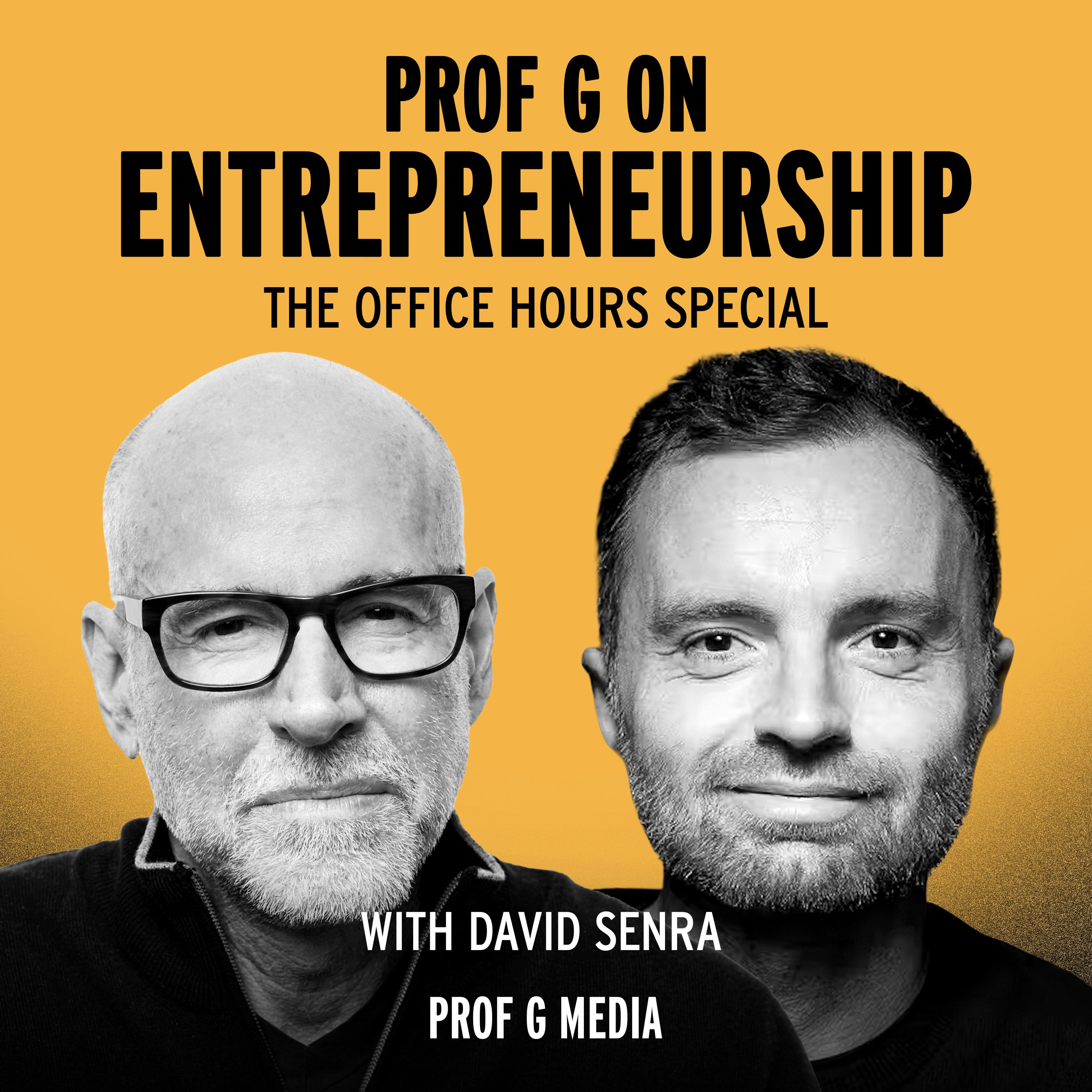
In the first episode of Prof G on Entrepreneurship, a three-part Office Hours special, Founders podcast host David Senra joins Scott to answer listener questions on what motivates the best entrepreneurs, whether founders can build something big and still have a life, how to compete with incumbents, and when to sell a company.
Want to be featured in a future episode? Send a voice recording to [email protected], or drop your question in the r/ScottGalloway subreddit.
Plus, you can now call or text Scott a question at our new Office Hours hotline: (201) 472-3656.
Learn more about your ad choices. Visit podcastchoices.com/adchoices