 The Prof G Pod with Scott Galloway
16 Nov 2026 · 27m

 Add vo to ChatGPT or Claude to ask about everything you hear
vo listened to this episode to put together the overview and transcript, so there may be the odd mistake.
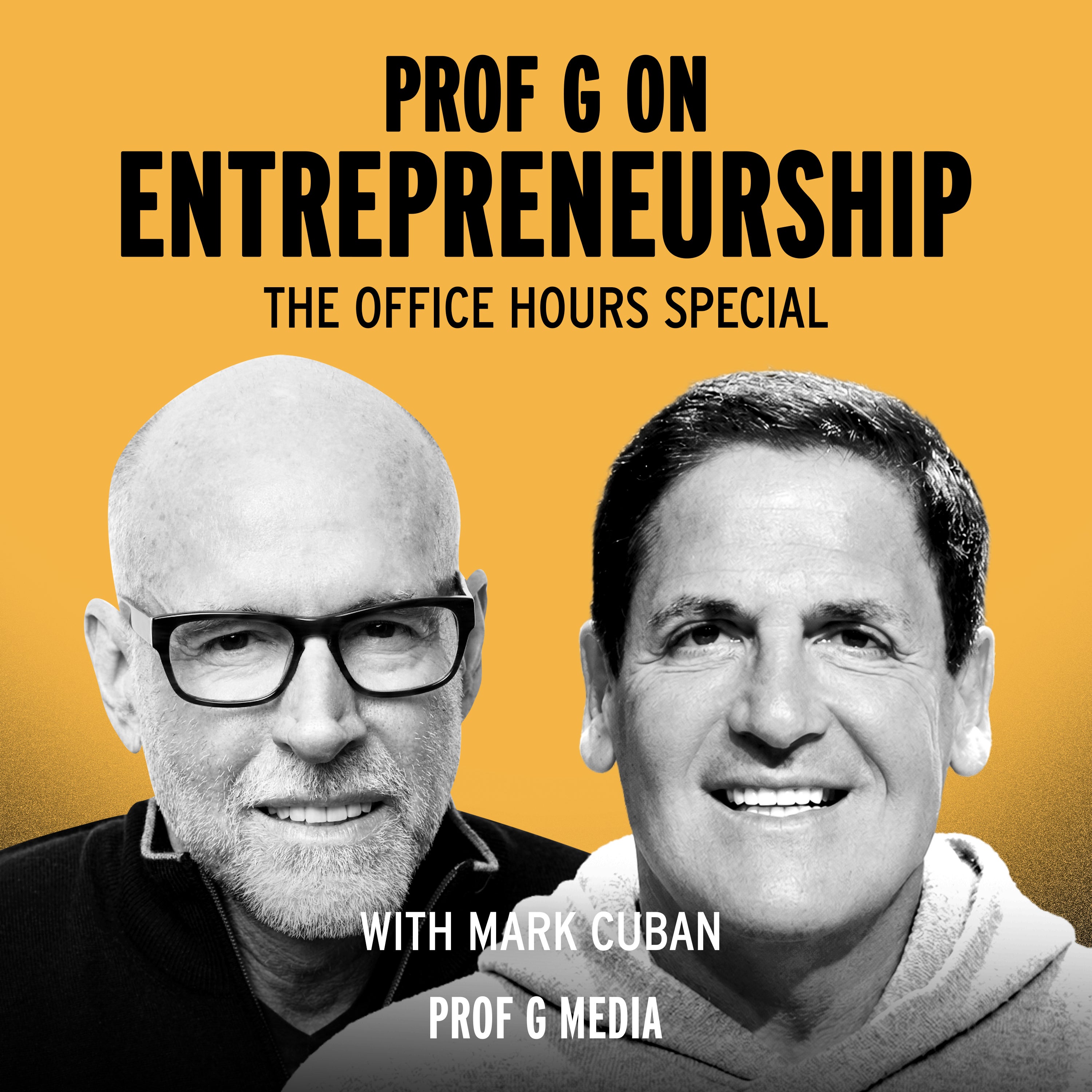
Mark Cuban discusses entrepreneurship anxiety, common startup mistakes (especially sales and spending after raising capital), when to close a business, balancing growth with financial discipline, and how healthcare policy and transparency affect entrepreneurship.
Mark Cuban (co-founder of Cost Plus Drugs; built multiple businesses; Shark Tank investor; based in Dallas, Texas).
entrepreneurs are “always scared” and anxiety is healthy; the most common founder mistake is not being the number-one salesperson; raising money creates an obligation and can cause founders to burn cash on office space/hiring; profit-focused, “profitable growth” beats growth-at-all-costs; healthcare entrepreneurship is blocked by high/opaque costs—use AI to check hospital financial assistance; transparency could lower prices; close when mental/financial strain hits a breaking point.
AI prompts to check nonprofit hospital financial assistance (under 600% FPL); Cost Plus Drugs cost-plus 15% model; “kitchen cabinet” board of directors; Red Envelope (failed after going public); e-commerce incubator backed by Goldman/JP Morgan (closed in six months); Broadcast.com and the Mavs referenced.
0:00Support for the show comes from Xero. Successfully running a small business means staying on top of every cost all day long. But to do that, you need something more powerful than a spreadsheet. Xero is small business accounting software that makes managing business finances easier from day one. Accounting, payments, payroll, and analytics are available in one connected platform. Reports, visual dashboards, forecasts, and AI insights help owners better understand cash flow and make smarter decisions. Join the 4.9 million small business owners who rely on Xero. Try Xero free for one month. Terms apply.
0:36Learn more at Xero.com. That's X-E-R-O dot com.
0:51Welcome to Prop G on Entrepreneurship, a special three-part series about starting a business, building wealth, and what it takes to succeed on your own. Today, we're joined by the inimitable Mark Cuban. Mark's the co-founder of Cost Plus Drugs. Mark's built several businesses and backed hundreds of entrepreneurs on Shark Tank. Together, we'll answer your questions about managing the anxiety of running a business, the mistakes founders make, how healthcare keeps people from taking the leap, and when to keep investing or call it quits. Mark, where are you? I'm in Dallas, Texas. Good for you, brother.
1:24All right. Question number one comes from Don, who emailed us. Don asks, I'm about to turn 40, married with two young kids, and have been running my business for four years. I relate to what you've said about becoming much more motivated to make money once you have children. The downside is that it can make the stakes feel very high, particularly running a business and a challenging economic client. I have plenty of evidence that things are going well and still find myself looking for reassurance that the next job is coming and everything is going to be okay. I sometimes feel as though I might be missing a piece of the entrepreneurial puzzle, optimism.
1:55Did you experience this? And was there a point in your career when you started to feel more steady and trust that you'd be able to handle whatever came next? Thanks for everything you guys put out. Mark, you want to start here? Sure. I've been in that situation multiple times, and there never comes a point where you're not scared, if not terrified, that something's going to change and you don't act appropriately. You know, there's always been new technologies, but now, particularly with AI, it's changing so rapidly, it gives people, you know, different opportunities to compete with you. So it is, I mean, your feelings are valid and it's something that won't go away until maybe if you sell the business.
2:39But it's certainly something every entrepreneur experiences. Yeah, I'm still anxious. I still, I see threats everywhere. And I mean, I would say it's not my optimism that's built businesses. It's my fear almost. I just worried about everything all over everyone. Did this happen? Did this get done? What if this happens? And something that did help that's more about a relationship, I've always had a partner who made money. And so I felt like kind of at a minimum, we weren't going to be out on the street, if you will. But even now that I have some economic security and I don't have the same level of economic security as Mark, I still feel anxious.
3:19I still feel financial insecurity. I still feel vulnerable. And so, you know, my brother, the upside of entrepreneurship is huge. The downside is that you just are always anxious and always paranoid. It's probably healthy. But I would also argue working for a company is a different type of anxiety and paranoia. Other people you don't even meet are making decisions for you that you have no control over. And sometimes you don't feel appreciated. It's a different type of anxiety. Any closing thoughts here, Mark? No, I mean, you nailed it, Scott. It's always going to be that way. But I think it's healthy.
3:54It means you're thinking about the business. It means your eyes are open to what could change. Because you never want to be in a position where you become complacent and think everything's going to just continue the way it is and it's always up and to the right because that's when something happens that can take it all the way. Yeah, or in sum, Don, you're exactly where you're supposed to be. All right, question number two comes from Michael who texted us. What's the most common mistake you saw founders make on Shark Tank? That's an interesting one, Mark. Yeah, I think probably the most common is not being the number one salesperson.
4:29By definition, the companies coming on were relatively small. You know, we didn't have many$10 million in sales companies or large, you know, consumer products companies. And so there are often times when they would come in thinking that a shark was going to be a silver bullet or asking questions about hiring somebody in sales that can help them increase your sales. When you're getting started, it's your baby. And you understand better than anybody what it's going to take to make this company successful. But if it's your product or service and you aren't so excited about it that you want to be telling everybody and selling it to everybody and, you know, helping people with that product or service, you're not going to be successful.
5:10I would tell entrepreneurs all the time, sales cures all. And it's your responsibility. If you don't take that responsibility, you're going to fail. And we saw that a shocking number of times on Shark Tank. Yeah, I very much agree. I feel like entrepreneur is synonym for salesperson. You're either selling employees, selling capital. And if you can't sell, you need to partner with someone who can sell. You're just selling clients. I just feel like even now, I'm just selling all the time. I'm curious if you agree with this. One of the biggest mistakes I've made as an entrepreneur, and I consistently make the mistake, is believing that just because I've raised money or have money, that I need to spend it.
5:50I just, every goddamn time I raise venture capital, I end up getting too much office space or hiring people too quickly and they're not very good. I just, and the vibe when you raise outside capital is put it to work, scale, grow fast. And I haven't had the ability to put capital together, to allocate capital quickly without it just being low ROI capital. I'm just spending money when I didn't need to. Thoughts, Mark? Yeah, for sure. Because the person who gave you the money or the company that gave you the money has an expectation. You don't walk into a VC or PE meeting thinking or saying that, you know, our growth rate is going to be 10 % a year and we're happy with that.
6:30Somebody has an expectation that you're going to be, you know, a meteorite in terms of sales and at some point profits. And entrepreneurs often feel like, okay, I got to spend it. And that in turn, the downside of just spending it is now all of a sudden, because your money disappearing, you're burning so fast, you have to spend more time thinking about your next raise as opposed to just operating a successful business. So, you know, I always tell people that raising money is not an accomplishment, it's an obligation. And with that, we'll take a quick break. We'll be right back.
7:08This is Advertiser Content from Xero. When I was starting a business, I thought that to be a business, you had to spend money like a business. I would lease these big office spaces thinking somehow that that made the business real. It didn't. You don't need it. You want to throw around nickels like they're manhole covers. And in order to do that, you need total visibility into your finances. Spreadsheets might work when you have five clients, maybe even 10 clients. But when you start to really grow the way you want to grow, you need something more powerful. So that's why I was interested to try this platform called Xero.
7:45Xero, which is spelled X-E-R-O, by the way, is a financial management platform that gives small business owners clarity and confidence in their numbers. All your accounting, payments, payroll, and analytics are connected in one unified platform. Okay, let's take a look at this together. It's nice to have all of your critical financial info in one kind of easy to used central location. It has your account. The invoice is owed to you. It's good to start off with positive news. The bills to pay, that's the bad news. Other things you can do, you can review expenses and approve purchases. You can also do visualizations on your cash flow so you can see trends and get a sense for the trajectory of the business or the expenses.
8:27It's pretty intuitive. It's how I think about a business. All right, let's give it a whirl. We're going to send Kara Swisher an invoice for staying at my New York place more often than I do. She thinks it's for free. It's not. She likes my chocolate-covered almonds. She thinks she's been stealing my clothes without me noticing. No, that comes with a cost. All right, Kara, here it comes. Send. There, we're in business. So that's my advice. Don't get the expensive office space. Get Xero. I'm serious when I say that Xero's tools can help you transform your business, provide more visibility, and save you from yourself.
9:07Learn more at referrals.xcro.com slash propg. At the time of recording, you can get 90 % off for six months on a zero subscription. Terms and conditions apply.
9:23Welcome back. Question number three comes from Jeff Sherman now on Threads. Too many would-be entrepreneurs stay in a job for the healthcare. how do we cost plus drugs, the healthcare system, to tilt towards entrepreneurial paths? Do you understand that question, Mark? Yeah, I do understand the question because I get it a lot. You know, it's hard to try for anybody, put aside whether or not you're an entrepreneur, to try to optimize the money they're going to spend on healthcare. Because there's so much certainty associated with it on one end, you don't know if something catastrophic is going to happen and how do you protect yourself against that?
10:01And on the other hand, you're, you know, the one debt you have to pay for the rest of your life are the premiums you pay to the insurance company. Even when you hit 65 and you go on Medicare, you're still writing checks till the day you die. And so in terms of a magic bullet for entrepreneurs to walk away from the corporate health care, there really isn't one. You know, if it was push comes to shove and I had to make a determination, one thing that I do tell people to do is use AI because there are certain rules that nonprofit hospitals have to follow. meaning that if somebody comes in looking for care, they have to have a patient financial assistance program in place that they have to make available to anybody who has an income typically under 600 % of the federal poverty level, which for somebody with a family of five would be somebody making over$100 ,000 a year.
10:59So I tell people to go into Quad or ChatGPT or Gemini or whatever, and just say, hey, find me a local hospital, go to their financial assistance page and tell me whether or not I'm eligible and whether or not this type of care is available to me. And if that's the case, you may be able to take the jump into entrepreneurship knowing you have a hospital or an assistance program available to you locally. Yeah, I love what you're doing, Mark. I think U.S. healthcare is the most disruptible business in the world right now. 17 % of GDP, four out of five people aren't satisfied with it. I think employee-centered health insurance in some ways has been part of the problem.
11:38And that is an employer pays about $27 ,000 a year. You as employee recognize about$6 ,000 of that, and it creates opacity and a lack of consumer shopping. You get referred for an MRI. You don't shop around for it because it's like it's not my money. There's no consumer pressure like there is in other sectors to offer it at a reasonable price. In addition, a lot of people feel trapped and their human capital isn't allocated to its best return because they don't want to leave the safety or risk giving up their health care. There was a study showing that once men turned 65, they were much more likely to finally start a business because they were qualified for Medicare.
12:19So yeah, I think what you're doing is not only good for people, I think it's good for the economy. Well, let me add this one little piece to that. 67 % of people who get their health care from an employer get it from a self-insured employer. And that means the employer takes all the economic risks associated with the health care of their employees and their families. What makes that interesting is that literally, if these employers took the time to do one simple thing, that is take the benefits contracts that they're currently looking at signing or have already signed and put it into Claude and Gemini or ChatGPT and just ask one simple prompt.
13:01Where are they ripping me off and what can I do about it? And you will be shocked at the response you'll get because these big vertically integrated healthcare companies, the United, the Cigna's, the CVS's, et cetera, they're not aligned with your interest. They don't care. They're too big to care. And they write these contracts to corporations that it's like they don't even read them. And so if your employer is self-insured and they are willing to go through the process of using AI and reacting to it and changing those contracts, literally those self-insured employers can change health care for the entire country because they have complete control.
13:42They don't have to work with those big conglomerates. They can work with what they call independent third-party administrators to process medical claims and put together a medical network. They can work with transparent pharmacy benefit managers who process the pharmaceutical claims and can work with cost-plus drugs where we sell at cost-plus 15%. If we stop working with these conglomerates, the whole system will change and prices will go down dramatically. And to your point about lack of transparency, opacity, all those contracts that they sign are like Fight Club. Number one rule of Fight Club is you can't talk about Fight Club.
14:20If they were to sign contracts that would allow, that would remove all the gag clauses so that they could share them and publish them, you would see immediately prices drop. And to that end, Scott, we created an open source platform called CostPlusWellness.com where we have the contracts that I've signed for my employees and their family members, and we post them for any company to use. Let me ask you this, Mark. If you were to expand the cost plus gestalt or way of doing business to another sector of health care, what would you want to attack next? Oh, hospitals, for sure. Hospitals. I've literally tried to invest in smaller hospitals, and I told them, look, for us to do this, we have to be transparent for all of our costs.
15:08Because the missing element is that people don't trust the economic side of healthcare. Nobody knows what they're supposed to be charged. Nobody knows what's fair. Nobody knows who's making how much money. And so it's all just a blur to everybody. But I think for any nonprofit hospital, because effectively taxpayers are subsidizing a big portion of their balance sheet, I think any nonprofit hospital should be required to publish their general ledger entries. all of them, to publish all of their purchasing and purchasing receipts and purchasing requisitions. Because once you make that public, and again, it's taxpayer money subsidizing it, you lose that information asymmetry that the big healthcare conglomerates have and that the big hospital systems have.
15:55And now all of a sudden, we can make more informed healthcare decisions, both on the medical and the pharmacy side. And I can't resist this, but while we have you, obviously health care is, I mean, you're a thoughtful guy. You have a lot of influence over public policy. I don't know about that. Well, there's certain industry, my question is, there's certain industries that the government's better at. I believe the government is better at running the Navy than any private sector. I believe that movie theaters and the automobile industry should be run by the private sector. Of course. It feels like health care kind of straddles that line.
16:32Sometimes I think we need single payer and then I worry about a lack of innovation. Have you thought where is the demarcation of private versus public interest as it relates to health care? Sure. It's a process, though, right? I would love universal health care. I mean, if all of a sudden we came up with new ways to do things and it was$10 per person per month and everybody got coverage, everybody, even the most libertarian person would say yes. The problem is we don't have access to all that information. Everything is hidden. Even something like TRICARE, who provides pharmacy benefits for the military.
17:10Elizabeth Warren asked them for the prices that they charged the government for pharmaceuticals sold to the military, to individual active members. They wouldn't give it to her. They refused to provide that information, even in a SCIF. When you don't have available information, it's impossible to know the right direction to take. And I use Canada as an example. Back in the mid-40s, I believe it was, there was one province, I think it was Saskatchewan, and they were able to put together all their claims, put together all the prices for their claims, and come up with a global budget just for that province.
17:48It worked there because they were able to capture all the relevant data. Then it went to another province, and then by 1965, they had universal health care. If we had transparency and all costs on the medical and pharmacy side, we would be able to do the same thing. You could have one single state say, okay, we're taking all of our claims for all of our employees. We're going to extrapolate that based off of these publicly available costs, and we'll know what it'll cost for us to offer that service. We inflate it a little bit because costs go up. And then we go back to our voters and we say, look, here are our options.
18:24It doesn't mean anybody is going to miss anything. It doesn't mean we're not a capitalistic system any longer. It just means the government is leveraging the price transparency that wasn't available to it before and allowing voters to make a decision. I think that's very applicable to what we could do, but we can't do any of it if there's no transparency. Okay, one more quick break. We'll be back in a minute.
19:17business finances easier from day one. It makes accounting, payments, payroll, and analytics available in one connected platform. And with Xero, you can tailor your data for your specific needs. Xero's reports, visual dashboards, forecasts, and AI insights can all help owners better understand cash flow and make smarter decisions. Xero gives you the information you actually need so that you can achieve your goals on your own terms. According to customer surveys in the US, UK and Australia, 91 % of customers agree that Xero is easy to use. Join the 4.9 million small business owners who love using Xero.
19:52Try Xero free for one month. Terms apply. Learn more at Xero.com. That's Xero.com.
20:02Okay, we're back. Question number four comes from MRMZXX on Threads. How do you determine how long to wait for ROI or decide to close? I founded a restaurant for delivery apps. While sales are improving month on month, I've been absorbing OPEX with my salary so far. Mark, thoughts went on when to fold your tent, so to speak? When you can't afford it mentally and financially. Because the financial strain is obvious. I mean, if you run out of money, you run out of money. But as we talked about earlier, the mental strain is even worse because it'll drive you nuts. It'll tear apart a family because if other people are depending on you and you have this dream of this restaurant and these apps, it's going to be very, very difficult for you.
20:48When you reach your breaking point on one side or the other, then it's time to close. Yeah, there's this terrible trope or mythology fomented by everyone from Donald Trump to the media that never give up. That if you just hang in there long enough, eventually you'll succeed. No, sometimes it's darkest before it's pitch black. And this is a very difficult question to answer because sometimes if you do figure it out and hang in there, the winds do pick up again. What I suggest is, one, there's no shame in stopping and moving on to the next thing. Mark, I know you've had business failures. I've had a lot of them.
21:27No one's watching you. No one cares. No. Or I should say that. The people who lent you money knew they were taking a risk. You're going to be fine. Your family's going to be fine. Forgive yourself. What I find is really helpful is to have a kitchen cabinet, and that is immediately have a board of directors. And that is find people who know you, know the business, have a vested interest in your success, maybe a little bit of arm's distance so they can be honest with you, and sit down with them and say, this is where the restaurant is. This is the growth. I'm not making any money here. But you need thoughtful people to ask you questions like, well, what are your options?
22:02Is this because we're in a recession? Is this because you need to change the menu? Is this because your food costs are too high? It is very hard to read the label from inside of the bottle. I don't think you want to start a business. I don't think you want to raise money. I don't think you want to get married. I don't think you want to get divorced. I don't think you want to close a business without talking to several people who just have the benefit of some perspective and distance to coach you. But you face this every day. What I will say is the best businesses I've had have been successful.
22:37That's number one. But number two is businesses I've started that have failed fast. The worst business I've ever had, I started a company called Red Envelope, which is an e-commerce company that went public. I just hung in there. I kept doubling down. And it went out of business 10 years later. That's the worst. That's the worst. I had an e-commerce incubator in New York backed by Goldman and JP Morgan, raised money in 99. It was over within six months. I look at that as almost a success. Six months, interesting. Next. But anyways, in sum, build a kitchen cabinet because there's probably some nuance and some questions we're not able to ask you here.
23:15And the only thing I'll add to that, and you're exactly right, Scott, it doesn't matter how many times you fail. You only have to be right one time. Broadcast.com, baby. Hey, more than broadcast, but I'll take it, right? That was your big one though, right? Yeah, that was the biggest, yeah. Up until the Mavs, when I sold the Mavs, that was bigger. Right, but without broadcast, there was no Mavs. There was no Mavs, 100%. Yeah, yeah, yeah, yeah. I remember reading back. I mean, we're about the same age. I remember reading that and going, wow. All right. Our final question comes from LinkedIn. Hessa asks, I'd love to hear both your takes on balance and growth with financial discipline.
23:51How do founders know when it's time to take a bigger risk versus protect their runway? Thoughts, Mark? Yeah. You know, it really depends on context. When you're in a zero interest rate environment, the likelihood that you can raise more money or borrow money is much higher. So you can chase growth much more easily and with more confidence. If it's difficult to raise money or we're in an inflationary environment, you have to figure out a way to grow profitably. And I think that's what a lot of folks miss these days where just chasing growth, top line, you know, it's exciting as an entrepreneur when you hit 100 ,000 in sales, then you hit a million in sales, then hopefully you hit 5 million in sales and you're really proud, but you've got to be able to make money from that.
24:42You've got to be able to show cash flow. Otherwise, you're always going to be dependent on somebody else. So I try to balance growth and make it profitable growth. And with my investments now, because where we are, all the political uncertainty, financial uncertainty, you know, federal debt uncertainty. I really want my investments to be profitable as soon as possible. And I'll give up something on the growth side, knowing that if you're profitable, even if you're not growing as quickly, you're going to stay in business given all the uncertainty. Yeah, we're cut from the same cloth here. The way I've gotten wealthy is slowly.
25:20And that is The companies that have worked for me, and granted, I've never built a billion-dollar business like Mark has, but the businesses that have been successful for me, kind of 30%, 40 % solid growth, and I throw around nickels like they're manhole covers. I just, why are we spending money on this? Every month, what is this expense? Why do we need it? And just because companies don't go out of business because they're bad ideas. They go out of business because they run out of money. And you really want to be, especially in those early days, you really want to imprint real cost discipline.
25:55And when I look at all the businesses I've started, the only thing I could suss out that distinguished the winners from the losers was when I started the company. And when I started the company in an economic down cycle or a recession, they were almost always successful. People were inexpensive. Real estate was inexpensive. I had to be financially disciplined. When I raised money in 99 or in 07, when there was just a ton of capital, hard to find good people. Real estate was 100 bucks a square foot. You mistake capital expenses for revenues in a business. You can buy revenues. It just none of those businesses work for me.
26:36So I still think it's like goes back to what the original question was. Be paranoid. annoyed, you know, always think about the expense side and revenues and customers make a business, not office space, not employees, not expenses. Any closing thoughts, Mark? Yeah, you don't have to show off. You know, when you have a business, I think I've seen a lot of companies make mistakes. They want fancy office space. They want the night. They want it to look good when somebody walks in. Right. They want it to sound good. They want to have, you know, and one of the things, particularly if you're in a business that sells to companies, you get caught up trying to sell companies that are resume builders, big name companies that are not profitable because it shows people that you're growing.
27:19Maybe it's a good top line and you might break even, maybe even lose money. Don't chase those things. Like Scott said, throw around nickels like they're manholes or man cover, manhole covers, because that is how you have to approach it. Nobody ever failed while they were cashflow positive. You always have that going for you if you just take it nice and slow and focus on cashflow profitability. Perfect. Mark Cuban is a successful entrepreneur, investor, and co-founder of Cost Plus Drugs. He's also a former shark on Shark Tank and wrote the book, How to Win at the Sport of Business. He joins us from Dallas.
27:57Mark, I absolutely love this. Thanks so much for your time. Yeah, thanks for having me, Scott. It's always a blast to work with you and help entrepreneurs. This episode was produced by Jennifer Sanchez, Laura Janir, and Asher Schwartz. Our editor is Brad Williams. Kami Reek is our social producer. Drew Burrows is our technical director. And Catherine Dillon is our executive producer. Thanks for listening to the Prof G pod from Prof G Media.
29:02That's X-E-R-O dot com.
In part two of Prof G on Entrepreneurship, a three-part Office Hours special, Mark Cuban joins Scott to answer listener questions on living with the anxiety of running a business, the most common mistake founders made on Shark Tank, how healthcare keeps would-be entrepreneurs in their jobs, and when to keep investing or close up shop.
Want to be featured in a future episode? Send a voice recording to officehours@profgmedia.com, or drop your question in the r/ScottGalloway subreddit.
Plus, you can now call or text Scott a question at our new Office Hours hotline: (201) 472-3656.
Learn more about your ad choices. Visit podcastchoices.com/adchoices
Scan the code with your iPhone camera
Listen in the app.