Ask ChatGPT



Asymmetrical warfare and America’s fiscal “asymmetry” (debt vs defense). The episode argues weaker actors win by avoiding conventional fights, using drones, guerrilla tactics, and “violence as a service,” while the U.S. faces interceptor shortages and a widening fiscal gap that limits strategic options.
No guest interview is included in the transcript. Mentioned experts: David Dunn (University of Birmingham, international politics professor), historian Timothy Snyder (returned from Ukraine), and national security journalist Spencer Ackerman. Also referenced: historian Sir Neil Ferguson; Admiral Mike Mullen; Palmer Luckey (Anduril co-founder).
Iran’s drone threat forced a UK-based B-1 bomber withdrawal; Ukraine’s drone innovation shifts casualties from 2:1 to 8:1; “Ferguson’s Law” warns debt-service can end great-power status; cutting defense by ~$200B/year via program cuts, force reductions, and procurement reform is feasible.
Written by AI. May contain mistakes.
Exploring the concept of asymmetrical warfare throughout history.
“The opportunity to reduce America's defense budget by 50%.”
Discussing the implications of military withdrawals and asymmetrical tactics in modern conflicts.
“The End Mujahideen against the Soviets, or the North Vietnamese and Viet Cong against the U.S.”
Examining the relationship between national debt and military capability.
“Ukraine's four-year war against Russia is a case study in asymmetrical warfare.”
Proposing potential defense budget cuts and the political challenges involved.
“In a 2025 paper, historian Sir Neil Ferguson proposed Ferguson's Law, named not for himself but Adam Ferguson, an 18th-century Scottish philosopher.”
Analyzing the trends of military casualties and safety in U.S. operations.
“The Pentagon reduced defense spending by 30 % between 1988 and 1997 because we were no longer fighting the Cold War.”
Explore the contrasting approaches to soldier safety in U.S. military strategy.
“Sergeant Fritz Nyland, the real-life Ryan, was sent home from Normandy after the army believed three of his brothers had been killed.”

Get the gist, explore an idea or ask about something said.
 Claude
On The Prof G Pod with Scott Galloway, what are the key points of this episode?
Searching your listeningAutomatic transcript. May contain errors.
0:00Real innovation is powered by real people. This is Amex Corporate. Trusted experts, smarter technology, 24-7 dedicated support from day one to answer questions, help set up policies and approvals, and consult on spend capacity as your business needs evolve. Plus, on-demand resources help level up operations at every stage. That's the trusted service you've come to expect. Built to simplify, designed to scale. This is Amex Corporate.
0:32This episode is brought to you by Google Chrome. You think you know a browser, but Gemini and Chrome? That's new. It can help you with practically anything on the web, like restoring a vintage motorcycle from a 50-page restoration block, or finally break down that long article you've had open for weeks. Gemini and Chrome is here for it. Ready to make anything online make sense? There's no place like Chrome. Check responses set up required, compatibility and availability varies 18+. hey y 'all kelly clarkson here with wayfair i know holiday magic starts at home so i tend to go a little overboard the twinkling lights the trees the cozy blankets but the thing i love even more than decorating is having everyone over and knowing my home is ready with wayfair it's easier than ever to make holiday magic at home oh i think i found room for one more wreath don't wait head Head to Wayfair.com and get your home holiday ready today.
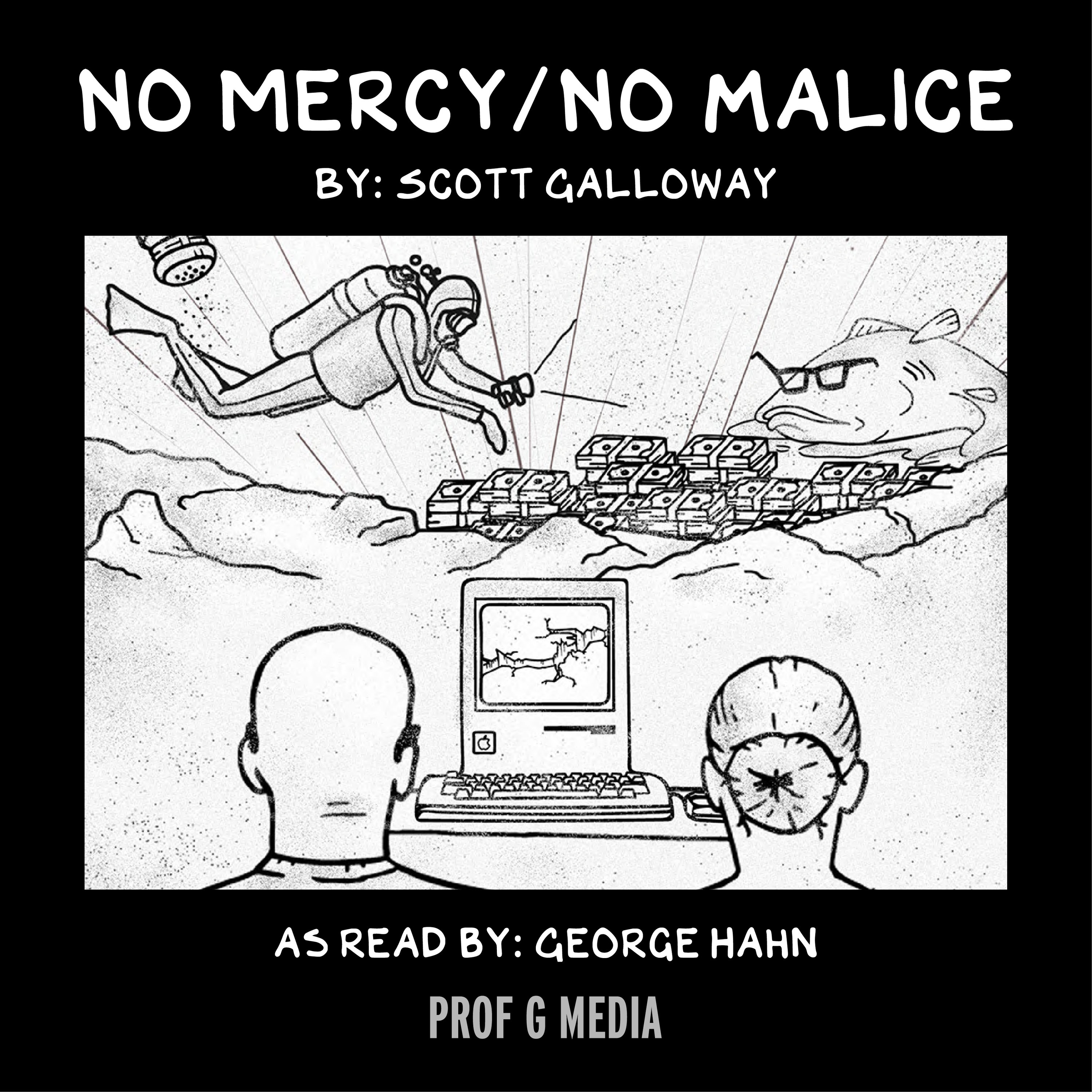
1:29I'm Scott Galloway, and this is No Mercy, No Malice. The silver lining of the wars in Ukraine and Iran. The opportunity to reduce America's defense budget by 50%. Asymmetry, as read by George Hahn.
2:18George Hahn: The End Mujahideen against the Soviets, or the North Vietnamese and Viet Cong against the U.S. Throughout history, weaker forces have defeated stronger ones by eschewing conventional combat in favor of asymmetrical warfare. One famous term for this was coined by the Spanish irregulars who harass Napoleon's occupying army. Guerrilla or little war. Put another way, don't fight on your enemy's terms. This week, the Air Force withdrew a dozen B-1 bombers from a base in the UK after British authorities foiled an Iranian plot that threatened U.S. military operations. According to David Dunn, a professor of international politics at the University of Birmingham, the unprecedented withdrawal reveals the vulnerability of American military installations abroad and represents a setback for the U.S.
3:22George Hahn: in its war with Iran. Fairford is normally the place during a crisis where America sends bombers to beef up America's military capability, Dunn told Time. Rather than relying on bombers or other conventional means, Iran forced the withdrawal with a drone threat. Furthermore, Iranian operators aren't even military, as the Islamic Revolutionary Guard Corps has become adept at deploying violence as a service, an asymmetrical tactic that involves hiring untrained, on-demand combatants who, like gig workers, are cheap and disposable. Meanwhile, closer to the front, the asymmetrical drone war has depleted the high-tech U.S.
4:09George Hahn: interceptor arsenal, catalyzed a$95 billion multi-year munitions replenishment request from the Trump administration, and rendered an American victory a mathematical impossibility. The interceptor math doesn't even touch the strategic heart of the Iran war. Iran's control over the global economic artery that is the Strait of Hormuz, wrote national security journalist Spencer Ackerman. The math merely shows how overwhelmingly far the U.S. is from being able to force the Strait of Hormuz open and keep it that way. Math is a modern warrior's most important skill. But I'm getting ahead of myself. Ukraine's four-year war against Russia is a case study in asymmetrical warfare.
5:04George Hahn: Ukraine is now the world's leading drone innovator, shifting the enemy casualty rate from 2 to 1 at the war's start to 8 to 1 in the first half of this year. Russian casualties are around 30 ,000 per month, exceeding the 27 ,000 recruits it takes in each month. A hard truth for Americans? In war, strength isn't what you can afford to spend, but what you're willing to lose. Last week, I spoke with historian Timothy Snyder, who just returned from Ukraine. On the front lines, Ukraine is winning, he explained, but over its cities, Russia is exploiting an interceptor shortage, our fault, to extract a terrible price on Ukraine's economy and society.
5:52George Hahn: The Ukrainians innovate. The Russians copy, Snyder told me. Everything the Ukrainians do, the Russians are able to do a few months later, but at scale. In business, this is called the second mover advantage. Netscape commercialized the web browser. Microsoft scaled it. Diner's Club introduced the credit card. Visa turned it into a financial empire. MySpace pioneered social networking. Facebook perfected it. And Apple is the ultimate second mouse. Asymmetry gives an army a lead, not a moat. David wins one round with a new slingshot, but in the second, Goliath has a factory in Yelabuga manufacturing thousands of slingshots at a lower unit cost.
6:45George Hahn: In his 1961 farewell address, President Dwight D. Eisenhower famously warned that the influence of America's growing military-industrial complex endangered our liberties and democracy. He also highlighted the connection between debt and national security, although few Americans remember that part of the speech. As we peer into society's future, we, you and I and our government, must avoid the impulse to live only for today, plundering for our own ease and convenience the precious resources of tomorrow, Ike said. We cannot mortgage the material assets of our grandchildren without risking the loss also of their political and spiritual heritage.
7:34Spoiler alert, we didn't listen.
7:39George Hahn: In recent years, interest payments on the debt, the fastest-growing part of the federal budget, have exceeded defense spending. In a 2025 paper, historian Sir Neil Ferguson proposed Ferguson's Law, named not for himself but Adam Ferguson, an 18th-century Scottish philosopher. Ferguson's law states that any great power that spends more on debt service than defense risks ceasing to be a great power. The debt burden draws scarce resources towards itself, reducing the amount available for national security and leaving the power increasingly vulnerable to military challenge, which Neil Ferguson wrote, Sovereign debt crises have been the last chapter of empires from ancient Rome and the French monarchy to the Ottoman and British empires and the Soviet Union.
8:38George Hahn: America is exceptional, but it's not exempt from history. Countries typically are not conquered, they go broke. This isn't news to Congress, or shouldn't be. In 2010, Chairman of the Joint Chiefs of Staff Admiral Mike Mullen called the debt the most significant threat to national security. We tend to think of Social Security and Medicare as political third rails that can turn the mention of reform into an electoral wipeout. Defense cuts are another one, but not because voters are likely to punish elected officials. It's worse. Our leaders are afraid of looking unmanly. The performative stupidity of Defense Secretary Pete Hegseth has conflated math with weakness.
9:29George Hahn: Mullen, who commanded more warriors than Hegseth ever will, did the math. He argued that defense cuts need to be on the table, reminding us that the defense budget going back to the 1930s has gone up and down on a fairly regular basis. In short, we've forgotten how to make the hard trade-offs because, as Mullen put it, we haven't had to do the analysis for far too long. The key national security metric isn't the debt. It's the fiscal gap. How much we need to raise taxes and or cut spending every year as a share of GDP so the debt stops outpacing the economy and interest payments stop eating a growing share of the budget.
10:22George Hahn: The Treasury estimates the fiscal gap is 4.7 percent of GDP. Defense spending in fiscal year 2026 totaled approximately$1 trillion,$838 billion in defense appropriations and an additional$150 billion from the one big beautiful bill. Closing the fiscal gap through spending cuts alone would mean permanently cutting every non-interest dollar the government spends by 21%. Social Security, Medicare, Medicaid, the Pentagon, etc. A responsible president would tell the Pentagon to find$200 billion a year in cuts. The current president asked Congress to boost Pentagon spending by 45 percent to$1.5 trillion, more than the U.S.
11:20George Hahn: spent at the peak of World War II adjusted for inflation. Cutting$200 billion would mean doing three things simultaneously. continuously, killing programs that don't work, shrinking the size of the military, and reducing operational scope. The good news? We've done it before. The Pentagon reduced defense spending by 30 % between 1988 and 1997 because we were no longer fighting the Cold War. In 2024, the Congressional Budget Office mapped out options for cutting roughly$100 billion a year, including shrinking the active duty force by 18 percent, retiring carriers and fighter squadrons, and asking allies to carry a greater share of the security burden.
12:14George Hahn: One budget watchdog's list of cuts to underperforming weapons systems, many of which came in over budget, would trim about$40 billion a year from current spending. Anderil co-founder Palmer Luckey told CNBC in February that disrupting the cost-plus procurement model of defense contractors and adopting a product mindset could bring the total defense budget below$500 billion while maintaining required capabilities if efficiency improves. The issue isn't a scarcity of options, but political will Also, in warfare, the enemy gets a vote As Snyder told me, the relentless cycle of drone and interceptor innovation means The Ukrainians and the Russians are creating the only two modern armed forces in the world Getting our fiscal house in order is the necessity.
13:20George Hahn: Modernizing our military, replacing$80 million fighter jets with$30 ,000 drones, is the opportunity. At least 22 U.S. service members have died in the Iran war. Casualty figures are difficult to verify, partly because the Trump administration is allergic to the truth, and partly because the American public doesn't have the stomach for it. Saving Private Ryan, great movie, fictionalized one man's rescue, but the impulse behind it was real. After the five Sullivan brothers were killed in the Battle of Guadalcanal in 1942, the military began separating siblings and pulling surviving sons out of combat.
14:08George Hahn: Sergeant Fritz Nyland, the real-life Ryan, was sent home from Normandy after the army believed three of his brothers had been killed. Nobody had to storm a French village to get him. A chaplain filed the paperwork. Our ally, the Soviet Union, gave a mother who lost nine sons a medal. Our adversaries have a bias towards sacrificing the lives of their soldiers, whereas the trend for the U.S. military is a bias towards safety. Since 1980, accidents, suicide, and homicide have killed seven times as many active-duty troops as enemy fire. We'll sacrifice 800 ,000 Americans to opioids in the name of shareholder value, But sending a B-2 bomber and its two-person crew on a mission likely to result in their deaths is akin to playing baseball with a Fabergé egg.
15:07George Hahn: Put another way, every president is capable of greenlighting a trillion-dollar weapons system. But no president wants to be LBJ, who presided over casualty counts exceeding 500 killed per week during the height of the Vietnam War. Valuing life is a hallmark of a great society. But because we've combined that with regulatory capture by defense firms, the U.S. has built the most expensive glass jaw in history. The silver lining of these current conflicts? They present America with a historic opportunity to build a more lethal fighting force while cutting defense spending by a trillion dollars. Embracing asymmetrical warfare with political will should result in a superweapon, a robust balance sheet.
16:11George Hahn: Life is so rich.
16:26Hey y 'all, Kelly Clarkson here with Wayfair. I know holiday magic starts at home, so I tend to go a little overboard. The twinkling lights, the trees, the cozy blankets, but the thing I love even more than decorating is having everyone over and knowing my home is ready. With Wayfair, it's easier than ever to make holiday magic at home. Ooh, I think I found room for one more wreath. Don't wait. Head to Wayfair.com and get your home holiday ready today. Wayfair, every style, every home.
17:20Door to terms plans start at$49.99 a month. Visit simplisafe.com slash licenses for alarm license information. Starting a business can seem like a daunting task, unless you have a partner like Shopify. They have the tools you need to start and grow your business. From designing a website, to marketing, to selling and beyond, Shopify can help with everything you need. There's a reason millions of companies like Mattel, Heinz, and Allbirds continue to trust and use them. With Shopify on your side, turn your big business idea into... Sign up for your$1 per month trial at shopify.com slash special offer.
As read by George Hahn.
https://www.profgmedia.com/p/asymmetry
Learn more about your ad choices. Visit podcastchoices.com/adchoices