Ask ChatGPT


 The SaaS Revolution Show
19 Jun 2025 · 39m · 14 chapters
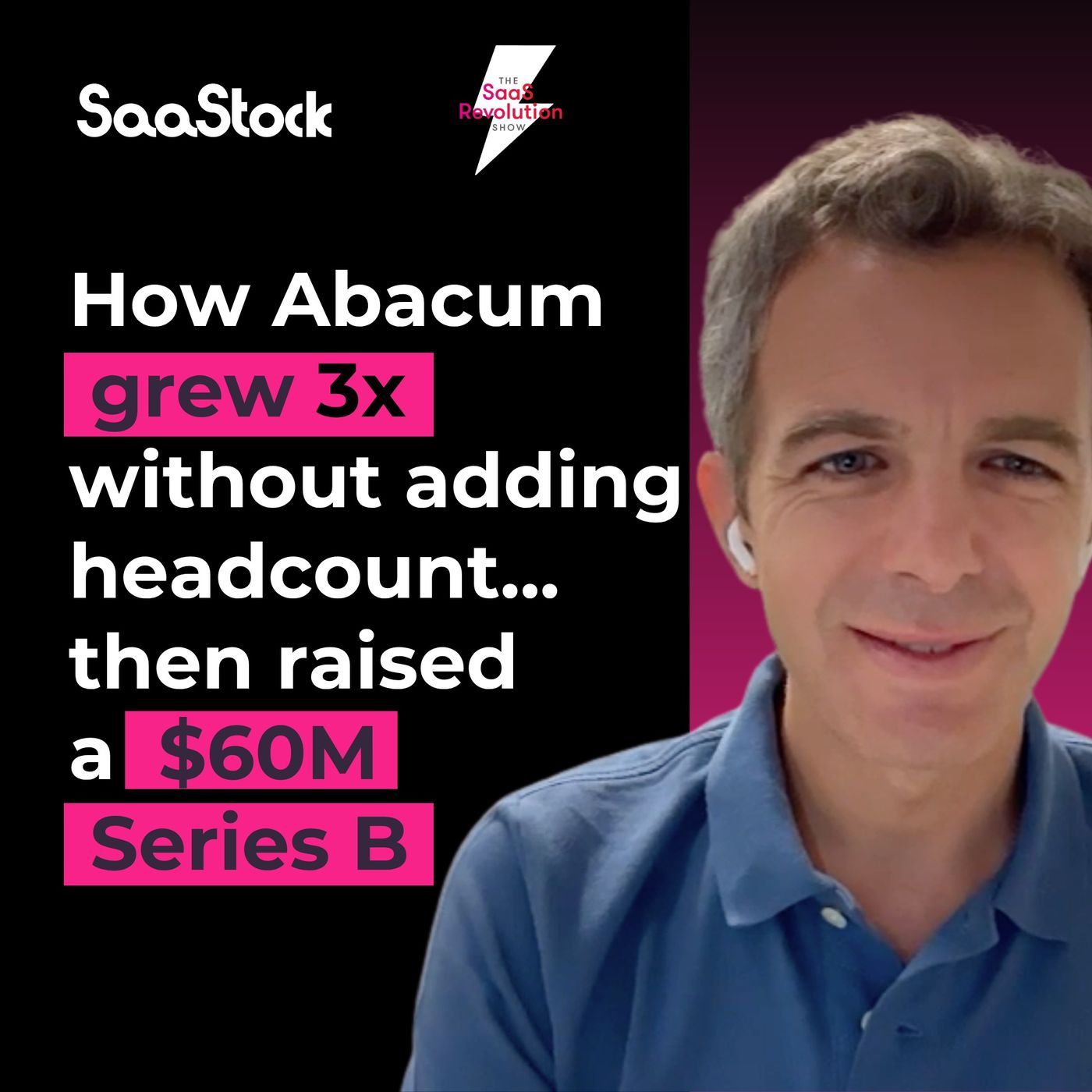
Abacombe (Abacum) founder Jorge Juk explains how the company tripled revenue in 12 months without adding headcount, then raised a $60M Series B led by Scale Venture Partners. He ties the growth to heavy product investment in FP&A for mid-market finance teams, disciplined go-to-market execution, and an “efficient growth” hiring philosophy.
Jorge Juk is co-founder of Abacombe/Abacum; engineered; sports fan; husband and father of three. Previously CFO/CEO in fast-growing companies including Travelperk, Wallapop, and Privalia (sold to Ben Privé). Co-founded with Julio (CEO), who leads go-to-market.
3x revenue while keeping costs/headcount flat; high close/win rates above benchmarks; no CMO/VP sales in 2024—founder-led sales discipline; COVID and low-rate environment helped early funding; Series B supports ROI-based hiring.
FP&A platform built with ETL, corporate performance (actuals vs budgets), BI/reporting, and collaborative planning; 2024 product maturity positioned Abacombe as strongest mid-market FP&A solution; founder “never stop selling” anecdote from his prior SaaStock experience.
Written by AI. May contain mistakes.
Discussing Abacum's recent Series B funding and impressive growth.
“So raised 60 million, I think, led by scale venture partners, correct?”
Jorge shares his background and the inspiration behind starting Abacum.
“I would say it's camp no, but a lot of people call it no camp, so now it's the Spotify camp no.”
Exploring the challenges Jorge faced as a CFO that led to Abacum's creation.
“role as CFO at some of those companies, then I would expect there was a particular pain that you felt and saw and led you to build what is now Abercrombie, right?”
Jorge discusses the funding journey of Abacum and the impact of COVID-19.
“So obviously, like we mentioned on the podcast, the Series B has just been announced.”
Jorge talks about managing work-life balance while running a company.
“So, and I would say that you work 365 days a year, right?”
Jorge describes his daily routine and how he incorporates family time.
“but the younger one was three years old when slightly, well, she was almost three.”
Discover how to juggle personal well-being with the demands of entrepreneurship.
“She helps me tremendously to keep the balance.”
Learn about the strategic decisions made to achieve 3x growth and prepare for funding.
“then have a corporate performance module, be able to display actuals versus budgets, reporting.”
Explore effective sales strategies and go-to-market approaches that led to improved performance.
“I'm sure the product was a big part of that.”
Understand the importance of founders remaining engaged in sales activities.
“What does that look like from that CEO position with the kind of structure of the team, as you say, owning the go-to-market?”
Learn why engaging with clients in person can enhance relationships.
“They felt that we became a bit, you know, more transactional, you know, and that caught, like, impacted.”
Discover the challenges and strategies of expanding from Europe to the US.
“How does it look like on your customer base from a European to US perspective?”
Understand the shift from growth-at-all-costs to a focus on efficiency and ROI.
“But the idea of being nervous from the start.”
Explore what success means for founders and the importance of personal fulfillment.
“And so you are able to deliver the results that you need in order to potentially go out there into the market.”

Get the gist, explore an idea or ask about something said.
 Claude
On The SaaS Revolution Show, what are the key points of this episode?
Searching your listeningAutomatic transcript. May contain errors.
0:23Welcome to the SaaS Revolution Show, a podcast by SaaS.com. Here, we interview SaaS founders from around the world who've been there and done that. They share the ins and outs of how they built their businesses, their operations, their path for securing investment, and more. Our mission with the podcast is to help you, the founder, learn how to scale your SaaS, maintain your well-being, and navigate the complexities of this ever-changing industry. I'm your host, Alex Dima, and together, we'll explore the good, the bad, and the ugly in the journey to SaaS success. All right, welcome to the SaaS Revolution Show.
1:00I am your host, Alex Thuma. Delighted to be joined today by Jorge Juk, who is a co-founder of Abacombe. How are you doing, Jorge? Hi, Alex. Thank you very much. I'm thrilled to be here. Yeah, good to have you on the podcast. Obviously, we're doing this remotely, doing this virtually. I get to do this in person tomorrow, which I'm excited for as I'm flying out to Barcelona, where you're based and you've kindly agreed to speak to the SaaS founder community in Barcelona at the upcoming SaaS.local event there. So a nice little dummy run for us today, a bit of practice for the in-person. Not that we need to practice, but good to do this anyway.
1:46But I always love doing this in person as well um so excited for that apart from uh the 4 30 a.m start to get to the airport but uh i used to be better at those when i was a little bit younger um but lots of coffee so i'm going to be very caffeinated tomorrow bob you have a great flight yeah yeah fingers crossed fingers crossed it should be fine uh great to have you on the podcast for the first time. I think we've been looking to do this for a while, but the timing has been quite right, I think, for this one, because Abacum has just announced its Series B. So raised 60 million, I think, led by scale venture partners, correct?
2:31So congrats on that. And a lot of, I guess, interesting things from that which can lead into the conversation today because I saw within a lot of the announcements there was a lot of publicity last week which was which was great in that Abacan managed to grow 3x over the last 12 months whilst keeping the costs the same and so we'd really love to dig into that and I guess this is all tied together right because probably a few months ago So Abacum was named by Deloitte as the fastest growing tech company in Spain, you know, from their research of, you know, 50 fast growing tech companies. So exciting, exciting times for you guys doing really well.
3:23And, you know, what we want to get out of this is how you're doing well. You know, what are the things that Abacum are doing that, you know, our audience can can learn from? I guess before we jump into that, maybe just a little bit about yourself, like who you are outside of being a co-founder of Abacom as well. That would be great. And maybe just lean into then why you started Abacom and we can fast forward into today and how you're doing these amazing things. Awesome. of course Alex I hope that you know this story might help someone provide insights I've been privileged to work with with amazing entrepreneurs and and I wouldn't be here if it wasn't for that inspiration so always try to you know to put my green soul there briefly on my side if you want husband father of three and i'm a founder and i'm actually engineered by education and and i would add a sports freak uh i love any any type of sport and and so more or less you know that's that's who i think yeah on the sports side is your team barcelona it is it is i still never been to the uh uh the new camp or the camp?
4:53Is it the camp new or the new camp? What would you say? You actually can say it both ways. I would say it's camp no, but a lot of people call it no camp, so now it's the Spotify camp no. How many games have you been to? I'm actually a season pass ticket. My grandpa and my dad had won. I had that privilege, that luck, and so I've been going to watch the game since I was really, really young. And that probably helped on my Barcelona, you know, finesse. And is Laminio Mal the best in the world right now? Is he going to win the Ballon d 'Or? It doesn't depend on me, but he clearly is the best in the world right now.
5:40Yeah, okay. I thought I would hear that from a Barcelona fan, but it also does appear that he's such an amazing generational talent. So I think, and obviously this is not a football podcast, by the way but it's just you know sharing a bit of light into who who is but um uh i can't remember what podcast it was but they were saying that you know like when messi and ronaldo sort of you know come around people are not expecting to see such talents you know again for a very long time and then you know all of a sudden the media mouths here and we're kind of talking about him as being that next generational talent so uh yeah very uh very exciting player to watch and and am i right Obviously, I know you're an entrepreneur because you're the co-founder of Abacom.
6:25Prior to that, were you at Travelperk? I was. I had the privilege, as I said, to work with great founders, entrepreneurs. I was CFO, CEO in really fast-forward companies like Travelperk, Wallapop, Privalia, who was sold to Ben Privé a while ago. and just working with Abby and Lucas Cotown, this type of level, this type of career of entrepreneurs, it did spark that it ignites my desire to at some point be a founder myself. I guess, I mean, you can obviously share then why you built Abacom, but given your role as CFO at some of those companies, then I would expect there was a particular pain that you felt and saw and led you to build what is now Abercrombie, right?
7:23A hundred percent. So as I was saying, I wanted to be an entrepreneur. I actually thought I was going to probably copycat something that was working somewhere else, bring it to Spain or some other market. But I was extremely lucky that during the summer of 2019, my friend Julio from the NBA reached out. He wanted to launch his own company. He had been exploring the market and he had a clear thesis on building software for finance teams. And he was already, you know, looking really deep into the FBA space. That highly resonated with my personal experience. I was extremely frustrated as a CFO on having to do everything financial manually with no proper tool for collaboration.
8:15I'm crossing back in the day, you know, all companies were embracing the SaaS revolution. All teams except finance. I had this feeling that we were stuck in the past and it had to be a better way on how to work on financial planning. And so got extremely excited about partnering with Julio and truly working on building the product I wish I had. I saw the founder market fit was extremely strong. And based on Julio's experience and my experience, that we would actually have a shot on getting this company started and then test ourselves on the execution to see if we deserve, you know, and we were good enough to build a company that has the opportunity because we think the market is huge and that the opportunity is out there.
9:09So there is the opportunity to build a generational company here. And when did this start? So obviously, like we mentioned on the podcast, the Series B has just been announced. When did you start? And I guess, did you straight away raise sort of pre-see, go venture back, decide to be venture backed and go for that? Yes, so in the early days, Julio and I didn't have probably the level of savings that would require to build a product like the one we have. And we also knew that the level of speed and growth that we needed to deliver and required to get external funding. and we were extremely lucky to have the backing of KFAN to founders and slightly later of Crandom going through Y Combinator.
10:04That also helped us accelerate. And lack is always an extremely important factor. So although when we launched back on March 2020, is when COVID hit and we were slightly naive. We didn't think COVID was going to be as crazy as it was. At first, we were a little bit scared about, okay, watch out. We have this weird virus going all over the world. But then the reality is that it was great for tech companies. Some months later, low interest rates, money flowing into the space. That allowed us to do super successful funding rounds. The seed round led by Crandon, the Series A led by Atomical. and so we were able to raise quite a substantial amount of money to fuel and to invest on building the best solution for the mid-market in FP &A and so it's always I always keep in mind that the life plays a role and I think that we were lucky as also someone really smart said you know like needs to find you when you're working so that's what julio and i have been doing since day zero work is extremely hard on the working extremely hard maybe and i don't doubt that and i think every entrepreneur so you know should be working extremely hard uh and you you need to what does that look like on a you know day-to-day sort of like week-to-week basis like are you you know what time do you start work what time do you finish work you know do you have to work on weekends and like how do you manage that is there any work-life balance i guess that when you found a company you need to be you need to realize that this is going to be part of your bit of your life so it's not like something external that you can put aside your mind is going to continuously, you know, thinking about challenges, opportunities, problems.
12:17So, and I would say that you work 365 days a year, right? Maybe you're not in front of the computer, but clearly your mind, you know, alongside my wife, my kids, a vacuum is there. and and so then what you need to do is have the discipline to to find some time to take care of yourself because in order to perform at the maximum you need to try you know to to have time to practice sports to be healthy because if not you're not gonna endure and and although some people say that owning a company is like a marathon not a sprint you're actually sprinting a lot of you know but and so while you're going to be sprinting while doing the marathon you need to find times to to make sure that you are in the best shape possible then i do have to say that kids also force you to to take some time away from from work and my kids are 14 11 and 8 but the younger one was three years old when slightly, well, she was almost three.
13:34And so they were already old enough that if they were talking to me and I was with my phone or with my computer, I was not paying attention. So they would say, hey, dad, come play with us. And now that they're getting older, they are even more vocal. Hey, are you going to work over this weekend? What are you going to do? So then I'm, in this case, Yes, I'm extremely lucky about having Lucia, my wife, for my life. She helps me tremendously to keep the balance. And then what I try to do is organize myself. So on your question, how is my week looks like? How is my day-to-day? I like to run. So I try to wake up at 5.50 every morning.
14:20If I need to work, then I'll work a little bit before the kids wake up. time you have all that breakfast or you know getting ready to school or i'll go outside and i'll run and i try to do that three four days a week and then you know you you try to get yourself and spending time with family and abaco the thing that i'm probably not good at is keeping track with my friends. I do apologize to them that that's probably the ball that I'm not able to jog at currently, the way that I would like, but it's true. It's a matter of priorities. The days only have 24 hours a day, right? And so you try to make the most.
15:07And my focus today is on that. A little bit on myself, on making sure that I'm healthy, as healthy as I can get. With sleeping, probably I need to do much better on that, but try to sleep a little bit, summer's fort and family time and a vacuum time. And then, yes, keep on pushing every day. Yep, look, that's good. It's a good recipe and a good way to think about it. And I think you're right. Being an entrepreneur, it's 365 days a year and it may be Christmas Day, but you may still be thinking you know or certainly will be like i think they're you know constantly sort of moments that if you look like you know in the morning if i look at my morning routine you know i take the dogs out for the morning you know go for a walk but there's you know constantly think whilst i'm doing something for myself and for the dogs you know thinking about work uh sort of in these moments it's very hard to uh to not you know you're very committed to this right so uh but i also like your point about a lot of people say it is a marathon and that is true but within that you've got a sprint like a lot of sprints so um uh it's good to hear so let's fast forward then maybe just to the last 12 months right because uh i guess kind of what you've been doing over the last 12 months from a performance perspective um you know on the business has enabled this series b so can you unpack that a little bit and maybe uh you know on the growth side and then uh we'll talk about some of the things that you've done on the growth side to grow 3x uh what has worked maybe what hasn't uh but then we can also then touch on keeping the cost the same like how do you grow 3x and keep the cost the same 2024 was a pivotal year for us we had been growing quite a lot.
17:05If not, we would have not been named the fastest-run company in Spain, right?
17:13But also the reality is that the company, the product, everything takes time for you to crack. Building an FBA solution is not easy. Probably maybe every founder says that, but I do believe it's one of the most complex and difficult products to be built. then you need to build a product that has ETL components to connect to different data sources, pull the data seamlessly, data transformations, then have a corporate performance module, be able to display actuals versus budgets, reporting. So BI capabilities, then planning. You need to model inside the platform. Build your models for a scenario for forecasting, budgeting.
17:57And then our solution is extremely collaborative. So it needs to be easy to use, even by non-fine-mass people. So all those are like even four products in itself. Why am I saying that? Because it took time. And well, we were able to raise quite some such amount of money, as I said, Alex, earlier on. So we were able to invest a lot in the product. We made that bet as founders that even despite in 2023, market conditions were not good. We kept with a heavy investment on that product side. so when we when we started maybe going through 2023 getting closer to 2024 the product had reached a level of maturity that I know placed us probably as the strongest FP &A solution in the mid-market and and we can we could take hours debating about what that means but not not to go crazy so maybe the audience will have to believe that but it's true we we had been focused on building the product for the mid-market and it reached the level of maturity that it was it showed that it was extremely good.
19:09Why am I? What came out of that? And also learning on our playbooks, on sales and marketing that we blew our expectations in 2024. We grew much faster than expected. Our close one ratios were extremely high and they were above benchmarks and market benchmarks. And one thing that built our equity story. And the focus on efficiency, I think every company out there through 2023-2024 everyone transitioned from growth at all costs to efficient growth. And so Julio and I, what we did is okay, every head can count. So anyone that comes and joins a company needs to bring and provide a positive ROI. Let's not scale ahead of all time.
20:09Through 2020 to 2021, there was a lot of companies, even ourselves, that we, on a different mindset, we grew quite a lot, but then the world changed from day to night, from night to day, right? And so we knew that, that 2024 for us was the year to validate the product we have built, everything that we have learned, and to test our efficiency. So let's see how fast can we grow while keeping costs extremely under control. And so you can imagine how your efficiency metrics and how your KPIs would look if you do 3x in growth but keep the same headcount. and that's the equity story that we went out there to the market explaining to the people like hey guys and this is what we've done this is the problem we have this is the company we've built this is the customer feedback and we as I said earlier we truly believe there's a huge opportunity ahead of us who wants to partner with us to continue pursuing this dream and to go after a massive market and with a problem dad you know it looks quite good maybe if you could explain a little bit just about the go-to-market sort of motion and how you're acquiring customers and did anything change around that in 2024 like was there any adaptations that you needed to make to the market or just refinements to improve the go-to-market motion and then maybe touch on uh you said close win rates massively improved.
21:55I'm sure the product was a big part of that. Anything outside of the product that helped you improve the close win rates as well? My co-founder Julio, he oversaw the go-to-market teams. His focus, we distributed the company and he was fully focused on that go-to-market piece and what his focus on the sell side was discipline. was, and he talks about four pillars, five pillars, like having the best people possible, you know, having the best people, period, enabling them, be on top of, you know, of the team, helping them every day, every day, right? And one thing that we say, we don't work with quarterly objectives.
22:47We work with multi-objectives because why is we going to wait, where you're only going to have four feedback touch points over the year when you can have 12. And then be extremely hands-on on the sales side and helping the team, coaching them, be working really close on the details of every deal. Building on technology, set up the teams for scalability, invest in tooling and in processes to ensure that, you know, you don't need to grow your headcount tremendously to sustain a high growth rate, right? And so I... On one hand, I don't think we are fully sexually smart, and he's brilliant. But what he did was, you know, and the team, what they did is work.
23:46Work hard, do the basics right, show up every day and then with not the like but also leveraging on a really strong product that we had invested quite a substantial amount of money that we had been working to develop extremely close to our customers and so all that combined is what provided the recipe for success So Julio is your co-founder and for those that don't know he's the ceo right um and as you said he owns the go-to-market uh sort of piece um but what does that look like i mean does he have a vp of sales or a cro and is there a cmo and then he's working with them on on the go-to-market or is it how like fully involved is he i know uh you you sort of spoke about uh you know speaking with the hiring the best people, speaking with them every day, working hard, probably doing some sales himself.
24:52What does that look like from that CEO position with the kind of structure of the team, as you say, owning the go-to-market? Well, I think last year, it got pretty popular, the founder mode, right, Alex? So we, as we could say, as a YC company, we embodied that founder mode and mantra. And last year, we didn't have a CMO or a VP of sales. Julio and I were getting really close with the team. Most of the team has been with us for quite a substantial amount of time. And that's also one of our strengths. the synergy and the team that we've put in place that have kept on this fight with us for a long period of time.
25:48And so yes, Julio was overseeing directly the go-to-market function and putting a lot of effort on making that happen. As founders, I don't think there's no founder out there that is not selling. right although i'm not directly involved in in sales and i have my other and i try to keep the focus on what really matters what was the needle sometimes the time i'm here talking to you you know i've been on on the photo market side and also selling if needed and so that is probably one of the areas for any founder right that will stay with you through all your journey the day that we IPO, Alex, I'll tell you if I keep on selling.
26:39But probably it's like that, right? And nevertheless, Julio was keeping that close, working hand-by-hand with the automotive team and delivering such an amazing resort. I mean, just on the IPO fitting, I don't know how long ago, maybe over a year ago, we had Henry Shupp from ZoomInfo on the podcast. and so this is post IPO and he he spends 50 of his time sales meeting customers with every CEO founder it can be different in terms of like how much time they are spending whether it is 50 but I thought it super interesting that you know this public company He valued at$15 billion at the time. And 50 % of his time, he's kind of focused on sales.
27:33And I think just in general, an important reminder that probably the founder should never stop selling. And I've sort of made that mistake in the past. You know, SaaStock is going 10 years. And I was the first salesperson at SaaStock, right, and got us to our first million in revenue. and you know we got to a certain point you know a couple of years ago we built out the sales team and I thought okay well you've got good sales team now I don't need to be involved in sales and could stop doing that traveling around and doing all these dinners that are putting weight on me because I wasn't running like you every morning but but it turned out that you know retrospectively that was a mistake because, you know, key customers, you know, liked it when, you know, we took them out for dinner or, you know, we're meeting with them.
28:25They felt that we became a bit, you know, more transactional, you know, and that caught, like, impacted. So it was something when I look back at it, it's like, oh, I should never have stopped, even though that we've got a great sales team there, you know, should have, should have continued. So hopefully, again, that is a helpful anecdote for uh for the listeners there um maybe just like so you're in barcelona but julio is in new york is that right uh how and when did you make that decision uh you know one of you to remain in spain and julio to go to uh to new york and what does it look like i guess from the customer base as well i would imagine probably bigger opportunity in the in the us than there is in Spain.
29:11How does it look like on your customer base from a European to US perspective? From the start, we knew or we had the ambition to build a global leader. And on software, that means that you need to be in the States. So we didn't move into the US earlier because of COVID. Frontiers or Europeans were able to travel to the States without having to quarantine in November 2021. And that is when we opened the office in New York and we started traveling. I spent one, two weeks a month in New York while we were working on Julio's visa. Because from the early days, our debt, our ambition was to be, as I would say, have a really big presence in the States.
30:05We are a U.S. company. and we understood that that meant that we needed to move to the US. Maybe San Francisco would have been a probably better location, someone said. Also, New York had a better commute to Europe because we had most of our team in Europe back in that day. So also a tiny difference, six hours versus nine. There is more of overlap. It makes things easier. But the idea of being nervous from the start. Then the world through 2022, 2023, it changed. The increase in interest rates caught us all by surprise. And then the mantra, as I was saying, grow to all costs to efficient growth.
30:55That meant that our plans to have almost 100 people office in New York in 2022 were put on hold. but Julio remained Julio moved to the US in June 2022 with his family and he stayed there I travel more to the US but at some point the cost side we say okay Julio you stay in the States I'll take care of Europe we try to multiply ourselves and in terms of market, US is our biggest market than Europe, UK, Nordic, Germany, France. And we also have customers in South America, in Africa, so almost all over the world. EBITDA is an international language. That's the beauty of Abaco, right? We don't suffer from localization.
31:55And we can sell anywhere, I would say. but our current focus is the US and Europe in a sense. Maybe as we look to wrap up, so obviously you've now got 60 million fresh in the bank courtesy of Scale Venture Partners and some others. I guess maybe a few years ago and before the efficiency versus growth at all costs, then you would see the companies that have raised such amounts, go out and hire a whole bunch of people. Typically, that's where a lot of the investment goes into, right from raising capital. But now with this efficiency mindset and raising$60 million, how do you think about or how are you thinking about deploying it?
32:48Well, a matter of ROI, right? It's every hire that you make needs to contribute positively into the company's economics. And so we have clear targets on efficiency. And growing doesn't mean that you're going to forget about those KPIs. And in SaaS, it's true that you need to invest in growth. People notice the ranking period across several functions. And therefore, that is what you need to take into account. How fast can I hire people? how fast can I run them, how fast they will have a positive contribution into the business, and keep on going while you are able to build the processes, the tools, set up the foundations in order to be able to grow as fast as possible, but controlling your destiny as much as possible.
33:52and last years a lot of companies we knew that you could not go out to the market if your numbers were not really strong. Raising on those conditions was really hard and tough and therefore the relevance of cash flow and the amount of cash you have when you might need to have to raise again or when are you turning profitable? That's all the question marks that, you know, startups like companies are asking themselves. And so you are able to deliver the results that you need in order to potentially go out there into the market. And so for us, it's a matter of being extremely disciplined. The money today is not like back in 2021.
34:46You need to invest, to invest, spend it as fast as possible. to grow. Don't worry about any other thing because money will come for free. Not at all. Today it's a matter of when busy is looking into your numbers, they expect to see growth but efficiency. And you need to combine both. And that's a day every day you wake up and you make sure that you are keeping that discipline that consistency and across any function and i i guess finally um you know personal goal for you uh and julio um i know you mentioned you want to grow from the outset a very big company um what does success look like for uh for both of you you know is it an ipo is it something else well i i'll do it for myself julio would would have to answer for we have to leave this answer in my case what success looks I try to be so we embarked in this adventure because we thought the opportunity was massive we were building a product in a big market and therefore there was the opportunity to build a really big company then as a founder and I know that every day I'm being assessed.
36:22Maybe I'm a good founder for a zero, 20, 50 people, 100 people company. I have not yet challenged myself as a leader of 1 ,000, 2 ,000, 3 ,000 people company. I don't know if I'm going to get to those levels, but what I say is that this type of companies grow at a really fast speed and therefore you need to ask yourself, you know am i am i am i able to to follow uh to you know to to keep to keep up with the speed and the pace the company has i work hard for that right i am passionate about about what we're doing the product we're building and so try and train my best to to help out long run i do not know if i'll imagine a vacuum is able to IPO.
37:10Would I be already the right leader for that type of company? Who knows? We'll see. So for me, success is not a matter of I need to bring this company to IPO. For me, success is I'll do my best. I don't want to look back and say I didn't put 100 % on this. Into my family, into my kids. I did my best and I got to do maximum in that case nothing to regret even if it's a vacuum it's a failure it's I've done everything I could I try to do it the best I could in my way and and and so if the answer is yes to those to those questions I'll be extremely happy whatever the outcome it is it's a great mindset and perhaps a good reminder for everybody that ultimately if we do our best, we couldn't ask for much more, that whatever happens, then there's no regrets that you've enjoyed that journey.
38:23And that's an important part. But well, boy, thank you so much for coming on the podcast. Excited to do this in person tomorrow to the Barcelona SaaS founder community. So I'll see you tomorrow evening. And yeah, thank you for being on the SaaS Revolution Show. Great to have you on. Congrats on the success so far. Thank you very much, Alex. Looking forward to that. Thanks for tuning in to this week's episode of the SaaS Revolution Show. I hope you enjoyed it. And if you learned something from it, check out sasdoc.com forward slash events to find all the upcoming SaaS Doc conferences around the world.
39:04Want exclusive SaaS content and actionable insights to grow your SaaS? Join our community of over 36 ,000 SaaS founders at sassock.com.
After a huge year of growth, Abacum just raised a $60M Series B.
In this episode, Co-founder and COO Jorge Lluch joins Alex to discuss how they did it, including: tripling revenue without growing headcount, staying laser-focused on efficiency, and delivering a great product.
They discuss:
- Abacum’s early stages, including the decision to take time and invest heavily in the product early on.
- How Jorge’s frustrations as a CFO helped shape the Abacum platform.
- How they stayed disciplined to balance fast growth and efficiency.
- The pillars behind Abacum’s GTM motion.
- Growing a global company and expanding from Europe into the US.
- Life as a co-founder and the true meaning of success.
Guest links:
LinkedIn: https://www.linkedin.com/in/jorgelluch/
Website: https://www.abacum.ai/
Check out the other ways SaaStock is helping SaaS founders move their
business forward:
🇮🇪 SaaStock Europe | Dublin, Ireland
Book tickets: https://saastock-europe.com/
🇺🇸 SaaStock USA | Austin, Texas
Book tickets: https://saastock-usa.com/
🤝 SaaStock Founder Membership: A private members group of B2B SaaS
founders between $100K - $10M ARR who are committed to growth and
helping others (https://www.saastock.com/founder-membership/)
🌎 SaaStock Local: Monthly meet-ups in cities all around the world,
bringing together SaaS enthusiasts and experts to discuss the most
pressing topics in SaaS (https://local.saastock.com/home)