
 Ask ChatGPT


 The Standard
6 Mar 2026 · 24m · 10 chapters
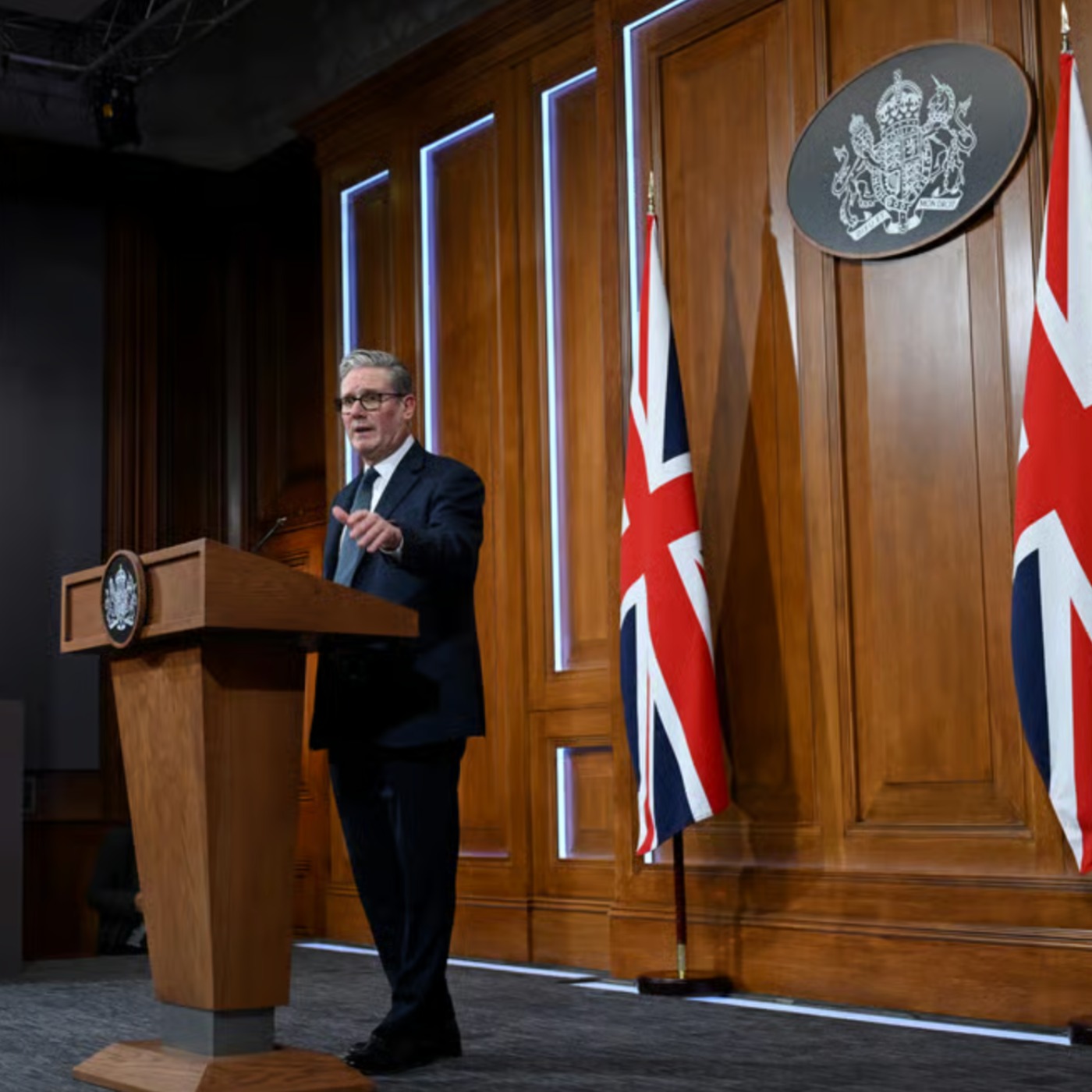
In this episode, host Tamara Komornik interviews Marko Milanovic, an international law expert and Professor of Public International Law at the University of Reading. The discussion centers around the legality of the US-Israeli strikes in Iran, the implications of Keir Starmer's decision to not join the offensive, and the broader questions about international law and moral justifications in warfare.
Written by AI. May contain mistakes.
Discussion on the recent conflict involving Iran and the legality of military actions.
“For all the latest news, head to standard.co.uk.”
Marko Milanovic discusses legality of UK involvement in the Iran conflict.
“Without further ado, here's my conversation with Marco.”
Marko explains the law surrounding the use of force and the UN Charter.
“and what the outcomes could possibly be, and let alone what the unintended consequences could be, right?”
Discussion on self-defense in relation to Iran's military actions.
“It is as illegal as any kind of use of force of that kind can possibly be.”
Exploration of Iran's military response and implications for international law.
“On that whole question of the law of the UN Charter, that's where this war, the Israeli-American attack on Iran is clearly illegal.”
Marko discusses the UK's potential actions in response to Iranian aggression.
“So that's why the Israeli-American intervention against Iran is unlawful.”
Discussing Iran's nuclear program and its implications under international law.
“So here, the basic point is simply this.”
Exploring moral justifications for overriding international law in extreme cases.
“So, for example, under the JCPOA, Iran was supposed to have, I can't now remember the exact numbers, but about 450 kilograms of enriched uranium at a very low level of enrichment, above 3%.”
Analyzing the repercussions faced by states like Iran and Russia for violating international law.
“But at the same time, if Iran was behaving, then why is the enrichment at 60 %?”
Discussing the perception of the U.S. as a global enforcer of law and its implications.
“You know, is there a punishment for the US and Israel and actually Iran for flouting international law?”

Get the gist, explore an idea or ask about something said.
 Claude
On The Standard, what are the key points of this episode?
Searching your listeningAutomatic transcript. May contain errors.
0:00Marko Milanovic: Youth mental health is a complex challenge that requires comprehensive solutions. We must strengthen after-school programs. We must make digital literacy tools available in our schools. We must work with mental health professionals to support children. And we must empower mentors, educators, and parents to keep kids happy. Learn more about our commitment to finding lasting solutions at empowerourfuturecoalition.com slash solutions. Paid for by the Coalition to Empower Our Future.
0:30Tamara Kormornick: Mom, Dad, I'm not throwing shade, but the whole New Year's resolution thing, kind of slipping. No offense. Anyway, my best friend Jenny's dad, crushing it. He uses Blue Apron. He says he ordered one pan assemble and bake meals and these things called meal kits? They're all super easy to bake. He keeps yelling, protein and fiber, baby. Also, the food? We tried it. So good. So maybe you check it out or whatever. Blue Apron. Get$50 off your first two orders plus free shipping with code STIR50. Terms and conditions apply. Visit blueapron.com slash terms for more.
1:10Marko Milanovic: Keir Starmer has spent much of the week defending his decision not to join the US and Israel's offensive in Iran, saying that any UK actions must always have a lawful basis. So did he make the right call to allow American and Israeli forces to use British air bases?
1:31Marko Milanovic: Hi, and welcome back to The Standard Podcast. I'm Tamara Komornik. For all the latest news, head to standard.co.uk. Coming up, is the war in Iran illegal?
1:56Marko Milanovic: Since US and Israeli forces launched their joint offensive in the Middle East, Iran has retaliated by hitting civilian infrastructure in neighbouring countries in the hopes that their leaders will pressure the US and Israel to stop attacking its leadership and military apparatus. And Britain has now suffered a casualty. Its base in Akhateri in Cyprus has suffered damage as a result of an Iranian drone attack. In this episode, I speak to international legal expert Marko Milanovic, who is a professor of public international law at the University of Reading. I wanted to ask him his opinion on the legality of the war, whether he thinks Keir Starmer made the right call, and whether it's ever okay to flout international law for a greater good.
2:46Marko Milanovic: Just to mention, my conversation with Marco took place before Downing Street's emergency COBRA meeting, after which Keir Starmer announced that the UK is strengthening its military presence in the Middle East and Cyprus and is sending additional typhoon fighter jets, wildcat helicopters and a Royal Navy warship to the region. Without further ado, here's my conversation with Marco. Hi Marco, thanks so much for taking time out of your very busy schedule to come on the Standard Podcast. We are delighted to have you with us today.
3:19Tamara Kormornick: My great pleasure.
3:21Marko Milanovic: So Marco, I want to kick off our conversation with Keir Starmer's decision not to join the US and Israeli offensive strikes in Iran. His defense is that any UK actions must always have a lawful basis. So Marco, what do you imagine some of the objections Starmer might have had to fully participating in this war with its allies?
3:49Tamara Kormornick: So first of all, there's the policy or political objections, right? Do you want to involve yourself in a war, which no one informed you about, where you have no idea what the strategic sort of purpose of that whole intervention is and what the outcomes could possibly be, and let alone what the unintended consequences could be, right? So, I mean, this country, as well as the US, have been involved in a number of countries in the Middle East or the wider region. Many of them have not turned out that great, if I can put it that way and very mildly. So that's, I think, the main reason for not to get involved.
4:25Tamara Kormornick: It's like it's a stupid idea.
4:27Marko Milanovic: Yeah, especially Labour's track record with foreign intervention in the Middle East. I think Keir Starmer is just trying to distance himself from that.
4:38Tamara Kormornick: I mean, it's a genuinely smart idea not to get into wars. You don't know how to win or what winning actually entails. And you don't know how much pain you will cause. And what, again, what is the outcome? What is the pros and cons of the whole calculation, right? So would you blindly trust Donald Trump to make that calculation or Benjamin Netanyahu? I think the answer is clearly not. But I mean, this is not my expertise, right? So I'm an international lawyer and I understand that different policy people can have different views on whether, you know, using force against Iran is in some sense a good idea because Iran is a bad actor, which has done many, many horrible things in the region, including to its own people, right?
5:23Tamara Kormornick: Especially the past few months. especially in the past few months. And it is possible for reasonable people to disagree on the question of whether going to war against Iran is a good idea. Where there is no reasonable disagreement possible is on the question of whether the war is legal. And that I can give you a very clear answer on. It is absolutely not legal. It is as illegal as any kind of use of force of that kind can possibly be. And I am sure that the legal advisors of the government including the Attorney General, have provided advice to that effect to the government. And so in their own assessment, the government obviously took this legality issue into account.
6:08Marko Milanovic: So your expertise is in the use of force concerning international law. Could you give us a whistle-stop tour of this area of law and how it applies to the intervention in Iran at the moment?
6:25Tamara Kormornick: Sure. So there's really two separate bodies of law that we need to think about here. And people often confuse these issues, but they're really separate issues. One is the law on the use of force, the law of the UN Charter, which governs whether states are allowed to resort to force in the first place. And the other is the law of armed conflict, also known as the law of war, international humanitarian law, which governs how wars are fought. So the first question is, for example, when Russia invaded Ukraine, did it commit aggression? Did it breach the charter? And the second question is, when Russia bombs particular objectives, for example, energy infrastructure in Ukraine, is that a war crime?
7:06Tamara Kormornick: Does that violate the rules of international humanitarian law that govern targeting of objects or persons, right? So these are separate questions. You can fight an aggressive war, yet nonetheless comply with the rules governing how the war is fought and vice versa. You can fight a defensive war, but commit war crimes in a defensive war. So two separate bodies of law. On that whole question of the law of the UN Charter, that's where this war, the Israeli-American attack on Iran is clearly illegal. Why? Because the UN Charter in Article two prohibits any resort to force between states. And then there are two exceptions to that prohibition.
7:46Tamara Kormornick: One, if the Security Council authorizes the use of force, and the other, if a state is attacked, and then it has to act in self-defense. And the requirements for self-defense here are simply not met.
8:00Marko Milanovic: Well, Britain isn't exactly not getting involved with the war. Starmer has allowed US and Israeli forces to use British military bases. And he's actually said that the basis of the decision is the collective self-defense of longstanding friends and allies. And he's saying that it is in accordance with international law. Is this something that sits right with you? Does that fit into the category of self-defense?
8:29Tamara Kormornick: In principle, it does. So let me just explain this a bit more. So as I said, the American-Israeli attack cannot be justified by self-defense. That's for several reasons. The main one is that at the moment the attack was initiated a couple of days ago, Iran was not engaging in any kind of ongoing armed attack on Israel or the United States. Then there is this whole theory that sometimes self-defense could be done in an anticipatory way to prevent an attack that is imminent. And even on that theory, and even if we understand that theory very, very broadly, as some states like the UK actually do, it is impossible to argue that Iran was about to engage in an imminent armed attack against Israel or the United States, nuclear or otherwise, right?
9:15Tamara Kormornick: There was no evidence, certainly no evidence that was presented that Iran had made a decision to attack these two states, that it had the capability to do so, in particular nuclear capability, and that today was the last window of opportunity in which it was strictly necessary to use force to deflect that kind of imminent attack. So that's why the Israeli-American intervention against Iran is unlawful. However, Iran is also not just a victim here, it is also the aggressor, because of the way it chose to respond. So if Iran had responded simply by firing its missiles at Israel or the United States, that would be self-defense.
9:55Tamara Kormornick: But Iran did something else. Iran decided to use its missile arsenal against basically all of its neighbors in the Middle East, in particular, the countries in the Gulf. And it has targeted purely civilian infrastructure in those countries, for example, ports, airports, you know, that type of stuff. That type of activity, which essentially Iran is doing to inflict pain on its neighbors so that they would pressure America to stop the attack is simply not defensive in nature. It exceeds the scope of permissible self-defense. So Iran is here the attacker. Iran is attacking the United Arab Emirates.
10:33Tamara Kormornick: It is attacking Saudi Arabia. It is attacking Qatar. It is attacking Bahrain. You see what I mean?
10:38Marko Milanovic: And also Cyprus now.
10:40Tamara Kormornick: And also Cyprus. Well, and us, because, I mean, they were essentially targeting the British base in Akrotiri. So what the UK can do and what all of the Gulf countries can do, they can defend themselves against what is an attack by Iran. And they need not defend themselves only individually. They can also engage in what the UN Charter expressly permits in Article 51, so-called collective self-defense. They can call their friends and allies and ask them, Can you please help us to deflect this Iranian attack? So the UK, France, Italy, any state in the world really has every right, if invited by these states, to help them deflect the Iranian fire that is raining on them.
11:25Tamara Kormornick: And that's what the UK can do. So I think every international lawyer generally will agree with this point. Where there is disagreement is on this question of specifically permitting the US, which is the initial aggressor here, remember, to use our basis for a very strict and limited purpose, which is how the government has put it, to deflect these missile attacks by Iran. And the reason why there's this agreement on this is that it's hard to disaggregate this defensive use of force in defense of Gulf countries from what is an overall war of aggression by the US and Israel. In my view, if the UK is able to monitor, you know, flights from a criteria, Diego Garcia, and ensure that they are used solely to defend countries in the Gulf, that is legally permissible.
12:16Marko Milanovic: And Marco, if the UK were to become more involved, for example, sending troops or actually providing military materials, what do you think the circumstances would have to be for this to happen. So if Iran keeps trying to strike British military bases, is that an attack on Britain?
12:42Tamara Kormornick: Yes. So the UK has every right to defend itself. So do the Gulf countries, remember. And defense here doesn't simply mean intercepting the fire that rains on you, because intercepting that fire is very difficult.
12:54Marko Milanovic: Extremely expensive as well.
12:56Tamara Kormornick: They're extremely expensive. So it's perfectly lawful for the UK and other countries, including countries in the Gulf, to target missile launchers in Iran or drone facilities in Iran that are used to target the countries in the Gulf. But only that. So what the UK cannot do is it cannot assist the overall war of aggression that Israel and the United States are conducting. That's what we cannot do, right? And the question is, how do you thread this very thin red line and to keep us ourselves essentially from becoming complicit in what is the Israeli-American attack on Iran? Some countries have basically said we don't want to have anything to do with it, like Spain.
13:36Tamara Kormornick: We have decided that our interests are too much involved for various reasons, that we do want to help the Gulf countries defend themselves. But what we must avoid is being complicit in the Israeli-American attack.
13:51Marko Milanovic: We'll take a quick break. Coming up, I asked Marco about Iran's bad behaviour with regards to its nuclear programme and whether he thinks flouting international law can be justified.
14:09Marko Milanovic: Tired of your car insurance rate going up even with a clean driving record? You're not alone. That's why there's Jerry, your proactive insurance assistant. Jerry compares rates side-by-side from over 50 top insurers and helps you switch with ease. Jerry even tracks market rates and alerts you when it's best to shop. No spam calls, no hidden fees. Drivers who save with Jerry could save over$1 ,300 a year. Switch with confidence. Download the Jerry app or visit jerry.ai slash ACAST today. Most all-in-one HR systems are a patchwork of disconnected and manual tools. Rippling is totally automated. If you promote an employee, Rippling can automatically handle necessary updates, from payroll taxes and provisioning new app permissions to assigning required manager training.
14:56Marko Milanovic: That's why Rippling is the number one rated human capital management suite on G2, TrustRadius, and Gartner. If you're ready to run the backbone of your business on one unified platform, head to rippling.com slash AcastBiz and sign up today. That's R-I-P-P-L-I-N-G
15:22Marko Milanovic: Welcome back. Let's get back to my chat with Marco. let's just turn back to the us and israel's basis for the war which is to target military infrastructure and the leadership of iran for i think they would say anticipatory defensive purposes uh regarding nuclear activity uh marco could we chat a bit about the agreement that iran is bound under or in negotiations under to not produce enough enriched uranium to actually make nuclear weapons. Right.
16:06Tamara Kormornick: So here, the basic point is simply this. The fact that the Israelis and the Americans are violating international law and attacking Iran does not somehow mean that Iran is a lovely, wonderful state that complies with international law. It's not, right? It is actually routinely violating international law. And one thing it has routinely violated are its obligations with regard to nuclear non-proliferation. So in particular, for many years, Iran has had a nuclear enrichment program where it enriches uranium. It is a party to a treaty, which is called the Non-Proliferation Treaty, which prohibits states from acquiring new nuclear weapons.
16:48Tamara Kormornick: Like if they sign up to that treaty, they're not allowed to have nuclear weapons due to acquire that capability. It does permit them though to have a nuclear program for purely civilian energy purposes. So that's the treaty that Iran freely signed up to. Then there is action by the UN Security Council which in a series of resolutions essentially restricted Iran's ability to produce enriched uranium because the Security Council, and this was, by the way, a unanimous Security Council, including Russia and China, thought that Iran was essentially pursuing a nuclear weapons program. Then there was this JCPOA deal, which was blessed by the Security Council, which Trump then withdrew from in his first administration, and which Iran basically chose to violate as well.
17:38Tamara Kormornick: So that's sort of where we are. Iran does not have the right to enrich uranium for any kind of purpose that is potentially military in nature, because Iran is bound both by the Non-Proliferation Treaty and by the Security Council decisions on this matter. Iran has clearly exceeded those limits. Yeah. So, for example, under the JCPOA, Iran was supposed to have, I can't now remember the exact numbers, but about 450 kilograms of enriched uranium at a very low level of enrichment, above 3%. That is necessary if you want to build a power plant. But Iran has enriched uranium to the level of 60%, and there is no civilian use for that type of enriched uranium.
18:25Tamara Kormornick: The reason why they did it is because even though they haven't decided we're going to build a nuclear bomb now, what they want to have is a capability to do so at fairly short notice. You see what I mean? So they've essentially laid down the foundations for a potential rush to the bomb. And I understand, by the way, why both Israelis in particular and the United States would regard that as a threat. Everybody should regard it as a threat. That doesn't mean, though, you get to bomb them without Security Council approval. That's the core point. Mm.
18:59Marko Milanovic: That's actually what I want to touch on now. Marka, if I could get you to flip your lawyer cap back to front. Is there a justification for overriding international law if it's to prevent, you know, a country that's under a recognized terrorist dictatorship from harvesting, you know, the materials to make a nuclear weapon and risk of it? causing harm to the region and to the world?
19:31Tamara Kormornick: Well, that's a really good question. It's not a legal question, obviously, right? What I can say is that there are many, many situations where one can say, you know, it is permissible to break the law on moral grounds, you know, or ethical grounds for a greater good, because the law somehow bounds you too much and leads to injustice or to, unwise, imprudent outcomes. That's perfectly possible. Civil disobedience, for example, is built around this idea that for some kind of higher cause, like, I don't know, protesting climate change, you as a protester would go and glue yourself to the runway at Heathrow.
20:14Tamara Kormornick: Yeah. But then you are breaking the law willingly. The legal system will punish you while taking into account the reasons for why you've done that. You see what I mean? But there's a gazillion examples, you know, we can talk about. And if you live in a country, for example, where the law is an instrument of oppression, like if you live in Iran, you have every right to disobey the law of Iran. Like if you're a woman in Iran, and the state is dictating to you what you can wear or what you can do, you know, morally, obviously, you can say, well, I don't care. You know, the question is what the state will then do to punish you.
20:47Tamara Kormornick: So in principle, one can then say, you couldn't imagine situations where breaking international law for a higher purpose could in some sense be justified. So I'm not denying that. I think this is a far cry from that, though. Yeah. So, you know, this is a case where nuclear, the nuclear threat posed by Iran could have been contained by other means and was contained by other means. So the JCPOA agreement that Obama had negotiated did contain Iran's nuclear ambitions. It did do that. And it was Trump then who decided to withdraw from it. You see what I mean? It was Trump now who decided in the middle of negotiations, which again, were completely nebulous in terms of what their defined goals were, to use war to pummel Iran into obedience.
21:41Tamara Kormornick: And Iran is a very bad state, don't get me wrong, but there are many other bad states out there. And simply choosing to bomb them because they do horrible things or do horrible things to their own people is not the wisest course of action in international relations. And certainly does not, to my mind, seem like a good justification for breaching international law. Like, are we going to attack Russia now, which does have nuclear weapons and is in many ways as bad a state as Iran is. Do you see what I mean? So it poses substantial dilemmas, this kind of idea, you know, it's an axis of evil rogue state and we should therefore go to war against it.
22:19Tamara Kormornick: I mean, I personally don't think this is a close case where breaking the rules of international for some alleged higher purpose is justified.
22:30Marko Milanovic: But at the same time, if Iran was behaving, then why is the enrichment at 60 %? You can understand it from especially Israel as a fairly close neighbor and the US perspective.
22:45Tamara Kormornick: Totally. I mean, you can totally understand it. And by the way, that's what the world has been doing for all of these decades. You know, the whole world, remember, including at the time, China and Russia, imposed incredibly severe sanctions on Iran, precisely because everybody perceived their program as a threat. So my only point is simply that this, accepting that Iran's nuclear program was a threat does not necessarily entail you get to use force unilaterally against them without UN approval. That's the basic point, right? So everybody agrees North Korea is a threat to its neighbors. Doesn't mean you get to bomb North Korea now, which, by the way, we're not going to do or the U.S.
23:26Tamara Kormornick: is not going to do because they have already succeeded in obtaining a nuclear weapon. So the lesson, actually, that many dictatorships will learn from this episode is that if you do succeed at getting a nuclear weapon, you're safe. And it's the best tool of regime preservation there is, basically.
23:42Marko Milanovic: Yeah, you're basically untouchable. Yeah.
23:49Marko Milanovic: I just want to touch on punishment. You know, is there a punishment for the US and Israel and actually Iran for flouting international law?
24:01Tamara Kormornick: So Iran has, as we just discussed, been repeatedly punished for violating international law. Its economy has been reduced to tatters. Is it just sanctions? Sanctions are the best way, I mean, in some cases, of punishing a state for violating international law. When Russia invaded Ukraine, even though it's one of the most powerful states in the world, it got pummeled by incredibly powerful sanctions. It's, you know, hundreds of billions of dollars of its assets have been frozen, for example, in Europe alone. So there are consequences for breaking international law. What we don't have in the international legal system is some kind of cavalry and international police force that can just jump in and arrest wrongdoers.
24:47Tamara Kormornick: Like that does not exist. The closest we have to that is the Security Council, but the Security Council is, you know, the slave of the five permanent members who wield the power of the veto and the Security Council. So that kind of centralized method of enforcement that you're kind of used to having in domestic law just doesn't work in international law. By the way, though, it doesn't work in most domestic legal systems either. So when you think of domestic law and enforcing law generally, you shouldn't think of the UK or Switzerland as your like basic example. In most countries in the world, powerful people get away with breaking the law all the time.
25:29Tamara Kormornick: Yeah. And the legal system is not capable of stopping them. So international law in that sense is not really radically different from how domestic law works in most countries in the world.
25:41Marko Milanovic: Well, it seems that the U.S. is taking its role as the world's policeman very, very seriously right now. Today, it's more like the world's organized crime boss rather than the world's policeman.
25:59Tamara Kormornick: I mean, and Don is a really good name for the current president. So there you go.
26:05Marko Milanovic: Well, Marco, thanks so much for your time. It's been great to speak to you on this.
26:10Tamara Kormornick: My pleasure.
26:19Marko Milanovic: And that's The Standard. For all the latest news, head to... Youth mental health is a complex challenge that requires comprehensive solutions. We must strengthen after-school programs. We must make digital literacy tools available in our schools. We must work with mental health professionals to support children. And we must empower mentors, educators, and parents to keep kids happy. Learn more about our commitment to finding lasting solutions at empowerourfuturecoalition.com slash solutions. Paid for by the Coalition to empower our future. If you work in university maintenance, Grainger considers you an MVP because your playbook ensures your arena is always ready for tip-off and Grainger is your trusted partner.
27:06Marko Milanovic: Offering the products you need all in one place, from HVAC and plumbing supplies to lighting and more and all delivered with plenty of time left on the clock so your team always gets the win. Call 1-800-GRAINGER, visit Grainger.com or just stop by Grainger for the ones who get it done. When it comes to managing money, forget the hype and look at the results. Bill has a trillion dollars of secure payments powering our BillPay tools. Instead of just moving money, Bill is powering the financial operations of nearly half a million customers. So stop the guesswork and start scaling with the proven choice.
27:45Marko Milanovic: Ready to talk with an expert? Visit Bill.com slash proven to get started and grab a$250 gift card as a thank you. Terms and conditions apply. See offer page for details. Standard.co.uk. If you're new here, hit follow and give us a rating. If you'd like to get in touch, email us at podcasts at standard.co.uk. We'll be back here on Monday morning. See you then.
Keir Starmer has spent much of the week defending his decision not to join the US and Israel’s offensive in Iran, saying that “any UK actions must always have a lawful basis'.
In this episode, host Tamara Kormornick speaks to international legal expert Marko Milanovic, Professor of Public International Law at the University of Reading. They discuss the legality of the US-Israeli intervention in Iran, if Starmer made the right call on behalf of Britain, and whether flouting international law can ever be justified on moral grounds.
Hosted on Acast. See acast.com/privacy for more information.


