
 Ask ChatGPT



In this episode of The Standard, hosts discuss the tragic shooting at Bondi Beach, Sydney, where at least 15 people, including a London-born rabbi, were killed during a Hanukkah celebration. The incident has been classified as a terrorist attack and has raised concerns about rising anti-Semitism in both Australia and the UK.
Written by AI. May contain mistakes.

Get the gist, explore an idea or ask about something said.
 Claude
On The Standard, what are the key points of this episode?
Searching your listeningAutomatic transcript. May contain errors.
0:01Hi, I'm Charlie Duffield, and welcome back to The Standard Podcast. If you're new here, hit follow and give us a rating. For all the latest news, head to standard.co.uk. Coming up later in the show, how to support the Jewish community after the horrific anti-Semitic attack in Australia. But first, at least 15 people, including London-born Rabbi Eli Schlanger, have died and dozens more remain in hospital following a shooting at Sydney's Bondi Beach. Armed with long rifles, the attackers, 50-year-old Sajid Akram and his son, 24-year-old Navid Akram, opened fire on people gathered in the Archer Park area of Bondi Beach at 6.47pm on Sunday local time.
0:55The attack has been declared a terrorist incident, targeting a Hanukkah celebration at a park next to the beach on the first day of the Jewish Festival of Lights. In London, the Metropolitan Police said it is boosting its security around Jewish communities following the anti-Semitic terror attack in Australia. Sir Keir Starmer acknowledged that the attack was not an isolated incident and was part of a pattern of incidents focused on Jewish holy days as he addressed MPs. It was an appalling anti-Semitic terror attack that took place. And I'm sure I speak for the whole committee and the whole House, in fact, the whole country, in saying our thoughts are with those affected by this attack.
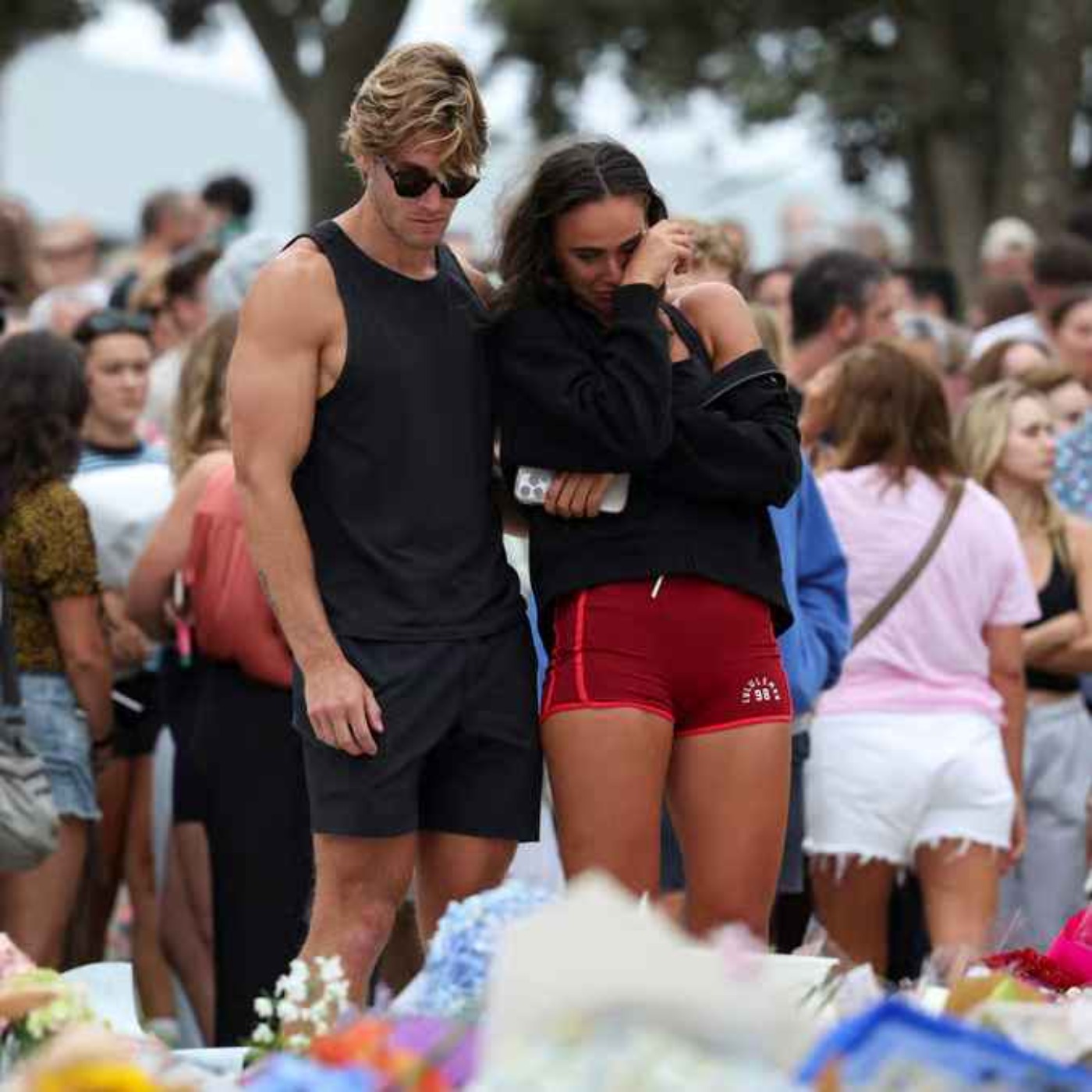
1:40It has impacted not just in Australia, but across the globe. And it has impacted on Jewish communities here in the United Kingdom, which I know feel even more insecure today than they did before. This is clearly not an isolated incident. These incidents are chillingly focused on some of the holiest days in the Jewish calendar. Of course, we have in our minds Heaton Park here in the United Kingdom in October. Meanwhile, vigils have been taking place around the world to remember the victims and mark Hanukkah. Here's what one attendee had to say. It's so important for the Jewish community to know that they have allies.
2:19I think that's really important. So I would say to anybody who's watching this around the country, go this week. there'll be multiple Hanukkah events. Just go along. You don't need to understand what it's all about. Just go and stand with your Jewish friends. And if you have no Jewish friends, go and make some Jewish friends. Just go to Hanukkah and just be there this week because it's so important for this community to feel like they have allies. Until October the 7th happened, I did not realize how significant that was. Every single time I turn up at something, it's embarrassing how much people thank me for ordinary human sympathy and empathy being thanked all the time.
2:57So please, please go. But I think it's also really important, as one of the speakers said earlier, to be visible and to be out and to show that these kinds of things are not going to drive people off the streets, not going to stop people doing the things that they do. It comes as Victims Minister Alex Davies-Jones has said that Britain is being blighted by an abhorrent rise in anti-Semitism. Here she is speaking on Sky News. We all need to get a grip on anti-Semitism. As the victims minister, it is my job to listen to the voices of victims. We are going further, whether that's with legislation, whether that's with financial support for the Jewish community, whether that's with introducing, as I've said, new offences of protesting outside religious places of worship to protect those who are just seeking to celebrate their faith.
3:41There is more that we can all do, and we are going further. The Community Security Trust, a charity which seeks to protect British Jews from terrorism and anti-Semitism, says there were more than 1 ,500 anti-Semitic cases reported in the first six months of this year, or an average of eight a day. Joining us now is Emily Hilton, who grew up around Bondi Beach in Sydney, and is the International Policy Director at Diaspora Alliance, a Jewish-led organisation that works to oppose anti-Semitism and its politicisation. Emily, you grew up in Bondi Beach. Can you describe the place and the community there?
4:21How are you feeling about this horrific attack that has taken place? Bondi is a central part or a central area of Jewish life in Australia, as well as a number of other communities that are around. For the Jewish community, it has a special place, as it is sort of one of the hubs of Jewish life in Sydney and Australia. And my father's friend used to call when he was growing up, He said that Bondi was known as Little Jerusalem because the Jewish community was so large around there. And from my childhood, I remember going to bar mitzvahs at Bondi Pavilion. And yeah, I think this attack is shattering.
4:57You know, the idea that Jewish people risk violence, celebrating our festivals, gathering publicly. I guess in terms of Australia, Australia has always felt like actually a very safe place to be Jewish. And I think that what is so shocking about this attack is how that idea is shattered and the sort of implications and reverberations of this and what's to come. And obviously, a lot of different communities in Australia have felt that fear over time, over the last, particularly in the last 20, 30 years, I think particularly with the Muslim community as well. But this really hits close to home. I think a lot of us are just still in shock about what happened and the sort of horrific details that continue to emerge.
5:35Do you think people are afraid to go out and worship? This is the second time in two months where there's been an attack on a Jewish festival. I think that it would be understandable if people did feel worried about gathering publicly. I actually did still go to a celebration of Hanukkah last night, almost in defiance of this idea that we need to feel afraid. But I do think that it gives people pause as to whether going to those kinds of events are safe in this moment. And understandably so. You know, I think that there is a sense that these attacks do affect Jewish communities around the world when they happen.
6:11And I completely understand if there are people who are feeling concerned or worried and don't want to take the risk. And that's in many ways how we hold on to the importance of our traditions and being in community. I think Judaism is a very communally based religion. And how we hold on to that in these times of deep distress and crisis is a real question for us. And how would you like people to show support or solidarity to the Jewish community? Yeah, I mean, it's an interesting question. I think something that I feel very concerned about is the ways in which our grief and our pain and distress at this time will be politicized by those who want to push certain political agendas.
6:52I think particularly it has been concerning to see how quickly the right and right wing politicians try to make this about the Palestine marches or Palestine solidarity. And that feels really like a cheapening of the horror we have witnessed and the ability for us to grieve. before we have to start challenging this weaponization of our experiences. And I think that actually, at this time, when so many different communities are and feel under attack, you know, the Jewish people are sadly not the only ones who have experienced violence and threats, and the sense that public space is no longer safe or for them.
7:29That is something that numerous different communities, whether that be Muslim communities, Palestinian communities, trans communities, migrants and asylum seekers, this is a part of a broader pattern of hostility and violence towards minoritized and marginalized people. And so I think what we really need in solidarity is not only to be there for each other, but also to have those who are in power to really recognize the interconnectedness of this violence and what it says about the state of our world and what they're going to do to push for long term and systemic changes to that. It's been said that this attack felt inevitable.
8:06How do you respond to that? I think we have to be very careful about implying things are inevitable or that this is sort of just inherently like a steep incline of violence. We still don't know all the details about what happened with this attack. And it's important not to speculate, in part to not fuel fear and hysteria, in part because we don't want to spread misinformation. I don't think we should right now talk about inevitability. But I do think what we can say is that, as I said just now, there is a climate, I think, right now of increased violence and hostility towards minority and marginalized communities, including Jewish communities.
8:42And whilst these might all come or be happening for different reasons, it's all part of a broader, I think, destabilizing within our world, thanks to different factors of political polarization, the rise of the far right, the rise of extremism, extremism, a disconnect between political leaders and the public. Politicians really need to take this seriously and think about how they're going to support and protect different communities in a way that also doesn't pit out these different communities against each other. Let's go to an ad break. Coming up, we'll hear more from Emily about how to address anti-Semitism.
9:18We'll see you back here in just a moment. Welcome back. It's obviously not so long ago that the Manchester attack took place here in the UK as well. Do you think enough is being done to tackle antisemitism? I think that the challenge with what we have right now, the situation we're in right now, is that there is a real need to address antisemitism and address violence and hatred against all different communities. But we're also seeing the ways in which the issue of antisemitism is politicized over the well-being, I think, of Jewish communities and what they need. And that is what is also particularly concerning, I think, particularly in the face of this attack and what happened in Manchester, you know, the fact that the government immediately came out and started to talk about drawing connections between these attacks and the Palestine movement, when we don't know that there is necessarily those connections, and implying that the best way to keep Jewish people safe is to shut down these protests, when actually what they could be doing is looking at practical policy recommendations that keep Jewish communities safe.
10:18It doesn't feel like that's actually a care for us and our needs. It feels like it's about them fulfilling their own political agenda with disregard, actually, for what Jewish communities need right now. So I think that whilst I don't think that enough is being done to protect Jewish communities, and I also don't think enough is being done to protect a lot of different minority communities because we have a government that is more interested in filling culture wars than it is actually protecting marginalized and people in this country. So do you have any examples of the type of action you'd like to see taken?
10:46I think in one sense, it's about building out a better understanding of the interconnectedness of these different attacks on different communities and also focusing on practical things that work. I know some people are recommending increased funding for sort of local community security. But I also think there's things like, for example, increasing the protections for minority rights and minority communities through legislation, making sure that they're clearly distinguishing between Jewish people and their foreign policy or their position on Israel. I think we see that a lot of that conflation happen at the government level.
11:20And that only further suggests that Jewish people are ambassadors or representatives of Israel when Israel is a separate country that we do not have in this country as Jewish people responsibility or influence over. I think we also need to see the government really consider what are the ways in which we build better understanding and political education around not only anti-Semitism, but also Jewish people in Jewish communities, much like how we need to do this around other communities as well that are facing ire. You know, we've seen the ways in which the government has been willing to throw many of us under the bus for the sake of their own political gain.
11:52And that is creating an incredibly hostile environment, frankly, for lots of different minority communities, including Jewish people. The events are obviously still unfolding. But are you worried about the attack being used for political gain? Britain's chief rabbi has called for more hate speech arrests at pro-Gaza protests. I think the chief rabbi's comments actually are a disgrace and only add fuel to the fire in terms of generating alleging connections and suggestions that this attack was because of someone's pro-Palestine politics, which we just, A, don't know yet, but is about tarnishing the entire Palestine movement with the brush of something that may or may not have happened.
12:31It feels completely politically motivated and frankly is grotesque to suggest that this attack is somehow indicative of people taking a stand for Palestinian rights. I feel incredibly disappointed that he continues to be given the platform to make such terrible remarks, and he should be ashamed. So is there anything else you want to add? I think basically right now, what's important is that the worst outcome of this attack, the worst outcome that could happen is that it just leads to more divisive politics, that it forces communities to be pitted against one another at a time when we actually need to be coming together to think about how do we keep each other safe?
13:11How do we challenge the violence that is being rained down upon many of us in different ways? How do we make sure that, you know, there is not a competition of solidarity or a competition of safety? We have to be thinking about shared safety and collective safety, and that we can grieve the horrific anti-Semitic violence that we saw at Bondi and hold fast to our principles that we all need to work together to build the world we want to see, a world that is free from this kind of violence, that is free from the sort of systems that have allowed this to happen. And that's all we can hope for right now.
13:50And that's The Standard. For all the latest news, head to standard.co.uk. If you'd like to get in touch, please do drop us a line at podcasts at standard.co.uk. We'll be back here tomorrow morning. We'll see you then.
At least 15 people including a London-born rabbi have died and dozens more remain in hospital following a shooting at Sydney's Bondi Beach.
The attack was declared a terrorist incident, and targeted a Hanukkah celebration at a park next to the beach on the first day of the Jewish festival of lights.
It comes as Victims Minister Alex Davies-Jones has said that Britain is being blighted by an “abhorrent” rise in anti-Semitism.
We’re joined by Emily Hilton, who grew up around Bondi beach in Sydney and is the international policy director at Diaspora Alliance, a Jewish-led organisation that works to oppose antisemitism and its politicisation.
Hosted on Acast. See acast.com/privacy for more information.


