
 Ask ChatGPT



Written by AI. May contain mistakes.
Jim Fadiman explains what microdosing is and its growing popularity.
“so I now see microdosing chocolate and microdosing marijuana.”
Jim shares his personal experience with psychedelics in Paris and its impact on his life.
“I graduated from college and I went to live in Paris off of my friends and off of odd jobs, writing a bad novel, doing all the things that I felt someone should do who missed the good period in Paris.”
Jim discusses the historical context and research on psychedelics and LSD.
“Well, when I was now working quickly with this little group, I wrote Sandoz, now I'm a first-year graduate student, and I said, is there any research published, and can you suggest or send me any?”
Jim elaborates on the effects of microdosing and its applications in daily life.
“What I was trying to avoid was not saying hallucinogenic, which is an even worse word because it has nothing to do with psychedelics either.”

Get the gist, explore an idea or ask about something said.
 Claude
On The Standard, what are the key points of this episode?
Searching your listeningAutomatic transcript. May contain errors.
0:04Hi, you're listening to The Standard Podcast, and for today's episode we are sharing a preview of our sister podcast, Brave New World. In today's episode, Evgeny Lebedev is joined by psychologist and researcher Jim Fadiman, who's often described as the father of microdosing. The two go for a deep dive on psychedelics, what the evidence says, what's still unclear, and where this all goes next in medicine. To listen to the full episode, just search Brave New World Standard in your podcast app. A microdose is a very small dose of a classic psychedelic. The word is becoming a little more popular, so I now see microdosing chocolate and microdosing marijuana.
0:50There's one called microdosing marriage that I didn't even look up. So the word is out, meaning very small. What we're talking about is a tenth to a twentieth the size of what is called a recreational dose, a concert dose. It can be defined very simply. It has no classic psychedelic effects. Welcome back to Brave New World, the standards podcast where we explore the cutting edge of science, medicine, and the future of humankind. I'm your host, Evgeny Lebedev, and in this series, we're venturing into the realms of neuroscience, longevity, consciousness, and the extraordinary breakthroughs reshaping the human experience.
1:35Today we are stepping into what many now call the psychedelic renaissance, a renewed scientific and cultural interest in substances, one central to ancient traditions, rediscovered in the 1940s, suppressed for decades, and now returning to the heart of modern psychiatry and well-being. And today's guest has been part of this story from the beginning. Jim Fadiman is a psychologist, author, and researcher. He has spent over half a century exploring one of the most controversial, and now increasingly accepted, frontiers in mental health, psychedelics. He worked with Ellis Dean in the 1960s when it was still legal and funded, lived through its prohibition, and at 86 remains a leading figure, often called the father of microdosing.
2:29Jim Fadiman, welcome to Brave New World. I'm very, very, very excited to speak to the godfather of microdosing and particularly because I always get microdosing wrong. So I think our listeners could learn of my mistakes during this conversation with you. But before we talk about your book on microdosing, I'd love to just ask a few questions about yourself, about your journey, how you got here. Particularly, I love the story that I heard you tell on the podcast with Sam Harris about how you got introduced to psychedelics in Paris. Fabulous story. I graduated from college and I went to live in Paris off of my friends and off of odd jobs, writing a bad novel, doing all the things that I felt someone should do who missed the good period in Paris.
3:20And I'd been there about eight months, and my favorite professor, Richard Alpert from Harvard, who became Ram Dass, wrote and said he was coming through Paris and loved to see me. So we ended up on the Bouls-en-Michel at a cafe. I was doing my I live in Paris forever routine. And he said, the greatest thing in the world has happened to me, and I want to share it with you. and I sat back and waited the start of a marvelous story. He was a great storyteller, but instead he reached into his jacket pocket and pilled out a little bottle of pills. Now, I was so straight that I didn't drink coffee. So whatever it was, I wasn't for it.
4:08But I also noticed that Richard, who was wonderful and very neurotic, was in the best shape I'd ever seen him. so I waited until he uncapped it and rolled a pill towards me and took it now this was what would be now we'd call a moderate dose of psilocybin and we're sitting in the cafe and the the street gets a little better lighting a little brighter I'm feeling very good and I'm also aware of the people walking in back of us conversing the way you normally overhear people in a cafe or something. But then I realized that my French wasn't that good, and I'd never been able to really understand those conversations before.
4:55That woke me up. And I said to Richard, this is really too much for me, all this visual and color and now the sound. And he says, too much for me too. And I said, well, you didn't take anything. He said, it's my first night in Paris. So we withdrew to my sixth floor walk-up, and my life started to change. So that was the beginning. That was very much a beginning. And a few years later, this was in Vietnam time, and for Americans, we had a draft. And I didn't think I would be a very good soldier. I thought I would really be a disgrace to my country. I didn't really even want to kill people. I didn't know.
5:40I had all the wrong attitudes. But my draft board basically said, you know, come on in. And by the way, there are alternatives, one of them being graduate school. So I became instantly in love with graduate school and had been accepted the year before. So I went to Stanford. And outside of Stanford in the little town of Menlo Park, there was a little group called the International Foundation for Advanced Study, which was doing research, clinical research with LSD. I think it'd be really interesting to our listeners to hear the journey that these compounds have been since LSD has been synthesized.
6:23and psilocybin and other compounds came into research and mainstream. Well, when I was now working quickly with this little group, I wrote Sandoz, now I'm a first-year graduate student, and I said, is there any research published, and can you suggest or send me any? And I got two very large volumes from Switzerland, which were just abstracts, just that first page of a research paper, and there was the first thousand studies. So this was not exactly an unknown compound. When it was made illegal in the United States a few years later, it was the most researched psychiatric drug in the world. However, in my world, in a graduate student, I started working with these guys, and they were putting out their first research paper, and they said, well, now that you're our psychologist, I'd had like four or five weeks of graduate psychology.
7:25We'd like you to go over the paper and review it. And I went through it, and there was a whole lot of little descriptions of kind of mystical experiences, all of which I edited out and said, no journal is going to take this. So my colleague, Professor Willis Harmon, said, okay, I'll put them in a little appendix. And I said, who got the appendix? He said, well, just friends. So he sent the paper and the appendix to the Journal of Neuropsychology, which accepted it. So on one level, that's what was going on. A personal level, which is, I think, closer to where your listeners have been, this group now said, would you like to have a session with us?
8:08And I thought, well, I had a wonderful time with Richard Alpert, and these are my new friends. We'll get together, and it'll be rather camaraderie. It'll be talking and we'll be sharing and we'll be bonding. So I showed up and I was given LSD, probably 200 micrograms or 300 micrograms. I didn't ask because I didn't really know the difference. And after 45 minutes or so, I'm looking out a very large window onto a beautiful tree. And the tree is glowing and the colors are very bright and the leaves are very alive. my hosts say, would you like to lie down and have an eye shade? And I said, I would love that.
8:50And three hours later, when I sat up, my inner world had been enlarged and my belief system about most things had been shattered. And I have fortunately never recovered. As you are the godfather of microdosing, and your latest book is called Microdosing, to just explain a little bit, define the term, and talk a little bit about the safety as well, which I think is very important. A microdose is a very small dose of a classic psychedelic. The word is becoming a little more popular, so I now see microdosing chocolate and microdosing marijuana. There's one called microdosing marriage that I didn't even look up.
9:34So the word is out, meaning very small. What we're talking about is a tenth to a twentieth the size of what is called a recreational dose, a concert dose. It can be defined very simply. It has no classic psychedelic effects. So I think the term you use is subperception. I started with the word subperceptual and everyone has attacked me for years because they're correct. It's a terrible term. What I was trying to avoid was not saying hallucinogenic, which is an even worse word because it has nothing to do with psychedelics either. We now use the term subthreshold. Subthreshold. Which means it doesn't have any of the effects of psychedelics.
10:14It has effects only in terms of improving the physical and mental functioning of the body. There are no visual distortions. There are no brilliant breakthroughs. Anacondas, which you know from ayahuasca, anacondas do not eat you alive. and you don't realize that you are part of divinity and everything is love. All of that is not part of microdosing. Microdosing simply has the general effect of improving your ability to function. Your visual acuity improves. You're able to be creative for longer periods of time. If you go to the gym, you would notice that you did one or two more sets of reps. and overall your life functions better because your health is better.
11:01And it works for physical and mental conditions where we have a deficit, but it also is used widely now by students who wish to have better grades, who wish to have better focus in class. As one report said, I can now pay attention to even the worst teacher. Just to make it really simple, it is what you'd combine with everyday life. Absolutely. This is basically what people do is they microdose in the morning, they go to work, they attend meetings, they do whatever their tasks are, they do coating or plumbing. in the afternoon they will maybe take a walk that's a little and they enjoy it a little more when they return home they are nicer to their children and enjoy them more and at the end of the day and again not unusual people say oh yeah i forgot i was microdosing but i had a really good day that's it for the preview to hear the full episode search brave new world standard in your podcast app we'll be back here tomorrow morning see you then
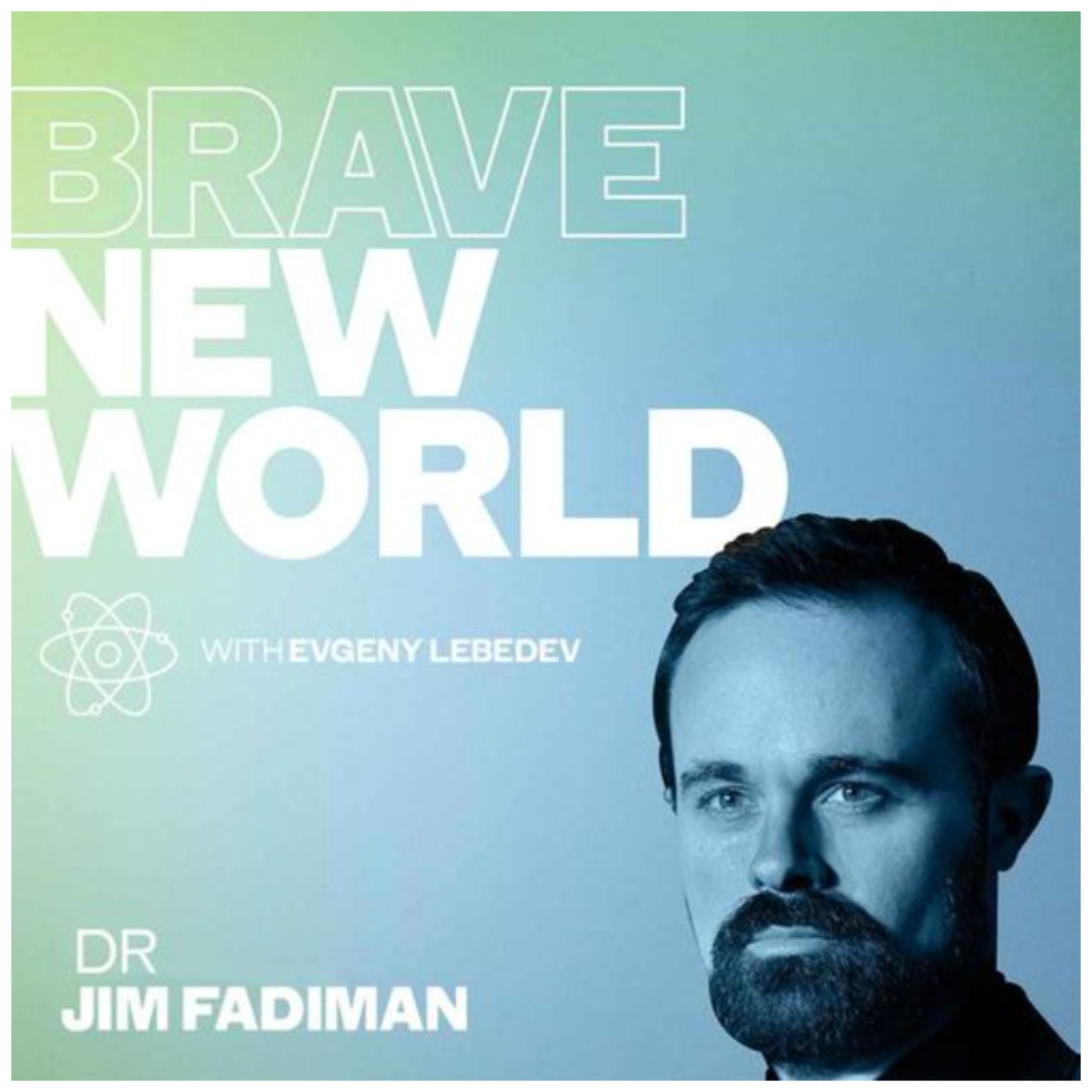
For this episode of Brave New World, Evgeny is joined by psychologist, author, and researcher Dr Jim Fadiman, a central figure in the modern understanding of psychedelics, who also goes by the “father of microdosing”.
Drawing on decades of research and thousands of user reports, the conversation traces the history of psychedelics - from early scientific study in the 1950s and 60s, through prohibition, to today’s renewed interest in clinical and psychiatric settings. Jim discusses why most formal research has focused on high doses, how observational reports have shaped microdosing research, where evidence is strongest and still emerging.
Evgeny and Jim look ahead to the future of psychedelics in medicine, the balance between scientific caution and public interest, and what a first step might look like for someone curious but sceptical.
Hosted on Acast. See acast.com/privacy for more information.


