
 Ask ChatGPT



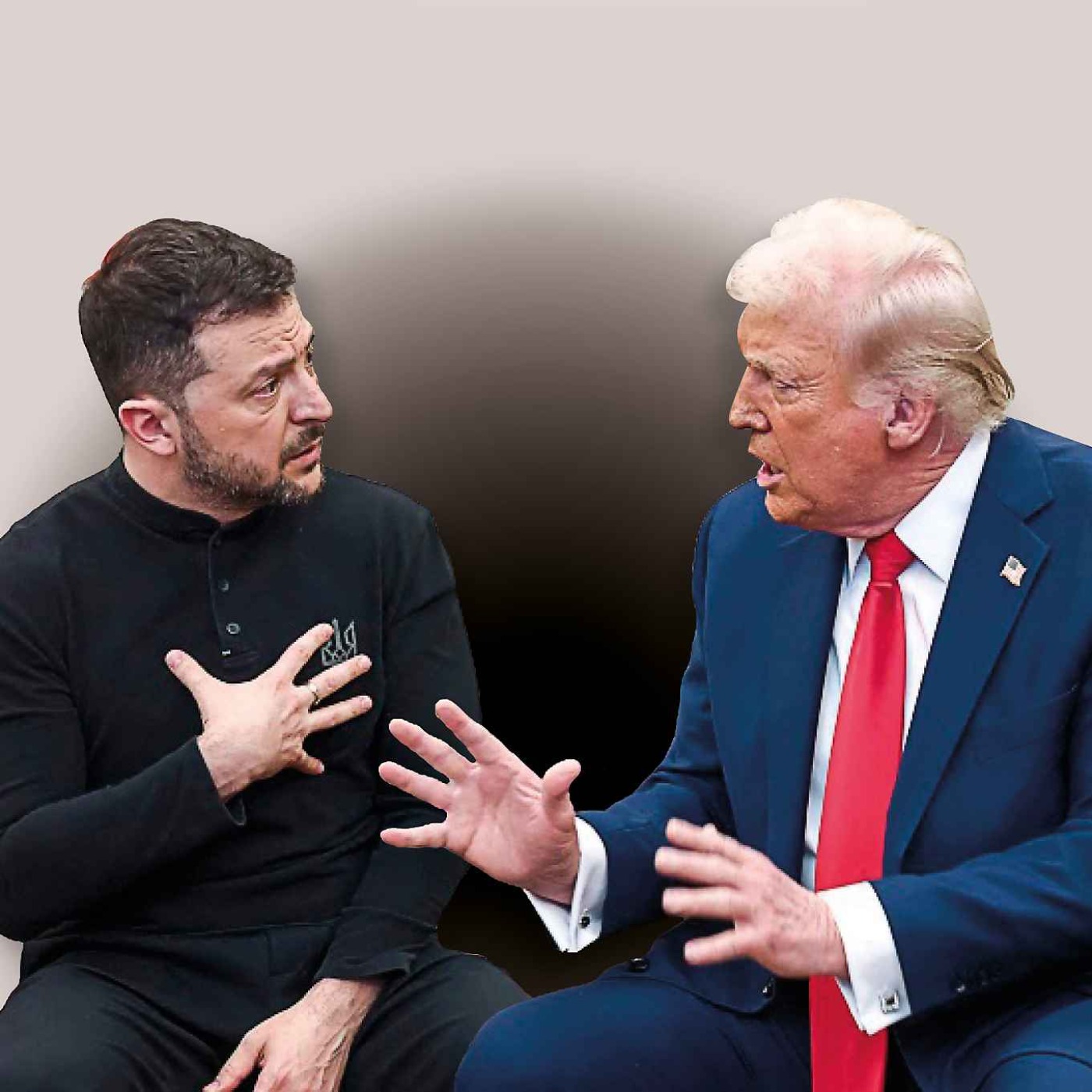
In this episode of The Standard, host Rachel Abbott delves into the implications of US President Donald Trump’s recent decision to pause military aid to Ukraine, following a public disagreement with Ukrainian President Volodymyr Zelenskyy. The discussion explores the potential fallout from this decision and examines whether Ukraine can withstand pressure without American support.
Written by AI. May contain mistakes.

Get the gist, explore an idea or ask about something said.
 Claude
On The Standard, what are the key points of this episode?
Searching your listeningAutomatic transcript. May contain errors.
0:03Hi, it's Rachel Abbott. Welcome back to The Standard Podcast. First of all, during the war, everybody has problems. Even you. But you have nice ocean and don't feel now. But you will feel it in the future. God bless. God bless. God bless. You will not have the war. Don't tell us what we're going to feel. We're trying to solve a problem. Don't tell us what we're going to feel. I'm not telling you. Because you're in no position to dictate that. Remember this. You're in no position to dictate what we're going to feel. The fallout from Friday's public disagreement between US President Donald Trump and Ukrainian President Volodymyr Zelensky has continued with the US pausing military aid to Ukraine.
0:46It was announced that the assistance was being reviewed to ensure that it is contributing to a solution. America has provided a consistent supply of military assistance and weapons since Russia invaded Ukraine three years ago. From the White House on Monday, during a press conference, when pressed on Russia's comments about the US's foreign policy being largely in line with their vision, Trump suggested to reporters that Zelensky won't be around very long if he does not make a deal with Russia. Well, I'll tell you what, I think it takes two to tango. And you're going to have to make a deal with Russia and you're going to have to make a deal with Ukraine.
1:24You're going to have to have the assent and you're going to have to have the consent from the European nations because I think that's important, and from us. I think everybody has to get into a room, so to speak, and we have to make a deal. And the deal can be made very fast. It should not be that hard a deal to make. It could be made very fast. Now, maybe somebody doesn't want to make a deal, and if somebody doesn't want to make a deal, I think that person won't be around very long. That person will not be listened to very long, because I believe that Russia wants to make a deal. I believe certainly the people of Ukraine want to make a deal.
1:59They've suffered more than anybody else,
2:04As Europe reels from Donald Trump's decision to pause USA to the country, the UK's Deputy Prime Minister, Angela Rayner, has insisted the Prime Minister will not be blindsided or bounced from the pursuit of peace in Ukraine. Well, the Prime Minister set out yesterday that we are absolutely focused on making sure that we get that peace and the security guarantees as part of that. He mentioned in the House that we won't be derailed or sidelined by commentary, ongoing commentary, but that we will use our relationship, our long-standing relationship with the US and our European allies to support Ukraine and President Zelensky in getting that peace deal and making sure those securities are part of that.
2:44We're now joined by the London Standards political editor, Nicholas Cecil. Hi Nicholas. Hello. A US official told the Associated Press that the Trump administration was pausing and reviewing aid to Ukraine to ensure that it is contributing to a solution. Could you walk us through Trump's decision? Why has he decided to cut support? And what does this mean? Yes, well, this is another very big step by Donald Trump. And it's certainly caught a number of European countries by surprise. It's not clear whether Britain knew this was coming or not. And it has echoes of basically Trump and Putin deciding to pursue peace talks about Ukraine, the very start of this period of negotiations.
3:28And there's been quite an angry response from some quarters. France is often quite outspoken on these matters. And certainly there was a French minister saying that basically this was strengthening the hand of the aggressor Vladimir Putin. One of the things you need to remember with this, it was Vladimir Putin who invaded Ukraine three years ago. This seems to have kind of fall by the wayside in some parts of Washington at times. What this does, and this is the important thing really, is that this pushes more and more pressure on Ukraine to do a deal. So America and Britain seem to be adopting very different strategies.
4:05Certainly, the American view or the American approach with Trump in the White House is basically to force Ukraine to strike a deal with Russia. In these talks, Ukraine is a weaker party. The Russians have more military might. They're seizing more territory bit by bit. and they rely very, very heavily on American support. The approach Trump is basically taking, he wants to do a deal with Putin and it looks like the loser will be Ukraine. Then he will be able to claim he's delivered peace in Ukraine and present himself as possibly worthy of a Nobel Peace Prize. How has President Zelensky responded?
4:42Certainly what sparked this off was some comments by Volodymyr Zelensky, which he was stressing that the end of the war could be a long way off. Zelensky is trying not to be pushed around by Trump, but he hasn't got a strong hand. And in a way, that's what led to this extraordinary clash in the Oval Office in the White House last week, where basically Trump and J.D. Vance, the vice president, tried to twist the arm of Vladimir Zelensky to sign a minerals deal to hand America a huge amount of the mineral wealth of Ukraine, basically pay for this US support against Putin's war. Mr. Lezenski was unwilling to do so because what he sees as crucial is to get what's been called a US security guarantee backstop, basically to try and prevent a further attack by Putin.
5:33Because the big concern here is that some kind of peace deal is done. Putin stops his advances, his attacks for a few months, or possibly a year or two, and then comes back for more and tries to take more of Ukraine and may attack some of the Baltic states or some other countries in Eastern Europe. So the fear is that Trump is going for a quicker and easier deal to be done than what would deliver a lasting peace. So crucial to a lasting peace, this is a view of Britain and other European countries and Ukraine, is to deploy a peacekeeping force in Ukraine after the fighting ends. This would be led by Britain and France.
6:12But ultimately, it is that sore clashes between this peacekeeping force and Russia, then America would step in as a backstop. Now, if that arrangement is set up, the view by a lot of military experts is that there would not be another invasion by Putin because he would know that there was this American backstop. The problem with this is that Trump is now being seen as such an unreliable ally by an increasing number of countries that there are these doubts about how much you can rely on American assurances. Previously, under things like NATO's Article 5, this is the mutual defense agreement. If one NATO country was attacked, then other NATO countries could come and help them.
6:57But now, with Trump in the White House, military and intelligence experts are warning, can European countries really rely on that anymore? And the Kremlin has since welcomed the ports of aid. Yes, this is music to the ears of Vladimir Putin and the Kremlin. Certainly in European capitals, Trump will be seen to be doing Putin's work. Trump's view is basically put pressure on Ukraine to force them to make concessions, to come to the negotiating table, unless he's got a cunning plan, which no one has seen so far. Trump cries himself on being a dealmaker. And in business deals, it's a weaker partner who often has to give the most ground.
7:32The view in many European capitals is that if Ukraine loses too much here and Putin emerges as a victor, that will only encourage not only Putin into further aggression, but other authoritarian leaders, for example, Xi of China, will that encourage him to attack Taiwan. There are wider questions here that go beyond Ukraine, which I'm sure Trump is aware of, but certainly there's a view in diplomatic circles that he doesn't seem to be fully taking them into account.
8:17Welcome back. Nicholas, what has been the British approach so far? And could you tell us what our government's response has been to the latest announcement? The British approach has been very much basically to try and bolster Ukraine. So what often happens in conflicts before peace is declared, each side tries to get in as strong a position as possible before negotiations start, or certainly before serious negotiations start. And so the view from Britain and many European countries has been everything must be done in terms of military, diplomatic, economic support, to increase support for Ukraine now, and to try to weaken Russia, partly through further sanctions.
8:57So that's what the British view has taken. And so Keir Starmer has also thought at the same time to act as this bridge between America and the European Union and other European countries. And if you notice, the Starmer administration has gone out of its way not to criticise Donald Trump and his key members of his administration. Sometimes what Trump or other people say in Washington is just so flatly untrue, then the UK government will rebuff it and take a stance, not aggressively, but basically to counter that. Other European countries, particularly France, and sometimes Poland and Germany, have taken a clearer stance where they disagree with Donald Trump.
9:38But Britain has traditionally had this special relationship across the Atlantic, and Sir Keir Starmer, who actually has been seen to have done pretty well in recent days in terms of talks with Trump and getting the European leaders together in London. Starmer sees Britain's role on the global stage very much is trying to bring people together and not to be knocked off course by surprise announcements. For example, Angela Rayner, the Deputy Prime Minister, was saying that the government wouldn't be bounced by overnight announcements into kind of being deflected from its aim to get a peace deal and to get everyone working together on that.
10:17That suggests that the British government was not told that this withdrawal of aid, this pause of aid was about to be announced from Washington. But again, Ms. Rainer, she was on the media round, she was asked numerous questions about what the government's response was to Donald Trump's latest move. And she really ran a mile to try and avoid criticising him. What could the UK and the EU's relationship without the US signal to President Donald Trump and other countries, including Russia? Russia, the Kremlin are watching this with glee. And they're talking about the start of, this is their words, of fragmentation of Western unity.
10:57So before on Ukraine, there was very much, or pretty much unity on Ukraine between key allies in the West about the need to support Ukraine, both militarily and economically. This is clearly now very, very fractured. But certainly in European capital, many, many leaders are watching on absolutely aghast at the way Trump is going about these peace talks on Ukraine. Former British Defence Secretary Sir Ben Wallace, he's even said that there was a stench of appeasement, kind of Nazi-style appeasement in the Trump approach to basically twisting the arm of Ukraine and cozying up to Russia to try and end this war.
11:40And finally, how long could Ukraine hold out against Russia without US support? Well, there's no immediate additional threat to Ukrainian defences. Ukraine is losing ground week by week to Russian forces, often at huge cost in terms of lost lives and injuries to Russian soldiers. It's very easy to forget that hundreds of thousands of Russian soldiers have been killed or wounded in Putin's three-year war, as well as very high casualties on the Ukrainian side and thousands of civilians killed. But certainly before Biden left office, Joe Biden, he dispatched a whole load of kit to Ukraine. But basically, in the coming weeks, months, it's unlikely to see the Ukrainian defenses suddenly collapse.
12:25But it's a major diplomatic blow to Ukraine. And ultimately, if you stop the flow of American weapons, it will make it easier for Russia to gain ground. And one of the reasons for this is that although European countries supply a lot of military aid to Ukraine, some of the really top-end equipment, a lot of that does come from America.
12:48That's The Standard. For all the latest news, head to standard.co.uk. And please do drop us a line at podcasts at standard.co.uk. This podcast returns tomorrow. We'll see you then.
The fallout from Friday's public disagreement between US President Donald Trump and Ukrainian President Volodymyr Zelenskyy has continued, with the US pausing military aid to Ukraine.
As Europe reels from Donald Trump’s decision, the UK’s Deputy Prime Minister, Angela Rayner, has insisted the Prime Minister will not be “blindsided or bounced” from the pursuit of peace.
But how long could Ukraine hold out without US support? We’re joined by The London Standard’s political editor, Nicholas Cecil.
Hosted on Acast. See acast.com/privacy for more information.


