
 Ask ChatGPT



In this episode of The Standard, hosted by Charlie Duffield, the discussion revolves around recent political developments in the Middle East, particularly the return of Israeli hostages and the implications of a ceasefire agreement. The latter portion of the episode explores the intersection of artificial intelligence and traditional beer brewing.
Written by AI. May contain mistakes.

Get the gist, explore an idea or ask about something said.
 Claude
On The Standard, what are the key points of this episode?
Searching your listeningAutomatic transcript. May contain errors.
0:02Hi, I'm Charlie Duffield and welcome back to the Standard Podcast. if you're new here hit follow and give us a rating for all the latest news head to standard.co.uk coming up later in the show how chatbots are brewing up a storm in the world of beer if you use a little bit to make beer a little bit better then that's fine but i think beer is all about people coming together community you know going to the pub is where you go to talk to people be served by a person have a beer with a friend meet new people as with any industry i hope that The AI is used sparingly with precision and it doesn't take over breweries a whole, which has been done by humans for so long.
0:46But first, US President Donald Trump has addressed Israel's parliament, the Knesset, as the country celebrates the return of the remaining living hostages held by Hamas for two years. The Israeli military has confirmed that all 20 living hostages in Gaza have now been handed over after being kidnapped by Hamas in southern Israel during the 7th October attacks in 2023. In exchange for the hostages, Israel released 250 Palestinian prisoners and more than 1 ,700 detainees. Speaking on BBC Breakfast, Foreign Office Minister Hamish Volkner referred to it as a historic and welcome day. These are scenes that so many people right across the country, myself included, have been waiting to see.
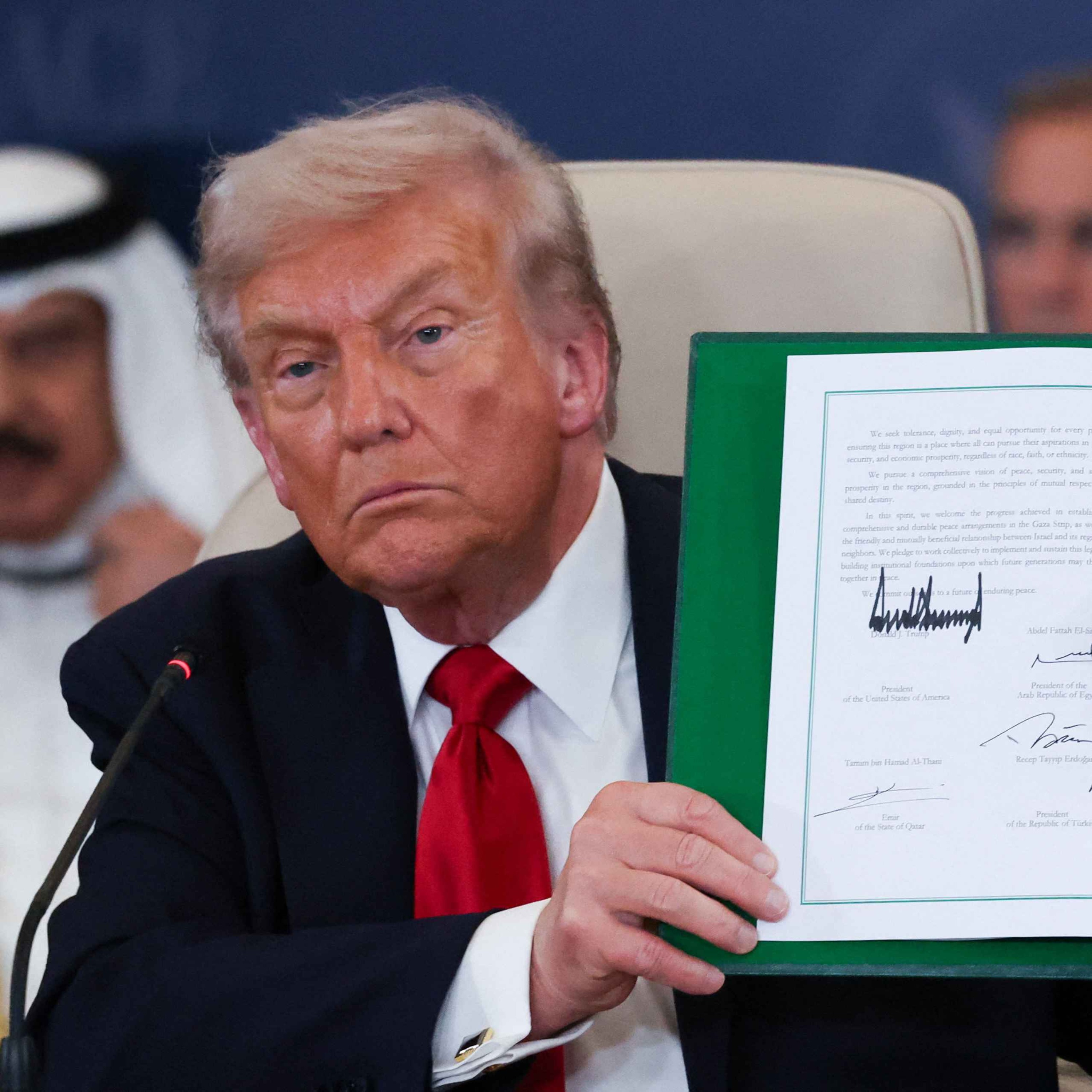
1:36It is hugely welcome news. This is an agony that has gone on and on, both for the Palestinians and of course the hostage families. And today is a historic and welcome day. The agreed ceasefire started at midday local time on Friday, with tens of thousands of displaced Palestinians moving back towards northern Gaza, which was mostly destroyed by Israel. Meanwhile, Donald Trump declared that the war is over as he flew to Israel on Air Force One to address the Israeli parliament. Flanked by Israeli Prime Minister Benjamin Nehnyahu, the US president was seen holding a book in which he wrote, This is a great honour, a great and beautiful day, a new beginning.
2:20Here's what he had to say in his speech. And after so many years of unceasing war and endless danger, today the skies are calm, the guns are silent, the sirens are still, and the sun rises on a holy land that is finally at peace. It's an incredible triumph for Israel and the world to have all of these nations working together as partners in peace. and it's pretty unusual for you to see that, but it happened in this case. This was a very unusual point in time, a brilliant point in time. Generations from now, this will be remembered as the moment that everything began to change and change very much for the better.
3:03Like the USA right now, it will be the golden age of Israel and the golden age of the Middle East. He then headed to Egypt for a peace summit with world leaders after hailing the historic dawn of a new Middle East. Irish Jeopardy Premier Simon Harris has said the horrors, genocide and famine in Gaza cannot be forgotten as he welcomed the release of hostages in the Middle East. He also announced an additional£5 million for aid organisations in Gaza. So today represents a day of significant hope for the people of the Middle East after the most horrific humanitarian catastrophe, a loss of life on a scale that's almost unimaginable.
3:46Hostages released, bombings stopped, aid beginning to flow into Gaza. And Ireland's done ready to do everything we can to help with the huge humanitarian effort which is now needed. There are people starving and it is so important that we get them aid as a matter of urgency. So today I'm announcing an additional€6 million in funding for Gaza. I also today think of all of the hostages that have been released. I cannot imagine what they have endured for the last period of time. I cannot imagine the anguish and the fears and the worries that their families have lived with. And today their loved ones are reunited in the arms of their families.
4:21And we think of them today too. Occupied Palestinian territories are still illegally occupied. But at the moment what we're simply seeing is a cessation of hostilities. We're also a country that knows a lot about peace and about peace processes. Peace is never easy. There's no such thing as a perfect peace plan. But the opposite to peace is the utter devastation and horrors that we've seen over the last number of years. This is about step by step. I mean, what has happened, the horrors, the genocide, the famine in Gaza, none of that can be forgotten, none of that can be airbrushed. What has happened over the last number of years, the violation of international law, all of that is important and extremely significant.
4:56Joining us now is the Palestinian political commentator Ahmed Najjar, who has family in Gaza. How are you feeling watching the news today? I think it is promising in a way that is going ahead. Obviously, very, very worrying as well that Israel might resume its genocide in Gaza after their hostages have been released. We have heard some of the Israeli ministers threatening that the war has not ended and they will go back in and destroy the so-called Hamas infrastructure. I don't know what's left for them to destroy. There's more than 90 % of Gaza has been flattened. So the situation in Gaza is dire.
5:36We hope that now the humanitarian aids and the commercial products are being allowed for people to carry on with their lives. There are also construction materials that desperately need to go in. millions of families, now millions of people, are displaced and without any shelter. We do hope that the Israelis get back into the people of Gaza and resume their genocide. We know that Israel is acting without any accountability, acting like a rogue state that is not held accountable to its actions. So that's really the situation. Trump is being held as the peace president, whereas Israeli Prime Minister Benjamin Nehnyahu has not publicly said that the conflict is over.
6:22Do you feel hopeful about this ceasefire agreement or sceptical? He is now delivering a speech in the Israeli Kinesis, as Israel describes him as the best US president for Israel. So we are very worried. We haven't forgotten what he said at the beginning or halfway through the genocide that he wants to take Gaza over and wants to cleanse Gaza. These are his words and turn it into the Riviera of the Middle East. We're obviously worried about what he has in his intention for Gaza. Or for the Palestinians to start off with, you know, Palestinians are being oppressed and suppressed for the last 77 years.
7:01Look at what's going on in the West Bank, the settlers' violence against Palestinians and burning their villages and their trees, all the trees and houses and stealing their houses, destroying their agricultural lands. Obviously, also, the Israeli army hasn't left Gaza completely. They only have left about 40 to 50 percent of Gaza Strip. So they still need to leave the rest of it. We'll see what's happening. It really is a precarious time at the moment. Palestinian prisoners, some of them been deported to Egypt, so they have not been identified with their families. They've been deported. We are dealing with a rogue state.
7:40We are dealing with a state, a genocidal state. We're negotiating the allowance of humanitarian aid to come in. We're negotiating the allowance of food and water to get into Gaza. It isn't a good place for the Palestinians, and I don't understand why the Western media are describing them as detainees rather than hostages because the 1 ,700 that have been described as detainees, they have been kidnapped by the Israeli army and tutored. Some of them were raped and many of them were killed, in fact. Can you describe what the situation is like on the ground in Gaza right now? The situation is appalling, is beyond comprehension.
8:21I spoke to my family. They have nowhere to go back to. They have nowhere. They have lost everything, all their houses, everything and now they're struggling to find a shelter they're worried that might be no a healthy water for drinking if they were to go back to the to where they are from from Jabalia the north of Gaza all of their houses so my parents houses and my five siblings houses have been completely destroyed so we have actually seven houses that of ours have been completely flattened and none of my family, none of my siblings or parents have anywhere to go to. So obviously being on the phone with them and trying to help out of what they can do.
9:07There isn't much they can do and Israel is still controlling what comes into Gaza in terms of food and medicine and water and electricity and what have you. So we're still living under the Israeli thought. The world is still unfair on us. The world is still favoring Israel. The world is still complicit in this genocide. Israel is not allowing even journalists to go into Gaza to report into that. That should be enough for the world to anger the world and to sanction Israel. But of course, Israel is not sanctioned. Israel is welcomed into the international arena. Israel is welcomed into red carpets.
9:44And it's an extremely, extremely dangerous country to the whole world. This is just the beginning of a long process of rebuilding and reconciliation. What do you want to see happen in the weeks and months ahead? I want to see Israel being held accountable first and foremost. As long as Israel is not being held accountable, we will never see a peaceful day in the region. And we will never see a better world if Israel keeps acting with impunity. Israel committed a genocide and it seems to be getting away with it. let's go to a break coming up in part two people have been brewing beer for millennia but with the ai revolution are robots now taking that job too we'll see you back here in just a moment welcome back you've heard of lab-grown meat but what about ai-generated beer whether you prefer a good lager, ale, porter or stout.
10:42Until recently, beer has always been made by people with a thorough and long-standing expertise that has been paramount to the process. But it turns out that like so many other facets of modern life, beer is not immune to artificial intelligence. The owners of Beck's, the German brewery founded in Bremen in 1873, celebrated its 150th birthday by employing a new brewmaster, none other than ChatGBT, to write a recipe using hops, yeast, water and malt. The result was a lager called Beck's Autonomous, which is said to have a hoppy texture, a subtle sweetness and a generous head. But is this AI experimentation a welcome development for those who love the ancient drink?
11:28To find out more, I spoke to The Standards food and drink writer Josh Barry. Josh, tell me a little bit more about the history of beer brewing. Beer goes back millennia. First record, I think, was in present-day China, perhaps 5 ,000 years ago. Traces were found on pottery, traces of kind of fermented wheat and so on, which is used to make beer. The oldest recipe comes from Mesopotamia, which is where Iraq is now, and that was found in a poem written 3 ,900 years ago, which had a reference to beer or at least how it was known then. And it's been, you know, made all around the world for thousands of years, Europe included, and in the UK, not as old as Mesopotamia or China, but certainly centuries.
12:13And in Europe and the UK, there's a long heritage, right? At the moment, Netflix's House of Guinness is airing, which is all about the Guinness family dynasty. Guinness is old compared to the first beers. Guinness, which started as a porter, only dates back to 1759. And obviously one of the most famous brands in the world. The same recipe for Guinness is made since the one made by Arthur Guinness II. That dates back to, I think, 1825. So what's happening with breweries and AI at the moment? A lot of breweries from Japan to the US to here in the UK in Cornwall. You know, robots aren't brewing our beer as such.
12:51but brewers are sort of looking at AI in terms of helping with recipe development and nailing the right balance, kind of what the best mix of hops and so on, barley or whatever. In terms of formulas and stuff, using Chachi GPT or whatever it's called, sorry, I'm not very tech savvy, brewers are looking at kind of ways that AI might help them be more efficient, be a bit more kind of quick and ready to kind of blend new flavors or whatever and formulate recipes. breweries around the world are kind of looking at what customers like and they're asking various questions and then coming up with recipes that will suit generations what younger people like to drink is different to what older generations like to drink I think that was in Japan actually brewery there kind of created four beers one to suit each market demographic it's a marketing strategy and a way to be more efficient in terms of selling the right product to the right groups Do we know how people have responded to these AI beers?
13:48Irrespective of however beer is made, if it tastes nice, then people like it. So a few examples have been, you know, people have said, yeah, this is a good beer. Well, this was Becks, actually, in Germany. Becks, which is a pretty famous lager, and it's not a particularly highly regarded one. It's just, you know, an everyday session lager. The brewers there made a new beer using a recipe. maybe they're AI using their own data, algorithms, customer insight and information. You know, they've got years of heritage and expertise in crafting or creating at least sort of everyday regular lager. And they made one with the help of AI and apparently it improved the flavor and the taste and people responded quite positively to it.
14:31Finally, what do you think of all of this? If AI is designed to eliminate mistakes and optimised flavour, doesn't that remove the happy accidents, the small, unique imperfections that often define a beer? I'm not a fan of AI really, or technology overall, to be honest. I think it's the same in any industry, like music, where AI is being used to kind of create tunes and melodies and take up mistakes that might exist, you know, in live music, whatever. And in any industry, basically, you know, apart from, I guess, more broadly speaking, you know, unless it's being used to help diagnose disease and improve healthcare or education or transport it seems to me like ai is completely soulless and weird and the world once run by kind of creatives who might paint a picture or create a song or whatever and for example make beer and brew beer something that's been done for thousands of years and been really exciting and interesting and lots of mistakes but as you say happy accidents it's now being run by like quite strange people in silicon Valley.
15:34And that's The Standard. For all the latest news, head to standard.co.uk. If you'd like to get in touch, please do drop us a line at podcasts at standard.co.uk. We'll be back here tomorrow at 5pm. We'll see you then.
Today Israeli families are welcoming home hostages as hundreds of Palestinian detainees are freed, following Friday’s ceasefire agreement in the Middle East. US President Donald Trump addressed Israel’s parliament, the Knesset, and said that the “the war is over”, with today marking “a new beginning”. He then headed to Egypt for a peace summit with world leaders. Meanwhile, Irish deputy premier Simon Harris said the horrors, genocide and famine in Gaza cannot be forgotten, as he announced an additional five million pounds for aid organisations in Gaza. Palestinian political commentator and writer Ahmed Najar, who has family in Gaza, is here with his reaction to the news.
And in part two, The Standard’s Food & Drink writer Josh Barrie joins us to discuss how AI is being used in the ancient craft of beer brewing.
Hosted on Acast. See acast.com/privacy for more information.


