
 Ask ChatGPT



This episode of The Standard discusses the anticipated approval of a £1.7 billion extension of the Docklands Light Railway (DLR) to Thamesmead, which is expected to be announced by Chancellor Rachel Reeves in the upcoming autumn budget. The discussion includes insights from The Standard’s City Hall and Transport Editor, Ross Lydall.
Written by AI. May contain mistakes.

Get the gist, explore an idea or ask about something said.
 Claude
On The Standard, what are the key points of this episode?
Searching your listeningAutomatic transcript. May contain errors.
0:02Hi, I'm Charlie Duffield and welcome back to The Standard Podcast. If you're new here, hit follow and give us a rating. For all the latest news, head to standard.co.uk. Coming up later in the show, what we know so far about Transport for London's new plan backed by the Treasury. The DLR is a little bit of a sort of unheralded part of the London Transport Network, but it pretty much runs on most of these pretty effectively. and it gets a lot of people around, gets them where they want to go in a quite unassuming way. And the idea of getting across the Thames between two parts of unloved suburbs will be good news for a lot of regular people who are not living in the fancy parts of town but deserve a home and a job just like the rest of us do.
1:01But first, good news for Londoners. The government is expected to approve a 1.7 billion Docklands Light Railway extension to Thamesmead in the upcoming autumn budget, in a massive boost to south-east London. Construction will start in 2027, and the link will open in 2032, with new stations on either side of the River Thames. The project will unlock up to 25 ,000 homes and 10 ,000 jobs that may mean the Bakerloo Line extension and West London Orbital Rail Link remain on the back burner. It's likely to be the biggest upgrade to the London Transport Network for the next decade. And here's the moment the new DLR trains started running last month.
1:45The new DLR trains have arrived. So I'm on board the brand new DLR train. What's it like? Well, it feels bigger and it certainly feels airier than the existing fleet. This walkthrough feels really quite bright, smooth, and there we are, look way down there. I think many Londoners are really going to like these. I'm so excited. I mean, even you're smiling at being on this wonderful new train. And they are remarkable. Look, I mean, what it means is you can see from the front to the back, walkthrough, It increases the capacity of each train by about 10 % overall, with DLI by more than 50 % digital screens.
2:24You can charge your phone. If you're in a wheelchair or a buggy, more space for you. The real win for us, though, is it increases frequency, increases reliability, but also it's the potential now for us to build a new home because you'll have more people able to get around this part of the city, the east and the south, on the DLI. Now, 54 of these new trains are due to come on stream in the next year and a half. They've been built in Spain and unlike the previous models, they have air conditioning under walkthrough, which means about 50 % increase in capacity. Currently, Thamesmead has neither a tube station or a train station.
3:04Residents who rely on public transport have to catch a bus to Abbeywood or Woolwich to access the DLR or Elizabeth line. London Mayor Sir Sadiq Khan has described the DLR extension as essential to deliver thousands of homes and jobs and is confident it can open by 2032. There would be two new stations, one after Galleon's Reach on the north side of the river and one in Thamesmead. But the DLR extension is likely to come at the expense of TFL's two other big ticket schemes. To find out more, I spoke to The Standards City Hall and Transport Editor Ross Lydell. Ross, let's start by talking about the DLR itself.
3:46How many Londoners rely on it to get around the capital? There are around 100 million passenger journeys on the DLR each year. Now that's a big number, but it's not a massive number in London terms. You know, the most popular form of transport in London is the London Bus Network. And then you go down to the tubes that are about. say on an average day you've got more than 5 million journeys on the buses in London, about 3.5 million on the Tube and probably around a million or so, maybe just under a million on the DLR. So it's a significant part of the network. It's also the case that many people will change between the two.
4:24They'll go from Elizabeth Line on to DLR or vice versa or Tube to DLR. It's a key way of getting to Bank Station and it's a key way of getting to Canary Wharf and also connecting Stratford and Lewisham. And particularly in Greenwich as well, there's a real headache with the DLR that Cutty Sark Station is out of action in Greenwich and Greenwich sort of town centre is suffering because of that. So for people who have relied on the DLR, it's a very good way to get around. It costs exactly the same to use as a tube. So it's very important for a considerable number of people. And if you live in east or southeast London, it will be your main mode of transport.
5:02And can you tell me more about TfL's plans? Transport for London has been trying to extend the DLR, the Docklands Light Railway, from Becton on the sort of northeast side of the Thames to Thamesmead in southeast London for probably two to three years now. Now, it's a project that's sort of slightly come out of nowhere. You know, back 15, 20 years ago, Ken Livingston, when he was mayor, he had this idea of a Thames Gateway Bridge because there's this underlying issue that there are fewer crossings of the Thames in East London than there are in West London. And this has been largely remedied by the opening of the Silbertown Tunnel back in April.
5:44However, that's obviously for cars and buses. But for either the Tube or the DLR or trains, there's a real lack of connectivity between the northeast side of London and the southeast side. So TfL has put forward this proposal and it seriously put it forward in the last year or so as one of Sadiq Khan's sort of three big ticket items in terms of what it's asked the government to help it fund. The idea is to take the branch line of the DLR that goes to Becton at present to essentially sort of bend it round towards the river, go under the river and pop back up again at Thamesmead. It will then go on a viaduct to Thamesmead town centre and really unlock that entire area.
6:30It's a bit of a sort of peninsula at Thamesmead with loads of brownfield land and really very, very poor transport links. The only way to get to Thamesmead is by bus unless you're a car driver. And this will be a massive benefit to actually opening up the area and making it accessible to people using public transport. Let's go to an ad break. Coming up, what might next week's autumn budget mean for transport? We'll see you back here in just a moment.
7:04Welcome back. So what's behind this decision? Why has it been approved? And what are the Treasury's hopes here? This budget has been talked about for many weeks now, including by Rachel Reeves, when she sort of tried to pave the way for potential tax increases, although then more recently she seems to have backed away from that idea. The reason that Thamesmead is interesting for her as Chancellor and also interesting for Sadiq Khan is that back in September, there was what was known as the New Town Task Force, which earmarked Thamesmead in obviously south-east London as one of two areas in London, the other being Cruise Hill in Enfield, where a new town could be built.
7:46Essentially what that would mean would be sort of thousands more homes, probably up to about 15 ,000 homes in Thamesmead, essentially to try and ease the housing crisis, which is obviously very well known in London and is an issue elsewhere that homes are so expensive and there are not enough homes for people to live in. Now Thamesmead has the advantage over the Enfield site in that it's brownfield land rather than greenbelt land. Obviously greenbelt land, any sort of building there is highly controversial. So if London is to get more homes, and here we're talking about 15 ,000 homes along the riverside or the riverfront in Thamesmead, the challenge, and this is something that the task force report made quite clear, was that there would need to be a transport link provided.
8:31In addition, you couldn't simply stick up 15 ,000 new homes and expect people to drive to them. So here we have the government essentially doing some joined-up thinking. At last, some people would say, so that not only is it supporting the idea of more new homes in London, it's also supporting the idea of transport links to those new homes. So it really is a win-win situation, and that's exactly what the Mayor of London, Sadiq Khan, has said today. That's his view. He's saying this is a huge vote of confidence in London and it's a win-win situation. Is this all good news, though? This all comes with the caveat that we don't know any numbers yet in terms of how much money is involved.
9:11Now, Transport for London has not asked Rachel Reeves to provide it with£1.7 billion to build this link, which is the estimated cost that's the case that it's asked her for permission to go out and actually borrow the money. So it will be TFL, it will be Londoners who will pay for this in the long run. There is a lack of detail and there could be devil in the detail. We simply don't know. But as it stands just now, it's good news. However, the sort of trade off is that Sadiq Khan had asked Rachel Reeves to support three big transport projects in London. And it's likely that if she's saying yes to Thamesmead, then she will say no to the other two.
9:51Now, the other two also have their supporters. One of these is the Bakerloo Line tube extension. That would be to take the Bakerloo Line south from Eleventon Castle down to Lewisham and beyond. And the other is what's known as the West London Orbital, which is a rail link over around the sort of Cricklewood, Old Oak Common, sort of Hounslow area. And that would form a new part of the London overground. So what is likely here is that if Rachel Reeves is saying, yes, London, you can have the DLR extension to Thamesmead, what she won't also say is you can have the Bakerloo line extension or the West London orbital.
10:27So good news on one hand, probably rather disappointing news in terms of the other two projects. But probably in fairness to her, she's probably picked the best one. Why do you say it's the best one? Well, it's probably the best one, certainly because it's a lot cheaper than extending the tube. Actually, trying to extend any tube line is a very expensive business. And actually taking the tube out of tunnels and then onto old rail track would be a costly, costly process, probably looking around maybe 10 billion rather than 1.7 billion. And also, that route there is already served by train lines.
11:02It's not as if there isn't already existing public transport links into that part of southeast London. And here you were talking about Thamesmead, which is terribly served, apart from buses, as we say, there's no other way to get there on public transport. So that really is unlocking something that is already completely closed off apart from two bus users. And even then, it's still a sort of 20 to 30 minute bus ride from either Abbeywood or Woolwich. It's not an easy place to get to. So that makes perfect sense that the DLR extension could be built more quickly than the tube extension could be and also a lot more cheaply.
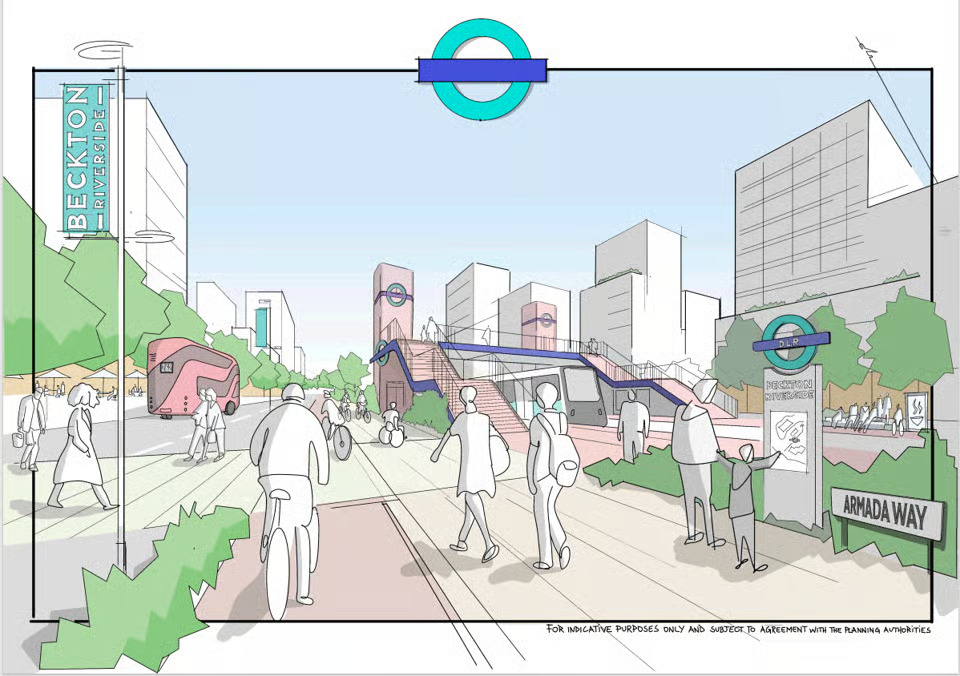
11:35And if you want to compare the DLR extension to the West London orbital, this really would benefit many more people. Again, in that part of West London, there are pretty good transport links. That would just be a sort of icing on the cake there that would take you to places from other places that you can't get to directly just now. But this DLR link has the potential to be of much wider benefit and therefore probably more attractive as a whole. So, Ross, there will be two new stations as part of these changes, won't there? That is TfL's plan. It would build a new station sort of on the north side of the river in what's known as sort of Becton Riverside.
12:13And then another new station after you go under the Thames in a brand new tunnel at Thamesmead. So TfL has the challenge of building two new DLR stations. That is normally not the most difficult thing to do because quite often these stations are sort of elevated. They're on stilts. Certainly compare them to tube stations. They're much simpler constructions. The challenge here will be actually tunnelling under the Thames, but we know TfL has just done it, or contractors for TfL have just done it with the Silvertown Tunnel, so it can be done. It will just take at least a couple of years to dig that tunnel.
12:45And as we heard in the introduction, new DLR trains have recently been introduced. Tell me a bit more about them. So about a month or so ago, I had the pleasure of having arrived on one of these new DLR trains. These are walkthrough trains. They're bigger in terms of the length than the existing trains. They're like five carriage trains. They're air conditioned. They've got nice new seats. Everything's brand new. They would replace the current fleet, which is probably 30 years old or more, which looks pretty tatty. I was on it this morning, actually, just coming to City Hall. You know, it works, but it's pretty sort of minimalist, if you like.
13:23These new trains are much nicer. However, within about three weeks of them being introduced, the first three of these new trains was going to be more than 50 in total. The first three of these new trains had to be taken back out of service because the brakes on one of the trains was found to be faulty. The train itself had actually overrun the platform at Canning Town a few weeks ago. That obviously set alarm bells ringing. You can't have trains, especially automated trains like the DLR is, overrunning the platform. So TFL is currently examining what the cause of that is. We don't know what's caused it.
13:58It'll probably be until the start of the new year before the trains start coming back into service again. This project has been something of, probably a fiasco would be to overstate it, but it's been something of a headache because the trains are already probably more than a year behind schedule. This often happens, sadly, with new rolling stock, that it's very hard to build new trains and get the technology on the trains to talk to the technology on the tracks. So TfL is having a tough time getting these new trains in. It's a bit of an embarrassment. It's also unfortunate for TfL that with the good news of the extension, it still hasn't got the new trains in more than a year after it should have done.
14:34But all being well, come 2032 or around that time, we will have an extension to Thamesmead on the DLR and passengers will be going to and from Thamesmead on pretty shiny new trains. And finally, is there anything we can expect from next week's budget when it comes to transport? Well, it'll always be interesting in terms of what Rachel Reeves does with motorists. Will she increase fuel duty? Fuel duty in terms of the levy you pay on petrol or diesel has been held constant for years because normally the chancellor, whether it's been a Tory chancellor or a Labour chancellor, has been terrified of upsetting drivers and essentially adding to the cost of living by making it more expensive for them to fill up a tank, whether it's petrol, diesel or whatever.
15:21However, environmentalists say that this is terrible because it's essentially if you don't increase the rate of tax on fuel, then you are making it more attractive to drive and therefore more attractive to pollute the environment. The challenge here this time could be as well what she does with the electric vehicles, because at present, electric vehicles are not charged tax in the same way as drivers do pay some levy on fuel, be it petrol or diesel. Obviously, more and more people are driving electric cars. And just recently, Sadiq Khan said that from January, electric vehicles would no longer get a 100 % discount from the congestion charge.
16:02So as more people drive electric vehicles, what does the Chancellor do? She knows that if you've just sold your diesel or your petrol car, bought an electric vehicle, you're not paying the same tax to her that you would have done on that sort of liquid fuel. But do you have to pay a different tax on your electric vehicle? and I think that will be one of the main things to look out for next week.
16:27And that's The Standard. For all the latest news, head to standard.co.uk. If you'd like to get in touch, please do drop us a line at podcasts at standard.co.uk. We'll be back here tomorrow morning. We'll see you then.
Chancellor Rachel Reeves is expected to give the go-ahead for an extension of the Docklands Light Railway to Thamesmead in her Budget next week.
London mayor Sir Sadiq Khan has described the news as a “win-win” as it will improve transport links in a poorly connected part of south-east London and should “unlock” thousands of new homes and jobs.
But what does it mean in practice? Where will the new stations be built, what difference will it make to commutes – and does it mean that other London transport schemes such as the Bakerloo line extension will be less likely to happen? The Standard’s City Hall and Transport Editor Ross Lydall is here with the latest.
Hosted on Acast. See acast.com/privacy for more information.


